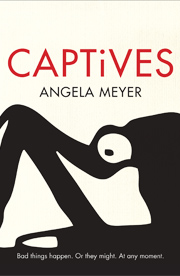
 Have you read any flash fiction? Some of the pieces in Pulse would qualify but, besides this, I hadn’t read much until I picked up Angela Meyer’s collection Captives, which I bought for my Kindle last year. I bought it for a few reasons: I enjoyed and reviewed the short story collection she edited, The great unknown; I follow her blog Literary Minded; and of course I like short fiction. So I read Meyer’s book and was – dare I say it – captivated!
Meyer has divided her collection into 7 sections, the first 6 of which are titled using polarities – On/Off, Up/Down, In/Out, With/Without, Here/There, Then/Now – with the last being, simply, Until. The titles are as terse as the little works they contain. And a couple are very little, being just a couple of paragraphs, while the longest are, I’m guessing, around 500 words. This brings me to the matter of definition. How do we define flash fiction? Well, as with all definitions, there’s not complete agreement. Most agree that it can be as short as a sentence, but there’s no such agreement on the upper limit. Some say 300 words, some 500 words, and others 1000 words. The term itself was first used in the early 1990s, but there are other terms, including micro fiction and sudden fiction. I won’t discuss this further. I’m happy to be fluid about the definition, and I like the term flash fiction.
Writing a very short story sounds challenging to me. As Becky Tuch writes in The Review Review “Distilling experience into a few pages or, in some cases a few paragraphs, forces writers to pay close attention to every loaded conversation, every cruel action, every tender gesture, and every last syllable in every single word.” Meyer clearly understands this imperative, and demonstrates a sure grasp of the form. Indeed, several of the works included in Captives have been published elsewhere, which suggests her writing in this form has gained recognition.
Captives contains 37 pieces, and they vary greatly in topic, theme and setting. Some are set in the past, some the future, some in exotic places like Norway or Scotland, and others in Australia. Some are realistic, while others toy with the unexplained. Their protagonists range from a man who has accidentally locked himself in the toilet (“Thirteen tiles”) to a sister with a secret (“We were always close”). Some pieces have been inspired by news stories like those about men who lock up women for years (“Green-eyed snake”) or about the man who walked a tightrope across the Grand Canyon (“Tightrope walker’s daughter”). Other pieces reveal writers she admires, such as George Orwell (“Booklover’s corner”) and Italo Calvino (“One of the strings and their supports remain”). In all, though, the protagonists confront a challenge, a change, a decision, or they create worlds that suit themselves. As you’d probably expect given the form, we don’t always know the outcome. Meyer leaves clues, of course, and sometimes we can be confident we know what will happen, but other times those clues simply tease us with possibilities.
The collection starts with a bang, almost literally. In “The day before the wedding” the bride discovers something new about “her love”. He is out duck-shooting, and
Still her love had the gun trained on her, and she stood, and even when he lowered it and his expression revealed play, a joke, she knew she’d seen his true face.
I don’t think this spoils the story, because the conclusion which follows is one of those teasers I mentioned – unsettling, but for whom? Meyer’s language here is tight and spare, and uncompromising. I loved it, and knew I’d made the right decision to buy this book.
Subtitled “Bad things happen. Or they might. At any moment”, the collection is dark, overall. But, there are (somewhat) lighter pieces. In “Glitch”, Daniella finds a solution to her problem of hearing the devil, “the hiss of Beelzebub”, in the machines around her, and in “Brand new” the narrator finds comfort in the company of a brain-damaged elderly man. This story reminded me of my reading group’s joke that when we are old and have lost our memories we will just read the same book every month. Much cheaper, and just as much fun – if we choose the right book!
I can’t possibly cover all the pieces, so will look at one section, In/Out, which comprises six pieces. In “Meds” the narrator needs to decide whether he will join his partner and friends in their calm, medicated (or, as he sees it, capitulated) lives, while in “One of the crew” a woman fakes being a writers’ festival official. There’s an interesting paradox here: in the first story our protagonist is invited “in” but doesn’t want to accept, while in the second the woman wants to be “in” so pretends to be so. In two of the other pieces, the in/out dichotomy is more literal. There’s the aforementioned toilet prisoner in “Thirteen tiles”, and there’s “Foreign bodies”, in which Kate, a prisoner in gaol, starts to swallow increasingly bigger objects. The conclusion to this story, though, pushes literalism to the limit. Indeed, in many of the stories, Meyer plays with the tension between literalism or realism and the absurd or fanciful. There’s often a fine line …
I haven’t talked much about the writing, because the stories themselves are so powerful. However, part of the power of the stories comes from the writing, of course. It’s perhaps intrinsic to the form, but the writing is direct, spare. It can also be elliptical at times. Meyer expects her readers to work, but that too is the nature of short fiction. And there is tight pointed use of imagery, as in the opening paragraph of “We’ve always been close”:
My sister and I stretched a tarp over the mud to make a slide into the dam, just like when we were kids. It was full from the recent storm. Magpies called. From the dam, I splashed gritty brown water up onto the slide to give my sister something to slip on. She squealed and laughed and the sound dirtied my chest with guilt. She gripped my shoulders after landing, as she was afraid of the bottom. We’ve always been close.
On the surface a happy scene, but we know from the language that something is not quite right …
Captives is an appropriate title for the collection because, whether they know it or not, most if not all the protagonists are captives in one way or another – some physically, some psychologically or intellectually, some both. Some escape, while others remain trapped (at least to the best of our knowledge). Deborah, a psychologist in “Spark”, is trying to escape:
She had wanted to agitate the structure, to act out, in ways a psychologist should not.
Fortunately for us, though, Meyer is a writer of fiction and it is perfectly acceptable for her “to agitate the structure”. This she has done with confidence and flair. Not every story grabbed me equally, but I think that’s more to do with me and my experience. I wouldn’t be surprised if different readers found different stories worked best for them. So, my recommendation is that if you haven’t read flash fiction, this would be an excellent place to start.
 Angela Meyer
Captives
Design: Sandy Cull
Carlton South: Inkerman and Blunt, 2014
ISBN: 9780987540126
 Last October, I wrote a Monday Musings post on writers-in-residence programs. The first one I listed, because I listed them alphabetically, was Accor Hotels MGallery Literary Collection. This is (or was?) a collaborative program with Melbourne’s The Wheeler Centre. Quoting what I wrote then, ‘it involved providing eight award-winning Australian writers with a short residence in one of Accor’s boutique MGallery hotels and commissioning those authors to write a short story which will be published in a book which will be “presented exclusively to guests at MGallery Hotels”.’ Well, it just so happens that this weekend we are staying in one of these hotels, and what did I find but the book of short stories titled Edition de luxe: A collection of short stories inspired by our hotels. Woo hoo!
 Whispering Gums