Monday musings on Australian literature: Role of Aboriginal literature

Most keen readers have firm views about the value of reading to them. Some, I think, read mainly to escape. Others like to be opened to other ways of being and thinking. Others like the things they learn – yes, even from fiction! And still others love beautiful or interesting language. These aren’t the only reasons, and aren’t mutually exclusive, but are I think among the main reasons …

Last week I reviewed Anita Heiss‘s Am I black enough for you? Heiss has a PhD in Aboriginal literature and publishing, and is active in promoting Aboriginal literature. She has co-edited The Macquarie PEN Anthology of Australian Aboriginal literature, and she was the guiding force behind BlackWords, the topic of last week’s Monday Musings. She is a writer herself (of novels, poetry and non-fiction) and has published two children’s books co-written with students of La Perouse Primary School as the result of workshopping stories with them. She is regularly invited to talk about Aboriginal literature – in Australia and overseas – at conferences and seminars. You won’t be surprised then to know that she has very clear ideas about the role of Aboriginal literature.

Here is what she says in Am I black enough for you?:

Aboriginal literature from Australia serves many purposes: it records our ‘truths’ about history; it functions as a tool for reconciliation, allowing non-Indigenous Australians to engage with us in non-confrontational ways; it provides a means of self-representation in Australian and world literature and assists understanding of the diversity of our identities; finally, it challenges subjective and often negative media stereotypes and interpretations in our lives.

While this feeds into some of the reasons we read, it is a far more political manifesto for literature than we are used to. But then Indigenous Australians are in a very particular, and minority, position.

By some definitions, aspects of this could almost be seen as propaganda – in the sense that she’s essentially talking about promoting a cause – but propaganda, once a neutral term, now has very negative connotations. It contains notions of ‘skewing” facts, and of coercion and control, usually by the state. This of course is not what Heiss is talking about – but she is talking about the role literature can play in reflecting and expressing, to both the self and other, a particular view of things. Whether this is conscious – as Heiss clearly is with her chicklit books (see my review of Paris dreaming) – or subconscious is not really the point. (If it’s too conscious, too manipulative, and/or not believable, readers will stay away). The point for Heiss is that more indigenous writers need to be able to express themselves so that indigenous and non-indigenous people will better understand and know the reality of indigenous Australian life and experience, rather than rely on non-indigenous-written texts and stereotyping. Education, more than persuasion, is what she sees as the goal.

Heiss’s manifesto, as I’m calling it, also made me think of “ideological” novels, that is, those novels which consciously argue a philosophical or political, that is, ideological, line. But this too, I think, is not really what Heiss is saying – though individual indigenous novels could very well fit this specific definition. She is recognising, rather, that all literature functions as part of the prevailing ideology (or culture) within which it is written and therefore can’t help but impact this ideology simply by being, regardless of whether it reinforces or questions or rejects existing norms. The more Aboriginal literature is published, the more it is likely to shift the prevailing ideology, which is a good thing.

Why am I writing this? Just, I guess, because as a reader I like to think about who writes and why they write the things I read, and about the role literature plays in my life (and our collective lives). I appreciated Heiss’s clear manifesto on what she believes and thus on why she does what she does. I wanted to share it – and tease it out a little. I’ve done that, and now I’m happy!

Anita Heiss, Am I black enough for you (Review)

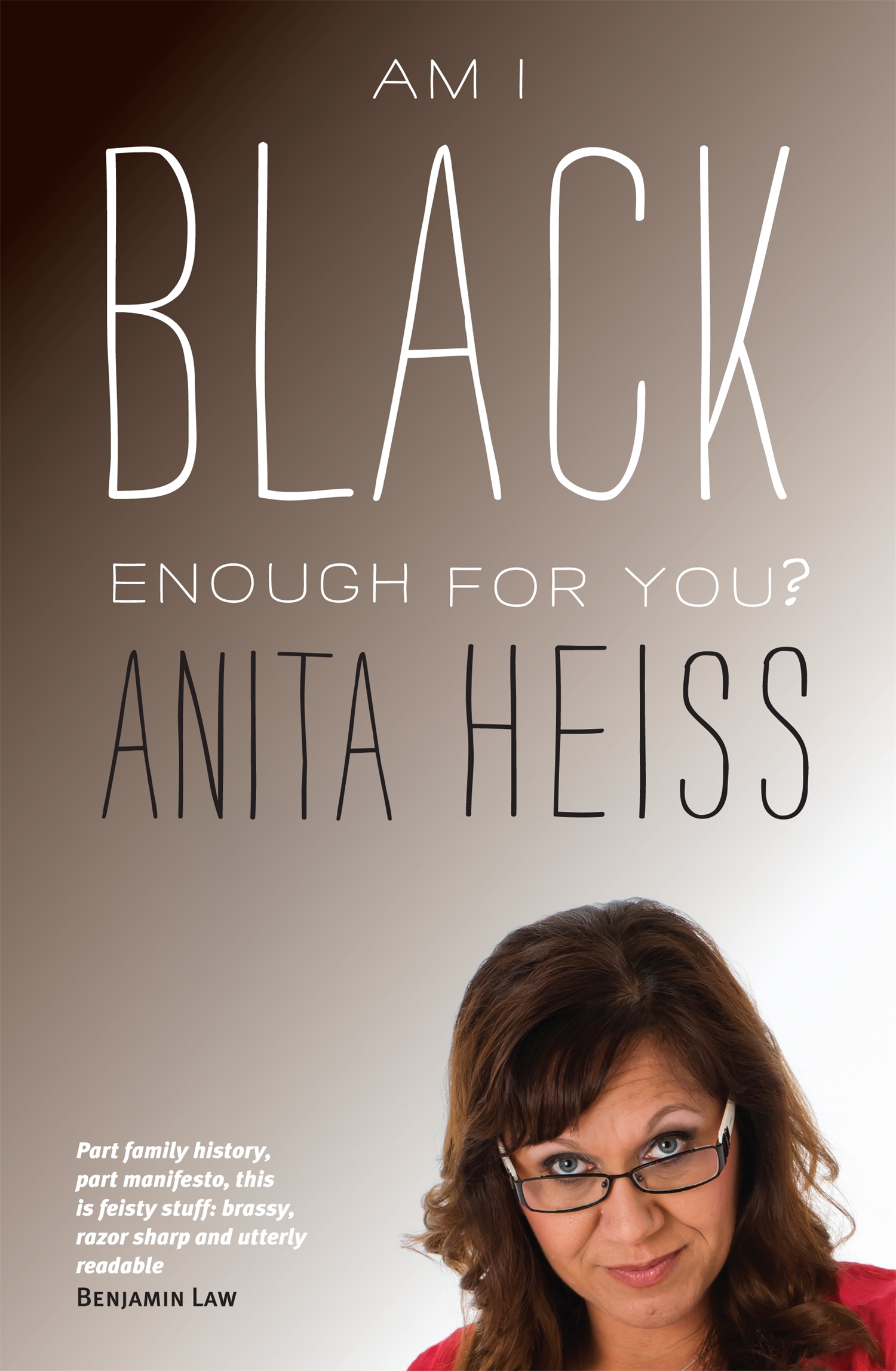
Anita Heiss, Am I black enough for you?

Courtesy: Random House

Anita Heiss‘s Am I black enough for you? is a challenge to categorise, so I’ll start with writer Benjamin Law‘s description on the cover of my edition. He calls it “part family history, part manifesto” to which I’d add “part memoir” because “family history” does not really cover the self-description aspect of the book.

For those of you who don’t know Anita Heiss, she is a Wiradjuri woman and an activist for indigenous Australians. She has a PhD in Communication and Media, focusing on Aboriginal literature and publishing, and is a writer. (I reviewed her chicklit novel, Paris dreaming, earlier this year, and reported last year on her address to the inaugural Canberra Readers’ Festival.) She co-edited the Macquarie PEN anthology of Aboriginal literature and was the guiding force behind BlackWords (the subject of this week’s Monday Musings). And this is just the start … she has been, or is currently, on many boards and committees, particularly to do with indigenous people and communications. She is an Ambassador for the Indigenous Literacy Foundation. She is, in effect, a tall poppy … which brings me to Am I black enough for you?

You see, in 2009, one of Australia’s influential shock jocks, Andrew Bolt, wrote a post titled “It’s so hip to be black” on his blog, asking readers to accept his proposition that there is “a whole new fashion in academia, the arts and professional activism to identify as Aboriginal”. He named many people, including Anita Heiss, calling them “white” or “political” Aborigines. His facts were questionable and his language emotive – such as “madness”, “trivial inflections of race”, “comic”. His argument was that these “white” Aborigines were obtaining unfair benefits from their decision to “be black”. The result was a court case brought by Anita Heiss and eight others against Bolt and his employer, The Herald and Weekly Times, for breaching the Racial Discrimination Act. Heiss and her co-defendants won the case. They did not seek damages. It was ground-breaking stuff that brought out some good discussion about the nexus between racism and free speech, about rights and responsibilities, but it also generated a lot of vituperative commentary. You can research all this pretty easily on the ‘net.

This is the background to Am I black enough for you? which, you might now have gathered, could also be described as an “identity memoir”. On the publisher’s website, Heiss writes that “I wanted to demonstrate that we as Aboriginal people have our own forms of self-identification and self-representation”. She wanted to “challenge the stereotypes” and present “alternative realities of being Aboriginal today”. This she does very well.

Heiss opens the book with her family background, Wiradjuri mother and immigrant Austrian father. She describes herself:

I’m an urban beachside Blackfella, a concrete Koori with Westfield Dreaming, and I apologise to no-one.

This is my story: it is a story about not being from the desert, not speaking my traditional language and not wearing ochre …

In the first four chapters of the book, she tells of her background – her grandmother and mother and their experiences as indigenous women, her father and his values, and her school days. Having laid that foundation, she presents in the fifth chapter, the current working definition of an Aboriginal or Torres Strait Islander person used by the Federal Government:

An Aboriginal or Torres Strait Islander is a person of Aboriginal or Torres Strait Islander descent who identifies as an Aboriginal or Torres Strait Islander and is accepted as such by the community in which he “or she” lives.

That seems pretty tight to me, though no definition is perfect. It’s better than using “a caste system defined by blood quantum (half-caste … quadroon)”.

There are a lot of “ah-so” moments for me in the book – some confirming things I’d already believed and some raising my consciousness about how easy it is to say the wrong thing without being aware of it. Heiss chronicles many instances where (mostly, I think) well-meaning whitefellas seem to get it wrong, such as the non-indigenous academics who proclaim themselves experts in “everything Aboriginal” or the critic who argued that Aboriginal literature “must” be in traditional language otherwise it’s Australian literature. It’s good to have these ideas aired publicly. It helps us test our own conceptions.

Am I black enough for you? has, like most of Heiss’s writing, a strong political and educational purpose. She is on a mission to encourage both indigenous and non-indigenous Australians to think about indigenous identity and, further, about how we relate to each other. She therefore writes in a bright, breezy, accessible style. She’s acutely aware of the power of words and language to define and to obfuscate (though she wouldn’t use such an obfuscatory word!), and frequently discusses language in the book. She makes a particular point about this in the chapter on her academic life, “Epista-what?”, when she says that using academic language, particularly to discuss indigenous issues, served “largely to alienate the very people it was talking about.”

There is much more in this book, and I hope many Australians read it. It’s well-structured, more or less chronologically but in a way that aligns with various themes – academia, the role of literature, her writing, gender – all of which link back to affirming indigenous people’s identity. She comes across as a generous woman – in her relationships with indigenous and non-indigenous people alike. She believes that optimism, rather than negativity and anger, is more likely to get results. It is possibly this optimism which underlies my small frustration with the book: several times she hints at dark times and stresses but, being the optimist, she focuses more on her strategies for overcoming them than on how they have informed her being. I’d like to understand more of that. However, Am I black enough for you? is not a misery memoir, and that’s probably a good thing!

Australian Women Writers ChallengeRead for the Australian Women Writers’ Challenge 2013ANZLitLovers Indigenous Writers Week, and Global Women of Color. Lisa (ANZLitLovers) and Marilyn (Me, You and Books) both enjoyed the book.

Anita Heiss
Am I black enough for you?
Sydney: Bantam, 2012
346pp.
ISBN: 9781742751924

Monday musings on Australian literature: BlackWords

NAIDOC Week, to which last week’s Monday Musings was dedicated, officially finished yesterday, but I’ve decided to bookend it with another Monday Musings focusing on indigenous Australian literature. This post, in fact, also harks back to two Monday Musings ago which talked about the AustLit database – because I want to introduce you to one of AustLit’s projects, BlackWords.

BlackWords was established in 2006 under the guidance of Dr Anita Heiss (whose Paris dreaming I reviewed earlier this year and whose memoir Am I black enough? for you I’ll be reviewing this week). It is a resource for and database of Aboriginal and Torres Strait Island writers and storytellers. It contains, where available, the standard information provided throughout the database:

  • author biography
  • lists of works by the author and about the author

Aboriginal and Torres Strait Islander Australians are the traditional keepers of their oral history, we are the custodians presiding over Indigenous Australian literature … (Indigenous writer and David Unaipon Award winner Yvette Holt)

It now contains records for over 5,000 people and organisations. Wow! The database aims to cover “published and unpublished books, stories, plays, poems, and criticism associated with eligible writers and storytellers … in English, in Australian languages, and in translations.” Given that the loss of language is a significant concern for our indigenous peoples, capturing works in Australian languages is a particularly important goal.

… each time we translate black words onto white paper we are reclaiming an integral piece of our heritage, culture and language.” (Yvette Holt)

Tara June WInch

Tara June Winch (Photo: Howcheng, using CC-BY-SA 3.0, via Wikipedia)

Currently the BlackWords homepage spotlights three featured authors: Tara June Winch, Anita Heiss and Samuel Wagan Watson. Click on the author’s name and you get taken to their AustLit page. In the right sidebar of their page is something called Resource Maps. For Anita Heiss and Tara June Winch these include Wiradjuri Trail (Wiradjuri being the nation they both belong to). The Resources Maps contain hand-built links to internet sources on the topic. As with all of AustLit, these maps are works in progress.

The left sidebar contains a variety of links, encouraging other explorations, such as “Teaching with BlackWords”,  “Publishers” and “Translations”.

Specifically for BlackWords, the site also includes a timeline of historical dates significant for Aboriginal and Torres Strait Islander people. It starts at 1788 … the date when white people established their first settlement in Australia. The text entries for these dates include links to works and authors in the database. Also, under the dates – where relevant – are links for search terms that will lead searchers to works indexed in the database about the event/date. So, for example, under 1788, are links for Pemulwuy, an Aboriginal warrior who resisted the white invasion, and Bennelong, who was captured by Governor Phillip and found himself caught between two cultures. (The timeline is a little tricky to find. It would be more obvious if placed in the left sidebar, but instead it’s a dot point under “About” on the About page.)

… when storytellers speak, their words will inextricably tie indigenous peoples to their lands and to their mobs … (Yvette Holt)

BlackWords is a wonderful initiative and has now reached the critical mass to be of value to indigenous and non-indigenous Australians alike. It is for resources like this that the Internet is at its best, don’t you think?

Melissa Lucashenko, How green is my valley (Review)

Almost a year ago I reviewed a short story, “The silent majority”, by Melissa Lucashenko. It was published in the Griffith Review of November 2009. I enjoyed the story and so, in honour of NAIDOC Week and ANZLitLovers Indigenous Literature Week, I thought I’d review another of her Griffith Review contributions. This one, “How green is my valley”, is described as a memoir, and was published in Winter 2006.

I love how Lucashenko, with her dual Aboriginal and European heritage, traverses both in her writing. She commences “The silent majority” with the famous opening words of Pride and prejudice – “”It is a truth universally acknowledged”. The title of this piece immediately brings to mind Richard Llewellyn‘s classic novel How green was my valley, and clues us into her themes: beauty under threat, complicated relationships with land, and the precarious balances involved in maintaining it.

Lucashenko starts her memoir – though, really, I’d call it a personal essay – with a Mark Twain quote, which has a prescience now that he could not have guessed:

Everybody talks about the weather/but nobody does anything about it.

She then describes the experience of torrential rain in Bundjalung country, the coastal regions of north-east New South Wales/southeast Queensland. She’s moved, she says, to “one of Australia’s wettest shires”. The first half of the essay describes how residents manage – or don’t – the rain. She talks of students being let off school, of the weather not distinguishing between rich and poor, and of how community is fostered as people with 4WDs deliver food to the stranded who don’t. “The information we receive from land”, she says, “is tightly nuanced”. Farmers watch closely and know how the days will pan out once the rain sets in:

We who live on Bundjalung land know that eventually the rain will stop, the mould will retreat and the mud will dry. Whatever climate change is going to mean for our kids, in the short term life for us will return to normal.

Then, halfway through the essay, comes the sting in the tail: she reminds us that the inhabitants of Tuvalu will lose their home in the next few decades as their island is submerged, and the semi-traditional hunting lifestyle of the Inuit of the Arctic Circle “will be shattered by global warming even sooner”. She wonders whether indigenous people like the Inuit will be able to translate “the clan, the traditions of egalitarianism, stoicism and intensely valued community, to life in suburbs and towns.”

Lucashenko’s thesis is that it can be done, that it is possible to be “bicultural”, to span the chasm “between industrial and indigenous views of the ‘good life’ and what constitutes a proper society”. She argues that the egalitarian ethic espoused by Henry Lawson and Banjo Paterson

the traditions of mateship that faithfully mimic the brotherhood of initiated Aboriginal men and the myriad skills of surviving from and maintaining the land – were learned by some colonial whites from Aboriginal people.

Hmm … I haven’t heard that before. I suspect Australia’s mateship tradition has rather multi-pronged origins but this could certainly be part of it.

Lucashenko’s point though is to draw a parallel between white Australians’ love of land and indigenous people’s. She says that any Australian who has holidayed at the same beach every summer, or “diligently looked after” their own little patch, has “walked in Aboriginal footsteps” whether they know it or not. Hmmm … again I think this is a little bit of a long bow, in the sense that there are people all over the world who love their bit of land. But it doesn’t spoil her argument that it would have been good had the influence of Aboriginal knowledge and practice been greater, because then

More Australians might have learned not just to love the place (as some indisputably do) but to listen to the land more seriously. Had more Aboriginal philosophers been valued rather than shot or packed off to missions, all Australians might have learned the careful and intense attention to detail that many of us in the valley are still forced to practise as a matter of course.

With climate change breathing down our necks, will we all “be rooned”, she asks (alluding to one of my favourite old ballads “Said Hanrahan“). Will our “valley” be destroyed by our inability to tame our capitalistic consumerist urges, or will we learn in time how to be true custodians of our land?

Melissa Lucashenko
“How green is my valley”
Published in the Griffith Review, Edition 12, Winter 2006
Available: Online at the Griffith Review
Monday musings on Australian literature: Indigenous Australian memoirs

As Australians would know, this week – July 7-14 – is NAIDOC week. NAIDOC originally stood for an organisation – ‘National Aborigines and Islanders Day Observance Committee’ – but the acronym has now become the name of the week itself. Fascinating how acronyms can take on lives of their own, isn’t it? Anyhow, the theme for this year’s celebrations is We value vision: Yirrkala Bark Petitions 1963.

This theme commemorates the 50th anniversary of two bark petitions which were sent by the Yolngu people of Yirrkala in northeast Arnhem Land to the Australian Parliament. The petitions concerned the Commonwealth Government’s granting of mining rights on land excised from Arnhem Land. They asked the Government to recognise the Yolngu peoples’ traditional rights and ownership of their lands. These petitions were the first indigenous Australian documents recognised by the Government and helped, the NAIDOC website says, to “set into motion a long process of legislative and constitutional reforms for Aboriginal and Torres Strait Islander people”. Many Australians know of Eddie Mabo and the Native Title Act of 1993, but I wonder how many know of actions like this which occurred decades earlier?

In this spirit of commemorating the past, I thought today’s Monday Musings could focus on indigenous Australian memoirs/autobiographies. I’ve written on this topic before, and so will try to avoid repeating myself too much. Interestingly, all of the books I mention below are by women. The Cambridge companion to Australian literature says, in fact, that since the 1970s, Aboriginal women have dominated indigenous autobiography.

A number of themes run through indigenous memoirs/autobiographies and, of course, identity is a big one. One of the best known examples of a memoir about identity is Sally Morgan‘s My place which was published in 1988, Australia’s bicentenary year – the bicentenary, that is, of white settlement in Australia. It was not a year that was universally celebrated by indigenous Australians, for good reason. My place was, possibly, the first book by an indigenous Australian that many non-indigenous Australians had read – and it became a best-seller. Morgan, also an artist, told the story of her family – and of their shame that was so strong that she had not been told she was indigenous. She’d been let think she was of Indian (that is, from the subcontinent) extraction, until she was well into her teens. I haven’t read My place since 1988, but I expect it would still stand up well today. Morgan is a great story-teller.

Anita Heiss‘s Am I black enough for you, which was published in 2012, is also about identity, but in a different more confident way. I’m reading this one now. In it, Heiss aims to educate Australians about the breadth of indigenous life and experience in Australia, to show us that people do not have to be living a traditional indigenous life in the desert to identify as indigenous.

A big topic for indigenous memoirs is the experience of the Stolen Generation. Many of these also deal with identity, but from a specific point of view. I mentioned one – Doris Pilkington‘s Following the Rabbit Proof Fence – in my previous post. While I’ve read a couple of novels dealing with this issue since that post, I haven’t read more memoirs. There are many out there, though, including Rosalie Fraser’s Shadow Child: A Memoir of the Stolen Generation (1998), Doris Kartinyeri’s Kick the tin (2000), Donna Meehan’s It is no secret: The story of a stolen child (2000).

As Australians would know, the most comprehensive study of the Stolen Generation appeared in the government report Bringing them home (1997). This 700-page report contains excerpts from the testimonies of over 500 indigenous people about their or their families’ experiences of being stolen.

A common style of memoir – for indigenous and non-indigenous people alike – is what I’d call the “success memoir”. You know, those chronicling major success or high achievement. Sydney 2000 Olympic Games gold medallist Cathy Freeman wrote Cathy: Her own story in 2003. As often happens with memoirs written by non-writers, she had a co-author, the sportswriter Scott Gullan.

Last but not least is the simple story-of-my-life memoir, though most memoirists wouldn’t be writing their stories if they really were simple! Ruby Langford Ginibi would fall into this category – I think, as I haven’t read her yet. Ginibi published her first book, the gorgeously titled Don’t take your love to town, in 1988 when she was 54. She won a Human Rights Literary Award for it. Ginibi was a lecturer in and historian of Aboriginal history, but her start was way different. She married young, had nine children, lived and worked in the bush, and also worked as a clothing machinist. One of the obituaries written after her death says:

Through her numerous books, short stories, poetry, interviews and public appearances and her commitment to ‘edu-ma-cating’ non-Aboriginal people about Indigenous peoples’ circumstances and struggle she made a distinctive and substantial contribution to Australian history and literature.

 “‘Edu-ma-cating’ non-Aboriginal people”. That’s what all these writers are doing in their different ways … I’m glad they are, and will continue to read a few each year.

Unfortunately, many of these books are likely to be out of print but most should be available in libraries – in Australia at least. If you’d like to read one, I suggest you do so now and join ANZLitLovers Indigenous Literature Week. Lisa will, I understand, accept reviews after the week has finished.

Monday musings on Australian literature: Inaugural First Nations Australia Writers Workshop

I had planned another topic for today’s Monday Musings, but when I heard via AustLit News about the inaugural First Nations Australia Writers Workshop to be held in May this year, I decided to write about it sooner rather than later …

The workshop aims to bring together established and emerging writers of Aboriginal and Torres Strait Islander backgrounds with a view to further developing indigenous arts practice. It is being presented by the First Nations Australia Writers Network (FNAWN) and is to be held at the State Library of Queensland, in Brisbane, from 9th-10th May, 2013. The Network was apparently established last year and its Chairperson is Canberra-based Wiradjuri poet, writer, activist Kerry Reed-Gilbert.

The workshop has an impressive line-up of presenters, including writers I have reviewed here:

  • Alexis Wright whose Carpentaria (see my review) won the Miles Franklin Award in 2007. It has been published in many countries and been translated into multiple languages. She has written several other works, and has a new novel coming out this year.
  • Melissa Lucashenko who won the Dobbie award for her first novel Steam pigs. Her latest novel is Mullumbimby (2013). (See my review for her short story “The silent majority).
  • Anita Heiss about whom I’ve written several times on this blog. Her most recent book is her memoir, Am I black enough for you?, which I plan to read and review in a couple of months. Heiss also co-edited The Macquarie PEN Anthology of Aboriginal Literature. (See my review of her Paris dreaming.)
  • Kim Scott whose novel That deadman dance (see my review) won multiple awards including the Miles Franklin Award in 2011. Like Wright, Scott has had several novels and short stories published.
  • Marie Munkara whose Every secret thing (see my review) won the David Unaipon Award in 2008 and whose next novel will be published this year.

Exciting list, eh? Other presenters are Kerry Reed-Gilbert, Bruce Pascoe, Sam Wagan Watson and more, including some new names to me. AustLit News also mentions Tony Birch whose novel Blood was shortlisted for the Miles Franklin Award last year, but I can’t find him on the Workshop’s website. Sharon Shorty, a Canadian First Nation writer, will also be presenting.

The program is broad-ranging with an emphasis on practical issues – copyright, preparing your manuscript, the future of the book, “writing our stories” – which is what you’d expect for a workshop. Creative Partnerships Australia puts it this way:

With the rapid and seemingly constant changes in the publishing and literary sectors it is imperative that Australia’s Indigenous writers embrace the knowledge, technology and global context for the sustainable development of their livelihoods and their art.

If you would like to keep in touch with the Workshop:

Tax-deductible (for Australians anyhow) donations are welcome to support attendance, particularly by writers from remote areas. Click this link if you are able to help.

Monday musings on Australian literature: Indigenous writing and Canberra

This is going to be a difficult post to write because, really, my knowledge is superficial, but I figure that if I put out some feelers, I just might learn something from those who read this and, hopefully, comment. I was inspired to write it by – yes, you’ve probably guessed it – Canberra’s centenary, because at last Monday’s “Very Big Day Out” celebration, we were given a beautifully produced program titled Centenary of Canberra: Celebrating First Australians. It describes the major events that are/will be occurring in Canberra over the centenary year involving indigenous Australians. Many of these events involve indigenous people from other parts of Australia – but given Canberra’s role as the nation’s capital it seems right that we don’t narrowly focus on ourselves. There’s a big Australia out there.

To today’s topic though … the first thing I need to say is that the history of indigenous culture in the Canberra region is a complicated one, and is still being researched. It appears that several groups are associated with the area, representing several languages, with the Ngunnawal, Ngambri and Wiradjuri people having the closest association. I don’t intend to write more on these groups and what connections they may or may not have with each other and the land, as it’s not relevant to my main concern here. The important thing is, I think, the conclusion in Our Kin Our Country report published in August 2012 by the ACT Government’s Genealogy Project:

the verification of a distinct regional Aboriginal population that survived, resisted and adapted to European occupation and settlement in the areas surrounding what is now known as Canberra.

Indigenous writers associated with Canberra include the late activist Kevin Gilbert, Jennifer Martiniello who established the ACT Indigenous Writers Group, and Jeanine Leane whose David Unaipon award-winning book, Purple threads, I reviewed last year. Kevin Gilbert and Jennifer Martiniello are represented in both the ACT Centenary anthology, The invisible thread, and the Macquarie PEN anthology of Aboriginal literature.

Kevin Gilbert and Oodgeroo Noonuccal (or Kath Walker) were the first indigenous writers I became aware of, back in the late 1960s. They were both activists who exposed the devastating effect dispossession had on indigenous people. In 1992, Gilbert, a Wiradjuri man, made a speech at the Aboriginal Tent Embassy (in Canberra), stating:

You cannot build a vision, you cannot build a land, you cannot build a people, on land theft, on continuing apartheid and the denial of one group of Aboriginal people … (from the Macquarie PEN anthology of Aboriginal literature)

He was a prolific writer of poetry, plays and non-fiction.

Jennifer Martiniello‘s piece in The invisible thread is also highly political, speaking particularly of the impact of loss of language:

I could tell you about growing up in a voided space. What it is like as a child to be an echo, a resonance of something unnamed in the silence. I could tell you about my grandmother’s and my father’s first three languages – Alyerntarrpe, Pertame, Arrernte – and about my own eliminative reduction to one, English. My father’s fourth language, and the supreme evidence of colonial obsession with an abstracted literacy that could not read the forms and expressions of our multiple literacies. I could show you the void of two hundred blank white pages of history unmarked with the black ink of our lives … (from “Voids, Voices, and Stories without End”).

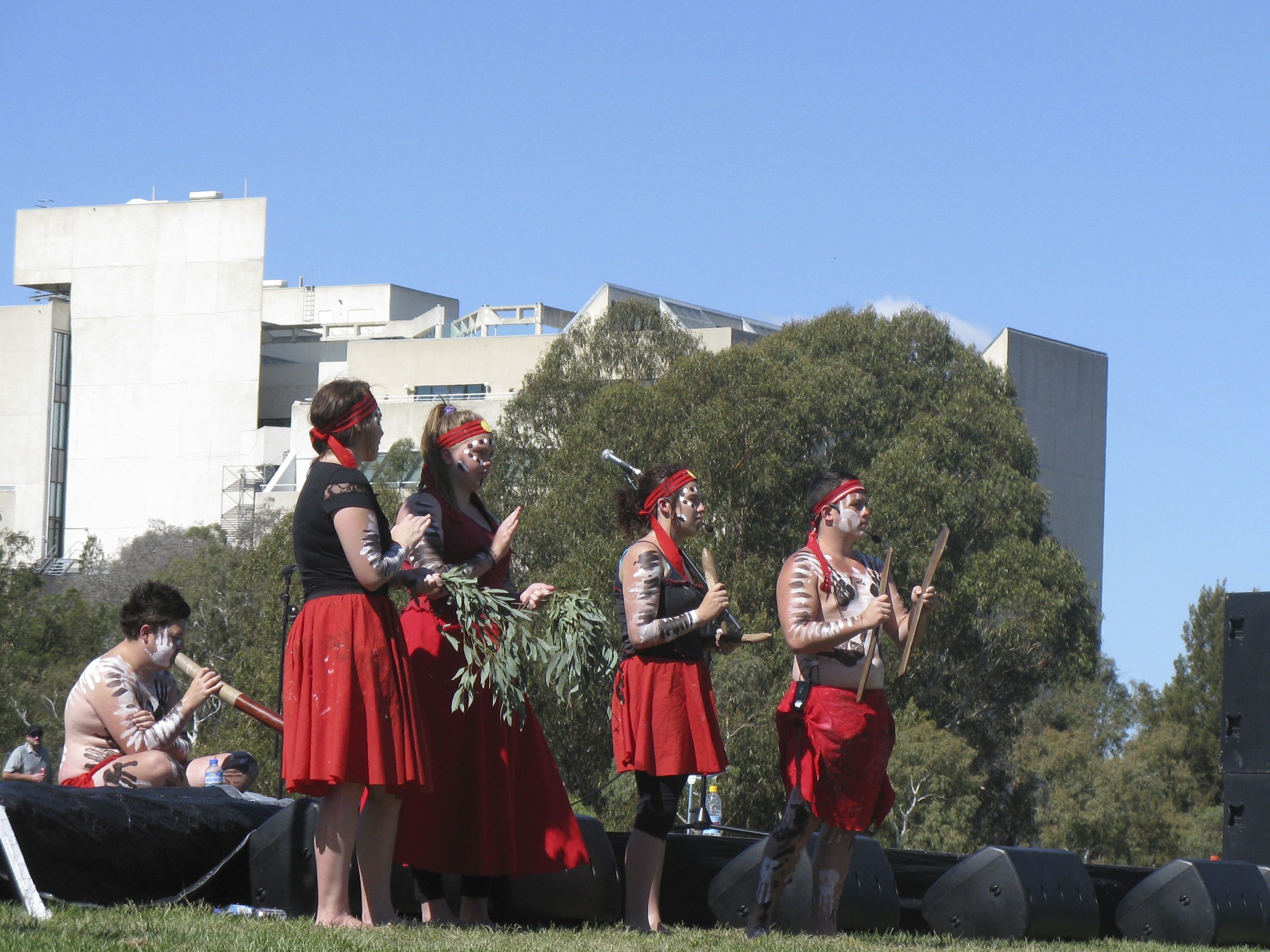
Wiradjuri Echoes

Wiradjuri Echoes, at “The Very Big Day Out”, 11 March 2013

Martiniello is of Arrente, Chinese and Anglo-Celtic descent.

Jeanine Leane‘s Purple threads also has an activist element, albeit couched in stories which are warm and funny as well as sometimes dark. They are set in a world where, she says, “black was not the ideal colour”. (By the way, when I reviewed this work I wasn’t sure what to call it but I have since seen it described as a “story cycle”. That sounds good to me!). Leane, a Wiradjuri woman, has also written and published poetry.

There are, I’m sure, other indigenous writers associated with Canberra, but these are the three best known to me. Identifying writers as belonging to a group – indigenous, migrant, women, gay, and so on – is an uncomfortable thing. It would be good to simply see writers as writers, people as people, but when you are a minority, when recognition doesn’t come easily to your “group”, there is value I believe in overcoming my discomfort … to help bring other ways of being and seeing to the attention of us in the majority culture.

As I was researching this post I came across a comment made by Cara Shipp, a local teacher of secondary English, at the Dare to Lead Conference: Leading indigenous perspectives in the national curriculum (Sydney, November 2010):

I think there is a danger in concentrating too much on the traditional cultural stuff. In terms of the way it is delivered, that can play into the stereotype that Aboriginal culture is dead and past. The only texts suggested for teaching in the draft National Curriculum are Dreamtime stories and I am not sure this is a good thing.

Really? Only Dreamtime stories in 2010? She has a point. I sure hope the final National Curriculum includes some of the great indigenous writing we know is out there.

Anita Heiss, Paris dreaming (Review)

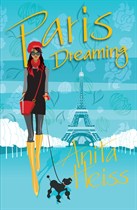
Anita Heiss Paris Dreaming

Paris Dreaming (used by permission of The Random House Group Ltd)

Late last year I wrote a post about the inaugural Canberra Readers’ Festival. One of the speakers was indigenous Australian author, academic and activist, Anita Heiss. I wrote then that I bought one of her books. It was her fourth (I think) chick lit novel, Paris dreaming. This might surprise regular readers here, as chick lit is not really my sort of thing, however …

There are reasons why I was happy to read this book. First was that my reading group chose it as part of our focus on books featuring Canberra for our city’s centenary year. Yes, I know, it’s called Paris dreaming, but the heroine starts in Canberra and Canberra is mentioned (not always positively I must say) throughout the book. The other reason is the more significant one, though, and that is Heiss’s reason for writing the book. I said in the first paragraph that she is an activist and her chick lit books, surprising though it may sound, are part of her activism. In fact, I think pretty much everything Heiss does has an activist element. In her address at the Canberra Readers’ Festival she described herself, an educated indigenous Australian, as in the top 1% of the bottom 2.5% of Australia. She feels, she said, a responsibility to put her people on the “Australian identity radar”.

Does this book do it, and if so how? Well, one of her points is that 30% or more of indigenous Australians are urban and this book, as its genre suggests, is about young urban indigenous women. Anita Heiss manages I think (though I’m not the target demographic so can’t be sure) to present characters that both young indigenous and non-indigenous women can relate to. Our heroine Libby and her friends are upwardly mobile young professionals. They care about their work; they love fashion, drink and food (this is chick lit remember!); and they wonder how to marry (ha!) their career goals and romance.

Indigenous design vase, on hall table, Governm...

Indigenous art vase, Government House, Canberra

So what’s the plot (besides the obvious chick lit formula which this book certainly follows)? At the start of the novel  30-year-old Libby, manager of the education program at the National Aboriginal Gallery, is on a man-fast. She’s been bitten one too many times and has sworn off men, much to the dismay of her tiddas (her “sisters”). She is, though, keen to develop her career and wants a new challenge – all part of the chick lit formula – and so pitches a proposal to her boss that she mount an exhibition of indigenous Australian art at the Musee du Quai Branly in Paris. Of course, her boss approves and off she goes to Paris where, following the formula, she falls for hunky, sexy Mr Wrong while Mr Right watches on, spurned (and spurned and spurned). But, of course, I don’t need to tell you how it comes out in the end do I? This is not subversive chick lit because that would not serve Heiss’s purpose …

Did I enjoy it? Yes, but not so much as a piece of literature because my reading interests lie elsewhere, but as a work written by a savvy writer with a political purpose. This purpose is not simply to show that young, urban, professional indigenous Australians exist but, as she also said in her address, to create the sort of world she’d like to live in, a world where indigenous Australians are an accepted and respected part of Australian society, not problems and not invisible. She is therefore unashamed about promoting indigenous Australian creators. She names many of them – artists, writers, filmmakers – and discusses some of their work, educating her readers as she goes. Most of the people, works and places she mentions are real but there’s an aspirational element too. The National Aboriginal Gallery does not exist but she presents it as a significant player in the Canberra cultural institution scene. Good for her!

I’ll probably not read another of Heiss’s choc lit (as she, tongue in cheek, calls it) books, but I’m glad to have read this one – and I’ll certainly look out for works by her in other genres (including her memoir Am I black enough for you?). Heiss is a woman to watch.

Anita Heiss
Paris dreaming
Sydney: Bantam, 2011
313pp.
ISBN: 9781741668933

Melissa Lucashenko, The silent majority (Review)

I have reviewed many individual short stories by Americans (through the Library of America), but not by Australians. Time to rectify that a little, and why not with a short story by Melissa Lucashenko, an Australian writer of European and indigenous Australian heritage. She is an award-winning novelist and an essayist, but I hadn’t read her – until now.

You might be wondering why I chose her and this story? But it’s obvious really. I was pottering around the web and came across this:

It is a truth universally acknowledged, Jo decided, that a bored teenager with a permanent marker is a pain in the bloody neck.

How could I go past it? I had to read it to see what it – and Lucashenko whom I was keen to read – was all about. It’s a short, short story, well suited, I suppose, to publication in a magazine like the Griffith Review. Jo is a single mum of indigenous heritage and during the course of the story is mowing the grounds of the cemetery in the small northeastern NSW town of Mullumbimby. Her teenage daughter Ellen is supposed to be babysitting her young nephew Timbo while Jo does her mowing but, like a teenager, gets bored and “tags” Timbo with slogans such as “Better Conditions or I ring DOCS*” and “Pay me a living wage”. The daughter is needling her mother, but there is of course double meaning for the reader in these slogans, messages about the conditions many indigenous Australians face.

The story mainly comprises Jo’s thoughts as she gets on with her mowing. She reflects on those who lie in the ground beneath her – the Protestants and Catholics, in their separate sections. They are the literal “silent majority” of the title, and she wonders about their stories, now lost with the erasure by time of their details on the gravestones. Jo wonders about

These stories that had once been so important to the town, that had needed carving in granite: where were they now.

Stories, though, are important to Jo – and, in my experience, are an important treasured part of indigenous Australian culture. Jo is a little worn by her “previous life and its discontents” in which an Eeyore-like man Gerry kept dragging her into “his tight white world”. In fact, she appears not to have much time for people, with her “favourite humans living in the pages of books” and her preferred living creatures being horses. She quotes Walt Whitman – I found that interesting – on horses:

They do not sweat and whine about their condition.
They do not lie awake in the dark and weep for their sins.
… not one is demented with the mania of owning things.

Hmmm … this certainly conveys to me a sense of cynicism about humans, of all colours. But the real point of the story comes in the third last paragraph, with her pondering on what the land was like before, when it was

not yet doomed by the axes and greed of men who – months and years from anything they thought of as home – had tried to slash and burn their way to freedom here.

So what we have here is a meditation, in a way, on stories and their importance, on animals and land, and on walking a line between white and indigenous culture. It’s not all melancholic, as what I’ve said here might suggest. There are some touches of humour. Overall, I was intrigued by her writing and I liked the story, though it felt a little undeveloped. I understand that Lucashenko’s next novel is set in the Mullumbimby area. I wonder whether this story is part of it – or, at least, whether Jo appears in it. I hope so.

Melissa Lucashenko
“The silent majority”
Published in the Griffith Review, Edition 26, November 2009
Available: Online at the Griffith Review

*The Department of Community Services which is feared by struggling parents for fear their children will be taken away.

Jeanine Leane, Purple threads (Review for Indigenous Literature Week)

What I especially like about Jeanine Leane’s book, Purple threads, is how well she draws the universal out of the particular. That she does this is not unusual in itself. After all, this is what our favourite books tend to do. The interesting thing about Purple threads, though, is that the particular is an Indigenous one. Even as I write this post my mind is flicking back-and-forth between thinking about the Indigenous Australian themes in the book and the more universal ones about family and relationships. More on that anon. First, I want to say a little about the book’s form, because ….

I’m not sure whether to call Purple threads a novel or a book of connected short stories, except I don’t think it matters much. What is significant is that the stories revolve around a mostly female-only Indigenous Australian family living on a small piece of land in the Gundagai area of New South Wales in the 1950s to 1960s. The main characters run through the whole book, and the stories are told pretty much chronologically. There could even be a plot line or two, but they are not strong and are not what drive us to read on. This form had an eerie familiarity as I was reading and I realised it was because it reminded me of another David Unaipon Award winning book I have reviewed here, Marie Munkara’s Every secret thing. Is this a coincidence – after all, there are similar books by non-Indigenous writers – or should I go out on a limb and wonder whether this form reflects an Indigenous Australian way of story-telling? In addition to this similarity in form, these two books share a particular style of humour. Munkara’s is probably more belly-laugh, and is definitely more gut-wrenching, but both have a self-deprecating element, a willingness and ability to laugh at themselves, to see the absurd. It’s a form of humour we also see in Alexis Wright‘s Carpentaria. Okay, enough of that, back to the book itself.

The stories are told first person by Sunny (Sunshine) who lives with her sister Star, and her grandmother, Nan, and aunts, Boo (Beulah) and Bubby (Lily). Her mother, father, grandfather, more aunts and uncles, and others in the community, also appear in the book, but these five named characters are the focus. They are well differentiated. Nan is the down-to-earth matriarch of the group who doesn’t know how to read but “sure as hell know[s] how ta think”. Boo is independent and feisty, the one who takes action when action is needed. She loves the ancient Romans, particularly Empress Livia “who knew how to work behind the scenes”. Bubby, on the other hand, is the gentle, romantic one, who loves Emily Bronte and Wuthering Heights. The stories chronicle the first two decades of Sunny’s life in this female-dominated household. There are anecdotes about walks with Aunty Boo, about spoilt Petal (Sunny and Star’s mother), and about interactions with neighbours, teachers and others in the community. Most of the stories are light, albeit with a good degree of bite, but some are dark, such as the story of the young white neighbour, Milli, who is regularly beaten by her husband. This story, in fact, forms a minor plot line in part of the book.

The universal themes are about the way families comprise different and sometimes conflicting personalities and yet manage to love and support each other to ensure their joint survival. The particularity, though, has to do with being Indigenous, with being lesser, in a rural community. Leane handles this cleverly, using, for example, the Christian symbol of “the black sheep” throughout the book to tease out the ironies and complexities packed into this idea when it is played out in a sheep-farming community. The symbol is explicitly introduced to us in “God’s flock” where Sunny talks about going to church and being taught the story of “the black sheep”:

‘ … But Jesus, if we pray to him [the priest says], will find all the lost sheep and return them to the fold, even the black sheep that no one  else wants or loves.’

At least this bit made sense to us. Apart from Jesus, we didn’t know any other sheep farmer who loved black sheep. Most hated them, in fact. That’s why every year my Aunties always ended up with a few black lambs to raise ….

Leane shows how Nan and the Aunties navigate life in a world where “black was not the ideal colour” and in which “women livin’ by themselves are always easy targets”. They navigate it with dignity, often by pretending to go along with white society’s ways while staying true to their own values, which involve respecting and caring for other people and creatures and for their little bit of land.

Purple threads, apparently drawn from Leane’s life, provides an engaging but uncompromising insight into a life most Australians know little about. I hope I’m not being too pompous when I say that we need more books like this, and they need to be read by more people, if we non-Indigenous Australians are to have a chance of truly comprehending the experience of being Indigenous in our nation.

Read for ANZLitLovers Indigenous Literature Week, for which Lisa has also reviewed it.

Jeanine Leane
Purple threads
St Lucia: University of Queensland Press, 2011
157pp
ISBN: 9780702238956

(Review copy supplied by University of Queensland Press via ANZLitLovers blog giveaway. Thanks Lisa. Thanks UQP)

* I have assumed copyright permission for this cover on the basis that the book was provided by UQP