Ellen van Neerven (ed.), Writing black (#BookReview)

Writing black: New indigenous writing from Australia is one of the productions supported by the Queensland Writers Centre’s if:book that I wrote about in a recent Monday Musings. It’s an interactive e-book created using Apple’s iBooks platform, and can be downloaded free-of-charge via the if:book page or directly from iBooks.

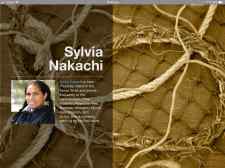
Title page for Ch. 16, Sylvia Nakachi

Ch. 16, Sylvia Nakachi (Using fair dealing provisions for purposes of review)

Writing black was edited (and commissioned) by Ellen van Neerven (whose book Heat and light and story “Sweetest thing”, I’ve reviewed here). It contains works by 20 writers, in a variety of forms, including prose by writers like Bruce Pascoe, Tony Birch, and Marie Munkara; poetry by Tara June Winch, Lionel Fogarty, Kerry Reed-Gilbert and Steven Oliver (most of which are presented in both text and video); and twitter-fiction by Siv Parker. For each writer, there is a “title” page which provides a brief biography, and the works are illustrated with gorgeous sepia-toned photography by Jo-Anne Driessens.

In her editor’s introduction, van Neerven states that, by the time of publication, there had not been a “digital-only anthology of Australian indigenous writing”. This book addresses that gap, but with a very particular goal. It was, she writes, “moulded by possibility”, by the fact that “the multimedia and enhancements a digital publication allows lifts the imagination”. Certainly, we see some of these possibilities in this production.

Her point, though, that particularly interested me was this:

Expectations of what we write about are changing, no longer the narrow restriction of life stories and poetry. Indeed, Indigenous writers do not need to write about Indigenous issues at all, if they choose not to. With more Indigenous books and authors comes a new generation of readers — open-minded to what Indigenous writers can write about, and across new forms and experiences.

Great point – just as it’s important that we see indigenous people on television and in movies, for example, without their indigeneity needing to be referenced or be part of the story. Anyhow, we see this broadening of content in Writing black – in Jane Harrison’s “Born, still”, for example – although, not surprisingly and completely understandably, given where we are on the reconciliation journey, many of pieces do have political intent.

This brings me to one of the appealing aspect of this production, which is its variety, not only in form as I’ve already mentioned, but in tone and content. The pieces span moods from the intensity of Tara June Winch (“Moon”) to the cheeky humour of Marie Munkara (“Trixie”), from the anger of Kerry Reed-Gilbert (“Talking up to the white woman”) and the frustration of Steven Oliver (“You can’t be black”) to the melancholy of Bruce Pascoe’s (“A letter to Barry”). Many of the pieces speak to loss of country and identity, and the emotional impact of these. What makes them particularly powerful is that they come from all over, from the tropical north to country Victoria to various urban settings.

Another appealing thing, which stems from its being an e-Book, is that we can hear poets perform their own work, as well as read the text ourselves. One of these is the new-to-me Steven Oliver. He has four poems in the collection – “Real”, “You can’t be black”, “Diversified identity” and “I’m a black fella” – with video of him reading each of them. He (or his poetic persona) is an urban dweller who regularly confronts questions concerning his indigenous identity. In “Real” he describes a discussion with another who refuses to accept he’s “black”, who produces those crass arguments like he’s “more of a brown” and “not really a full”, but who suddenly turns when our poet responds that his English name suggests he’s not “from here”. Oliver writes:

Listen here Abo, you know-it-all coon
It seemed that my friend has spoken too soon
Just moments ago I was not the real thing
Yet now by his words my heritage clings

This is a long-ish poem, but is accessible. Its use of rhyming couplets provides a light touch that keeps the reader engaged while the actual words drive home a serious point about Aboriginal identity. I hope it’s taught in schools.

Another poem of his, “You can’t be black”, also addresses assumptions others make about what being Aboriginal is:

You can’t be black
When the media shows Aborigines they live on communities
And struggle with petrol, poverty and disease
So you can’t be black
If you’re black you wouldn’t have nice clothes on your back.

Oliver’s poems are made to be performed, as are those of the next poet Kerry Reed-Gilbert.

She also comes out fighting, with five poems. She writes of being in a bar, waiting for the racist slurs (“A conversation and a beer”), or of being exploited by people who only want to know her to further their own aims (“Talking up to the white woman”). She speaks in the voice of a white racist in “Because my mum said so” to show how racism is learnt through families. This is a particular concern of mine. I’ve seen schools trying their hardest to teach tolerance and respect – but that role-modelling at home is mighty powerful stuff.

Another well-established poet who has been politically active for decades is Lionel Fogarty. His two poems in this collection focus more on caring for country, on sharing the land, on passing knowledge on.

The prose pieces are, overall, more diverse. There’s Tristan Savage’s cheeky short film script, “Gubbament man” about Freddy the indigenous “discrimination prevention officer”. Siv Parker’s twitter-fiction piece “Maisie May” was originally released as tweets over several hours on, note, 26th January, in 2014. It tells of a trip to country for the funeral of Aunty Maisie May who “could tell you about country and our ways that we lost over the years.” Marie Munkara is here too with her particular brand of humour to tell about “Trixie” who takes revenge on her ex. There’s also Tony Birch whose “Deep rock” clearly draws from (or fed into) his novel Ghost River (my review). And there’s David Curtis whose “What kind dreaming” tells of three young indigenous men, two already becoming familiar with the life and law of their country and the other a greenhorn from the city, who go bush. Our greenhorn soon learns a few things from the other two, who respect “them old people”.

In an interview in Sydney Review of Books, Ellen van Neerven comments briefly on why she wanted to do this “digital collection”:

For me it’s as much about audience and access. There is a really hungry international audience for Indigenous writing but also lots of roadblocks in getting the books out there. Being able to access work online is definitely an advantage and we’ve had a lot of feedback and contact from people overseas who have been able to find out about Indigenous writing and read content from 20 different authors that way.

And that’s exactly it. This oh-so-rich collection introduces readers to many of Australia’s current significant indigenous writers, not to mention the range of issues that interest them. And it’s free to download. That we should be so lucky! A big thanks to if:book and the Queensland Writers Centre for supporting such innovative and sophisticated projects as this one.

aww2017 badgeEllen van Neerven (ed.)
Writing black: New indigenous writing from Australia
State Library of Queensland, 2014
133pp.
ISBN: 9780975803059

A paradox of empowerment: Kim Scott’s Ray Mathew Lecture

Kim Scott and the whale's eye

Kim Scott and the whale’s eye

Why was Raimond Gaita’s Seymour Biography Lecture booked out, but not Kim Scott’s Ray Mathew Lecture*. Both lectures, held at the National Library of Australia, are endowed by generous benefactors and are free. Don’t get me wrong. I love that Gaita was booked out, but so should double Miles-Franklin-winner Noongar-author Kim Scott have been. His novel, That deadman dance (my review), is a pivotal book in terms of our understanding of first contact and therefore important to reconciliation. I had to see him in person.

Scott’s lecture, titled “A paradox of empowerment”, was described on the National Library page as being about “how reclaiming Aboriginal language and story may offer a narrative of shared history and contribute to social transformation.” And this is exactly what he spoke about, based on his Noongar project.

The evening started with a Welcome to Country by local Ngunnawal elder Tyrone Bell, who explained the tradition behind this practice. It led beautifully into Kim Scott’s talk, which he said was fundamentally about reclaiming Aboriginal language and story.

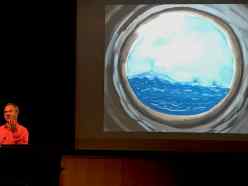
Looking through a whale's eye

Looking through a whale’s eye

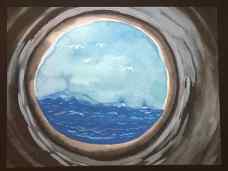
Scott started by explaining the picture on the screen beside him. It’s from a story about a Noongar man entering a whale. He chose it because it represents the idea of seeing things differently. (You could tell he’s a novelist by the way he framed his lecture around imagery to convey his ideas!) For example, is this a porthole? Or are we looking through an eye, or even with the eye, this latter suggesting that the Noongar man has become the whale, has been transformed. This possibility of transformation was the underlying theme of his lecture.

Before he continued though, Scott offered some provisos. He likes, he said, to be particular, to start with the local (which approach also appeals to me). However, he is often criticised, he confided, for being somewhat diffident, hesitant, by which I understood him to mean for not being out there on the political hustings. He’s hesitant, he said for a few reasons:

  • the project – a small community-based language revitalisation project – is insecure. Funding and resources are uncertain, people with the needed knowledge are passing away, and the project is not connected to any institutional infrastructure.
  • it is a regional, provincial activity that may not be relevant elsewhere, although he suspects it is, because the reality is that some of most substantial renaissance work has originated in regional projects.
  • the project produces books – which give status, provide focus, can be used by schools – but books can be accessed widely, which could result in non-Aboriginal people learning the language before its owners do. This would continue the disempowerment the project aims to overturn.

Outside the circle

And here, Scott the novelist turned to again to metaphor. He quoted Governor Phillip who, having been welcomed into Port Jackson by the local people, found their curiosity problematic. He wrote:

‘As their curiosity made them very troublesome when we were preparing our Dinner, I made a circle round us; there was little difficulty in making them understand that they were not to come within it, and they then sat down very quiet.’

Scott used this circle motif as a metaphor for the ongoing exclusion of indigenous people by the settlers. The circle marked a power relationship, an exclusion, that became a defining feature of Aboriginal people’s identity. And yet, he said, researchers like Bill Gammage (The biggest estate on earth) and Tony Swain (A place for strangers) are starting to identify what lay outside this circle – knowledge and skills, an active not passive relationship with the land – that the settlers could have learnt from. This knowledge is still outside the circle, he said.

Noongar language (Daisy Bates)

Noongar language (recorded by Daisy Bates)

He provided specific examples – many of which he used, in fact, in That deadman dance – of the Noongar’s documented sophisticated, positive response to the first settlers in Western Australia. But still, they were kept outside the circle. He shared, as an example of the Noongar’s open-minded, lively response, a Noongar story recorded by Daisy Bates, which incorporated the name of the new colony’s town, King George Town, into their language.

Changing this circle is, he said, vital to healing. He believes that through projects like his, together with the research of people like Gammage and Swain, things are beginning to change, that Aboriginal culture is starting to be recognised, appreciated, rather than denigrated.

Wirlomin Noongar Language and Stories Project

And so he got to the Wirlomin Noongar Language and Stories Project, a local language revitalisation project that is occurring outside the circle. His argument is that over time, since first contact, Governor Phillip’s original circle expanded, and the world outside it became increasingly impoverished. The Wirlomin language project believes that by recovering language, and the stories that go with it, the circle can be changed.

Proven benefits to social and personal wellbeing emanating from strong attachment to Indigenous cultural traditions. (Kral and Falk 2004, Anderson and Kowal 2012, and others).

He described the project – what it uses, what it produces, and how the knowledge is shared. I won’t detail that here, as you can learn much of it at the website. But I will share his teasing out decisions made, and their political implications. For example, when Kayang (Hazel) Brown took people to a special place in country, told its stories, and then re-covered the marks, her aim was not to practise the same attitude of exclusion, but to establish a protocol of respectful, negotiated relationships for sharing knowledge.

Another example concerned an event the group was organising to present books in language that they’d produced. He said that his view, “as the sophisticated man in the group” was to only invite Noongar, but Aunty Hazel (Kayang Brown) said they should invite some of the local non-Aboriginal people. Scott questioned why, given these people had controlled and spoiled their land, but Kayang responded, regarding one particular person, that “we grew up with him”. So he was invited, was given a copy of the stories, and responded positively, and emotionally. Scott learnt, through this experience, the paradox of empowerment through giving, and what can be achieved by moving into the circle.

All these, he concluded, open up possibilities of healing and transformation, with giving and sharing being the major denominations in the currency of identity and belonging.

This was a wonderful lecture, given by a man who emanated dignity, humility and grace. It was deceptively simple, but the thinking behind it was generous and sophisticated. You had to be there!

Ray Mathew Lecture
National Library of Australia
21 September 2017

* The Ray Mathew Lecture was established in 2009, through The Ray Mathew and Eva Kollsman Trust, created by Eva Kollsman to support and promote Australian writing. The lecture is named for the Australian poet and playwright, Ray Mathew (1929–2002), who left Australia in the late 1960s, and never returned. He spent most of the remainder of his life living in the New York apartment of his patrons, Eva and Paul Kollsman.

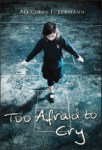
Ali Cobby Eckermann, Too afraid to cry (#BookReview)

ANZ Lit Lovers Indigenous Literature Week bannerHaving reviewed Yankunytjatjara/Kokatha woman Ali Cobby Eckermann’s poetry collection, Inside my mother (my review) for Lisa’s ANZlitLovers Indigenous Literature Week, 2017, I decided to also read her 2012 memoir, Too afraid to cry. It filled in a lot of gaps, which is not necessary to appreciate or comprehend the poetry but which does deepen the understanding.

The memoir’s dedication starts with the lines:

this is a poetic memoir
a story of healing
not burdened by blame

And that is pretty well what it is. It’s not an angry book, so much as a sorrowful one. Sorrow about the abuses and losses that affected her childhood and early adulthood, in particular. The sorrow starts early, when she’s young, and abused. She writes of her uncle rubbing her leg inappropriately, and progressing to assault, though she doesn’t say that because she’s only 7 years old. However, while she may not have the language to analyse what was happening to her, she does have the language to describe the feelings:

I felt the icy wind inside my head begin to blow. I could not move. The icy wind is very dangerous.

This “icy wind” becomes a metaphor throughout the book for the abuse, for her memory of it, and for its impact on her psyche until she can no longer cry – “the ice block had turned to stone, and now there was no moisture left inside me”. Hence the title of the memoir.

So, to summarise the book before I delve any further, Too afraid to cry is the story of a young indigenous baby adopted by a non-indigenous family. It’s a good loving family, with parents who, unable to have children, adopted four – two from the mission – and fostered another. But this family, as loving as it is, is a deeply religious one which does not understand the pain experienced by children from a different culture to its own. The result is that Eckermann is left to contend with racism and abuse that she, too, does not initially understand. Here, for example, is a schoolyard experience:

[I] didn’t notice that they had begun to form a circle around me, but I did notice that the icy wind was blowing inside my head and was starting to freeze my guts. Someone held me while other hands pulled my underpants down. There was a strange noise in my ears, like a faraway scream, but I could still hear the sounds of those doing the laughing and teasing. They said they wanted to know if I was the same as other girls. Someone laughed, saying they didn’t know if ‘boongs’ were different. I was frozen with the icy wind roaring through my body. I didn’t want to know what a ‘boong’ was.

Note the “icy wind” again. As childhood turns to adolescence, Eckermann, who had been an excellent student, begins to withdraw from her family and turns instead to alcohol and drugs to cope with the pain and sense of disconnect. It’s not a surprising story, but it’s a useful one for those who don’t understand what disconnection from one’s own culture can do, particularly in a society where difference is not tolerated. Eckermann learns much later, apparently, of the ridicule her adoptive mother had faced for having aboriginal children.

Anyhow, gradually, after many experiences, painful ones, risky ones and some more positive, Eckermann finds her way to her own culture, and healing begins:

Slowly the stone inside me turned to ice and then the ice began to melt. I felt real tears on my face for the first time in my adult life.

What’s remarkable about the memoir – something you may have guessed from what I’ve written – is her ability to get into her head at the time, to write from the point of view of the age and person she was when the things she describes happened, rather writing them as memory that she is now reflecting and commenting on. Of course the telling of the experience, the choosing of which experiences to tell, is a form of commentary, but I’m sure you get my point.

The memoir is remarkable for other reasons too. It’s told in 92 short anecdotal chapters, which are divided into four parts. The style is spare, with short, simple sentences. This is a book which shows rather than tells. Much of the commentary is conveyed through poems inserted between some of the chapters, such as “Heroin” between Chapters 45 and 46. It’s a short poem, like most of hers, and uses repetition and powerful wordplay on the word “arms”, to invoke prostitution, loving and heroin. The last stanza reads:

in their arms
they survive
a modern world.

Some of the poems appear again – the same or sometimes changed* – in Inside my mother.

Another aspect of the memoir, which adds to its sense of almost mythic universality, though is probably also done to protect individuals, is her minimal use of actual names. Her siblings, for example, include Big brother, Foster brother, and some relations are Aunty and Uncle. She does though name her mothers.

Too afraid to cry is an innovative and evocative memoir, which manages to convey hurt and pain, truthfully, but with a generosity that is humbling.

aww2017 badgeAli Cobby Eckermann
Too afraid to cry
Elsternwick: Ilura Press, 2012
224pp.
ISSN: 978-1-921325-29-8 (eBook)

* Changed, I think. I’m writing this in California, and my copy of Inside my mother is back in Australia.

Ali Cobby Eckermann, Inside my mother (#BookReview)

ANZ Lit Lovers Indigenous Literature Week banner

Ali Cobby Eckermann, a Yankunytjatjara/Kokatha woman, has featured a few times on this blog, including in my review of her verse novel, Ruby Moonlight, and my Monday Musings post on her winning the valuable Windham-Campbell Prize this year. She is now appearing again as I review her poetry collection, Inside my mother, for Lisa’s ANZlitLovers Indigenous Literature Week, 2017.

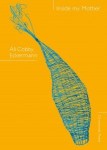
Ali Cobby Eckermann, Inside my mother

Inside my mother is a challenging read, particularly if you are an occasional reader of poetry like I am, but it’s well worth the effort – for the insights it offers, and for the pure pleasure of reading a skilled wordsmith. As the title suggests, the collection’s focus is mothers – and there’s a reason for this, one all too familiar to First Nations Australians. Cobby Eckermann’s family has a history of children being taken from their mothers – her mother was taken from her mother, Cobby Eckermann was taken from hers, and then Cobby Eckermann had to give up her son for adoption. You can hear and feel the pain of these losses in the collection, but you can hear more too, because while these losses frame the collection, Eckermann doesn’t confine herself to them.

The collection is divided into four parts, which build up in intensity until we reach the last part in which the focus is squarely on grandmothers, mothers and children – and the attendant losses.

The poems, though, are not all grim in tone, they vary in form, and they are held together by recurring motifs or ideas, specifically, mothers (of course), sky, earth and birds, all of which make perfect sense given the author, her culture and themes. The first poem is one of a small number of shape poems. Shaped like a bird’s wing, and titled “Bird song”, it references the power of Indigenous spirituality, and ironically comments on how it was so often co-opted by the church. It gets the collection off to a good start. Part 3 starts with another poem about birds, “Tjulpu”. It comprises two-line stanzas, with a separate final last line, and attests to the power of birds for the speaker. “Life is extinct/without bird song”, it starts.

The first First Nations Australian poet I ever read, probably like most Australians around my age, was Oodgeroo Noonuccal (or Kath Walker, as my still loved edition had her). When I started reading Inside my mother, I wasn’t immediately reminded of Noonuccal, but when I got to the devastating poem written in the voice of a woman who drinks too much, “I tell you true”, I immediately thought of Noonuccal’s poems and their effective blend of the personal and the political. The poem is a plea for people to not rush to judge when they see someone “drunk and loud and cursing/Don’t judge too hard ‘cos you don’t know/What sorrows we are nursing”.

This poem looks simple. It uses those traditional rhetorical tools of rhyme and repetition to produce a singsong rhythm which satirically mocks the seriousness of the story it is telling. The effect is mesmerising. The second verse starts:

I can’t stop drinking I tell you true
Since I found my sister dead
She hung herself to stop the rapes
I found her in the shed

Other poems deal with traditional culture (“Vengeance”), political issues (“Hindmarsh Island”, “Kulila”, “Oombulgarri“), love (“Love 22/06/10”), stolen generations (“Severance”, “First born”, “The letter”), to name just a few. The meaning of some of these, particularly those I’ve listed under political issues, depend on knowledge of the politics they reflect. I needed, for example, to look up Oombulgarri.

Some poems are more personal (or, personally political!), such as “Eyes”, to give just one example. “Which eyes will she need today”, the speaker asks? Those of terror, or submission, or of “wonder or contempt”. I won’t tell you which ones she chooses, but they’re appropriate for the overall tone of this collection, reflecting its sorrow and its grit.

And then some, as usually happens with poetry collections, I found a little obscure, although, as I reread many for this review, more of them fell into place. You can’t rush poetry.

While it’s not my favourite poem in the collection, the last poem in Part 1 is appropriate to end on because it addresses the theme of this year’s NAIDOC Week. It’s called “Lament”, and is another poem featuring two-line stanzas, and repetition. Of the six stanzas, three are the same: “I can not stop/must sing my song”. And why can’t he stop? Because he’s the “last speaker/of my mother tongue.” Language. So important.

aww2017 badge

Ali Cobby Eckermann
Inside my mother
Artarmon: Giramondo, 2015
90pp.
ISBN: 9781922146885


Monday musings on Australian literature: Women writers on the outback

After I posted my completion of the AWW Bingo Card yesterday a discussion ensued on Lisa’s ANZLitLovers blog regarding her comment on the dearth of books written by women “set in the outback”. That got me thinking … and it seemed like a good topic to play with in a Monday Musings.

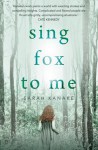
Sarah Kanake, Sing Fox to meThere’s a question to resolve first, that of defining “outback”. What do we mean by it? In my post, I said that I tended to see “the outback” as Australia’s dry remote regions, but for the Bingo I used Sarah Kanake’s Sing fox to me (my review) which is set in a remote mountainous area of Tasmania. Meanwhile, over at Lisa’s blog, a commenter suggested that Lucy Treloar’s Salt Creek is set in the outback (I’ll drop the inverted commas from now on!), to which Lisa replied that she “did think of Salt Creek (because I loved it) but it’s on the coast down on the Coorong, not the outback.”

So, what – or where – is this Outback?

I did some research. Online dictionaries offer broad definitions – “the back country or remote settlements; the bush (usually preceded by the)” (dictionary.com) and “the remote bush country of Australia” (The Free Dictionary). The Advanced English Dictionary, quoted by the Collins Dictionary, has it as “The parts of Australia that are far away from towns are referred to as the outback.”

However, perhaps the best definition for our purposes is that offered by The Oxford Companion to Australian Literature (2nd ed.):

‘Outback’ denotes the remote and sparsely settled inland districts of Australia but does not indicate such extreme remoteness as implied in a similar expression, the ‘Never-Never’.

It goes on to say that the term was used in the latter part of the 19th century, but became more common in the 20th century, so much so that “the original semi-colloquial expression is now an orthodox term”. It also says that while the outback was romanticised, particularly by bush balladists like Banjo Paterson, Henry Lawson “forcibly” presented the other side in his Some popular Australian mistakes where he wishes “that Australian writers would leave off trying to make a paradise out of the Outback Hell”.

I’ve read elsewhere* that the outback is the region “past” the bush. So “past” the bush but not as far as the “Never-Never”! Now, as a librarian, I’m into categorising, but I also recognise that categories need to be loose and flexible. So, I’m going to accept any area that is sparsely populated and that has a challenging or forbidding environment to live in. This means, I’d argue, that mountainous Tasmania could qualify, but that the Coorong is borderline. It’s only 150kms from Adelaide and it is coastal rather than inland (which is where we tend to see the outback), but it does have a rather challenging environment.

Outback literature – past

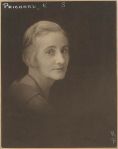
Katharine Susannah Prichard

Prichard, 1927/8 (Courtesy: State Library of NSW, via Wikimedia Commons)

I’m not going to write a deeply researched thesis on this, but write primarily from “the top of my head”. Generally – and I am generalising – much late 19th to early 20th century literature set in the outback tended to be about nationalism, identity and the pioneering spirit. There were novels by women about farmers and pioneers (such as Katharine Susannah Prichard’s The pioneers, my review). Miles Franklin wrote her autobiographical novel, My brilliant career, about a grazier’s daughter who wanted a different life from that being mapped out for her, and then of course there’s the remarkable Barbara Baynton whose short stories in Bush studies (my reviews) certainly didn’t “make paradise” of the outback. Life for her characters, particularly women, was hellish. Baynton and Franklin were realists who didn’t buy into the romance of the bush.

Their realism, and that of some of their peers, was picked up through the middle of the twentieth century by writers like Ruth Park (Swords and crowns and rings, which I’ve reviewed and which is set partly in rural areas before moving to Sydney), Kylie Tennant (The battlers) and Eve Langley’s The pea pickers (my review). But, it’s a huge subject and I really want to get to what inspired this post, contemporary women’s writing about the outback. (The Bingo challenge itself though, I should add, didn’t specify contemporary writing.)

Outback literature – current

In the discussion on Lisa’s post, she suggested that today’s outback novels deal with issues like inheritance and indigenous ownership, to which I added climate change and environmental issues. Before continuing, I should mention that there’s a whole genre of writing that I’m not including here, rural romance, because my focus today is literary fiction.

Alice Robinson, Anchor PointAnd in this area, contemporary women writers have been contributing some provocative books. Gillian Mears’ historical novel, Foal’s bread (my review), is about hard country life, about conservatism and snobbery which refuses to see substance. Jessica White’s contemporary novel Entitlement (my review), on the other hand, explores issues relating farming succession and indigenous connection to land. Cli-fi, fiction about climate change, can be set anywhere, but not surprisingly a subset is set on farms, which is where Alice Robinson’s Anchor point (my review) sits. She also touches on indigenous ownership issues.

And then, of course, there’s Thea Astley who I’d argue is still “contemporary” given she only died in 2004. Most of her books are set in remote places, including her last novel, published in 1999, Drylands (my review). It is set in “a God-forgotten tree-stump of a town” which is “being outmanoeuvred by the weather. As simple as that. Drought. Dying stock.” Drylands moves us into the dystopian vein and brings me to a book which probably wouldn’t immediately be thought of as an outback novel. I’m talking Charlotte Wood’s The natural way of things (my review), which is set in a remote, isolated place that is critical to the way the plot plays out.

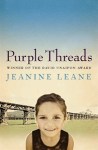
Jeanine Leane's Purple threads

Finally, in this very brief survey, I must mention Indigenous writing. Ali Cobby Eckermann’s Ruby Moonlight (my review) is an historical verse novel exploring early contact between indigenous and non-Indigenous people in remote South Australia. Jeanine Leane’s Purple threads (my review) tells of a mostly-female indigenous family living on a small piece of land in the Gundagai area of New South Wales in the 1950s to 1960s. It explores the experience of being indigenous, being lesser, in a rural community. And Alexis Wright’s Carpentaria (my review) is set in a fictional town called Desperance in northwest Queensland. It depicts conflict between different indigenous groups and with the local multinational mining company, and exposes the psychological, spiritual and physical impact of colonisation on indigenous people.

Note: Bill (Australian Legend) has reminded me in his Bingo post that “the Outback” is a white construct. Mea culpa, he’s right, but I’m going to stick with my paragraph above, because I don’t want to ignore indigenous writing. How hard it is, sometimes, to get out of our own world-view.

So, it’s now very clear to me that women are still writing books set in the outback (by my definition). It’s also clear that the issues they are addressing have moved on – not surprisingly – from those of a century ago.

I’d like to know what you think. Do you accept that these books are “outback” novels? And have they reminded you of other novels by women set in the outback? Now that I’ve started, I could certainly go on …

If you are not Aussie, do you have anything equivalent in your national literature?

* Albeit in Wikipedia, with no citation.

Bruce Pascoe, Dark emu, black seeds: Agriculture or accident? (Review)

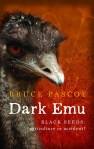
Bruce Pasco, Dark emu

Indigenous author Bruce Pascoe’s Dark emu, black seeds: Agriculture or accident? was my reading group’s October book, and a very interesting read and discussion it turned out to be. It’s not a simple book to discuss and really got us thinking, eliciting a variety of responses, though we all agreed with Pascoe’s basic premise that we Australians need to revise our understanding of, and beliefs about, Australia’s history. How could we not?

Publisher Magabala’s website says Dark emu

argues for a reconsideration of the ‘hunter-gatherer’ tag for pre-colonial Aboriginal Australians and attempts to rebut the colonial myths that have worked to justify dispossession.

Pascoe, they continue, contends that indigenous “systems of food production and land management have been blatantly understated in modern retellings of early Aboriginal history”.

A case to be argued

Dark emu is, then, a book that is determined to argue a case – and herein lies its challenge. In his Introduction, Pascoe sets out his main thesis which is that Aboriginal economy was “much more complicated … than the primitive hunter-gatherer lifestyle we had been told was the simple lot of Australia’s First People”. He asks:

Could it be that the accepted view of Indigenous Australians simply wandering from plant to plant, kangaroo to kangaroo in hapless opportunism was incorrect? (p.12)

Now, there are a couple of things here that disconcerted me. Firstly, emotive language like “hapless” doesn’t help when you want to present a logically argued case. And, anyhow, “hapless” is not a word I would ever apply to hunter-gatherer societies. Being hunter-gatherers doesn’t, to my mind, mean they don’t know their environment and don’t use this sense and knowledge in their hunting and gathering. But secondly, I didn’t comprehend his argument that the early settlers had no legitimate right to seize the land because Aboriginal Australians were practising agriculture:

In denying the existence of the economy they were denying the right of the people their land and fabricating the excuse that is at the heart of Australia’s claim to legitimacy today. (p.17)

Arguing this seemed to me to imply the corollary that if indigenous Australians did not have this economy, if they were indeed simply hunter-gatherers, then taking the land would be legitimate? But surely the fundamental truth is that, regardless of how indigenous people were living and using the land, it was their home and they had a right to be treated as the owners? Being on the path to sedentism, practising agriculture and aquaculture, didn’t, in my mind, make their ownership of the land more legitimate. Did it? I needed to understand this a bit more so, unusually for me, I set off looking for discussions of the book before completing my review, and I found the answer.

It was in a discussion of the book by Amy McQuire at NewMatilda.com. McQuire wanted to know why Australia had “so readily embraced” Dark emu, and whether it meant Australians must now “embrace the issue of sovereignty and treaty”. She quotes Professor of Law Megan Davis (from It’s our country: Indigenous arguments for meaningful constitutional recognition and reform):

“It mattered whether claiming a territory was done by settlement or whether by conquest and cession, because each had differing implications for the reception or not of British law.

“Settlement occurs when the land is desert and uncultivated and it is inhabited by backward people.

“Conquest means that it is a forcible invasion of occupied land and cession means that there is a treaty over occupied land. In the case of conquest, the laws of people conquered apply until the Crown or other foreign power laws apply, and in regard to cession, a treaty is entered into but the Crown or foreign power abrogates it.”

She writes “When lands are cultivated, then they are gained through conquest or they are ceded by a treaty”. And when lands are conquered or ceded, it still has laws of its own.

“Until the Crown asserts sovereignty and actually changes them ‘the ancient laws of the country remain’.”

Ah, so now the penny dropped. It’s all about the “law” (European law, that is), not about “reason” or “logic”. Pascoe makes reference to “Australia’s claim to legitimacy”. He discusses the way colonisers can fabricate history and be reluctant to credit colonised peoples (e.g.. p.61) for their achievements, and in so doing underrate sovereignty. But it didn’t properly click with me. I consequently didn’t see why he was arguing so forcefully for this “new” vision of pre-colonial Aboriginal Australian life. I was reading it more as an interesting, and yes very important, contribution to our understanding of Australian history, and I was seeing it as a way of correcting the historical record, and therefore of restoring the “truth” and, critically, “Aboriginal pride in the past”. But I didn’t fully grasp the import of the distinction he was making (and why, accordingly, the odd emotive word or long bow crept in.)

Convincing the doubters

However, this little niggle didn’t stop my being thoroughly engaged by the book. I loved the way Pascoe interrogates records from the past, particularly the journals of explorers such as Charles Sturt and Thomas Mitchell, to prove that Aboriginal Australians* were developing a sedentary culture based on intensification of agriculture and aquaculture. They managed the land, “manipulating the landscape” to produce crops for harvesting, corral animals for hunting, and trap fish for capturing and spearing. They irrigated, they built wells and dams, they stored food for future use. They built dwellings and lived in village groups. And they had been doing so for thousands, if not tens of thousands, of years making them among the world’s earliest, if not the first, agriculturalists (depending on whose “dating” you believe).

Pascoe, however, doesn’t stop at his argument that they practised agriculture. He also contends that they practised it sustainably, using a variety of techniques, including what archaeologist Rhys Jones called “firestick farming”. He argues that there’s much about Aboriginal practices that we could learn and use today, and that modern Australian agriculture could be more sustainable, particularly in our environmentally-uncertain-climate-changing world, if we focused our efforts on Australian plants and animals.

The depth of Pascoe’s research is mind-boggling, and is perhaps partly explained by his comment in that NewMatilda.com article that academics had criticised his previous writing, which apparently used his own words. He decided “to use an authority that they respected … the explorers and the settlers… you know the ‘heroic’ first settlers.” (Oh dear!) But he also draws on a wealth of other research from anthropologists (like WEH Stanner), archaeologists (like Rhys Jones), historians (like Gill Gammage and Rupert Gerritsen), and others. The book is heavily but not intrusively footnoted (I do like a footnote!), and contains an extensive bibliography.

While I would never have called myself a doubter needing to be convinced, it is true that, for all my interest in the subject, my knowledge of indigenous history and culture was rather out of date. Dark emu should, really, be read by all Australians, and at 156 pages of text, it is not a big ask.

Several of my blogger friends have reviewed this book, including historians Janine (Resident Judge of Port Phillip) and Yvonne (Stumbling Through the Past), as well as teacher-librarian Lisa (ANZLitLovers) and biographer Michelle (Adventures in Biography).

* Terminology, terminology! I note that Pascoe mostly uses the term Aboriginals.

Bruce Pascoe
Dark emu, black seeds: Agriculture or accident?
Broome: Magabala Books, 2014
175pp.
ISBN: 9781922142436

Larissa Behrendt, Under skin, in blood (Review)

ANZLitLovers ILW 2016In my last review – that for Ali Cobby Eckermann’s Ruby Moonlight – I shared the following lines:

Jack knows the remainder of the conversation
before it was spoke ya see any blacks roaming
best ya kill ’em disease spreading pests
(“Visitor”, from Ruby Moonlight)

Quite coincidentally, this point I was making, that it was not “the blacks” who brought disease, turned out to be the subject of my second choice for Lisa’s 2016 Indigenous Literature Week, Larissa Behrendt’s short story, “Under skin, in blood”. I chose it because I wanted to read at least something by Behrendt.

The story is told in first person by an older woman – called Nana Faye by Merindah, the granddaughter she’d raised – and is divided into three parts. The first and third parts are set in the present while the middle part flashes back to Faye’s past as she tells us why she no longer has her husband and son (Merindah’s father).

In the present, Faye (and Merindah) live in Faye’s grandmother’s country, Gadigal land, around Sydney. But Faye spent her married life, the place where Merindah was born, in Baryulgil on the land of the Bunjalung people. Faye’s flashback is inspired by a discussion she has with university student Merindah who is researching the Northern Territory’s Kahlin Compound, a place to which “half-caste children” (members of the Stolen Generations) were taken between 1911 and 1939. It had – and here you’ll start to understand my introductory paragraph – high rates of leprosy. Merindah is researching claims – claims which have indeed been made and researched – that children there were used as guinea pigs for leprosy drugs. Whether or not these claims are true – they may never be fully resolved due to lack of records – the case causes Faye to comment that the most lethal things white settlers brought to Australia were not guns and alcohol but “microbes” which were “flowing through their veins, floating in their blood, under that skin like bark from a ghost gum tree”. Leprosy, in other words, and malaria, small pox, syphilis, influenza. These killed more indigenous people in the first year of white settlement than bullets.

But these microbial-based diseases are not the main focus of Faye’s memories. It’s the mine in Baryulgil, the mine that opened in 1944 and which everyone thought made them lucky. Having lost their land to the pastoralists, but having decided to stay to be close to their country, the people suddenly found they had jobs – but, what were they mining? Asbestos! Faye tells of the tragic impact asbestos had on her husband Henry and son Jack:

… the mine we felt lucky to have, that gave us the benefits of work and kept the community together was slowly but surely killing us.

The scandal is that there was awareness of deleterious health effects of asbestos in the early 20th century, and certainly by the 1960s its relationship to mesothelioma was recognised. Australia’s best known asbestos mine, Wittenoom, was closed in 1966, ostensibly for economic, not safety reasons. It is telling though that Baryulgil was not closed until 1979. Faye says that the official enquiries that came later found

the mine was barely profitable and only continued to operate to prevent permanent unemployment among the Aboriginal workers in the area. Turned out this employment that was supposed to be doing the community a favour was actually a death sentence.

So, Wittenoom was closed more than a decade earlier because it wasn’t profitable, but different decision-making was used for Baryulgil. Now, normally, I’d approve of decision-making that took into account social values but this one is a bit suss.

This is, I have to say, a fairly didactic story. It could almost have been an essay, except that Behrendt has clearly thought, as she in fact says in her interview with Annette Marfording, that telling it as a story, showing the impacts of policy on human beings, would be the more effective way to go. So, while the story imparts a lot of factual information, Faye shares the devastating impact on her of losing her husband and son. She also tells how indigenous cultural practices work to their disadvantage in a white world. She says:

The hardest thing is to trust these people. These people who have the power of life or death over you, and use that power carelessly. These people we are mute to argue against. And our words never seem a match for what they wrote down, even though we have good memories and they make mistakes.

Now, that is probably the most important message in the story.

awwchallenge2016Larissa Behrendt
“Under skin, in blood”
in Overland (203), Winter 2011
Available online

Ali Cobby Eckermann, Ruby Moonlight (Review)

ANZLitLovers ILW 2016Ali Cobby Eckermann has been on my radar for a while, so when Lisa announced her 2016 Indigenous Literature Week, I decided Eckermann’s verse novel Ruby Moonlight would be my first choice. This novel won the poetry prize and the book of the year in the 2013 New South Wales Premier’s Literary Awards.

I enjoy verse novels but don’t read them often enough to build up a comprehensive understanding of the form. Eckermann’s Ruby Moonlight is the shortest and sparest of those I’ve reviewed on this blog, but its narrative is just as strong. It is set in colonial South Australia – the not-very-poetic subtitle being “a novel of the impact of colonisation in mid-north South Australia around 1880” –  and tells the story of Aboriginal teenage girl, Ruby Moonlight, whose family is massacred by white settlers. The novel reads like a classic three-act drama. It opens with the massacre and Ruby’s lonely wanderings, and then moves into a somewhat idyllic phase when Ruby meets the also lonely “colourless man”, Miner Jack. They become friends and lovers, giving each other the company and warmth they both so desire:

good friendships
blossom
slowly
(from “Friends”)

and

in the moonlight
solace is shared
in this forbidden friendship
( “Solace”)

But it can’t last, of course, not in that place and time, because neither the colonisers nor the Aboriginal lawmen will accept it: “it is the oasis of isolation/that tolerates this union”. Nothing else.

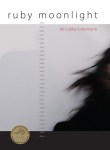
Ali Cobby Eckermann, Ruby MoonlightThe poetry, as you can see from my excerpts, is spare. There’s no punctuation, not even apostrophes, and no capitalisation except for proper names. Lines are generally short, and description is generally minimal. There’s a lovely but restrained used of repetition, and the rhythm is matter-of-fact, that is, it moves the story along with few flourishes (if that makes sense). The story is told through separately titled poems, each of which occupies its own page, though some only part of it. The titles are simple and to the point – “Ambush”, “Friends”, “Oasis”, “Hate”, “Cursed”, “Sunset”. You could almost track the trajectory of the story through its titles. This spareness, I think, enhances the emotional power. The poems say what they need to say without embellishment.

The excerpts above are from more narrative-focused poems, but there are also poems which provide context, describing the seasons as time passes, commenting on the landscape within which our characters operate, providing a sense of the country’s spirits watching, tending, ready to act. The novel opens on the poem “Nature” which sets the scene perfectly by conveying the opposing faces of nature – “sometimes/turning to/butterfly” or sometimes just to “dust” – which also subtly heralds the coming massacre. And, a few poems in, soon after the massacre, comes one describing nature’s nurturing of Ruby:

chirping red-browed finches lead to water
ringneck parrots place berries in her path
trust nature
(“Birds)

The words “trust nature” are repeated at the end of each couplet in this poem, providing a soothing mantra for Ruby.

Most of the poems are presented in couplets or triplets, but occasionally one uses a different structure, usually to mark a dramatic change. Early in the novel is the devastating, shaped-poem, “Ambush”, in which all lines but one comprise single words (“hack/hack/hack” it starts); and half-way through is another shaped-poem, “Tempo”, which marks both the passing of time and acts as a transition from a short time of idyll for Ruby and Jack to the appearance of others:

Jack knows the remainder of the conversation
before it was spoke ya see any blacks roaming
best ya kill ’em disease spreading pests
(“Visitor”, immediately after “Tempo”)

The irony of it! Who brought disease?

So, Ruby and Jack. One of the delights of the book is the sympathetic representation of these two characters. Bereft after the loss of her family, Ruby stumbles across Jack, a loner who scrapes a living out of fur-trapping. Both are outcasts in colonial Australia, Jack an Irishman, a hated “Mick” (“a music-less man stands aloof at the bar/scowling his hatred for the Micks”, from “Loose”) and of course Ruby, a lubra or black woman. These two cautiously find a “small trust … growing” (“Solace”) between them, but it is a “forbidden friendship”, forbidden from both cultures, so their times together are snatched carefully. Ruby is watched by members of another mob, people who are “slowed by fatigue” and “weary with worry” (“Signs”), and who know the dangers:

camp smoke whispers
tell story of the killings
(“Whispers)

Jack and Ruby become the target of the aforementioned “music-less man” – a man who’d lost his “music heart” after an act of barbarity – and his hired help, two brothers “with rotten teeth smirks” (“Scheme”). Hatred and greed fuel these men. And so the scene is set, but it doesn’t quite play out the way you expect, because Eckermann wants to focus more on our universal need for warmth, love and companionship, and also on survival.

The novel is imbued with indigenous presence, from the opening where Ruby’s family live in “Harmony” in their environment, through her meeting with the other mob, the Cloud people, “on their winter trek”, to the appearance of “Kuman”, her guardian spirit who guides her to safety.

Ruby Moonlight is a special read that adds another perspective and voice to colonial contact narratives, a voice that pays respect to indigenous law and traditions, addresses the politics of contact, but also recognises our personal and universal need for love and companionship. It’s a warm and generous book, but it doesn’t pull punches either. A good read.

awwchallenge2016Ali Cobby Eckermann
Ruby Moonlight
Broome: Magabala Books, 2012 (2015 reprint)
74pp.
ISBN: 9781921248511

Monday musings on Australian literature: Spotlight on Larissa Behrendt

Courtesy: Annette Marfording

Courtesy: Annette Marfording

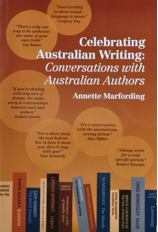
This is the fourth in my occasional series of Spotlight posts inspired by Annette Marfording’s Celebrating Australian Writing: Conversations with Australian Authors, and this time I’m featuring an indigenous author to coincide with Lisa’s (ANZLitLovers) Indigenous Literature Week.

Larissa Behrendt is the perfect subject for what is also NAIDOC Week, not only because she has a few books under her belt, but also because her new book published earlier this year, Finding Eliza, explores how colonisers have written about indigenous people. Behrendt is a Eualeyai/Kamillaroi woman, and in her interview with Marfording describes herself as a Type A person. Looking at what she has achieved in her less that 50 years I can well believe it. She is currently Professor of Indigenous Research and Director of Research at the Jumbunna Indigenous House of Learning at the University of Technology, Sydney. She has won awards for her fiction, and been on the boards of various arts organisations including the Sydney Writers Festival, Bangarra Dance Theatre and the Museum of Contemporary Art. She was the National NAIDOC Person of the Year in 2009 and NSW’s Australian of the Year in 2011. As a lawyer, she has served on many boards, review committees and land councils, most of them indigenous-related. The list is impressive.

Marfording’s interview occurred in August 2010. As she does with each of her interviews, Marfording commences with a brief biography of her subject at the time of the interview, and follows the interview with a biography update to the time of publication. It’s nicely done.

I particularly loved this interview not only because Marfording asks, as she does in all the interviews, thoughtful, relevant questions showing her understanding of the subject, but because in this interview she covers some issues of particular interest to me. More on that anon.

Marfording asked Behrendt, as she tends to ask all award-winners, what winning awards means to her. Behrendt admits that it is affirming to win an award but also says that the richest prize is when a reader tells her that a book “touched” them or that it’s “like me and I never see myself in a book”.

Some of the questions Marfording asked relate to the autobiographical nature of her work, as her two novels, Home (2004) and Legacy (2009), both draw strongly on her family, with Home looking particularly at the stolen generation issue and Legacy being more specifically about her father and her relationship with him. She said that although Home was heavily fictionalised, her father found it hard to read. “It was flattering to me as a writer,” she said, “because it meant I’d got it right.”

Marfording also questioned Behrendt about the fact that her two novels also tend to be issue-based. As a fiction reader, I loved Behrendt’s response. She said that, as a lawyer, she has advocated and written factual pieces on many of the same issues, but that

telling a story that actually explains how a policy can impact on somebody’s life so personally, telling that story from a really human point of view, can influence more people than the most eloquent legal argument, especially when you can talk to somebody through the universals that they understand, like the love between siblings, the love between parents, etc.

I love this reference to universals – to the things that bring us all together. She mentions them again later in the interview, but here I want to share her gorgeous language. She said:

I’ve got very strong opinions, and I think it was a real learning process to learn that sometimes it’s through the whisper of a story that you can influence people more than through the louder, shouting style of activism.

There were other questions too, but I want to conclude on two that focused on her as an indigenous writer, one on labelling, and the other on the issue of non-indigenous people writing about indigenous people (which, as you know, I’ve raised here a few times).

Regarding labelling, Behrendt described it as a complex question. While she has no problem being identified as an indigenous writer, she said it can become problematical when writers are pigeonholed. For example, at the Byron Bay Writers Festival she was invited on a panel discussing “fathers”, a panel that recognised the diversity of perspectives, but in many festivals indigenous writers are lumped together on a panel about indigenous writing. She said that:

What we like to say is that within our writing – and I think that’s true of every Aboriginal author – there are universal themes about family, about love, about betrayal, about hurt, about anger and jealousy, and these are the things that actually unite us.

It’s a problem, in other words, when indigenous authors are seen to be writing only about indigenous subjects. Love it. The comment reminded me of Ellen van Neerven’s Heat and light (my review) in which some of the stories didn’t focus on or clarify race or ethnicity of the characters. They were just about people. For Behrendt, any story – whether the focus is an indigenous issue or not – is, essentially, about universals.

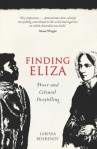
Larissa Behrendt, Finding ElizaAnd finally, that issue about non-indigenous writers writing on indigenous people. Again Behrendt is thoughtful rather than dogmatic. She says she’s always interested in how non-indigenous people portray indigenous people – hence, obviously, Finding Eliza – but that it’s difficult for them to do it authentically because they don’t know enough about Aboriginal life and culture. The reverse is a little different because Aboriginal people are “so bombarded with the dominant culture”. She identifies some writers who have not done it well – albeit she respects their hearts – and then names some who have impressed her. Kate Grenville in The secret river is one. Grenville, she says, doesn’t try an Aboriginal point of view. Instead

through using her non-indigenous characters, by showing their ignorance, their violence, their sense of entitlement, their fear, she tells a very strong story about Aboriginal experience. You read her book and you know exactly what it was like for Aboriginal people.

Grenville talks in Searching for The secret river about the issue of presenting the indigenous perspective. It was something she thought carefully about. Nice to see she’s been vindicated, in the eyes of Behrendt anyhow. The other effective portrayal she offers is Liam Davison’s The white woman. (Davison was tragically killed in the MH-17 disaster, and Lisa reviewed The white woman, as well as his other novels, as a tribute to him.) Behrendt says that Davison tells the story of massacres in Gippsland but relates

the story from the perspective of somebody who goes out as part of those hunting parties, and by getting into the psyche of the kind of person that can actually commit the most brutal aspects of a colonisation of a land, he tells a very strong story about Aboriginal people.

So, while she doesn’t see it as a no-go zone for non-indigenous writers, she does believe that the level of ignorance makes it a difficult challenge.

Another great interview with a writer who’s been in my list of must-reads for a long time. I’ll be starting soon with a short story. Watch this space.

Previous Spotlight posts:

Annette Marfording
Celebrating Australian Writing: Conversations with Australian Authors
Self published, 2015
273pp.
ISBN: 9781329142473

Note: All profits from the sale go to the Indigenous Literacy Foundation. To find out where you can purchase this book, please check Marfording’s website.


Monday musings on Australian literature: Recent books by Indigenous Australians

Next week, from 3rd to 10th of July, Lisa at ANZLitlovers is running her now annual Indigenous Literature Week. While she usually holds it during or near Australia’s NAIDOC Week in order to support that program’s goal of increasing awareness and understanding of indigenous Australian culture, she does in fact accept reviews of works by any indigenous authors worldwide. In other words, you don’t have to be or read Australian to join in, so if you’d like to raise awareness of an indigenous culture near (or not so near) you, do head over to her blog (link above) and make your contribution.

Lisa has included links to lists of indigenous Australian books, including her own, to get people started, so I’m not going to repeat that. But, for my own benefit as well as to support Lisa’s week, I thought I’d suss out and share some works – across genres and forms – that have been published in the last 12 months or so. It’s a serendipitous list:

  • Tony Birch, Ghost riverLarissa Behrendt’s Finding Eliza: Power and colonial storytelling (UQP, 2016): historical analysis of how indigenous people – in Australia and elsewhere – have been portrayed in stories by the colonisers.
  • Tony Birch’s Ghost river (UQP, 2015) (my review): novel set in working class Melbourne in 1960s; long-listed for the 2016 Miles Franklin Award.
  • Ali Cobby Eckermann’s Inside my mother (Giramondo, 2015): poetry collection.
  • Lizzie Marrkilyi Ellis‘ Pictures from my memory: My story as a Ngaatjatjarra woman (Aboriginal Studies Press, 2016). (Yvonne’s Stumbling through the past review): memoir by a Central Australian woman.
  • Stan Grant’s Talking to my country (Lisa’s ANZlitLovers review): memoir, exploring the complicated experience of growing up black in a white dominated world.
  • Ambelin Kwaymullina’s The foretelling of Georgie Spider (Walker Books, 2015): the last in her Young Adult fantasy series, the Tribe trilogy, set in a post-apocalyptic world in which Aboriginal culture and philosophy play a significant role.
  • Marie Munkara’s Of ashes and rivers that flow to the sea (Vintage, 2016): memoir about her search for her origins. (I read her David Unaipon award-winning Every secret thing, and loved her voice)
  • Lesley and Tammy Williams’ Not just black and white (UQP, 2015) (Lisa’s ANZLitLovers review): won the David Unaipon Award in 2014

I decided to focus just on 2015 to 2016, but in my research I included the new biennial Indigenous Writers Prize in the New South Wales Premier’s Literary Awards, and found that the 2016 joint winners were books published in 2014, so I’m including them too:

  • Bruce Pascoe’s Dark Emu (Magabala Books, 2014) (Lisa’s ANZLitLovers review): analyses pre-colonial indigenous Australian culture suggesting that it was more “settled” than the common “hunter-gatherer” assumption. (I’ll be reading this with my reading group later this year.)
  • Ellen van Neerven’s Heat and light (UQP, 2014) (my review): collection of stories, some connected, some not, and including a longform speculative story, about living as an indigenous person in contemporary Australia.

But what am I hoping to read? First up, an older book, Ali Cobby Eckermann’s Ruby Moonlight, followed by, if I have time, a newer one, Stan Grant’s Talking to my country.

Do you make a point of reading indigenous literature? And do you have favourites?