TS Eliot’s The waste land, app-style

TS Eliot plaque SOAS London

Would Eliot have liked this new way of publishing? (Image, via Wikipedia, released into Public Domain by Man vyi)

Hands up if you’ve seen Touchpress‘s gorgeous iPad app for TS Eliot‘s poem The wasteland? Now, if your hand is up, why didn’t you tell me about it? Luckily, though, I have a real-life, dinky-di librarian friend who told me what my online friends didn’t!

This is not going to be a proper review as I only downloaded it yesterday, but it’s worth sharing sooner rather than later. At least , I think it is, because it’s a great example of how technology can enhance our reading experience, particularly of complex texts. The app comprises the following menu items:

  • Poem (the full text)
  • Performance (a filmed performance of the full poem by Fiona Shaw. You can watch the performance on its own, or with the text synced to it!)
  • Manuscript (facsimile of the original typed manuscript showing Eliot’s handwritten edits)
  • Perspectives (commentary on the poem and Eliot, by various people including Seamus Heaney and Jeanette Winterson)
  • Readings (several audio renditions of the poem, including two by Eliot himself, and others by Alec Guinness, Ted Hughes and Viggo Mortenson)
  • Notes (annotations and references explaining the poem)
  • Gallery (images relating to the poem).

There is a Home icon so you can quickly return to the menu screen to navigate around the app. And there are also well thought through navigations on other screens. For example, on the screen containing the straight text of the poem are icons linking directly to the annotations (Notes) and the list of audio versions (Readings).

I feel like the proverbial child in a lolly shop. Where do I start? Do I simply read the poem? Probably not, since if that’s all I wanted to do I’d have taken my lovely old Collected Works down from my bookshelf. So, what do I do? Do I read it with the annotations? Or listen to TS Eliot read it or watch Fiona Shaw perform it? Or do I play around with the edited manuscript facsimiles? Whatever I do, though, I’ll be in good company. The app – for a rather challenging poem, remember – was one of the topselling apps the week it was released and was named “app of the week” in the US.

I read, much of the night, and go south in the winter
(line 18, The waste land)

It will take many nights to read, watch and absorb this terrific production, but it’s winter here so I’m starting now…

TS Eliot
The waste land
iPad app (AUD16.99) 
Touch Press and Faber and Faber, 2011
951mb

Margaret Mendelawitz, Charles Dickens’ Australia: Selected essays from Household Words 1850-1859

It was not to be a high-brow intellectual periodical. Above all he wanted to reach and entertain the masses and, at the same time, help shape discussion and debate on the important social questions of the time. (from Introduction, by Margaret Mendelawitz)

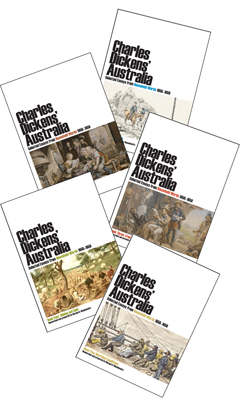
Five covers for the Charles Dickens' Australia set

Set book covers (Courtesy: Sydney University Press)

Charles Dickens‘ Australia is a set of five volumes containing essays, stories and poems relating to Australia from the magazine, Household Words, that Dickens established and editedThe magazine was published from 1850 to 1859 which, as Margaret Mendelawitz says in her introduction, was an “extraordinary decade in Australian and British history”. The discovery of gold in Australia (and California) transformed the world. Social justice was becoming a serious issue for debate and action. And it was when “the age of capital” really began.

So, it is rather fortunate that a writer of Dickens’ calibre produced a magazine in this period – and that he was sufficiently interested in Australia (as I described in a post last year) to actively seek and commission articles about life and social conditions here for his magazine. As you might expect, the magazine is available online (in gorgeous facsimile and for electronic downloading) but the value of these five volumes is that they have been carefully researched by Mendelawitz and contain the articles specifically relating to Australia. According to the Sydney University Press website, of the 3000 articles published in the magazine over its lifetime, only 100 dealt with Australia in some way. Unless you like the fun of the chase, these volumes are an excellent way to get to the Australian content without having to do the searching and sifting yourself.

This isn’t the only reason though for reading the articles via this set. It is a beautifully conceived anthology. Firstly, the articles have been thematically organised into five manageable volumes:

  1. Convict Stories
  2. Immigration
  3. Frontier Stories
  4. Mining and Gold
  5. Maritime Conditions

And there’s more. Each article  starts with a small panel containing a brief description of its content, its publication details (the volume and issue numbers, pagination, and date) and the amount paid for it! The articles are footnoted, with those original to the article clearly identified as such. Curiously, the editorial additions – the introduction, etc – are referenced differently, with the notes placed at the end of each piece rather than in footnotes. The additions are: a foreword by Geoffrey Blainey; an introduction by Mendelawitz; a list of contributors providing a brief, targeted biography and a list of their articles included in the set; and, a short but appropriate bibliography. These are all repeated in each volume, presumably so the volumes can stand alone.

I was initially perturbed that the article authors are not named in the table of contents, but then I read the introduction which tells us that “regardless of their source, all articles appeared anonymously”. Mendelawitz has followed that practice in her table of contents, but has identified the author/s on the articles themselves, providing another reason for reading this set because knowing the authors and their backgrounds adds a further dimension to the reading.

Mendelawitz covers a lot of ground in her introduction. She talks a little about Dickens himself and about the history of Household Words, she describes the era in which it was written, and she discusses the writers, the content and the “house” style. I found these last two particularly interesting. The articles, as I’ve said, were published anonymously. They were also carefully edited to meet what Elizabeth Gaskell called a “Dickensy style”. This meant they had to be bright, regardless of how dry the subject, and would characteristically start with a snappy, provocative paragraph. It also meant that those that did not accord with Dickens’ views were rewritten. I can’t help thinking that, if slavishly enforced, this adherence to a set style could result in the articles feeling formulaic. It’s something I’ll check out as I read the volumes in depth.

The final point I’d like to make in this overview concerns the issue of fact versus fiction. Mendelawitz argues that the articles are “literature, not history”. They are valuable, she says, for the insight they provide into 19th century Australia but this “does not depend on them being the literal truth”. She writes:

As a collection they demonstrate the complementary nature of storytelling between the writing of history and fiction. The stories in Household Words frequently draw a fine line between fact and fiction, giving voice to characters and events that could easily go unrecognised and unrecorded. In many ways they exemplify the fundamental problem  encountered by historians through the ages of how to separate and present fact, fiction, myth and truth.

Regular readers of this blog know that this issue interests me. I expect to come back to it when I review the first volume in the near future … from what I’ve read so far, I think I’m in for a fascinating ride.

Margaret Mendelawitz
Charles Dickens’ Australia: Selected essays from Household Words 1850-1858
5 volumes
Sydney: Sydney University Press, 2011

(Review copies courtesy Sydney University Press)

Jay Griffiths, A love letter from a stray moon

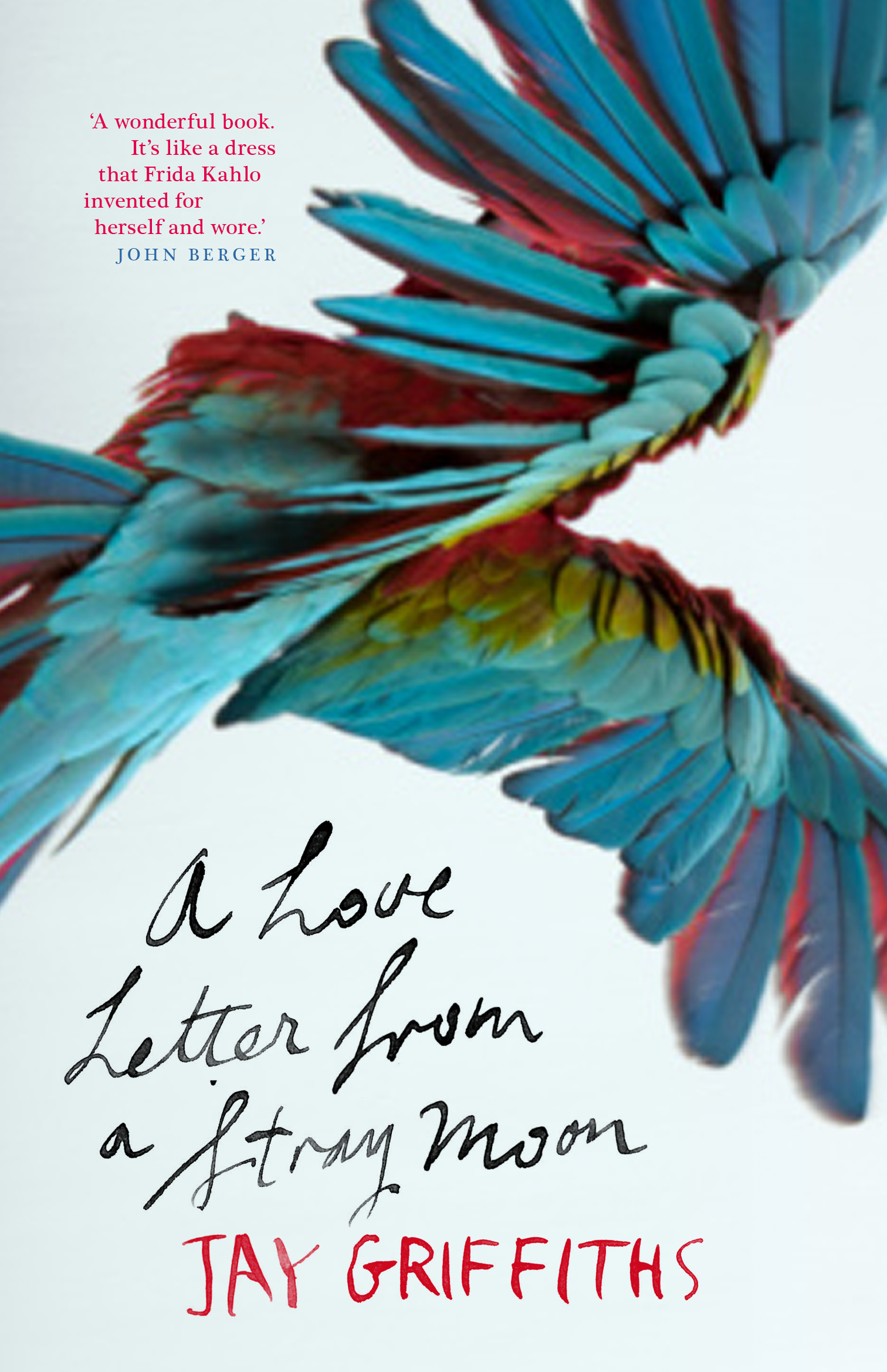
Jay Griffiths, A love letter from a stray moon cover

Book cover (Courtesy: Text Publishing)

I have always wanted wings. To fly where I belong, to become who I am, to speak my truths winged and moon-swayed.

I’m not sure I can do justice to this poetic, passionate novella by Jay Griffiths. Titled A love letter from a stray moon, it’s a first person outpouring in the voice of Mexican artist Frida Kahlo. I don’t use the term “outpouring” pejoratively, but rather to describe the full-on passion with which it is told. This is a book with confronts the senses with its power – the imagery is strong but beautiful, the story raw and honest (or so it seems to me.) It’s a book you want to describe as a “tour-de-force” but that would be too clichéd.

The opening lines of the novel quoted above introduce us to its two main metaphors – wings/flight and the moon. For Frida, flight equates with hope and with magic. The moon, though, is a far more complex image, and I’ll try to tease it out a bit as I go on. First though the story. This is biographical fiction (historical fiction?) in the form of a prose poem, told in the first person voice of Frida. The facts of Kahlo’s life are conveyed – such as the terrible accident when she was 18 which left her unable to bear children; her falling in love with, marriage to and divorce from Diego Rivera; her relationship with Trotsky; and even her death and cremation which requires some suspension of disbelief but that’s not hard to do given the novel’s style and tone. If you didn’t know much about Frida you could, I think, read this piece of fiction and feel you’ve got the basic facts, as well as a good understanding of the woman who “lived” those facts.

Woven through all this is the Mexican Revolution which started in 1910 (three years after she was born), discussions of the rise of Fascism, and her ideas on love, art and life (and particularly on how they interrelate). There are also, though this seems a bit anachronistic, some strong references to climate change. In fact, at the end of the novel, Griffiths dedicates her book to two groups of people, climate change activists and Zapatistas. Frida died in 1954. Was climate change an issue then? In the book Griffiths has Kahlo expressing concern about the Amazon and Tuvalu:

But the  Amazon will die of thirst, she will seize up with drought … One island nation, five atolls and four islands, pacific and named by doves, Tuvalu, is silently submerged as the quiet waters lap its shores, past the fishing boats, up its beaches, up, to the houses at the coastline, on, on, the gentle sea, the sea murmuring in quiet amazement at itself, on, until the centre where it can see itself coming, reflecting its rise, it meets itself in a full circle of embrace and Tuvalu will only be a story of mythic islands beneath the waves.

Let’s though get back to the moon. The motif is sustained throughout the novel. It’s appropriate of course for a woman, with its implications for women’s reproductive cycle, but Kahlo draws so much more from it than this single meaning. She layers meaning upon meaning for the moon, some of them superficially paradoxical but together they form a whole. Throughout the novel, for example, she opposes the ideas of gold, earth, sun and matter to silver, moon, and myth. The moon represents for her the mythical, the immaterial and creativity but it also connotes coldness and barrenness. I did say it was a complex symbol – but it’s fittingly s0 for a complex woman. In the first chapter, “Exiled from Casa Azul” she talks of wanting to fly to the moon, describing it as “pure idea” versus the sun which, more pragmatically, “lights the earth”. In the next (very short) chapter, “The moon’s instructions for loss”, she expands on her idea of the moon a little further:

And the moon? In the revolution of the earth’s turning – and I was a revolutionary – a shard of earth was flung off, coalescing, reforming further and later, far off as the moon. But shard is the wrong word, too hard and substantial; so immaterial was this moment, so unearthly the earth, so unanchored the moon, what word could be better? The moon was more like Idea, more like Metaphor, or Time, Flight, or Potential or Longing. A highly strung intensity of latency.

In the rest of the book, these ideas about the moon are explored, teased, stretched as far as they will go to convey the wild, free essence of her life. In her mind the moon is closely related to the idea of flight. She refers to Icarus (whose downfall of course was the sun), arguing that the important thing was not the fall but that he dared to fly.

In one of many references to flight she says:

… flight’s true reality was never in its being made material. What is real need not be material at all.

Given the challenges of her physical life (polio as a child and a leg amputation late in life in addition to her accident), it’s not surprising that Frida found significance in the life of the mind, the spirit and the soul.  “The mind needs myths, good ones”, she says.

And then there’s art. She was known for her self-portraits, in which she painted her passion and her pain. Her art was an extension of her “self”:

…so I make this as a votive painting, a prayer, a vow, a plea, painting to win him back to me…

Frida was a rebellious soul … whose passions were personal and political. Somehow Griffiths has managed to capture all this in a novel which could so easily have been over-the-top. It isn’t, because her Frida’s voice sounds authentic. Frida says, towards the end, ‘I would re-enchant myself with mankind, nothing less … I will promise to find the god of new beginnings.”

I have not done justice to this wonderful, complicated little book – but I hope I have conveyed something of its magic. After that, it’s up to you.

Jay Griffiths
A love letter from a stray moon
Melbourne: Text Publishing, 2011
117pp.

(Review copy supplied by Text Publishing)

Jane Austen’s letters, 1807-1809

Portrait of Henry IV. Ink and watercolor on pa...

Watercolour by Cassandra, for Austens (juvenile) "History of England" (Presumed public domain, courtesy Wikipedia)

The letters Jane Austen wrote between 1807 and 1809 seem somewhat different to those she wrote later. There are probably a number of reasons for this but one could be that this was an unsettled period for her. Her father died in early 1805 which changed her (and her mother’s and sister’s) life circumstances dramatically. From then until July 1809 they did not have a home of their own. It is interesting that while she had written earlier versions of some of her six completed novels in the late 1700s and early 1800s, none was published until after she, her mother and sister moved to Chawton. This must tell us something, surely, about her state of mind.

The letters, mostly written to her sister Cassandra, are not necessarily easy to read. They are full of pretty straightforward gossip and chat about family and friends. There are myriad names to wade through. (Fortunately Deirdre Le Faye’s edition has an excellent Biographical Index.) If you don’t get bogged down though, you will find some gems, and gain an understanding of life in Georgian and Regency England.

So, what do these letters tell us about her? To make it easy to read, I’ll use headings.

She was a keen, clear-eyed and somewhat acerbic observer of humanity

These letters often make you laugh (though perhaps not so much if you were the subject of some of her comments). Here she is on her oldest brother, James:

I am sorry & angry that his Visits should not give us more pleasure; the company of so good & so clever a Man ought to be gratifying in itself; – but his Chat seems all forced, his Opinions on many points too much copied  from his Wife’s, & his time here is spent  I think in walking about the House & banging the doors, or ringing the Bell for a glass of Water.

And on one Miss Curling:

I wish her no worse than a long & happy abode there [Portsmouth]. Here she wd probably be dull, & I’m sure she wd be troublesome.

And on Lady Sondes (and her second marriage):

…but I consider everybody as having the right to marry once in their Lives for Love, if they can – & provided she will now leave off having bad headaches & being pathetic, I can allow her, I can wish her to be happy.

Austen, it is believed, had a somewhat tricky relationship with her mother. She mentions her mother often in the letters, mostly with cool description rather than warmth, and sometimes rather more pointedly:

My mother has been lately adding to her possessions in plate – a whole Tablespoon & a whole dessertspoon, & six whole Teaspoons, which make our sideboard border on the Magnificent. They were mostly the produce of old or useless silver …

She understood the import of money

This period of her life – post her father’s death, and pre-Chawton and the publication of her books – was her most insecure financially. Consequently, money seems to feature more prominently in this section’s letters. On one acquaintance, she says:

She looks remarkably well (legacies are a very wholesome diet) …

And on some particularly rich people:

They live in a handsome style and are rich, and she seemed to like to be rich,  and we gave her to understand that we were far from  being so; she will soon feel therefore that we are not worth her acquaintance.

On the impact of her own impecunious state which meant, for example, that she had to rely on the favours (and therefore schedules) of others when travelling, she writes:

I shall be sorry to pass the door at Seale without calling, but it must be so … till I have a travelling purse of my own, I must submit to such things …

She thought about writing constantly

We know that Jane Austen had a longstanding interest in writing and this is obvious in these earlier letters – from her (sometimes self-deprecating) comments on her letter writing to her brief but pointed comments on the books she was reading. Through her letters we get a sense of what she thinks a good novel should be. For example, she says of  Sarah Harriet Burney‘s Clarentine that

It is full of unnatural conduct & forced difficulties, without striking merit of any kind.

We also see that she is ever conscious of the act of writing. Often she feels she has no news and mentions how this challenges her letter writing ability:

I really have very little to say this week, & do not feel as if I should spread that little into the shew of much. I am inclined for short sentences …

I enjoyed her praise of another letter writer, Mr Deedes, who

certainly has a very pleasing way of winding up a whole, & and speeding Truth into the World.

There are also descriptions and stories which clue us to her writing and story-telling bent. She describes a fire at Southampton, vividly and with a touch of humour. Always there is humour. In another letter, having discovered that her aspiring-writer niece is also reading her letters, she discusses (with humour again) her increasing awareness of her writing:

I begin already to weigh my words & and sentences more than I did, & am looking about for a sentiment, an illustration or a metaphor in every corner of the room. Could my Ideas flow as fast as the rain in the Storecloset, it would be charming. We have been in two or three dreadful states within the last week, from the melting of the snow &c. – & the contest between us & the Closet has now ended in our defeat; I have been obliged to move almost everything out of it, & leave it to splash itself as it likes.

By mid 1809, the family had moved to the “remarkably pretty village” of Chawton, and Austen at last settled down to her writing (but she had only eight more years to live). One of the last letters in this section is to a publisher asking about the non-publication of Susan (later, Northanger Abbey) which she’d sold to them in 1803. She never did see it published. It was bought back by her brother Henry in 1817, and published posthumously… How sad is that?

Note: This is my third post on Austen’s letters. The first looked at her letters from 1814 to 1816, and the second from 1811 to 1813. With this post covering 1807 to 1809, you might be wondering about 1810. Well, there are no letters from 1810. This is probably because they were among those destroyed by family members after her death. Why, we do not really know.

Geoff Dyer, Jeff in Venice, death in Varanasi

Geoff Dyer, Jeff in Venice, death in Varanasi

Bookcover (Courtesy: Text Publishing)

What, a few moments earlier, had seemed such a persuasive notion – that ridiculousness might be the animating principle of life –  seemed, in the face of this more pedestrian idea of progress, abruptly … ridiculous. No sooner had I thought this, than I’d suddenly had enough of walking. (“Death in Varanasi”)

Hmm … what has the “idea of progress” got to do with “the animating principle of life”? Geoff Dyer‘s Jeff in Venice, death in Varanasi, which comprises two loosely connected novellas, is full of non-sequiturs, paradoxes and other confusions – so much so that I’m not quite sure what to make of it, but perhaps by the end of this review, I will!

I wanted to read it because I’d been hearing about it around the traps, and had seen it recommended several times on people’s reading lists. There is, it seems, a vague autobiographical element to this book: Dyer has been to the Venice Biennale and to Varanasi, and he has written journalistic pieces as have the two (or is it one?) narrators the book. But, he went to both with his wife, not as a single man, and he is Geoff not Jeff. Methinks there is some teasing/playing with us going on here!

The first tease relates to the form. Are the two novellas connected by character? Is the third person Jeff in “Geoff in Venice” the same as the first person narrator in “Death in Varanasi”? And there are teases in the subject matter, but let’s talk plot first, such as there is. “Jeff in Venice” describes Jeff’s few days at the Venice Biennale, and particularly his falling in love (or is it lust) with the lovely Laura. There is quite a bit of explicit sex in the story: in other words, the so-called “little death” is well covered. This first story is about art, life and love – and yet encompasses, paradoxically, the idea of “death”. In “Death in Varanasi”, the main character, a freelance journalist who could very well be Jeff, goes to Varanasi for a few days to write a commissioned piece, but decides to stay. One of the first things he does in Varanasi is go to see the cremations by the Ganges. Death is all around, and yet, paradoxically, this is where many westerners turn up to find “enlightenment”, that is, to find the meaning of life. The narrator, himself, gradually drops all vestiges of his former self until, near the end, he has shaven his head and wears a dhoti.

So what is the background premise to these stories? As far as I can tell it is something to do with being in one’s mid-forties and starting to wonder what it’s all about. Jeff Atman, “stuffed with pastry, tense with coffee”, decides to dye his hair because:

For a long time he’d thought of grey hair as a symptom, a synonym of inner dreariness, and had accepted it as inevitable – but that was about to change.

There are a lot of sly little jokes and word-games in the book. When Jeff’s newly dyed hair is about to be revealed, he calls it “the moment of untruth” which, in a sense it is, though it is also his new truth. It’s all a matter of perspective isn’t it? (After all, the hairdresser had quoted Plath – a hairdresser quoting Plath impresses Jeff –  at him by saying “We do [dye] it so it looks real”.) And so the new real Jeff goes to the Venice Biennale, a place characterised as much by “party-anxiety and invite-envy” as it is by exciting new art to discover. This first story is about hedonism, about booze, drugs and sex. It’s a common story in literature – a certain dissipation that follows disillusion, and leads to … well, it seems to me, back to disillusion. See, it’s a tricky  book!

I enjoyed the satirical descriptions of the Biennale, of the art world and, particularly, of the more sycophantic adherents. But, I couldn’t quite believe the relationship with Laura – it felt more like male fantasy than real. Perhaps that’s how it was supposed to come across.

In the second story of the book, the tone becomes a little more meditative, lower key. I expected to meet the beautiful Laura again. After all, she told Jeff in the first story that she planned to go to Varanasi to be a hedge fund manager (of all things!). But, we don’t meet her and, if there’s a reference to her (and I think there is), it’s very obscure and does suggest we are dealing with Jeff again. “Death in Varanasi” starts with:

The thing about destiny is that it can so nearly not happen and, even when it does, rarely looks like what it is.

What happens is that the narrator’s brief stay turns into something longer term. It’s not so much that he makes a definite decision to stay as that he doesn’t decide to leave: “there was nothing to go home for”.

As I said at the beginning, this is a book full of teases and paradoxes. The narrator in Varanasi “invents” the God Ganoona who “is all that which is not anything else. But it’s also that which is everything else”. In a similar vein he talks of being desire-free:

… for the idea of desirelessness to take root, to set off in that direction, to try to free yourself of desire, surely that must manifest itself as a desire, a yearning, an urge. How then does desire transcend itself?

This book demands some mental gymnastics – not hard ones, necessarily, but ones asking you to keep on going without pondering too long or thinking each one is the answer. In a discussion about the book on The First Tuesday Book Club, English author Philip Hensher says that in all his books Geoff Dyer “seems to reinvent the genre, to make the reader think twice about what it is he’s reading … the book is constantly retreating from you” so you have to make up your own mind. And that, in my best Dyeresque way, is where I’ll leave you … it’s worth a look, even if at the end you are not quite sure what you saw!

Geoff Dyer
Jeff in Venice, death in Varanasi
Melbourne: Text Publishing, 2009
296pp.
ISBN: 9781921656897

(Review copy courtesy Text Publishing)

Jane Austen, Sense and sensibility (Vol. 2)

Austen, Sense and sensibility, Ch 36 illustration

From Chapter 36, illus. by CEBrock (Presumed Public Domain, from solitaryelegance.com)

…and because they were fond of reading, she fancied them satirical… (Lady Middleton on the Dashwood sisters, Ch. 36)

In January, I wrote about Volume 1 of Jane Austen’s Sense and sensibility, which my local Jane Austen group is reading volume by volume this 200th anniversary year of its publication. Unfortunately I missed the February meeting and so didn’t take part in the discussion. But, I am still reading it volume by volume. Here are some thoughts on Volume 2 (which comprises Chapters 23 to 36).

In my discussion of Volume 1, I suggested that the “sense” and “sensibility” dichotomy is not as absolute as the title would suggest. However, in Volume 2, Elinor and Marianne are pretty well entrenched in these two opposing positions. Marianne gives full rein to her emotions as the extent of Willoughby’s perfidy becomes clear, while Elinor takes tight control of herself to hide her emotional distress about Edward. Is this a flaw in the novel? Or Austen’s skill in setting up the characters and then, in this central section, using their prime characteristic to further her plot and themes? Let’s see how it pans out in Volume 3.

Also in my discussion of Volume 1, I talked about what I saw as the theme of “judgement” being developed in the book. The word “judgement” does not appear as frequently in this volume, but I think the idea is still there. Elinor is convinced that Marianne and Willoughby have a “secret” engagement because she does not believe Marianne to be so lacking in judgement as to behave the way she does (giving Willoughby a lock of hair, writing to him) without being engaged. And yet, she’s not totally confident in Marianne because she decides to go to London with Marianne and Mrs Jennings

as she did not think it proper that Marianne should be left to the sole guidance of her own judgement…

Is Elinor a bit of prig? Some think so, but I prefer to see her as a wise young person, who needed to be so, given the mother and sister she had. As the volume progresses, we see the failure of judgement in many of the characters, such as Fanny Dashwood who ironically prefers to have the Steele sisters as her guests over her relations, the Dashwoods, and Mrs Jennings whose general kindness makes it hard for her to see through more calculating characters like Lucy Steele.

For all this, though, it is money that drives the plot in this book, that generates its main plot crises, one of which occurs in this volume. Money is behind Willoughby’s callous treatment of Marianne, as Miss Grey has £50,000! Miss Morton has £30,000, and so is being promoted in this volume as a good catch for Edward Ferrars who has only £2,000 of his own (though he is promised more if he marries well. What’s that about money begetting money?) Lucy claims to love Edward for himself, and not his money. Money is the governing principle in the lives of Mrs Ferrars and her daughter, Fanny Dashwood. John Dashwood never appears without money being far behind. Money is a significant factor – particularly regarding women and marriage – in all of Austen’s novels, something she establishes clearly in this, her first one to be published.

One of the delights of this volume is the way characters are so beautifully and consistently delineated. For example, here is how some of the characters respond to the news of Willoughby’s engagement to Miss Grey:

  • Hail-fellow-well-met Sir John Middleton finds the behaviour “unaccountable” from such a bold rider;
  • Cheery but garrulous Mrs Palmer “resolved never to mention his name again, and she should tell everybody she saw, how good-for-nothing he was”;
  • Cold Lady Middleton shows “calm and polite unconcern”; while
  • Kind Colonel Brandon makes “delicate, unobtrusive enquiries”.

Austen’s ability to define character so clearly, using satire, irony or straight description as the character warrants, is one of the things I love about her.

Finally, I just have to share this little bit of “plus ça change”:

Why don’t he, in such a case, sell his horses, let his house, turn off his servants, and make a thorough reform at once? I warrant you, Miss Marianne would have been ready to wait till matters came round. But that won’t do now-a-days; nothing in the way of pleasure can ever be given up by the young men of this age.

What do I hear today about today’s younger generation wanting it all now?

David Mitchell, Earth calling Taylor

Fist full of money

Money, money, money (Courtesy: OCAL from clker.com)

And now for something a little different from novelist David Mitchell, a short story titled “Earth calling Taylor”. You can read it online at FT.com. FT.com is the online version of the Financial Times, so it’s not surprising that Ryan Taylor, the protagonist of the story, works in the finance industry. The story starts with Ryan waiting to hear whether he has received the promotion to portfolio manager that he’s expecting.

The scene then shifts to a hospital, where Ryan joins his mother and step-siblings to visit his father who is recovering from a fall. It seems to be a happy and supportive family – they are sitting around the bed, squabbling with the father, who is clearly “on the mend”, over a game of Scrabble. His brother, Jason, is (“only”, says Ryan) a speech therapist and his sister is a successful lawyer in human rights areas, while Ryan, as we know, works at the more self-centred, self-serving end of the occupation spectrum.

And, he’s edgy, so he leaves them, on a flimsy excuse, to go check for messages on his Blackberry. He’s not a very appealing character – he blatantly and unrepentantly fantasises about a nurse in the lift, he wishes for a little cocaine to settle himself down while swigging some hard liquor from his hip flask, he jumps to the wrong (read, negative) conclusions about people, he throws a tantrum when the expected message doesn’t arrive, and so on.

Running through the main narrative are intonations by his boss Calvin Hathaway on such subjects as “wanting” (in an uber-capitalist meaning of the word) and a little third person, somewhat mock-heroic, tale in which Ryan stars as himself:

The crowd went wild. King Ryan is anointed.

Rather puerile, eh? When he reads his Blackberry messages and, with only one to go, still hasn’t received the hoped-for message, he thinks “suddenly I’m down to my last life”. An appropriate pop culture allusion that mocks his intensity.

Fortunately, our Ryan is not all bad. Set against his comparatively minor concerns are some characters with real miseries in their lives, providing a nice contrast with his petulance over the “will-I-won’t-I” promotion problem. And, he shows that he can in fact evince some empathy for others, such as for an old, sick woman in hospital. “I’ll be her, one day” he thinks, and responds kindly to her. However, when she calls him “a very kind young man”, he thinks that that’s not an “accusation” he hears at his workplace.

The resolution, though formally open-ended, is somewhat predictable and yet, due to the various undercurrents Mitchell has injected into the story, you want to keep thinking after you’ve finished reading. By rounding out Ryan just a little, Mitchell encourages us to feel some sympathy for him at the end, even though we think that his values are rather skewed.

The irony is that the story takes place on New Year’s Eve – but, we wonder, will Ryan make the most of his new start (whatever that turns out to be)?

Jane Austen, Sense and sensibility (Vol. 1)

Ch 22 of Sense and Sensibility, (Jane Austen N...

From Chapter 22, illus. by CE Brock (Presumed Public Domain, via Wikipedia)

This year is the 200th anniversary of the publication of Jane Austen’s first (published) novel, Sense and sensibility. To celebrate this, my local Jane Austen group plans to discuss the novel over the next three months, volume by volume. We tried this last year with Mansfield Park and valued the opportunity it presented to delve a little more deeply into the novel – not only the characters and themes, but the writing and structure. Consequently, in this post I’m going to focus on Volume 1 (chapters 1 to 22) which ends with Lucy Steele’s dramatic announcement to Elinor.

But first, some caveats. I’m going to assume that most readers who come to this post will know the story – and if you don’t, the Wikipedia article provides a good summary. Also I am not going to write a formal review but just share some of the ideas that have struck me during this slow reading*.

I have always liked Sense and sensibility, partly because I’m fascinated by the dichotomy Austen sets up between the two sisters: Elinor (sense) and Marianne (sensibility). And yet, it’s not an easy-to-like novel. The heroines aren’t as sparkly nor the heroes as dashing or heroic as in Austen’s next novel, Pride and prejudice. It feels more serious, less witty – though not as serious as Mansfield Park. This could be because its premise – the sudden drop in wealth for Mrs Dashwood and daughters and their dislocation from their family home, due to the death of their husband/father – mirrors what happened to Jane and her mother and sister after Rev. Austen’s death in 1805. It wasn’t until the family settled in Chawton in 1809 that Austen, to the best of our knowledge, returned seriously to her writing. I wonder if this novel is her working through this very real experience of grief and insecurity. (Interestingly, a very similar story is played out at the beginning of Tracey Chevalier’s Remarkable creatures in which she describes the removal of the Philpot sisters from London to Lyme Regis in 1805).

That’s the historical background to the novel – and forms its social milieu. But there is more to the novel than social history. Austen is a far more complex writer than that. Take, for example, the money issue. There is a lot of focus on money and income in volume 1 – on who has what – indicating Austen’s real awareness of the issue, and yet Mrs Dashwood does not focus on husband hunting for her daughters. In fact, she says:

“I do not believe,” said Mrs. Dashwood, with a good humoured smile, “that Mr. Willoughby will be incommoded by the attempts of either of my daughters towards what you call catching him. It is not an employment to which they have been brought up. Men are very safe with us, let them be ever so rich. …”

This is no Mrs Bennet … but she’s not without her faults either.

And, take the dichotomy issue. It’s actually not quite as clear-cut as the title would suggest. Check the way our two heroines are introduced:

Elinor … possessed a strength of understanding, and coolness of judgment, which qualified her, though only nineteen, to be the counsellor of her mother, and enabled her frequently to counteract, to the advantage of them all, that eagerness of mind in Mrs. Dashwood which must generally have led to imprudence. She had an excellent heart; her disposition was affectionate, and her feelings were strong: but she knew how to govern them: it was a knowledge which her mother had yet to learn, and which one of her sisters had resolved never to be taught.

Marianne’s abilities were, in many respects, quite equal to Elinor’s. She was sensible and clever; but eager in everything; her sorrows, her joys, could have no moderation. She was generous, amiable, interesting: she was everything but prudent. The resemblance between her and her mother was strikingly great.

In other words, Elinor has sense (“coolness of judgment”) but is also emotional (“her feelings were strong”); and Marianne is emotional (“eager in everything … no moderation”) but also has sense (“sensible and clever”).

However, as I read the volume 1, the issue that kept raising its head was that of “judgment”. I’m not sure whether it will continue to do so in the next two volumes, and I need to think about how the judgment issue plays out in other novels, but it does seem that Austen is exploring people’s ability to judge – and most seem to be not very good at it. Sir John Middleton, who praises the Steele sisters, is confident in his judgment, as is Marianne of hers on Willoughby – and we know how those turn out. Meanwhile, Edward, says, Elinor, “distrusts his own judgment” – and he is probably right to (in some matters at least!) Elinor, on the other hand, recognises that she has made errors at times and suggests that you need “time to deliberate and judge”. Related to all this is the fact that Marianne tends to judge people by surface factors, whereas Elinor tries to understand what makes people (such as Edward, Col Brandon, Mr Palmer) behave the way they do. I look forward to seeing whether this idea continues to be specifically explored in volumes 2 and 3.

But let’s move on to Austen’s writing; specifically, her plotting. Until recently, Emma was my least favourite Austen. Then I read it again more attentively and was bowled over by how beautifully it is plotted. I started to notice something similar in Sense and sensibility but will just give one particular example – how Austen uses parallels to create links between the storylines and move the plot along. These parallels, though, aren’t all slavish, aren’t exact. Here are some from volume 1:

  • Willoughby asks for/is given a lock of Marianne’s hair; Edward wears a ring made of Lucy’s hair
  • Willoughby and Edward both leave Barton Cottage in different but less than happy circumstances, and the Dashwoods ascribe this, in both cases, to the influence of strong controlling women – Willoughby’s aunt, and Edward’s mother
  • Elinor states that correspondence between Marianne and Willoughby would convince her of their engagement; later, evidence of correspondence between Lucy and Edward convinces her of their engagement.

And here I shall finish, mainly because I’ve gone on long enough. There is so much more to say, but maybe they will still be relevant in volume 2. Meanwhile, I’d love to know what other Austen readers think …

* Our little nod, perhaps, to the Slow-Reading Movement which I must admit does hold some attractions for me.

Alan Bennett, The uncommon reader

Light with bite is how I would describe Alan Bennett‘s delightful novella The uncommon reader. But, before I explain that further, a quick plot summary for those few who haven’t come across it. It explores what happens when Queen Elizabeth II stumbles across a mobile library on the palace grounds and becomes obsessed with books and reading. Bennett cheekily suggests what the impact might be on her family, staff and the politicians around her when reading becomes not only something she wants to do all the time (instead of her work) but also results in her starting to think and question.

One of the delightful things about the novel is that it can be read on several levels from the straight (a sweet story about the current English Queen discovering the thrill of reading late in her life) through the contemplative (a meditation on readers, reading and the value of literature) to the satirical (an expose of life in the palace, and more broadly of politics and those involved in the political process).

Take for example, reading. The Queen (in the book) says that: “Books are not about passing the time. They’re about other lives. Other worlds.” Fair enough, we all agree with that I’d say. But then there’s this, again from our newly enlightened reading Queen: “Books generally just confirm you in what you have, perhaps unwittingly, decided to do already. You go to a book to have your convictions corroborated. A book as it were closes the book.” Hmmm…Bennett’s Queen is one clever (and scary) lady!

Jokes at the expense of palace officials, politics and politicians abound. Nothing really new here but they are proffered with a light touch. The Queen, now talking about writing her own book, says “To enquire into the evidence for something on which you have already decided is the unacknowledged premise of every public enquiry, surely?” on which the Prime Minister thinks to himself “If this was to be the tone of what the Queen was planning to write there was no telling what she was going to say. ‘I think you would do better just to tell your story, ma’am'”.

This is no sentimental tale, but neither is it completely cynical (though some could see it that way). Sly is perhaps the best word to describe its ability to engage us with the humanity of the characters while skewering them and their (our) world at the same time. However, I won’t go on, except to say that the ironies, word play and allusions evident in the title give a clue to what is inside – and yet it can be read and enjoyed whether or not you pick up all, some or none of them. I’m sure I missed my share. But that’s okay, as I would be more than happy to read it again.

Alan Bennett
The uncommon reader
London: Faber and Faber, 2007
124pp
ISBN: 9781846680496

Note: I originally posted this on my reading group’s site but, since one of my online groups will be discussing this in the next quarter, I decided to post it over here too as a record of my current reading and discussions.

On polishing Jane Austen’s halo

My American friend Peggy who, several years ago, very generously sent me the Pride and Prejudice Game, has now sent me a link to a short interview – with a transcript – conducted on NPR (National Public Radio) with Dr Kathryn Sutherland. Sutherland is the academic who has been researching Austen‘s manuscripts for the last three years and whose quoted-around-the-world comments I discussed briefly in a recent post.

This interview contains statements by Sutherland that are similar to those she made in a BBC interview (in a link provided by blogger Arti in her comment on my previous post). In Peggy’s link, Sutherland says that she has received some negative reactions to her comments. Not surprising, I suppose, given what was clearly out-of-context seantionalist reporting.

Anyhow, this is what she said to the NPR interviewer:

I’ve heard a range of responses. And I have had some very extreme and, I have to say, unpleasant responses to my work. All I can say is that, you know, as critics we should just stop polishing her halo.

There are very few authors that we put in this extraordinary position where we feel that we should never say anything critical about them. She can stand up to it. She’s interesting. She’s experimental. She’s an extraordinary writer. The idea that we can never question what she wrote I think is absolute nonsense.

Can’t say fairer than that …