Graham Greene, Travels with my aunt (Review)

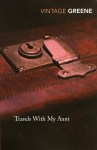
Graham Greene, Travels with my auntEvery year, my reading group aims to do at least one classic – usually something from the nineteenth century – but this year someone suggested Graham Greene. Yes, we all responded, why not? But which one? For reasons I don’t recollect, Travels with my aunt was suggested and given none of us had a burning desire to do another, it was scheduled. This suited me as I hadn’t read it before.

It surprised me a little. I was expecting something lighter because I’d understood that it was  a comedy, a bit of a romp, and it is – but I found layers too. Wikipedia says of Greene’s work, overall, that “he explored the ambivalent moral and political issues of the modern world, often through a Catholic perspective”. Travels with my aunt might be a fun book but this description is relevant to it too – though I’m not an expert on “the Catholic perspective” bit.

Anyhow, let’s start with the plot. It concerns middle-aged retired banker Henry Pulling’s travels in Europe and South America with his septuagenarian Aunt Augusta whom he only gets to properly know after his mother’s funeral. Henry is a bachelor whose hobby is growing dahlias. It’s a quiet, English sort of life. His aunt, though, is a completely different kettle of fish. She appears at her sister’s funeral, whisks Henry off to her flat where she lives with her valet-cum-lover, the black Wordsworth. She tells him that his mother was not his mother, but had married his father and faked pregnancy in order to take on his care when he was born to… Well, of course, we can guess who the birth mother is can’t we? From this point on, she engages Henry in her various travels which, it has to be said, become increasingly morally suspect. When she says that “sometimes I have the awful feeling that I am the only one left anywhere who finds any fun in life”, she’s not joking, but her fun can have a more than questionable edge.

The story is told first person by Henry. I’d call him a naive, rather than an unreliable, narrator – I think there is a subtle difference. This is one of the jokes of the book. We know or suspect things that Henry, in his inexperienced not to mention conservative British way, doesn’t immediately cotton on to. Part of the story’s enjoyment is the tension Greene creates between Henry and his free-wheeling Aunt. This tension provides one of the layers I referred to.

Another layer I’ll tentatively suggest was inspired by discovering that Greene’s full name was Henry Graham Greene. This made me wonder whether there is a little of the autobiographical in the book. There’s certainly not in the literal sense, because Greene, who left his wife and the associated traditional, domestic, settled life, led a peripatetic and adventurous life, one closer to Aunt Augusta’s. But the ending, which I won’t give away, poses some interesting questions when looked at from this perspective.

Other layers relate to various issues Greene refers to or hints at along the way, such as American imperialism, particularly in South America; World War 2 and the actions of collaborators; the impact of the pill (resulting in pregnancy now being the girl’s fault); Catholicism and its role (or not) in personal value systems; and, I think, some critique of “Englishness”.

However, I don’t want to make it sound too serious. The book is a romp. There’s no doubt about that, as we follow Henry and his aunt to Brighton, France, Istanbul via the Orient Express and, eventually, to Paraguay. The activities his aunt engages in, not to mention the stories she tells Henry about her past shenanigans, are funny, outrageous, sometimes farcical, and not always legal. You do have to keep up with a rather large cast of colourful characters, including the young Tooley and her is-he-a-CIA-operative father O’Toole, the Nazi war criminal and love of Augusta’s life Mr Visconti, various policemen and military personnel, and the put-upon Wordsworth who calls Augusta his “bebi gel”.

Greene’s writing is frequently funny. Here is a description of an American tourist having a cuppa in Europe:

One of them was raising a little bag, like a drowned animal, from his cup at the end of a cord. At that distressing sight I felt very far away from England, and it was with a pang that I realized how much I was likely to miss Southwood and dahlias in the company of Aunt Augusta.

Then there’s Aunt Augusta on her plans to fund their trip to Istanbul:

“I hope you don’t plan anything illegal” [says retired banker Henry!]
“I have never planned anything illegal in my life,” Aunt Augusta said. “How could  I plan anything of the kind when I have never read any of the laws and have no idea what they are?”

And there’s this on the is-he-CIA O’Toole:

“Are you in the CIA like Tooley told me?”
“Well … kind of … not exactly,” he said, clinging to his torn rag of deception like a blown-out umbrella in a high wind.

There are also many delightful set-pieces, such as the description of a Christmas lunch for the lonely, and some ridiculous confrontations with various policemen.

This book is too well-known for me to write something more comprehensive, so I’m going to leave it here, and let you tell me what you think.

Meanwhile, I’ll conclude on a quote from early in the book. It’s Henry reflecting on his mother’s life:

Imprisoned by ambitions which she had never realised, my mother had never known freedom. Freedom, I thought, comes only to the successful and in his trade my father was a success. If a client didn’t like my father’s manner or his estimates, he could go elsewhere. My father wouldn’t have cared. Perhaps it is freedom, of speech and conduct, which is really envied by the unsuccessful, not money or even power.

Without going into what he meant by “successful”, I think this notion of freedom – particularly “of conduct”, which is an interesting take – is what’s at the bottom of this book, the freedom to choose how you will live your life. In the end, Henry realises he is free to choose. Whether he makes the “right” or “best” choice is up for discussion, but it’s the freedom that’s the point.

Graham Greene
Travels with my aunt
London: Vintage Books, 1999 (Orig. pub. 1969)
261pp.
ISBN: 9780099282587
Northanger Abbey musings (1)

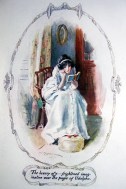
Northerner Abbey illus br Brock

Ch 9, illus. by CE Brock (Presumed Public Domain, solitaryelegance.com)

My Jane Austen group is reading Northanger Abbey – again – because this year is the 200th anniversary of its publication. However, I did write about the novel when we did it in 2015, so what to do? Well, the thing is that every time I read Austen something else pops into my mind to think about – and I’d love to share a couple of them.

Now, my group often does slow reads of the novels, and we are doing Northanger Abbey in two parts: up to Chapter 19, which is just before Catherine leaves Bath; and from Chapter 20 to the end which encompasses her arrival in and departure from Northanger Abbey. My comments in this post relate to the first part.

On heroes and heroines

Northanger Abbey, as you may know, spoofs or parodies Gothic novels, which were popular at the time. One of the clues to the parody is the frequency with which Austen refers to her heroine Catherine’s likeness (or not) to “heroines”. The novel commences:

No one who had ever seen Catherine Morland in her infancy would have supposed her born to be an heroine…

And Austen goes on the describe why Catherine is not heroine material. She’s a simple country girl living in an ordinary family in which nothing dramatic happens. Her father is a “very respectable man” who is “not in the least addicted to locking up his daughters”. There are no lords or baronets in the vicinity to create hero intrigues … and so it goes.

However, it’s not this Gothic spoof that I want to discuss, but the whole concept of hero/heroine. It occurred to me as I was thinking about the heroine thread during this read that when I was a student writing essays I always referred to the protagonists of novels as the “hero” or “heroine”. I don’t do this so much now, preferring something like “main character”. I’m guessing this is part of our post-modern world.

But, this is not what I want to talk about either! My question to myself was where did this concept of “hero” and “heroine” come from, so I did a little digging. And here’s my disclaimer, because it was just a little digging that I did. I discovered a couple of things. One is that the poet-playwright-critic Dryden was the first to use the word “hero” in this way in 1697. The site on which I found this went on to say that “it is still commonly accepted as a synonym for protagonist, even when the protagonist does nothing particularly heroic”. Yes!

Britannica.com told me that:

The appearance of heroes in literature marks a revolution in thought that occurred when poets and their audiences turned their attention away from immortal gods to mortal men, who suffer pain and death, but in defiance of this live gallantly and fully, and create, through their own efforts, a moment’s glory that survives in the memory of their descendants. They are the first human beings in literature …

This must be what Dryden was picking up on – a move from a focus on gods to people and their agency in their own lives. Another site (whose link I didn’t capture) said that:

The Novel was a new genre. Contrary to the epic or the drama, the Novel places the hero at the heart of its reflections. For the first time, we have access to the thoughts and feelings of the hero.

I’d argue that Austen, in presenting Catherine to us as she does, is drawing our attention to a transition from the notion of “hero” (or “heroine”) as someone who “live[s] gallantly and fully, and create[s], through their own efforts, a moment’s glory that survives in the memory of their descendants”, like a Gothic novel hero, to more realistic stories about ordinary human beings that she wrote. This is not to say that ordinary human beings can’t be heroic, but it’s a different sort of heroism, nest-ce pas? This is simplistic, I realise, in terms of analysing the “hero” in literature, but it’s given me something to hang my thinking on to.

On “nice”

In a conversation with hero (!) Henry and his sister Eleanor, Catherine asks Henry “do not you think Udolpho the nicest book in the world?”

Now, if you went to school when I did, you were probably told not to use the word “nice” because it’s over-used and meaningless. Well, this is what Henry teases Catherine about. He replies (teasingly, cheekily, condescendingly, depending on your attitude to our hero), “The nicest—by which I suppose you mean the neatest. That must depend upon the binding.”

At this point sister Eleanor steps in and tells Catherine that

“He is forever finding fault with me, for some incorrectness of language, and now he is taking the same liberty with you. The word ‘nicest,’ as you used it, did not suit him; and you had better change it as soon as you can, or we shall be overpowered with Johnson and Blair all the rest of the way.”

“I am sure,” cried Catherine, “I did not mean to say anything wrong; but it is a nice book, and why should not I call it so?”

“Very true,” said Henry, “and this is a very nice day, and we are taking a very nice walk, and you are two very nice young ladies. Oh! It is a very nice word indeed! It does for everything. Originally perhaps it was applied only to express neatness, propriety, delicacy, or refinement—people were nice in their dress, in their sentiments, or their choice. But now every commendation on every subject is comprised in that one word.”

“While, in fact,” cried his sister, “it ought only to be applied to you, without any commendation at all. You are more nice than wise…”

I loved reading that this injunction we all heard in the mid-late twentieth century was “a thing” back in the very early nineteenth. “Nice” has such a fascinating semantic history that I’m not going to explore here – but I can’t resist telling Henry that he’s wrong because my Shorter Oxford Dictionary says that, back around 1500, it originally meant “silly” or “stupid”. Did Austen know that too, and is having a joke on Henry?

What fun Austen is to read …

Monday musings on Australian literature: Arnold Haskell on the arts (3)

This should be my last post on Mr Haskell’s survey of the arts in Australia, and it focuses on Radio and the Movies. First though, in his section on literature, he talked about Australian readers and bookselling. He wrote that the average Australian “is a great reader; more books are bought per head of population in Australia and New Zealand than anywhere else in the English-speaking world”. He admires Australian booksellers who can’t quickly acquire the latest success. So, “they buy with courage and are true bookmen in a sense that is becoming rare in this [i.e. England] country.”

I believe Australians are still among the top book-buying nations, per capita, but I couldn’t find any supporting stats, so I may be making this up! However, I did love his commendation of the booksellers of the time, and his sense of their being “true bookmen” (as against their peers in England). He certainly wasn’t one to look down on the colonials!

“an admirable institution”

He writes about the “admirable” ABC (Australian Broadcasting Commission). He recognises that wireless has become a necessity “in a country of wide open space” because it is, for many, “the only form of contact with the world”. He says the ABC “supplies much excellent music, and at the same time appeals to the man-in-the-street through its inspired cricket and racing reports”. You all know how much I like the ABC.

BUT radio is a vice too, he says, when it is left on all day “in every small hotel, seldom properly tuned and dripping forth music like a leaky tap”. He is mainly referring here to commercial broadcasting which he describes as “assaulting popular taste by their dreary programmes of gramophone records and blood-and-thunder serials … Unlike America, they cannot afford to sponsor worthwhile programmes”. Hmm, my old friends at National Film and Sound Archive might disagree given Australia’s large and by all accounts successful radio serial industry, though perhaps much of this occurred from the mid 1940s on – i.e. after Haskell did his research.

“isn’t Ned Kelly worth Jesse James?”

Haskell has a bit to say about Australians’ love of cinema, with “the consumption per head being greater than anywhere else”. Film theatres are “the largest and most luxurious buildings” in Australian cities, but

the films shown are the usual Hollywood productions. There is as yet no public for French or unusual films.

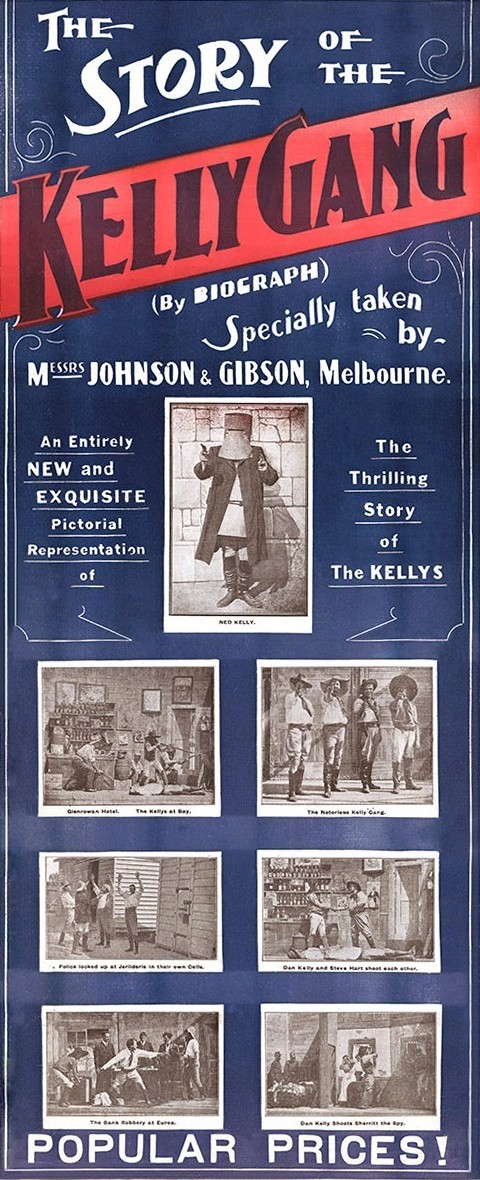
Poster for 1906 movie (Presumed Public Domain, via Wikimedia Commons)

Poster for 1906 movie (Presumed Public Domain, via Wikimedia Commons)

Australian films are being made, he said, “in small quantities” but are “not yet good enough to compete in the open market.” He is surprised that given Australia’s “natural advantages”, it had “produced so little in a medium that would encourage both trade and travel”. He goes on to describe how much people knew about America through its films -“we have seen cowboys, Indians, army, navy, civil war and Abraham Lincoln”. He suggests that Australia had just as interesting stories to tell and places to explore:

What of the Melbourne Cup, life on the stations, the kangaroos, the koala bear, the aboriginal, the romance of the Barrier Reef and the tropical splendour of the interior, the giant crocodiles of Queensland? What f the early history, as colourful as anything in America? isn’t Ned Kelly worth Jesse James?”

He suggests that films could do more for Australia in a year than his book, and yet, he says it seems “easier and safer to import entertainment by the mile in tin cans and to export nothing”!

He makes some valid points but he doesn’t recognise that Australia produced, arguably, the world’s first feature film, back in 1906, The story of the Kelly Gang – yes, about Ned Kelly.  It was successful in Britain, and pioneered a whole genre of bushranging films that were successful in Australian through the silent era. Three more Kelly films were made before Haskell visited Australia – but films were pretty ephemeral, and he clearly didn’t know of them.

At the time he researched and wrote this book, 1938 to 1940, there was still an active film industry. Cinesound Productions produced many films under Ken G Hall from 1931 to 1940, and Charles Chauvel made several films from the 1930s to 1950s, but the war years were lean times, and it was in those early years that Haskell did his research. It’s probably also true that then, as unfortunately still now, Australians were more likely to flock to overseas (that is, American, primarily) productions than their own.

Anyhow, I hope you’ve enjoyed this little historical survey of an outsider’s view of Australia as much as I have – though I guess it’s all rather irrelevant, and even self-indulgent, if you’re not Australian! Apologies for that!

Monday musings on Australian literature: Arnold Haskell on the Arts (2)

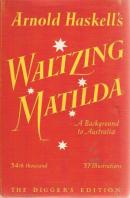
Arnold Haskell, Waltzing MatildaBack in November, I wrote a post on the Arts chapter in dance critic Arnold Haskell’s book Waltzing Matilda and focused on theatre and literature. In this post, I’ll look at his discussion of the press.

“compares … favourably”

Haskell starts by saying that Australia’s press started in a “thoroughly unprincipled and worthless manner”, though he doesn’t explain what he means by this. However, by the time he is writing, he says it “compares, as a whole, favourably with the English and American”, adding that its style is “English and not American”. He describes the press’s treatment of “the abdication” (Edward VIII) and “the September crisis” as “dignified and free from deliberately fostered sensation”.

There were, he admitted, sensational papers, such as Truth and Smith’s Weekly, which “at first glance are not a good advertisement for Australia”. At times their humour is raw and undergraduate, but he comes to admire their humour, even when they targeted him. He praises their writers as “excellent”, and writes:

These papers greatly upset me at first, but I can now appreciate their value as an antidote to wowsing. For all their presentation and methods they are usually on the side of the angels.

Wow, no faint praise here – and rather a long way from today’s “fake news”! Anyhow, he shows himself to be an open-minded traveller.

And then, of course, there’s “Grannie” or The Sydney Morning Herald, which he describes as “the dean of papers” and

the organ of conservative views and amazing respectability. Its very make-up clears it of any suspicion of frivolity. It is a power in the land and it knows it.

Next he discusses the Sydney Daily Telegraph suggesting it might become a rival. It’s owned he writes

by a young man, Frank Packer, a colossus with the figure of a prize-fighter and the flair to do great things. It is brilliant, erratic, out for scoops at all costs, technically well presented.

Packer sold it in 1972 to Rupert Murdoch. And this brings me to Melbourne, which my Melbourne readers will be relieved to read that Haskell doesn’t ignore! He writes:

In Melbourne, probably in Australia, the greatest power in journalism is Sir Keith Murdoch; he has been called ‘Lord Southcliffe’ and also ‘the maker of Prime Ministers’. He looks the part.

Haha … I enjoy Haskell’s references to physical appearances. Haskell praises several Melbourne papers, Murdoch’s Melbourne Herald, as well as The Age and Argus. He’s surprised that they didn’t take sides in Victoria’s “drink referendum”. Of papers in smaller cities, he is similarly positive, saying they “are also of a high standard, and are surprisingly free from parochialism.”

And then he – remember he was an arts critic – says something even more interesting:

The Australian press as a whole gives considerable space to art criticism and treats the artist with far greater respect than our own popular press, though its criticism of local artists tend to be too benevolent to be of the greatest value.

This is interesting on two fronts. One is his praise of the commitment to arts criticism, which suggests too that there was a readership for it. The other is his belief that criticism of the arts can have value – that it is important – but that to have value it needs to be willing to be a bit tougher than it is.

He says Keith Murdoch is interested in art, and that he has “an admirable critic” in Basil Burdett. Haskell describes Burdett as “a man with an artistic background that would be exceptional in any country”. Now, I hadn’t heard of Burdett, so I decided to check him out in Trove. The first hits I got were about his death in an air crash Singapore in 1942. He was Assistant Australian Red Cross Commissioner in Malaya. The Sydney Morning Herald, reporting his death, quoted Australian artist, and President of the Society of Artists, Sydney Ure Smith:

He had taste, knowledge, and that rare quality — enthusiasm … As a writer on art, he was well-informed and progressive without being narrow. He was a valuable art critic.

Anyhow, Haskell mentions two other critics, and I’ll share his description of those too. There’s The Sydney Morning Herald’s “well-informed art critic”, Kenneth Wilkinson, whose field, Haskell writes, “is made to cover painting, music, the drama and the films; probably too much for any one man”. Fair point, don’t you think? And there’s “J.S. McDonald, now curator of the Melbourne Museum”. He “was formerly an art critic” and “whether one agrees with him or not” he “is one of the most entertaining and forceful writers on art”. Has anyone heard of these?

Haskell then turns to the social pages, which occupies much space in all papers and which Australia’s intelligentsia describes as “provincial”. However, Haskell again shows his independence of mind when he suggests it probably is, but why “very lengthy accounts of the doings of that small clique known as cafe society in the London and New York press should be worthier of attention I cannot understand”. Why indeed! Further, he comments that Australian gossip columns are “not snobbish”. They are, and this must clearly be a dig at the British equivalents, “written by journalists about people and not by titled amateurs about their friends”! He writes that

Miss Brown of Wagga, Miss Jones of Gundagai, will both find a space when they come to Sydney or Melbourne, and, what is more, their dresses will be described as minutely as the Governor’s Lady’s.

Perhaps this is a good time to remind you of my first post on Haskell in which I quoted his being (initially) “aggressively uninterested” in visiting Australia.

Haskell also talks about “the paper that has represented Australia the most and that has a place in the history of Australian literature … the famous Sydney Bulletin.” He admits it’s “a little tamed today” but still represents “a national way of thinking”. Its goals, which were to encourage Australians to love their own country, have resulted in “the formation of an Australian manner of expression” which is “often crude, never ‘literary’ from the English point of view”, but is “vigorous and creative”.

I love that an English visitor was able to assess Australia, as a place in its own right and not a little England.

Monday musings on Australian literature: Arnold Haskell on the Arts (1)

Arnold Haskell, Waltzing MatildaA couple of months ago I wrote a post on British dance critic Arnold Haskell’s book, Waltzing Matilda: a background to Australia (published in Australia in 1944). I said then that I’d come back to it, so here I am, focusing this time on his chapter on “The Arts”. It comprises 22 pages covering, according to the chapter subtitle, “The theatre – The cinema – Painting – The press – Literature”. Today, I’ll just discuss the theatre and literature.

“a national theatre is not yet born”

He starts with the theatre, and says that although he knows “from experience that Australia has a vast theatre-going public and a fine theatrical tradition … the theatre is unfortunately in decay”. Performances are more likely to be “Gilbert and Sullivan” or English or American musicals or sensational-type plays with imported stars. When an Australian does show ability “he [of course, it’s a “he”] promptly leaves for England or America”. If he stays he’ll “probably starve, both artistically and financially”.

Serious theatre – performing, say, Chekhov or Gogol – mostly occurs in amateur repertory societies and some of these “reach an extraordinarily high standard”. He blames the lack of development of a national theatre on “apathy and the great national inferiority complex” (aka “the cultural cringe” I’ve often mentioned here). However, when it comes to music, ballet and opera things are a little better, particularly in opera where Melba, who had died in 1931, had “dealt a smashing blow to the inferiority complex”.

“still in the formative period”

Haskell spends more of his chapter on painting than on anything else but let’s get to literature. He says, it has “not produced men who are the equals of Streeton, Heysen or Gruner”. Interesting. I might be wrong but I’d say that now Miles Franklin, Katharine Susannah Prichard, and Eleanor Dark are at least as well-known as those three artists.

Anyhow, here is his impression:

Those who could write the great Australian novels, who are neither apathetic nor complacent and who correspond in some way to our Bloomsbury, are unfortunately too busy talking to accomplish more than a poem, a pamphlet or a short story. They are dissatisfied, they hate the squatter, despise the ‘dinkum Aussie’ and are well to the left of his traditional labour. Their thoughts are in Spain or Russia. They have both imagination and compassion, but there is more of bitterness in their make-up… They concentrate on the ideal of some vague revolution just as the masses concentrate on sport.

He argues that the “flourishing school of contemporary American literature was started by such minds as these in their magnificently creative intervals from drinking and posing in Paris.” (Don’t you love it?) He’s referring, I presume, to Hemingway, F Scott Fitzgerald, et al. He sees – quite perspicaciously I’d say – that the problem is that Australians were looking to Europe, were seeing the distance between them and Europe “as a handicap” BUT he says “the differences between Australia and England will produce a national art and literature, not the similarities.” In other words, look to your own. America has recognised this, he writes, “and has made her differences a source of pride”. Our own Nettie Palmer saw it too, and argued strenuously for an Australian literature. She pondered in her 1929 article, “The need for Australian literature”, on what recognition the work of Australians had received. “To what extent, ” she asked, “have their efforts been made barren by the ingratitude and even hostility with which they have been met at the outset.” Cultural cringe again? For Palmer, it is the artist (the writer, in her case) who illuminates, or makes understandable, our lives for us.

Anyhow, Haskell does recommend some Australian authors/works which have become “part of the Australia scene”, which I’ll share as I know we all like lists:

  • Marcus Clarke’s For the term of his natural life: Haskell writes beautifully about this book and how Kensignton-born Clarke used his two years’ bush experience to make himself “an Australian writer”. He argues that Clarke’s characters “have a humanity not unworthy of Dostoievsky” and compares him favourably against Henry Kingsley’s Geoffrey Hamlyn which he describes as “stilted and old-fashioned” and Rolf Boldrewood’s Robbery under arms which is just “a typical boy’s yarn”.
  • Henry Lawson’s While the billy boils, and other works: Haskell says Lawson’s work is universally seen as “honest Australian” and that “no interested tourist should omit reading these sketches of the Australian character”.
  • Vance Palmer and Brian Penton “depict the Australian scene with skill and conviction”, and Mrs Aeneas Gunn’s The little black princess “gives a particularly delightful picture of the aboriginal mind and was highly recommended to me by a distinguished anthropologist”. (Oh dear, but these were different times.)
  • Ion Idriess, who covers “the more adventurous sides of Australian life”, is “not a polished writer” but tells “magnificent” stories from his own experience.
  • Katherine [sic] Susannah Prichard, Helen Simpson and Henry Handel Richardson “are so well known in England that they are accepted as English writers”! What does this mean? And interesting that these are all women writers who are described this way. He says that The fortunes of Richard Mahoney “gives a gloomy picture of Australia but it is surely the greatest contemporary work of Australian fiction”.

Haskell also mentions several poets – Adam Lindsay Gordon, Henry Kendall, CJ Dennis and ‘Banjo’ Patterson [sic] – as worth reading. I’m just going to share, though, what he says about Paterson because Paterson, himself, felt he was just a ‘verse-maker’ not a poet. Here is Haskell:

Patterson, a bigger figure [than Dennis], might be called Australia’s Kipling, though there is little actual resemblance. It might be very easy to dismiss this very hearty verse as being of little account, easy but superficial. When one knows Australia this is altogether impossible. It has a quality of greatness because Patterson has written folk-songs and ballads of Australia. His verse has an extraordinary quality of spontaneity. It is truly indigenous.

Dennis, he writes, “is famous for his amusing doggerel in the Australian vernacular” and “has left behind some humorous journalism. It is more deliberate and sophisticated; it is a tour de force and not a cri de coeur.”

Haskell admits that there are other names he could share. However, his aim has not been, he says, to produce “a study of Australian literature” but rather a “personal account” of his “journey” because his prime goal has been to “see Australia at first hand and not through literature”. I understand that …

George Augustus Sala, The tyranny of pie (Review)

When I decide to write about a Library of America (LOA) Story of the Week it is usually because it’s by a favourite author (like Willa Cather, Kate Chopin, or Edith Wharton), or by an author I want to read but haven’t yet (like John Updike or Washington Irving) or on a topic that interests me (like the environment or race issues or food). You can guess from the post title, then, why I chose the story I’m writing about today!

I’ve covered a few LOA food stories: Scotsman John M. Duncan’s “A Virginia barbecue” (1823), American George G. Foster’s “The eating-houses” (1849), and Cuban-American Ana Menéndez’s “Celebrations of Thanksgiving: Cuban offerings” (2004). Two are about events and one about restaurants, though they all mention food too of course. Englishman George Augustus Sala’s piece, however, starts from the point of view of food – the pie, which, I’ve just realised, is appropriate for this American Thanksgiving weekend. Sala, like Virginia-barbecue-Duncan, was a traveller to America, so wrote his piece from the perspective of an outsider.

George Augustus Sala

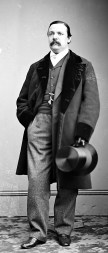
Sala c. 1855-65, by Mathew Brady (Public Domain via Wikipedia)

But, who was this Sala? Aussies will be interested to know that it was he who coined the still-used description “Marvellous Melbourne” when he visited Australia in 1885. He was born in 1828, and is described in LOA’s notes as a “prolific and flamboyant journalist”. He “found fame” as an acolyte of Charles Dickens, and was a regular contributor to Dickens’ journal, Household Words (about which I’ve written before). However, LOA continues, it was public praise from William Makepeace Thackeray which really launched his career. Unfortunately, although Sala published much and earned good money from writing for The Daily Telegraph, he was a spendthrift who was also often drunk, and “died virtually penniless”.

Now, the piece. It comes from his second trip to the States. His first trip was in 1863 during the Civil War, and while he was critical of much he did like American humour. He wrote, says LOA, a three-book series of anthologies, Yankee Drolleries (1866–1870), which introduced British readers to established authors like Oliver Wendell Holmes (whom I wrote about recently) and the up-and-coming writer, Mark Twain.

During his second trip, which resulted in his book America revisited, he found an improved America. LOA quotes this:

The truth is, that in New York there is room enough for Everybody, whereas in London, huge as it is, there is not sufficient room for Anybody.

By the late 1870s, we’re told, Manhattan had become a popular travel destination for the European upper class.

Sala, LOA also says “had a lot to say about American food. His comments range from despair and scorn to grudging, if infrequent, admiration”.  He apparently approved of New York, because its food and accommodation were “what Europeans usually consider to be refinement and comfort.” But on leaving New York, “you must expect nothing better than pork and beans and Indian pudding, or hog and hominy if you go South; the whole washed down by rough cider or molasses and water.” His short “The tyranny of pie” piece appears as a digression in his America revisited chapter about a train trip to Baltimore.

I’m sure you all know the phrase “as American as apple pie”. The Huffington Post provides some background to this in an article titled “Why are we ‘As American as Apple Pie’?” The pie was an English tradition, and brought to American by the Pilgrims, but by 1860, well before Sala’s second visit, the phrase was already in use. Novelist Harriet Beecher Stowe wrote, says Huffington’s Kimberly Kohatsu, that “the pie is an English tradition, which, planted on American soil, forthwith ran rampant and burst forth into an untold variety of genera and species.”

It is partly this variety which captures Sala’s eye. He commences, though, by praising signs of “improvement and reform” in America – in

everything except Pie. The national manners have become softened—the men folk chew less, expectorate less, curse less; the newspapers are not half so scurrilous as our own; the Art idea is becoming rapidly developed; culture is made more and more manifest; even “intensity” in æsthetics is beginning to be heard of and Agnosticism and other “isms” too numerous to mention find exponents in “Society,” and the one absorbing and sickening topic of conversation is no longer the Almighty Dollar—but to the tyranny of Pie there is no surcease.

What is all this about we readers wonder? Soon he writes:

The day before we left New York one of the ripest scholars, the most influential journalists (on the Democratic side) the brightest wits and most genial companions in the States lunched with us. He would drink naught but Château Yquem; but he partook twice, and in amazing profusion of Pumpkin Pie.

Ah, I was thinking, he’s like me. He doesn’t like Pumpkin Pie, and wonders about the taste of this Château Yquem drinker … but, I was disappointed because, within a couple of sentences he writes:

The worst of this dreadful pie—be it of apple, of pumpkin, of mulberry, or of cranberry—is that it is so very nice. It is made delusively flat and thin, so that you can cut it into conveniently-sized triangular wedges, which slip down easily.

He then suggests that the pie is “as important a factor in American civilisation as the pot-au-feu does in France” but that England has nothing equivalent. The closest England has to a dish “by which we nationally stand or fall” is “the roast beef of Old England” but it is expensive and

there are hundreds of thousands of labouring English people who never taste roast beef from year’s end to year’s end—save when they happen to get into gaol or into the workhouse at Christmastide.

This is where his little piece ends. I did enjoy its cheeky humour, and this pointed conclusion.

George Augustus Sala
“The tyranny of pie”
First published in: America revisited: from the Bay of New York to the Gulf of Mexico, 1882.
Available: Online at the Library of America

Monday musings on Australian literature: Arnold Haskell’s Australia

Arnold Haskell, Waltzing MatildaWho is Arnold Haskell you are probably asking, if you are anything like me. The answer will probably surprise you: he was a British dance critic, who wrote many books on ballet, and was, in fact, involved in the development of the Royal Ballet School. But, he also visited Australia a couple of times, first in 1936, as a publicist-reporter with the Monte Carlo Russian Ballet. He returned to Australia in 1938 to research his book Waltzing Matilda: a background to Australia, which was published in England in 1940 (though not published in Australia until 1944). And guess where I found this book? Yep, in my aunt’s house.

So, he visited Australia a couple of times before the Second World War, but his book was published during the war. I find that quite fascinating – who would be interested in what is really a travel book in such  abnormal times? (I looked at the records for this book in Trove. There are several editions: most are categorised as “description and travel”, but some as “civilisation” and “history”. I think the former is better, but it just goes to show that categorisation is never easy!)

Anyhow, here is how he starts his Introduction:

I happened on Australia four years ago, at four days’ notice and by complete accident. Had I been given a week’s notice I probably would not have come at all. I was completely, even aggressively uninterested in that continent. … When I let my friends know where I was going, they said “Why?” which did not encourage me, and left me speechless for once.

His lack of interest wouldn’t surprise Australians who are aware that for the British, particularly at that time, we Australians were simply colonials, and had nothing of interest to offer, and particularly nothing for those who saw themselves as sophisticated. Haskell saw Australia, for example, as offering “hospitality, hearty but uncouth”. He says in this first paragraph that he was “bribed” to accept the trip, partly by the work (the ballet company) and partly by the opportunity to visit Ceylon (now Sri Lanka) and Honolulu, en route. Harrumph!

However, he “became … enchanted”, and so returned later for 6 months to see more. As there were no books that described Australia in the way he as a traveller wanted, he decided to write it himself:

Australia, in comfort at all costs, in luxury if possible; Australia, stressing the modern plumbing in the most modern hotel in Sydney rather than the lack of plumbing in the dead centre [had he visited his own counties I wonder?]; recounting the lives, thoughts and works of many eminent painters rather than the pathetic state of the rapidly dwindling aboriginal; in fact to write of Australia as one writes of Europe or America: positively and without the eternally negative point of view.

It would be easy for us to take exception to this, but it’s more interesting to read it as a reflection of (a certain segment of) the times, and as something that can provide insight into the world as it was then. And anyhow, he goes on to say that he want to trace

the evolution of a society from brutality and chaos to as perfect an expression of ordered democracy as can be found, to show the amazingly rapid transition from an unhappy group of felons, often not so bad, and their gaolers, often not so good, of overbearing petty Himmlers and dictator governors to a civilised community of amazingly tolerant people living in a country freer from crimes of violence than any other, in a continent that has never known the hatred, violence, hypocrisy and destructiveness of Europe.

Ah, it would be lovely to pat our own backs at this, except that we know that there has been violence here. It just wasn’t spoken of back then.

He goes on, completely oblivious to Australia’s long history of occupation by indigenous people, talking about how Australia’s history is still mainly a “family tradition rather than history”, one in which “I remembers” have not yet made it into “the ordered framework of text-books and university courses”. Again, although his view is myopic, I love this way of describing the “short” history as he saw it.

However, his book is not, he says, a history but a personal story which he hopes will “provide the background” that he found lacking.

I will come back to this book, I think, because as well as travelling around the states, he also did some of his own primary research checking letters, manuscripts etc to obtain his own perspective. It should make for fascinating reading … but for now, I’m tired folks, so signing off with a shorter than usual one!

William Makepeace Thackeray, The luck of Barry Lyndon (#Review)

By the time I reached about the 30% mark (on my Kindle) of William Makepeace Thackeray’s classic novel, The luck of Barry Lyndon, I was reminded of a monologue by English comedian Cyril Fletcher which my father had on an old gramophone record. It’s about a “lunatic” (this was in less linguistically-sensitive times) who decided to write a novel. I won’t spoil the fun because you can watch Fletcher perform it himself on YouTube (it’s the first short story):

If you’ve watched it, you might see my point, because Barry Lyndon does go on and on and on, reporting adventure after adventure after adventure, with no apparent change or development in his character (except that he gets older!). I am exaggerating a bit, but …

So, why did I persevere? Firstly, it was my reading group’s June book, and I always like to do my homework; secondly, it is a classic that I haven’t read; and thirdly, I sensed satire, and was intrigued to see just where it was going. As a reading experience though it’s a challenge, one that was perhaps less so for contemporary readers in 1844 because they received it in serial form over 10 months or so. Still, I’m not sorry I read it.

What's in a name?

What’s in a name?

Anyhow, enough introductory patter. Let’s get down to it, starting with a little about the story. It’s a picaresque tale, a popular form in the 18th century in which the story is set, and spans many countries from Ireland and England to much of Europe. Its “hero”, Redmond Barry, pretends to be (believes, indeed, he is) a gentleman – he knows how to speak, dress, and duel – but, see how I enclosed “hero” in quotation marks? That’s because he is, in fact, an anti-hero – a conman and consummate rake (another great 18th century type!). Having lost the hand of his cousin, and then his money through gambling in Dublin, he ends up a soldier fighting the Prussians in the Seven Years’ War. While in Europe, he teams up with an uncle and together they manage to live the high life, gambling their way around Europe. “Luck”, of course, runs out, and he’s penniless again but he manages to essentially bully the wealthy and widowed Countess of Lyndon into marriage. However, things again go bad as Redmond Barry (now renamed Barry Lyndon) mismanages his wife’s money – and so the story continues to its inevitable conclusion.

The “luck” of Barry Lyndon?

One of the questions the book raises is that of “luck”. To what extent is Lyndon master of his own fate and to what extent does luck come into play. As one of the members of my reading group said, Lyndon is one of literature’s greatest justifiers. He can justify (excuse) just about everything he does, but he’s also the consummate unreliable narrator. He continually asserts the “truth” of his story, even though, early on, he’s told us that the “Irish gentry . . . tell more fibs than their downright neighbours across the water.”

The novel opens with:

Since the days of Adam, there has been hardly a mischief done in this world but a woman has been at the bottom of it …

And there it starts. Whatever happens to Lyndon is always someone else’s fault – nothing to do with his gambling, his inability to manage money, or his insensitivity to the needs of anyone but himself. There is a strong misogynistic thread through the novel – but this is part of the satire, which is common in picaresque novels. The targets are many, but a major one is idea of the 18th century gentleman, the sort of person Barry Lyndon proclaims throughout that he is but that he shows by his actions he is not!

The novel is, overall, a romp, albeit a rather tedious one at times, but it does have some things to tell us, besides what a “gentleman” should be. One of these, I think, is that it chronicles social change in Europe, the change from the chivalric life of aristocracy to a more bourgeois life of the middle classes. I’ll give one little example. Lyndon spends his life settling scores through the “gentleman’s” method, a duel (though to be fair he “pinks” people rather than kills them). However, late in the novel, as things close in, he is brought to account for one of his schemes. He writes:

Of course I denied the charge, I could do no otherwise, and offered to meet any one of the Tiptoffs on the field of honour, and prove him a scoundrel and a liar: as he was; though, perhaps, not in this instance. But they contented themselves by answering me by a lawyer, and declined an invitation which any man of spirit would have accepted.

We are talking late eighteenth century, you see – the time of the American War of Independence and the lead into the French Revolution. The times, they were a-changing.

Truth or fiction?

So, there’s the issue of Lyndon asserting the “truth” of his story, asking us to trust that he is the decent, good guy he says he is. His misfortunes, he says, are due to

the consequences of villainy in others, and (I confess it, for I am not above owning to my faults) my own too easy, generous, and careless nature…

Hmm … not quite the “faults” we readers would ascribe to this wife and child-beater, profligate spender, and keen duellist.

However, there’s another angle to this “truth” idea. It’s related to the idea that this is a “memoir”, not a novel. He writes:

Were these Memoirs not characterised by truth, and did I deign to utter a single word for which my own personal experience did not give me the fullest authority, I might easily make myself the hero of some strange and popular adventures, and, after the fashion of novel-writers, introduce my reader to the great characters of this remarkable time. These persons (I mean the romance-writers) …

Later, we find, in one of the occasional “footnotes”, which are part of the novel and provide the occasional corrective to Lyndon’s narrative:

[Footnote: From these curious confessions, it would appear that Mr. Lyndon maltreated his lady in every possible way; that he denied her society, bullied her into signing away her property, spent it in gambling and taverns, was openly unfaithful to her; and, when she complained, threatened to remove her children from her. Nor, indeed, is he the only husband who has done the like, and has passed for ‘nobody’s enemy but his own:’ a jovial good-natured fellow. The world contains scores of such amiable people; and, indeed, it is because justice has not been done them that we have edited this autobiography. Had it been that of a mere hero of romance one of those heroic youths who figure in the novels of Scott and James there would have been no call to introduce the reader to a personage already so often and so charmingly depicted. Mr. Barry Lyndon is not, we repeat, a hero of the common pattern; but let the reader look round, and ask himself, Do not as many rogues succeed in life as honest men? more fools than men of talent? And is it not just that the lives of this class should be described by the student of human nature as well as the actions of those fairy-tale princes, those perfect impossible heroes, whom our writers love to describe? There is something naive and simple in that time-honoured style of novel-writing by which Prince Prettyman, at the end of his adventures, is put in possession of every worldly prosperity, as he has been endowed with every mental and bodily excellence previously. The novelist thinks that he can do no more for his darling hero than make him a lord. Is it not a poor standard that, of the summum bonum? The greatest good in life is not to be a lord; perhaps not even to be happy. Poverty, illness, a humpback, may be rewards and conditions of good, as well as that bodily prosperity which all of us unconsciously set up for worship. But this is a subject for an essay, not a note; and it is best to allow Mr. Lyndon to resume the candid and ingenious narrative of his virtues and defects.] (Ch. 17)

I love the satire here of romance-adventure novels, epitomised by writers like Sir Walter Scott, and note Thackeray’s plea for what became the great social novels of the nineteenth century. (You have to wonder, though, at the idea of “Poverty, illness, a humpback” being “rewards”!)

And here I will end because many have written eloquently about this classic. All I wanted to do was to make a couple of points! Have you read Barry Lyndon, and did you enjoy it?

William Makepeace Thackeray
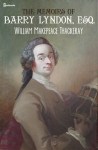
Barry Lyndon (orig. The luck of Barry Lyndon)
Goldfish Classics Publishing, 2012
[339pp.]

Helen Macdonald, The human flock (Commentary)

I know, I know, I sound like I’m obsessed with Helen Macdonald. I’m not, but I am interested in nature and landscape, and she has thought and researched at length about the topic. I’ve called this post a commentary, because it’s not a review. Rather, I’m going to draw on both an On Nature column she wrote for The New York Times Magazine and her book H is for hawk (my review) – and look at a political issue she raised in both writings.

I’ll start with a comment that occurs near the beginning of H is for hawk. Early in her hawk training sessions, she takes Mabel out walking in the streets of her town, but almost no-one speaks to her. They all saw her, she says, how could they not, but “they just pretended they hadn’t”. Except for those who did. A man from Kazakhstan saw her. They discuss Kazakh falconers, and he tells her “I miss my country”. A Mexican cyclist “skids to a halt” and admires Mabel, saying he’s never seen a hawk so close, only high in the sky where they are “free”. And then she realises

that in all my days of walking with Mabel the only people who have come up and spoken to us have been outsiders: children, teenage goths, homeless people, overseas students, travellers, drunks, people on holiday … I feel ashamed of my nation’s reticence. Its desire to keep walking, to move on, not to comment, not to interrogate, not to take any interest in something peculiar, unusual, in anything that isn’t entirely normal.

I thought, interesting, but moved on, with her, to the next part of her story.

Then, late in the book, she’s out walking with Mabel again, and runs into a retired couple she knows. They exchange pleasantries, including discussing the beauty of a herd of deer they’d all seen. Their conversation concludes with:

“Doesn’t it give you hope?” he says suddenly.
“Hope?”
“Yes,” he says. “Isn’t it a relief that there’re things still like that, a real bit of Old England still left, despite all these immigrants coming in.”

Helen is horrified, but says nothing. However, as she walks home she thinks

… I should have said something. But embarrassment had stopped my tongue. Stomping along, I start pulling on the thread of darkness they’d handed me.

She thinks of why and how people and creatures move between countries, of Göring’s desire to move Jews from Germany, of Finnish goshawks in England, of a Lithuanian mushroom gatherer in England who couldn’t understand why English people didn’t know which mushrooms in their woods were and weren’t edible. She says:

I think of all the complicated histories that landscapes have, and how easy it is to wipe them away, put easier, safer histories in their place.

Today’s “Old England”, for example, is not, actually, the England of 100 years ago, let alone 400 hundred years ago, given the impact of settlement and agriculture on the land and its “natural” inhabitants. And those deer? Well, they and the hare are “legacies of trade and invasion”, albeit back to Roman times. Immigrants in their day, in fact. She suggests that instead of fighting “for landscapes that remind us of who we think we are”, we should “fight, instead, for landscapes buzzing and glowing with life in all its variousness”.

Starling murmuration

Starling murmuration, by Walter Baxter, using CC BY-SA 2.0, via Wikimedia Commons

This brings me to the article, “Human flock”, she wrote for The New York Times Magazine. It’s about waiting and watching at a lake in Hungary for a flock of Eurasian cranes on their southward migration. Are you catching my (her) drift now? She talks of various migrating birds, sandhill cranes, snow geese, and starlings. She describes a murmuration, the collective noun for a flock of starlings. She discusses why these birds flock. The reasons include for protection (out of fear), to signpost where they are to other starlings, and for warmth. These flocks, though, are also made up of “thousands of beating hearts and eyes”, of individual birds in other words..

As she watches and thinks, her mind turns to “more human matters”, to the “razor-wire fence” built by the Hungarian government to keep Syrian refugees out. She writes:

Watching the flock has brought home to me how easy it is to react to the idea of masses of refugees with the same visceral apprehension with which we greet a cloud of moving starlings or tumbling geese, to view it as a singular entity, strange and uncontrol­lable and chaotic. But the crowds coming over the border are people just like us — perhaps too much like us.

The flock made her realise that “in the face of fear, we are all starlings, a group, a flock made of a million souls seeking safety”. But flocks can also be transformed into “individuals and small family groups wanting the simplest things: freedom from fear, food, a place to safely sleep”. It’s a powerful statement for humanity. And I like the way it picks up ideas she touched on but didn’t explore at depth in H is for hawk.

Nature, or, more accurately, exploring its meaning for us and our relationship to it, is clearly an ongoing project for her. I’ll be interested to see how her ideas develop – but for now, you may be pleased to know, I’m moving on to other books and ideas!

PS Helen Macdonald gave the closing address at the 2015 Sydney Writers’ Festival on “On looking at nature”. She gets into nature, history, culture and diversity. It runs for around 38 minutes, and makes for great listening.

Helen Macdonald
“On Nature: The human flock” in The New York Times Magazine, December 6, 2015.
Available: Online

Delicious descriptions: Helen Macdonald on nature

Before I share the couple of quotes I saved for this post, from my review of Helen Macdonald’s H is for hawk, I want to mention one more idea that I considered including in my ever-lengthening review, and that’s the idea of a journey. I’m mentioning it now because Claire (of Word by Word) mentioned it in her comment on my post and because it was also mentioned in my reading group discussion. I sort of covered it when I said that the book could also be seen as a quest story, but I had planned to point to a specific reference Macdonald makes: “for years,” she says, “I’d scoffed at White’s notion of hawk training as a rite of passage”. She realises that there’s truth in his statement and that she too was trying to rebuild something. This, this “passage” from one mode of being to another is, in effect, a journey – and it is, in the end, the fundamental thing that the book chronicles.

(This is a good point to note the value of rereading! Macdonald, in the light of her current experience, reads White’s Goshawk very differently from the way she’d read it when she was a child with a child’s view of the world. I love it.)

Northern Goshawk

Northern Goshawk (Photo: Norbert Kenntner, Berlin, via Wikipedia using CC-BY-SA 3.0)

But now, Macdonald’s nature writing. The book abounds with descriptions of the nature – of the landscape, of the creatures within it. It’s intensely evocative, and sometimes confrontingly visceral. The first chapter, as well as the title itself, tells us that nature will be a significant aspect of the book. “Forty-five minutes northeast of Cambridge is a landscape I’ve come to love very much indeed” is the opening sentence. The last line (the postscript), too, is a natural description, albeit a more symbolic one worthy of the last line of a grief memoir! Nature, in other words, plays a complicated role in the book. It has a literal role, that is, it exists for its own sake. She clearly loves the natural world around her, has her “magical places”. But it has other roles too: complex, psychological ones, political ones*, as well as the more expected symbolic ones (like, you know, “the world itself started to grieve. The skies broke and it rained and rained”).

I touched on the psychology in my review when I referred to her starting to think and see like a hawk, seeing this as a way to escape her grief. But that’s just one aspect of her exploration of the relationship between psychology and nature. There’s TH White and what she calls his “moral magic trick”. It relates to his determination not to give in to his cruel urges – he never beat his students at Stowe school, for example. She says that animals played a “curious role” in his keeping this goal:

For White it was a moral magic trick, a way out of his conundrum. By skilfully training a hunting animal, by closely associating with it, by identifying with it, you might be allowed to experience all your vital, sincere desires, even your most bloodthirsty ones, in total innocence. You could be true to yourself.

In other words, you could shed, perhaps, your “perpetual disguise”.

Often though, she describes nature for its own sake – how it looks, how it feels, her experience of it. It’s a lived and earthy beauty:

It’s turned cold: cold so that saucers of ice lie in the mud, blank and crazed as antique porcelain. Cold so the hedges are alive with Baltic blackbirds; so cold that each breath hangs like parcelled seafog in the air. The blue sky rings with it, and the bell on Mabel’s tail leg is dimmed with condensation. Cold, cold, cold. My feet cracks the ice in the mud as I trudge uphill. And because the squeaks and grinding harmonics of fracturing ice sound to Mabel like a wounded animal, every step I take is met with a convulsive clench of her toes. Where the world isn’t white with frost, it’s striped green and brown in strong sunlight, so the land is parti-coloured and snapping backwards to dawn and forwards to dusk. The days, now, are a bare six hours long.

And here is Mabel in this season:

… Mabel has eaten nothing but quail for a week, and it’s made her a hot-tempered, choleric, Hotspur-on-coke, revenge-tragedy-protagonist goshawk. She is full of giddy nowhere-to-go desire. She foots her perch. She gets cross. She jumps in the bath and out again, and then in again. She glares …

So evocative, so drawn from experience – and such an inspiring command of language.

Macdonald’s England is pretty wild – full of brambles and thorns, of predators and prey – something I didn’t quite expect given my image of green pastures and tamed hedgerows! Towards the end she shares the lesson of her experience, which stems from the idea that we should not imbue nature with meanings from our human experience of the world, and then use that to “shore up our own views of the world”:

And I have learned, too, the danger that comes in mistaking the wildness we give a thing for the wildness that animates it. Goshawks are things of death and blood and gore, but they are not excuses for atrocities. Their inhumanity is to be treasured because what they do has nothing to do with us at all.

Nature is to be valued, respected – and preserved – for itself.

You won’t be surprised to hear that Helen Macdonald is “a writer, poet, illustrator, historian and affiliate at the Department of History and Philosophy of Science at the University of Cambridge”.

* I may address this one in another post – if I can maintain the energy!