W. Somerset Maugham, The four Dutchmen (#Review)

W. Somerset Maugham, Collected Short Stories Volume 4Finally, an excuse to mention W. Somerset Maugham here – and the excuse is, as Aussie literary fiction followers will probably know, that Mirandi Riwoe’s Stella shortlisted novella, The fish girl, is a response to (was inspired by) Maugham’s short story “The four Dutchmen”. I don’t usually feel I need to read the original work in these situations but given the original here was a short story and given it gets Maugham into this blog, I decided to read it.

Before I get to the story, I must explain that one of the reasons I’d like Maugham here is because I was astonished some years ago to discover just how many of his novels, short stories and plays had been adapted to film. Wikipedia says that he was “one of the first authors to make significant money from film adaptations”. So, having seen several of the films and read a few of his books, I’ve wanted him here – albeit Maugham described himself as “in the very first row of the second-raters”!

“The four Dutchmen” has not, as far as I know, been adapted to film, but it makes interesting reading. In his introduction to the volume of collected stories which includes this one, Maugham says that “most of these stories are on the tragic side. But the reader must not suppose that the incidents I have narrated were of common occurrence.” He then describes how the majority of the people in the Asian regions from which the stories come are decent hardworking people, but

they are not the sort of people I can write stories about. I write stories about people who have some singularity of character which suggests to me that they may be capable of behaving in such a way as to give me an idea that I can make use of, or about people who by some accident or another, accident of temperament, accident of environment, have been involved in unusual contingencies.

The four Dutchmen – a captain, chief officer, chief engineer, and supercargo on a Dutch tramp – are such people. The four fattest men our narrator ever knew,

They were the greatest friends, all four of them; they were like schoolboys together, playing absurd little pranks with one another.

And in such a way, the first person narrator (ostensibly the author) sets them up as jolly, cheery men for whom having a good time was more important, say, than winning money from each other at bridge. After all,

‘All friends and a good ship. Good grub and good beer. Vot can a sensible man vant more?’

But,

… the captain was very susceptible to the charms of the native girls and his thick English became almost unintelligible from emotion when he described to me the effect they had on him. One of these days he would buy himself a house on the hills in Java and marry a pretty little Javanese. They were so small and so gentle and they made no noise, and he would dress her in silk sarongs and give her gold chains to wear round her neck and gold bangles to put on her arms.

The last two sentences here comprise the epigraph Riwoe uses to open The fish girl – but more on that next week.

What happens is that the captain brings a Malay girl on board, against the wishes of his friends, and tragedy ensues – as our narrator pieces together from later newspaper reports and the hotel manager. It’s a story about friendship and loyalty, envy (probably) and revenge. But it’s also about colonial attitudes to local inhabitants, and about men seeing women as objects or toys to be played with and discarded at will.

The interesting thing is Maugham’s attitude. What is it? This is not a didactic story. The first person narrator makes no specific commentary on the rights and wrongs of the four men’s behaviour, but seems to act rather as observer and reporter. However, I think we can glean some opinion. He initially finds them fun to be with, but there are hints that he sees them lacking in substance. At one point he says “to me not the least comic part of them was their serious side” and a little later he comments ironically, after the chief had made an egregious statement, that he “had a philosophic soul”. His, the narrator’s, concluding comment seems off-hand – as if it’s just another story about characters he’s met. And maybe that’s all it is to him, but I’d say there’s ironic intent behind the reference to the “comic and celebrated friendship”.

It’s somewhat more difficult to pin down his attitude to the young woman who is first referred to as “pretty little Javanese”, then “a little thing” and “Malay girl”, before finally being characterised as “brazen hussy”, “bad rubbish”, and “trollop”. She has no voice at all in “the story” – but these descriptions of her are reported rather than his own, so again I’d say he is asking us to consider the attitudes and values he portrays. Anyhow, next week I’ll review Riwoe’s post-colonial response to the story.

Meanwhile, I’d love to know what you think of Maugham (if you’ve read him)?

W. Somerset Maugham
“The four Dutchmen” (1928)
in Collected short stories, Vol. 4
(Selected by Maugham himself)
London: Vintage Books. (Orig. pub. 1951)
ISBN: 9781409076421 (ePub)
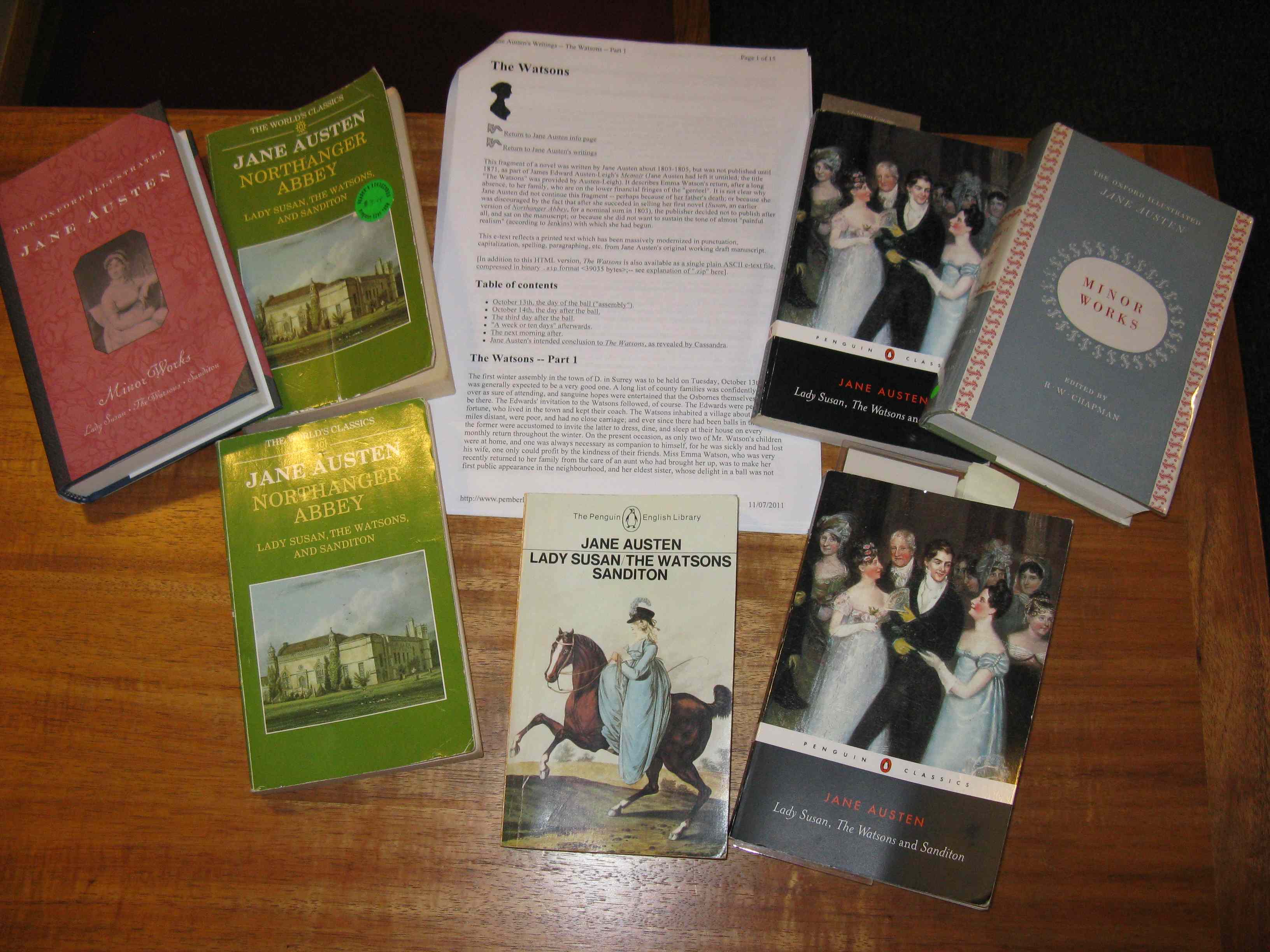
Jane Austen, The Watsons (Unfinished) Redux

Book covers for Jane Austen's The Watsons

Book covers for Jane Austen’s The Watsons

Jane Austen fans, as you probably know, do a lot of re-reading. Given we only have six complete novels, plus her juvenilia and a couple of unfinished novels, we have little choice. Fortunately, it’s not a chore! And so, having completed rereading all her novels over the last few years for their respective 200th anniversaries, my local Jane Austen group decided to return to her two unfinished novels, starting this month with The Watsons. This was the third time we’ve done it in our relatively short existence. We did it in 2008 and again in 2011 (at which time I wrote my own reflections for this blog).

I do not plan here to write a “proper” review, so if you are interested in my thoughts, please check the link above. However, there are a couple of additional comments I’d like to make, starting with the question I posed in my 2011 post. The question relates to its unfinished nature. There are in fact two main questions regarding this: why did she stop writing it and why didn’t she pick it up again? And here I’ll quickly recap the novel’s background for those who don’t know it. The Watsons was written in Bath probably around 1803-1805, though there isn’t complete consensus about this. It’s commonly believed that she abandoned it after her father’s death in 1805 because of sadness and the resultant uncertainty in her living conditions. Whether this is true or not, it is true that she didn’t take up serious writing again until she settled in Chawton in 1809.

Now, it was at Chawton that she took up two earlier works, which became her first two published books, Sense and sensibility and Pride and prejudice. Why did she not then take up The Watsons and rework/finish it too? This is the more interesting question, I think, than why she stopped it in the first place. There are some theories around, though I haven’t investigated them thoroughly. However, her nephew James Austen-Leigh, who wrote the first “memoir” we have about her life, conjectures that Austen had become aware of “the evil of having placed her heroine too low, in such a position of poverty and obscurity” but I’m not sure I buy it.

My group discussed this idea, and we all felt that Austen had other “poor” heroines, of whom Fanny Price is the obvious example. But, the Dashwood girls were not well-to-do either. It’s true that Austen’s plan for The Watsons, as Cassandra reported, was for things to get worse for our heroine, but still …

No, my idea is different. The Watsons is broadly about four sisters and their marriage prospects – as is Pride and prejudice and Sense and sensibility. When we look at The Watsons, which Austen started after drafting those two books, we can see characters and storylines which remind us of these first two books. And so, I wonder whether, having published P&P and S&S, Austen felt she didn’t have enough new ideas to add to this storyline and wanted to try something different. Certainly, the next book, Mansfield Park, was something different. The marriage plot is still there, but it’s about a poor relation who is taken in by her wealthier ones. The interesting thing is that The Watsons commences with the return of 19-year-old Emma Watson to her family having spent 14 years with a wealthy uncle and aunt. Perhaps Austen decided to explore the story of the poor relation from a different angle, from the time of arrival at the new home?

Another thing about The Watsons is that as well as having characters who remind us of those first two novels, it also has characters reminiscent of some in later books, particularly in Emma. This suggests that while she didn’t finish The Watsons, her work on it wasn’t wasted – and she knew it.

We’ll never know of course. There’s so much we don’t know about our Jane, but it is fun trying to fill in the gaps.

A couple of apposite quotes

There’s more I could explore about this tiny fragment of around 17,500 words, but I’ll save those for the next re-read! Instead, I’ll conclude with two excerpts which grabbed my attention this time.

Gender and money

The first is a conversation between the heroine Emma and the wealthy aristocrat, Lord Osborne, who is interested in her, though his regard is not returned. In this conversation, he suggests that all women should ride horses:

‘I wonder every lady does not. – A woman never looks better than on horseback. –’
‘But every woman may not have the inclination, or the means.’
‘If they knew how much it became them, they would all have the inclination, and I fancy Miss Watson – when once they had the inclination, the means would soon follow.’
‘Your lordship thinks we always have our own way. – That is a point on which ladies and gentlemen have long disagreed. – But without pretending to decide it, I may say that there are some circumstances which even women cannot control. – Female economy will do a great deal my Lord, but it cannot turn a small income into a large one.’

Here we see Emma’s mettle. She stands up to Lord Osborne – to his assumptions about women and to his obliviousness that not all people have the means he has.

On reading to escape

And finally, The Watsons contains another of those wonderful quotes by Austen about books and reading. Here, right near the end of the fragment, Emma is thinking about the downturn in her fortunes through the death of her uncle:

The evils arising from the loss of her uncle were neither trifling, nor likely to lessen; and when thought had been freely indulged, in contrasting the past and the present, the employment of mind, the dissipation of unpleasant ideas which only reading could produce, made her thankfully turn to a book.

So, even in 1805, reading was seen as a way to occupy the mind and so escape, for a while, the troubles of life.

Jane Austen
“The Watsons”
in The Oxford illustrated Jane Austen. Vol VI, The minor works (ed. R.W. Chapman)
London: Oxford University Press, 1969
pp. 315-363

Caroline Moorehead, Dancing to the precipice (#BookReview)

Unusually, my reading group read two biographies about non-Austrian women this year, Jane Fletcher Geniesse’s book on Freya Stark (my review) in January and now, this month, Caroline Moorehead’s book Dancing to the precipice: Lucie de la Tour du Pin and the French Revolution on the French aristocrat Henriette-Lucy, Marquise de La Tour-du-Pin-Gouvernet. Interestingly, Moorehead has also written a biography of Freya Stark. Moreover, while Caroline Moorehead is an English writer, it turns out that her father was the Australian war correspondent and historian Alan Moorehead. How tangled is all this!

But now the book itself. Dancing to the precipice chronicles the life of French-born aristocrat Lucie, from her birth in 1770 to her death in 1853, a period which, you’ll realise, covers some of Europe’s and, in particular, France’s most tumultuous times. Lucie de la Tour du Pin, as Moorehead calls her, saw most of it up close and personal, but somehow managed to survive. The evocative title conveys a sense of how tenuous that survival could be. It comes from Lucie’s own words written just before the storming of the Bastille. She wrote:

Amid all these pleasures we were laughing and dancing our way to the precipice.

Lucie, Moorehead tells us, went on to say that while this blindness was pardonable among the young, it was “inexplicable in men of the world, in Ministers and above all, in the King”. She wasn’t wrong – and the rest of the book tells us how often throughout their lives they nearly went over the precipice.

Dancing to the precipice is a thorough work, thorough in its description of Lucie’s life, and thorough in the research carried out by Moorehead. The biography is footnoted (though not intrusively) and contains an extensive list of sources at the end. It is also well-indexed. All of these are important – to me, anyhow! The reason the book is able to be so thorough – without Moorehead ever needing to resort to gap-filling – is because her life is so well documented, by herself primarily.

Lucie, in fact, has been described as the Pepys of her generation because of the memoir she started writing when she was 49. Titled Journal d’une femme de 50 ans, it was published posthumously and covers her life through the Ancien Régime, the French Revolution, to the time of Napoleon, until March 1815 when he returned from exile on Elba. In her Afterword, Moorehead explains that in addition to this memoir, which apparently has never been out of print, she had access to an extensive collection of letters written by Lucie to a god-daughter and many others, and the papers and correspondence of her husband. A wealth of resources that I suspect many biographers would die for.

Except, it’s perhaps this wealth that has caused my one little criticism of what is, really, an excellent biography. My criticism, as you’ve probably guessed, concerns the amount of detail in the book. There were times when I wondered whether I really needed to know as much as she gave, for example, about the wedding of a half-sister or the love-life of her friend. In terms of social history, perhaps yes, but there were times I wanted a tighter focus, and to not be inundated with quite so much information about so many people. That said, Dancing to the precipice is a fascinating story about an astonishing period of history and an engaging and resilient woman.

There were many aspects of the book I enjoyed, starting with refreshing my old high school and university history studies in the French Revolution. As Moorehead revealed each new phase in that tortuous process by which France moved from the ancien regime to the final republic, I remembered. I loved the description of Lucie and her husband’s time as émigrés in Albany, NY, in America, and the resourceful way they fit into the life there, despite their aristocratic training. I also loved the descriptions of fashion and food in Paris, and of the salons, and the role played by women in encouraging intellectual discussion and debate. Every time the émigrés felt it was safe to return to Paris, the salons started up again (until, eventually, they didnt!) Moorehead draws a stark comparison between the engagement of women in public debate in France versus that of their English counterparts:

Englishwomen remained, to the surprise and annoyance of their French guests, firmly in their segregated and inferior places, expected to withdraw after dinner to allow the men to talk literature and politics. In England, a visitor smugly remarked, women were ‘the momentary toy of passion’, while in France they were companions ‘in the hours of reason and conversation’. As Jane Austen put it, ‘Imbecility in females is a great enhancement of their personal charms’, something that Lucie, brought up to talk intelligently, would find extraordinary. (Loc 4713)

What most retained my interest in the book, though, was Lucie herself. Always the aristocrat but also believing in the need for change, her resilience and resourcefulness in the face of blow after blow was inspiring. Besides the escapes from France and the returns, only to have to escape again, there was the loss of her children. Only one from her ten pregnancies outlived her, something Moorehead argues was extreme, even accounting for the times. Lucie was also unusual for a more positive feat, that of having a successful, loving marriage for 50 years. She and Frédéric were, it appears, true partners.

So, there was more to enjoy about the biography than to criticise, and I’m very glad I read it. I’ll conclude with a quote from the book describing Frédéric’s last days, and his statements about the importance of studying history:

He now spent much of his time in his room, reading and writing to [grandson] Hadelin, long letters mulling over his own life and urging the young man to study, to think on serious matters, to develop a taste for reflection. He should turn, he wrote, towards ‘the vast questions of humanity: there you will find true riches’. […]  It was in history, he told Hadelin, that he should seek to find ways of understanding the world, and to learn how to make his mark on it; for it was to history that ‘one must look to discover motives and judgements, the source of ideas, the proof of theories too often imaginary and vague’. Reflection, he added, was ‘the intellectual crutch on which the traveller must lean on his road to knowledge’.

It’s astonishing that this couple who, Moorehead writes, stood out “for the reckless ease with which they challenged political decisions they considered to be lacking in morality or common sense”, regardless of who was in power, survived into their old ages. It says, I suspect, something about both the respect with which they were held and their ability to judge when it was time to skedaddle. A most interesting read.

Caroline Moorehead
Dancing to the precipice: Lucie de la Tour du Pin and the French Revolution
London: Vintage, 2010
ISBN: 9781409088929 (ePub)

Jane Austen’s Persuasion, Vol. 2

Jane Austen, Persuasion

I recently posted my thoughts on Volume 1 of Persuasion, which I read for my Jane Austen group’s slow reading of the novel. This post, obviously, is on the second (and last) volume. As before, I’ll be focusing on reflections from this read rather than writing a traditional review. And, again, just in case you need a refresher on the plot or characters, please check Wikipedia.

Persuasion

… and Self-interest

Last meeting, my Jane Austen group discussed Lady Russell’s advice to Anne. Some found it wanting while others felt she was justified in recommending that 19-year-old Anne reject Captain Wentworth’s proposal. In Volume 2, we get to question Lady Russell’s judgement again, when she sees Mr Elliot as a good suitor for Anne.

So, we have a conundrum. She’s Anne’s friend and supporter, but she’s also a member of the aristocracy, which is not presented positively in the book, and her judgement is suspect. What are we to make of her?

At the end of the novel, Lady Russell is treated well. Is this because her advice, poor though it is (in hindsight, particularly), doesn’t stem from self-interest? Here is Austen wrapping up Lady Russell at the end:

There is a quickness of perception in some, a nicety in the discernment of character, a natural penetration, in short, which no experience in others can equal, and Lady Russell had been less gifted in this part of understanding than her young friend. But she was a very good woman, and if her second object was to be sensible and well-judging, her first was to see Anne happy.

If we agree that Lady Russell is redeemed because her focus was Anne’s happiness, not self-interest, where does this leave Mrs Smith? She was prepared not to share with Anne her knowledge of Mr Elliot’s character, her reason being:

After listening to this full description of Mr. Elliot, Anne could not but express some surprise at Mrs. Smith’s having spoken of him so favourably in the beginning of their conversation. “She had seemed to recommend and praise him!” “My dear,” was Mrs. Smith’s reply, “there was nothing else to be done. I considered your marrying him as certain, though he might not yet have made the offer, and I could no more speak the truth of him, than if he had been your husband. My heart bled for you, as I talked of happiness.

But, given her hopes for Anne interceding on her behalf with Mr Elliot, is there not some self-interest in her decision not to influence Anne? Mrs Smith’s situation was dire in a way that Lady Russell’s was not, but … Anyhow, she too is treated well in the novel’s wrapping up.

What this says to me is that while Austen gently satirises groups (such as the aristocracy) or ideas (such as persuasion/influence/advice-giving), she is not black-and-white about it. She understands humanity – and would like us to, too!

… or, being persuadable

Last post I commented on Anne’s wondering whether Captain Wentworth, after Louisa’s accident at Lyme, might have realised “that a persuadable temper might sometimes be as much in favour of happiness, as a very resolute character.” Well, in the resolution, we discover that he did!

There, he had learnt to distinguish between the steadiness of principle and the obstinacy of self-will, between the darings of heedlessness and the resolution of a collected mind.

Meanwhile, Anne tells him that, despite the pain it caused, her 19-year-old self was right to listen to Lady Russell:

I must believe that I was right, much as I suffered from it, that I was perfectly right in being guided by the friend whom you will love better than you do now. To me, she was in the place of a parent. Do not mistake me, however. I am not saying that she did not err in her advice. It was, perhaps, one of those cases in which advice is good or bad only as the event decides.

This last sentence reminds me of that “good spirit” narrator in The museum of modern love (my review) who said in the opening paragraph, “It’s a human condition to admire hindsight. I always thought foresight was so much more useful”. If only Anne knew, eh, what the event would decide?

Anne Elliot, Fanny Price and Elinor

Jane Austen fans love to consider her characters, to discuss who is the worst villain or the best hero, or whether character X is like character Y, and so on. So, when my Jane Austen group discussed this volume, one member hesitatingly suggested that Anne Elliot could be seen as a mature Fanny Price (Mansfield Park). Yes, I said, I had the same thought! Not so some other members of the group, but here’s the thing. Both Anne and Fanny resist pressure or encouragement to marry people they don’t love, both have strong moral codes, both nearly lose their “love” to rivals, both are relied upon by their families to provide nurturing and support. There are differences. Anne, with her “higher” social position, has more power and agency than Fanny, the poor cousin, but a couple of could see a distinct similarity.

Another member responded that she saw a likeness to Elinor (Sense and sensibility). There is some argument for that too. Elinor is also a steady, moral character who is relied on by her family, and she too nearly loses her “love” to another. And, like Anne and Fanny, Elinor does not need to learn lessons the way Marianne (Sense and sensibility), Elizabeth (Pride and prejudice), Emma (Emma), and Catherine (Northanger Abbey) do. But she doesn’t have to contend with pressure from others the way Anne and Fanny do, which is why I’d see a closer connection between Anne and Fanny.

The Navy

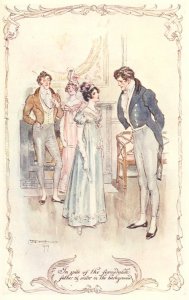
Anne and Captain Wentworth, Ch 20
Anne and Captain Wentworth in front of her “formidable” family (CE Brock, Public Domain)

I said in my Volume 1 post that I’d talk about the Navy in this post, but I’ve ended up talking about other things. However, it’s worth mentioning that in Persuasion, Jane Austen, who had two Naval brothers, presents the Navy positively, as family-oriented men whose values draw more from having good relationships with their families and their “brother” officers  than from status/position. Here is Anne watching Admiral and Mrs Croft in Bath:

They brought with them their country habit of being almost always together. He was ordered to walk to keep off the gout, and Mrs. Croft seemed to go shares with him in everything, and to walk for her life to do him good. Anne saw them wherever she went. …  Knowing their feelings as she did, it was a most attractive picture of happiness to her. She always watched them as long as she could, delighted to fancy she understood what they might be talking of, as they walked along in happy independence, or equally delighted to see the Admiral’s hearty shake of the hand when he encountered an old friend, and observe their eagerness of conversation when occasionally forming into a little knot of the navy, Mrs. Croft looking as intelligent and keen as any of the officers around her.

This continues her feelings from late Volume 1 when the visiting party in Lyme had spent time with Captain Wentworth and his naval friends. She saw their hospitality, their lack of “the usual style of give-and-take invitations, and dinners of formality and display” that typified her circle. “These would have been all my friends,” she thinks, and the idea lowers her spirits. It’s surely no coincidence that in this novel Austen presents some of the worst of the aristocracy with its focus on appearance and position against the best of the Navy with, as Louisa notices, “their friendliness, their brotherliness, their openness, their uprightness”.

And then there’s the last line of the novel:

She gloried in being a sailor’s wife, but she must pay the tax of quick alarm for belonging to that profession which is, if possible, more distinguished in its domestic virtues than in its national importance.

What does this mean, besides the point that being married into the Navy means you will always have the worry of war? Many have discussed the meaning of “more distinguished in its domestic virtues than in its national importance”, with some believing that it is Austen suggesting a new world in which the professional classes, the middle class, represented here by the Navy, is gaining ascendance in English life.

What do you think?

Jane Austen’s Persuasion, Vol. 1

Jane Austen, Persuasion

My Jane Austen group is reading Persuasion – eleven years since we last did it – because 2017 is the 200th anniversary of its publication. Of course I’ve read it several times, so, as you’ll know from my other Austen re-reads, my aim here is to focus on reflections from this read rather than to write a traditional review.

You’ll probably also know that my group often does slow reads of her novels, a volume at a time. Persuasion was published in two volumes, so last month we read Volume One. It finishes at Chapter 12, just after Louisa Musgrove has her fall at Lyme. This post is about this volume.

But first, I want to say something my relationship with Persuasion. I first read it in 1972 when the second TV miniseries was screened in Australia. I was reading it in tandem with the screening, and the night the last episode screened I sat up late to finish the last chapters. I’ll never forget my emotional response to it. I can’t remember whether the miniseries was a good one, but I sure thought the book was. Why?

Persuasion doesn’t have the sparkle of Pride and prejudice, nor the  young spoofy humour of Northanger Abbey, nor even the heroine we love to laugh at in Emma, but it is quiet, emotional and deeply felt. Its heroine Anne, at 27 years old, is Austen’s oldest. She’s caring, intelligent, but put upon by her unappreciative family – and yet we don’t feel she’s a pushover. The novel’s romance, when it comes, feels right and well-earned. No-one ever says that Austen should not have married Anne to her man the way some do about some of her other heroines such as Marianne in Sense and sensibility, and Fanny in Mansfield Park. No, when it comes to Persuasion, Austen fans are generally in agreement: it’s a lovely book in which the hero and heroine belong together. But, it’s about so much more too …

I’m not going to provide a summary, so if you need to refresh yourselves on the plot and characters please check Wikipedia.

A specific setting

I’m not sure why it is, but on this my nth (i.e. too many to count) reading of Persuasion, I suddenly noticed that it was the only book, really, that gives us a very specific date and that is set pretty much exactly contemporaneous with when Austen was writing it. It starts in “this present time, (the summer of 1814)” and ends in the first quarter of 1815. This period pretty much covers the hiatus in the Napoleonic Wars when Napoleon was exiled to Elba – and is why Naval Officers are out and about, on land and available for appearing in Persuasion! Sir Walter’s friend and advisor, Mr Shepherd tells him:

This peace will be turning all our rich Navy Officers ashore. They will all be wanting a home.

It is the appearance of the Navy and Austen’s contrasting the substance of naval officers with the superficiality of the aristocracy that gives Persuasion its particular interest – beyond its lovely story, I mean. It is very much a book about social change. (I should say, here, that Austen was partial to the Navy, having two successful Naval brothers)

Two themes

Anyhow, this idea and that relating to persuasion are developed in Volume 1 through various themes, two of which I’ll discuss here.

Appearance and Social status

That social status is a major concern is heralded on the book’s first page when we are told about Sir Walter’s favourite book: “he was a man who, for his own amusement, never took up any book but the Baronetage”. The narrator tells us soon after that:

Vanity was the beginning and the end of Sir Walter Elliot’s character; vanity of person and of situation.

However, he has not been sensible with his money, and needs to rent out his home Kellynch-hall, hence my earlier quote. But, Sir Walter doesn’t like the Navy, and his reasons convey two of the novel’s themes – the focus on status and the cult of appearance. His response to the idea of renting his home to a Naval officer is:

Yes; it is in two points offensive to me; I have two strong grounds of objection to it. First, as being the means of bringing persons of obscure birth into undue distinction, and raising men to honours which their fathers and grandfathers never dreamt of; and secondly, as it cuts up a man’s youth and vigour most horribly; a sailor grows old sooner than any other man …

This is of course ironic, because the naval officer, Admiral Croft, to whom he eventually agrees to rent the place is a thoroughly decent man (who removes Sir Walter’s myriad “looking glasses” when he takes residence). Croft also, Anne “fears”, looks after the Kellynch estate and its people far better than her family did. However, for Sir Walter, the only thing that matters is status.

As the novel progresses, the difference between the Navy and the aristocracy is further developed, but more on that anon.

Anne’s sister Mary is highly aware of her status as a Baronet’s daughter, and the “precedence” due to her. That she stands on this demonstrates her superficiality and lack of decent human feeling. She complains when she goes to her in-laws’ home that her mother-in-law does not always give her precedence. One of her sisters-in-law complains to Anne:

I wish any body could give Mary a hint that it would be a great deal better if she were not so very tenacious; especially, if she would not be always putting herself forward to take place of mamma. Nobody doubts her right to have precedence of mamma, but it would be more becoming in her not to be always insisting on it.

Later, after Louisa’s fall at Lyme, when it is suggested that calm, capable Anne remain behind to care for Louisa, Mary objects:

When the plan was made known to Mary, however, there was an end of all peace in it. She was so wretched, and so vehement, complained so much of injustice in being expected to go away, instead of Anne;—Anne, who was nothing to Louisa, while she was her sister …

Here again is Mary’s misplaced sense of “precedence”. It is also a lovely example of Austen’s plotting, because only a few chapters earlier Mary had refused to stay home from a family party to look after her own injured little boy, preferring Anne do it. Austen had set us up nicely to see the superficiality of Mary’s desire to care for her sister-in-law. The more you read Austen, as I’ve said before, the more you see how fine her plotting is.

Strength of character versus Persuasion (or the influence of others)

Another ongoing issue in the novel concerns strength of character. Captain Wentworth reflects on Anne’s lack thereof in refusing their engagement when she was 19:

He had not forgiven Anne Elliot. She had used him ill; deserted and disappointed him; and worse, she had shewn a feebleness of character in doing so, which his own decided, confident temper could not endure. She had given him up to oblige others. It had been the effect of over-persuasion. It had been weakness and timidity.

A little later, he praises Louisa Musgrove’s strength of mind, but we, the reader, realise her pronouncements are theoretical. She had not been put to the test. She says:

What!—would I be turned back from doing a thing that I had determined to do, and that I knew to be right, by the airs and interference of such a person?—or, of any person I may say. No,—I have no idea of being so easily persuaded. When I have made up my mind, I have made it.

Meanwhile, Louisa shares gossip about Anne, suggesting that Lady Russell, who had discouraged Anne from marrying Captain Wentworth, had also discouraged her from marrying Charles Musgrove (which of course reinforces for Wentworth the idea of Anne’s weakness of character).

… and papa and mamma always think it was her great friend Lady Russell’s doing, that she did not.—They think Charles might not be learned and bookish enough to please Lady Russell, and that therefore, she persuaded Anne to refuse him.

In this case, though, the decision was all the then 22-year-old Anne’s – but Wentworth only hears the gossip.

Henrietta adds to the chorus about Lady Russell’s persuasive power:

I wish Lady Russell lived at Uppercross, and were intimate with Dr. Shirley. I have always heard of Lady Russell, as a woman of the greatest influence with every body! I always look upon her as able to persuade a person to any thing!

You can see Austen building up the plot here, leading us to see Wentworth as unlikely to be interested in Anne again.

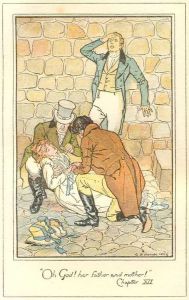
Persuasion, Lyme fall, CE Brock
Oh God! her father and mother (CE Brock, 1893?)

Anne, though, sees that firmness of character can go too far, that Louisa’s wilfulness against the advice of others had resulted in her potentially life-threatening fall. She wonders

whether it ever occurred to him now, to question the justness of his own previous opinion as to the universal felicity and advantage of firmness of character; and whether it might not strike him, that, like all other qualities of the mind, it should have its proportions and limits. She thought it could scarcely escape him to feel, that a persuadable temper might sometimes be as much in favour of happiness, as a very resolute character.

Will he see it her way? We’ll have to read Volume 2 to find out!

There’s a lot more I could say, but I think I’ve said enough. Next post I plan to take up the Navy issue a bit more …

Emily Midorikawa and Emma Claire Sweeney, A secret sisterhood (Pt 1) (#Review)

Emily Midorikawa and Emma Claire Sweeney, A secret sisterhoodMidorikawa and Sweeney’s book, A secret sisterhood, published this month, is subtitled The hidden friendships of Austen, Brontë, Eliot and Woolf, by which you might guess why a copy came my way! And so, as homework for my Jane Austen group meeting this month, I’ve just read the first part, which is about Jane Austen and Anne Sharp. If this part is representative of the whole, then I’m going to enjoy the book – but will probably read (and post on it) part-by-part. Not only will that spread my enjoyment, but it will enable me to slip the reading of it in between other books.

The impetus for the book, as Midorikawa and Sweeney (M&S from now on) explain in their Introduction, was to suss out literary friendships among female writers. They argue that literary male friendships, such as between Byron and Shelley, and Hemingway and Fitzgerald, are well-known and documented, but not so much those of women writers. They say, in fact, that “the world’s most celebrated female authors are mythologised as solitary eccentrics or isolated geniuses.” Jane Austen, for example, is seen as “a genteel spinster”, but there is more to her story than that – and M&S set about researching it.

Now, Anne Sharp is not unknown in Austen scholarship, so after reading M&S’s section, I decided to remind myself of what I already knew about this woman. She appears in several of Austen’s extant letters (Deirdre Le Faye’s Jane Austen’s letters) and in many biographies, such as those by Claire Tomalin and Carol Shields. Where she doesn’t appear, however, is in the first official Memoir of Austen written by her nephew, James Edward Austen Leigh in 1869. Why is this?

Jane Austen by sister Cassandra (surely public domain!)

Well, as Austen scholars and aficionados know, the Austen family worked hard to create what they thought was a suitable image of their famous relation. Letters were destroyed, for a start, and Jane Austen’s romances were not mentioned in the first edition. M&S argue that the family wanted to emphasise her neat handwriting, the precise way “she dropped sealing wax on her letters”, her matchless needlework. This is perhaps a little exaggerated, but the Memoir, we know, needs to be treated with some caution.

Anyhow, the real question is: was Austen-Leigh’s omission of Anne Sharp from his memoir justified, or are M&S drawing a long bow? Well, as with all research, it depends a little on your perspective and/or goals. M&S want to argue a literary friendship for Austen, and Anne Sharp would be the closest candidate for this role.

One of the features of Austen section (as I haven’t read the rest) is the insight they give into the challenges of literary research. There is, we know, a dearth of primary sources about Austen’s life. We have her letters – but their value is limited by two main factors. First, sister Cassandra destroyed any she thought were not conducive to the image of Jane that she wanted to leave, but also, Austen’s most revealing letters would have been to Cassandra, and of course she would only have written to Cassandra when they were apart. Consequently, events which occurred when they were together were less likely to have been recorded and would not have been recorded with the same openness. (Austen did write to other people, but we have even fewer of those letters. Hands up who keeps letters!)

However, as M&S found, there are other sources and these have not always been fully researched (or perhaps not even known about). For example, Austen’s niece Fanny, for whom Anne Sharp was governess, kept diaries from the age of 10. M&S write that Fanny’s “unpublished notebooks and letters” have been “largely unmined” by scholars but her writings show what must have underpinned the “deep affection” between Jane and Anne, which is the fact that Anne was a writer.

So, there in Fanny’s diaries are references to Anne Sharp’s playwriting, and M&S spend some time developing their thesis from these diaries, as well as from other sources including sister-in-law Mary Lloyd’s “pocketbook” and references to Anne in Austen’s letters. Along the way, they also research some of Sharp’s own story. M&S argue that although biographers have generally ignored the rapport between the two, Sharp was in fact a “trusted literary friend”. They cite evidence for this, including that Austen asked Sharp for her opinion on some of her novels and that Sharp responded with some writerly commentary.

Also, Sharp was one of the very few non-family members to whom Austen gave one of her 12 presentation copies of the first edition of Emma. Two others went to the Prince Regent (who’d asked for a dedication) and the established author Maria Edgeworth. M&S cite this act as indicative of the esteem in which Austen held Sharp. They also argue that her sending a copy to Edgeworth demonstrates her desire to establish some kind of literary alliance or friendship. Was it that, or did she just want the endorsement of an established author? We don’t know but M&S could be right. Whatever she wanted, however, she didn’t get it from Edgeworth.

More evidence they cite for the importance of Sharp to Austen is that Sharp was, as far as records show anyhow, one of the last people to whom Austen wrote before her death. And, she was one of the people to whom Cassandra sent not only a lock of Austen’s hair after her death, but a couple of other mementoes as well.

Have M&S convinced me of this friendship? Yes, I think so, though I’m not sure they’ve completely proved Austen’s desire for “a literary friendship”. However, this first part of A secret sisterhood is a good read, not just because I love all things Jane but because of the open way they share the process and challenge of literary research. I expect each part will be different because the sources and existing knowledge will be different, but I’m looking forward to reading them and will share my thoughts with you (eventually).

Emily Midorikawa and Emma Claire Sweeney
A secret sisterhood: The hidden friendships of Austen, Brontë, Eliot and Woolf
(Uncorrected proof)
London: Aurum Press, 2017
306pp.
ISBN: 9781781315941

(Review copy received from publisher’s rep)

Ian McEwan, Nutshell (#bookreview)

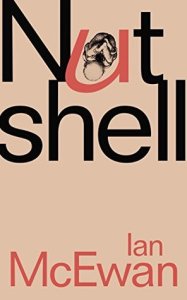
Ian McEwan, NutshellLike Carmel Bird’s Family skeleton, which I reviewed recently, Ian McEwan’s Nutshell has a narrator who won’t appeal to those who don’t like devices like skeletons in cupboards or babies in wombs. However, repeating what I said in my review of Bird’s book, it all depends on the writer’s skill, and McEwan, like Bird, is a skilful writer. Consequently, when the novel opened with “So here I am, upside down in a woman. Arms patiently crossed, waiting, waiting, waiting and wondering who I’m in, what I’m in for”, I relegated my disbelief to the pillion and set off for the ride.

As you’ll have guessed from that opening quote (if you didn’t already know), our narrator is a foetus. In my experience, McEwan writes strong, attention-grabbing first chapters, and Nutshell delivers here too. Our foetus-narrator, close to being born, is forced to be party to, or at least cognisant of, a plot concocted by his mother, Trudy, and uncle, Claude, to kill his father. Ring any bells? Yes, he (and it is a “he”) is a Hamlet in the wings. This is a clever modern riff on Hamlet, exploring many of the same issues, such as revenge, action versus inaction, corruption. It’s also a commentary on what we could grandly call the modern condition – on our world which is “too complicated and dangerous for our quarrelsome natures to manage”.

SORT OF SPOILER (so miss this paragraph if you wish)

If you know your Hamlet what I say next won’t be a spoiler, and if you don’t know your Hamlet, the part I’m giving away happens slap-bang in the middle of the book, hence is not, I’d suggest, a spoiler? So, with that fair warning, here goes. Nutshell is a tight, murder-mystery. For the first half of the book, the question is “will they do it?”, while in the second half, it’s “will they get away with it?” We are privy to most of the plotting and planning because our foetus goes, of course, wherever his mother does. However, this is as much an ideas-driven book as a plot-driven one so, I’m going to move onto some of the ideas the novel teases out.

McEwan is clear about what he sees as the “rotten state” (one of the many allusions in the novel to Hamlet) the world is in. There are references to world powers out of control. Europe  is “in existential crisis, fractious and weak”, while China, “too big for friends or counsel” is “cynically probing its neighbours’ shores”. “Muslim-majority countries” are “plagued by religious puritanism” and “foe-of-convenience” America, now “barely the hope of the world” is “guilty of torture”. There’s also the nuclear threat, climate change “driving millions from their homes”, the “urinous tsunami of the burgeoning old”, and our increasing loss of liberty in the service of security. For our foetus, though,

Pessimism is too easy, even delicious, the badge and plume of intellectuals everywhere. It absolves the thinking classes of solutions. We excite ourselves with dark thoughts in plays, poems, novels, movies. And now in commentaries. Why trust this account when humanity has never been so rich, so healthy, so long-lived.

It’s an attitude I like – and is what makes Nutshell not the bleak book it could be.

How does McEwan get away with all this?

The book, though, is not without its awkwardness. Sometimes the “rants” are a little too much, providing a virtual grab-bag of the world’s ills, from the loss of the Enlightenment’s rationality to the threat of North Korea. And sometimes our foetus-narrator is a little too knowing. Most of the time, McEwan makes clear why his narrator knows what he knows, including the limits to his knowledge, but sometimes our imaginations are stretched just a little too far. This is a very-knowing, very smart, highly articulate foetus, one who is not above giving his mother a kick:

In the middle of a long, quiet night I might give my mother a sharp kick. She’ll wake, become insomniac, reach for the radio. Cruel sport, I know, but we are better informed by the morning.

It is his “one morsel of agency” (and he uses it, giving, perhaps, Hamlet a lesson!) It is through these radio talks that our foetus learns most of what he knows about the world. Overall, McEwan maintained the conceit well, and I enjoyed the foetus-narrator’s view on the world he expects soon to join. Fortunately, my disbelief stayed on the pillion!

Besides this, the book is fun to read. There are allusions galore – not only to Hamlet but to a wide range of literary works. I would have missed many but I enjoyed spotting others, such as Jane Austen’s “two inches of ivory”, Julian Barnes’ “sense of an ending” and of course Hamlet’s “rotten state” and “a piece of work”. There is probably a bit of McEwan showing off here – flexing his literary credentials – but spotting allusions gave me little fillips of pleasure! There are also many funny scenes, including several involving descriptions of the lovemaking of the adulterous schemers:

I brace myself against the uterine walls. This turbulence would shake the wings off a Boeing. My mother goads her lover, whips him on with her fairground shrieks. Wall of Death! On each occasion, on every piston stroke, I dread that he’ll break through and shaft my soft-boned skull and seed my thoughts with his essence, with the teeming cream of his banality.

The question of course has to be asked: why choose such a narrator? I’m sure there’s more than one answer to this question. I have no idea what McEwan has said so I could be way off here, but early on our narrator describes himself as “an innocent”, “a free spirit”, a “blank slate”, albeit becoming less blank by the day. Is he the perfect naive (but certainly not unreliable) narrator, able to comment, “unburdened by allegiances and obligations” on the murky world, or is McEwan suggesting there’s no such thing as innocence? Or, is his function to answer that question of whether we should bring children into the world. In the end, I think that McEwan’s message – or one of them anyhow – is that the world is worth hanging around for. It is “Beautiful. Loving. Murderous”, like Trudy, and our foetus wants to live it, hoping he will find meaning. An engaging read.

Ian McEwan
Nutshell
London: Vintage, 2016
ISBN: 9781473547131 (ePub)

(A reading group read)

Shakespeare’s Sonnets, app-style

Back in 2011 I wrote a post, a few in fact, on Touchpress‘s wonderful iPad app for TS Eliot‘s poem The wasteland. I love that app. It’s an excellent example of how interactive digital media can enhance learning about or enjoyment of literature, for a start, though Touchpress has applied its approach to a wide range of scientific and historical topics, including the solar system and Leonardo da Vinci’s Anatomy.

As you’ve probably worked out by now, Touchpress has also done one on Shakespeare’s sonnets, the whole 154 of them. It was released back in 2012 but I only bought it a year or so ago, when I decided it was time I became more familiar with this part of his oeuvre. So far I’ve only dipped into it, but have decided it’s worth posting on it now, rather than wait until I’ve finished it.

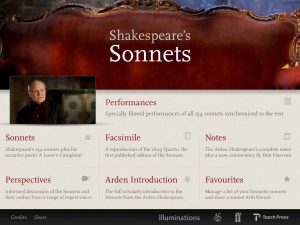
SHAKESPEARE SONNETS APP MENUSo this is an introduction rather than a proper review. The app follows a similar format to that used for Eliot, with some variations due to the work itself, and its age and particular history. It comprises the following menu items:

  • All 154 Sonnets in text form
  • Performances, by different people, such as Jemma Redgrave, David Tennant, and Stephen Fry, of each sonnet (filmed performances with the text synced to it)
  • Facsimile reproduction of the first published edition of the sonnets in 1969
  • Perspectives, that is, commentary on the sonnets, including their form, history and Shakespeare’s use of them, by various academics/Shakespearean scholars, such as Katherine Duncan-Jones, James Shapiro, Don Paterson – filmed talks, with transcript of the text.
  • Notes, that is, Arden’s detailed notes on each sonnet, including notes on individual lines.
  • Arden’s scholarly Introduction
  • Favourites, which as you’d assume allows users to save and share – yes – their favourites.

There is a Home icon so you can quickly return to the menu screen to navigate around the app. And there are also well thought through navigations. For example, on the screen containing the straight text of the sonnet are icons linking directly to the Notes, the filmed reading of the sonnet, and the Facsimile version. If you then  choose Notes, you get three tabs – Arden Notes (explanation of allusions and idioms, definitions of obsolete words, and the like), Commentary (critique) and My Notes (make your own notes).

As with all Shakespeare – given the unfamiliar-to-us language of his time – the sonnets come to life when read by people who know what they are doing.  You can read them in order, or navigate easily to particular sonnets. You can also read/hear them by performer, as when you touch a performer’s image up pops a windows listing the sonnets they perform.

Anna Baddeley, reviewing the app for The Guardian says

The Sonnets app, like its older sister The Waste Land, has the power to awaken passions (in my case, Shakespeare and poetry) you never knew you had. Reading outside and trying vainly to shield my iPad from the glare, I prayed the sun would go in so I could see what Don Paterson had to say about Sonnet 129.

Paterson’s commentary is the best thing about this app. It’s like sitting in the pub with a witty, more literary friend, who uses language such as “mind bouillabaisse” and “post-coital freak-out”. Most fascinating is his emphasis on the weirdness and borderline misogyny of the sonnets, a view echoed by the other academics interviewed for the app.

I don’t know Don Paterson, whom Wikipedia tells me is a Scottish poet, writer and musician, but Baddeley is right – in the sense that his commentaries are fresh, engaging, personal, funny and yet also meaningful. I wouldn’t go so far as to say they’re the best thing about the app, because it’s the whole that is important, but they certainly give it life.

This is not something to read in a hurry, and it is a BIG app, but how wonderful it is to have these sonnets so readily available on my iPad wherever I go.

Have you used this app, or would it interest you?

William Shakespeare
Shakespeare’s sonnets
iPad app
The Arden Shakespeare, Touch Press and Faber and Faber, 2012
1.55Gb

George Orwell’s Politics and the English language

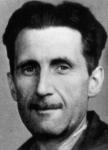
George Orwell, 1933 (Presumed Public Domain, from Wikipedia)

I was reminded of George Orwell’s rules for writing this weekend while reading an article about the German architectural historian, Nikolaus Pevsner (1902–1983). In her article, “New guides to Bath: Society and scene in Northanger Abbey, Judy Stove-Wilson wrote that

Pevsner noted the strong tendency of English towards monosyllables. He regarded this as symptomatic of ‘understatement, the aversion against fuss, the distrust of rhetoric’ (Pevsner, The Englishness of English art, 1956, p. 13).

The reason I was reading this article, as you’ve probably guessed from the title, is because my local Jane Austen group is currently discussing Northanger Abbey. Pevsner wrote in 1968 an oft-quoted article on Austen, “The architectural setting of Jane Austen’s novels”. He, keenly interested in architecture, was critical of Austen’s minimal descriptions of buildings in her novels, though he was impressed with her knowledge of and use of Bath in her novels – and of course much of Northanger Abbey is set in Bath.

But, I’m digressing. My inspiration for this post is his comment on “the strong tendency of English towards monosyllables”. It made me chuckle given the German language’s predilection for multisyllabic words. It also reminded me of Orwell’s 1946 essay, “Politics and the English language” and his 6 rules:

  1. Never use a metaphor, simile, or other figure of speech which you are used to seeing in print.
  2. Never use a long word where a short one will do.
  3. If it is possible to cut a word out, always cut it out.
  4. Never use the passive where you can use the active.
  5. Never use a foreign phrase, a scientific word, or a jargon word if you can think of an everyday English equivalent.
  6. Break any of these rules sooner than say anything outright barbarous.

No. 2, of course, is the one I was remembering.

However, on returning to the essay to check Orwell’s actual rules, I realised that the whole essay is worth reading again, because in our world of “alternative facts” Orwell’s words on the relationship between politics and language are as relevant today as when he wrote them 70 years ago. He writes that, paradoxically, our language

becomes ugly and inaccurate because our thoughts are foolish, but the slovenliness of our language makes it easier for us to have foolish thoughts.

This is reversible, he believes, and reversing it is critical because good writing enables clear thinking, and the ability “to think clearly is a necessary first step toward political regeneration”. I should clarify, if you don’t already know, that his target is factual, and particularly “political writing”, not “the literary use of language” by which, presumably, he means creative or fictional writing.

Later in the essay he makes very clear why he is writing it, and you’ll quickly see why I’m sharing it now:

In our time, political speech and writing are largely the defence of the indefensible. Things like the continuance of British rule in India, the Russian purges and deportations, the dropping of the atom bombs on Japan, can indeed be defended, but only by arguments which are too brutal for most people to face, and which do not square with the professed aims of the political parties. Thus political language has to consist largely of euphemism, question-begging and sheer cloudy vagueness. Defenceless villages are bombarded from the air, the inhabitants driven out into the countryside, the cattle machine-gunned, the huts set on fire with incendiary bullets: this is called “pacification”. Millions of peasants are robbed of their farms and sent trudging along the roads with no more than they can carry: this is called “transfer of population” or “rectification of frontiers”. People are imprisoned for years without trial, or shot in the back of the neck or sent to die of scurvy in Arctic lumber camps: this is called “elimination of unreliable elements”.

Hmm … I bet everyone reading this can think of their own contemporary examples. Please share them if you like!

I won’t write more on the essay, as my main aim was simply to share its continuing relevance. I’ll just leave you with a sentence from his last paragraph:

Political language — and with variations this is true of all political parties, from Conservatives to Anarchists — is designed to make lies sound truthful and murder respectable, and to give an appearance of solidity to pure wind.

That George Orwell. He really was something.

George Orwell
“Politics and the English language” 1946

Northanger Abbey musings (2)

A month ago I posted some musings arising from the first part of my current slow read of  Northanger Abbey with my Jane Austen group. In this post I’ll share some reflections on the rest of the novel, Chapters 20 to 31, which is the part that encompasses our “heroine” Catherine’s arrival in and departure from the Abbey.

On the art of fiction

In my previous post, I discussed how Northanger Abbey spoofs or parodies Gothic novels. Northanger Abbey also contains Austen’s famous defence of the novel. These contribute to one of the pleasures of this novel, which is the joy Austen seems to be having in being an author. She intrudes regularly with her own voice, not only commenting on the characters but on fiction itself. It’s the new novelist having fun, flexing her muscles, and making an argument for more “realistic” fiction over the Gothic novel that was popular in her time.

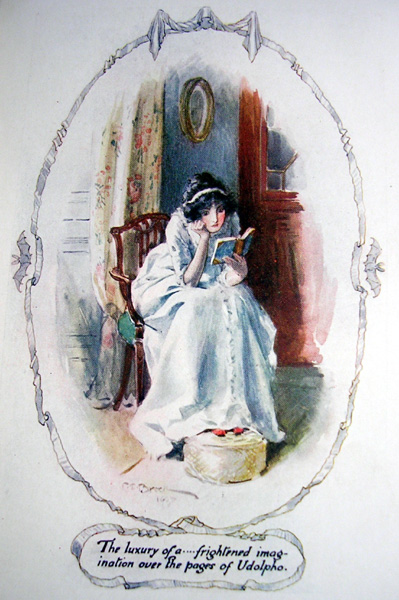
Northerner Abbey illus br Brock

So, for example, here is Catherine, at the Abbey, deciding that the General had been up to no good regarding his late wife:

His cruelty to such a charming woman made him odious to her. She had often read of such characters, characters which Mr. Allen had been used to call unnatural and overdrawn; but here was proof positive of the contrary.

Mr Allen is the sensible neighbour who, with his wife, had taken Catherine to Bath. One of the things Austen does in this novel, and particularly in the second half, is satirise readers of Gothic novels, readers who let their imaginations run away with them. Catherine, our narrator tells us, is too “well-read” to let the General’s “grandeur of air” and “dignified step” dissuade her from her belief about his dastardliness. And so, when at last she is proved wrong (though the General does prove villainous in other ways), Henry admonishes her:

What have you been judging from? Remember the country and the age in which we live. Remember that we are English, that we are Christians. Consult your own understanding, your own sense of the probable, your own observation of what is passing around you. Does our education prepare us for such atrocities? Do our laws connive at them? Could they be perpetrated without being known, in a country like this, where social and literary intercourse is on such a footing, where every man is surrounded by a neighbourhood of voluntary spies, and where roads and newspapers lay everything open?

There is so much to tease out here besides Austen’s satirising the Gothic sensibility … but let’s save them for another re-read, and move on.

Soon after, Catherine considers Henry’s admonition, and thinks:

the whole might be traced to the influence of that sort of reading which she had there indulged. Charming as were all Mrs. Radcliffe’s works, and charming even as were the works of all her imitators, it was not in them perhaps that human nature, at least in the Midland counties of England, was to be looked for.

So, it is human nature that most interests Austen – not the one-dimensional “angel” and “fiend” characters of the Gothic novelists.

Late in the novel, as our hero and heroine are coming together, Austen writes:

Henry was now sincerely attached to her, though he felt and delighted in all the excellencies of her character and truly loved her society, I must confess that his affection originated in nothing better than gratitude, or, in other words, that a persuasion of her partiality for him had been the only cause of giving her a serious thought. It is a new circumstance in romance, I acknowledge, and dreadfully derogatory of an heroine’s dignity; but if it be as new in common life, the credit of a wild imagination will at least be all my own.

Here, I’d say, there are two main things going on. One is the cheeky novelist teasing us with her “new circumstance in romance” undermining the conventional idea of romantic love between heroes and heroines in novels. The other is the more serious Austen making a rather subversive observation about the realities of love and human relationships, because she was a pragmatist at heart. She believed in love, but she also understood the implications of the marriage market.

If all this sounds a little confused, that’s probably because it is. Austen plays around in this novel with ideas about fiction versus reality, Gothic (European) sensibility versus more ordered (English) values, and reading versus readers. To do so, she slips in and out of different modes of narrative, daring us to keep up with her. No wonder it’s the book that has proven the hardest to adapt to film.

More word teasing from Henry

In my last post, I shared Henry’s little tirade about the word “nice”. I can’t resist sharing another little tirade from later in the novel:

“No, and I am very much surprised. Isabella promised so faithfully to write directly.”

“Promised so faithfully! A faithful promise! That puzzles me. I have heard of a faithful performance. But a faithful promise—the fidelity of promising! It is a power little worth knowing, however, since it can deceive and pain you…

Love it …

And here endeth my reflections on my most recent re-read of Northanger Abbey. What a delight it has been, yet again. It may not have the romance of Pride and prejudice or the complexity of Emma, but it has the lively, fresh mind of an author who wants to engage with her readers about the very thing she is doing, writing a novel. I find that irresistible.

Picture credit: From Chapter 9, illus. by CE Brock (Presumed Public Domain, from solitaryelegance.com)