Sarah Waters, The little stranger

The little stranger, by Sarah Waters

The little stranger (Book cover courtesy: Virago Press)

I’m not quite sure I know where to start with this one –  the ghost story that isn’t. Or is it? The little stranger is my second Sarah Waters’ novel. I found The night watch riveting, and I did see and enjoy (but not read) her very Dickensian Fingersmith.

Like The night watch, The little stranger was shortlisted for The Man Booker Prize. It’s an easy read, and rather a page-turner, but by the end I have to say that I felt a little unsure about what I’d read. In one of those interesting bits of reading synchronicity, I recently read Helen Simonson’s Major Pettigrew’s last stand. It is very different to this one, and is set a few decades later, but they both deal with the loss of “old families” and the breaking up of their estates. Waters, though, is the far superior writer.

So, what is the plot of The little stranger? Its first person narrator, Dr Faraday, was born to the working class but, through family sacrifice, has pulled himself up into the professional middle class. After a brief flashback to a childhood memory of Hundreds Hall, where his mother had worked as a housemaid, he proceeds to chronicle the relationship he develops with the Hall’s family when he is in his late 30s and practising in the nearby town as a GP. The family comprises the mother, Mrs Ayres, and her adult children, Caroline and Roderick. The book is set soon after World War 2, and the story he tells occurs over the period of about a year, but is told from the vantage point of some three years later.

Waters is best in her vivid description of the house, its inhabitants and its increasing dilapidation. I’m tempted to read the house as a metaphor for the society it represents – for the days of elegance and upstairs-downstairs that are now on the way out.  And, extending this idea, “the little stranger” (or “dark germ”) that seems hell-bent on bringing about the house’s destruction could then be seen as a metaphor for the rapid modernisation that was occurring in post-war England and that was pushing the old families to the brink of economic and, thereby, social ruin. After all, servant Mrs Bazeley reassures the young servant girl Betty that “it” is not interested in them.

To support this way of looking at the novel, here is Dr Faraday early-ish in the novel:

But Hundreds Hall had been made and maintained, I thought, by the very people they were laughing at now. After two hundred years, those people had begun to withdraw their labour, their belief in the house; and the house was collapsing, like a pyramid of cards. Meanwhile, here the family sat, still playing gaily at gentry life, with chipped stucco on their walls, and their Turkish carpets worn to the weave…

And here is Dr Seeley (to whom he later goes for advice):

The Ayreses’ problem … is that they can’t or won’t adapt … Class-wise they’ve had their chips. Nerve-wise, perhaps they’ve run their course.

Quotes like these support a social change interpretation. And yet, perhaps it is more psychological? Dr Seeley suggests that part of one’s psychology, one’s dream-self , can break loose and become some sort of “psychic force”:

The subliminal mind has many dark, unhappy corners, after all. Imagine something loosening itself from one of those corners. Let’s call it a – a germ. And let’s say conditions prove right for that germ to develop – to grow … What would this little stranger grow into? A sort of shadow-self, perhaps a Caliban, a Mr Hyde. A creature motivated by all the nasty impulses and hungers the conscious mind had hoped to keep hidden away: things like envy, and malice and frustration…

Somewhat supporting this interpretation is Caroline’s report of her mother as saying:

the house knows all our weaknesses, and is testing them one by one.

And so what do you think? Psychological/psychic or social? Or perhaps bit of both? That is, the arrogant upper class family out of touch and unable to adapt (social) releasing all its weaknesses (psychic). I’m not sure that Waters makes the case clearly enough – partly I think due to the ambiguity posed by the narrator.

Her characterisation is in fact coherent and convincing, except for the narrator. How are we to read him? Is he genuine – does he really care for the family? Does he genuinely care for the house and its history? Or, is he a social climber who wants his way into the house any way he can. I must say I couldn’t fully work him out. Is he reliable? The tone is quite reminiscent of that in Ishiguro’s wonderful Remains of the day. Like Ishiguro’s butler, Dr Faraday tells the story from some time after the events, and he peppers his account with such words as “recall”, “I think I noticed”, “must have”, words that suggest that all may not be as he sees it. And in some ways it isn’t, but there is no intriguing twist, neither is there a traditional resolution. As I read I wondered whether he was stringing me along, whether he was the cause of the malevolence. He did after all chip away a decorative acorn from the house on his youthful visit:

I was  like a man, I suppose, wanting a lock of hair from the head of a girl he had suddenly and blindingly become enamoured of.

If he was the malevolence, there is no evidence to suggest it is anything other than unconscious. And further, if he was, it certainly makes the whole class divide story more complex – and, more interesting.

Regardless, though, of how the end comes about, of “who” (one? many? none?) is responsible, it is pretty clear that the winners – if there can be such things in the messy game of life – are the old underclass. Hundreds was, in Dr Seeley’s view, “defeated by history, destroyed by its own failure to keep pace with a rapidly changing world”. It is not surprising, I suppose, that by the end the narrator is both “baffled and longing”.  Social change never has been easy!

Sarah Waters
The little stranger
London: Virago, 2009
450pp.
ISBN: 9781844086023

Helen Simonson, Major Pettigrew’s last stand

If you like warm-hearted novels with a positive ending you may like this. If you like such novels with a touch of social commentary you will probably like this. If you like books like The Guernsey Literary and Potato Peel Pie Society and Miss Garnet’s angel, then this is definitely for you. But if you like a little more meat in your sandwich, a little more fodder for the brain, then you may like to look elsewhere for your next read.

Major Pettigrew’s last stand concerns one widowed Major Pettigrew and the little, very English village in which he lives. He meets Mrs Ali, the English-born-of-Pakistani background owner of the local shop, and the result is a story of racism, classism and materialism as these two find they have much in common but are confronted by bigotry and cultural expectations (from both sides) that set to derail them. I won’t go into details. There are some interesting characters including the Lord of the manor, some businessmen and a self-centred ambitious son, but most are a little too stereotyped for serious analysis. Some valid contemporary issues regarding English village life are raised, particularly regarding the increasing cultural diversity in the population, and the aristocracy and its role in villages, but the plot becomes a little melodramatic and predictable for my preference.

There are however some nice observations in the book:

…as I get older, I find myself insisting on my right to be philosophically sloppy. It’s so hard to maintain that rigour of youth, isn’t it?

I have no patience with all this analysing of writers’ politics … let them analyse the prose.

Good point. I often – as I’m sure many of us do – wonder how much we should take into consideration the politics of the creator. Is it OK to like TS Eliot? Should we listen to Wagner?

Life does often get in the way of one’s reading…

Ain’t that the truth?

Simonson is British born but wrote this in the USA where she now resides. There are quite a few “digs” at America. The Major, with whom we are supposed to sympathise, if not identify, is critical of American “self-absorption” though he discovers that his potential American daughter-in-law has more substance than he thought. The book, does, in fact  explore the way we stereotype each other in ways that can prevent “true” relationship developing. As the Major recognises at one point, he

knew he was a fool. Yet at that moment, he could not find a way to be a different man.

The novel has some genuinely funny scenes and is lightly satirical in that way that the English tend to do well… And so, while it is not my preferred type of reading, it is nicely written and will provide good reading for those who want a bit of grit without the grimness that often accompanies stories of racial conflict and politics. I know a few people to whom I will happily recommend it.

Helen Simonson
Major Pettigrew’s last stand
New York: Random House, 2010
361pp
ISBN: 9781400068937

(Unpublished proof copy, lent)

Leslie Geddes-Brown, Books do furnish a room

Book stacks

Book stack - part of the TBR pile

There was no resisting this book – Books do furnish a room – when I saw it on a table in the National Library of Australia’s bookshop. It’s rare for me to buy a coffee-table book but … this is one gorgeous book. It is lavishly illustrated with images of books in pretty well every room or area of a house from bathroom to bedroom, from stairwell to kitchen. It’s enough to make a booklover drool.

But, what really sold it to me was that, amazingly, it even has an example that justifies my practice shown right: “Surprisingly” says Geddes-Brown, “it is found in a home belonging to a former editor of South African House & Garden … his excuse is that he had no bookshelves and just piled books against his bedroom wall”. Love it! He can visit my house any time.

In her introduction Geddes-Brown, former Deputy Editor of World of Interiors and Country Life magazines, writes:

So books do furnish a room – but not always very well. This book, with images from stylish houses, taken by world-famous photographers, intends to show how it can be done.

Hmm…I do find the text a little simplistic but, what the heck, after all it is really an adult’s picture book. And, it does contain the odd bit of practical advice – particularly for those who have not thought a lot about such things – such as about shelf size, location, and lighting. The book is divided into four sections – Living with books; Working with books; Designing for books; and Making the most of books – with each section having a short introduction followed by lots of well-captioned images to lust after.

And that’s about all I’m going to say, because this is a book to look at not talk about. I will just leave you with this:

… in their way, books are like pictures on the wall; they reveal whether you are a minimalist with all covers hidden under plain wrappers, a maximalist whose every room has a generously filled bookcase, or an anarchist whose preferred method of storage is an untidy heap.

Which one are you?

Leslie Geddes-Brown
Books do furnish a room
London: Merrell Publishers, 2009
158pp.
ISBN: 9781858944913

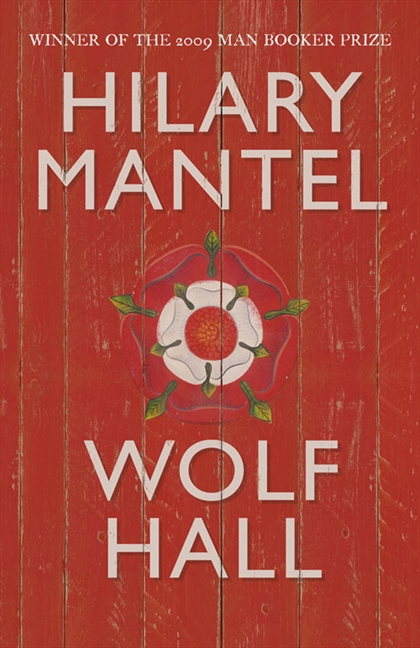
Hilary Mantel, Wolf Hall

An interesting question to ponder when thinking about Hilary Mantel’s Wolf Hall is the significance of the title. While the place Wolf Hall, the family seat of the Seymour family, does get a few mentions it does not really function as a location. Wolves, however, are one of the subtle motifs running through the novel. As its protagonist remembers late in the book:

…homo homini lupus, man is wolf to man.

Hilary Mantel, Wolf Hall

Cover image (Courtesy HarperCollins Publishers)

And, after reading the novel, it would be hard to refute this notion! Wolf Hall is set in England between 1500 and 1535, with most of the action taking place between 1527 and 1535. It deals primarily with the lead up to and first years of Henry VIII’s marriage to Anne Boleyn, but as seen through the eyes of Thomas Cromwell. Its plot centres on the machinations involved in dissolving Henry’s marriage to Katherine (Catherine) of Aragon, who had failed to produce a male heir, so he could legally marry Anne Boleyn; its real subject matter, though, is far wider than that. Its time period – the early years of the English Reformation – and its plot mean that it deals with the major issues of the time, including England’s separation from Rome, the translation of the Bible into English and the relaxing of rules regarding access to the Bible, the Act of Supremacy, and succession to the throne. Running through this are the jostlings for power, the skullduggery, and the betrayals (and suprising acts of loyalty) that are the hallmarks of the Tudor Court. Man was indeed wolf to man then (and I sometimes wonder how much has changed?).

This is an exquisite – though large! – novel. It won the 2009 Booker Prize: I can’t compare it with the others because I haven’t read them, but I did enjoy this immensely. In my recent review of The enchantress of Florence – and what fascinating synchronicity to read these two in sequence – I said that the one word I would use to describe it was “paradoxical”. The word I would use for Wolf Hall is “subtle”. It is subtle in so many ways – in its narrative style, its humour, its irony, its symbolism, its descriptions, its juxtapositions. Nothing here is heavy-handed or overdone.

But first, its narrative style. I was forewarned about Mantel’s use of “he” in this novel and perhaps this helped, because I rarely found it difficult or confusing. In fact, I rather liked the style. It’s a bit like a first-person novel told in third person – third person subjective (limited) point of view, I guess – and so the use of “he” reminds us that it is HIS perspective we are getting. Everything we know we know through him, through his thoughts and through his interactions with others. I found this approach intriguing – it gave immediacy and distance at the same time. And this brings me to the man himself.

Thomas Cromwell, for those who don’t know their English history, rose from very humble beginnings to being Henry’s trusted chief minister. He did this by dint of his character and the timely beneficial patronage of Cardinal Wolsey. He became street-smart in his youth but he also educated himself in the culture (literature and art) of the times. He could speak Latin, Italian and French. He was an accountant and lawyer.  He knew about trade. He was no slouch in the kitchen either. He was, indeed, a jack-of-all-trades. Here is a description early in the book (1527):

Thomas Cromwell is now a little over forty years old. He is a man of strong build, not tall. Various expressions are available to his face, and one is readable: an expression of stifled amusement … It is said he knows by heart the entire New Testamant in Latin … He is at home in courtroom or waterfront, bishop’s palace or inn yard. He can draft a contract, train a falcom, draw a map, stop a street fight, furnish a house and fix a jury…

A man, that is, not to be trifled with – and yet he is a man who develops a large and loving household full of loyal children, relatives and “wards”. Some of the loveliest sections of the book are set in his home, Austin Friars. He is also loyal – sticking by Wolsey, for example, in his decline – and firm, hard even, but not cruel.

However, I don’t want this review to be as long as the book and so shall move on. I loved Mantel’s descriptions – they are always short but highly evocative. Here is the Duke of Norfolk:

The duke is now approaching sixty years old but concedes nothing to the calendar. Flint-faced and keen-eyed, he is lean as a gnawed bone and cold as an axe-head;  his joints seem knitted together of supple chain links, and indeed he rattles a little as he moves, for his clothes conceal relics…

And here is another telling description (after charges against Wolsey have been written):

It is a wan morning, low unbroken cloud; the light filtering sparely through the glass, is the colour of tarnished pewter. How brightly coloured the king is, like the king in a new pack of cards: how small his flat blue eye.

Delicious aren’t they?

The novel ends at an intriguing point – but I won’t give that away here except to say that it does not conclude with the end of Cromwell’s life. That, we believe, is the subject of a sequel.

I would love to keep writing about the characters, the language, the way Mantel puts it all together – such as the way she drops hints then explores them later – but that could become boring. Better for you to read the book (if you haven’t already). Instead, I will end with what is probably the book’s overarching theme – that of “how the world works”, and that is through machinations behind the scenes:

The fate of peoples is made like this, two men in small rooms. Forget the coronations, the conclaves of cardinals, the pomp and processions. This is how the world changes: a counter pushed across a table, a pen stroke that alters the force of a phrase, a woman’s sigh as she passes and leaves on the air a trail of orange flower or rosewater…

It was ever thus, eh?

Hilary Mantel
Wolf Hall
London: Fourth Estate, 2009
653pp.
ISBN: 9870007292417

POSTSCRIPT: Steven, at A Momentary Taste of Being, posted a link to this fascinating article by Hilary Mantel on Thomas Cromwell. It is well worth a read.

Kazuo Ishiguro, Nocturnes: Five stories of music and nightfall

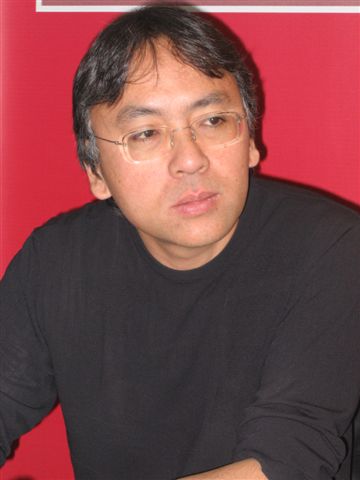
Kazuo Ishiguro

Kazuo Ishiguro, 2005 (Courtesy: Mariusz Kubik CC-BY-SA 3.0)

I like Kazuo Ishiguro – and have read 5 of his 6 novels – so I was looking forward to reading Nocturnes, his first published collection of short stories. Nocturnes, as the subtitle describes, comprises five short stories, each focussing in some way on music, and on a day’s end.

The five stories – a couple of them with overlapping characters – are unmistakably Ishiguro. All have first person narrators, and in all cases the narrator is either unreliable or in some other way not completely across what is going on. This is the Ishiguro stamp … as is the overall tone of things not being quite right, of potential not being quite achieved, of people still looking for an elusive something but not necessarily knowing quite what that is.

When reviewing a short story collection I don’t necessarily feel the need to list each story but with there being so few in this case, I think I will, so here they are:

  • “Crooner”: an aging crooner, with the narrator as his accompanist, serenades his young wife from a gondola at a time when their marriage is breaking down
  • “Come rain or come shine”: a nearly 50-year old ESL teacher visits old university friends, only to find that their relationship is under stress
  • “Malvern Hills”: a not-yet-successful young rock guitarist visits his sister and brother-in-law in the country, and meets some Swiss tourists who are also musicians and whose marriage is a little rocky. (Hmm… see a theme developing here?)
  • “Nocturne”: another not-very-successful musician (this time a saxophonist) finds himself in the same hotel as the (now ex-)wife from the first story, while they are both recuperating from plastic surgery
  • “Cellists”: a cellist with potential is mentored by another cellist who is not quite what she seems

While there is a similarity in the tone of these stories, there are also differences. “Come rain or come shine” and “Nocturne”, for example, are a little reminiscent of When we were orphans in the sense that Ishiguro slowly (even in a short story!) but surely leads his characters (and we readers alongside) into increasingly bizarre, if not almost surreal, behaviours. Moreso than the other stories, these two have a comic, albeit tinged with pathos, edge.

The technique Ishiguro uses to present his notions of failing or missed potential is one common to most of his writing: he explores and exposes the gap between appearance and reality. This gap is given literal expression in “Nocturne” where two would-be stars are both bandaged for most of the story as a result of their plastic surgery, but it is there in all the stories: from the first story’s Tony and Libby Gardner who are separating for the most “superficial” of reasons to the last story’s self-described virtuoso cellist. It is found in Ray Charles’ version of the title song in “Come rain or come shine” “where the words themselves were happy, but the interpretation was pure heartbreak”. This gap is also conveyed through the prevaricative words commonly used by Ishiguro’s narrators, such as “I guess”, “perhaps”, “maybe” and “probably”:

I guess it showed in our music (“Crooner”)

Perhaps it was simply the effect of receiving a clear set of instructions (“Come rain or come shine”)

Maybe they were just tired. For all I know, they might have … All the same, it seemed to me (“Malvern Hills”)

… that probably means … and Maybe it was plain spinelessness. Or maybe I’d taken on board … (“Nocturne”)

Maybe there was a tiny bit if jealousy there … and … well, maybe there’s something in that (“Cellists”)

Ishiguro’s hallmarks of misconceptions and misconstructions, assumptions and self-deceptions are all evident here…sometimes in the narrator, sometimes in the other characters, sometimes in both.

The stories stand alone but, somewhat like Tim Winton‘s The turning, there’s a feeling that these stories go together, not just because of the recurring characters in two of them, and the apparent similarity of setting in the first and last stories, but also because of the recurring musical motif and the consistency in theme. If I were a musical expert rather than dilettante I might have tried to relate the five stories to some sort of musical structure but, fortunately for you, I am just the dilettante! That said there are some neat little links between the first and last stories which round them off nicely, just like a well-conceived piece of music.

There are no twists in the tail or crashing codas in these stories. This may disappoint some readers but, for me, they are deliciously conceived quiet, subtle stories that cleverly draw you into their characters’ lives while at the same time leaving you with the impression that you should keep your distance lest you too suffer from their malaise and disappointments.

Kazuo Ishiguro
Nocturnes: Five stories of music and nightfall
London: Faber and Faber, 2009
221pp.
ISBN: 9780571244997

Tessa Hadley, Friendly fire

TessaHadleyMacmillan

Tessa Hadley (Courtesy: Macmillan Books, via their “noncommercial” terms of use)

“Friendly fire”, a short story by the English writer Tessa Hadley, is a simple story of two middle-aged women cleaners in an industrial warehouse, Pam who owns the cleaning business and her friend Shelley who is helping her out for the day. The story focuses on Shelley and nothing much really happens – it’s more about what goes through Shelley’s mind as she cleans the factory floor and its toilets.

The first thing that strikes about the story is the language: the stars are “like flecks of broken glass” and “she let the cold creep into her as if she were made of stone”. Very quickly we get the sense that Shelley is not the happiest person on the planet. Hadley also uses double negatives – “they didn’t make a bad team” and “it wasn’t that she wasn’t proud” – further conveying Shelley’s less than joyous feelings about life.

So, what happens? Shelley and Pam go to the warehouse, clean (one upstairs and one downstairs) and then leave for home. While she is cleaning, Shelley thinks about her son Anthony who is a soldier in Aghanistan, and we realise that it is her fear for his safety that occupies her mind day and night, that colours her emotions. The title of the story comes from her worry that her son might have been involved in a friendly-fire incident. Her husband tells her: “Why d’you have to make up trouble … as if there wasn’t enough already?” In between, she thinks about the ups and downs of her marriage, her daughter’s teen pregnancy, her menopausal loss of libido. Life certainly seems rather circumscribed these days for Shelley. Even her husband’s playful phone messages – about funny place names like the Fishmonger called “A Plaice to Go” – fail to lighten her spirits. Perhaps she’d like to be in a different place?

At the end of the day, they return to the car and “the sky was a blue so pale that it was almost no colour”. Muted like her sense of her life! So, what is it about? Primarily, it is about the worries of a mother for her son engaged in an arena of war. It’s not dramatic, but it’s a nicely observed story that conveys the wider implications of our engagement in war, and how women – the mothers – bear much of that.

George Orwell, Bookshop memories

I do like to read a bit of Orwell every now and then – and for that reason, though I have other books of his to read in my TBR pile, I recently bought his essay collection, Books v. cigarettes, in Penguin’s delightful Great Ideas series. I blogged about the first essay a couple of months ago. Tonight I decided to read the second essay, “Bookshop memories”, in which he draws on his experience of working in a second-hand bookshop. It was published in 1936.

There’s a nice little Wikipedia article about the essay, giving the background to his writing it and a brief summary of its content, so I won’t repeat all that again here. Rather, I’ll just comment on a couple of observations he makes that tickled my fancy, and these relate to one of the sidelines of the bookshop: its lending library. He says that in a lending library “you see people’s real tastes and not their pretended (my emphasis) ones, and so, he notes that:

  • “classical English novelists have dropped out of favour. It is simply useless to put Dickens, Thackeray, Jane Austen*, Trollope etc into the ordinary lending library; nobody takes them out”. Dickens, he says, “is one of those authors people are ‘always meaning to read'”
  • there is a growing unpopularity of American books (but he doesn’t give any reason for this)
  • people don’t like short stories because, for some, “it is too much fag to get used to a new set of characters with every story”. Orwell says on this one that the blame lies as much with the writers as the readers: “Most modern short stories, English and American”, he says, “are utterly lifeless and worthless”. Those that “are stories”, such as by D.H. Lawrence, are, he says, “popular enough”.

I don’t think the second point is true today (at least in Australia), but I suspect that the first and third still have some credence. Again and again I hear in bookgroups, “let’s not do a classic” and “I don’t like short stories”. Of course, there are exceptions (my bookgroup, for example, likes to do a classic a year!) but I think the rule still applies. Will it be ever thus?

* Have you noticed how Jane Austen is more often than not referred to with both her names while the fellas often aren’t? We comfortably talk about Shakespeare, Dickens, and Wordsworth, but far less so of Austen. Chivalry? Sexism? Odd isn’t it?

Jim Crace, Being dead

The old “so many books, so little time” mantra means that I very rarely read a book more than once (other than my Jane Austens of course), but I have read Jim Crace’s Being dead twice. I love this book. I know some find the subject matter unappealing but I find it not only fascinating but rather beautiful.

Beach near Bermagui, New South Wales

Beach near Bermagui, New South Wales

For those who haven’t heard of this novella (really), its plot centres on a murder. Joseph and Celice, a middle aged couple (and, significantly, zoologists), are bashed to death on a secluded part of a beach at the book’s beginning and, from this point, the story moves in multiple directions to explore a number of before and after scenarios relating to this event. In fact, one of the things I like about the book is its four-part structure, and its forwards-backwards movement in time as the different strands of the story are played out. Crace moves backward from the moment of their death to the beginning of that day, and alongside this he recounts forward the story of their relationship from the point of their meeting. The third strand concerns their daughter as she reacts to the news of their disappearance, and the final strand, which is the one that turns off some readers, chronicles the decomposition of their bodies as they lie undiscovered in the dunes. It’s not for nothing he makes them zoologists!

Near the end of the book is a clue to why Crace has chosen this structure. He writes that “Earth is not a visionary and can’t be blamed for what’s ahead. It is retrospective … It is the past that shapes the world, the future can’t be found in it”. It seems to me to be a pretty fatalistic – what will be, will be – view of the world, and one I rather like. I don’t think he’s quite saying we can’t change our world but he is saying that what we do, what is now, shapes it and our lives, that there’s no future mystery out there waiting to make something of us. Right near the end is this:

Nothing could be changed or amended, except by the sentiment of those who were not dead. That’s the only Judgement Day there is. The benefits of hindsight. The dead themselves are robbed of hindsight.

So what about the characters who are the focus of all this? Crace has in fact chosen pretty ordinary, fairly unlovable (except to themselves) not-particularly-admirable characters. By doing this he makes the point that we all have our lives, that the only really important thing is love, and that there is dignity in that. As he writes: “Love songs transcend, transport, because there is such a thing as love”.

And it is all told in language that is rhythmic and oddly beautiful despite the horror of the subject matter:

The corpses were surrendered to the weather and the earth, but they were still a man and wife, quietly resting; flesh on flesh; dead, but not departed yet.

Crace is a great stylist, I think, which is why he can tell such a story in four parts but in less than 200 pages. Take the title for example: the use of the present participle “being” is very telling. Present participles imply action, continuation, ongoingness, but death is usually seen as the end. In this book there are several continuations: the world, the natural world in particular, continues, and Joseph and Celice’s love continues. Oh, and they stay dead. Great title.

So, to labour the point, his message is that we and only we make our lives:

There is no remedy for death – or birth – except to hug the spaces in between. Live loud. Live wide. Live tall.

Carpe diem I suppose – but an oh so eloquent evocation of it!

Julian Barnes, The limner

I’m probably going to show my ignorance here as I’m no expert in short stories. I do however like them and have read a fair smattering over the years. Julian Barnes’ The limner is interesting because it is historical, that is, unlike most short stories that I have read, it is set in the past rather than contemporaneously with the author’s time. I think, in fact, that I have read more futuristic short stories than I have historical ones, and yet historical fiction is an equally popular genre. Is it in fact so that there are comparatively few short stories that are historically set, or is it simply that I haven’t read them? If the former, why?

Anyhow, it is an ironic story, not the least because it is a story by a writer (of course) about a man (a limner or portraitist) for  whom language means little. The limner, you see, is deaf and mute – and, what’s more, does not feel he misses much by not being able to speak and hear. His view is that “the world’s knowledge of itself, when spoken and written down, did not amount to much”. It is, in fact, a story that looks at what lies beneath the surface, that explores that age-old theme of appearance versus reality.

I have only read two works by Julian Barnes – The history of the world in 10 1/2 chapters (fiction) and The pedant in the kitchen (non-fiction)but these, together with this short story, reinforce my sense that I should read more. I like his way of viewing the world through whimsical and often ironic eyes. Wadsworth, the protagonist of this story, is an outsider: he is “industrious” and “of a companionable nature” but as time has gone on he has become less and less interested in painting his subjects – who are mostly adults, and mostly men. The plot turns on one particular, but apparently fairly typical, commission – the painting of a portrait of a customs collector. This customs collector, Mr Tuttle, is not interested in having his wife or children painted. The story commences, pointedly, with the statement that Tuttle had been argumentative about the fee and size of canvas, while Wadsworth, for his part, had agreed easily to his demands re pose, costume and background. As the story progresses it becomes clear that Mr Tuttle is a vain, pompous, self-important man who, while continually asking for “more dignity” to be represented in his portrait, in fact  exhibits little of that same dignity.

Without giving away the story, I will simply say that Wadsworth makes some decisions that enables him to preserve – though he doesn’t put it quite this way – his own dignity, and those of the lesser mortals in Mr Tuttle’s household. It is a neatly conceived story that makes its points lightly, humorously and, perhaps, a little predictably. While it’s not as challenging to read as some short stories – and I do like a challenge – it is also a little deceptive in its simplicity. It is well worth a read.

George Orwell, Books v. Cigarettes

George Orwell, 1933 (Presumed Public Domain, from Wikipedia)

George Orwell, 1933 (Presumed Public Domain, from Wikipedia)

We all do it! That is, we say we haven’t got the time to do something or we can’t afford something when in fact we really could if we changed our priorities. This idea is the inspiration for George Orwell’s essay titled “Books v. Cigarettes” (written in 1946). It all started when a newspaper editor told him of some factory workers who said that they read the newspaper but not the literary section because “Why, half the time you’re talking about books that cost twelve and sixpence! Chaps like us couldn’t spend twelve and sixpence on a book”. Orwell’s response is to examine what he believes is a widespread view (in 1940s England anyhow) “that the buying, or even the reading, of books is an expensive hobby and beyond the reach of the average person”.

He does this by attempting to ascertain how much his own reading costs him.  You can read the details in the essay (it’s a short one) here. In short, he decides that he averages £25 per year on his reading habit, but £40 on smoking. And this, he says, is based on buying not borrowing books which would of course significantly reduce the cost of his reading. He then tries to establish a relationship between the “cost” of reading and the “value” you get from it, but realises how difficult it is to apply a value across the board. As he says

There are books that one reads over and over again, books that become part of the furniture of one’s mind [my emphasis] and alter one’s whole attitude to life, books that one dips into but never reads through, books that one reads at a single sitting and forgets a week later…

How do you value these different experiences? He decides to avoid this tricky problem and just estimate what it costs to treat reading as simple entertainment, so he divides the average price of a book by the average time it takes to read one and discovers that this cost compares favourably with going to the cinema. And of course, he says, if you bought second hand books or borrowed them, the cost of reading would compare even more favourably.

Finally, he presents the rough estimate that only 3 books are bought per person per year in Britain. A woeful situation he says in a society which is nearly 100% literate. And his conclusion?

…let us admit that it is because reading is a less exciting pastime than going to the dogs, the pictures or the pub, and not because books, whether bought or borrowed, are too expensive.

Thanks to George Orwell, next time I go to buy that case of wine, I see that I will have to stop and think about whether I should buy a few books instead!