My final live-streamed session of the Festival was even more interesting than I expected. My friend and I chose it partly because it fit our respective busy time-tables, but partly also because, as people interested in language and literature, we are interested in translation.
Emily Wilson: Translating the Odyssey, Sunday May 6, 4.30pm
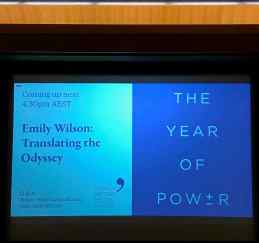 This event was an interview format, with the interviewer being journalist Jennifer Byrne who, for over ten years, hosted the First Tuesday Book Club (aka The Book Club).
Byrne is a cheery, engaging interviewer. However, on this occasion it felt, at times, that her interview agenda was at cross-purposes with what was important to Wilson. This made for a fascinating discussion, with ideas about translation, feminism, and The odyssey itself, jostling between them.
Now, clearly I’m behind in my literary gossip, because apparently Emily Wilson’s translation of The odyssey has made quite a splash, particularly because, of the over 60 translations into English done to date, it’s the first by a woman. It was this point – particularly because of the Festival’s “power” theme – that Byrne wanted to concentrate on, but Wilson, Professor of Classics at the University of Pennsylvania, had other ideas.
Byrne briefly introduced Wilson, noting that the book has had excellent reviews for being a “cultural landmark” and for being lean, clean and fast. To prove this point, she asked Wilson to read the opening lines.
Why another translation?
Given the plethora of English translations of The odyssey, Byrne asked why she did it?
Firstly, Wilson replied, the publisher Norton had asked her. However, her real, and more academic, reasons were:
- the original has music and rhythm to it. This does not come across in most translations, which are tend to be free verse, so she chose a regular metre for hers.
- most translations are too long and slow, so she made hers tighter, pacier (and thus, also, more teachable, which is already appealing to academics)
- most translations simplify the story to only Odysseus’ perspective but there are more in the original, which she worked to bring out.
At this point, Byrne tried to focus Wilson on the gender issue and what she brought to the text in terms of female perspective, but Wilson didn’t really want to be pinned down. She was surprised, she said, by the focus on her being the first woman translator, and said she was more interested in the poetics and narrative perspectives than in a feminist agenda.
She also said that a women’s voice doesn’t necessarily mean a feminist perspective. She argued, logically, that given she’s the only woman English-language translator to date, it’s impossible to assess what a “female” perspective is. Conversely, it is possible to ascertain a male perspective because there have been so many male translators and similarities in their approach can be identified. For example, male translators have, in general, translated a certain non-gendered Greek word into a gendered English word, “man”, while she used non-gendered words, like “human” or “person”.
However, she admitted her gender may have influenced her bringing out other perspectives, such as those of slaves (and other under-class people) versus the more common focus on gods and goddesses. Moreover, she said, most translations downplay abuse of power in the work because Odysseus is a “good guy.” Wilson said she wanted to offer a less heroic image of him, which led to some discussion of double standards. Odysseus had affairs, but Penelope would bring down the house of Odysseus, if she did. His power, in fact, rests on her fidelity.
Wilson then explained that the Greek word “hero” simply means “warrior”, and that in the original, the words frequently used for Odysseus stem from “poly” (“many”) suggesting many layers to his character. Wilson wants readers to question whether there’s something wrong with Odysseus. He sacks a holy city for example. We were given an example of two translations:
He could not save his men from disaster (Robert Hiller, I think)
He failed to keep his men safe (Wilson)
Wilson’s translation more actively suggests failure on Odysseus’ part.
Why this story?
Wilson described her early introduction to it via a play when she was 8, and her later realisation that she’d loved the story because it’s about being lost, about confusion re where home is, and about the meaning of belonging, all of which were issues for her then.
She also said that she loved Greek and Latin languages.
Towards the end of the hour – but I’m time-shifting it to here – Byrne asked about the story’s relevance to now. Wilson believes it’s highly relevant: it’s about strangers, about dealing with people not like you, about whether foreigners are dangerous. She used the word “migrant” at least once in her work.
The challenges of translation and more on the feminist perspective …
Byrne noted that Wilson’s translation had come in at exactly the same number of lines as the original, and Wilson agreed that she’d tightened it up, had made it pacy. The challenge was to identify the essential thing being said.
Regarding translation being the same as the original, which seemed to be what Byrne expected, Wilson said that “if you want the real Homer you need to learn Greek.” Fair point. And how I wish I could avoid the mediation of a translator and read foreign texts myself, but it’s not a feasible things I realise. Anyhow, Wilson said, logically, that it’s not worth doing a translation if it’s the same as the others.
The conversation then turned again to female perspectives, particularly regarding the power theme. Wilson discussed how male translators describe the women, characterising, for example, Helen of Troy as “bitch” and “shameless whore”, Calypso as a “nymphomaniac”, how they avoid using the word “slave” for people who clearly were enslaved. She gave examples of Greek words and her translation of them.
Continuing this theme, she discussed the women who were killed by Odysseus at the end. They were clearly raped by the suitors, but male translators have tended to describe them as “sluts” and “whores”. Wilson commented that the hanging of these women has been seen as “justice”. Given that The odyssey is seen as the starting point of western civilisation, this viewpoint makes this act the foundational moment of misogyny. Male translators do not present these women, she said, as having no choice.
Nonetheless, Wilson said, she couldn’t root out the misogyny in the text, but she could be clear about it.
By this point, Byrne seemed to be cottoning on. She had thought translation should be a close analogy, but “you’re bringing in a viewpoint”, she said. Wilson responded that male translators bring a viewpoint with their “sluts” translation – and then reiterated that …
Translators need to be aware that they are going to have to interpret, have a viewpoint, but they need to be conscious and try to have a better interpretation than previous ones. Theoretically, translation is impossible. It’s a case of how can I describe this word that has no direct meaning? Translators need to be aware she said of three questions: Who am I writing for; what century am I in; and who am I?
There was some discussion about the institutional barriers to women translators, and then it was the closing Q&A, which was wide-ranging and, nicely, drew from live-streaming sites as well as the venue itself. I’m going to share just two questions. The first asked her about what Margaret Atwood’s Penelopiad (my review) offered. Wilson responded that Atwood does not make Penelope a hero, but a more complex character.
The other was a Year 11 teacher asking, on behalf of her students, whether the killing of suitors at the end is justified. Wilson said this is actually three questions. Does Odysseus think it is justified: Yes. Does she, Wilson, think it is justified: No. But the harder question is, does the narrative think it is justified: she “thinks not”!
And so ended my 2018 SWF experience. I so appreciated being able to experience a tiny bit of it.
 Whispering Gums