AS Patrić, Black rock white city (Review)

AS Patric, Black rock white cityWith that extended conflict known as the Yugoslav Wars (1991-2001) now over for more than a decade, we are starting to see books written about them. I’ve reviewed two on this blog to date, Aminatta Forna’s novel The hired man (2013) (my review) on the Croatian War of Independence, and Olivera Simić’s memoir Surviving peace (2014) (my review) on the Bosnian War. AS Patrić’s Miles Franklin Award winning novel, Black rock white city, (2016), which also draws from the Bosnian War, now makes three.

Like The hired man, Black rock white city explores the aftermath of war, but unlike Forna’s book, which is set within the war-torn country, Patrić’s book is set in Australia, and tells of refugees, Jovan and his wife Suzana. The novel starts about four years after their arrival and, although both were academics in Sarajevo, they, like so many refugees, work in their new country as cleaners and carers. It soon becomes clear that they have not recovered from their war experience. Gradually, over the course of the book, Patrić reveals the horrors of their experience. We learn that, like so many who suddenly find their country at war, they had to face that awful question, “should I stay or should I go”. As it turned out, they stayed too long, and Jovan feels he failed his wife by not going early. When we meet them, their relationship is stressed, and they seem unable to provide each other the love and emotional support they so badly need. It’s excruciating to read, because it’s so real, so believable.

I found this book particularly enlightening because I worked with a woman who was damaged by this war. Like Patrić’s two protagonists, she was Bosnian Serb, but unlike them she left early. However, the impact on her of this forced loss of her country, her culture, was immense.

But, I digress … back to the book. It opens with hospital cleaner Jovan cleaning graffiti in an examination room. We soon discover that the hospital is experiencing a bout of graffiti-writing, and that Jovan is the graffiti cleaning expert. No-one knows who is creating the graffiti, which becomes increasingly bizarre. It appears on all sorts of surfaces (such as a corpse’s back, a menu blackboard, the optometrists’ charts) and comprises a variety of seemingly random, though often pointed, words and phrases (such as “The/Trojan/Flea”, “Obliteration”, “Dog Eat Dog” and “Masters of Destiny Victims of Fate”), which Jovan starts to read as messages to him. The graffiti artist is dubbed Dr Graffito. This storyline gives the book the patina of a mystery or even, perhaps, a thriller.

However, while the graffiti provides a plot-line for the novel, the main narrative concerns Jovan and Suzana, their relationship with each other and with other people, including a lover (for Jovan, because Suzana, in her pain, has withdrawn sex), work colleagues, friends and neighbours. Underpinning this narrative is the ongoing trauma of war. Jovan, for example, is frequently dogged by “the black crow”. He “feels as though he uses a rail for a pillow – always listening to the vague rumblings of oncoming annihilation”. Once, Suzana remembers, he could

turn almost anything over to a new perspective, see something deeper, redeeming, more beautiful even if painful. It was what made him such a superb poet back in Yugoslavia … He doesn’t write anymore and it’s as though he never did.

There is poetry in his head though – including a mantra that gets him through his days: “Maroochydore and Mooloolaba, Noosa and Coolum”. Language – the loss of his own, his inability (or is it refusal?) to speak proper English, not to mention the disturbing graffiti – functions as a metaphor for his sense of displacement.

Meanwhile, Suzana, notes Jovan,

is spending more of her time scribbling into her notebooks. The only place safe for her in the time since Bosnia, was somewhere buried underground. Coming to the surface isn’t going to be easy.

Patrić crafts the story skilfully. It’s a debut novel, but Patrić has published two short story collections and is a teacher of creative writing. It shows. The story is told third person, initially from Jovan’s perspective, but later Suzana’s is alternated with his, which fleshes out our understanding of Suzana, while keeping the perspective tightly focused on their experience. The plot unfolds stealthily, as we shift between two questions: will the graffiti artist be discovered, and can Jovan and Suzana pull through? By the end, the strands come together – so cleverly, so shockingly. And then there’s the sure, controlled writing. The pacing, the wordplay and touches of humour, the imagery, the dialogue, and the changing rhythms, make it delicious to read, even while the content confronts and distresses.

Late in the novel, Suzana suggests to Jovan that Dr Graffito is “putting his pain into someone else”, and that seeing his “madness in someone else might make it feel more bearable”. I don’t want to spoil the novel, but Suzana seems to be right, until the end where Dr Graffito’s actions force a confrontation that bring it all to a head.

What is Patrić’s motive for writing this? Early in the novel, Jovan finds one of the many notes Suzana loves to leave around, a quote from her favourite author, Nobel-prize winner, Ivo Andrić:

You should not be afraid of human beings. I am not, only of what is inhuman in them.

Jovan, on the other hand, says that “so much of what happens, shouldn’t happen”. These two ideas form the crux of the book. We have a cast of human beings, who are all real, all flawed in some way. They muddle on, some better than others, some needing a bit of “moral flossing”, some a bit of “ethical cleansing” (and what a clever wordplay that is, keeping war’s horrors close to our minds.) We see what happens, during and after war, when people let hate get the better of themselves and release the “inhuman” within, thereby wreaking what “shouldn’t happen” on others. This is a big book, for all its mere 250 pages, because it tackles the fundamental question of how are we imperfect humans to live alongside each other.

Fiction, Suzana says, is writing for the soul. If that is so, Black rock white city is one soul-full book – and a worthy winner of the Miles Franklin.

Lisa (ANZLitLovers) was also impressed by this book, as was Bill (the Australian Legend).

AS Patrić,
Black rock white city
Melbourne: Transit Lounge, 2015
248pp.
ISBN: 9781921924835

Louise Mack, The world is round (Review)

Louise Mack, The world is roundI’ve had Louise Mack’s debut novel, The world is round, on my TBR for about 20 years. Published in 1896, when she was 26 years old, it’s a fairly straightforward tragicomedy about a young well-to-do 21-year-old girl, Jean, who aspires to be a writer, and the two men who love her, the 30-plus-year-old self-confident, successful lawyer-and-writer Musgrave, and the around-25-year-old, shy and financially struggling Harrison. It’s a short work, a novella really, being just 93 pages in my edition.

Now, when I was searching Trove for information about Mack for this week’s Monday Musings, I found a couple of articles about her writing, amongst a myriad about her lecture tours. One was written in 1895, before this novel was published but after some of her verse and short prose pieces started appearing in journals like the Bulletin. The article quotes Mrs Bright, editor of Cosmos:

In these early days it is not possible to predict the place that Miss Mack is destined to fill in Australian literature. At present she shines chiefly in dialogue and a quaint, satirical style; peculiarly noticeable in sketches like “A study in Invitations.” In time she may develope [sic] a faculty for descriptive writing, which will supply the only quality now lacking to ensure her high rank among the popular novelists of the day.

The other was written in 1896, soon after the publication of her novel. The writer says:

Miss Mack has a particularly taking satirical style, but her descriptive writing is hardly up to her ability in the other department. Were she to but slightly improve in that qualification it would enhance the already strong position she has attained in the ranks of popular writers.

So, the praise is qualified. Her niece, the writer Nancy Phelan who wrote the introduction to my edition, discusses her not living up to this early potential. She notes that a common view is that she was “praised too soon, told she was good and encouraged to rush into print” when she needed time to sit back and think, and “be disappointed”. Phelan writes:

She wrote instinctively … but without proper guidance and criticism her work too often became facile. Facility, with a fertile imagination and love of inventing stories, made her a successful romantic novelist but it eroded her talent, and years of formula writing elbowed aside the poet. She never lost her poetic awareness but had little occasion to use it. Haste, lack of reflection, putting words on paper before they were ready robbed them of their true value; it was quicker and easier to write of trivial events than to try to address deep, difficult thoughts and emotions.

Yet in all Louise’s books there are glimpses of the writer she might have been. Even in her most idiotic novels there are occasional patches of true feeling or sensitive descriptions …

Why have I written all this? Well, partly because it might explain why this particular writer from the past has sunk from view. However, I’d argue that The world is round is worth reading – for a couple of reasons. One is that it is a good read, in which you can see why she received early praise. As our 1895 and 1896 writers above say, her dialogue is good and she has a lovely, light, satirical eye. (I’m going to share an excerpt which shows both of these in a Delicious Descriptions next week.) The other is that it is a good example of why “classics” (or older works) are worth reading. I’m going to focus my post on these two points.

a “brilliant little study”

The 1896 writer notes that “the reader’s report” for this novel described it as a “brilliant little study of two men and two women, sparkling and witty, and told in a graphic style”. It is a fun read, still today. It has a light touch, never wallowing in the issues it raises, and not weighed down with long explication or too many adjectives that you sometimes find in debut novelists. There are moments of sadness or pathos – obviously at least one of the would-be lovers is going to be disappointed, for a start – but Mack never becomes sentimental. (You can see this skill in those columns I referred to in my Monday Musings.)

The story is told third person, chronologically, in named chapters – “Musgrave”, “Jean”, “In which a friend is brutal” – and takes place in various interiors, such as James Musgrave’s chambers, Harrison’s classroom, and Jean’s home. Mack draws on the life she knows, presenting a picture of a small group of characters moving around each other in a small environment. This is very reminiscent of Jane Austen, to whom there is a tongue-in-cheek allusion in this conversation between Jean and Musgrave:

“I don’t suppose I will ever be a George Eliot, or a Thackeray, but perhaps I may be a–”
“Miss Austen.”
Miss Austen! oh, surely I’ll be something b–I mean surely I won’t be like her.”
“She did some good work.”

I mean to say! Anyhow, Mack’s descriptions of her small group of people and their interactions ring true, while also drawing on standard literary tropes, like the well-to-do heroine and her poor friend, the experienced confident suitor and the awkward poor one. The plot plays out, perhaps more through little vignettes than a flowing narrative, but it is enjoyable to read, largely because these vignettes are well-drawn, and confidently mix a light tone with the occasional darker one. I’ll leave the story there.

on reading “classics”

As I was reading this old book or forgotten “classic” (let’s not get into the definitions of “classic” here now), I started thinking about why we read such books. It’s easy to explain those classics that belong to the canon: they address the big universal themes or ideas, their writing is skilled and timeless, and, often, they have innovated or contributed something to literary culture. But, what about what we might call the second rung, books like Mack’s The world is round? Are they really worth reading over contemporary writers? I’d say yes, and one of the justifications is in the first line of Mack’s novel. It starts:

Sydney was revelling in the clear, cold weather of June, the most delicious month of the Australian seasons.

Now, that is not an attitude most Australians would have today, but is clearly how the colonials, those transplants from mild temperate Britain, felt about Australia’s climate. In other words, books written in a different time can provide a fascinating insight into the attitudes and values of that time. They might be fiction, but they can’t help also betraying their era. For students of colonial Australia, Mack’s novella offers some delightful insights into “the life and times”.

I don’t want to bore you with details, but will just share one more example. It concerns the poor friend who tells Jean that she “can’t write about Australia, it doesn’t appeal” to her. She admits she’s a “Colonial” but she knows nothing of bush life. She says, “I’ve never taken my country into my soul, and never will until I get away from it”. However, she’s poor, and is offered a job governessing in the bush on a cattle station. She learns to love the Bushies and to prefer them over “the posturing, pseudo-intellectual Sydney set”. She writes several pages to Jean on the subject. Now, this friend plays a role in the plot in terms of providing a counter assessment of Jean’s literary skills and there’s a plot reason for sending her away, but I can’t see much reason for this little outburst, except for Mack to make some point about colonial society and its values.

So, there you have it. This is less review, more wandering reflections, but I hope I’ve convinced you that Louise Mack is a worthy addition to the list of past writers who should be kept alive.

aww2017-badgeLouise Mack
The world is round
Pymble: Angus & Robertson, 1993 (orig. pub. 1896)
93pp.
ISBN: 9780207180163

Josephine Rowe, A loving, faithful animal (Review)

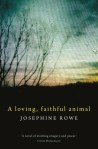
Josephine Rowe, A loving faithful animal

How many novels have you read featuring the Vietnam War? I’ve not read many I must say, but last year I did review Charles Hall’s Summer’s gone, and now this year I’ve read Josephine Rowe’s A loving, faithful animal. It’s a debut novel but, from its form, you can tell that Rowe is an accomplished short story writer. I have in fact read one of her short stories – from her collection, Tarcutta Wake. Unusually for me, I didn’t review it at the time. I think this is because I planned to read the whole collection, but that hasn’t happened (yet, anyhow), which is clearly my loss.

So, before I discuss the content of this novel, I should explain what I mean by my comment regarding short stories and its form. For a start, it’s a multi-voice novel. On its own, this is not unusual, but here the voices are also in different persons, which is not unheard of either, really. However, added to this is the fact that the chapters (or “stories”), particularly “Breakwall”, could be read as stand-alone pieces. To make the novel out of these pieces, they are linked via character, and there’s an overall chronological narrative arc to them, but they also remain little jewels in themselves. There’s real skill here, in the way Rowe juggles her voices, perspectives, stories to create a very satisfying whole.

Now, to discuss the novel itself. It comprises six stories, starting in second person with Ruby, whom we come to realise is the younger daughter of the book’s central family. It then progresses through four stories told from different third person limited perspectives – Ruby’s mother Evelyn, her father Jack, her uncle and father’s brother Les or Tetch, and her sister Lani – before returning to Ruby’s second person voice to conclude. The story is one of a family broken by the father’s ongoing trauma (PTSD) following his Vietnam War experience. It’s a devastating story showing how such trauma can play out, resulting in domestic violence, dividing loyalties and causing splits in families.

… she did not drive away …

The novel opens on New Year’s Eve, around 1990. The family has struggled on for some time. Jack has been unable to retain good employment, going in and out of rehab, with Evelyn always drawing him back, wanting their relationship and the family to work. But, every time she takes him back, she loses something too, particularly in terms of the respect of her elder daughter. As the novel opens, it’s New Year’s Eve, and Jack has gone, for good this time it seems, after something unspeakably brutal – the full details are never, fortunately, given – has happened to the family’s pet dog, Belle, the titular “loving faithful animal”. Except, as you’d expect, there’s more to the title than this. Evelyn, too, is “a loving faithful animal”, as in her way is Ruby and, perhaps we could also argue, Jack’s half-brother, Les/Tetch. He had escaped the war by “getting rid of his own fingers” and now hovers on the edge of the family, wanting to keep an eye on them, wanting his brother to be okay, but wanting too some family for himself.

What I enjoyed most about this book, besides its tackling this important subject, is its empathetic but unsentimental portrayal of its characters. Evelyn’s loyalty (her faithfulness) is shown to be both admirable and stupid. We see the catch-22, damned-if-you-do-damned-if-you-don’t nature of her situation, with the added element of a young girl having made her bed, that is, having married against her parents’ advice, and now having to lie in it:

But she could never quite bring herself to. Run out on him like that. And it was never as simple as money. It was never as simple as pride, because she’s not sure she’s never had much of that either. Or if she does, it hasn’t turned out to be worth much, not when it comes right down to it. (II “The Coastal Years”)

Life is cruel, particularly when stubbornness and lack of forgiveness face off against each other. Anyhow, we also ache for Jack who can’t escape his past, and nor “get a handle on” the future, so leaves rather than inflict more cruelty. We see and understand Lani’s decision to reject it all and escape into a future on her own, while Ruby stays determinedly loyal. Every decision though comes at a cost.

It’s not an easy book to read, and not just because of the subject matter. Rowe is not the sort of writer who wants to tell a simple narrative. She wants to convey emotions, psychology, motivations, not just actions, because these are the stuff of life. And this requires a particular sort of writing which, for Rowe here, is a sort of minimalist, sometimes disjointed, sometimes lyrical style:

This is Exhibit A in the Museum of Possible Futures, the life that might have rolled out smooth as a bolt of satin, if she had just swung her slender legs up into that beautiful car and driven as fast as she could in the opposite direction, leaving the man with the camera far behind. Your father, he could keep the photograph.

But she did not drive away. Instead she sold the car and spent every night of her life trying to lead your father out of the jungle, out of the mud, away from the cracks of invisible rifles, strange lights through the trees. (I “A Loving, Faithful Animal”)

There’s more of course – isn’t there always? – including little running motifs involving cicadas and panthers, and Tetch whom I’ve barely mentioned, but I’ll close here. This is the sort of book that I’d love to see in next year’s awards shortlists, for its writing and for its fierce, authentic evocation of the lasting effects of war. I wonder if I will.

Lisa (ANZLitLovers) was also impressed by the book.

AWW Logo 2016

Josephine Rowe
A loving, faithful animal
St Lucia: UQP, 2016
200pp.
ISBN: 9780702253966

Anna Spargo-Ryan, The paper house (Review)

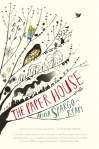
Anna Spargo-Ryan, The paper-houseI hadn’t heard of Anna Spargo-Ryan’s novel, The paper-house, when it was sent to me for review, which is not surprising given it’s a debut novel. However, I loved the cover – designed by one of Australia’s top book designers, Sandy Cull – and so was more than willing to give it a go. It traverses some familiar ground, grief and loss, and  mental illness, but it did so differently enough to keep me well engaged.

The novel starts with a young couple, Heather and Dave, in a strong, happy relationship. They decide to have a child and that this means buying a house to accommodate their new family. They see one south of Melbourne and immediately know that’s it. And already here, by page 4, as she describes the end of their house-hunting, we have garnered a good sense Spargo-Ryan’s clear but evocative writing:

After six weeks of looking and imagining, we ate teacakes on the western side of the peninsula and our hearts stayed behind when we left.

So simply said – no florid adjectives – but so arresting in its clarity. And it also encompasses two motifs which feature strongly in the novel, hearts and imaginings. Indeed the book opens with the line “My heart fell out on a spring morning”. We know, right then, that this is going to be a story about feelings – not to mention, also, that our writer has a wonderful turn of phrase!

Another strong thread in the novel is that of gardens. Their new house, of course, has a garden:

And the garden: a maze of established trees and crouching shrubs and flowers with bees on them and the faint trickle of water. A garden in which to wander, in which to get lost. For picnics and parties. It breathed in time with me and spat me out into the afternoon air, where the sea caught on the updraft and shot through the corridors. I watched it heave and change as it became night.

It’s a big garden, one which disappears from view behind a “row of pittosporums with their straight backs”, one with “good solid pittos … [which] keep the neighbours out of your business”. These pittosporums become a sort of reference point in the novel for her experience of the garden and, in a way, for her mental state, because this is a story about mental states. It’s about suffering a deep, deep loss, and how this new loss brings back a similarly deep past loss that has remained unresolved.

But now, I don’t want to give away this loss, though perhaps if you’ve heard of the book you already know. The story is told chronologically but, interspersed with this main narrative which chronicles around 6 months in the couple’s lives, are flashbacks in which Heather remembers life with her mentally ill mother Shelley, with her father and her older sister Fleur, and with her Gran. It was clearly a loving family but one under immense stress which each member handled in slightly different ways. As the contemporary story exposes Heather’s increasingly unstable state, we are also inexorably led to the tragedy that occurred in Heather’s teenage life. The resolution has a certain predictability to it, but Spargo-Ryan builds it so well that it doesn’t feel clichéd.

One of the pleasures in reading this sad but ultimately hopeful book lies in the characters around Heather. Her sister and father, and elderly neighbours Sylvia and Ashok, in particular, are colourful but human, and they create a warm, engaging but not sickly-sweet community which tries to shore up Heather. There’s husband Dave too, but he is a little more shadowy, off working as a teacher during the day when much of the action takes place.

The story is told first person by Heather, and as her mental state worsens we find ourselves a little destabilised, uncertain about what is real and what isn’t. She’s reliable only in the sense that she’s telling us what she is seeing and believing, but what she sees and believes is not always “real”. This is where the garden becomes significant. Initially the focus of her dreams for her little family, it becomes escape and refuge:

I threw myself from the bed and into the air. Nightlife moved in silhouette and shadow: the broad wings of a fruit bat against the sky, the low call of the boobook owl that always spoke in couplets – mopoke, mopoke. In the garden the pittosporums stood to attention and the moon pooled at their feet.

Shhh, said my body, folding around me.

But gradually it enables her imagination to run amok – and it plays an important role in the resolution.

The book is beautifully produced – creatively presenting text and white space to mirror and convey the disarray of Heather’s mind. However, what I most liked about it is the way it conveys the impact of mental illness on family members, the way it explores how family members, neighbours and friends can work together to nurture an ill person, and, importantly, the way it shows how carers can get lost in the focus on the ill person. It’s all done through language that shines and shows, rather than didactically tells and exhorts. By the end I had real tears in my eyes, and that doesn’t happen often.

AWW Logo 2016Anna Spargo-Ryan
The paper house
Sydney: Picador, 2016
295pp.
ISBN: 9781743535202

(Review copy courtesy Picador Australia)

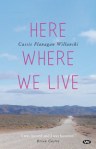
Cassie Flanagan Willanski, Here where we live (Review)

Cassie Flanagan Willanski, Here where we live“Write what you know” is the advice commonly given to new authors – and it’s something Cassie Flanagan Willanski, author of Here where we live, seems to accept. Set in South Australia, where Willanski lives, this debut collection of short stories reflects her two main interests, creative writing and the environment. The book won Wakefield Press’s Unpublished Manuscript Award a couple of years ago, and I can see why.

I wasn’t sure what to expect when I opened the book. Adelaide author and creative writing teacher Brian Castro is quoted on the front cover as saying “I was moved and I was haunted” and on the back “Her stories are as spare and understated as the harsh landscape she describes…” I’d concur. Her stories are not your typical short story. That is, they don’t have tight little plots, nor do they have shock (or even just surprising) endings. They are more like slices-of-life, or like chapters of a novel, in the way they tease out moments in people’s lives that you can imagine continuing into a larger story. And yet, they are complete in themselves and absolutely satisfying.

However, there is more to these stories than “just” slices of life. Willanski writes in her author’s note that they were written as part of her Master of Arts degree, in which she explored “the ways white Australians have written about (and for) Indigenous people in the twentieth and twenty-first centuries”. She introduces the notion of “Indigenous invisibility” which she describes as “ignoring Indigenous Australian people’s current existence, and mourning them as extinct”. She then talks about the issue we’ve discussed here before noting that as white writers became aware of this “Indigenous invisibility” they started to “write about them as characters in their books”. She says she has tried to reflect in her stories the various attitudes she found in her research. I found them authentic and sensitive, but the real judges of whether she’s been successful are indigenous people, aren’t they? There’s a reference to indigenous elder and activist Sue Haseldine in her acknowledgements, which may suggest some acceptance?

There are nine stories in the collection, three told first person, and the rest third person, except for the last and longest story which has two alternating voices, one third, the other second. Her protagonists include a young girl, a young male teacher, a 70-something woman, and a woman grieving for her late female partner. A few stories are connected, but this is not critical to appreciating the collection. Several of the stories, Willanski says in her author’s note, were inspired by real events but in each her imagination has created something new and fictional. Some of these real events are matters of history, such as the Hindmarsh Island Bridge controversy and the Maria shipwreck, while others draw from personal experiences.

Despite the historical inspiration behind some stories, they are all set in contemporary South Australia. The first two are told first person: “This is my daughter’s country” opens the first (“My good thing”) and “The night my husband told me he was going to leave me we were in the middle of a heatwave” starts the second (“Drought core”). Straightaway we are introduced to Willanski’s nicely controlled, pensive tone, and her ongoing themes: family relationships, indigenous issues, the environment and climate change.

The first story is told in the voice of a white woman who has an indigenous husband and a daughter. They are going back to country to clean rockholes. No-one is named – “this is my daughter”, “this is my husband”, “my daughter’s grandmother” – which gives the story a universal, almost mythical sense. There are hints of challenges – subtle references to the Stolen Generations and to environmentally destructive tourism – but it’s a short, warmhearted story about the drive to connect with land and people, and sets up the collection nicely.

I can’t describe every story so I’ll jump to the fourth one, “Stuff white people like”. It is lightly, self-mockingly satirical. It tells the story of a young couple, Oliver and Clay, visiting Ceduna where Oliver is considering a job as a “Nature School Teacher”. They are both earnest, Oliver particularly so, in wanting to understand and relate to indigenous people, so they decide to attend a “healing ceremony” for “‘Maralinga, climate change, feral animals, you name it,’ said the principal vaguely.” It’s an uncomfortable experience, and Oliver doesn’t know how to react to the event which isn’t what he expected. He doesn’t want to be “like the other white people” but how should he be? Clay is able to go with the flow a bit, but not Oliver. Later, on their trip home, she is able to laugh, and take the jokes in the book Stuff white people like, while Oliver is “crippled with self-awareness”. He can’t quite match Clay’s insight. She reads from the book about white people “knowing what’s best” for others:

“Do you think I’m like that?”
“‘Cos you’re excited to get to work with Aboriginal  kids? No!” She stopped for a minute, trying to piece together her thoughts. “Well, I mean–” she said and stopped again.
“What?” said Oliver.
“Well it’s just that Aboriginal people already know about having school outside.”
“I know,” said Oliver. “What’s your point?”
Clay looked at him again, then said, almost irritably, “Well, you’re taking something they’ve been doing for thousands of years and putting the white seal of approval on it.”
“But the missionaries took it away,” said Oliver.
He didn’t say it, but it was implied, and they didn’t know what to do with the implication. Oliver would be giving it back.

I love this on so many grounds – the personal and the political, the desire and the discomfort, the sincerity and uncertainty. These underpin the collection.

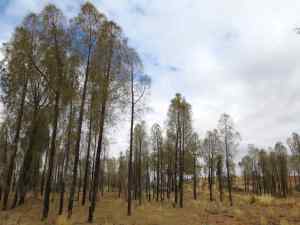
Desert oaks

Desert Oaks, Centralia

There’s only one story in which Willanski speaks “for” or “in the voice of” indigenous people, “Oak trees in the desert”. It’s about the First International Woman Against Radioactive Racism Conference, held in Monument Valley, Utah. This is a fictional conference, but “radioactive racism” is “real” and the aforementioned Sue Haseldine is active in this area.

Willanski opens the story with an indigenous Australian woman introducing herself at the conference. It’s a strong story, with the first-person voices of various First Nation conference attendees interspersed with the third-person story of white Australian woman, 76-year-old Bev, whose late husband had worked at Maralinga and had contracted cancer. There’s also a young white woman activist-organiser providing, again, a light satirical touch. Like many of the stories, it’s very personal but also has a big political message. (I also enjoyed it because I love Australia’s desert oaks, and I’ve driven in the stunning Monument Valley.)

This is getting long so I’ll end with the last story, “Some yellow flowers”, which contrasts a mature love, through the grieving Jean whose partner Nancy has died, with the young love of two teenagers, Loretta and Jackson. This story brings together several of the collection’s themes, including developing and maintaining loving relationships, climate change and caring for the environment, and indigenous-settler relationships. There is a big storm – one of those one-hundred-years storms that are occurring more frequently these days:

The roof shrieks and the sea spray pelts against the front verandah. The separation between land and water, sea and sky, past and present and living and dead becomes more obviously a figment of daytime imagination.

Dreams are had, stories are told, relationships are resolved – not simplistically, but with a sense of continuum.

This is the sort of writing I like: undramatic, understated, reflective stories about ordinary people coping with breakups, death, new relationships, but overlaid with a strong set of values and contemporary concerns, in this case encompassing the intertwined issue of respecting indigenous people and caring for our country. While not always comfortable reading, it’s a hopeful book – and I like that too.

awwchallenge2016Cassie Flanagan Willanski
Here where we live
Mile End: Wakefield Press, 2016
146pp.
ISBN: 9781743054031

(Review copy courtesy Wakefield Press)

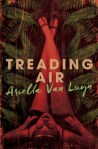
Ariella Van Luyn, Treading air (Review)

Arielle Van Luyn, Treading air

It wasn’t until I reached the end of Ariella Van Luyn’s debut novel, Treading air, that I discovered it was loosely based on the life of a real person. I’m glad it happened that way. I like introductions, but I always read them last because I like to come to my reading as unencumbered as possible – and totally unencumbered I was with this one. Even the title gives nothing away.

So, I was pleasantly surprised to find the first page labelled “Brisbane 1945”, because I spent some of my formative years in Brisbane, albeit rather later than 1945. I was even more surprised, a couple of chapters in, to find a section labelled “Townsville 1922”, because my Mum was born in Townsville at the end of that decade, and I visited it a few times in my youth. There, see how I’ve sneakily given you the historical setting –  and implied the structure – without specifically saying so?

Now, let’s get to the story. As Van Luyn explains in her acknowledgements at the end of the novel, it concerns Elizabeth (Lizzie) O’Dea, aka Betty Knight/O’Brian/Stewart/Johnson, who was born in Brisbane around the turn of the 20th century*. She married Joe O’Dea and moved to Townsville in 1922 where Joe was promised a job. However, as Van Luyn tells it, Joe soon loses that job, and Lizzie, with few work skills, becomes a prostitute, which she sees as far more lucrative, and yes, less demeaning, than the domestic work her mother had done. From there, life becomes increasingly challenging … but, I’ll leave the plot here, because there are other things to discuss.

The novel opens in Brisbane’s lock hospital where Lizzie’s been sent by a magistrate. This opening set-up gives me a great opportunity to discuss how Van Luyn uses fiction and history to construct her character and story. Brisbane’s Courier Mail and the Townsville Daily Bulletin both report on a case at that time: Lizzie is accused of “attempting to steal £20” which brings about a “bond” (deferred) sentence on 8 May 1945. The Courier-Mail writes

“It is rather remarkable,” said Mr. Wilson, “that in this long list of stealing convictions she has never been given a chance to see if she could reform. “We will just try it for an experiment. …” Mr. Wilson ordered O’Dea to enter into a bond to come up for sentence if called upon within six months. “We will both thank you, sir,” said the woman as she left the dock.

Mr Wilson’s “experiment” idea resulted from O’Dea arguing that she wanted a chance to be there for her husband Joe’s imminent release from his 20-year prison sentence.

However, the “crime” Van Luyn uses in the opening of her novel is Lizzie’s stealing “tins of bully beef and some US army blankets”. This crime actually occurred in 1944 and the court case in October of that year resulted in a fine of £5. Here is Van Luyn’s story of the court case in her opening chapter:

At first, in the police court, surrounded by dark wood, she couldn’t make sense of what Mr Wilson was saying about Joe. In a wig that hung down his cheeks, he looked at her medical report and decided to be generous: only six weeks in the lock hospital to recover [because she’d been found to have “the clap”]. He said when Joe got out a few days after she had, they could start a new life together. “We’ll try it for an experiment,” Wilson said, and Lizzie wanted to stick her fingers in his eyeballs. She isn’t a bloody lab rat.

My marginalia here is: “feisty, independent”. So, I have two points to make. One is that Van Luyn shifts a crime of which Lizzie was accused to a different time because, presumably, it’s a more interesting time, narratively speaking. And the other is that, instead of having Lizzie thank Mr Wilson, Van Luyn has her responding (internally, anyhow) in a feisty manner to establish Lizzie as an independent woman, a survivor. For an historian, these “plays” with the facts would be unforgivable, but for Van Luyn, they enable her to engage the reader in the story and quickly establish the sort of person she believes, from her research, that Lizzie was. In other words, Van Luyn plays with the “facts” to create her “truth”. As she is writing fiction, I have no problem with that! Do you?

The other main point I want to make about this book draws from Sulari Gentill’s comments at the Canberra Writers Festival. She said she likes to find interesting but forgotten people. I understood this to mean working class people and minorities, that is, the “little” people, the women, and those disadvantaged by culture, race, and so on. This is certainly what Van Luyn does here. In addition to Lizzie, a working class woman, she also has Chinese and indigenous characters in Townsville. In this focus on the “forgotten people”, her book reminds me of others I’ve reviewed recently, including Eleanor Limprecht’s Long Bay (my review) about abortionist Rebecca Sinclair, and Emma Ashmere’s The floating garden (my review), which uses fictional people to tell the story of a real situation, the removal of marginalised people from their Milson’s point community to make way for the Sydney Harbour Bridge.

“Her life has twisted away from her”

Back to the story. It’s told third person, but from Lizzie’s perspective, and alternates between the 1920s and the mid 1940s, so we know at the beginning that Lizzie’s been “on the game” and is a survivor. Several dramas occur during the novel – including a murder, a shooting, an attempted suicide  – and all these can be found in court records of the time. Van Luyn doesn’t over-sensationalise these, any more than she does Lizzie’s life as a prostitute. She is, though, explicit in her descriptions, giving us a picture of a lusty, resourceful young woman who’s determined to survive. Life is tough going, however. Lizzie, like Townsville, is “unformed”, but Joe, she comes to realise, “can’t look after her” as she’d hoped, so “she has to look after herself”. Moreover, although prostitution is more lucrative than domestic work, she’s not very good at saving – not surprisingly, given her upbringing – so the gap between the dream of an independent future and the reality stays wide for much of the novel.

It’s to Van Luyn’s credit that she has managed to create out of a scrappy historical record a character who, petty criminal though she is, not only comes alive but engages us fully. This is not a sentimental story, but it nonetheless reminds us that not everyone gets a lucky start in life. There are Lizzies still amongst us today. This is the sort of historical fiction I enjoy.

awwchallenge2016

Ariella Van Luyn
Treading air
South Melbourne: Affirm Press, 2016
282pp.
ISBN: 9781925344011

(Review copy courtesy Affirm Press)

* Researching Trove, I found several court reports in which her age wanders around wildly, suggesting birthdates anywhere between 1893 to 1902.

Robyn Cadwallader, The anchoress (Review)

Robyn Cadwallader, The anchoressLet me start by saying that I’m not a big reader of historical fiction, and particularly not of non-Australian historical fiction, so to read a novel set in mediaeval times is quite a departure for me. However, I did want to read Robyn Cadwallader’s The anchoress for a number of reasons. Not only is Cadwallader an Australian writer living in the outskirts of my city, but we did meet a couple of years ago for a lovely lunch when she was in the throes of negotiating the publication of this book in three countries! And, besides this, the topic was so intriguing. I’m not a mediaevalist and had never heard of anchoresses and anchorholds before. It’s taken me sometime to get to it, but I finally have.

Now, one of the reasons I don’t jump to historical fiction is that I’ve tended to see it in terms of bodice-rippers and romances, and these don’t really interest me. But, The anchoress is not such a story. I don’t read back cover blurbs before I read books but towards the end of this book, as I was trying to guess where it might be going, I did look at the back, not because I wanted to know the end – because I didn’t – but because I was intrigued about how this book that was teasing me was marketed. The last sentence of the blurb is that the book is “both quietly heartbreaking and thrillingly unpredictable”. This reassured me that it wasn’t likely to go where a “genre” novel would probably go. Does that make sense?

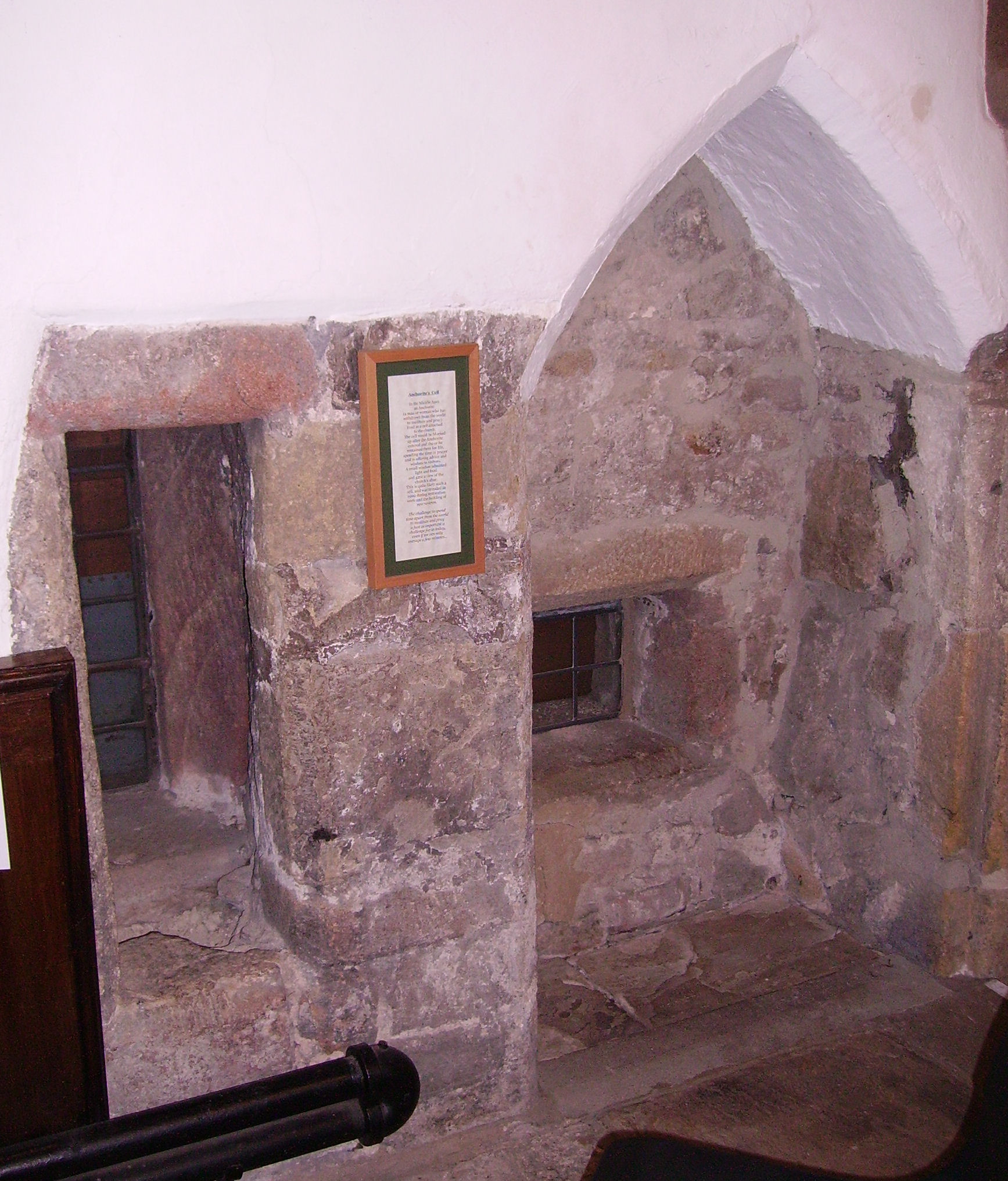
Anchorites' cell, Skipton

Anchorite’s cell, Holy Trinity Church, Skipton, UK (Courtesy: Immanuel Giel, Public domain, via Wikimedia Commons)

So, the plot. It tells the story of Sarah, a young 17-year-old girl who, after some traumatic experiences including the death of a loved sister in childbirth, asks to be enclosed as an anchoress. This means she agrees to spend the rest of her life in a small stone cell, essentially “dead to the world”, tended to by a maid through a window in the wall and visited by a priest who will provide guidance and take her confession. Her support is paid for by a patron, the local Lord. She is given a Rule book as her guide, and is expected to provide advice to village women. Sarah’s story is told first person but, interspersed with hers – in shorter third person chapters – is the story of young, inexperienced Father Ranaulf, her priest-advisor-confessor. And so the stage is set for – well, we don’t quite know what.

As the story progresses, all sorts of narrative possibilities present themselves. Will she stay (like Sister Agnes) or leave (like Sister Isabella)? How will her relationship with Father Ranaulf develop? And why did Sarah really decide on this rather extreme course for her life (because, of course, there is a reason)? These all have the potential for melodrama or cliche, but Cadwallader keeps it grounded. There is drama – a fire – but even it is downplayed in the service of Cadwallader’s bigger themes rather than generating page-turning excitement.

However, it’s not plot that draws me in my reading, but character, themes and language. And here the main characters are well-drawn. The story takes place over the period of a year or so. At the beginning Sarah is an idealistic young anchoress, keen to do it right. She takes seriously her decision with the uncompromising enthusiasm typical of a young person, and so is determined to be disciplined. She allows herself no pleasure, not even some tasty food donated by the villagers, despite advice that this level of self-denial is not expected, and moves into self-flagellation. Over the course of the novel she comes to a more realistic understanding of what being “holy” might mean, and of what she needs to survive her chosen role. Father Ranaulf is also young and inexperienced, which results, initially, in stiff, black-and-white responses to Sarah. Over time, he too comes to a more humane understanding of her and of his role as her advisor. I’m almost tempted to call it a mediaeval coming-of-age story as these two young people come to a maturer world view. Anyhow, it’s nicely and realistically done.

There are other characters of course – Sarah’s maids, villagers who visit Sarah, various priests, and Sarah’s patron and local Lord, the somewhat cliched Sir Thomas. These are less rounded but they enrich the picture Cadwallader paints of mediaeval life, and contribute to the story-line.

“Body without a body”

“True anchoresses”, Sarah reads in her Rule, “are like birds, for they leave the earth – that is, the love of all that is worldly – and … fly upwards towards heaven”. Birds are a recurring motif in the novel, starting with a symbolic bird, the jongleur whom Sarah calls Swallow. “An acrobat”, she says in the opening paragraph of the novel, “is not a bird, but it is the closest a person can come to being free in the air. The nearest to an angel’s gift of flying”. For Sarah, being enclosed was her way of emulating Swallow, of leaping into the air, of being a “body without a body”. She yearns to be free of her body, to leave the senses behind, but the more she tries to escape them, the more they make themselves known. Her challenge is to reconcile this dichotomy, this need to deny the senses while still very much having them, this being, theoretically, dead to the world, while very much alive.

Tied up with Sarah’s challenge is the wider story of mediaeval life and values. Cadwallader conveys life at the times, mostly through the people who visit Sarah. Life, we discover, if we didn’t already know it, is hard for women. We meet women who are abused and assaulted, and we realise that their rights are few in a society which sees women as “lustful and tempting”. Father Ranaulf tell Sarah that:

It is man who is mind and soul, woman who is body.

Wise Father Peter allows women some advance on this when he tells Father Ranaulf that holy women can develop manly souls and “almost become a man”! But it is Sarah who really confronts Renaulf, and forces him to a more empathetic understanding of her (and, by extension, of other women).

Life is also hard for the poor, as Cadwallader tells through the villagers’ lack of power in the face of the Lord’s control over the land they work. And life is a challenge too for church-men, who have to manage villagers and lords while earning money to survive. Father Ranaulf wants to make beautiful books but must “produce an income”, not to mention advise an intelligent young woman who won’t accept his platitudes and thoughtless “rules”!

So, The anchoress is an engaging story. It’s about a time long distant, thus satisfying our historical curiosity, and it’s about power in gender and class, that still resonates today. But, above all, it is about human beings, about how we read or misread each other, about how (or if) we rise to the hard challenges, and about whether or not we accept a duty of care to those who come into our lives. An enjoyable read.

awwchallenge2016Robyn Cadwallader
The anchoress
Sydney: Fourth Estate, 2015
314pp.
ISBN: 9780732299217

Julie Proudfoot, The neighbour (Review)

Julie Proudfoot, The neighbourWhen Julie Proudfoot offered me her debut novel, The neighbour, for review I was more than happy to accept. After all, it had won Seizure magazine’s Viva La Novella Prize in 2014, and you all know how much I love a novella. I must say it’s a gorgeous looking book. I’m not one to judge books by their covers, but neither am I immune to a beautiful book, and The neighbour is that – from its rich, green and mysteriously intriguing cover to its crisp, clear internal design. It is such a pleasure to hold and read. No wonder I prefer print to electronic!

But of course, the most important thing is the content, and the book delivers here too. It’s an Ian McEwan style page-turner. By this I mean it starts with a dramatic event which sets in train actions and reactions as the characters struggle to come to grips with the event, with its impact on themselves and their relationships, and with the way it exposes secrets and past traumas. The event is the horrible but accidental death of a child due to a mistake made by a neighbour. The circle of characters is tight – Ryan, Angie, and the nearly-five Lily, who live next door to Luke, Laney, and their four-year-old son Sam. On the opening page, Luke acknowledges, internally, that a frisson of tension (“a nervous kind of energy”) exists between himself and Angie  – and then she asks him for a favour he does not want to do.

“His actions were wrong, but now he can right them”

The neighbour is a novel about psychological disintegration brought about by grief and guilt, and about the tension that ensues when one wants to forget, another wants to remember, while yet another wishes to atone. Grief, we see, is a personal, private thing, and particularly so when it is bound up in a secret that prevents its full expression. Luke has always been Mr Fix-it for Angie and Ryan, so of course he wants to keep on fixing. If he can just fix their house, the loose roof-tiles, for example, he can make amends. Actions, he tells Angie, are the only way he can “beat down” the guilt. But you can’t help or fix for others if you are falling apart yourself, and you certainly can’t if those others don’t want that help. This is something Luke has trouble recognising as his thinking becomes more and more disordered.

And Luke’s thinking becomes so disordered, in fact, that his behaviour moves into quite bizarre territory. His determination to fix things for Angie and Ryan, despite their refusal, edges him into stalker territory. But, stranger still, Lily’s death resurrects (I’ve chosen this word specifically but I’m not going to explain why!) memories of his older brother’s drowning when they were children. Luke’s response to these memories is, there’s no other word for it, sadistic, but we go with it because we know Luke is losing his hold on reality. He is not a sadist. He is a troubled man. We care about him – because Proudfoot makes sure we do.

She achieves this by telling most of the story through Luke’s perspective, though we also occasionally enter other perspectives, such as Angie’s, too. It’s in third person, but present tense, so we journey with Luke, and other characters, as they try to make sense of their situation. Here’s Luke after Ryan has vehemently rejected his attempt to fix their roof:

As he climbs back over the fence, he can feel Ryan watching him. It’s going to be tough. Ryan will fight it. He knows this, but they’ll thank him in the end. They don’t even know what they need right now. He’ll get them all back on track. Ryan and Angie need never be aware of it.

The language, as you can see, is clear and direct. Because we are in Luke’s head most of the time, description is kept to a minimum, but the writing is nonetheless evocative. Sentences are generally kept short, which keeps the story moving and develops tension. The short, choppy sentences also mimic the characters’ erratic, distressed mental states. Here is Angie through Luke’s eyes:

When she talks her face is in parts. Her eyes shine. Her mouth moves. Her cheeks square up when she speaks and droop when she stops. In doing what Ryan wants, she has become fractured and tense. The more Luke tries to help her, the worse she gets.

Then there’s the plotting. It’s delicious. As the novel progresses, we think we’ve guessed the back story, and we have, but not quite. As it builds to its conclusion, we think we know how it will end, and we are right, almost. The end, in fact, has a beautiful irony – and is perfect.

Despite its brevity, The neighbour tells a complex story of grief, guilt, culpability and responsibility. There are layers, here, as there often are in tragic accidents, but rather than labour them, Proudfoot trusts us to comprehend them while she gets on with the story. This is a powerful, thoughtful – and at times – shocking novel that gripped me from its opening sentence. I look forward to seeing what Proudfoot produces next.

Lisa (ANZLitLovers) read and enjoyed this when it first came out.

awwchallenge2016Julie Proudfoot
The neighbour
Sydney: Xoum Publishing, 2014
204pp.
ISBN: 9781922057983

(Review copy courtesy the author)

Caroline de Costa, Double madness (Review)

De Costa, Double madnessI’m not a crime reader as most of you know, and in fact most of the crime novels I’ve read here have been review copies sent to me. Caroline de Costa’s Double madness is one of these. I accepted it for a couple of reasons. It’s a debut novel by a doctor, indeed a professor of Medicine at the James Cook University in Cairns, who has been shortlisted for a nonfiction work in the Queensland Premier’s Literary Awards. And it is set in beautiful far north Queensland, my home state.

Not being an expert in crime writing, I can’t really compare it with other novels, but I’d say it’s in the sub-genre known as police procedural. According to Wikipedia, in police procedurals the detective is a police officer and the story depicts the activities of the police investigating the crime. Tick. However, Wikipedia also says that in police procedurals the perpetrator is often known to the reader, but this is not the case here, and that the novel will often deal with a number of unrelated crimes, which is also not the case here, though several references are made to one other crime. None of this matters, really thought, does it? Categories can be helpful in analysis, but in the end what counts is the work itself. I was just intrigued.

Double madness opens with the victim’s body being found, by accident, in a secluded part of the north Queensland rainforest, by a doctor and his wife who are driving home the scenic way. Finding the body is, I presume, a pretty traditional opening for a crime novel of this sort. The dating, like the setting, is also precise – 27 February 2011, which is three weeks after the category-5 Cyclone Yasi hit northern Queensland, causing significant destruction. The novel is told in almost straight chronology, with each chapter titled by a date, the last being 17 March 2011. Early in the novel, though, there are a few flashback chapters – mostly to 2009 – which flesh out a few characters for us.

Our main detective is the 30-something now-single mother, Cass Diamond. She’s of indigenous Australian background. Ah, so we have a non-indigenous writer, as far as I know anyhow, writing an indigenous character. You may remember discussions we’ve had here on this topic. I’ve quoted writer Margaret Merrilees, “To write about Australia, particularly rural Australia, without mentioning the Aboriginal presence (current or historical) is to distort reality, to perpetuate the terra nullius lie”. De Costa is writing about Far North Queensland, a place with a significant indigenous population, where it would indeed be poor form to ignore indigenous characters. My assessment is that de Costa has done it well. Cass makes some references to her indigeneity, and to some of the challenges she faces, but this is not her defining characteristic in the novel. She is “just” another police officer, and is defined as much, if not more, by being a single mother whose “fridge was a temple consecrated to convenience foods”. In other words, she’s in that band of job-jolly detectives who struggle to keep their personal life going, though Cass does a better job than most (that I’ve seen on TV anyhow). She does, for a start, seem to have a good relationship with her teenage son. Moreover, she’s not drunk, middle-aged or unduly cynical – yet, anyhow!

Back now, to the plot. Tucked into the copy sent to me was a slip of paper containing a short interview with the writer by reviewer Fiona Hardy. De Costa tells Hardy that she had “for some time been interested in the concept of folie-à-deux [share psychosis]”. Folie-à-deux translates as double madness – hence the book’s title. De Costa also tells Hardy, when describing the sort of detective she has created, that she has to write what she knows. And she knows medicine. Consequently, not only does the investigation and resolution of the crime involve some medical knowledge, but the story is set largely amongst the community’s medical fraternity. In other words, the good doctors of Cairns have been getting up to a bit of mischief with our victim, so when the murder is committed they find themselves in the frame. They are not, however, the only ones. There be a husband, and sons, and sundry other possibilities. All I’ll say is this is a tricky plot with a goodly dose of red herrings. For more, you’ll have to read the book.

I wouldn’t call Double madness a ground-breaking or particularly innovative detective novel, but it’s an enjoyable read. The writing is clear and straightforward, keeping to the point and moving along at a fair pace. There’s no unnecessary description, but where it is needed, such as to describe the bush or, say, a doctor’s experience of working through a cyclone, it feels real and authentic. Hardy, in her interview, notes that the cyclone Yasi makes an effective metaphor for the havoc wrought by the victim, Odile Janvier, on those around her. She’s right, it does.

When I read fiction, as I’ve said before, I look for some underlying messages or themes or issues being explored because I like my reading to further my understanding of humanity. Double madness is not, in this sense, a deep or enquiring book, but it is quietly subversive in the way it handles race and gender. Its indigenous characters are not defined by their indigeneity, and women detectives and medicos play important, but accepted and unremarked, roles in the investigation and resolution of the crime. Moreover, while the murder victim is a woman, she is far from the norm of murdered women victimhood. Good on de Costa.

So, if you are looking for a new crime author for your crime fan friends this Christmas – because yes, it’s that time of year again – then Double madness is well worth putting on your list.

awwchallenge2015Caroline de Costa
Double madness
Witchcliffe: Margaret River Press, 2015
359pp.
ISBN: 9780987561565

(Review copy courtesy Margaret River Press)

Emily Bitto, The strays (Review)

Emily BItto, The strays, book coverLet me start by saying I really enjoyed reading Emily Bitto’s The strays. It was scheduled for my reading group the day after my return from Tasmania, and I suddenly found myself in the last day of my Tasmanian holiday without having started the book. Wah! I read it in two days, helped by several hours in a couple of airports. I haven’t done that for a long time, and what a joy it was to have a real length of time to commit to a book. It helped, of course, that having both a strong plot and an intriguing set of characters, The strays is compelling to read. It reminded me, albeit loosely, of Evelyn Waugh’s Brideshead revisited and Ian McEwan’s Atonement.

This is a debut novel, which also won this year’s Stella Prize. Set primarily in the 1930s, with the last of four parts set in the 1960s, The strays is both historical fiction and a coming-of-age novel. It is also a classic outsider story. Lily, who tells the story first person, is befriended when she is 8 years old by schoolmate Eva, the middle daughter of the Trenthams who, early in the novel invite a number of artist “strays” to form a utopian-bohemian artistic community. The Trenthams are inspired by the Reeds and their Heide group, but The strays is not a Heide story*.  This may be the strength of the novel, but also perhaps its weakness – a strength because it frees Bitto to tell her own story, but a weakness because it removes potential ideas on which to hang her story.

Before I get to that, though, a little more about the story. The first three parts follow the Trenthams for 8 years, from when Lily is 8 to 16. During this time Lily becomes increasingly involved with the Trenthams, in preference to her boring, conservative, middle-class parents, eventually living with them full-time. Some members in my reading group found her parents’ relinquishing of their daughter unbelievable, but this was during the Depression, and Lily’s parents did have some problems of their own to manage. I could suspend my disbelief. From Lily’s point of view, she was in thrall to the excitement of the Bohemian life, telling her parents, “I love you both but I want to be different”.

Her parents, however, should have been concerned, because the Trenthams are rather casual, neglectful parents and the four girls more or less run their own lives, sometimes being fed properly, sometimes not, sometimes, in the case of one in particular, going to school, and sometimes not. The story is as much about them, as about the artists, though we do hear about the artists too. There’s exploration of experimental art and its acceptance or otherwise by society, obscenity charges, mentee supplanting mentor, and so on. There are parties, and other occasions, where artists and children come together. Bitto, through Lily, paints all this beautifully. Indeed, I loved her ability to evoke scenes, people and places with effective, yet tight imagery.

Bitto’s use of Lily as her narrator works nicely. Through most of the novel, we see the story through her child’s point-of-view, but occasionally, with a “later I realised” type of comment, we are reminded that this is an adult telling the story of her childhood:

When was it that I became a voyeur in their midst? I was the perfect witness, an unsuspected anthropologist disguised within the body of a young girl, surrounded by other young girls who were part of the family. Yet I was cuckoo in the nest, an imposter who listened and observed, hoarding and collecting information.

This narrative style keeps the story grounded. We see the dysfunctional dynamics and its effects before Lily, wooed by the excitement, does – though she does have moments of clarity. When the youngest daughter goes missing on one occasion, she writes:

I drew in my breath. These adults were no use in a crisis.

The subtext is that her parents would be.

But, here’s the thing. The book tackles a lot of ideas. There’s the exploration of society’s reaction to experimental art; the idea of coming to terms with the past (for Lily); the utopian artist community and whether it can really work; indulgent or neglectful parenting, creating a dysfunctional family life that comes back to bite; the exploration of girlhood friendships and the whole coming-of-age thread; not to mention those big issues like loyalty and betrayal, envy, sexuality and sensuality. It’s not that these were uninteresting, or even that they weren’t well developed. It’s more that I struggled to find Bitto’s main focus, and I guess I like some sort of central idea on which to hang my understanding of a book.

My reading technique is that when I finish a book I go back and reread the beginning. This usually puts the whole into context, pinpointing what the author was about. However, this technique didn’t work wonderfully with The strays. Bitto’s Prologue starts by discussing the mystery of instant attraction between people, and then moves on to the idea of past life connections and that people’s souls can be twinned from one life to the next. These ideas are used to explain Lily’s relationship with Eva, but I’m not sure that this is fundamental to the book’s meaning. The prologue then discusses the past. Three decades after the main events, Lily receives a letter:

and I become aware of an old compulsive pain I have pressed like a bruise again and again throughout the years.

AND

I feel a tenderness in my chest, and the past rushes in as a deluge I can no longer hold back …

AND

I let my mind turn back once more, to recreate again that distant, still wracked past.

Is it this, the idea of coming to terms with or resolving the past, that binds the book together? It is partly. By the end of the novel, Lily has come uneasily to terms with what happened those three decades ago, and its impact on her life. I say uneasily because – and here we come to the epigraph, by William Pater, which expresses a different idea again to those in the prologue: “To burn always with this hard, gem-like flame, to maintain this ecstasy, is success in life”. Lily’s uneasiness is that she has chosen “conventionality”, but recognises that part of her “is still drawn to the romance of the fully lived life”. Then we have the book’s concluding paragraphs, which are more concerned with mothering and family in Lily’s recognition that it was the Trentham children who paid the debt for their parents’ experiments. See my problem regarding central idea? Or, is it just that I’m being boringly 20th century?!

Whatever it is, they are just niggles. As a read, The strays is up there as one of my most enjoyable for the year – for its lucid writing, for the story and a setting that had such appeal, and, yes, even for that whole raft of ideas that she throws so determinedly at us. Even for that.

Lisa at ANZLitLovers enjoyed the book too.

* Interestingly, a couple of “real” people are mentioned, one being politician and later judge, Herbert Evatt – as a supporter of modern, experimental art.

awwchallenge2015Emily Bitto
The strays
South Melbourne: Affirm Press, 2014
290pp.
ISBN: 9781922213211