Today’s Monday Musings is more personal than these posts usually are. Ten days ago, the last aunt of my aunts and uncles died. She’d been failing for some time, really, but she fought death to the end. Indeed, when we were in her house last week starting that awful job of clearing a house, we were told we needed to find five library books. We found four but where was the last? We searched all the likely places but to no avail – and then it came to light. She’d packed it in her hospital bag. Just hours before she died, in a state described as “gravely ill”, she went to hospital and took a book, of course! This got me thinking, once again, about the role of literature in our lives – and, particularly, what we can learn from reading.
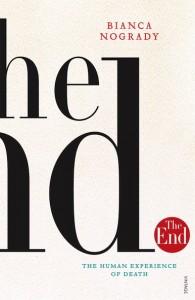
So, what have I learnt about death and dying from books? I’ve read several non-fiction books – mostly non-Australian, but one, Bianca Nogrady’s The end: The human experience of death, is by an Australian and I’ve reviewed it here. These books have been interesting, but they tend not to get to the heart of things. For that, think, we need fiction (or, poetry, but I’m limiting my discussion here to fiction). Learning, though, is perhaps not quite the right word. Experience might be better, because when we read fiction, we don’t so much “learn” facts, as “feel” or “experience” the emotions and ideas being shared. A memorable dying scene for me comes from English writer Penelope Lively’s Moon tiger. Claudia is seized by joy and wellbeing at the sight of the sun catching raindrops on trees, sending out sparks of colour, and then:
The sun sinks and the glittering tree is extinguished. The room darkens again. Presently it is quite dim; the window is violet now, showing the black tracery of branches and a line of houses packed with squares of light. And within the room a change has taken place. It is empty. Void. It has the stillness of a place in which there are only inanimate objects: metal, wood, glass, plastic. No life. Something creaks; the involuntary sound of expansion or contraction. Beyond the window a car starts up, an aeroplane passes overhead. The world moves on. And beside the bed the radio gives the time signal and a voice starts to read the six o’clock news.
Maybe it’s just me … but I found this sense of the person being there one minute and then gone the next, and of life continuing regardless, quietly powerful. It has framed my ideas of dying ever since, I think.
Fiction about death and dying tends to deal with three broad aspects: fighting or rejecting death, reflecting on it, and accepting it. Most books, naturally, encompass two or three of these aspects. Anyhow, here is a small selection of Australian novels that deal with death in some way, that don’t simply have deaths “in” them but tackle in some way the meaning or implication of death. I’ve listed in alphabetical order by author:
- Peter Carey’s The chemistry of tears (my review) tells the story of two people – a contemporary museum conservator who is devastated by the loss of her (secret married) lover and a 19th century father who commissions an automaton to entertain his consumptive son. Grief, and how to live with it, underpins this novel, though it explores many other issues too.
- Brooke Davis’ Lost & found (my review) was inspired by the untimely, freakish death of her mother. Its three characters, a young girl and two old people, are all facing the death of a significant person and end up on a quest together searching how to live with loss – something we all face at least once, and mostly many times, in our lives.
- Helen Garner’s The spare room is an uncompromising novel about a woman caring for a friend with terminal cancer. The friend is fighting her prognosis, including trying some alternative treatments that seem to be having no beneficial effects whatsoever, though the friend maintains the faith. The narrator – significantly called Helen – becomes increasingly frustrated with her friend’s inability to accept the facts, and finds it increasingly difficult to maintain her caring role. It’s a confronting story. I admire Garner’s honesty in presenting a story that is not pretty.
-
Courtesy: Picador
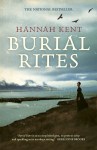
Hannah Kent’s Burial rites (my review) was inspired by the story of Agnes Magnusdottir, the last woman executed in Iceland. The book takes place between the time when Agnes is convicted and sentenced and when the sentence is actually carried out. Kent explores the reactions of people to Agnes, and Agnes’s own sense of who she is. Death hangs over this novel, in the way it forces people to confront mortality, their own values, and justice.
- David Malouf’s The conversations at Curlow Creek is set in the 1820s and concerns the conversations that occur between a military officer and an arrested bushranger who is to be executed in the morning. It’s about the connections made between the two men, between the captor’s reflections on his own life and the condemned man’s concerns about death, God and forgiveness. It’s a long time since I read this book, but it has a mesmerising quality, a sense of grace, that has stuck with me.
- David Malouf’s Ransom was inspired by the section of the Iliad which chronicles Achilles’ revenge killing of the Trojan prince Hector and Priam’s visiting Achilles to ask for his son’s body back. The story plays out much the way it does in the original, except that Malouf’s Priam does attempt to cut through the brutal, revenge-fuelled pattern of behaviour to something more humane. I am always attracted to works which question the revenge code.
- Marcus Zusak’s The book thief (my review) is quite different altogether. A Holocaust novel, it is about state-sanctioned death. It is also, and some reviewers find this a little twee, narrated by Death, who is fascinated by what defines humanity. He concludes that there is no simple answer, that humans are capable of wondrous things and of heinous things. Zusak takes that idea that it is death which defines life, which gives it meaning, and runs with it in a pretty audacious way.
Ella Berthoud and Susan Elderkin’s book, The novel cure, includes dying as one of the “ailments” they deal with. Their focus of course, given their therapeutic goal, is on literature “which consoles and stills, while gently encouraging acceptance”. However, what I like about the books I’ve listed here is the way they look at wider issues – from managing grief to how the presence of death helps us understand humanity. I’m reminded of a favourite line from Marion Halligan’s novel, The fog garden, which was inspired by her grief over her husband’s death. She wrote “read a wise book and lay its balm on your soul”. Amen to that!
I’d love to know if you have any favourite books about death.
 Whispering Gums