Jane Austen, Sense and sensibility (Vol. 1)

Ch 22 of Sense and Sensibility, (Jane Austen N...

From Chapter 22, illus. by CE Brock (Presumed Public Domain, via Wikipedia)

This year is the 200th anniversary of the publication of Jane Austen’s first (published) novel, Sense and sensibility. To celebrate this, my local Jane Austen group plans to discuss the novel over the next three months, volume by volume. We tried this last year with Mansfield Park and valued the opportunity it presented to delve a little more deeply into the novel – not only the characters and themes, but the writing and structure. Consequently, in this post I’m going to focus on Volume 1 (chapters 1 to 22) which ends with Lucy Steele’s dramatic announcement to Elinor.

But first, some caveats. I’m going to assume that most readers who come to this post will know the story – and if you don’t, the Wikipedia article provides a good summary. Also I am not going to write a formal review but just share some of the ideas that have struck me during this slow reading*.

I have always liked Sense and sensibility, partly because I’m fascinated by the dichotomy Austen sets up between the two sisters: Elinor (sense) and Marianne (sensibility). And yet, it’s not an easy-to-like novel. The heroines aren’t as sparkly nor the heroes as dashing or heroic as in Austen’s next novel, Pride and prejudice. It feels more serious, less witty – though not as serious as Mansfield Park. This could be because its premise – the sudden drop in wealth for Mrs Dashwood and daughters and their dislocation from their family home, due to the death of their husband/father – mirrors what happened to Jane and her mother and sister after Rev. Austen’s death in 1805. It wasn’t until the family settled in Chawton in 1809 that Austen, to the best of our knowledge, returned seriously to her writing. I wonder if this novel is her working through this very real experience of grief and insecurity. (Interestingly, a very similar story is played out at the beginning of Tracey Chevalier’s Remarkable creatures in which she describes the removal of the Philpot sisters from London to Lyme Regis in 1805).

That’s the historical background to the novel – and forms its social milieu. But there is more to the novel than social history. Austen is a far more complex writer than that. Take, for example, the money issue. There is a lot of focus on money and income in volume 1 – on who has what – indicating Austen’s real awareness of the issue, and yet Mrs Dashwood does not focus on husband hunting for her daughters. In fact, she says:

“I do not believe,” said Mrs. Dashwood, with a good humoured smile, “that Mr. Willoughby will be incommoded by the attempts of either of my daughters towards what you call catching him. It is not an employment to which they have been brought up. Men are very safe with us, let them be ever so rich. …”

This is no Mrs Bennet … but she’s not without her faults either.

And, take the dichotomy issue. It’s actually not quite as clear-cut as the title would suggest. Check the way our two heroines are introduced:

Elinor … possessed a strength of understanding, and coolness of judgment, which qualified her, though only nineteen, to be the counsellor of her mother, and enabled her frequently to counteract, to the advantage of them all, that eagerness of mind in Mrs. Dashwood which must generally have led to imprudence. She had an excellent heart; her disposition was affectionate, and her feelings were strong: but she knew how to govern them: it was a knowledge which her mother had yet to learn, and which one of her sisters had resolved never to be taught.

Marianne’s abilities were, in many respects, quite equal to Elinor’s. She was sensible and clever; but eager in everything; her sorrows, her joys, could have no moderation. She was generous, amiable, interesting: she was everything but prudent. The resemblance between her and her mother was strikingly great.

In other words, Elinor has sense (“coolness of judgment”) but is also emotional (“her feelings were strong”); and Marianne is emotional (“eager in everything … no moderation”) but also has sense (“sensible and clever”).

However, as I read the volume 1, the issue that kept raising its head was that of “judgment”. I’m not sure whether it will continue to do so in the next two volumes, and I need to think about how the judgment issue plays out in other novels, but it does seem that Austen is exploring people’s ability to judge – and most seem to be not very good at it. Sir John Middleton, who praises the Steele sisters, is confident in his judgment, as is Marianne of hers on Willoughby – and we know how those turn out. Meanwhile, Edward, says, Elinor, “distrusts his own judgment” – and he is probably right to (in some matters at least!) Elinor, on the other hand, recognises that she has made errors at times and suggests that you need “time to deliberate and judge”. Related to all this is the fact that Marianne tends to judge people by surface factors, whereas Elinor tries to understand what makes people (such as Edward, Col Brandon, Mr Palmer) behave the way they do. I look forward to seeing whether this idea continues to be specifically explored in volumes 2 and 3.

But let’s move on to Austen’s writing; specifically, her plotting. Until recently, Emma was my least favourite Austen. Then I read it again more attentively and was bowled over by how beautifully it is plotted. I started to notice something similar in Sense and sensibility but will just give one particular example – how Austen uses parallels to create links between the storylines and move the plot along. These parallels, though, aren’t all slavish, aren’t exact. Here are some from volume 1:

  • Willoughby asks for/is given a lock of Marianne’s hair; Edward wears a ring made of Lucy’s hair
  • Willoughby and Edward both leave Barton Cottage in different but less than happy circumstances, and the Dashwoods ascribe this, in both cases, to the influence of strong controlling women – Willoughby’s aunt, and Edward’s mother
  • Elinor states that correspondence between Marianne and Willoughby would convince her of their engagement; later, evidence of correspondence between Lucy and Edward convinces her of their engagement.

And here I shall finish, mainly because I’ve gone on long enough. There is so much more to say, but maybe they will still be relevant in volume 2. Meanwhile, I’d love to know what other Austen readers think …

* Our little nod, perhaps, to the Slow-Reading Movement which I must admit does hold some attractions for me.

Barbara Hanrahan, The scent of eucalyptus

Writer-artist Barbara Hanrahan was born half a generation before I was and in the city of Adelaide not a country town in Queensland, but the childhood she depicts in her first novel, The scent of eucalyptus, could almost have been mine. Almost, but not quite, as I was brought up in a standard nuclear family and she by three women – her mother, grandmother, and Aunt Reece (who had Downs Syndrome) – resulting in a somewhat different experience of home-life even if not of wider society.

And there’s another more crucial difference. The half generation time lag accounts for a major change appearing on the horizon – in the education of women. Hanrahan, like my mother who was born nearly half a generation earlier, suffered from the reduced opportunities and low expectations that were women’s lot back then. Both were expected to undertake commercial training at high school – rather than join the academic streams they desired – in order to fulfil “the plan” as Hanrahan calls it:

“( … Our expectations were swallowed by shorthand symbols, hammered by typewriter keys, imprisoned by the columns of a neatly-ruled ledger whose credit column never balances its debit.)

I was part of a school that was a factory, pumping forth each year, from the swollen Commercial class, the girls of fifteen who would go to work as typists and clerks. At eighteen they would be engaged, at twenty, married, at thirty – old. These were the girls I stood with under the lacquered fig trees in the Grade Seven photograph. (They are at their prime at the age of twelve … )

How sad that is. I loved this book from beginning to end. The writing is poetic – not the sort of poetry that is full of allusions and ambiguities in which you have to work hard to locate meaning, but the sort that paints word pictures of both the physical and emotional landscape. An example is her description of a visit to relations in the hills:

“I remember rising while it was still dark to visit them; … watching the sky turn pale and frayed with light; seeing houses jump forward from the darkness; hearing the cold voices of first roosters, the kookaburra’s ruffled peal.”

The writing is rhythmic. There are few wasted words, there is effective use of repetition, there is stream of consciousness, and she uses punctuation precisely to control flow and meaning.

Hanrahan tells her story more or less chronologically, with thematic chapters interspersed at appropriate points and occasional asides foreshadowing her future. The novel spans her life – this is an autobiographical novel – from birth to puberty. It’s not strong on plot, but there is a powerful story here about the development of self. For example, in chapter 2, we see the origins of the artist she was to become: “As a child and ever after, the minute, hidden facets of things intrigued me”.

The first few chapters introduce us to the significant people – the “important” three – in her life. Here she is on her mother:

“My mother was a lark whose tongue was cut; a gull with clipped wings. She learned to expect nothing that she did not strive for … My mother trod a familiar path; hedged by as many briers as Sleeping Beauty’s ever was”.

Such economy of expression that conveys so much. She writes similarly of her grandmother and aunt, and we learn how “the three” love and support each other but also harbour disappointments. These, though, our narrator is barely aware of:

“(I was deceived by familiarity. I didn’t see, couldn’t see, forgot to reason.)”

And so the novel progresses through infancy, kindergarten, and primary school until we reach the point at which I began this post. She paints perfect pictures of school days, of special holidays, of childhood friendships, of fears and hobbies, of a flirtation with religion, and of a sense throughout, but becoming stronger as she grows older, of being “different”:

“And as I grew older I became adept at leaping quicksilver from one of my selves to the other. And as I grew older the split grew deeper, yet I forgot it was there.”

This is a delicious novel – the language is almost mesmeric, capturing a world that has passed and yet is still part of our cultural landscape. I will finish with one final excerpt which delighted me. She, like most Australians, grew up with the image of outback Australia, our “sunburnt country”, firmly entrenched in her mind, but she, also like most Australians, was “a city child” and so she asks:

“But where were the hills of the history book, stitched with the pathways of Burke and Sturt and Leichhardt?- the hills of the sun-burned earth and budgerigar grass, and azure skies and fiery mountains we sang about at school before the flag spangled with all the stars of the Southern Cross I was never sure of seeing? Where were the old dark people I did not link with the lost couples on suitcases at the railway station? Where were the crocodiles and brolgas, the billabongs and snakes? Where were the flowers that wilted in blistered clay, the rusty waves of Spinifex that looped the cliff?

… I looked about me for the sunburned land. In vain.”

This is not the end of the book … but is as fine a place as any to end my review because it, as much as anything, conveys the paradox of her childhood – the knowing one thing but the seeing of/the being something else. This is a book for all Australians to read … and for anyone else who is interested in a thoughtful, lyrical rendition of a childhood.

Barbara Hanrahan
The scent of eucalyptus
St Lucia: University of Queensland Press, 1973
188pp.
ISBN: 0702225169

Joanna Biggar, That Paris year (Guest post)

When I received That Paris year via the LibraryThing Early Reviewers Program, I got the sudden attack of the guilts! How was I to review this book alongside all the other books I wanted to read? And then the thought struck me! My daughter, Hannah (aka Wayfaring Chocolate), is a reader, was an exchange student (albeit in the USA), and had recently been to and fallen in love with Paris. Perhaps she might like to read and review it  – and, yes, she would (with not too much arm-twisting). I posted a version of that review, as required, on LibraryThing, and then suggested we post it here too. She did some small revisions and … here it is … Thanks, Hannah!

Wayfaring Chocolate’s review of That Paris year, by Joanna Biggar

That Paris year, book cover
Book cover (Image: Courtesy: Alan Squire Publishing)

That Paris year weaves together the story of five American female college students on exchange at the Sorbonne in Paris in 1962. There is something dream-like about the narration of the girls’ lives as it is J.J., one of the five, who recounts the story of each, through her own memories, tales the others have told her and, at times, her own surmising about what may or may not have happened in their lives. It is not that J.J. is an unreliable narrator, but that the novel reads in the same way that life is experienced – as a sometimes clear, sometimes hazy pinning together of what we ourselves remember and feel, what others have told us of their own lives, and the threads we create in our minds to tie the two together. Moreover, this novel shows how sometimes, in pulling together our own and others’ stories, we have the potential to blur the boundaries of our selves:

Still, I wondered at it, wondered where she had disappeared when she recited Eve’s thoughts as if they were her own.

Each of the five girls followed in this novel is initially set out as markedly different. Yet for all their varied degrees of attractiveness, confidence, studiousness and self-awareness, ultimately each girl seems focused on one thing above all else: the quest for love, sex, and a life partner. It is this that weakened the novel a little for me as, while I myself am a female university student in my early twenties with a deep love of Paris who wouldn’t mind not being single, I felt suffocated by the constant idea thrumming through this novel that a man is what will, ultimately, define me as a young woman.

The novel certainly deals with other aspects of women’s coming-of-age, such as coping with parents’ divorce, class dichotomies, living in a foreign country, and navigating the limits – or limitlessness, it seems at times – of friendship. I only wish some of these narrative threads had been fleshed out in more detail. Such issues are as relevant today as they were during the novel’s 1962 setting, and the evocative writing of Joanna Biggar ensures that the reader is cognisant of this. The political tension between America and France at this point in history, the insecurities one character (Gracie) faces when comparing her homeliness with the long-legged grace of her statuesque friends, even the novelty of putting on an American Thanksgiving dinner in Paris – these are concepts that Biggar tackles with humour, grace, and a fair degree of sympathy.

For example, even when Gracie’s dogged belief that her intelligence is a curse preventing men from liking her made me want to reach into the book and shake her by the shoulders, I couldn’t help but feel both sympathy and understanding for her in the following:

By trusting me, by believing there was a place of revelation – Paris – where possession of all womanly secrets was obtained, she had simply been delivered into another of Dante’s circle. In only a few short weeks, she already felt doomed … by being short, ill-dressed, and homely in the world capital of style.

One thing I did particularly enjoy was that there were times during the reading when I felt that all I had to do was close my eyes to believe myself back in a smoky Parisian cafe, or perhaps on a beach in Avignon with the wind rising, or sitting by the Seine watching stylish Parisian women strut past me. Biggar has a talent for evoking a Paris, and a France, that is both familiar yet not clichéd, and this was something I particularly took pleasure in. There were also moments when particular lines jumped out at me as if they were my own, such as when one character tells another that:

Maybe it’s just that you have a way of listening like you’re hearing more than I even know I’m saying […] Jocelyn listens too, so much so that sometimes I think she can play back to me what I’ve said. Maybe she doesn’t hear in quite the same way.

Haven’t we all had people in our lives who, we know, implicitly “get” us, and others with whom conversations only ever take place on the surface? I think Biggar captures the way in which both types of friends are valuable in different ways. In fact, you could read her novel as a study of different types of friendship (and, as I’ve mentioned above, how for some women friendships are apparently mediated through and in reference to men).

Yet despite my slight reservations with the novel, I would still recommend it for anyone who has had, or wants, a Paris Year of their own. This novel brought back memories of my own time in the City of Lights and, for that, I am grateful.

Joanna Biggar
That Paris year
Bethesda: Alan Squire Publishing, 2010
469pp
ISBN: 9780982625101

(Review copy courtesy Alan Squire Publishing, via LibraryThing Early Reviewers Program)

Toni Jordan, Fall girl

Jordan Fall Girl

Fall girl cover (Courtesy: Text Publishing)

It’s just as well I’m not one of those readers who likes to draw conclusions about writers’ lives from their writing, because if I were I’d be seriously concerned about Toni Jordan. You see, her latest novel, Fall girl, is about a con-artist, a very experienced one in fact. And Jordan writes so convincingly you’d almost think … ah, but we’re not going there, are we!

Now, Toni Jordan writes chick lit, but it’s chick lit with a difference. The heroine of her first novel, Addition (which I reviewed earlier in this blog’s history) has obsessive compulsive disorder and at the start of the novel is almost a recluse. She is not, in other words, your typical chick lit heroine.  And so it also is with Fall girl‘s heroine, Della. She too is a little off-the chick-lit-beaten track. She is:

  • not in normal employment;
  • not really upwardly mobile (as her family lives in a dilapidated mansion, and tends to spend up big “wins” rather than using the money to improve their lifestyle);
  • not focused on fashion and appearance (though she does prefer to dress well); and
  • not looking for a husband (though of course this being chick lit, romance does rear its head).

The hero, Daniel Metcalf, however, is somewhat more typical: “he looks like a model from an adventure store catalogue”. He is tanned, strong, big and muscled, and there is a little nod, I think, to Jane Austen’s Mr Darcy in him. But there is also a bit of a mystery about him that our heroine needs to resolve if she is to succeed in this, her biggest “sting” by far.

What can I say about it? It’s a fun read. The plotting and characterisation are good. It’s told first person, in a mostly light tone, but there is light and dark, as not everything runs smoothly (of course). There are some lovely comic scenes – particularly during the scientific expedition on which Della (aka Dr Ella Canfield) takes her mark, Daniel, to demonstrate how professionally his grant money will be spent. Without giving anything away, the resolution is in keeping with chick lit without being completely, neatly tied up.

Is there anything else to it? The writing is good – in a traditional, straightforward way – and the structure is generally chronological, with the odd flashback to fill in Della’s family background. It drips with irony, but in a light-hearted, rather tongue-in-cheek way. Jordan knows that we know the conventions of the genres – of both chick lit and the con – and plays them to effect. We read, and we smile, not grimace. But, there is something else here too, something besides the chick lit and the con story, and that is a coming-of-age story. Not the traditional adolescent story, but we discover as the novel wears on that twenty-something Della has not really achieved self-determination. Everything she does is in accord with her training and her father’s “rules”. Towards the end of the book, her stepmother Ruby talks to her about her upbringing in the family and her inculcation into its “business”, and says:

What you choose to believe is up to you, Della. You don’t have to listen to anybody. You have to make up your own mind.

But, of course, being a Jordan novel, it’s not typical “coming-of-age” either and what Della decides is part of the fun of the ending.

This is a light, entertaining read – and yet it’s not lacking in things for readers to think about. In fact, it’s just the right sort of read for the Christmas holidays. Lisa at ANZLitLovers would probably agree – but go check her review for yourself.

Toni Jordan
Fall girl
Melbourne: Text Publishing, 2010
234pp.
ISBN: 9781921656651

(Review copy supplied by Text Publishing)

Kate Jennings, Snake

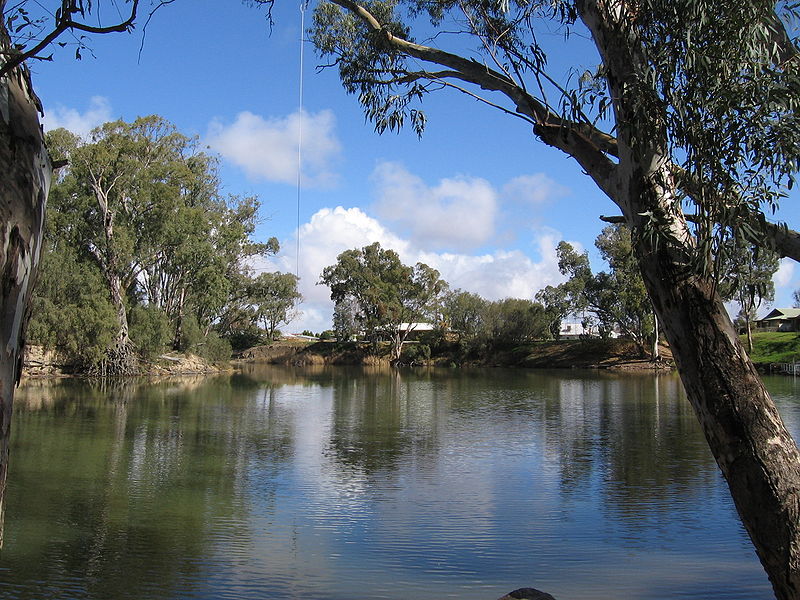
Murrumbidgee River

Murrumbidgee River in the Riverina (Courtesy: Mattinbgn, via Wikipedia, using CC-BY-SA 3.0)

In her “fragmented autobiography”, Trouble, Kate Jennings used excerpts from her first novel, Snake, to convey her childhood experience of growing up on a farm in the Riverina region of New South Wales. She had, she wrote, an “unhappy mother, diffident father”. Snake is the story of such a mother and father. While the novel is not totally “true” to her life in the factual sense, I have read enough novels and memoirs (such as Jill Ker Conway‘s The road from Coorain) about rural Australian life to know that it is “true” to the sort of experience it describes.

The blurbs on the back of my edition include the following descriptions: “a string of prose poems” (Times Literary Supplement) and a “domestic dystopia” (Sydney Morning Herald). The novel – novella in fact – is intriguingly structured. It has 4 parts. Parts 1 and 4 are short bookends, told in second person: the first part is addressed to the father and the last to the mother. The middle two parts are told in the more traditional third person voice and chronicle the life of the family: Rex the ironically named father, Irene the mother, and Girlie and Boy, the children who are caught in the middle. The chapters are short, some being only a paragraph or two long, and present vignettes of the family’s life rather than a simple this-then-that chronology. Dystopian is, unfortunately, an accurate description of their life. As Daphne, Irene’s sister, guesses on the wedding day,

Rex was a nice enough chap but about as interesting as a month of rainy Sundays. Irene will be bored with him before they arrive at the Blue Mountains guesthouse for their honeymoon.

While we never hear from Daphne again, she was not wrong. Rex is a “good man”, “decent”, a farmer of simple needs, while Irene, as her father realises, “dances to a tune no one else hears”. Not a likely recipe for success.

I thoroughly enjoyed this novel. Despite its unusual mix of voice and rather episodic form, it has a strong narrative that drives us on to its inevitable (but no spoiler here) conclusion. The snake motif runs through the book. Snakes are a fact of rural Australian life and so are a natural, real presence in the book, but their symbolic allusion to temptation, deceit and danger lurks behind every reference. Early in the novel, we are told of Irene’s youthful romantic tendencies – her love of

… smoky-voiced singers and innuendo-laced lyrics. Tommy Dorsey and Benny Goodman, Frank Sinatra and Peggy Lee, they were the snake charmers and Irene the snake.

Later, Girlie looks at snakes in a book on Australian fauna: they are “fanged, flickering, unblinking”.

Kate Jennings is a poet – as well as novelist and essayist – and it shows. The language is accessible but full of imagery. This is particularly apparent in the chapter titles, most of which are obvious in meaning, though some are more cryptic: “Home is the first and final poem”, “Send my roots rain” and “My mother has grown to an enormous height”. They are fun to think about as you read. There are some beautifully apposite descriptions. Here for example is Rex experiencing misgivings about his new wife:

The sight of her caused his nature – practical, honourable – to assert itself … What was done was done. Without being conscious of it, he coughed importantly – I am a man, I have a wife – and squirmed inside the jacket of his uniform until it sat better on his shoulders.

And here is Girlie reading:

Girlie read books like a caterpillar eating its way through the leaves on a tree.

Their town is, ironically, called Progress. However, very little “progress” occurs in the book. Rex struggles to keep the farm going in the face of mice and locust plagues, hail and dust storms. Irene tries to make a life that suits her romantic, imaginative spirit – she creates a garden, seeks friendships with interesting people, looks for work – but in the end nothing works:

Rex and Irene had given up arguing. He no longer bothered to tell her that he wasn’t asking much – harvest his crops, care for his animals, share it all with a good woman, tra-la – and Irene didn’t reply that far from not asking much, he was asking everything.

Such is the life of a mismatched couple. We’ve read of such couples before, and we will again, but for a clear-eyed, finely balanced, while also touching, portrayal, this one by Kate Jennings is hard to beat.

Kate Jennings
Snake
Sydney: Picador, 2003 (first pub. 1996)
153pp.
ISBN: 9780330364003

Arnold Jansen op de Haar, King of Tuzla

Translated works always represent a challenge. There is something slightly disconcerting about knowing that you are not reading the actual words of the author, but someone else’s interpretation of them. There’s been some discussion of this around the blogs and in the media this year, partly because of the publication of Why translation matters by award winning literary translator Edith Grossman.

Ramona Koval, of Radio National‘s The Bookshow, interviewed Edith Grossman earlier this year. Koval introduced the interview with:

According to Edith Grossman, translation is a strange craft, generally appreciated by writers, undervalued by publishers, trivialised by academics, and practically ignored by reviewers.

Well, maybe translators are ignored by professional reviewers, but I’ve often seen the issue discussed in blogs and online bookgroups. We are keenly aware of the translator’s role and have been known to compare translations. Anyhow, to continue… The Wikipedia article on Grossman includes a quote from a speech she made in 2003:

Fidelity is our noble purpose, but it does not have much, if anything, to do with what is called literal meaning. A translation can be faithful to tone and intention, to meaning. It can rarely be faithful to words or syntax, for these are peculiar to specific languages and are not transferable.

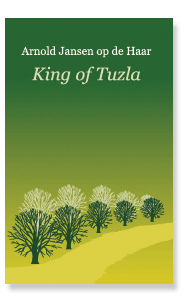
Arnold Jansen op de Haar, King of Tuzla bookcover

Book cover (Courtesy: Holland Park Press)

This brings me nicely to Arnold Hansen op de Haar’s King of Tuzla. I found it a strangely compelling book. I can’t say I loved it, and at the beginning I nearly gave it up, but it’s short and so I decided to push on. However, more of that anon. First a brief plot. It tells the story of a young Dutch army officer, Tijmen, who finds himself in the middle of the Bosnian War as part of a UN unit, and tracks his experience of the war and his feelings about it. Interspersed between his story are little “cameo” stories about various civilians and the impact of the war on them. In fact, the novel starts with one such cameo, the Muslim Galib who had been a civil servant but had lost his job due to the war and was now a farmer. These cameos do not become part of the main narrative.

The book is divided into 5 parts. The first three parts are essentially chronological, while the last two are told after the war, in flashback, some of it through Tijmen’s journal entries. Overall I liked the structure of the book. The early chronological sequence, the interspersed cameos that gave “life” (albeit often horrific) to the matter-of-factness of the military detail, and the change in pace and perspective in the last two parts give the book interest by layering meaning.

The characterisation of Tijmen and his fellow officers is effective. Tijmen himself is an intriguing character: a bit of a loner, interested in the arts (reading, ballet, iceskating), ambitious (but “Eleven years later and still he had got nowhere”), and a little proud (the King of Tuzla, the Duke of Sapna, is how he sees himself during the conflict). I must say, though, that I don’t quite know why the book has been described as a coming-of-age novel. He is an adult when the novel starts and, while he is a little naive in the ways of the world, I saw no coming-of-age focus.

The trouble is that the book is a bit of a plod to read at times, and I wonder whether this is to do with the translation. So, here’s the rub: do I place my concerns at the author’s or the translator’s feet? Part of the problem is the flow. It felt clipped and jerky, but not in a way that seemed like it was done for effect. And at times, the sentences just plodded on one after another, like a boring history text. Maybe all this was intended, but I found it hard going. In addition, there are errors, such as “the colonel still lay there snorting” (“Snoring” seems more likely) and some awkward expressions, such as “It was some minutes before Eddy was able to extricate himself from the situation with some difficulty”. Is this a translation problem? “With some difficulty” seems redundant, and makes the sentence clunky to read.

There are, however, also some lovely images and gorgeous rhythms. I particularly liked this, for example (despite the errant, to me, semi-colon after “popes”):

This was the area where the different population groups overlapped like different geological strata. It was the land of popes; the mullahs and rabbis, the Christians, the Muslims, the Jews and the gypsies. The land of the long hot summers and the long severe winters, of rakija, walnuts and prunes and the land of the centuries-old struggle between the Turks, Hungarians, Austrians and Germans…

And this poignant description of Tijmen’s flat:

Eight years in the same flat, where time’s mechanism had jammed. No-one had been loved there.

In the end, figuratively speaking as we learn this two-thirds of the way through the book, the war is too much for Tijmen and he leaves the army. The book concludes with some nicely structured words beautifully conveying what he had earlier described as “this uselessness, this futility, human helplessness”. (Wouldn’t it be better with another “this” before human?) This may not be the best war novel I’ve read, but it has its power.

This book has received some varied reviews. You may like to read a couple: Stu at winston’s dad and Lisa at ANZLitLovers.

Arnold Jansen op de Haar
(Trans. by Paul Vincent)
King of Tuzla
London: Holland Park Press, 2010
(Orig. pub. 1999)
199pp.
ISBN: 9781907320064

(Review copy supplied by Holland Park Press)

Jeanette Winterson, Oranges are not the only fruit

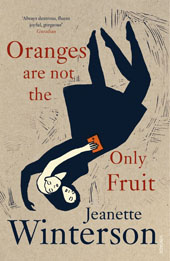
Winterson, Oranges are not the only fruit, book cover

Book cover: Used by permission of the Random House Group Limited

As I was reading Jeanette Winterson’s novella Oranges are not the only fruit, the question, rightly or wrongly, that was uppermost in my mind was “What is it with the oranges?” Is there something about oranges that I don’t know? Something specific that they symbolise?  I racked (wracked) my brain for something in my literary past that would give me a clue, but I came up with nothing. I guess she wanted to choose a motif to represent her mother’s limiting interactions with her and an orange seemed as good as anything? Certainly oranges are a recurring motif, and her mother regularly insists they are “the only fruit” until the end when a “pineapple” makes its appearance. I’m not sure, however, that this change heralds anything in their relationship other than compounding the paradoxes that seem to underpin this novel.

This is an intriguing book. It is a semi-autobiographical coming-of-age novel which tells the story of the first person protagonist, Jeanette, who was adopted by a religious zealot and is being brought up to be a missionary. However, around the age of 16 she discovers that her (homo)sexual leanings do not meet her mother’s (or her church’s) approval and, well, the plot is slim but perhaps I will leave it here nonetheless…

The novel exhibits some of the hallmarks of postmodernism, of which the most obvious is its metafictional elements, the way it contains stories within stories and plays around with the idea of stories in relation to “truth”. It all begins with Winterson naming the main character after herself and modeling that character’s life on much of her own, resulting in our being, from the start, teased by notions of what is “true” and “real”.

The book is divided into chapters titled appropriately, given Jeanette’s upbringing, by books of the Bible, such as Genesis, Joshua and Ruth. These titles are descriptive but also symbolic and even a little satirical; Jeanette, for example, has walls to confront just like Joshua. And the narrative, while roughly chronological, intermittently leaps from “reality” to “fantasy” as Jeanette tries to escape or make sense of her experience of life. Sometimes these stories – such as the Winnet story near the end – represent a parallel fantasy life for what is happening to her, but other times the reference point is more indirect, and draws on history and myth such as the King Arthur legend (and Sir Perceval’s search for the Holy Grail).

And this brings me to “story” and “history”. Readers of my blog will know that these notions, and the related one of “truth”, fascinate me when they are played out in fiction. I tend to enjoy reading books that deal self-consciously with them, that recognise the challenges and ambiguities inherent in them – and this is one of those books. Jeanette, the character, has some interesting things to say on these topics around the time the “truth” of her life, her sexuality, is becoming clear. She says in the short chapter titled Deuteronomy: The last book of the law:

Of course that is not the whole story , but that is the way with stories; we make them what we will. It’s a way of explaining the universe while leaving the universe unexplained … People like to separate storytelling which is not fact from history which is fact. They do this so they know what to believe and what not to believe. This is very curious …

And she goes on to discuss how history, the past, “can undergo change” because “the lens can be tinted, tilted, smashed”. She recognises that “perhaps the event had an unassailable truth” but we all see it through our own lens. Tellingly, near the end of the book, in the chapter titled Ruth, she runs into Melanie, her first lover (now married with a child):

…she [Melanie] laughed and said we probably saw what had happened differently anyhow … She laughed again and said that they way I saw it would make a good story, her version was just the history, the nothing-at-all facts.

Melanie, it seems, does not have the imagination to re-vision her “story”.

So, did I enjoy this book? Yes, pretty much. I like her attempt to make sense of what was a very particular childhood, and to try to draw from it some larger “truths” about how we might all manage the “stories” of our lives. It is not a straightforward read – and it is first novel with, perhaps, a little of the overdone in it. I’m not sure why, for example, she suddenly decides to include a little rant against Pol Pot. It usefully supports a point she is making about the uses of history, but it is odd in a story that is nowhere else political. Perhaps that’s just being post-modern!

In her introduction to my 1991 Vintage edition, Winterson claims to have written an experimental, anti-linear novel. Well, it is a bit of that I suppose, though not dramatically so. I would have called it reasonably linear – at least in the chronological sense – but perhaps the ideas in it do “spiral” (as she calls it) a bit in the way she toys, through the various narratives, with the idea of “story” and what it means to us. What it means, I think, is not always clear – we like stories but we cannot (perhaps need not) always draw conclusions from them. That is the paradox of our lives. As she says near the end

…not all dark places need light. I have to remember that.

Jeanette Winterson
Oranges are not the only fruit
London: Vintage, 1991 (orig. 1985)
171pp.
ISBN: 9780099935704

Craig Silvey, Jasper Jones (Review)

Jasper Jones cover (Courtesy Allen & Unwin)

Jasper Jones cover (Courtesy Allen & Unwin)

What is is about coming-of-age novels? Why do we like to read them long after we’ve (hopefully) come of age ourselves? Is it because we like to compare our own experience with that of others? Whatever the reason, it is clear that we do like to read them because they sure keep being written and published. In my few months of blogging I have already written about two, and have now read another, Craig Silvey’s Jasper Jones.

Like many, though not all, such novels, Jasper Jones has a first person narrator. It is set in a small country town in Western Australia in the late 1960s, and the protagonist, Charlie, is the nearly 14-year-old son of a high school literature teacher. He is a reader and therefore, almost by definition in the world of teenage boys, not “cool”. The book opens with the town’s bad-boy, Jasper Jones, knocking on his window in the middle of the night and, to Charlie’s surprise and delight, asking him for his help. The plot revolves around the shocking help that Jasper wants, how Charlie responds and the impact on him, his friends and family.

It is  a pretty dark and gritty story, and Silvey, mostly, controls it well, though there are times when he pushes the melodrama button a little too heavily. Silvey teases us at the beginning with the notion that the book will be a re-setting of Harper Lee’s To kill a mockingbird. There’s a death, an indigenous person likely to be blamed for it, a much maligned apparently “mad” person,  an apparently thoughtful and wise father AND Charlie’s own regular reference to the book and to how Atticus Finch might think in particular situations. However, fortunately I think, Silvey is a little more sophisticated a writer than that and Harper Lee’s book functions more as a frame for the story and the ideas being explored than as a direct model for the plot.

One of the things I like in the novel is the friendship between Charlie and his Vietnamese refugee school-mate, Jeffrey Lu. I’m not a teenage boy but I have known some in my time! The dialogue between the two boys rings pretty true – their puns, their ribbing of each other, their jokey arguments. True too is their uneven burgeoning interest in the opposite sex – Charlie is attracted to classmate Eliza Wishart  and to enjoying some “sassytime” with her, while Jeffrey’s focus is on making the town cricket team.

The novel is neatly plotted – and while some of it is predictable it is not all so. The fact that Charlie fears insects seems to be resolved when we discover that his love-interest Eliza has a similar fear – but it reappears again, cleverly, in the denouement. The story is well-paced, and it deals with a range of side issues, such as racism (against the Vietnamese refugee family, and the “half-caste” Jasper Jones), on top of the usual coming-of-age ones, such as loss of innocence (in several meanings of the word). Many of the characters could be seen as stereotyped – the “bastard” cricket coach who aligns himself with the “boorish” bully boys, and the cold-hearted status-seeking shire president, to name two – but most of them work despite this. Charlie’s mother though stretches the imagination a little too much: she has married down, she has been forced to live in a country town too small for her, and she has lost a child. This does seem a bit of overkill and the panning out of her part of the story feels a bit like one too many layers in the book.

One of the concepts that Charlie explores is that of “timing and chance”. He learns that despite your best laid plans, time and chance sometimes take over and there’s not much you can do about it. Another issue that runs through the book is that of reading, words and language. Early on Jasper Jones tells Charlie he trusts him because:

But I hope you might see things from my end. That’s what you do, right?  When you’re reading. You’re seeing what it’s like for other people.

With this coming near the beginning of the book, it’s not surprising that Charlie’s ability to empathise, to see things from other points of view, is pushed to the limits as the story progresses. Charlie, whose ambition is to be a writer, also learns about the limits of words, about when they are useful and when they are not, and about finding the right ones to use when they are.

There are many thematic and stylistic things that can be talked about in this book, making it a good one for discussion but, in the end, it is a fairly traditional coming-of-age story in its style, tone and structure. That said, if you like such stories, as I do, there’s a good chance you’ll find this a compelling and entertaining even if not a particularly challenging read. And is there anything wrong with that?

Craig Silvey
Jasper Jones
Sydney: Allen & Unwin, 2009
368pp.
ISBN: 9781741757743

Four time winner: Tim Winton wins 2009 Miles Franklin

Photo by Denise Fitch, Australia Council for the Arts

Photo by Denise Fitch, Australia Council for the Arts

Well, it’s finally happened as I knew it must. Someone has equalled Thea Astley’s record number of four Miles Franklin Award wins as tonight Tim Winton was announced the 2009 winner with Breath. I was seriously considering making Thea Astley my third favourite writers post – I think this means that I will now have to.

Winton has won the award for Shallows (1984), Cloudstreet (1991), Dirt Music (2001) and now Breath (2009); and Astley for The Well Dressed Explorer (1962), The Slow Natives (1965), The Acolyte (1972) and Drylands (1999). Both writers are great stylists who use metaphor well, both tend to explore strong connections between character and landscape, and both are indubitably Australian! I think, however, that Astley’s pen ranged wider than Winton’s and she took more risks. That’s not to say that Winton doesn’t deserve his wins but I do think that Astley (she died in 2004) was and continues to be undervalued.

Breath

Anyhow, here is a brief recap of my thoughts on Breath which I read long before I started writing this blog. I’ll start with a quick plot summary just in case there’s someone out there who doesn’t know it! It is a first person, coming of age story told by Bruce “Pikelet” Pike. It starts with his boyhood friendship with Ivan “Loonie” Loon. As young boys, they dare each other to perform dangerous stunts in the local river, and then as teenagers, they take up surfing where they are encouraged into new levels of recklessness by a former professional surfer named Sando. As time passes, Pikelet’s friendship with Sando and Loonie disintegrates and is replaced by a rather equally scary relationship with Sando’s American wife Eva, an injured and therefore ex-skier.

Southwest Western Australia, by soulsurfer 3 @ flickr

Southwest Western Australia, by soulsurfer 3 @ flickr

I like the book. I like the way he sustains the “breath” metaphor throughout to represent various facets of life and life-giving (or life-taking) forces. Despite not being a surfer, I love his wonderfully visceral descriptions of surfing. I also like his exploration of the imperative to take risks that is so common in young men and that is often accompanied by a drive to “be someone”.

Related I suppose to the coming-of-age issue is the theme of learning to accept being ordinary.  After Sando and Loonie leave the first time, Pikelet goes out and surfs Old Smoky: the first time he does it he’s so successful he feels he’s not ordinary, but then in his overconfidence he does it again and nearly does himself in…this is the beginning of his changing point of view. As he says a little later when he reviews his relationship with Eva, “No, Eva was not ordinary. And neither was the form of consolation she preferred. Given my time over I would not do it all again”. In other words, while he had originally equated not being ordinary with doing big risky things, with courting fear, by the end of the novel he realises that life is “a tough gig” and is about more than courting fear and taking big risks. This doesn’t mean that he can’t do and enjoy a job that provides an andrenalin rush (paramedic/ambulance driver) but it does mean that he no longer seeks to be anything other than himself and that he now goes for an adrenaline rush in “safer” more acceptable ways.

Before he gets to this point, though, he has to come to terms with his Eva experience and with the fact that he spent a big part of his life blaming her for his problems. He eventually comes to the conclusion that “people are fools, not monsters”. This closely resembles my own world-view: that is, that mostly (there are obvious exceptions) when people do the wrong thing they do it, at best, from the best of intentions, or, at worst, for reasons of laziness, selfishness or just plain obliviousness.

There’s no neat ending or pat conclusion: Pikelet recognises that he has been damaged by his life experiences and that he needs to manage himself – but he still loves to surf, that is, to do something “pointless and beautiful”. In this sense it is very much a book of its post-modern age: the lesson almost is that there is no lesson, that each of us has to find our own way. Pikelet says to Sando “maybe ordinary’s not so bad”. As one who is rather ordinary herself, I concur!

Pramoedya Ananta Toer, This earth of mankind

Nationalism, in today’s western world, is pretty much a dirty word – and yet it is the idea of nationalism which underpins Indonesian writer Pramoedya Ananta Toer‘s Buru Quartet, of which I have just read the first book, This earth of mankind. Toer’s concept of nationalism was formed under colonial rule of his country by the Dutch and then under military rule by Indonesians. His notion of nationalism encompasses ideas of individual freedom and dignity, and the right of individuals and, by extension, the nations which they form, to be self-determining. None of these are well supported under colonial or military regimes.

Toer & a translator. Photo: Michael Scott Moore at radiofreemike.com

Toer & a translator. Photo: Michael Scott Moore at radiofreemike.com

Toer (1925-2006) spent quite a bit of his life as a political prisoner and, in fact, this novel was first told orally to co-inmates in 1973 when he was imprisoned on the Buru Island penal settlement. He was first imprisoned (1947-1949) by the Dutch government after an anti British and Dutch revolution, and then later by the Indonesian government, first in 1963 when he supported Chinese minorities, and then after a military coup in 1965.  On this third occasion, he was imprisoned until 1979, though after that was essentially kept under house arrest until 2002. The first two novels were published in 1979/1980, and were translated into English in 1981 by Australian diplomat in Indonesia, Max Lane, who was recalled to Australia that same year as a result. Clearly, the Indonesian government was not amused. Indeed, the books were banned by that government in 1981.


From Wikipedia, under GNU Free Documentation License

From Wikipedia, under GNU Free Documentation License

This earth of mankind is set in 1898, and provides a fascinating look at colonial life in Indonesia at that time. It tells the story of a Native, the only one to attend an elite school. Being a Native he has no formal name, and so throughout he is called several names – Sinyo or Nyo, Gus, and most commonly Minke. Early in the novel, he is introduced to a succesful concubine Nyai Ontosoroh and her beautiful daughter, Annelies, and is gradually drawn into their lives. The novel follows his – and their – fortunes as the colonial authority does its best to see that a Native does not rise above his station. Life turns out to be a paradoxical one for Minke – on the one hand his education teaches him to think and argue and believe that all things are possible while on the other hand the colonial structure, within which he lives, works to ensure that little is possible.

The novel is peopled with a wide range of characters of various ethnic backgrounds – primarily Dutch, Indo (people with Dutch and Native parentage), and Natives, but also French and Chinese. This ensures that the strictly enforced layer of colonially-decided rights is set against a wide variety of political and personal opinions and provides the reader with an excellent insight into a complex society. This is perhaps also the cause of its main flaw because it is, at heart, an ideological novel. And, like many ideological novels, characters and plots are simplified and exaggerated to make the point. So, in simple terms the story can be seen as poor clever boy meets rich powerful concubine and falls in love with her beautiful but weak daughter only to be crossed by the wicked brother. The story has a melodramatic edge and there’s not a lot of complexity – of greys – to the characters. They are there to serve a purpose.

That said, it is a rivetting read. Told, first person, in Minke’s voice, the novel immediately engages us with him and his situation. He is, in fact, a little more rounded than the others: we get a sense of his uncertainty as he makes his various decisions throughout the book. This is largely because it is also a coming-of-age novel: paralleling the ideological issues underpinning the novel is the story of Minke’s emotional, social and intellectual development. A major thread is that of education and what can (should) be expected of an educated person. Early in the novel his “mentor”, the French artist, Jean Marais, tells him:

You’re educated Minke. An educated person must learn to act justly, beginning first of all with his thoughts, then later in his deeds. That is what it means to be educated.

This advice underpins Minke’s thought and actions from that point on: at each test or decision point he tries to apply his education.  There’s bitter irony here though because it is the source of that education – Europe – that causes his major problems at the end. As Minke is fast learning, you have to be strong to survive.

There’s a lot more that can be teased out in this book – including the role played by language in controlling and enforcing power and status – but rather than ramble on, I will end with the words of Minke’s favourite teacher, Magda Peters. She says:

…without a love of literature, you’ll remain just a lot of clever animals

It is not surprising then that Minke, Toer’s alter ego in this book, becomes a writer!

(Translated by Max Lane)