
I came across the Colonial Texts series back in 1988 with the publication of its first book, Ada Cambridge’s A woman’s friendship. I bought it and read it, and was inspired to read another novel by Cambridge, Sisters. Somehow, though, I lost touch with this series, partly due to my young family busy-ness at the time but also, I’d say, due to poor general (ie outside academia) marketing.
The series is just one example of the flurry of activity that was happening around the late 1980s in terms of retrieving Australian literary history, particularly, but not exclusively, women’s writing. This was strongly related to the Australian Bicentenary which saw all sorts of renewed enthusiasm for things “Australian”, though there was at the time, and quite rightly, controversy about celebrating 200 years of settler society, given the long habitation of this land by First Nations Australians who had never been celebrated.
This is an important issue, but not related to this post, so, back to the series … The University of New South Wales’ Australian Scholarly Editions Centre (ASEC) devotes a page to it. The eight titles were published between 1988 and 2004, when it – just – stopped. ASEC describes the series’ aim as being “to provide reliable reading texts of little-known nineteenth-century Australian literary works”, in editions that include introductions and explanatory notes, which “outline relevant biographical, book-historical and critical contexts”.
ASEC also notes that the titles by Catherine Martin, Ernest Favenc and Tasma, as well as Ada Cambridge’s A Black Sheep, are “full-scale critical editions, recording variant readings in other lifetime printings”. These are, then, scholarly editions but this doesn’t detract from their essential content, which is accessible to any interested reader.
Some of these works first appeared as serialisations in the newspapers of the day, and for some, this series was the first edition since their original publication. Others, however, had – and/or have since – appeared in other editions.
The list
Here is the list of the books published, in series no. order, and with some notes from ASEC’s site.
- Ada Cambridge, A woman’s friendship (1988, ed. Elizabeth Morrison): a “gentle satire of class and sexuality” which “opens a window on Melbourne society of the 1880s and illuminates some important issues of the day – reform of dress and diet, the ‘marriage question’, socialism, and women’s suffrage”. (1889)
- Mary Theresa Vidal, Bengala, or, Some time ago (1990, ed. Susan McKernan): “depicts the life of the colonial gentry in the years before the goldrush, but it offers a more domestic and less exaggerated version of their lifestyle”. (1860)
- N. Walter Swan, Luke Mivers’ harvest (1991, ed. Harry Heseltine): “a tale of adventure, love, and revenge”, which ranges from the sheep runs of Victoria to the Palmer goldfields in North Queensland. Intersperses scenes of high passion and excitement with “satirical commentary on many aspects of nineteenth century Australian life and manners”. (1879)
- Catherine Martin, The silent sea (1995, ed. Rosemary Foxton): “centres around the Colmar Mine which is modelled on the largest gold mine existing in South Australia at the end of the nineteenth century … intelligent and sophisticated novel [which] encompasses compelling psychological obsession, passionate romance and ironic questioning set in vivid historical detail against Adelaide society and the outback”. (1892)
- Ernest Favenc, Tales of the Austral tropics (1997, ed. Cheryl Taylor): collection of stories which “draw their vivid realism” from the author’s experience as an explorer and rover in north Queensland”. Includes romances and comedies, but most “return to the theme of death in the desert, mangroves and caves. Their obsessive horror and ugliness are suggestive of tensions in the national identity, as it emerged in an alien environment, to confront many kinds of racial and cultural differences”. (1890s) (Lisa’s review of SUP edition)
- Louisa Atkinson, Gertrude, the emigrant : a tale of colonial life (1998, ed. Elizabeth Lawson) (Bill’s review of Mulini Press edition on AWW site): “the first Australian novel written by a native-born woman and the first to be illustrated by its author … [the] story of a young immigrant heroine making a life in a colony which is itself in the making … draws on authorial and family memories to summon the harsh, more complex, convict worlds of Sutton Forest, the Shoalhaven and Sydney in the late 1830s and 1840s”. (1857)
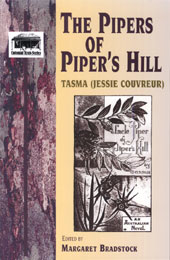
- Tasma (Jessie Couvreur), The Pipers of Piper’s Hill (serial version of Uncle Piper of Piper’s Hill ) (2002, ed. Margaret Bradstock) (my review of PGA edition): “the story of the Cavendish family who come to Australia from England to live with Mrs Cavendish’s parvenu brother, Tom Piper” focusing on “the clash of values between the impoverished old world of privilege and the new-world democracy of the self-made man … Tasma’s depiction of the conflicting currents of life in colonial society, and her delightful evocation of the characters involved, rapidly established her as an author of note”. (1888)
- Ada Cambridge, A black sheep: some episodes in his life (serial version of A marked man) (2004, ed. Elizabeth Morrison) (Narelle Ontivero’s review of Pandora’s edition of A marked man on Bill’s blog): follows the life and loves of Richard Delavel, from being “a rebellious Oxford undergraduate in 1850s England” to “a still restless middle-aged family man in 1880s Sydney … against a background of constraints and opportunities in Britain and Australia”. Described as “a powerful creation of an iconoclastic character in search of professional fulfillment” and “a complex reflection on marriage ties and social obligations and a lively evocation of late colonial Sydney”. (1888/1890)
It’s interesting, but not surprising, to see that the goldrush and goldmining feature in several of these, not to mention the clash between old and new worlds. It’s also interesting that a few are satirical.
Hmm…
In 1991, a report titled “Successful symbiosis of defence and books”, was published in The Canberra Times. Written by literary editor Robert Hefner, it describes the launch of NINE books published by the staff of the English Department at University College, the Australian Defence Force Academy, which, Hefner writes, “has for more than a decade, been building a reputation as one of the country’s leading centres for the study of Australian literature”. Australian polymath Barry Jones, who did the launch said:
It’s always very flattering to be asked to launch a book … but to have been asked to launch nine is something well beyond my experience … and to do it here in the environment of the Australian Defence Force Academy… makes the occasion all the more unusual and to be cherished.
The English Department here at the University College… an outpost — and I would hope a revolutionary and subversive outpost of the University of New South Wales — with its extraordinary symbiosis has been extraordinarily productive.

It was the idea that a Colonial Texts series would come out of a defence force academy that thrilled me so much when I bought my Cambridge. The nine impressive books are listed in the article. They include two Colonial Texts, Vidal’s Bengala and Swan’s Luke Mivers’ harvest. Bengala editor, Dr McKernan, said that something they’ve
all found in working on this series is that you can’t rely on public opinion for the good things to come to the surface… there’s a lot of pleasure in things that’ve been lost.
Don’t we know it! She went on to say, writes Hefner, ‘that this reinforced the sense that critics working today had a big responsibility to read and argue about things, “because in a hundred years’ time they may all be forgotten”.’ This is why our reframed AWW program is so important.
Why, you might wonder, did I head this section, Hmm? It’s because Hefner concluded his report with a comment by one of the launched authors, Adrian Caesar:
All these books were, I think, largely conceived, written and produced before the Government and the University of NSW began expending so many efforts and energies on making us more efficient, productive and accountable.
Very possibly we’ll have to work even harder in the future to match this output, since so much of our time is now taken up with shuffling bits of paper around our desks in order to prove how efficient, productive and accountable we are. This of course inevitably makes us much less efficient since it detracts from our proper task of teaching and research. I feel hopeful, however, that this department at least will maintain its productivity, despite, not because of the valiant initiatives to improve us.
You can’t help thinking that in saying this, he was foretelling the future, because publication of the last five Colonial Texts took much longer than the first three (even allowing for a couple of years lead-time before the first was published). And then they stopped. I’m sure that’s not because there was nothing else worth publishing!
 Whispering Gums