The gift of words

Xmas Tree

There be words in there

Middle age has come
and all the plans and needs
are chaff not seeds,
blowing down the blue air
to fall flat and trampled
by some window where
a hopeful girl braids
her thick hair and hums.

(“Humble”, by Ginny Jackson)

Better late than … hmm, perhaps not, but I’m going to tell you anyhow.

I’ve noticed in recent years that I don’t receive a lot of books for Christmas – and when I do, they are often not fiction – but a few hardy gift-givers still bravely feed my obsession. And so, I received a small but intriguing bunch this year, which I will list by category:

Fiction:

  • Margaret Atwood‘s The year of the flood. Atwood is one of my favourite writers but I’ve dropped the baton on her a bit in recent years. I hope to pick it up again and run this year with this, her most recent. Thanks, Mum.
  • Helen Simonson’s Major Pettigrew’s last stand. I have already read and reviewed this one – and suggested at the time that there were people I knew who would enjoy it. I didn’t have a copy then so couldn’t lend it to them. I now do … thanks Sandra, from my bookgrouplist swap.

Poetry:

  • Ginny Jackson’s The still deceived. I can always rely on my brother to choose something a little bit different for me, and this year was no exception. My brother lives in Tasmania and this book, published by Ginninderra Press, is by a Tasmanian poet/artist. I have only dipped into it – but if you like the poem opening this post you might like to dip into it too. Thanks, bro!
  • There’s something about a rose. I knew immediately who chose this book – my Dad, the rose lover. It comprises a selection of poems and art celebrating, yes, roses, and was compiled by the Friends of Old Parliament House Rose Gardens. The poems are by Australian poets, some well-known, such as Barbara Blackman, Les Murray and Chris Wallace-Crabbe, and others not so well known (to me at least). I have already dipped into and enjoyed several of the poems…and may share some with you as the year goes on. Thanks, Dad.

Non-fiction:

  • The Canberra gardener. I’ve had previous editions of this gardening bible, but not for some years. Published by the Horticultural Society of Canberra, this one is the 10th edition published in 2010. The previous edition was published in 2004, just as our last serious drought was starting to bite. As a result, this new edition focuses on how to create lovely gardens with less water. Funnily enough, our dams are now suddenly full (last year they were at 50%) but we have all learnt (if we didn’t already know it) that Australia is a dry continent and that we should make water conservation a permanent goal regardless of annual fluctuations in water levels. This book will help me in my endeavour. Thanks, Carmel.
  • Roger McDonald‘s Australia’s wild places. I do like a good coffee table book and this is a good coffee table book. It’s published by the National Library of Australia and comprises landscape photographs of Australia from the Library’s collection. The photos were chosen by award-winning Australian novelist, Roger McDonald, whose books tend to have strong rural themes. The book has an introductory essay, with a strong environment message, by McDonald, followed by gorgeous images by some of our top photographers, including Peter Dombrovskis and Frank Hurley. It is just the book for me to look at now, as we prepare for our annual foray into the Snowy Mountains for a bit of post-Christmas R&R. It was given to me by a friend who spent most of her career working with these images. Thanks, Sylvia.

So, there you have it, six books from six people, each book reflecting a little bit of both the giver and the receiver. What more can one ask of a gift?

And now, if it’s not too late, I’d love to hear if any of you received books this year, and what they were.
Richard Allen and Kimbal Baker, Australia’s remarkable trees

It’s odd, don’t you think, that a poem by Thomas Hardy is used to introduce a book titled Australia’s remarkable trees? The poem, “Throwing a tree”, starts with a line that leaves you in no doubt as to the poet’s sympathies:

The two executioners stalk along over the knolls

… and concludes with the poignant, nay tragic:

And two hundred years’ steady growth has been ended in less than two hours.

Relevant? Yes. But there are Australian poems that would have done the job, such as, for example, David Campbell’s “The last red gum”, which concludes:

So we stand, me and my brothers, just the bones of ancient trees
that have lined the riverbank since time began.
In a bare and barren landscape, fed by the red dust on the breeze,
We’ve been ravaged by the careless hand of man.

I’m being churlish though I know, as this is a gorgeous book. The best way to describe it, I think, is as the tree equivalent of a dictionary of biography: it documents 50 trees from all over Australia, through photographs (Baker) and text (Allen). The trees are categorised under six chapters:

  • Magnificent natives
  • Old curiosities
  • Foreign invaders
  • Historic trees
  • Private trees
  • Local giants

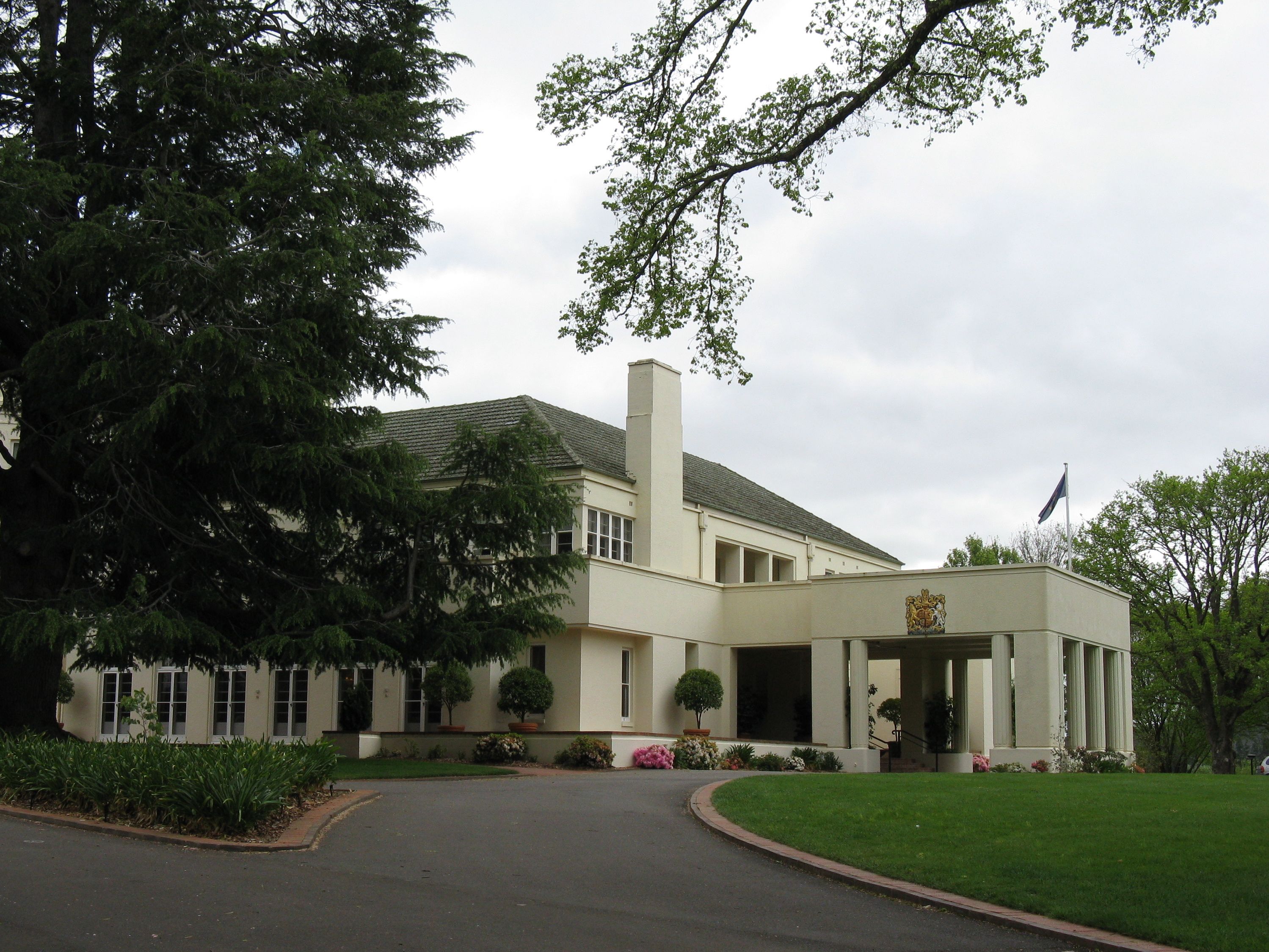
Not surprisingly, gum trees (22 of them) feature heavily in the book, with four of these being the River Red Gum . In his text – a page or two for each tree – Allen provides some background to the tree (the specific tree photographed, its species, and its location). Just enough information to whet the appetite. Take, for example, the Himalayan Cedar (Cedrus deodar) at Government House in Canberra.

Himalayan Cedar (Deodar cedrus)

Himalayan Cedar (left), Government House, Canberra. (If I’d known I was going to write about it I would have featured it more!)

This tree was 5 years old, when it arrived in Australia, from Britain, in 1837 and was planted on what was then a sheep station called Yarralumla (now the name of its suburb). It is HUGE and one limb is now supported by a steel cable, but it is still surviving and, Allen says, could live another 100 years. When I did a tour of the garden last year, the gardener told us that they are propagating from it: it is clearly of good stock, and propagating it will ensure that it continues to be part of the Government House landscape when it does finally die.

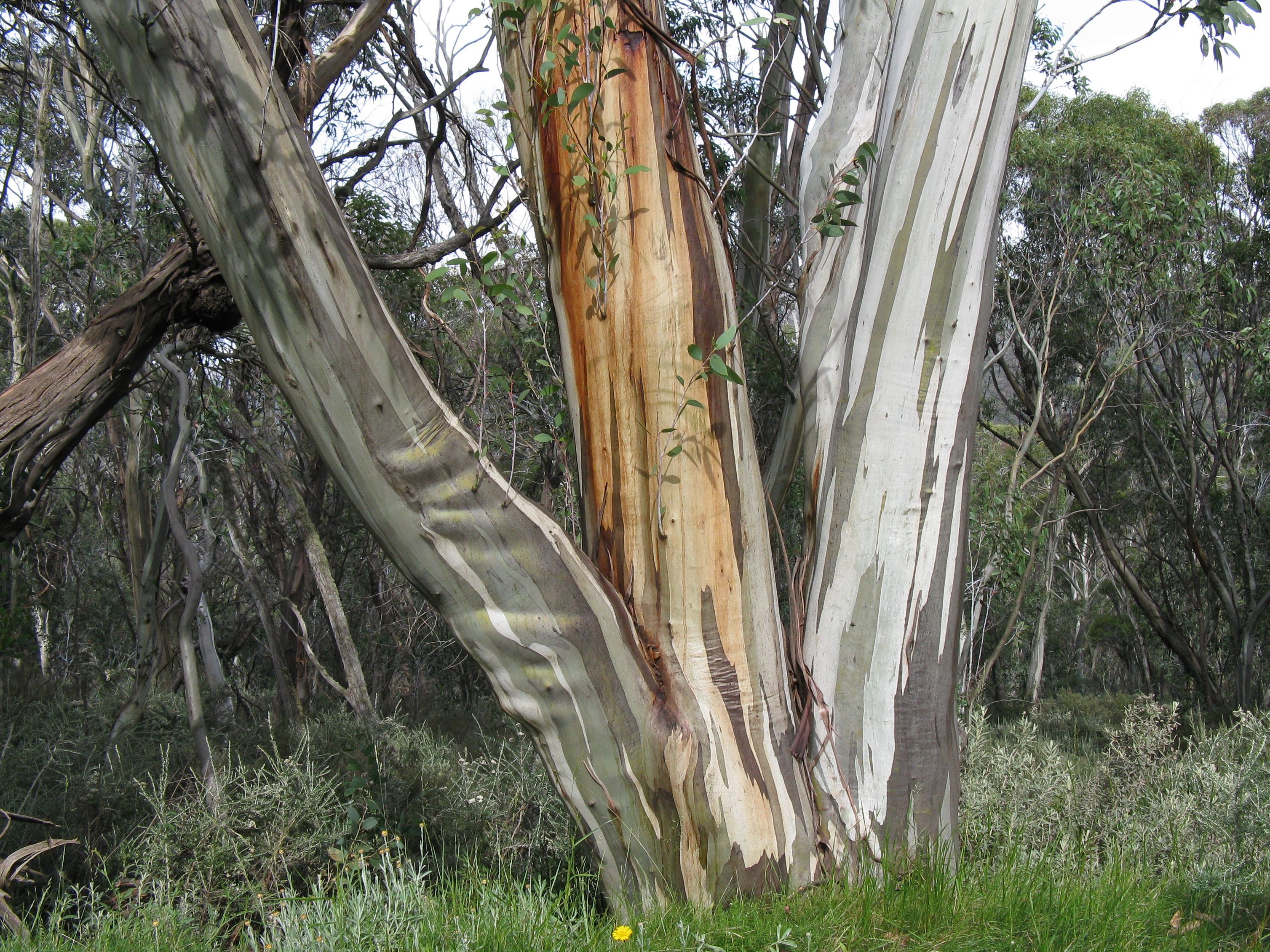
Snow gum (Eucalyptus pauciflora)

Snow gum on Merritt’s Traverse, Kosciuszko National Park, Thredbo

Among the gums featured is one of my favourites, the Snow Gum (Eucalyptus pauciflora). The one chosen for the book is from the Bogong High Plains in Victoria. It has the tortured, twisted formation typical of those that live in high altitudes. And, like my younger less tortured one here, it also has the gorgeous multicoloured ribbon marking that is characteristic of these trees.

These are just two of the trees presented in this book. There are many more gums (and other natives) and more exotics, there are the giants (such as Western Australia’s Karri) and the strange ones (like the Boab and the Banyan Fig), and of course there is the famous, recently discovered (1994) “living fossil”, Wollemi Pine (Wollemia nobilis).

This book has a lot to offer if you are interested in trees – for themselves, and for how they relate to landscape and our sense of place – and if you believe passionately, as the authors do, that preserving them is key to our future. John Muir would be proud. But again, strangely, the book ends not with an Australian reference but a quote from American architect, Frank Lloyd Wright, who apparently said “The best friend on Earth of man is the tree”. I think, though, that I will end with something a little more mystical. It’s from “Scribbly Gum”, by Judith Wright:

The gum-tree stands by the spring.
I peeled its splitting bark
and found the written track
of a life I could not read.

Richard Allen and Kimbal Baker
Australia’s remarkable trees
Carlton: The Miegunyah Press, 2009
254pp.
ISBN: 9780522856699