Chris Flynn, Here be Leviathans (#BookReview)

I am not one of those readers who shun weird narrators. Indeed, you’ll find several in this blog, including a skeleton, a dead baby, a foetus and a mammoth fossil. The critical thing for me is not who the narrator is, but whether that narrator is convincing and offers a perspective that engages my mind and heart. Of all the writers I’ve read over the last decade, one that stands out in his ability to surprise and excite me with different voices is Chris Flynn. His short story collection, Here be Leviathans, is astonishing from its first page to its last in its array of narrators.
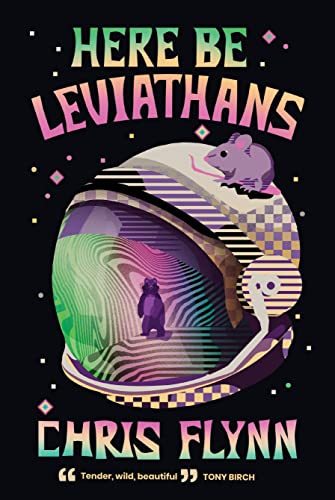
There are nine stories in this collection, and it is a testament to Flynn that by the second or third one I was fully invested in who would be the narrator this time. I was never disappointed, albeit they ranged from the animate (like the grizzly bear which opens the collection, in “Inheritance”) to the inanimate (such as the airplane seat which narrates the second story, “22F”).

But, before I continue with Flynn’s book, I want to share something he says in his also entertaining “Afterword/Acknowledgements/Blame apportioned” statement. Describing one of his stories as having been inspired by Thea Astley, he refers to his role as one of the judges in Meanjin’s Tournament of Books and shares the exact words of his that I quoted back in my 2013 post on that tournament:

Astley was the progenitor, the chain-smoking, wise-cracking, jazz-loving four times Miles Franklin-winning champion of linguistic manipulation whose style got on Helen Garner’s nerves and who pushed the envelope of Australian literature when no-one else had the cojones to do so.

Flynn’s work is different to Astley’s – time and experimentation having moved on – but he too pushes the envelope of Australian literature, which is why he was one of the writers mentioned the article that inspired my recent Monday Musings on weird Australian fiction. And like Astley, his interests are personal and political. He’s interested in the ways we live in the world, in the injustices we enact, which translates to a concern with issues like colonialism, the environment, and the fallout from an unbridled interest in progress. His touch might feel lighter than Astley’s – he can be laugh-out-loud funny at times – but fundamentally both writers question who we are as human beings. What does what we do say about who we are?

“What a piece of work is man” (Shakespeare via Albert VI)

So, let’s explore Flynn’s brand of weirdness, and why I enjoyed it so much – despite the fact that the opening sentences of the first story, “Inheritance”, were truly shocking:

I ate a kid called Ash Tremblay yesterday. Parts of him, at least. The good bits. The crunchy skull, the brain, a juicy haunch.

What is a reader to think? Fortunately, you don’t have to think very long because very soon our narrator outs himself (it is a “he”) as a bear. He shares a few home truths about humans and our assumptions and behaviours. If you ignore the gruesomeness – after all, a bear has got to eat – the story is pretty funny. Its ostensible subject matter is inherited memory – in this case the bear has inherited Ash’s memory – but it is also a work of ecofiction, which includes exploration of issues like sustainability and colonialism. It is refreshingly bold, asking us to envisage different ways of acting in nature, and, at 30 pages, it is also long. But who cares?

The second, much shorter story, “22F”, is also a work of ecofiction. Its first line seemed ordinary enough, “The first day in a new workplace is always nerve-wracking”. It is, isn’t it? As the story progresses, however, you start to wonder just who this new employee is until the penny drops, it’s seat 22F on a plane. After this story, I thoroughly enjoyed the challenge of working out who was telling each story as I started it. But, back to 22F. In his Afterword, Flynn explains that the story was inspired by the Werner Herzog documentary Wings of Hope about the sole survivor of a 1971 airplane crash. Herzog and that survivor, Juliane Koepcke, return to the site of the crash, and find parts of the plane in the jungle. Flynn writes:

Memory and place. A reminder that we are only passing through and that everything is part of something larger.

Along the way, though, he discusses other issues, like workplace behaviour:

Toilets are inveterate boasters and disgusting perverts. You can’t believe half of what they say.

Eventually 22F’s plane crashes, and while the bodies disintegrate reasonably quickly, 22F is “fashioned from material that does not break down so readily … I will be here for a very long time”.

And so the stories continue, some with multiple voices. “The Strait of Magellan”, for example, is told by the appropriately named super yacht Nemesis, with interspersed commentary by a pandemic virus, HHSV1-ABAD. “Shot down in flames”, on the other hand, is told in sequential voices – by a creek which has been here for sixty-thousand years (that is, that’s how long it’s had its name!), a red fox, a rifle, and finally a bushfire, which wins the day:

I ate the defiant people who stayed.

Such arrogance. Who do they think they are, that they might resist me? I am elemental. I define this paltry world. I decide who stays in their current state and who transforms. I will find you and I will devour you, for I am Alpha and Omega. I was there at the beginning and I will be there at the end. There is no escape.

Many of the stories’ narrators, in fact, identify human stupidity – and arrogance.

In his Afterword, Flynn describes the last story “Kiss tomorrow goodbye” as the “hardest” story to read, but that does it an injustice. It’s the only one narrated by humans, and is inspired by the people who live in the tunnels under Las Vegas. It looks hard because there’s not a punctuation mark in its 30 pages, and its spelling is idiosyncratic to say the least, but in fact the voice and its rhythms are such that it’s not hard to read. It’s a story about survival and makes for a good end to the collection – one that leaves us in no doubt about all the troubling issues that Flynn has explored throughout but that also offers a glimmer of hope in the ingenuity and defiance of its protagonists.

The question of course is do these weird perspectives work or are they just a writerly exercise in “pushing the envelope”? For me they worked. It was fun trying to nut out whose voice it was this time. But there was a point to all this, because these are voices we can’t really argue with. They are not us, but they know us intimately. They speak their truths, like Albert VI, the space monkey (macaque) in “Alas, poor Yorick” who is so hopeful of surviving his space mission but who, like all the Alberts preceding him, is ultimately another pawn in the space race.

Colonial aggression and environmental destruction are recurring themes in the collection, but both are subsumed into an overriding idea which concerns something more paradoxical – mortality and survival. Death or its threat pervades the stories, but there are openings too. Some are small, but they are there.

In his Afterword, Flynn says that “they don’t make them like Astley anymore. She wrote what she wanted and didn’t give a shit”. I disagree. I think they do, and Flynn is one of them. It is great that there are publishers around like UQP who are willing to work with such writers.

Chris Flynn
Here be Leviathans
St Lucia: UQP, 2022
233pp.
ISBN: 9780702262777

Review copy courtesy UQP, via publicist Brendan Fredericks
Chris Flynn, Mammoth (#BookReview)

Book cover

Mammoth, by Chris Flynn (UQP $32.99)

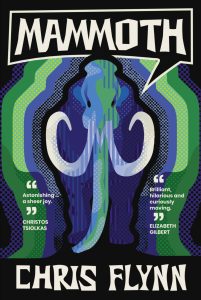
I am not a big fan of anthropomorphism and have read very few animal-narrated books. Animal farm is one, while Watership down, so enamoured by many of my generation, is not. However, I was intrigued by Chris Flynn’s Mammoth, which is narrated by a 13,000-year-old American Mastodon fossil, and was glad when my reading group decided to schedule it.

It is an ambitious book, encompassing the story of humanity’s destructive, often brutal march through time as seen through the eyes of those we supplanted, that is, the fossils of extinct creatures. Our narrator, Mammut, is accompanied by a number of other fossils – the skull of a Tyrannosaurus bataar, a pterodactyl, a prehistoric penguin, and the severed hand of an Egyptian mummy – who have found themselves together in 2007 Manhattan, waiting to be sold at a natural history auction. This auction did take place, and was, in fact, a major inspiration for the novel.

The story is framed by Mammut’s story of his life, death, disinterment as a fossil, and subsequent “life”. As he tells this long story, he is interrupted by the other “characters” who share their own stories, albeit far more briefly than Mammut’s. Each tends to use the voice of the time when he or she was first disinterred, meaning, for example, that Mammut’s voice is the more formal “arcane” one of the early 19th century, while T. bataar’s is the hip voice of the late 20th century.

As Mammut tells his story, he takes us to selected (representative) hot-spots of human brutality such as the Irish Rebellion of 1803, the oppression of Native Americans in the early 1800s, and Nazi Germany. He also covers theories of extinction, climate change, and the equation of big animals with power in the minds of men. The novel starts with a letter written in 1800 by Thomas Jefferson seeking mammoth bones (which he does eventually acquire for the White House), and ends with male celebrities vying for our fossils at the auction. Early on, Mammut tells T. bataar:

Let me tell you, and I say this as an original American, nothing compares to this nation’s willingness to promote patently false notions about itself in order to create a myth of American potency … Who do you imagine will buy us? You said it yourself, T.bataar. We represent power, for that’s what we were: Behemoths, Colossi, Titans. (p. 15/16)

Later, Pterodactylus tells the group about being used in training Hitler Youth:

We were presented to the eager teens as proof that Germany had once been the centre of might in Europe and the origin point for life on earth. Your mastodon friend in particular was elevated as a symbol of strength … I was referred to as the Reptilian Eagle, an apex predator who dominated the skies. It would have been a compliment, had it not come from the mouths of maniacs. (p. 159/160)

Mammoth is, then, a provocative book, confronting head on the ills of humanity. It could be deeply depressing – and in a way it is – but Flynn has taken his own advice (more on this anon) and told his story with humour, mainly through repartee between his fossil characters. I must say that I initially found this humour a bit silly, a bit obvious, and I wondered whether I was going to enjoy the book. However, the more I read, the more fascinated I became by what Flynn was trying to do. I didn’t find it as “hilarious” as some blurb writers did, but Mammoth offers such an idiosyncratic journey that I’m glad I decided to go with the flow.

One of the book’s main pleasures for me, besides its commentary on humanity’s destructiveness, is the writing master class contained within its over-riding story. This started with some digs about the writing life, such as Mammut’s “no-one gets into the writing game for money these days. No-one in their right mind, at any rate”. A sentiment that is reiterated later by French writer, Bernadin de Saint-Pierre.

However, more entertaining was the discussion of writing, or storytelling, itself. As Mammut’s tale progresses, his listeners begin to question him. Sometimes, it’s the issue of disbelief, to which Mammut responds by explaining his sources, by arguing that it’s perfectly valid for his molar to be observing action in one place while his head is elsewhere, or by allowing himself a little leeway:

I know you’re technically an elephant and all, but your recall of events is a little too precise. Not to mention the verbatim dialogue. Surely, you’re making some of this up? This is my problem with the memoir genre. There’s always more fiction in it than people let on.

I possess a remarkable memory, Palaeo, though I will admit to the occasional romanticism of the narrative. For the most part, what I am recounting is true. But, as you say, I am a storyteller who enjoys indulging in a yarn. (p. 143)

There’s also discussion of tone, regarding the degree of brutality and tragedy in Mammut’s tale:

… This entire tale has been a veritable famine of LOLs. Really, Mammut, next time you tell this story, you need to inject some humour, bro.

No too much, I think, T. bataar. No comedian ever won the Pulitzer … (p. 235)

Flynn, thus, cleverly engages with some current issues in criticism while simultaneously fending off potential criticism of his own work. He crowns this early on with the pronouncement that “No story’s gold from beginning to end” (p. 66). How can you argue with that!

There’s much more to this book. I haven’t touched on the fact that almost all its hominid characters are historical personages, many findable in Wikipedia. Mammoth offers an entertaining, accessible introduction to the history of palaeontology and 19th century natural science, and provides a springboard for further research, should you be so inspired.

For now, though, I’m going to end with a poignant statement made by Mammut early in the novel. “Our world was changing”, he says, “and there was nothing we could do about it” (p. 44). I fear this is exactly how our earth is feeling right now. Flynn, I think, would like us to take note and consider what we might do to prevent avoidable extinctions under our watch. An imaginative, engaging read.

Theresa (Theresa Smith Writes) enjoyed this book too.

Chris Flynn
Mammoth
St Lucia: UQP, 2020
254pp.
ISBN: 9780702262746

(Review copy courtesy UQP and literary agent Brendan Fredericks)

Delicious descriptions from Down Under: Chris Flynn (or Billy) on yoga

It’s been a couple of months since my last Delicious descriptions – life has been particularly busy – but I can’t resist stopping for a moment to share this one. It comes during one of my favourite set pieces in Chris Flynn’s A tiger in Eden which I reviewed a couple of days ago. This piece tells of a 10-day Buddhist retreat that the protagonist, Billy, attends. It’s one of those retreats where you remain silent for 10 days, meditate, do yoga, eat vegetarian food, and so on. Since I have taken up yoga (again) over the last few years, his description tickled me:

Golden Bow yoga pose
Golden Bow (Courtesy: OCAL, via clker.com)

Some of the moves were hard even though I was fit as f*ck sure I couldn’t do them, stretching dead far till you thought your tendons would snap I was sweating so I was. I always thought the yoga was a load of aul hippy shite, no one told me it was a workout. After a couple of days I was dead into it though and practising in my cell sure I could near get my legs behind my head flexible as f*ck it turns out, who knew sure I could always find work as a stripper if nothing else worked out.

This little excerpt gives you another look at Billy’s voice and how Flynn has gone about achieving it. I liked the sound of it in my head as I read (notwithstanding the liberal use of expletives!)

Chris Flynn, A tiger in Eden (Review)

Flynn Tiger in Eden
Courtesy: Text Publishing

Are all people redeemable, regardless of what they’ve done? This is the question that confronts us in Chris Flynn’s debut novel, A tiger in Eden. I wondered, as I was reading this book, what inspired Flynn to write – in first person – about a man who was a violent thug during the Troubles in Northern Ireland and how he managed to achieve such an authentic voice. I don’t read reviews before I read books, and I didn’t read the press release which came with the book until I’d finished it, but when I did I discovered that Flynn was born in Belfast during the period he writes about. “I was born into the war and knew nothing else growing up”, he says.

He has seen horror, he says. He has had guns pointed at him, and he has heard “stories of torture and cruelty so nightmarish I would not recount them to someone who had grown up outside of Northern Ireland. You don’t want that in your head”. This, however, is the world of Flynn’s protagonist, the thug-on-the-run, Billy Montgomery, whose head is full of violent memories and whose hands are stained with blood. “Sometimes”, he says, “I reckon the worst thing that can happen to a person is surviving”.

I don’t want to say too much about the story because it’s a slim book with a small cast of characters and a pretty straightforward plot. To say too much would give it away. It’s set in Thailand in the mid 1990s. The aforesaid thug Billy, who is not short of a penny due to his criminal past, is hiding out. But, here’s the interesting thing. Billy is a sympathetic character, despite the violence we know he’s done (though we don’t know the full extent until near the end) and even despite the violence we see him enact in the first half of the novel. He’s sympathetic because we realise early on that he’s trying to work through something, that he’s carrying some terrible baggage he wants to shake off.

It’s the mark of a good writer to be able to make an unappealing character sympathetic. And Billy is pretty unappealing. Not only is there his violent past, but his attitude to women is (or, at least has been) appalling, as has been his attitude to Catholics and various other “lesser”, to him, members of society. But, this book is really about the education of young Billy and so, through the love of a couple of good women (which is, yes, a little corny) and some other meaningful encounters, a Buddhist retreat, and reading, Billy starts to think about his life and, consequently, starts to confront his demons.

One of the things that makes Billy work is his voice. The novel is told first person in the vernacular of his ilk. This means there’s liberal use of swear words*, minimal punctuation, and the grammar is, shall we say, idiosyncratic. The result is a voice that sounds authentic – and, in this case, reliable. The only thing stopping Billy from telling the truth at times is the pain it would release.

Billy is, of course, the tiger in Eden, a potential threat to good people everywhere, but just to give it some added real and metaphoric punch, Flynn has our Billy confronting and staring down an actual tiger, an escapee from a zoo (just like Billy really). However, whilst I say Billy is “the” tiger in Eden, he is not the “only” tiger in Eden. Flynn shows Thailand to be a place spoilt if not corrupted by sex-tourists and cashed-up back-packers who abuse the locals one way or another. Here is Billy after realising that a genuine friends-only outing with a local Thai girl threatens her reputation:

The aul sex tourism had changed things for all these people, I could see that now ‘cos normal life no longer existed. It was kind of like how the Troubles had changed things back home, once you go down that road, sure there’s nothing going back, everything gets changed forever and not for the better. I felt ashamed so I did.

In other words, while Flynn’s main story is men like Billy, he manages to make a few other points along the way.

At the beginning of this post I said that the book confronts us with the question of redemption, and so it does, but that’s not so much what Billy is seeking. He does not specifically ask to be “saved”. He simply wants to be able – psychologically and actually – to put the past behind him and “make something” of his life. This is not a perfect book. It’s somewhat predictable and the supporting characters are not well fleshed out, but Billy is a character that will engage you and make you see the world from another angle. And isn’t that what reading is all about?

Chris Flynn
A tiger in Eden
Melbourne: Text Publishing, 2012
217pp.
ISBN: 9781921922039

(Review copy supplied by Text Publishing)

* So it’s not the book for you if that offends.