Canberra Writers Festival 2024: 3, Get thee to the nunnery

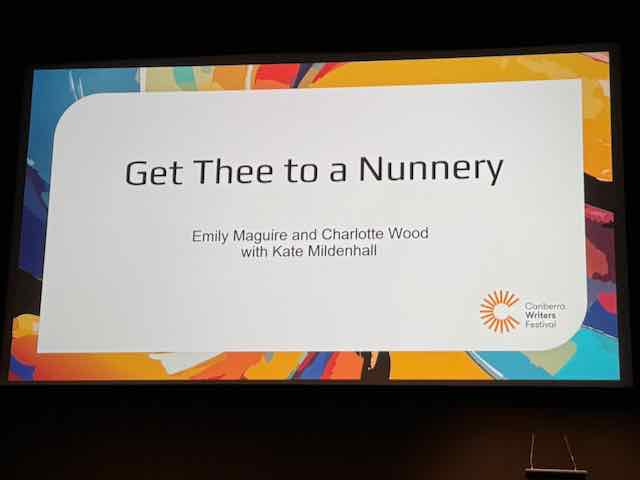
Emily Maguire and Charlotte Wood with Kate Mildenhall

I chose this session primarily because of Charlotte Wood, given I’d seen Emily Maguire the day before, but her presence was plus, as was having author Kate Mildenhall conduct the conversation. Here is the session’s description in the program:

Emily Maguire and Charlotte Wood have both written novels of cloisters – of monks and nuns and clerical power-broking. What is it about these reclusive places that makes for such potent and irresistible storytelling? In conversation with Kate Mildenhall.

Kate did a lovely acknowledgement of country, starting by saying we were honoured to be on this land. She thanked the Ngunnawal people for their care and recognised that the country always was and always will be theirs. 
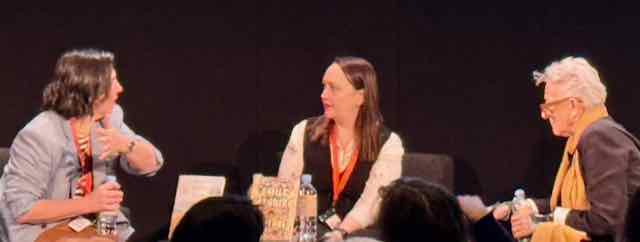
She then said that BeeJay Silcox deserved an A+ for the title of this session “Get thee to the Nunnery”, and did the usual introduction to the authors, Emily Maguire (and Rapture) and Charlotte Wood (and Stone Yard devotional), listing their books and achievements, which includes, of course, Charlotte being listed for this year’s Booker prize.

Kate introduced the conversation by saying that the two books were set more than 1000 years apart but both involved women – one young, one middle-aged – seeking monastic life albeit for different reasons, the former to live a life of the intellect and the latter to retreat from the world. 

On their characters
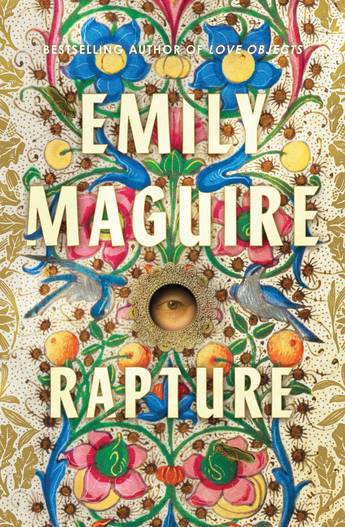
Emily explained that Agnes starts as child in Mainz, living with a widowed father who makes the shocking-for-the-time decision to keep his daughter. She consequently grows up listening to men. As a child of the era, she believes in God and constantly looks for signs of God.
Charlotte’s character, on the other hand, is unnamed and about Charlotte’s age. Charlotte liked a reader’s description that her character had “unsubscribed from her life”. She had hit an unspecified “wall of despair” so leaves her life as an environmental activist, and goes to a convent to rest. There is also a sort of “homing instinct” because she returns to the region where she had grown up. She initially finds the nuns’ lives embarrassing, all this singing and praying, until she realises that this is the work. After a narrative gap, we turn the page and find she’s been living there for a few years.

On “the heat” or seed for their books

Emily was inspired a decade ago by the legend of a female pope, which was believed through the high Middle Ages. The story thrilled her. It is a great trickster narrative, and she is personally interested in the early church and early Christianity. She started the novel 10 years ago but didn’t have the skills to write it then.

Charlotte can’t remember the beginning, but she was interested in why would a contemporary woman become a Catholic nun. She shared some of her personal background with Catholicism. She had skedaddled from it as a young woman, for all the obvious reasons, but has remained interested. As she thought about her question regarding modern women becoming nuns, she came across the idea of retreat and she got that, the idea of leaving a chaotic world for one of order. Then the pandemic happened. It pulled the rug from under her. The 2019 fires and the pandemic felt like a biblical wave of catastrophe and made her realise that our certainties about our lives were a complete delusion. She had driven through the Monaro – where she had grown up – during pandemic. “Old stuff came up” and “brought unlike things together”, so she invented a nunnery on the Monaro.

On wrestling about faith, religion, church when writing these books

Emily had to buy wholeheartedly into Agnes’ world in which God is the answer to everything, the good and bad. She also plugged into her childhood when Jesus was her best friend. It was easy, but also complicated, to sink into that. She boiled her thinking down to one idea: What does personal faith have to do with organised religion? As Agnes gets entrenched into the life, she starts to question what are her wants versus God’s?

Charlotte doesn’t believe in God but also doesn’t sneer at people who do. She can’t make the step to believe, but dislikes the fundamentalist atheist’s view. Also, as a young person, she loved spectacle of the Catholic Church, the language, rhythm, poetry, metaphor, the imaginative world of Bible, the stories of saints (horror fiction, and crime, interjected Emily!)

On the suffering of women (physical, spiritual, emotional)

Charlotte referred to the church’s idea of the mortification of the flesh. In our you-can-have-everything world, she understands the appeal of asceticism as conveyed in Emily’s novel.

Emily spoke of the saints’ stories involving harm to women’s bodies. But women can also feel that the body is what they have control over, and can accept (or do) harm to it, because it’s the “last site of resistance”. Religion can see women’s bodies as bad, dirty but there are also ideas about cleansing. It’s not either-or.

On deep reading, the idea of “lectio divina” in both works

Charlotte described its use in her book – read, think, read the same again, think, then say what comes up – and Sister Bonaventure’s advice that if you don’t understand something hand it over to God. This idea of handing one’s confusion to God is both disturbing and a relief to her narrator.

Emily said there’s been a long tradition of this practice, which is not Bible study but repetitive reading and thinking. It surprises Agnes. Does this “copying”, as she sees it, this not questioning, mean anything? She is shut down when she tries to argue, but if God made her mind one that could argue isn’t that what she’s supposed to do? Yet, sometimes sitting with ideas offers clarity.

Charlotte suggested that this idea of obedience (versus wanting to argue) is a challenge for the ego in our egotistical world. Emily added that she loved the lectio divina section in Charlotte’s book. She had turned hardline atheist, after her deeply believing youth, but now she is more “I don’t know”.

On research

Charlotte talked about being asked to speak at a conference in Melbourne on “communicating monasticism” run by nuns and priests. She was very nervous, because she didn’t research nuns, didn’t even interview any. It’s all imagined. But the conference attendees were very warm because they saw that she was respectful about their chosen life. And, they asked incredible questions.

Kate commented on the freedom writers of fiction have in this regard, but said there was evidence of extraordinary research in Emily’s book, though it’s held lightly. Emily explained that to make Agnes’ world and choices real she needed to do the research, including very basic levels, such as what is a chair, were there roads, and bigger questions like why didn’t Agnes choose a convent and would she have done this. She talked about how the modesty in monasteries – versus in ordinary Middle Ages life – was a gift to her plot of a woman presenting herself as a man.

On plotting, whether it comes naturally or has to be worked at

For Charlotte the plot alleviates the boredom, provides a change in the rhythm. She wanted quietude, stillness, but also needed an energy spike. She told us about asking a still-life artist friend about how she gets her very still pictures to shimmer. The answer was that she breaks up surface, the texture of paint, making it a bit unstable, though the image remains static. Charlotte said using the diary form gave some narrative movement to her story, but then she included the mouse plague, and the return of the wild-child nun with the bones.

Emily used the journey taken Agnes by Brother Randolph, but also, the legend has built into it the risk of being uncovered. She has learnt that propulsion is in the craft – the language, the sentences. Every sentence must do something. Charlotte added that the voice is likewise critical. If the voice is strong, the reader will follow along. It’s propulsive. That’s the key.

On “devotion” being part of the artistic life

Emily said that you lean into your writing, you just do it (like religion), and constantly check whether you are getting the answer you expected. There is devotion to the art, a communion with the page.

Charlotte agreed saying most writers feel a sense of sacredness when doing their work. For her it’s a vocation, a calling, not a job. (It doesn’t pay like a job!) It taps into something bigger than the self, connects with something outside self. At times you can feel it’s coming through you. Not from God for her, but the unconscious, perhaps. She said that when you leave Catholicism there’s a big hole, a yearning. Writing, for her, fills that.

Q & A

On Rapture not looking down on women, while the character in Stone Yard devotional does: Emily described Agnes as a “pick-me” girl, an imposter. It’s a power move to keep women separate, but Agnes, who separates herself, also feels a loss. Charlotte agreed that her character is an outsider and “judgey”, feels separate. She has ego, but respects Sister Simone, who has rigour, versus the other women whom she sees as embarrassing little girls. Simone picks her as someone who finds obedience hard. Charlotte realises she often writes about women who have disagreements. She’s interested in power dynamics.

On whether Charlotte has a name for her character in her mind: No, partly because the character is partly Charlotte herself. She wanted to risk showing part of her real self (her feelings about her mother, her memories of the town). Also the form of book. Starting as a diary means she’s not going to name herself. Charlotte likes the interiority of that.

On Emily’s relationship with Agnes: yes, she misses her!

There was also a question to Charlotte from a Cooma person whose family had connections with Charlotte’s. They had all read the book, including the men, and found it real. She wanted to know how men had responded. Charlotte said there’d been intense responses, though fewer in number than she’d had for The weekend. People, both men and women, had particularly shared their feelings of grief.

Kate concluded by asking what Charlotte and Emily do when the touring is done, what they retreat to for contemplation: Emily said writing is meditation, it stills the internal chatter, and Charlotte agreed, saying “writing time is home”.

This was another engaging session, topped off by my having a great chat afterwards with Karen Viggers (my posts), who was also in the audience, about our favourite reads of the year.

Canberra Writers Festival, 2024
Get thee to the nunnery
The Arc Theatre, NFSA
Saturday 26 October 2024, 10-11am

Delicious descriptions: Charlotte Wood on silence and solitude

It’s some time since I wrote a Delicious Descriptions post, but I want to explore Charlotte Wood’s novel Stone Yard devotional (my review) just a little more. Although I finished it over a week ago, I keep thinking about its evocation of quiet lives in retreat – and what Wood might be saying.

I am, admittedly, a woman of “a certain age”, but, nonetheless, I am surprised to find that where once I loved filling my life with noise and action, I am now enjoying quiet. By noise and action, I don’t mean energetic activity – I’ve never minded being sedentary – but I mean I have never actively chosen quietness. Recently, however, this has changed. Now when Mr Gums and I drive long distances, for example, we often drive in silence – no music, no audiobooks, podcasts or radio programs, just silence. And, I like it.

It is this silence that Wood’s unnamed narrator in Stone Yard devotional seeks, and Wood writes about it in a way that not only makes it meaningful in terms of why we might seek it, but that is calming to read.

It starts the afternoon our narrator arrives at the abbey. “The silence is so thick,” she writes, “it makes me feel wealthy”. What an idea that is, “the silence is so thick it makes me feel wealthy”. A couple of paragraphs later, she explains that the abbey’s welcome booklet says they “accept that guests might want total solitude”. “Noise is discouraged”, and guests “are free to decline joining others for eating or worship”. She “cannot think of a greater act of kindness than to offer such privacy to a stranger”.

A couple of pages after this, and despite not being required to join in, our narrator decides to go to Lauds in the little church, and finds herself wondering how they get anything done with all this toddling into church every couple of hours. But then she realises that this “is the work. This is the doing”. She finds herself “drenched in a weird tranquility” and she wonders whether this has come from

being somewhere so quiet; a place entirely dedicated to silence. In the contemporary world, this kind of stillness feels radical, illicit.

Such silence, however, while appealing in theory, is not as simple as it sounds. She talks about the Lectio Divina, which Wikipedia describes as a traditional monastic practice comprising “four separate steps: read; meditate; pray; contemplate”. This is a step too far for our narrator at this point in her journey, and she finds herself arguing internally with what she is seeing, but

Despite this, the process is strangely beautiful. Sister Bonaventure says getting caught on a word is the point, and if you remain troubled or confused by it, you just ‘hand it over to God’. This is so antithetical to everything I have believed (knowledge is power, question everything, take responsibility) that it feels almost wicked. The astonishing – suspect – simplicity of just . . . handing it over.

The narrator is an atheist and the novel is not about religion per se, so she comprehends this concept more broadly in the sense of letting the things that bother you just sit, instead of endlessly turning them over.

This brings me to the idea I shared in my post on the novel, that of

waiting. An incomplete, unhurried emergence of understanding, sitting with questions that are sometimes never answered.

Thoughts about stillness, silence, solitude, and contemplation, freedom and peace, form the backbone of this novel, but they are tested by the visitations or “visitants”. They are also specifically tested by the idea of an active life. Sister Helen Parry distances herself from the abbey’s inhabitants, getting on with her activist work via “internet video calls … calling for action on this or that”. She brings, says the narrator, “everything we so painstakingly left behind”. Local farmer Richard Gittens’ wife, Annette, views life at the abbey as “sick … unnatural”.

And yet … (indeed, Elie Wiesel’s “and yet” is the narrator’s favourite phrase) … the end, when it comes, seems to suggest that there is a place for all. And that, maybe, there is no either-or, but what is right for us at different points in time. A gift of a book for anyone interested in thinking about how to live in our noisy, troubled and troubling world.

Charlotte Wood, Stone Yard devotional, Crows Nest, Allen & Unwin, 2024

Charlotte Wood, Stone Yard devotional (#BookReview)

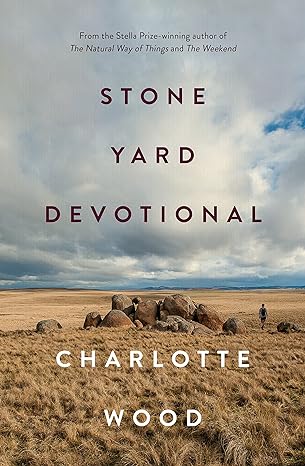
Charlotte Wood’s most recent novel, Stone Yard devotional, is set in the Monaro, a region just south of where I live. It’s a landscape that is much loved by many of us, including Nigel Featherstone, whose My heart is a little wild thing (my review) is also set there. The Monaro is expansive country, a dry, golden-brown plateau, characterised by rocky outcrops here and there, much as the cover shows. There are also hills in the distance, and big skies. Perfect country for contemplation, I’d say, which is exactly what Wood’s unnamed protagonist is doing there. (In fact, it’s also what Featherstone’s protagonist went there to do, for a very different reason – although, coincidentally, both books have something to do with mothers).

Stone Yard devotional is a quiet and warm-hearted read, one that asks its readers to not rush ahead looking for a plot, but to think about the deeper things that confront us all at one time or another. These things are hinted at by the two epigraphs, one being Australian musician Nick Cave’s “I felt chastened by the world”, and the other American writer Elizabeth Hardwick‘s “This is what I have decided to do with my life just now. I will do this work of transformed and even distorted memory and lead this life, the one I am leading today”. Add these to the title – with its hardscrabble sounding “Stone Yard” set against the gentle, inwardness of “devotional” – and you have a sense of the intensity to be found within.

“a place of industry, not recreation”

While this is not a plot-driven novel, there is a definite narrative arc. Taking the form of undated journal entries, the novel covers a period in the life of a middle-aged woman who has left her city life – her husband, her job in threatened species conservation, and her friends – to live in an abbey on the Monaro. It starts with a five-day stay, which is followed by more stays until the time comes when she arrives and doesn’t leave. Why she does this is not explicitly explained but through her contemplations we come to see that there’s unresolved grief in her life over the death of her parents some three decades earlier and, alongside this, a level of existential despair which has built up over time.

This is the set up. The narrative arc comes from three “visitations” to the abbey – a mouse plague which ramps up as the novel progresses, and the celebrity “environmental activist nun” Helen Parry, who accompanies the bones of the murdered Sister Jenny who had left the abbey decades ago to work among poor women in Thailand. These three events, both real and metaphoric in import, present practical and moral challenges, “a rupture” but also “a frisson of change”, for our narrator, and for all at the abbey.

So, we follow Wood’s narrator as she settles into life at the abbey, taking on the role of cooking for the group, and, as their non-religious member, the shopping and other errands that need to be done. Much industry is required to keep the place running when there is no financial help from the church, but the main industry is emotional and spiritual (in its wider meaning). Early on, our narrator recognises that prayer and contemplation “is the work … is the doing”. For her, as an atheist, this is not religious in origin or intent, but nonetheless contemplation is the real work she does while living at the abbey.

Much of this contemplation is invoked by flashbacks to and memories of events from the past, some experienced by her and others that happened around her (like the suicide of a farmer). Many involve her beloved and humane mother, who, like nuns Helen and Jenny, was an “unconventional”, determined to continue along her path despite what others thought. Such contemplation is hard, and our narrator is tested by the “visitations”, particularly Helen Parry with whom she has history involving bullying at school. Our narrator wishes to apologise but, as she comes to see, the hard work is in coming to that point of apology, not in having the apology accepted. But, forgiveness and atonement are only part of the bigger questions posed in this novel. Grief, despair and, ultimately, how to live are also part of its ambit – and are set against the shadow of climate change and its implications for our lives and choices.

This sort of exploration, however, can only work if we like the telling, and I found it thoroughly compelling. Stone Yard devotional is delicious for its details about life in an abbey on the “high, dry, Monaro plains, far from anywhere”, and for its insights into the women living there. No character is fully developed, but each, from the “business-like but soft-looking” leader Sister Simone to the distressed Sister Bonaventure, feels real in the role she’s been given in the narrative. While there’s not a lot of dialogue, our narrator reports on interactions between the women, and these contribute to her contemplations about life. She is not perfect and admits to moments of pettiness and poor judgement in her dealings with her co-habitants. Contrasting this little community is local farmer Richard Gittens, who supports the abbey in many practical ways and who represents, as our narrator recognises, “decency”.

All this is told in spare but expressive writing that maintains a tone which is serious and reflective, but which never becomes bleak.

There is no single, final enlightenment, but rather, as the narrator says earlier in the novel, “an incomplete, unhurried emergence of understanding, [a] sitting with questions that are sometimes never answered”. This is the sort of writing I love to read. In some fundamental way, it reminded me of my favourite Wallace Stegner quote. In Angle of repose, he wrote that “civilisations grow by agreements and accommodations and accretions, not by repudiations”. Through living this life in retreat, Wood’s narrator comes to know herself better. In so doing, she is able to lay some of her demons to rest, not through any major crisis but through quiet contemplation. The abbey does, indeed, turn out to be a “place of refuge, of steadiness. Not agitation”.

Interestingly, and perhaps pointedly, the novel ends on an anecdote about the narrator’s mother and her “reverence for the earth itself”. Ultimately, Wood invites us, without exhortation, to not be “chastened by the world” but to do the hard work of thinking about what is really important. A compassionate, and gently provocative, book.

Kimbofo (Reading Matters) also liked this book.

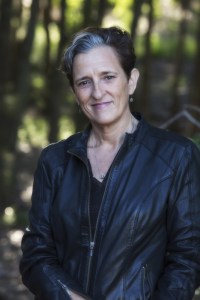
Charlotte Wood
Stone Yard devotional
Crows Nest: Allen & Unwin, 2023
297pp.
ISBN: 9781761069499

Charlotte Wood, The weekend (#BookReview)

Book coverAfter reading the first few pages of Charlotte Wood’s latest novel, The weekend, I was starting to wonder how on earth these women, with “their same scratchy old ways”, could be described as “dearest friends”. They seemed so different, and so irritated or, sometimes, cowed by each other’s differences. Where was their point of connection I wondered, besides their late friend Sylvie?

But, let’s start at the beginning. My edition’s back cover describes the set up beautifully: “Four older women have a lifelong friendship of the best kind: loving, practical, frank and steadfast. But when Sylvie dies, the ground shifts dangerously for the other three. Can they survive together without her?” Well, they are going to find out, because the book concerns a weekend – a Christmas weekend, in fact – in which the remaining three come to Sylvie’s beach-house to clean it out for sale. It’s a thankless task at the best of times, so when you get three very different, but still grieving personalities doing it, the stage is set for tension, at the very least.

Who then are these three? There’s retired restaurateur Jude who has had a married lover for over forty years; public intellectual Wendy whose much loved husband died many years ago and who now has the frail, demented dog Finn in tow; and out-of-work actor Adele whose relationship has just fallen apart, leaving her homeless. Wood sets the scene, and establishes their characters perfectly through describing their journey to and arrival at the beach-house (much like the opening title sequence for another house-party story, The big chill.) We quickly learn that Jude is organised, task-focused, financially comfortable and disdainful of other people’s frailties; that Wendy is disorganised and soft, but emotional and loyal; and that vain but always optimistic Adele is seen by her friends as “the child” of the group. While Wendy and Jude work at their Jude-assigned tasks, she can be found reminiscing over Sylvie’s LP collection.

Over the weekend, the women’s friendship is tested to its limits. Early on, Wendy reflects that “it was exhausting, being friends”, while Adele remembers their early years of friendship, and how they “saw their best selves in each other”. But, how honest are they, can they be, should they be with each other? Adele ponders early, that “it was dangerous business, truth-telling”. Over the weekend, of course, some truths come out – what they think about each other, and truths that were supposed to be secrets. And yet, the friendship holds fast:

Because what was friendship, after forty years? What would it be after fifty or sixty? It was a mystery. It was immutable, a force as deep and invitable as the vibration of the ocean coming to her through the sand.

“simple creatureliness”

However, there is a fourth main character in this story – the aforementioned Finn whom Wendy brings with her knowing full well that Jude would not be impressed. But what was she to do? Living alone and unwilling to euthanise him, she had no option. Utterly frail in body and mind, he is a significant character – or, at least, plays a significant role – in the book. This role is bifold. Firstly, we gain more information about the women’s characters and their attitudes to aging and death through their attitudes and reactions to him. His physical and mental frailty, his incontinence, deafness and blindness, confront the women with their own mortality. No-nonsense Jude doesn’t want him and his mess around, and thinks, frankly, he should be put down. She is barely aware of Finn’s importance to Wendy. Adele isn’t enamoured but more tolerant and understanding, while Wendy, for whom Finn was a lifeline after her husband’s death, finds it impossible to think about euthanasia. His presence throughout the novel sometimes mirrors, sometimes opposes the women’s volatile emotional states.

But, the other more interesting role played by Finn has to do with one of the novel’s over-riding themes, one triggered by ageing. It’s the question of what have I lived for, what have I achieved, when have I “finished [my] turn”? Wendy and Adele, for example, both feel they have more to achieve. For Wendy, it’s the intellectual idea she feels she’s moving towards, “the place she had always felt was there waiting for her”, and for Adele, it’s “clawing back her one great moment on the stage”. Jude’s life is more about “gathering experience, formulating opinions, developing ideas” to “fold away and save for” those times her married lover is able to see her. So, the underlying question is: When you no longer have those seemingly limitless goals of youth, what goals do you have, where do they come from, and what happens when you, perhaps, run out of goals or purpose? Finn offers this opposite – “simple creatureliness”, or, just being. This issue of goals and purpose is, I believe, one of the biggest challenges of ageing – alongside the obvious physical ones – and I love that Wood takes it on.

However, she doesn’t stop there, because her women also confront other ageing-related issues – increasing homelessness for older women, the threat of loneliness that often attends age, and coping with technological and cultural change not to mention with children who start to parent you.

To keep this story and its tensions focused, Wood uses the house-party setting, as many other authors have done before including John Clanchy in his novel Sisters (my review). I didn’t much like the melodramatic party scene, involving two interlopers, that occurs near the end, but this is a common trope, I think, in the house-party sub-genre. Overall, I loved the writing. It’s tight. We shift seamlessly between the characters without getting lost, each one nicely differentiated, and there are some spot-on images:

Every time Jude had to hold her tongue, every time she didn’t tell Wendy she should pay him the kindness of letting him die, she felt falsehood pulled tighter like a plastic bag, closer, closer over her mouth and nose. She couldn’t bear it.

AND

Outside the cicadas were filling the still summer air with sound. You must shed the dead skin … The bush was full of insects and snakes reborn, shining with newness. The dried carapaces rustled as the resurrected creatures slithered out of, away from, their dead selves. You had to struggle free from what had protected you.

By now, you may be thinking that this a grim book, but while its intent is serious, Wood’s touch is light, using some humour – sometimes generous, sometimes satirical or ironic – in the telling. This humour – as in the scene describing Adele, in the park, having just peed, running into a theatre producer – keeps these women real and relatable, and the tone edging to hopeful.

You would think that The weekend would be the perfect pick for my reading group, given we are all women not much younger than Wood’s protagonists and that many of us have been friends for thirty years plus. And yet, the responses of the twelve members present at our meeting were mixed. One group was ambivalent, arguing that the characters were too much like types, while the other loved it, believing it captured the dynamics of longtime women’s friendships with heart and humour. You know which group I belonged to – for all the reasons I’ve described above.

Lisa (ANZLitLovers) also enjoyed the book.

Challenge logoCharlotte Wood
The weekend
Sydney: Allen & Unwin, 2019
256pp.
ISBN: 9781760292010

(Review copy courtesy Allen & Unwin)

The natural way of things: Conversation with Charlotte Wood

I have just returned from an inspiring evening in which we got to see Aussie author Charlotte Wood in conversation with Guardian Australia’s Katharine Murphy. It more than made up for our disappointment last year when Wood had to pull out of the Canberra Writers Festival due to illness. Tonight’s event was presented “in association with the Canberra Writers Festival” and had the support of the National Library of Australia where it was held.  

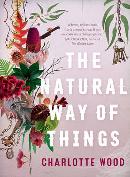
Charlotte Wood, The natural way of thingsAs the post title suggests, the evening was framed around Wood’s latest novel, The natural way of things (my review), which is partly why I was very keen to go because this is a provocative book that doesn’t leave you in a hurry. Wood started by describing the set-up, and explaining that the main plotline is like any prison novel. In other words, the question is: Will they escape or won’t they? I liked the simplicity of this!

Anger and the book’s genesis

Murphy asked her to talk a little about her comment, elsewhere, that anger had inspired the book. Wood explained that she didn’t realise how angry she was when she started writing the book. She talked about hearing a radio documentary about the Hay Institution whose inmates were described by the government as the “ten worst girls in the state”. The anger-inducing thing is that these girls had all been sexually assaulted in some way, and had been locked up for “being in moral danger”. They were locked up because they were in moral danger? You can see why Wood was angry – why any of us would be – on hearing that. Why were the victims locked up?

Wood then explained that her original story was historical, realist, in style, and it wasn’t working. Then, because when you are writing, “everything is about your book”, she started noticing contemporary stories – the army girl raped by a co-cadet, the woman employee sexually harassed by the David Jones CEO, etc – and decided to try a contemporary approach …

… but, while she was writing it, Julia Gillard became Australia’s first PM, and she saw a photo of Gillard, Quentin Bryce, and Anna Bligh together. They presented such a positive picture of female achievement that she thought her book was no longer needed. We all laughed at that! She then spoke of the hatred directed at Julia and her own distressed reaction to this. This is where her writing comes in: art helps you understand incomprehensible things, she said, you can give them shape.

Later, during the Q&A, she spoke more on the anger issue.  She’s uncomfortable with anger, she said – a little self-deprecatingly. She likes it when the book is described as “ferocious” or “fierce” rather than as “angry”. She talked about the importance of humour, of its being the essential companion to anger. (There is humour in the book, as I noted in my review). She quoted American thinker, Patricia Williams (she thought), who talks of the “gift of intelligent rage”. Wood saw this as anger/rage which encompasses positive energy.

That ending!

The discussion then turned to the ending, and its ambiguity. Murphy worried that Wood seemed to be suggesting that the answer is “separatism, opting out”. The ending is certainly the aspect that gave me some pause. It wasn’t that image that bothered many readers of the women pouncing on the designer handbags. No, for me, as for Murphy, it was the ambiguity. I like ambiguity, but here I was a little uncertain about what I was taking away.

Wood’s response was helpful. She said the book has different endings depending on who you are following, and that some readers come away feeling triumphant, while others feel demoralised. She said that for Yolanda, her only liberation was to “separate” herself, to go feral, to become an animal in fact, but that wasn’t Verla’s answer. This gave me a little structure for my thinking.

While she doesn’t like to talk in terms of messages, she agreed that part of it was that in order to be free you have to separate yourself to a degree from a culture that hates women. This can mean not reading women’s magazines that hurt/harm you, not laughing at sexist jokes, and so on.

She talked about another issue that intrigued me, and that’s to do with the men – the prison guards – ending up being trapped too. This is where the balance of power started to shift a little – and is the part of the novel she liked writing!

Nerdy stuff

Charlotte Wood (Courtesy: Wendy McDougall)

Murphy then asked her “nerdy stuff”, that is, about her writing process. I won’t spend a lot of time on this (though nerdy me was interested too). I’ll just share a couple of comments. One was that although she now has five novels to her name, she is still always unsure when she sits down to write, but one thing experience has given her is that she is now “quicker at diagnosing problems”. She has also learnt more about the “craft” of writing, such as how to shape stories.

She described writing as hard – it’s hard making up stuff out of your head, she said. She knows when she’s got the momentum up – it’s when her current book is in her dreams, when she thinks about it as soon as she wakes up. She referred to her PhD on the cognitive aspects of creativity. She found some commonalities between writers, but knowing what these are doesn’t help you do it, she said! Encouraging eh?

Murphy asked whether she kept a notebook to jot down ideas she comes across, things she hears. She said she does this a bit, but wishes she did notebooks as well as Helen Garner. Mentioning the notebook excerpts in Garner’s latest book, Everywhere I look (my review), she said she admires “the precision of her [Garner’s] observations”.

Plausibility in fiction

Early in the conversation, Wood referred to some readers questioning plausibility in the book. I followed this up at question-time, as it was an issue in my reading group. I loved her answer because – as you regular readers here will see – it concurred with my views!

She said it depends, partly, on the sort of novel you’re writing. She wanted this novel to be strange and weird. Her usual benchmark is to ask what she herself would believe. Her question for readers is: “Are you going with it. If you start worrying about factual details, you risk missing out on what’s true.” Yes! So, in this book, in particular, she didn’t “care” much about plausibility. Her next book is more realist so the facts will matter more, but I got the sense that fundamentally she focuses more on what she is trying to do, to say, than on getting all the facts right.

There was more, but I’ll leave it here on my question – and conclude by saying that Wood came across as warm, natural (!), thoughtful, and openly sharing of herself. This made it a most enjoyable event – the hour went way too fast.

Charlotte Wood, The natural way of things (Review)

Charlotte Wood, The natural way of thingsWell, I wrote this week’s Monday musings on Australian dystopian fiction as a lead in to my review of Charlotte Wood’s award-winning The natural way of things, but I wasn’t expecting to get the perfect intro for my review! In the post’s comments, author and publisher Anna Blay pointed us to an article by Maria Popova in an online digest called Brain Pickings. The article, titled “The Power of Cautionary Questions: Neil Gaiman on Ray Bradbury’s ‘Fahrenheit 451,’ Why We Read, and How Speculative Storytelling Enlarges Our Humanity”, starts with this:

The important thing,” Ursula K. Le Guin wrote in contemplating the cultural role of speculative fiction and the task of its writer, “is not to offer any specific hope of betterment but, by offering an imagined but persuasive alternative reality, to dislodge my mind, and so the reader’s mind, from the lazy, timorous habit of thinking that the way we live now is the only way people can live.” In doing so, she argued, imaginative storytelling can intercept the inertia of oppressive institutions, perilous social mores, and other stagnations of progress that contract our scope of the possible.

I would agree that the thing is “not to offer any specific hope of betterment” but to jolt the reader into thinking about what is, what might be, if we do nothing. It’s certainly how I’d see most dystopian fiction I’ve read, including Charlotte Wood’s novel, but not being a big reader of speculative fiction I haven’t sat down before and articulated it.

So, what is it that Charlotte Wood wants to jolt our minds about? For those of you – overseas readers at least – who haven’t read or don’t know of it, the plot tells the story of 10 women plucked from their normal lives and transported to a nightmarish place in the middle of nowhere – referencing the mythology of the forbidding Australian outback? – where they are imprisoned behind an electric fence and controlled, labour-camp style, by two boorish men, bruiser Boncer and the preening Teddy. The women pass from disbelief and anger, through resignation, to a sort of acceptance and attempt to make the best of their situation. There are shades of Margaret Atwood’s The handmaid’s tale here and also, perhaps of William Golding’s Lord of the flies, but not derivatively. This is very much its own work.

But now, back to my question. Wood’s target is misogyny, and specifically the way it plays out through the scapegoating of women for their sexuality – whether for assaults that happen to them or for sexual activities they may engage in consensually (think affair with a politician or the flight attendant in a “mile-high” situation) but for which the man is let off while the woman is excoriated. Early in the novel each girl is given a “nickname” which “explains” why they are there such as “army slut”, “cabinet minister’s moll”, “airline girl”, “cruise girl” and “football girl”. You get the picture, I’m sure. The girls are also named. Wood does respect and individualise her characters, beyond just being types. There is one other woman in the picture, and that’s Nancy. She’s on the staff with Boncer and Teddy. She dresses as a rather grotesque nurse who looks after the so-called “hospital” – and represents those enabling women who often feel special but don’t realise that they too are under control.

I came to this book ready to love it. Although I’ve avoided reading reviews, I’ve not been able to help hearing all the accolades, and it sounded like a book and topic that would be right up my alley. It is, and I “enjoyed” reading it, but I’m having trouble defining and articulating my somewhat uncertain response to it. I love the heart, I love the desire to attack an issue that’s absolutely critical, I love the overall narrative concept, I was compelled to keep reading, and I thought the ending was powerful. So, why uncertain? I’ll try to tease it out a bit.

Menace?

There are a lot of characters – the ten captive women, plus Boncer, Teddy and Nancy – though Wood focuses on two young 19-year-olds in particular, Yolanda the “football girl” and Verla “the cabinet minister’s moll”. We get more into their heads. They are analytical about their situations and plan and act in ways to improve their situations. A cautious friendship develops between them. As well as being differentiated in this way from the rest of the group, they are also differentiated from each other by two facts: Yolanda wasn’t tricked like all the others into accepting the agreement that got them to this place, while Verla, who guiltily remembers “gratefully signing the fake legal papers”, believes that her “Andrew”, the cabinet-minister, still loves her. The other women are more problematic. We don’t get to know them well, but what we do see suggests that they have not cottoned on. They focus on finding ways to groom themselves, they reject Yolanda’s feral way of managing the situation, they fall on the fancy handbags at the end and willingly follow the new man who appears. They seem to have learnt little. But, perhaps that’s also the point. They have a right to be the young women they are. See, I’m talking myself into understanding this as I go …

And then there’s the men. They are scary, certainly, and brutal, particularly in the beginning:

So she didn’t see the man’s swift, balletic leap – impossibly pretty and light across the gravel – and a leather covered baton in his hand coming whack over the side of her jaw …

The man Boncer cast an aggrieved look at them, is if they were to blame for the stick in his hand …

But pretty soon we see that they, too, are, in a way, victims of the system. They’ve been fooled it seems into being there, on promises of bonuses, and are ultimately pathetic. I certainly don’t want to excuse them – they’ve made choices. However, as the supporting system seems to fail, they start to rely on the women’s ability to keep the show going. The women realise that these men don’t know what’s happening any more either. There’s an uneasy tension between captors and captives – and with that cracks start to show in the menace, albeit some menace remains.

Natural?

The writing is good. There’s even humour, such as tempeh-loving, yoga-doing but clueless Teddy. The novel is structured by the seasons, starting in Summer, moving through Autumn and ending, appropriately, in Winter. The story is told third person, mostly focusing on Yolanda and Verla. They’re engaging, though they are also pretty slippery to fully grasp. There’s a distance that we never quite penetrate. We “see” Yolanda’s strength and Verla’s self-deception, but we don’t, I think, see “into” them.

Wood uses effective recurrent imagery or motifs, particularly smells, rabbits, horses and birds. The opening line is “So there were kookaburras here”, suggesting some sort of normality. In her interview with Annette Marfording long before this book was written, Wood discusses using kites and kite-flying to suggest “flight and escape”, and then she says “I realise I have a lot of birds”, which I assumed implies that they too suggest “flight and escape”. In The natural way of things, birds also suggest the related idea of “freedom”, but when hawks appear, we see another side, that of predator and prey. All relevant to the book.

Then there’s the irony in the title, “the natural way of things”, because there’s nothing “natural” about what the book describes. The title appears in the text once in a paragraph that occupies its own page. It’s powerful:

What would people in their old lives be saying about these girls? Would they be called missing? Would some documentary program on the ABC that nobody watched , or one of those thin newspapers nobody read, somehow connect the thread to make them a story? The Lost Girls they would be called. Would it be said, they ‘disappeared’, ‘were lost? Would it be said they were abandoned or taken, the way people said a girl was attacked, a woman was raped, this femaleness always at the centre, as if womanhood itself were the cause of all these things? As if the girls somehow, through the natural way of things, did it do themselves. They lured abduction and abandonment to themselves, they marshalled themselves into this prison where they had made their beds, and now, once more, were lying in them.

The “natural” way of things! Referring back to Ursula le Guin, I’d say that Wood has presented here a “persuasive alternative reality”. Indeed, it’s not far removed from Wood’s inspiration: the Hay Institution for Girls to which “problem” teenage girls were sent in the 1960s and 1970s, and treated with great cruelty. But, who or what is the enemy? Looking at Le Guin again, this would be “perilous social mores” (and those who uphold them) – the fact that the scapegoating of women is still “allowed” to happen. There’s (a little) more awareness now, but this behaviour is not stopping, not by a long shot. All of us, I’m sure, recognise the recent inspirations for Wood’s “girls”. Anna Krein’s Night games (my review) makes an interesting companion read.

So, where do we go from here? Dystopian novels don’t have to give answers, indeed they rarely do, they “simply” shine the light. The light Wood has shone is, though, a very complex one indeed. I think I’ll be reading this one again when my reading group does it in July.

Lisa (ANZLitLovers) has also read it and has posted her comments plus links to other reviews.

awwchallenge2016Charlotte Wood
The natural way of things
Crows Nest: Allen & Unwin, 2015
315pp.
ISBN: 9781760111236

Monday musings on Australian literature: Spotlight on Charlotte Wood

Courtesy: Annette Marfording

Courtesy: Annette Marfording

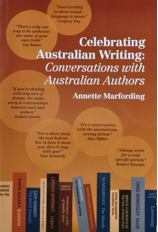
This is the third in my occasional series of Spotlight posts inspired by Annette Marfording’s Celebrating Australian Writing: Conversations with Australian Authors. (See the end of this post for links to the first two.) Since Charlotte Wood won this year’s Stella Prize, the Christina Stead Prize for Fiction (NSW Premier’s Literary Awards), and has just been shortlisted for the Miles Franklin Literary Award for her latest novel The natural way of things, who better to choose for my third post.

Charlotte Wood is no stranger to awards. She has written five novels to date, and each of them has won or been shortlisted for awards, which is a pretty impressive achievement. She has also written a non-fiction work on food, Love and hunger, and edited an anthology, Brothers & sisters. Oh, and she has numerous essays, and newspaper and journal articles under her belt too. She is about to publish another book, The Writer’s Room, which will contain interviews with Australian writers selected from the digital magazine of the same name that she edited for three years.

And this makes a good place to segue to Annette Marfording’s interview with her, which took place back in 2010. Marfording’s first question was about awards. Wood indicated that she was “anti-awards” and that the book she thought was her best, The children (at that time she’d published three novels), had received the least notice in awards listings. She says:

I guess it’s easy when you’ve been shortlisted a couple of times to start dismissing it, but the whole prize culture is kind of damaging to literature, I think. It turns books into a horserace and it’s not good for writers and it’s not good for writing either.

This is not an uncommon view, and I do understand her point. The arts are not something that can be objectively measured like, say, a 50m freestyle swim or a high jump, but the money and recognition can, on the other hand, be very helpful to careers, particularly, I suspect, early ones. Wood admits that the money is useful, and can help writers keep writing.

Charlotte Wood (Courtesy: Wendy McDougall)

Charlotte Wood (Courtesy: Wendy McDougall)

Marfording then asks Wood about some of the ideas that recur in her novels – family, and abuse and violence. Regarding family, Wood says that it’s because “the intensity of human relationships plays out so well in families”. She doesn’t think that abuse and violence are strong themes – in those first three books – though agrees that there’s an abusive relationship in Pieces of a girl, and there is psychological warfare in her books. As she says “A story without any friction is not a story.” True!

Some questions naturally come up in most interviews with writers – recurrent themes being one. Another relates to the writing process, use of research, drawing from other people’s lives, and so on. Marfording asked Wood about these as well. Regarding her process, Wood said that “I start writing and see what happens”. She doesn’t plan, so sometimes the shape of the book comes quickly, other times not so. She doesn’t do a lot of research she says, but may check out the odd specific thing.

And then of course there’s that issue of writing from the perspective of other, such as a male point of view. Wood said that she used to worry about this, but her view is that, despite gender, we are not all that different in the way we think. So, she tries to avoid focusing on the physical issues – which are different – and keeps instead to the mental space.

They also discussed her writing, which is often described as “lyrical”. Wood says that with more experience she had become “sparer”, that at first she was “so lyrical that it kind of made you throw up”. Imagery, it seems, comes easily to her. In this she reminded me of Thea Astley who also found imagery easy and did put some readers off. She too became a little more spare in her later years, though perhaps not to the degree that Wood describes herself doing. Wood talks of actively focusing on character, plot and structure, and balancing that with her interest in language and lyricism.

Other topics discussed included the anthology, Brothers & sisters that she edited, and the place of short fiction in Australia. Re the latter, Wood said she felt things were improving, with new works by Cate Kennedy, Paddy O’Reilly, Robert Drewe, Tony Birch and Nam Le recently appearing. Wood says that:

a short story is perceived as a step to a novel, and there is nothing less true. I find them so hard to write that I hardly ever write them.

The interview concludes with some discussions about the “business end” of writing – publishing, editing and writing courses – topics which always interest me, even though I have no plans to write a novel, memoir or any other book!

A question they didn’t really cover, but which was asked by Booktopia in their Q&A with her in 2011, was which writers she admires. She tells them:

I admire any writer who has the courage to push through the barriers of ambition and vanity to get to the real thing – truth and beauty. Some of the best writers I know are struggling to get published, but they keep going because they are real artists. For the same reasons – truth and beauty – I respect and admire Alice Munro, Helen Garner, Anne Enright, Marilynne Robinson, Kim Scott, Richard Ford, Joan London, William Maxwell and Nina Bawden, among others.

What a lovely range of writers – they give a great sense of her writerly values don’t they?

Wood comes across as calm and level-headed – and I have heard other writers say that she’s generous in mentoring others. I have decided that my next book has to be The natural way of things.

Previous Spotlight posts:

Annette Marfording
Celebrating Australian Writing: Conversations with Australian Authors
Self published, 2015
273pp.
ISBN: 9781329142473

Note: All profits from the sale go to the Indigenous Literacy Foundation. You can purchase the book from its distributor, lulu.com.


Stella Prize 2016 Winner Announced

WoodNaturalJust a short post for those of you who read my Stella Prize longlist and shortlist posts and haven’t heard the news – which would primarily be you readers from lands other than mine! The winner was not a surprise, as you may know if you read my response to BookerTalk’s question on my shortlist post. It’s Charlotte Wood’s The natural way of things.

Wood’s book has been garnering such positive reviews, I knew I should have read it before the announcement, but instead I read three others (Tegan Bennett Daylight’s Six bedrooms, Elizabeth Harrower’s A few days in the country and other stories, and Fiona Wright’s Small acts of disappearance.) I will definitely be reading Wood soon, since it is up for other awards this year too.

Charlotte Wood’s acceptance speech is available online at the Stella Prize site. Here are a couple of excerpts:

I know that the measure of a book’s quality, and the measure of one’s worth as an artist, can never be decided by awards. Nor can it be defined by sales, nor even the response of our beloved readers. If there is a measure – and I’m not sure there is – it can only be time.

Partly true. I discovered recently that Elizabeth Harrower missed out on the Miles Franklin Award for her wonderful The watch tower (my review) in 1966 to Peter Mathers’ pretty much forgotten Trap. (Of course, someone could revive it too as Text Publishing has Harrower’s books making me eat my words).  “Worth” though is not only about longevity. That’s one measure, sure. But relevance to the time in which the work is written and relevance to the readers of that time is, I’d argue, surely a “worthy” (ha!) measure of “worth” too. And that’s probably what awards in particular measure. Whether Wood stands the test of time, only time knows, but that she has captured something critical about our times can’t be denied if the universal acclaim this book is receiving is to be trusted. The judges certainly see it that way: they described the book as “‘a novel of – and for – our times” and “‘a riveting and necessary act of critique.”

Wood goes on in her speech to list some reasons to write, which are worth reading, but I’ll conclude with her argument about the importance of art:

Art is a candle flame in the darkness: it urges us to imagine and inhabit lives other than our own, to be more thoughtful, to feel more deeply, to challenge what we think we already know. Art declares that we contain multitudes, that more than one thing can be true at once. And it gives us a breathing space – a space in which we can listen more than talk, where we can attentively question our own beliefs, a place to find stillness in a chaotic world. I hope that my novel has provided some of those things: provocation, yes, but also beauty and stillness.

Now, I’m off to do some of my own form of stillness – yoga. Catch you all later …