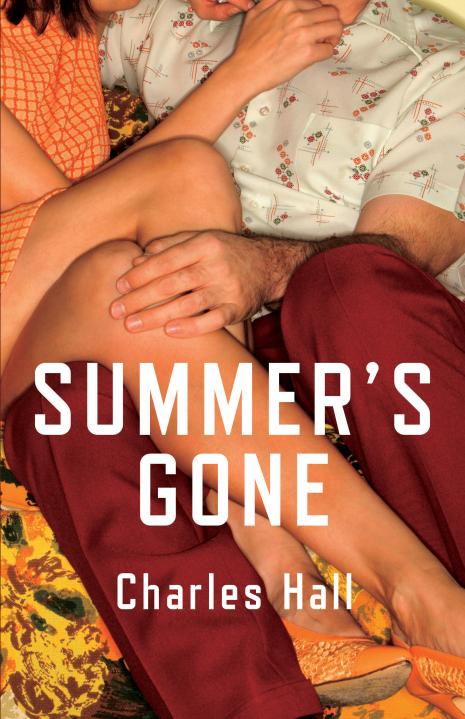
Courtesy: Margaret River Press
When Western Australian writer Craig Silvey set his coming-of-age novel Jasper Jones in the 1960s I was a bit surprised, as Silvey himself did not grow up in that era. I’m not so surprised, though, about Charles Hall’s debut novel Summer’s gone as Hall did grow up in the 1960s. The novel is, from my reading of the brief author biography, somewhat autobiographical, as debut novels often are: both Hall and his main character played guitar in bands, hitch-hiked across Australia, worked in labouring jobs and ended up studying at university. This, though, doesn’t mean the story is Hall’s story. It simply tells us that Hall wrote of a milieu he knows – a wise thing to do!
Summer’s gone is a part-mystery, part-coming-of-age narrative, and is told first person by Nick. It focuses on his relationship with two sisters, Helen and Alison, and another young man, Mitch, with whom he’d formed a folk band in 1960s Perth. The novel starts, however, in Melbourne in 1967 with Nick finding 20-year-old Helen dead (or dying) on their kitchen floor. What happened to her, why it happened, and Nick’s feelings of guilt about it, form the novel’s plot. The theme, though, is something else, it’s about
the trouble with dwelling too much on the past – sometimes you remember other things as well, things you don’t necessarily want to think about.
Except, of course, we do often need to dwell on the past if we haven’t resolved it, we need to think, as Nick does, about the things we did, didn’t do, or might have done differently. We need, in fact, as Nick has come to realise, “to say goodbye to things. And perhaps even to understand.”
To tell his story, Nick slips between the 1960s, the mid 1970s, the 1980s, and sometime around the present from which he is looking back. Hall handles these time-shifts well: it’s not difficult to know where you are, and it effectively replicates the way we often approach the past, that is, in fits and starts as we put together what happened.
It’s an engaging story. Nick, the young version anyhow, is a rather naive and not well-educated – but not unintelligent – young man. He’s not wise in the ways of the world, but he’s decent, and prepared to give things a go. He has a poor relationship with his Perth-based mother, and his only real adult role model is his uncle Clem in Melbourne. The relationship between the four young people is nicely evoked, though because it’s a first person story, the other three characters are only developed as far as Nick understands them, and Nick is not always the most perceptive person. I found this a little frustrating – I wanted to know the other characters more – but I suppose it’s fair enough given the narrative voice chosen.
What gives this book its greatest interest is the social history. Many of the main stories of the period are worked into the narrative – abortion, and the horrors resulting from lack of legalisation; the Vietnam War, conscription, draft-dodging, and the physical and psychological damage experienced by soldiers. Nick also spends time in a hippie commune, and other news events like the Poseidon bubble and crash, the beginnings of women’s liberation, and the release of the Beatles’ Sgt Pepper’s Lonely Hearts Club Band album also get a mention. If you lived through this era, the novel provides an enjoyable wander down memory lane. It reminds us of the hopes and ideals of a generation which felt free to explore life and love, to rebel against the constraints of their elders, even though this freedom wasn’t always all it seemed to promise. I did feel, however, that Hall could have left the social history to this era. The references to Chernobyl and mesothelioma started to feel a little forced, and not really necessary to the plot, even though the mesothelioma issue is used to tighten the noose around one character just that little bit more.
Hall’s dialogue is realistic, and gives flavour to the era, and I did enjoy his descriptions of place – of Perth suburbs, and Melbourne, of travelling the Nullarbor and of country Victoria. These descriptions are kept to a minimum, but are just enough to breathe life into the scene.
Early in the novel, Hall refers to chaos theory and the butterfly effect, to the idea that “a minor detail has the power to change everything”. That’s probably true but I’m not sure it tells us anything we don’t already know! There are many minor details in our lives, and we could go mad worrying about which is the one that will (or did) change everything. Fortunately, I think Nick eventually agrees.
This is not a difficult novel, but it is warm, readable, and sings to us of summers past when the world seemed golden, but when in fact there was, as there always is, much more to it than that.
Lisa at ANZLitLovers enjoyed the book also for its evocation of the era.
Charles Hall
Summer’s gone
Witchcliffe: Margaret River Press, 2014
288pp.
ISBN: 9780987561541
(Review copy supplied by Margaret River Press)
 Whispering Gums