Of all my Forgotten Writers posts, this one is the most questionable because I’m not sure she is completely forgotten. For baby-boomer and I think some Gen X readers, Catherine Gaskin was a household name. Just ask Brona who reviewed her 1962 novel I know my love, and said in her post that she’d read her mother’s whole bookshelf of Gaskins. But, Gaskin has, I believe, now slipped from view and is worth a little post. Her big, breakout novel was her sixth, Sara Dane (see Wikipedia), which was published in 1954. It remained popular through the 1960s to 1980s, when it was adapted to a miniseries in 1982. So, who was this writer …
Catherine Gaskin
Catherine Gaskin (1929-2009) was, says Wikipedia, a romance novelist – but I seem to remember her books as being historical fiction so I’d say her genre was mostly historical romance. She also included mystery and crime in her stories, at times. The youngest of six children, she was born the same year as my mother, but in County Louth, Ireland. She was not there long, however, as when she was only three months old, her parents moved to Australia, settling in the Sydney beach suburb of Coogee. She wrote her first novel, This other Eden, when she was 15 and it was published by Collins two years later, while she was still a schoolgirl. It sold 50,000 copies, and she never returned to school.
After her second novel, With every year, was published, she moved to London with her mother and a sick sister, Moira (who also published two novels). Three best-sellers followed, Dust in sunlight (1950), All else is Folly (1951), and Daughter of the house (1952). Wikipedia lists 21 novels to her name. In his obituary, Stephens tells that as a child she had loved reading, and read such authors as Ernest Hemingway, Graham Greene and Scott Fitzgerald.
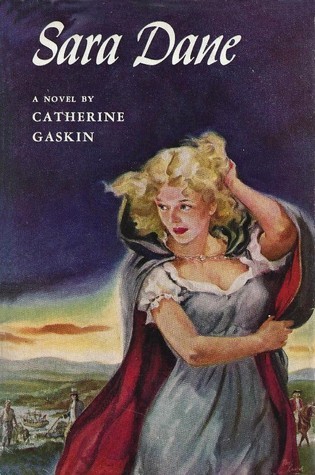
According to Wikipedia, she completed her best-known work, Sara Dane, on her 25th birthday in 1954, and it was published in 1955. It sold more than 2 million copies, was translated into a number of other languages, and was made, as I’ve said above, into a television mini-series in 1982. It is loosely based on the life of the Australian convict businesswoman Mary Reibey. Stephens writes that ‘a Herald critic described the novel as “most readable”‘ although the critic also suggested “that Gaskin’s understanding of history was not deep”. He says that “after Sara Dane, many of her books were overlooked by critics, although welcomed by readers”.
At least three of her novels – Sara Dane, I know my love, and The Tilsit inheritance – were adapted for radio, by Australia’s Grace Gibson Radio Productions, and many others besides Sara Dane, were translated into other languages.
Gaskin met the man who became her husband in London, and they married in 1955. He was a TV executive and 19 years her senior. They lived in various places together, including the USA, the Virgin Islands, and Ireland. However, she returned to Sydney at the end of her life, and died there in September 2009.
I was inspired to write this post by some research I did for the #1970 Year Club last year. Journalist Rita Grosvenor visited her in Ireland around the time of the publication of her novel, Fiona. Grosvenor writes that:
She is among the elite of the world’s women novelists, with such a faithful following of readers she can be sure that every time she produces a new book it will sell 50,000 copies in hard-cover – and that’s more than most authors sell with a handful of books. With paperback sales she often passes a million.
Grosvenor’s article was for the Australian Women’s Weekly, so there’s much about her living arrangements and house, but towards the end, she shares Gaskin’s thoughts about her writing. Despite her success, Gaskin is depressed every time she starts a book, fearing that “this time it is not going to work out, but somehow it does”. However, she says:
“I know I can never be a Graham Greene, but I always want to improve within my limitations. I’m a perfectionist.”
As Stephens writes, “she knew her limitations but didn’t like being regarded as a romantic writer”. She saw herself as “an entertainer and good craftswoman who married romance with history and studies of such subjects as trades and places”.
According to Stephens, Gaskin retired after her last novel, The charmed circle, was published in 1988. She wanted to travel with her husband, without publishers’ deadlines. So, they did travel, apparently, until his death in 1999. She then moved to Mosman, in Sydney, and spent the rest of her life there. Stephens quoted her as saying, ”I am not an Australian by birth but I think like one”.
Have any of you heard of or read Catherine Gaskin?
Sources
- Catherine Gaskin, Wikipedia [Accessed: 23 June 2025]
- Catherine Gaskin: Best selling Coogee author, Coogee Media [Accessed: 23 June 2025]
- Rita Grosvenor, “Ireland is home for Australian novelist“, The Australian Women’s Weekly, 6 May 1970 [Accessed: 7 October 2024]
- Tony Stephens, “The girl with the golden pen: Catherine Gaskin, 1929-2009“, The Sydney Morning Herald, 18 September 2009 [Accessed: 23 June 2025]
 Whispering Gums