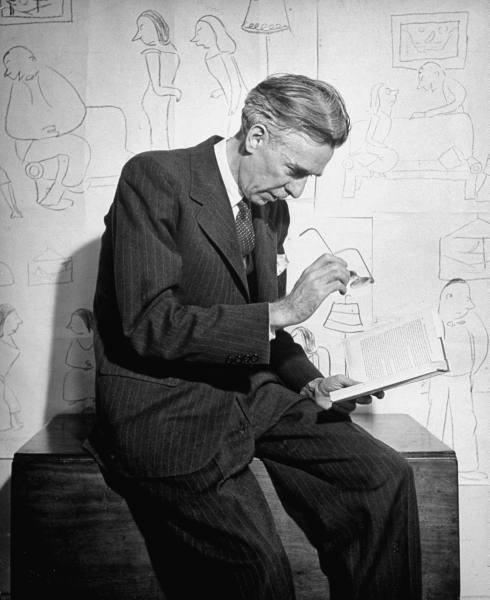
Thurber, 1945 (Courtesy: life.com, for personal non-commercial use)
If you like to think of yourself as a critic, read this. It is last week’s offering from the Library of America, and is an essay by James Thurber titled “The lady on the bookcase”; it was first published in The New York Times Magazine in 1945 under the title “Thurber as seen by Thurber”. I read it as a general spoof on the art of criticism; the Library of America says he “teases [his] colleagues and editors at The New Yorker.”
The scene is set in the first paragraph when he reports on a cartoonist complaining about being rejected:
“Why is it”, demanded the cartoonist, “that you reject my work and publish drawings by a fifth-rate artist like Thurber?” Ross came quickly to my defence like the true friend and devoted employer he is. “You mean third-rate”, he said quietly, but there was a warning glint in his steely gray eyes that caused the discomfited cartoonist to beat a hasty retreat.
Just this beginning, before I read any more, reminded me of why I had enjoyed Thurber in my baby-boomer youth when many of us read a bit of Thurber. Thurber was a writer and cartoonist, and in this essay he combines the two to poke fun at criticism … and at how editors tend to show a journalistic rather than a critical interest in his work by wanting to know the stories behind his work rather than analysing it.
He writes that:
I have never wanted to write about my drawings and I still don’t want to, but it occurred to me that it might be a good idea to do it now, when everybody is busy with something else, and get it over quietly.
… and, to continue his satire, he talks about “shoving” some of his originals around the floor until they “fell, or [he says archly] perhaps I pushed them, into five separate categories”. He goes on to describe the categories, illustrating each with some of his cartoons:
- the Unconscious or Stream of Nervousness category
- the space between the Concept of the Purely Accidental and the Theory of the Haphazard Determination
- the theory of the Deliberate Accident or Conditioned Mistake
- the Contributed Idea category
- the Intentional or Thought-Up category
If you haven’t worked it out by now, you can’t take much of what he says seriously – and that is his point. Don’t, he tells us, try to categorise or apply psychological theories to someone’s work, go for a run instead. Then again, I wouldn’t take this too seriously either, because Thurber is also being disingenuous: in the tradition of the satirist, he sets us up at every point, only to pull us down again. After all, like any creative artist, he wants us to look at and respond to his work.
Have a look at it … I’m sure you’ll enjoy the ten cartoons reproduced even if you don’t want to read the essay.
 Whispering Gums