Telling and writing the story: Richard Fidler’s Seymour Biography Lecture

Richard Fidler

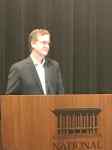
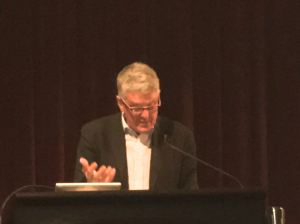
Richard Fidler, NLA, 2018

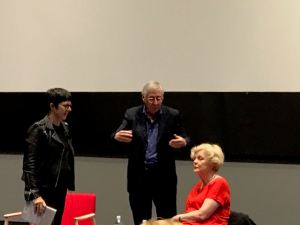
On Friday night I went to my fourth consecutive Seymour Biography Lecture at the National Library of Australia. A highlight on the Library’s calendar, it’s an annual lecture devoted to life-writing, and was endowed by the Seymours in 2005.

This year’s speaker, Richard Fidler, was, at first glance, a surprising pick – but a very popular one. He is well known to Australians, for several reasons, but particularly for hosting, since 2005, ABC Radio’s hour-long interview program, Conversations. He has also recently written two historical books, Ghost empire (2016) and Saga land (co-written with Kári Gíslason) (2017). These books, the lecture promo said, contain short biographies of historical figures from, respectively, Byzantium and mediaeval Iceland. So, he has not written a biography or memoir or autobiography, per se, but these books contain small biographies. Moreover, his Conversations program, it was suggested, comprises mini-autobiographies of the interviewees. Fidler then, as it turned out, was well able to talk about life-writing or, more broadly, telling life stories.

After being introduced by the NLA’s Director-General, Marie-Louise Ayres, Fidler commenced by telling us that he’d titled his lecture, “Telling and writing the story”. The event’s promotion explained that this meant

outlining some of the tensions that come into play when bringing someone’s life story to a listening audience and comparing it to the freedoms and constraints involved in writing biography for a reader.

Fidler commenced with a little anecdote exemplifying the dangers of biography. Back in 1988, he had read, he said, Robert Caro’s The years of Lyndon Johnson: The path to power (1982). It’s volume 1 of a larger work. Caro has now published three more volumes (in 1990, 1992 and 2012) and has apparently announced that he will conclude with a fifth volume which, he said this year, could take from two to ten years. Caro is now 82. Fidler proposed that this story provides a warning for the biographer – as you go in, he said, have an eye on the exit! This issue has not – to date, anyhow – been a problem for Fidler whose biographical work has taken a very different, and much shorter path.

Radio versus print

As the lecture’s promotion promised, Fidler talked about both his written and radio work, reflecting as he went on the difference between the two. I love this sort of discussion, this exploration of different media, of different forms of writing and presentation, in order to tease out what is inherent to each. As a consumer and reviewer of media, I believe that knowing and understanding the form in hand is a critical starting point. I’m therefore going (to try) to marshal my report on this lecture to focus on these issues, rather than be a blow-by-blow summary.

Print

Early in the lecture, Fidler said that written stories can take more liberties – the story can sprawl, for example, diving off on tangents at will. Radio, on the other hand, is more linear, it must keep moving forward in a direct path (though it does have the voice to guile you!) He likened radio to a shark driving ever forwards, while print is like a Portuguese man-of-war which can drag all sorts of bits-and-pieces along with it.

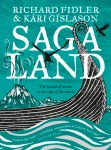
Richard Fidler, Kari Gislason, Saga LandHe exemplified this through the Saga land project, first explaining, for those of us who didn’t know, that Icelandic sagas – Saga land’s subject – are stories of real Vikings. Icelanders read these sagas, he said, the way we read Shakespeare. He also explained that in Old Norse, the word “saga” means “telling. He then read the beginning of the first saga about Gunnar, showing us how the narrative tension builds. (We’ll leave, here, the side issue of how much of the actual stories about these real people is fact, and how much fiction or hyperbole, as it’s irrelevant to my main thread. It’s an issue, he suggested, best left to saga scholars who still argue about it.)

He realised, he said, that these sagas would translate well to audio (to radio and podcast). Their first two chosen stories translated pretty easily to the audio form, but then he got to the story of Gisli which turned out to be much harder to transform into a linear form. How could he pour this sprawling story into the narrow form needed for a spoken narrative – a paradoxical problem, given the sagas originated in oral form. The “crush of family”, the multiple but confusing relationships, he said, are important to Gisli’s story. Eventually, though, he identified its core, and developed the narrative from there.

Fidler went on to talk about more stories from Saga Land, and talked a little about Ghost empire which he described as, essentially, the biography of a city, Constantinople. It reminded me of another “biography” of Constantinople, Orhan Pamuk’s mesmerising Istanbul: Memories of a city. Anyhow, regarding writing Ghost empire, he mentioned in particular the mini-biography of Constantine XI and how writing about him involved “a strange act of sympathy.” In fact, he described biography as “a profound act of sympathy”, which means, for him, “sitting beside his subject” as he writes rather than observing from a distance.

Radio

Of course, many in the audience were keen to hear about Fidler’s hugely popular radio program, Conversations, and Fidler did spend some of his 45 minutes on it too. He started by saying that the program’s aim was to present the stories of unknown people although, as listeners know, he also interviews better known people like “astronauts, authors and scientists.”

Fidler talked about the challenge of creating coherent narratives out of his subjects’ lives, many of whom, unused to the media, struggle to tell their stories coherently. His producers spend a long time talking – often on the phone – with selected interviewees, teasing out a narrative. Life is messy, a bit like a teenager’s bedroom he said!

Moreover, how reliable is memory, he asked – and then told a pertinent personal story to prove just how unreliable it is! He quoted British poet, Lemn Sissay’s definition of a family:

“Family is memory disputed between a group of people over a lifetime.”

Love it. Anyhow, he said that, consequently, he asks his interviewees “What do you remember?” rather than “What happened?” This question can often result in wonderful reveries, ones that make him almost stop breathing in order to not break the momentum. He gave an example from his interview with Angela Lansbury who gave an evocative description of the London of her childhood. Fidler said that he could see that a movie of that time was playing before her eyes.

Overall, he said, producing Conversations required artful deception in order to create the narrative arc of an hour.

Why read or listen to biography?

This subject wasn’t – really – specifically addressed, but Fidler did say a few relevant things. Regarding the value of reading Icelandic sagas, he said our interest springs from a deep-seated human need to understand our own lives through those of our ancestors. The sagas, he says, may fall short in terms of biographical rigour but they do tell larger truths. They were enjoyed as escapism but they also offered a different way of being human. Apparently, the poets Auden and Borges loved Iceland’s sagas.

Somewhat related to this issue was his discussion about the overall value of radio. It’s more intimate than television. It’s also more “profoundly democratic because you can’t be seen” and therefore not judged by the markers of appearance. He saw this as “a noble nakedness.”  In addition, radio has, he believes, an “enormous didactic momentum”, one which can create a “commonwealth of shared sympathies”, a sense of shared humanity.

There was more, including a Q&A during which questions included how subjects are found for Conversations, what he would ask Constantine XI if given the chance, and his tips for new interviewers.

But, I’ll leave it here and conclude with Fidler’s impassioned concluding statement, made in the context of the week’s astonishing events in which the ABC lost both its Managing Director and Chairman of the Board. He said that the public trusts that the Board will support the ABC, and that it’s not the government which funds the ABC, but you (that is, us), the audience. That of course brought him resounding applause – and so, sadly, ended another excellent Seymour lecture.

Further reading and listening: Saga Land: The Book and Radio Series

Previous lecture postsRobert Drewe (2015), David Marr (2016) and Raimond Gaita (2017)

Seymour Biography Lecture
National Library of Australia
28 September 2018

Vale Jane Austen: on the 200th anniversary of her death

Jane Austen by sister Cassandra

Today, July 18, marks the 200th anniversary of Jane Austen’s death. Unfortunately, because I am travelling I am unable to join my local Jane Austen group’s wake to commemorate her, but I had to do something of course, so I’ve decided to write a post on Austen biographies. I’m partly drawing from my group’s recent discussion of Austen biographies.

Now, if you are not an Austen aficionado and you’ve looked at my list below, you would probably be surprised to hear that very little, really, is known about Austen, and that what is known is not very exciting. Amazon’s entry on Spence’s book includes a quote from a Booklist review which says that “Jane Austen’s quiet life is not very rewarding biographical material.” And Tomalin, writer of probably the most authoritative biography, concludes that Austen “is as elusive as a cloud in the night sky”.

Yet, the biographies keep coming – and if you look (again) at my list below you will see that the number has increased in recent decades. Has any writer had as many biographies written about them than Austen? When my Austen group discussed them, we decided there were different types of biographies: the straightforward (chronological, womb-to-tomb style); those taking a more thematic approach (like Paula Byrne’s The real Jane Austen: A life in small things); and those wishing to explore specific perspectives/angles (like Helena Kelly’s Jane Austen: The secret radical).

Claire Tomalin, Jane AustenStill, we wondered how many of these biographies really have something new to say, or are most simply jumping on the Jane Austen bandwagon – because the fact is that there are many gaps in what is known about her. That’s largely why she’s so “elusive” as Tomalin says. And it’s why most biographies fill out with a lot of context. They either spend a lot of time on her books (some of which you would naturally expect in a literary biography), or they spend a lot of time talking about her times and/or the lives of members of her family. (And there are some dramatic stories there.)

Of course, there’s always the possibility of new information coming to light. Midorikawa and Sweeney’s work on the literary friendship between Austen and Anne Sharp that I reviewed recently, drew heavily on the unpublished diaries and letters of Jane’s niece, Fanny Knight, which they said had not been seriously mined by scholars. They did admit though that they had to “read between the lines of Fanny’s childish scrawl to decipher the obscured truths”.

And if you expected all this life-of-Austen industry to be as meek and mild as many think Austen was, you’d better think again. Austenites (I’ll refrain from using the more loaded Janeite) can be fiery, as the recent contretemps over the new biography by Lucy Worsley and its alleged similarities to Paula Byrne’s 2013 one.

Who knows the real story here, but there is one truth we can universally acknowledge, and that’s that in this anniversary year of Austen’s death, more books will come out about her.

The not-quite-complete list

  • Amy, Helen. Jane Austen (2013)
  • Auerbach, Emily. Searching for Jane Austen (2004)
  • Austen-Leigh, James Edward. A memoir of Jane Austen (1869)
  • Byrne, Paula. The real Jane Austen: A life in small things (2013)
  • Cecil, David. A portrait of Jane Austen (1979)
  • Grosvenor Myer, Valerie. Jane Austen, obstinate heart: A Biography (1997)
  • Honan, Park. Jane Austen: Her Life (1987)
  • Jenkins, Elizabeth. Jane Austen: A biography (1938)
  • Kelly, Helena. Jane Austen: The secret radical (2016)
  • Le Faye, Deirdre. Jane Austen (British Library Writers’ Lives Series) (1998)
  • Lefroy, Helen. Jane Austen (1997)
  • Midorikawa, Emily and Emma Claire Sweeney. A secret sisterhood. Part 1: Jane Austen and Anne Sharp (2017)
  • Nokes, David. Jane Austen: A life (1998)
  • Shields, Carol. Jane Austen: A life (2001)
  • Spence, Jon. Becoming Jane Austen (2007)
  • Tomalin, Claire. Jane Austen: A life (1997)
  • Worsley, Lucy. Jane Austen at home: A biography (2017)

Monday musings on Australian literature: Guest post from Bill of The Australian Legend

It’s been two years since I last published a Guest Post, for no any other reason than that the idea slipped off the radar as other busy-ness took over. However, during a recent email correspondence with (relatively new) blogger Bill, the idea re-popped into my head, and so I asked him, as he explains below.

First though, a quick intro. Bill appeared on the Australian lit-blog scene just over two years ago with quite a bang. Well, that’s a bit overly dramatic perhaps. What I mean is that he launched himself as a serious player in the lit-blogosphere, and one with a very particular agenda – to write about independent women, particularly independent women writers. Well, of course, I was interested in that and have enjoyed some good discussions here and on his blog ever since. If you’re likewise interested, I suggest you start with his About page and move on from there.  Meanwhile, let’s give the floor to Bill …

*****

Apart from my friend Michelle at Adventures in Biography who got me started on Lit.Blogging, Sue here at Whispering Gums was the first blogger I followed and who followed me. So I owe her a great debt, and feel guilty each time I think of the imaginary detective story where the private eye’s principal informant is the toothless derelict … Whispering Gums. (The real, and much nicer, origin of her name is here.)

It is a matter of great pride to me to be invited to do a guest post, and I’m only sorry that it is under false pretences. I was discussing (by email) with Sue some reviews I had put up on the Australian Women Writers Challenge site and I asked her in passing what she thought of biographies of women writers by men. My intended question was did she think the AWWC site should list them. Sue however thought I was asking her opinion of the biographies themselves, and promptly put it back onto me!

Do you remember the old BBC Radio show Just A Minute which was often used as a filler on Radio National? Well I feel like (the late) Derek Nimmo leaning in to the microphone to speak for 60 seconds on the life cycle of newts. But here goes, 1000 words on Biographies of Women Writers by Men, starting now.

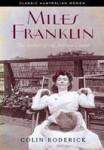
Colin Roderick, Miles FranklinI have reviewed two such biographies, Brian Mathews on Louisa Lawson and Colin Roderick on Miles Franklin. The former is a good example of a man being able to write sympathetically and insightfully about a woman, and the latter is not.

Walking up and down my own shelves I see I have numerous biographies by women. Three – Roe, Barnard and Coleman – on Miles Franklin, Barbara Baynton by Penne Hackforth Jones, Christina Stead by Chris Williams, two by Sylvia Martin – Aileen Palmer and Passionate Friends, ‘collected’ lives by Drusilla Modjeska, and by Dale Spender, Tomalin’s Jane Austen and Gaskell’s Charlotte Bronte; and I also have two more by men, Brian Dibble on Elizabeth Jolley (Doing Life which I really ought to have reviewed by now) and Ric Throssell on his mother, Katharine Susannah Prichard.

Of course, as you may know, I am an old white guy and so I am probably the very last person to be attempting to answer the implied question: does it matter? Well, in the case of Colin Roderick (1911-2000), one of the most influential figures in the Aust.Lit industry in the middle of the last century, his gender matters a great deal. He runs Franklin down both as a writer and as a woman:

[her] unshakeable conviction of physical inferiority and lack of physical attraction… converted her into a skittish coquette stringing two or three men along simultaneously and a synthetic man-hater… It forced her to become a defensively bellicose propagandist for feminist causes.

He routinely misstates her commitment to feminism, and writes that a determined suitor might have cured her flirtatiousness with a spanking. In the comments to my piece on Roderick, author Jess White, taking comfort from my description of him, describes Roderick’s biography of Rosa Praed, In Mortal Bondage, as “bizarre & bordering on fiction in places.”

The Roe biography of Franklin I would describe as asexual, but the earlier (in fact the first) biography, by Marjorie Barnard, which I haven’t read for a long time, does seem to me to reflect the fact that it is written by a woman. It starts (stereotypically!) by describing how Franklin dressed and how she looked: “her smile. Radiant, quick and gay, it transformed her. It was irresistible and in her old age still charming and youthful.” And ends with an analysis of love: “[Miles] held in her heart an impossible ideal of human relationships and when she found it unrealizable, not so much for herself as in the lives of others, she was bitterly hurt and disappointed”, which I have never been able to express half so well.

Unlike Roderick, Matthews takes Lawson’s feminism seriously and gives a good account of it. In fact, he takes Lawson seriously as poet, businesswoman, leading figure in the women’s movement at the turn of the century, and as a mother (with four difficult adult children!) Whether he adequately emphasizes with her, perhaps only a woman could tell. Unfortunately for Matthews there was very little evidence to say how Louisa spent her private life after leaving her husband – although we’re pretty sure she didn’t want to get pregnant again.

Marianne van Velzen in her account of Ernestine Hill turned to fiction to round out those areas where evidence was lacking, an approach which Matthews discusses and dismisses, and which I think detracts greatly from the usefulness of those autobiographies which resort to it.

At this point in my writing I went away for a couple of days, and by sitting, driving, with the radio off, was able to refine my ideas. We have seen that biographies may be ‘factual’ or ‘fictionalized’. Then, from a ‘gender studies’ point of view we may also categorise them as: Neutral, Masculinist, and Feminist. The problem of course with ‘Neutral’ is that old, conservative, white men regard their own point of view as neutral and all others as radical. But let us say for argument’s sake that ‘neutral’ is the gathering and presentation of historical material without (much) gender analysis, and that Jill Roe’s Stella Miles Franklin is an example of this. Colin Roderick’s biographies of Franklin and Praed are clearly ‘masculinist’, in that he devalues the opinions of the women he is writing about and ascribes to them motives which he wouldn’t ascribe to men. An example of a ‘feminist’ biographer might be Sylvia Martin who is exploring the space between spinsterism and lesbianism by looking into the lives of single women writers like Mary Fullerton.

A further division is suggested by Nathan Hobby who is both a blogger and PhD student writing a biography of Katharine Susannah Prichard. At the end of 2015 he wrote, “The best biographies, in my opinion, are generally written by biographers who care about biography as a genre rather than biographers who are simply passionate about their subject.”  So then we also have ‘serious’ biographers and the ‘simply passionates’. The latter definition clearly captures rellos such as Ric Throssell and journalists like Marrianne van Velzen.

If you are thinking I have drifted a bit far from the topic, I guess the questions I am trying to get to are: How many Australian women writers have been the subject of biographies by ‘serious’ men? And, assuming only Roderick actually attacks his subjects, how many of those biographies were sympathetic, and how many missed the point?

Now, all you Whispering Gum-nuts out there, it’s down to you. I’ve listed the four that I have. How many have I missed?

Thanks Bill for taking up my invitation – and for presenting some different angles for us all to think about regarding biographers and their biographies.

Here I stand: David Marr’s Seymour Biography Lecture

This week Mr Gums and I went to our second Seymour Biography Lecture, an annual lecture devoted to life-writing which was endowed by the Seymours in 2005. Our first, last year, was given by Robert Drewe who discussed memoir as a form of life-writing that is differentiated from but as valid as autobiography. It was a wonderful lecture, so we were keen to attend this year’s, and particularly when David Marr was announced as the speaker.

David Marr, NLA, Sept 2016

David Marr, NLA, Sept 2016

David Marr, as you may know, is one of Australia’s most recognisable contemporary public intellectuals. He wrote a biography of controversial politician and Chief Justice Sir Garfield Barwick (Barwick) and the multi-award-winning biography Patrick White: A life. In recent years he has written several biographical essays for the Quarterly Essay: on John Howard (2007), Kevin Rudd (2010), Tony Abbott (2012), George Pell (2013), and Bill Shorten (2015). The National Library of Australia’s Director-General, Anne-Marie Schwirtlich said, when introducing him, that these essays represent “a new form of biography”. That sounded interesting, but it turned out not to be the subject of his lecture. Oh well … a topic for another day, perhaps?

At this point David Marr got up to speak … I’ve seen him many times on television, but I greatly enjoyed seeing him in person. He has a lovely, natural speaking style – articulate, but informally formal if that makes sense. He started by saying how good it was to be giving a lecture in someone’s name, not in their memory but in their presence! (The Seymours were in the audience).

What’s the story?

Marr commenced by describing how he was called to Patrick White’s place in 1988 during one of White’s “near-death” experiences. When he got there, other family and friends were already there, waiting for the ambulance. Eventually, Wendy the ambo arrived, walked in, and asked, very appropriately Marr said, “What’s the story?” As it turned out White lived through more episodes like this, before dying in 1990. He told us all this, not so much because it was an interesting story, but to make the point that although he was present at these occasions, and although he wrote about them in his White biography, we will not find him there. That is, he did not put himself in the room with the others. In fact, he did not put himself in the book anywhere (although he admitted, slyly, that of course he is everywhere in the book – the words, the judgements, are his).

Marr then gave us his rules for biographers, but I’m afraid I only got four of the five down. They are:

  • The voice of the subject must be clear;
  • The biography must not “muck around with time”;
  • The biographer must spare the reader his/her “homework”; and
  • The biographer must stay out of the life.

This last “rule” would be the theme of his lecture …

Be an invisible biographer

Before exploring this, however, Marr said that it is the biographer’s truth that everybody’s life is open to writing about, that no-one owns his/her life. True, yes, he said, but “mighty obstacles can be put in your way”. Subjects can:

  • Stop their friends talking to you
  • Block access to their papers
  • Withhold copyright consent. He expanded here on family ownership of copyright, and the typical family view that “what’s hidden in life must be hidden in death”. (Hence, methought, sisters like Cassandra Austen destroy precious letters!)
  • Place a curse on their biographers. Here he mentioned Greek poet, Cavafy, who wrote “From all I did and all I said/Let no one try to find out who I was” (“Hidden things”). Cavafy also said that sometimes it is better to wait, that some things cannot be understood until time has passed.

Marr said he feared every one of these obstructions when he approached White – particularly the curses! But the timing was right for White, and Marr’s biography project was, amazingly, accepted. Marr described his aims as absolutely conventional: “I was  born in Pymble after all,” he said! They included finding out who White was, where his books came from, his impact on the world and world’s on him, and so on. But White – the irascible White – saw it quite differently. He saw it as his “last reckoning”, his last chance to see where all his life passions had ended up, his last chance to see which of his many and diverse arrows had hit their mark.

Marr spent four years (I think) on the project, meeting with White, visiting places he’d been, meeting people he knew, and so on, but he is not in the book. Editors today, he said, would “tell me to get in there”, to write of his adventures in research. He described this style as “quest biographies”, and he doesn’t (generally) like them. They “inflict their homework on readers” and “they also bugger around with time”. For example, the biographer may write about being in Greece researching the subject’s life while simultaneously describing the subject’s life in that place in some time past. Biographers can also, inappropriately in Marr’s view, foreshadow aspects of the subject’s life, as in “that was the last time X ever went to Y”. He argued that it is the great drama of our lives that we don’t know what is going to happen. Great biographers make the future unknown, he said. Even though we usually know the fate of the subject, a good biographer can make it a surprise.

He gave examples of visible biographers that he doesn’t like, but admitted that rules can be broken. The “quest biography” is, for example, suitable for the life of a fraud. And there are cases where the biographer has “absolutely earned the right” to be in the biography, the perfect example being Boswell in his Life of Johnson. Boswell’s world was Johnson. He spent twenty years talking, living, arguing with Johnson. Do the work, said Marr, put in the years, and deal with yourself as ruthlessly as Boswell does!

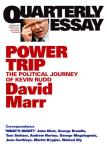
David Marr, Power TripThen Marr admitted that he has broken his own rule – when there’s been a purpose for him to be there in the work. His Quarterly Essay on Kevin Rudd is an example. He told of dining with Rudd who, late in the meal, asked Marr what his essay was about. When Marr told him, Rudd lost his temper, in a very controlled way. He was “astonishingly eloquent”, Marr said, speaking from his “angry heart” and Marr had to be there to be able to describe the experience.

So, there are no rules, but overall he’d like to see an end to biographers in the text. They should be in the shadows, “manipulating everything”, and saving their stories about themselves and their research for writers’ festivals and, when they’re old, for lectures!

Q&A

We had about 15 to 20 minutes of Q&A but some of the questions, interesting though they were, ranged wider than the focus of Marr’s lecture, so I’ll keep this brief.

  • How do you choose who to write about? Marr chose White because he read something contradictory about White’s parents. White had always said that they did not want him to be a writer, but then Marr read somewhere that White’s parents had bankrolled a publishing project on the condition they published a book of White’s poems. He wrote his Barwick biography because he was enraged by what Barwick was getting away with. He’s an explainer he said, rather than a creator.
  • Do you as a biographer ever withhold information? Yes, said Marr. There are some private matters that have no place in biography. His deal with Patrick White, he hastened to say, was that it was his (i.e. Marr’) book and he would write what he wanted to write. Any information he withheld, then, was withheld because it was not, in his opinion, essential to our understanding of White. Legal issues, too, can sometimes result in information being omitted, as has happened with his various Quarterly Essays on contemporary politicians.

During the book signing at the end of the evening, Marr commented that his was “a craft lecture”, meaning I suppose that it wasn’t a theoretical or philosophical one on the form and its meaning. Well, “craft” it may have been but I enjoy hearing from writers about their craft and, anyhow, amongst the “craft”, as you can probably tell, we got a bit of theory and philosophy too. Another wonderful Seymour lecture, with another thoughtful, inspiring writer.

Monday musings on Australian literature: Australian literary biographies

Given that a literary biography won the National Biography Award this year, that I’ve recently posted Musings on literary autobiographies/memories, and that my next review will be for a literary biography, it seemed high time that I devoted a Monday Musings to the form, don’t you think?

Brenda Niall's True North

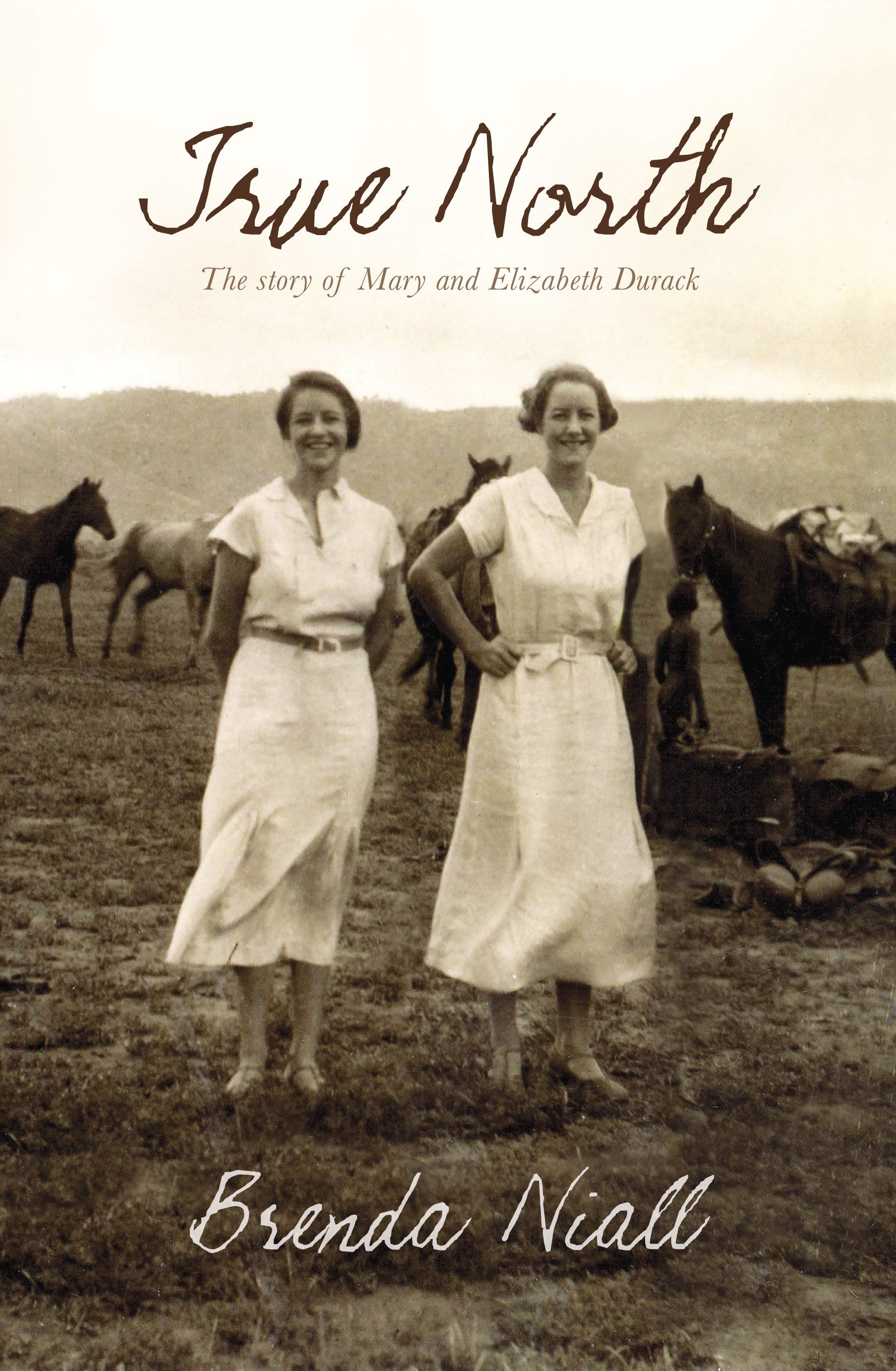
Brenda Niall’s True North: The story of Mary and Elizabeth Durack (Courtesy: Text Publishing)

Biographies make up a pretty small proportion of my reading diet, and when I do read them I tend to prefer literary biographies – for obvious reasons. I can, though, be persuaded to read others if the subject is really of interest to me and/or the biographer is one I admire. An example of such a book I’ve reviewed here is Hazel Rowley’s wonderful Franklin and Eleanor.

Do you read biographies? If so, why do you read them? I have, at times, worried that my interest is voyeuristic. I have felt uncertain about whether I’d be better to focus my attention on reading more of authors’ works than biographies about them? And yet, biography is, I think, a serious literary form in its own right. Indeed, at the Australian National University, there is the National Centre of Biography, about which I’ve written before. Its role, to summarise greatly, is to foster and encourage expert and innovative biographical writing in Australia. This, together with the fact that significant institutions like the National Library of Australia with its Seymour Biography Lecture and the State Library of New South Wales with its National Biography Award, suggests that I should worry no more.

What makes a good literary biography? Well, I know what I look for: well-researched (with foot-notes/end-notes), an intelligent but readable style, honest rather than hagiographic (or its opposite!) tone, and an analytical approach to the writer’s work situating it within the writer’s life and times. I also like it when the biographer engages the reader in the form of the biography, in the challenges they may have confronted, in how and why they chose the approach they did.

So, here I’ll list a few Australian literary biographies, that I’ve read or would like to, in alphabetical order, as libraries do it, by the subject. Inclusion here does not mean they are all the best of the form, but simply that they represent a variety in style and subject.

  • Jennifer Walker’s Elizabeth of the German Garden: A literary journey (2013). A recent addition to my TBR, I’m very keen to read this biography of the not-so-well-known Australian-born writer, Elizabeth von Arnim. I’ve read several of her works – fiction and non-fiction – and love her writing. (As an aside, given recent discussions on this blog regarding memoirs, she’s another author who has played with the memoir form in her writing.)
  • Karen Lamb’s Thea Astley: Inventing her own weather (2015). This is the book I am just finishing now and will review in the next few days.
  • Philip Butterss’ An unsentimental bloke: The life and work of CJ Dennis (2014) (my review). This year’s National Biography Award winner. The judges wrote that it’s “meticulously researched”, “fluent in style”, and that it “provides an illuminating analysis of the oeuvre, and its spinoffs, for which Dennis was famous and, briefly, rich”.
  • Brenda Niall’s True north: The story of Mary and Elizabeth Durack (2012) (my review). This is, really, more than a traditional literary biography. Elizabeth was an artist, and the two were daughters of a pioneering cattle family. I enjoyed it, but it suffered, perhaps, from the breadth of its focus.
  • Jill Roe’e Stella Miles Franklin: A biography (2008). This is a biography that I should read, given the importance of its subject to Australian literature and given the reputation of the biography itself. I can, though, suggest you check out Lisa’s (ANZLitLovers) review.
  • Helen Trinca’s Madeleine: A life of Madeleine St John (2013). (my review). St John is not regarded as “high” Australian literature – nor is Mary Durack, for that matter – but she was the first female Australian writer to be nominated for the Booker Prize and, like the Duracks, came from a family which had a public profile.
  • Hazel Rowley’s Christina Stead: A life (1993). Rowley was regarded as one of Australia’s best biographers until she died too young, in her 60th year, in 2011. Her subjects included the French couple Jean-Paul Sartre and Simone de Beauvoir, and American writer, Richard Wright. Her biography of Stead was universally praised, with, for example, critic Michael Upchurch at the New York Review of Books describing it as “everything a literary biography should be”. He wrote: “It’s a model of clarity. Ms. Rowley’s shrewd selectivity and handling of anecdote makes the book compellingly readable”.
  • David Marr’s Patrick White: A life (1991). Another biography I should read, but it’s a big tome, so will need time. Well-reviewed when it came out, it’s still the authoritative biography of Australia’s only Nobel Laureate in literature.

In 2010, journalist Gideon Haigh wrote an article titled “Sleaze-hounds and artist on oath: The state of Australian biography” in Kill Your Darlings. He bemoaned the scarcity of Australian biography “of quality”. I’d certainly agree that we’d like more good biographies. He suggested various reasons for the dearth, including that it “could be as simple as that there are easier ways to earn a living, and that living in the shadow of a subject for the years required to craft something really worthwhile involves a determination and a humility no longer common among those with writing aspirations”. I’m not sure I like the dig about “humility” but it is clear to me that writing a comprehensive, thoughtful biography is a huge task, one that takes not months but years, and that requires extensive research that must be expensive (even in today’s more digitally accessible world). I don’t know how well supported the endeavour is.

Do you have any thoughts or preferences about biographies?

Monday musings on Australian literature: National Biography Award

I have mentioned the National Biography Award before, but have never dedicated a post to it. Since this Monday musings coincides with the announcement of the 2014 award, I thought it would be a good time to write a little about this award.

The National Biography Award was initially endowed by Geoffrey Cains, with support a little later by Michael Crouch, and is managed by the State Library of NSW. Its aim, says its website, is “to encourage the highest standards of writing in the fields of biography and autobiography, and to promote public interest in these genres”.  As of 2013, the winner receives $25,000, with each shortlisted book receiving $1,000. I like the fact that more and more awards are providing a monetary prize for the shortlisted works. Associated with the award, since 2003, has been an annual lecture on the subject of life-writing. The list of lectures, and papers if available, can be found on the State Library of NSW’s website.

The shortlist for 2014 was:

    Alison Alexander, The ambitions of Jane Franklin
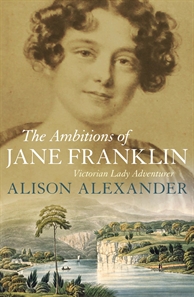
    Courtesy: Allen & Unwin
    • Alison Alexander’s The ambitions of Jane Franklin (Allen & Unwin). This one intrigues me as Lady Jane Franklin, about whom I’ve written before, was one of those amazing 19th century woman who came to my attention through contemporary novels, including Richard Flanagan’s Wanting and Andrea Barrett’s The voyage of the Narwhal, and a book of poetry titled Jane, Lady Franklin by Tasmanian Adrienne Eberhard. The biography is subtitled, Victorian lady adventurer. I don’t know Alexander, but she is apparently a Tasmanian historian.
    • Steve Bisley’s Stillways: A memoir (HarperCollins Publishers). Steve Bisley is an Australian actor and this book, the website says, is “a classic memoir of an Australian childhood in the sixties”. That in itself gives it some appeal to me.
    • Janet Butler’s Kitty’s war (University of Queensland Press). This one is on my TBR. It is based on the war diaries of World War 1 army nurse Sister Kit McNaughton. In 2013 it won the NSW Premier’s Prize for Australia. Butler works in the History department at La Trobe University.
    • John Cantwell & Greg Bearup’s Exit Wounds: One Australian’s War on Terror(Melbourne University Publishing). Cantwell was a Major-General in the army who served in Iraq and Afghanistan, and ended up with post traumatic stress disorder (PTSD). He has written this with Walkley Award winning journalist, Greg Bearup.
    • Sheila Fitzpatrick’s A Spy in the Archives (Melbourne University Publishing). Historian Sheila Fitzpatrick lived in the Russia during the Cold War, while researching for her doctoral thesis. She apparently felt at home in Russia, but, as a foreigner, was always seen by Soviet authorities as potentially a spy. The book explores this part of her life. Fitzpatrick is regarded as an expert in the field of Soviet/modern Russian history.
    • Gideon Haigh’s On Warne (Penguin Australia). Australians will know immediately the subject of this biography, the flamboyant, controversial but highly-talented cricketer Shane Warne. Gideon Haigh is a journalist who has written several well-regarded and award-winning books on sport, media and the automotive industry (among other topics).

    All books I’d willingly read … though Alexander’s and Butler’s would be my top priority.

    And the winner is: Alison Alexander’s The ambitions of Jane Franklin! Now I really do want to read this book … It was a little tricky to find who won via a normal Google search several hours after the announcement, so I turned to Twitter and there it was (of course). Will it be reported on Australian television news tonight? I wonder!

    Anyhow, once I knew the winner, I was able to search on that and found a Sydney Morning Herald article which quotes chair of the judging panel (and a previous winner), Jacqueline Kent, as praising the book for its detailed portrayal of a “highly intelligent, vital and strong-minded woman” She said that “This is a biography that drew on a huge amount of research but is also very light on its feet”. Apparently Franklin, according to the Herald, had left behind “8 million words in journals and correspondence”. Alexander is reported as saying that the biography would have been impossible without a “Find” key to search documents. Isn’t modern technology grand – though the “find” function can’t completely replace in-depth reading during which you can find all those wonderful serendipitous details that make research such fun.

    Monday musings on Australian literature: Hazel Rowley Literary Fund

    It seemed appropriate to talk about the Hazel Rowley Literary Fund this week given that several commenters on my review of Christina Stead‘s For love alone mentioned Rowley’s well-regarded biography of Christina Stead. Quite coincidentally – amazing how often such coincidences occur isn’t it – AustLit posted on their blog last week a piece titled The names behind our literary awards #1: Hazel Rowley. Today’s post was clearly meant to be.

    For those of you who don’t know, Hazel Rowley was one of Australia’s most respected biographers. Christina Stead: A biography, published in 1993, was her first biography. It won the National Book Council’s “Banjo” Award for non-fiction. Her next biography published in 2001 was on the African-American writer, Richard Wright, whose book Native son is on my TBR, courtesy of my daughter. This was followed by Tête-à-tête: the lives and loves of Simone de Beauvoir & Jean-Paul Sartre in 2005, and the biography I have read and reviewedFranklin & Eleanor: an extraordinary marriage, in 2011. Unfortunately, this is where her work ends because Rowley, born in 1951, died in New York of a cerebral haemorrhage in 2011 as that last biography was coming out. What a tragedy – for her, her family, and us. I love the fact that she wasn’t afraid to tackle already well-covered subjects, like Sartre and de Beauvoir, and the Roosevelts. I’m not an expert on the Roosevelts but from my reading I think she did contribute an interesting perspective to the body of work about them.

    Anyhow, soon after her death, her friends and family established the Hazel Rowley Literary Fund. It “aims to commemorate Hazel’s life and her writing legacy through activities that support biography and writing in general”. The main vehicle for this is the Hazel Rowley Literary Fellowship. It  is offered annually and provides up to $10,000  to a writer researching a biography, or “an aspect of cultural or social history compatible with Hazel’s interest areas”. The Fund states that “Preference will be given to projects that are about ‘risk-taking’ and expanding horizons, promote discussion of ideas, and make a significant contribution to public intellectual life”. That’s a big call – but an encouraging one too – particularly given the discussion in last week’s Monday Musings about “commercial imperatives” blocking “artistic ones”. More encouragement of “risk-taking” is what we want. Is it good enough though to rely on private funding to achieve this?

    (With thanks to AustLit for the inspiration for this post)

    Monday musings on Australian literature: the National Centre of Biography

    What is life? Life itself, as you will realise if you consult a dictionary, is hard enough to define. But what is a life? And why does it matter? For itself (a question of honour)? Or for what one can make of it as a biographer (which may mean trespass)? I am old-fashioned enough to believe that it matters for and in itself. But what precisely is it that I am trying to honour and how do I do that? (Veronica Brady, on writing about Australian poet Judith Wright)

    Do you like to read biographies? I do, though I don’t read as many as I would like to because fiction tends to have the edge in my reading priorities. Nonetheless, it is a form (genre?) that fascinates me. How do you structure the story of a person’s life? What do you do about the gaps in knowledge? (Even in a well-documented life you are not going to “know” all of your subject’s feelings and motivations.) How do you handle the ethics (not to mention legalities) of revealing perhaps “uncomfortable” truths? How do you make it readable? And so on …

    Biographies of course take many forms – from the brief overview documenting the key points in a person’s life to a narrative telling the story of someone’s life. In Australia, one of the best examples of the former is the Australian Dictionary of Biography (ADB) from the Australian National University (ANU). First published in 1966, the ADB now contains “concise, informative and fascinating descriptions of the lives of over 12,000 significant and representative persons in Australian history” (from the website), and is also available online. The online version largely parallels the printed version. In other words there is a long lead time (we are talking years, here) between when the articles are written and their appearance in print and online. (Surely this has to change?) Currently, ADB is working on entries for people who died between 1991 and 2000, with the edition covering those who died between 1981 and 1990 due for publication in 2012! It is, however, despite this lag time, a useful starting point for research into Australians.

    In 2008, the ANU established the National Centre of Biography (NCB). It is now responsible for the production of the ADB, but it has a wider mandate, relating to fostering and encouraging expert and innovative biographical writing in Australia through such activities as teaching, conducting public lectures and symposia, and inviting international scholars to the Centre. Exciting stuff, eh?

    This year, the NCB also launched Obituaries Australia. Their stated aim is to “collect every obituary that has been published and to index them so they can be searched by researchers”. Currently though the site contains only around 2000 entries, which is why almost every search I tried came up blank. You have to start somewhere though …

    All this suggests that biography is, in fact, alive, well and taken seriously in Australia. In addition to the work being fostered at the ANU, there are a number of literary prizes here for biographical or life writing. They include:

    There are also several non-fiction awards, such as The Age Non-fiction Award and the non-fiction and history categories in the Queensland Premier’s Literary Awards, for which biographies are eligible and have in fact won.

    I will come back to biography again in a future Monday musings, but, in the meantime, would love to know whether you read biographies and how well you think the form is supported by the literary or cultural establishment in your country.