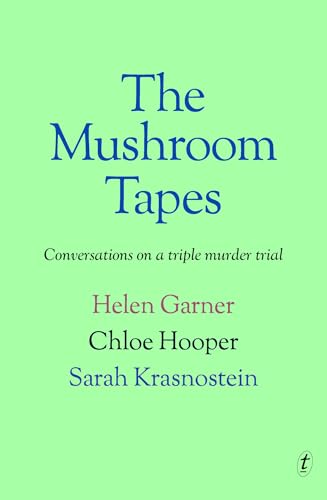
Helen Garner and Sarah Krasnostein in conversation with Beejay Silcox

Last night’s ANU/Meet-the-Author event was a sold-out affair, in a 500-seat theatre. And why not? Helen Garner, Chloe Hooper, and Sarah Krasnostein are among Australia’s top writers of narrative nonfiction, and they have just produced a book about the Leongatha mushroom murders. Indeed, it’s only because they have written about it that I am interested in reading about this case. Of course I knew about it, but I didn’t follow it intensely because these tragic criminal cases that capture the public’s attention so often become unedifying spectacles in which emotion overtakes reason in much of the public discourse. And I don’t want to go there.

As always, Colin Steele did the introductions, including explaining that Chloe Hooper had had to pull out due to her young son being sick. He referenced Jen Webb’s recent article on The mushroom tapes in The Conversation, and quoted her statement that “If I were asked to pick three people to write about this dramatic, yet banal, crime story, I’d choose them”. Yes! He then handed the floor over to Beejay Silcox.

The conversation

I was disappointed not to see Chloe Hooper because I have seen Helen and Sarah in action before, and because Kate (booksaremyfavouriteandbest) loved the event she attended with the three of them. So, Chloe’s absence created a significant hole, but Helen and Sarah filled it wonderfully – and graciously. They were open, thoughtful, and, as Kate found, still discovering new things to talk about.

Beejay started by quoting Janet Malcolm, who, she clearly knows, is a favourite of Garner’s. Malcom has argued that what journalists do is “morally indefensible” because of the way they draw in and then report on their subjects. But, continued Beejay, good journalists will overcome this risk by not rushing in, by, I think she said, applying “a tilt” to the way they look at things. And these writers are “masters of the tilt”.

On working together

The conversation covered the sorts of things you would expect for a book like this, including our complicity as readers/spectators, why this case, the need to resist easy answers, their process, their thoughts on the trial, and where the trust in each other had come in.

Sarah noted that there is no division between Helen’s work and her person, which of course is what so many of us love about her, but which has also brought her criticism. They all respected each other – not surprisingly – so had no doubts about each other’s personal processes. Helen said they were like people who had been in and survived a car crash. They were friends for life now.

Beejay referred to the fact that each had shared what their opening line would have been had they written the book alone (though they wouldn’t have, they said). Their lines (pp. 4-5) capture something about their individual approaches. Helen’s, which plays on lines by Sir Walter Scott, sounds baroque, Shakespearean. It speaks of empathy and the question of where is the line that an ordinary person crosses to commit such a crime. Chloe’s is more sociological (as in, what in society created this), while Sarah’s is more legal. As Sarah said, each had her own tone and vibe, her own interest in what they were observing.

Sarah commented on how the case had “asserted itself into public discourse with velocity”.

There was more talk about how and why they decided to write this book. They admitted to bristling at the assumption from others that it was “their story”. They found the sensationalism repellent. (In a humorous interaction, Helen dobbed Sarah and Chloe in as readers of the Daily Mail, which she eschews, but didn’t mind their passing on its news!)

It was an exhausting process, given the trial lasted 10 weeks. Helen talked of how you cope with something like this, on defending yourself against awfulness and pain of the trial, how the mind turns off. They noticed early that the journalists had formed a gang, presumably their way of coping. Beejay suggested that humour is another way, and that Helen provided some of the book’s comic relief.

On the court – and their approach to understanding it

The court is a workplace, said Sarah, so alongside extraordinary grief and distress are all the administrative aspects, such as when to have lunch, managing a juror needing a toilet break. They shared examples of humour and drama in the witness box. Sarah described their work as an “ethnography of a micro-world”, one in which they tried to capture the humanity of court.

Observing that their book is more about watching, than about the judgement, Beejay asked what was important to see, that we normally wouldn’t. Helen’s answer came quickly. It was distress and suffering. You see the survivors. Helen said they dreaded people thinking they were taking suffering lightly. Sarah agreed, adding that one of the heaviest things is that this is not a story of exceptionalism but more of “there but for the grace of god …”

They talked about emotions versus the banality, the quotidian details, such as, for Helen, Erin’s toe in the hiking sandals she would wear. She commented on being nearly undone by the domestic nature of it all, such as survivor Ian talking about having “a nice bowl of porridge” in the morning with his wife of many years, and now she’s gone.

Beejay described the book as both spectacle and literature, and quoted Helen’s comment in it that “everything could become a metaphor here“. The discussion went roundabout here, but essentially they agreed that in a case like this, metaphor must be handled carefully. In fact, Helen suggested that the urge to get metaphorical doesn’t belong in nonfiction. Sarah shared something from documentary filmmaker Ken Burns. He said that to find a detail that stands for the whole is a gold nugget, but then realised that that detail (from his Vietnam War film) represented the piece of a man’s soul that had come at great cost – so “gold nugget” was not appropriate. So, said Sarah, you must handle metaphor carefully, as you are dealing with human meaning. Helen had never heard Sarah say this. They agreed that nonfiction deals with facts you must honour, that it is chained to reality in a certain way.

On Erin

This led to a conversation about Erin, how the public had turned her into “a character”, and how information that had come up in the pre-hearings (such as probable earlier attempts on her husband’s life) was deemed inadmissible in court because there was no evidence. This decision would enrage a family, Sarah said, but is necessary to protect the presumption of innocence. (There was humour in the conversation here because Daily Mail readers knew this information, but Helen didn’t – and had felt an idiot!)

But, who was Erin? Mostly, women kill to protect, so Sarah had gone into the hearings with this understanding, but as information came out she had to reassess her thinking.

Helen found Erin a strange person, but thought the court artists’ depiction of her as evil, witch-like, was appalling. Later, they described the way the media/the public feasted on her was a form of horror.

Sarah said that when Erin started speaking on the witness stand, she was articulate, funny, recognisable, but gradually, as she was questioned, this picture melted. It was hard to separate Erin’s self from the persona. The unpalatable parts of her personality were on display. The bad-tempered teacher-like tone she used in response to the prosecutor was a misstep. It’s a middle-class story, said Helen.

Re explaining Erin’s crossing that line into murder, Helen was surprised to find that the prosecution doesn’t have to find a motive. She doesn’t have an answer. Like most humans, Erin embodied various people, mother, crabby teacher … Sarah added that Erin is not legally insane but is a deeply disordered person, so how do you apply “order” to her? We want answers, but we can often be mysterious to ourselves. Erin is recognisable as a mother, but like many of us can also harbour a primal rage.

Q & A

On how such an intelligent, well-educated woman could think she could get away with it: Helen has a theory about murderers. They have a great desire to do it, and a fantasy about how they are going to do it, but this all stops at the lethal blow because they haven’t thought about what happens next. So, for example, Erin hadn’t concealed evidence of her ownership of the dehydrator. This was astonishing,

On ethical issues they considered during the process: There were many, including the children, the community, whether they should look at sites (like the home). Are you adding to harm or does not looking do harm too? They questioned whether they were looking out of human curiosity, were they just perving? Sarah said that Helen has a view about “utility”. Courts are public, so we should understand them, we should ask questions about what they are doing. Hannah Arrendt described such crimes or behaviour as “a rent in the social fabric”. The law is being acted in our name, so we have duty to know what the law is doing. Part of the “utility” is to add complexity to our understanding, to show that the law, and these cases, are not simple.

On the role of gender in how the case played out publicly: Gender absolutely played a role. Had the crime been committed by a man it would not have held the public’s attention for so long. This was a middle class mum, set around something domestic, the serving of a meal. Her behaviour was a violent inversion of a major archetype of what women are. The gleeful mocking tone employed by some commentators was an insult to victims. (And reminiscent of how Lindy Chamberlain was “feasted upon”.)

Finally…

Beejay described the book as “a love letter to doubt”, to which Helen responded that she is a fan of ambivalence. Yes! She is not the god of all knowing consciousness; she wants readers to be there, questioning along with her. Doubt comes in different forms. At times, Helen and Sarah would be sentimental and mushy, while Chloe would remonstrate, “Guys, she’s planning to poison them”. They agreed that their essential subject matter was the preservation of doubt

Beejay concluded by asking them what they wished we all knew or felt. Sarah named the mockery, caricature, parody that was applied to the case. Why do people do this? These are people’s lives, and it affected a family and an entire community. Helen agreed, adding that “you want to preserve the tenderness in the story”. The old people who died kept disappearing from the story, but they were plain country people with faces of kindness, people who had helped Erin in need (which she recognised).

So, another excellent conversation with some meaningful takeaways encompassing how we respond to crimes like this, how we value writers who bring them to us in a considered thoughtful way, and how doubt and acknowledging complexity should be our mantras.

ANU/The Canberra Times Meet the Author
MC: Colin Steele
Lowitja O’Donoghue Cultural Centre, Australian National University
19 November 2025
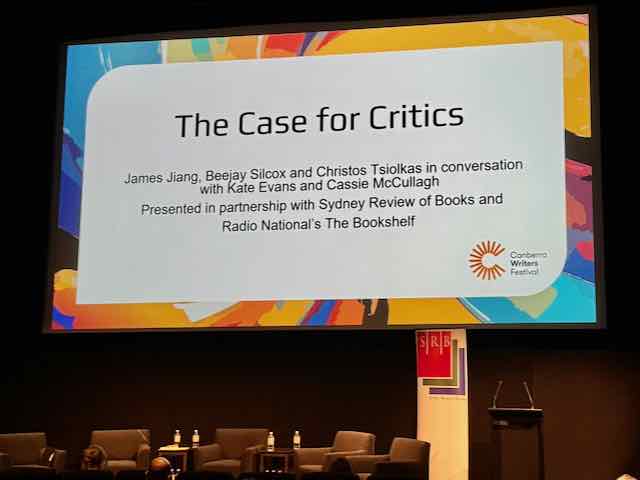
Canberra Writers Festival 2024: 6, The case for critics

Presented in partnership with Sydney Review of Books and Radio National’s The Bookshelf 

This was my final session of the festival, and it felt the perfect choice after five sessions focussing on authors and their novels. The program described it this way:

Derided, disparaged and cursed to the heavens, book critics are depicted as literature’s grand villains – as frustrated creators and gleeful wreckers. But what do critics really do? And why are they necessary for a healthy literary ecosystem? James Jiang, Beejay Silcox and Christos Tsiolkas – a trio of Aussie critics – make the case for criticism. In conversation with Kate Evans and Cassie McCullagh (recorded for Radio National’s The Bookshelf).

Again there was no Q&A, because it was being recorded.

The session was conducted jointly by Kate Evans and Cassie McCullagh though the participants didn’t need much guidance as this was a topic they cared deeply about.

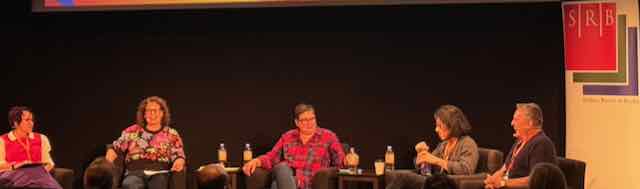
Cassie did the acknowledgment of country. The participants were introduced – author Christos Tsiolkas (who has appeared several times on my blog), Editor of the Sydney Review of Books James Jiang, and critic and Canberra Writers Festival Artistic Director Beejay Silcox. Then the discussion commenced. I considered using my usual headings approach but the discussion was so engaged and free flowing, that I decided breaking it up would lose some of the connections. So, I’ve bolded a few ideas here and there as a guide. And, I’ve put my own reflections in parentheses.

Kate leapt right with a question to Beejay about what happens when she “sees the whites of the eyes” of someone she has critiqued. This indeed had happened, Beejay responded, as she had loved one book by Christos and not another! But, if she can’t be honest she shouldn’t be doing the job. She doesn’t feel uncomfortable facing people if she has done her job properly, thoughtfully, respectfully.

Christos admitted that it can be difficult to receive criticism, but he also writes criticism. However, it’s film criticism, because as an Australian novelist he feels he can’t be objective about other Australian novelists. He has critiqued novelists no longer with us, such as Patrick White.

Beejay had been writing criticism out of Australia for seven years before she appeared on the scene, so she didn’t have that issue of being known. (In fact, some thought her name was a pseudonym being used by an author, and Christos was one of the suggestions for that author!)

James, who is ex-academia, believes reviewing living authors offers a “massive opportunity” because you can guide the development of the art into the future. Critical thought, in other words, gets sucked up into the culture at large.

Kate and Cassie, who use reviewers on their radio program, were interested in how you choose who reviews what. Debut authors can sometimes want to make a name for themselves and, for example, love to attack the sacred cows. So, their practice is to give these authors books from other countries to review. They are also conscious of hidden agendas they’d like to avoid, like friends or lovers who had fallen out! (I suspect that working for a national broadcaster that people love to criticise requires a different mindset.)

James, on the other hand, doesn’t mind a gung-ho critic. But he feels that increasingly in Australian letters there is the official story and the backroom chat, with the latter often not appearing in social media. He would like transparency, and wants these informal ideas to make their way into formal criticism.

Christos took this idea up, arguing that criticism is a conversation, an argument, but he likes to know the perspective of the critic, where they are coming from. He thinks Australians are scared of having the debate. He also thinks that to be a good reviewer you need to be a good writer. This came up a few times through the discussion, the idea that good criticism is a work in its own right.

Picking up the idea that Australians are scared of the debate, Beejay suggested that we are a comfortable country but criticism is inherently uncomfortable. She’s been told she is brave, but she’s not. She knows what bravery is and it’s not her. Rather, she is being honest. She worries for our culture if what she does is seen as “brave”. Criticism should open doors, but it is often mistaken for closing things down. (Thinking about bravery versus honesty, I wonder if it’s more about confidence. Confidence in what you think, confidence that you can present it clearly, and confidence that you can defend it.)

Christos talked about loving the American film critic Pauline Kael. She starts by asking what is the work doing, and how is it doing it. But, she has criticised – negatively – films that he loves. So, immediately he is in a conversation with her about why he loves the work, perhaps even despite her criticisms.

Writing schools, Christos said, should teach criticism and how to deal with criticism, because there is a sting to a critical review. He quoted Hemingway’s advice to young writers – don’t compare yourself to the present because you don’t know what will hold, compare yourself to the past. (This is probably good advice for critics too! So many works we read now won’t hold, for reasons that, admittedly, aren’t always due to quality.)

At this point, Kate asked what is good criticism. For her it is not about guiding her on whether to read a book or not. In fact, she said, let’s define criticism!

James suggested that criticism was ultimately a form of ekphrasis. The most interesting reviews are those that “recreate the object of scrutiny”, that “conjure the object”, for the reader. In other words, criticism explores the work itself rather than whether it is better or worse than some other work. So, probed Cassie, it’s not about evaluation but context? Not in a discrete way, James said, but you are evaluating all along. Every process of description contains evaluation. But it’s not plonking some assessment at the beginning or end. (I wrote YES! here, because I often worry that I don’t pronounce enough on my feelings about a book. Today’s session has encouraged me to continue with my preference for trying to work out what a book is doing, rather than focusing on whether I like it.)

Christos suggested that the best way to show you care about the art is to ask why it doesn’t work.

Kate then got to the nub of the word “criticism” which people tend to understand as something negative rather than something more analytical. Beejay took this up, saying that people want to ask about the negative, the “bloody”, but she also looks for awe. It’s about opening a book and being prepared to be drawn in, of watching a mind at work. (This is what most intrigues me when I’m reading: What is the mind behind this doing? Where is it going? Why is it doing this?) Her greatest fear is that she will lose the capacity for awe, to be amazed.

Christos said that it can be hard to write about what gives you the awe. (It can be hard to write about the opposite too, though, methinks?) Beejay suggested that the best critics bring doubt, not certainty. They offer “a (their) theory” about the work.

Christos talked about having trust in the critic (and he gave an example of a music critic he trusts, who works in an area he knows little about).

Asked about bringing in expertise, James made the interesting statement that he wants to estrange experts from their expertise. He talked about the difficulties of public writing – and used The Conversation as an example. Experts tend to dilute their writing for the public so that it ends up being “high advertising” for the university. He wants to get away from that. Good public writing might change the style – from academic – to make it interesting, to engage the reader, but shouldn’t dilute the content. SRB will accept essays from 3000 to 10000 words. He gave the example of a 10000-word essay by a poet on the poetics of videogames. There was a mismatch between the subject (video games) and perspective (a poet) but the the result was something good.

On this expertise issue, Beejay commented that many feel they need to have read everything relevant to be able to comment, but she doesn’t believe that’s so. Christos suggested it was partly generational, and came out of the post-modern era. He had to wash it all off when he left university. (I understand this.)

Beejay on the other hand was a lawyer, not an academic. She left the law, and thought academia was solipsistic, not willing to have conversation. She found criticism by accident. Books saved her life, and now she’s giving back to them. She’s jaded about academia.

James, however, grew up with working class parents, and was looking for where he could go to have the conversations he wanted. He found it in an English seminar. The classroom environment taught him to edit his own writing. (Kate commented that Michelle de Kretser’s latest novel, Theory and practice, feeds well into this discussion.)

The conversation then moved on to the focus on the latest thing, and how to not be “just recent”. Christos said the best festival panels for him are those where they discuss influences and books loved. We need to find space for this because there is the danger that some of what we focus on is just fashion, and that we are being influenced by the language around us. He wishes there were more spaces for reflective pieces. (Being involved in the Australian Women Writers blog, and a Jane Austen group, I don’t disagree with any of this!)

Beejay loves reading favourite writers on how they became who they are. She criticises Australia because she loves it, but we are anglophone and protestant. We have an incredible critical legacy and we forget it. Rodney Hall, for example, has a large body of work but only one book, besides his latest, can be bought in bookshops. Critics can keep older work alive, and the more alive our discourse, the more alive our culture.

Christos agreed, and talked about a community radio session that focuses on the things we love. (The damage done by academia is that there’s no love.)

Cassie wondered about pulling punches, and talked about being told to pull one. Beejay had never pulled punches, but she knows which punches she wants to make. James offered a different angle, suggesting that some things are interestingly bad, whereas others can be good but dull. There’s much good but dull publishing he suggested. Christos talked about being told he should have pulled a punch when reviewing a promising young woman because what she was doing was important. What he’d written was “fair but not right”!

Returning, it seemed, to the idea of evaluation, Kate grapples with “stars”. She’s not good with binaries, but if you’re not binary, are you being nuanced or wishy-washy. (I feel her pain!) Beejay suggested that how she feels is almost irrelevant to the reader, it’s how she thinks that’s important. Feeling can impact thinking, but she has written positive reviews about things she didn’t care for.

Cassie then asked about spoilers. For Christos, to do justice to a work, to get to a conversation about it, he assumes you are interested in the whole, in how it works. James gave the example of classical tragedies. We all know how they are going to end. But then, he said, he is more of a voice and style rather than a plot person. (Yes!) Criticism is an ethical activity, and you need to be brave about owning your idea. (I think I might have missed how this related to spoilers.) Beejay talked about having the trust of her reader and working out when to share what. Criticism is the tip of the iceberg. There is a lot of effort and care beneath it. (This discussion of spoilers missed a significant point that wasn’t addressed at all during the discussion which is whether there is a different between Review and Criticism. I feel there is, and that in reviews spoilers are generally not what readers want, whereas with criticism it’s as Christos said, it’s about the whole and you can’t do that without talking about the end.)

And that was that … have you made it to the end? If so, do you have any thoughts to share?

Canberra Writers Festival, 2024
The case for critics
The Arc Theatre, NFSA
Sunday 27 October 2024, 12-1pm

Canberra Writers Festival 2023: 1, Canberra’s Biggest Book Club

A preamble

The Canberra Writers Festival is back in 2023, with a new Artistic Director, the writer and critic Beejay Silcox. The Festival’s theme continues to be “Power Politics Passion”, which, for this year’s Festival organisers,

begs big questions: What do we value? Whose stories are heard? How do we reckon with the past and imagine the future? It is our hope that CWF will provide a space to explore these questions, and to celebrate the heft and craft of Australian storytellers — a joyful collision of art-makers, big thinkers, big dreamers and readers.

I love the look of this year’s Festival program. It feels more diverse and more literary, without losing the political flavour that makes it uniquely Canberran.

Canberra’s Biggest Book Club

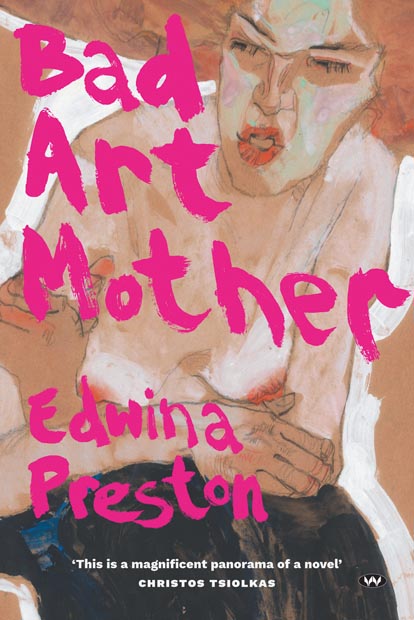
Canberra’s Biggest Book Club has been a regular Festival session, but I’ve not attended before, for various reasons, mainly to do with scheduling and location. This year, however, the stars aligned, including the fact that the featured book, Edwina Preston’s Bad art mother (my post), was one I’d read and was keen to see discussed.

The panel leading the “club” comprised Beejay Silcox, ABC’s The Bookshelf’s Kate Evans, and the author. The promotion for the session says:

There’s so much to unpick in this Stella Prize-shortlisted novel. Who gets to be an art-maker? At what cost? Whose artistic voices are valued, and whose are lost? These questions are as relevant today as they were half a century ago. That’s what makes this novel so vital and beguiling.

Because the session was framed as a “bookclub”, the format was that during the hour audience members could write questions on a piece of paper which would be collected by volunteers and handed to Beejay for inserting at intervals into the discussion.

Evans started by asking Preston for her “stuck in a lift” pitch for her book. Preston replied she wasn’t good at that but offered that it was about a female poet in the 60s coping with motherhood and a sexist culture.

Evans then asked Silcox, who had been chair of the Stella Prize panel that shortlisted this book, why this was the book she wanted us all to read. Silcox replied that the Stella books provide a core sample of the culture we are in right now, of the things we are thinking about. Bad art mother she said had urgency, and spoke to the collective history female Australian writers share. It was a YES on all levels for her – as a reader, critic and judge. I realised at this point that I like the way this woman thinks.

Evans then spoke to the point that this book had been rejected 25 times, and asked why. Preston said many reasons were offered such as it didn’t fit the “publishing cycle” (whatever that means), was likely to be commercially successful, didn’t like the voice of the child, not feminist enough …

This led to Evans to ask about her choosing a child’s voice. Preston said she had been thinking about Joy Hester and her son, and the idea of a parent giving up a child. The novel is not Sweeney’s story, but was inspired by that situation. She also thought later that a boy’s voice might offer an entry point for male readers. It also offered an opportunity to explore the sensitivity and vulnerability of male children. Silcox added that the use of the child’s point of view also provided an opportunity to explore different versions of mothering or parenting, through Owen’s perspective on all the people in his life. It’s a bit about urban family-making.

Next Evans moved to protagonist Veda’s antecedents, which included the Australian poet Gwen Harwood, whose letters Preston had read. This resulted in a fascinating discussion about Gwen Harwood, about women’s lives as artists, and about the role of correspondence in women’s lives. Preston talked about Harwood’s life, including the F*** ALL EDITORS acrostic poem scandal. Silcox talked about reading Harwood at school but knowing nothing about her radical side – and wishing she had. Harwood’s letters, we learnt, were brilliant, funny, scathing. She had a fighting, pioneer spirit, but she was also grounded by her children. Sometime around here, Harwood’s pointed poem “In the park“, was shared, including its last line, “They have eaten me alive”!

Preston talked about the challenges of being a woman artist and a mother. Veda feels she’s a bad mother while her son cuts her more slack. In Modjeska’s book Stravinsky’s lunch, said Preston, the artist Grace Cossington-Smith says that once her children left home, she had all the time but the urgency had gone. Veda faces a similar challenge when she has a weekend to herself.

Regarding her own time-management, Preston said she works best by writing in 1.5 hour blocks a few times a week. Working in short blocks means she always leaves something to work on next session. At this point we got an Audience Question, which was what surprised her most about her book. What an interesting questio. Preston’s response was not what I expected: she saw what her subconscious had created, how things she hadn’t explicitly planned had made the book work. This gave her confidence in her process. When asked for an example, she said introducing vegetarianism had opening up opportunities, like aligning meat-eating with masculine world views.

Another Audience Question concerned whose styles she admired. Preston had to think, but did say they included Jane Austen, George Eliot, Virginia Woolf and Elizabeth Harrower.

This provided a perfect segue to return to the idea of women creators, and a discussion that resonated with me. Do women, Silcox asked, need a room of their own? Preston talked about her PhD and her interest in women’s correspondence, which women tend to write in communal spaces. She contests the “room-of-one’s-own” myth. It’s a western, masculine view of art, she says. Interruptions are not a bad thing. Veda, however, subscribes to this “selfish artist” myth – as does Simone de Beauvoir. However, Preston asked, would de Beauvoir and Woolf have thought the same way had they had children? As someone who works happily in communal spaces, but has always worried about letting the sisterhood down, this spoke to me.

The panel then segued to the myth of genius, the sense that successful artists must be geniuses. Harwood was strong, but Veda is less strong, less sure, and destroyed herself. Silcox said that it was important to undermine these myths because it is hard enough “to carve a life on the page” in Australia without feeling you have to live up to these unrealistic ideas.

Evans then asked about Mr Parish, the man everyone loves to hate. Preston’s response was illuminating. He’s an archetype at the beginning, an early 20th century literary character, she said, but by the end he’s a human with fragilities and redeeming qualities.

Evans followed this by asking what the other women characters brought to the novel besides their art. They represent, was the answer, different relationships to art, and different family roles. These include the “I don’t have a creative bone in my body” Ornella who is not an artist, but is the most reliable person in the novel. All these women examine the themes from different perspectives. Silcox added that they offered “a polyphonic version of women”. She talked about the cages around us and finding ways to unlock them, about how you have to map the cage before you can break out of it. The book is so relevant, so resonant.

At this point another audience question was shared. Referencing Veda’s letters to her sister, it asked why women are so self-critical. Self-criticism is good for an artist, answered Preston.

Evans returned to the correspondence in the novel which offers a different more intimate voice. Preston talked about the role of correspondence in women’s lives, and how correspondence offers writing practice. Unlike diary writing, it involves considering the recipient, and providing details not always necessary in a diary. The letters in the novel are also, added Silcox, one-sided, which invites us to step in and wonder what Veda’s sister might have said (and how Veda might have responded to that). Good point, I certainly remember thinking about how Tilde might have responded.

The next audience question concerned the fact that all the women artists in the novel end up being successful. Had Preston considered including an unsuccessful artist. She hadn’t thought of this, she said, but the artists were, in fact, all successful later in life, and in Veda’s case, after her death.

This led to a discussion about ambition in women, and how it tends to be used pejoratively, as an insult.

Then there was an audience question about not liking Veda. Preston wondered if readers would like her. This didn’t concern her, but she knew it would be an issue for some. Silcox threw in that women being likable is another of those issues women have to deal with.

Evans, referencing a previous comment by Preston, asked her why she knew Veda had to die. Her answer was that the book needed to be a tragedy, though she also wanted to resuscitate Veda posthumously. The novel couldn’t be triumphantly feminist because everything isn’t fantastic.

This led to a discussion about Veda’s action that precipitated her downfall, and about her husband, the restaurateur and philanthropist. Again, Preston’s response was fascinating. She commented that men taking on cooking (like celebrity chefs) and public philanthropy results in their being celebrated for the things – cooking and caring – that women do invisibly.

Evans then quoted from the letter to Tilde in which Veda ponders what sort of mother she is, and whether if it came to the crunch she would sacrifice her art for her child. Is this question – Would I? – the heart of the book, she asked. Preston talked about 19th century women novelists discussing the writing-versus-babies quandary, and the “menopausal theory literary production”. She doesn’t agree it’s either-or. You can do both together, but it is a real quandary many women artists grapple with.

Finally, Silcox asked Preston to think about the writer she was before and after the book. What had it taught her? To trust herself, she said, and the workings of serendipity in her writing. What a great lesson.

And so ended another excellent writers’ festival session. I loved it for the number of ideas that went in different directions to those I expected, like the room-of-one’s-own discussion. Good stuff.

Canberra Writers Festival, 2023
Canberra’s Biggest Book Club
Saturday 19 August 2023, 2-3 pm