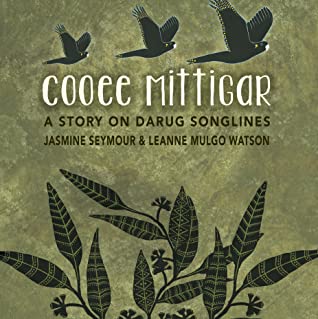
Jasmine Seymour and Leanne Mulgo Watson, Cooee mittigar: A story on Darug songlines (#BookReview)

Recently, on a bit of a whim, I bought two books from the Indigenous Australian publishing company, Magabala Books. They were the younger readers-young adult novel, Black Cockatoo (my review), which had been shortlisted for a few awards, and this picture book, Cooee mittigar, which had just won the 2020 Prime Minister’s Literary Award for Children’s Fiction. It is described on the Awards website as “introducing children and adults-alike to Darug ‘Nura’ (Country) and language”. So, a book for children and adults. I’m in …

The book tells the story of the seasons*, as understood or experienced by Sydney’s Darug people, through the eyes of the black swan, Mulgo. It is a perfect example of the generosity of Indigenous Australians. Despite being dispossessed of their country, despite being repeatedly discounted as having anything important to contribute, despite being overlooked or specifically excepted by policy-makers, they come back again and again, willing to share their knowledge – and, particularly, their language – when there’s a real risk that it too might be taken from them. They seem to understand, when so many don’t, that it’s only by sharing and communicating with each other our values and belief systems that we can mature as a nation.

And so, we have this beautiful hardback, written and illustrated by two Darug women, Jasmine Seymour and Leanne Mulgo Watson. Like many recent books I’ve read by Indigenous Australian writers, it incorporates Indigenous – Darug here, of course – language into the story. The technique they use is, in two-page spreads, to tell the story using English and Darug words, immmediately followed (on the same spread) by a glossary for the Darug words used. So, for example, we have:

In the time of yuruka and burara
Elders tell us not to hunt the buru.

yuruku – hot
burara – dry
buru – kangaroo

The glossary words are presented in slightly smaller but still clear text. The illustrations for the page, as you’d expect in a picture book, help convey the meaning. This spread, for example, is dominated by hot-dry looking yellows and tans, with two kangaroos lazing in the grass.

But now, let’s go back to the beginning. The book starts with a welcome: “Warami mittigar. Welcome friend. … Cooee mittigar. Come here friend.” We are then introduced to our guide, the afore-mentioned black swan, Mulgo, who tells us that she will teach us “about Darug life” – and off we go, starting, logically, with an introduction to Biami (dreaming ancestor spirit) and the idea of Darug dreaming and the songlines which tell the story of “Nura” or country. From here, we move through the seasons, starting when the “the darrabura [day] grows long and the weather warms up”. Each step of the way, we are told what to look for, what might be happening, what we can do, with respect to country and the natural environment, such as:

During dagara, gulgadya will bloom –
ready to be turned into spears.

dagara – frost
gulgadya – grasstree

The story ends with the gentle request to “tread softly on our lands”.

The language flows simply – though, as a non-indigenous reader, I’m sure it would take me a few readings to feel comfortable enough with the words to make it sound good aloud. Leanne Mulgo Watson’s illustrations draw mostly from greens, blues and yellows, but with touches of other hues. They are gorgeously evocative of the text, making them a delight for all readers, but they also provide good opportunities for actively engaging younger readers (and listeners).

At the end of the book is a complete glossary of the Darug words used throughout, with a simple pronunciation guide, which is a feature I’ve missed in other books. So, for example, there’s “warami – wara me – hello”. There is also a one-page description of Darug Country, and another page providing brief bios of Seymour and Watson.

Cooee mittigar concludes with a statement of its creators’ intentions, which are “to share Darug language and culture and show that the Darug people are still strong on Country”. They also “hope that Cooee mittigar will contribute to the continuation of stories and culture”. I’d be surprised if they haven’t achieved this, but I hope that in publishing this post I will have made my contribution to supporting their goals.
Challenge logo

Jasmine Seymour and Leanne Mulgo Watson (illus.)
Cooee mittigar: A story on Darug songlines
Broome: Magabala Books, 2019
48pp.
ISBN: 9781925936865

* As many Australians know, Indigenous Australians do not see the year through “our” four-season calendar, but through different seasons depending on the country.
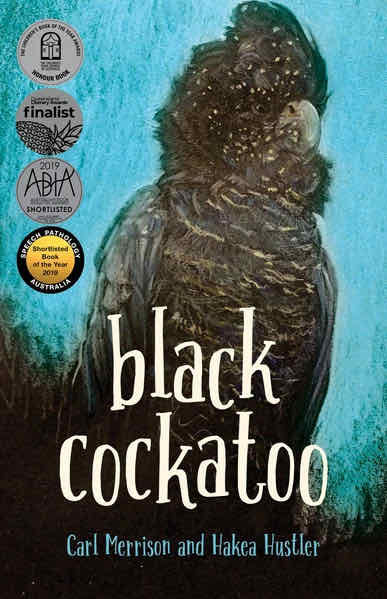
Carl Merrison and Hakea Hustler, Black cockatoo (#BookReview)

Black cockatoo is a young adult novel written by Indigenous Australian author, Carl Merrison, and his non-Indigenous collaborator, Hakea Hustler, and illustrated by Indigenous Australian illustrator, Dub Leffler. It is a beautiful, little (in size, not value) book that made quite a splash when it was published. It was shortlisted for several children’s literature awards in 2019, including those by the Children’s Book Council of Australia, Readings, the Australian Book Industry Association, and the Queensland Literary Awards. However, it is not the sort of book that I would normally post on here, so I plan to keep this review short.

I say this for a few reasons. For a start, children’s and young adult literature are not my main interest, though I do occasionally make exceptions, as I am making here. My main reason, however, is that not only am I not the typical age demographic for this book, but I am also the wrong cultural demographic, which makes me two steps removed from its target audience. But, I ordered this book from Magabala because I was intrigued about what was being written for young Indigenous readers, and it is on that basis that I’m posting on the book.

The story is set in a remote community in Australia’s Kimberley region, and focuses on 13-year-old Mia. She is disturbed to see her 15-year-old brother, Jy, becoming increasingly alienated from his community and culture, but feels powerless to do anything about it. In the book’s first chapter she rescues a young black cockatoo (dirrarn) which had been injured by Jy who had been target practising with his shanghai. The dirrarn is her totem animal.

What makes this book interesting for someone like me to read is the way it conveys the issues that I, an outsider, am aware of through my reading. One of these is the issue of family breakdown in Indigenous communities. Mia and her brother are being raised by their mother and grandparents, and haven’t seen their father or his family for many years. It’s clear that this is a tough gig for the grandparents. Mia overhears her grandfather (her jawiji) tell her grandmother that he’s “just tired”, and that:

I’m not sure I have it in me to teach him the right ways anymore. He’s just so headstrong.

In one way, of course, Jy is a typical teenager – stubborn and defiant – but concern about this behaviour is magnified in Indigenous communities where disconnection from culture can leave young people, young men in particular, highly vulnerable. In this story, the grandparents, like many in Indigenous communities, do their best to inculcate knowledge of and respect for culture, while also supporting their grandchildren’s need to make their way in a world they don’t know themselves.

This brings me to the main subject of this story, Mia. Her angst stems not only from her concern about her brother, but from having to make a decision about whether to take up her place at “a fancy school down south”. She’s confronting that conundrum faced by young Indigenous people that I’ve also gleaned through my reading, the challenge of straddling two cultures. There is a lovely sense here of Mia being supported and encouraged by her family, but also of her having some agency in what she does:

“You live in both worlds,” her grandmother added. “You will be strong in both ways.”

Black cockatoo is a short story but Merrison and Hustler pack a lot in here about the warmth and humour within extended Indigenous families, which lightens the more serious concerns they confront. The tone is not heavy, which is appropriate given the aim of this book being presumably to support young Indigenous people in making good choices rather than to demoralise them with the challenges they face!

The book is illustrated by Dub Leffler, with stylish, sometimes realistic sometimes more subtle, black-and-white images opening each chapter. Words from Jaru language are lightly scattered through the text:

It had been a proper long barranga dry weather, so to hunt we didn’t have to travel far to find big fat bin.girrjaru bush turkey.

There are two small glossaries at the end, one of Jaru words, and the other of Aboriginal English/Kriol words, that are used in the text.

While not all issues are resolved by the end, as you would expect, the novel’s conclusion, as you would also expect, is positive, with Mia coming to realise both her own inner strength and that she has the ongoing support of family and culture. It’s a good message in an accessible book, it seems to me, but the real proof is whether it works for its target readers, and that, of course, I don’t know.

Challenge logo

Carl Merrison and Hakea Hustler
Dub Leffler (illus.)
Black cockatoo
Broome: Magabala Books, 2018
62pp.
ISBN: 9781925360707

Angela Savage, Mother of Pearl (#BookReview)

Book cover

Having commented in my Reading Highlights post about how little self-directed reading I did last year, I decided to start the year with just that, before returning to the Review TBR pile. What to choose? Many books jostled for attention, but in the end I chose Angela Savage’s novel Mother of Pearl because I felt it would be a warm-hearted but meaty read, just right for this time of year. I was right.

Let’s start with the meaty first. The subject matter is commercial surrogacy, in Thailand specifically. This surrogacy involving “farang” couples was banned in Thailand during the writing of this book, but that doesn’t invalidate it. Many novels have been written about behaviours, cultures, practices that have changed or disappeared – and, anyhow, commercial surrogacy still exists in various forms in different countries around the world. So, on many fronts, both contemporary and historical, Mother of Pearl has much to offer.

And what it offers is a sensitive portrayal of a very complex issue. On the surface, the novel is about a childless Australian couple paying a poor Thai woman to carry “their” baby (created using the husband’s sperm and a donor egg) but, as Savage wrote on novelist Amanda Curtin’s blog*, what specifically interested her were “the political, ethical, cultural and emotional aspects of overseas surrogacy”. This, of course, makes the book sound very much like an “issues” novel, and it is. However, Savage, who is an experienced and award-winning crime writer – I have reviewed her novel, The dying beach – has written a novel that shows not tells, that is in no way didactic, that explores the “issue” from multiple angles without moralising.

How does she do this? Partly by creating well-rounded and engaging characters, which include Meg (the would-be mother), her sister Anna (an experienced Southeast Asian aid worker), and surrogate mother Mod. There are others, including Meg’s husband Nate. The novel starts in 1998 with Mod who is, then, a 16-year-old girl. We learn of the role of temple culture in her life, and we hear her “fortune” told which says that her “good luck will be earned, not won”. The novel then jumps ten years and we are introduced to forty-year-old Anna, recently returned from Cambodia, and her 14-months-younger sister Meg who has, ostensibly, given up the idea of having a child after years of trying, including gruelling IVF rounds. However, at Anna’s place, she meets a gay couple with a child born to a Thai surrogate mother, and the seed is sown.

Who are the winners, who are the losers (Anna, paraphrased)

From here, the novel, like many modern novels, switches perspectives, primarily between Mod, Anna and Meg, to explore the emotions and motivations, the practice and legalities of commercial surrogacy, and the cultural implications in Thailand. Anna – who is experienced in Thai culture and, let us say, the “disinterested” party – is our main guide through all this. She is, I’d say, our voice, because she is the one concerned about the exploitative aspects of this surrogacy. However, she comes to see that it’s a little more complex than would appear on the surface. This is not to argue that such surrogacy is a good thing, but that neither is it a black-and-white issue.

I particularly liked the way Savage explored the different motivations of surrogate mothers through Mod’s spending time with other surrogates and potential surrogates. We learn not only of the need for money, but of factors like the desire to earn Buddhist merit and the exploitation of young Thai women by their boyfriends and fathers. Exploitation, we realise, is a complex beast.

So, the novel is meaty because it does tease out many of those “political, ethical, cultural and emotional” factors that Savage intended to do. Meg’s single-minded focus on having a child, and the pressure this creates on others, is quietly interrogated. Aid-worker Anna’s discomfort with the exploitativeness of commercial surrogacy is teased out, as she faces reassessing “the moral high ground, where she’d once felt so at home”. The financial, cultural and emotional implications for Mod are also genuinely explored.

However, the novel is also warm-hearted because it is non-judgemental. Our main characters aren’t perfect. Meg and Anna, in particular, have their sisterly squabbles, tensions and fallings-out, but their disagreements aren’t bitter, and they both “put their foot in it” at times. More importantly, though, Savage leaves it to the reader to consider the issues and decide where we stand, and why.

Finally, underpinning all this is the writing. Mother of Pearl, which is logically divided into three parts – Preconception, Gestation, Afterbirth – is an accessible novel. The alternating perspectives are easy to follow, the pacing is good, and the writing flows well. There are some perfect descriptions, like

Anna recoiled like a sea anemone poked with a stick. She was fixed to the rock face; everything moved around her.

but they are not overdone in a novel for which the narrative is the driving force. I was concerned for a while that Meg and Nate were too good to be true, given the stresses they’d been under for years, but Savage injected enough little cracks to reassure me that they hadn’t stepped out of a romance novel. Finally, there’s the perfectly apposite pearl motif, which is also handled with a light touch.

Mother of Pearl, then, respects the complexity of its “issue” without becoming polemical. In so doing, it discourages judgement where compassion should prevail, and yet is clear-eyed about the realities that make surrogacy so problematical. A good choice for my first book of 2021.

Lisa (ANZLitLovers) also appreciated this book.

Challenge logo

Angela Savage
Mother of Pearl
Transit Lounge, 2019
318pp.
ISBN: 9781925760354

* Thanks to Lisa for providing the link to this post.

Monday musings on Australian literature: Australian Women Writers Challenge 2020

AWW Challenge 2019 Badge

Once again I am devoting my last Monday Musings of the year to the Australian Women Writers Challenge*. Last year in my opening paragraph, I wrote that I loved the sound of 2020 – and I wished you all a wonderful year to come in whatever form you would like that to take. My, oh my, little did we expect what was going to eventuate (which for me included a personal loss in addition to the impacts of the pandemic and other catastrophes). I no longer like the sound of 2020, and fervently hope 2021 turns out much better for us all. And so, may you all have a positive and fulfilling 2021.

Now, the challenge … it has continued to go very well. The full database now contains reviews for nearly 7,000 books across all forms and genres, from all periods, of Australian women’s writing. This means that the number of books reviewed on our database increased in 2020 by 900 books, which is about the same number added as last year, or just under 15%.

My personal round-up for the year

This year, for obvious reasons, was not my best Challenge year. I posted only 26 reviews relevant to the Challenge over the year, about the same as last year which was also a strange year (but differently). I feel disappointed about all this, but such is life. Anyhow, here they are, with links to my reviews:

Fiction

Book cover

Short stories

Book cover

Anthologies/Essays

Non-fiction

Book cover

This year, fiction (including short stories) represented around 61% of my AWW challenge reading, which is a little more than last year and a bit closer to my preferred ratio. I read three Classics. Two were novels and one a memoir, and they were read for Bill’s (The Australian Legend) Gen 3 week and Lisa’s (ANZLitLovers) Thea Astley week. Thanks to Bill and Lisa for the impetus to read these books, because they added a special depth ! In terms of that problematic word “diversity”, I read two novels by Indigenous Australian women, and one translated novel by an Iranian-born Australian writer.

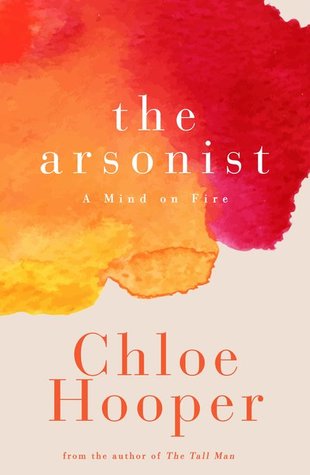
Chloe Hooper, The Arsonist

My non-fiction reading was eclectic, featuring biography and memoir of course, a work of creative or narrative nonfiction, a beautiful collaboration between an artist and a poet, and, unusually for me, also two books that could be seen to be in the self-help vein.

If you’d like to know more about the Challenge, check it out here. We are also on Facebook, Twitter (@auswomenwriters), and GoodReads. Do consider joining us. All readers are welcome.

Finally, as always, a big thanks again to Theresa, Elizabeth and the rest of the team. I (still) love being part of this challenge, partly because equating with my reading goals it is not really a challenge, and also because I enjoy working with the people involved. See you in 2021.

And so, 2021

Challenge logo

The 2021 sign up form is ready, so this is also my Sign Up post for next year. As always, I’m nominating myself for the Franklin level, which is to read 10 books by Australian women and post reviews for at least 6 of those. I expect, of course, to exceed this.

Do you plan to sign up?

* This challenge was instigated by Elizabeth Lhuede in 2012 in response to concerns in Australian literary circles about the lack of recognition for women writers. I have been one of the challenge’s volunteers since 2013. Theresa Smith (of Theresa Smith writes) now oversees the day-to-day management of the blog, but Elizabeth is still an active presence.