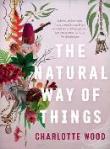
 Well, I wrote this week’s Monday musings on Australian dystopian fiction as a lead in to my review of Charlotte Wood’s award-winning The natural way of things, but I wasn’t expecting to get the perfect intro for my review! In the post’s comments, author and publisher Anna Blay pointed us to an article by Maria Popova in an online digest called Brain Pickings. The article, titled “The Power of Cautionary Questions: Neil Gaiman on Ray Bradbury’s ‘Fahrenheit 451,’ Why We Read, and How Speculative Storytelling Enlarges Our Humanity”, starts with this:
“The important thing,” Ursula K. Le Guin wrote in contemplating the cultural role of speculative fiction and the task of its writer, “is not to offer any specific hope of betterment but, by offering an imagined but persuasive alternative reality, to dislodge my mind, and so the reader’s mind, from the lazy, timorous habit of thinking that the way we live now is the only way people can live.” In doing so, she argued, imaginative storytelling can intercept the inertia of oppressive institutions, perilous social mores, and other stagnations of progress that contract our scope of the possible.
I would agree that the thing is “not to offer any specific hope of betterment” but to jolt the reader into thinking about what is, what might be, if we do nothing. It’s certainly how I’d see most dystopian fiction I’ve read, including Charlotte Wood’s novel, but not being a big reader of speculative fiction I haven’t sat down before and articulated it.
So, what is it that Charlotte Wood wants to jolt our minds about? For those of you – overseas readers at least – who haven’t read or don’t know of it, the plot tells the story of 10 women plucked from their normal lives and transported to a nightmarish place in the middle of nowhere – referencing the mythology of the forbidding Australian outback? – where they are imprisoned behind an electric fence and controlled, labour-camp style, by two boorish men, bruiser Boncer and the preening Teddy. The women pass from disbelief and anger, through resignation, to a sort of acceptance and attempt to make the best of their situation. There are shades of Margaret Atwood’s The handmaid’s tale here and also, perhaps of William Golding’s Lord of the flies, but not derivatively. This is very much its own work.
But now, back to my question. Wood’s target is misogyny, and specifically the way it plays out through the scapegoating of women for their sexuality – whether for assaults that happen to them or for sexual activities they may engage in consensually (think affair with a politician or the flight attendant in a “mile-high” situation) but for which the man is let off while the woman is excoriated. Early in the novel each girl is given a “nickname” which “explains” why they are there such as “army slut”, “cabinet minister’s moll”, “airline girl”, “cruise girl” and “football girl”. You get the picture, I’m sure. The girls are also named. Wood does respect and individualise her characters, beyond just being types. There is one other woman in the picture, and that’s Nancy. She’s on the staff with Boncer and Teddy. She dresses as a rather grotesque nurse who looks after the so-called “hospital” – and represents those enabling women who often feel special but don’t realise that they too are under control.
I came to this book ready to love it. Although I’ve avoided reading reviews, I’ve not been able to help hearing all the accolades, and it sounded like a book and topic that would be right up my alley. It is, and I “enjoyed” reading it, but I’m having trouble defining and articulating my somewhat uncertain response to it. I love the heart, I love the desire to attack an issue that’s absolutely critical, I love the overall narrative concept, I was compelled to keep reading, and I thought the ending was powerful. So, why uncertain? I’ll try to tease it out a bit.
Menace?
There are a lot of characters – the ten captive women, plus Boncer, Teddy and Nancy – though Wood focuses on two young 19-year-olds in particular, Yolanda the “football girl” and Verla “the cabinet minister’s moll”. We get more into their heads. They are analytical about their situations and plan and act in ways to improve their situations. A cautious friendship develops between them. As well as being differentiated in this way from the rest of the group, they are also differentiated from each other by two facts: Yolanda wasn’t tricked like all the others into accepting the agreement that got them to this place, while Verla, who guiltily remembers “gratefully signing the fake legal papers”, believes that her “Andrew”, the cabinet-minister, still loves her. The other women are more problematic. We don’t get to know them well, but what we do see suggests that they have not cottoned on. They focus on finding ways to groom themselves, they reject Yolanda’s feral way of managing the situation, they fall on the fancy handbags at the end and willingly follow the new man who appears. They seem to have learnt little. But, perhaps that’s also the point. They have a right to be the young women they are. See, I’m talking myself into understanding this as I go …
And then there’s the men. They are scary, certainly, and brutal, particularly in the beginning:
So she didn’t see the man’s swift, balletic leap – impossibly pretty and light across the gravel – and a leather covered baton in his hand coming whack over the side of her jaw …
The man Boncer cast an aggrieved look at them, is if they were to blame for the stick in his hand …
But pretty soon we see that they, too, are, in a way, victims of the system. They’ve been fooled it seems into being there, on promises of bonuses, and are ultimately pathetic. I certainly don’t want to excuse them – they’ve made choices. However, as the supporting system seems to fail, they start to rely on the women’s ability to keep the show going. The women realise that these men don’t know what’s happening any more either. There’s an uneasy tension between captors and captives – and with that cracks start to show in the menace, albeit some menace remains.
Natural?
The writing is good. There’s even humour, such as tempeh-loving, yoga-doing but clueless Teddy. The novel is structured by the seasons, starting in Summer, moving through Autumn and ending, appropriately, in Winter. The story is told third person, mostly focusing on Yolanda and Verla. They’re engaging, though they are also pretty slippery to fully grasp. There’s a distance that we never quite penetrate. We “see” Yolanda’s strength and Verla’s self-deception, but we don’t, I think, see “into” them.
Wood uses effective recurrent imagery or motifs, particularly smells, rabbits, horses and birds. The opening line is “So there were kookaburras here”, suggesting some sort of normality. In her interview with Annette Marfording long before this book was written, Wood discusses using kites and kite-flying to suggest “flight and escape”, and then she says “I realise I have a lot of birds”, which I assumed implies that they too suggest “flight and escape”. In The natural way of things, birds also suggest the related idea of “freedom”, but when hawks appear, we see another side, that of predator and prey. All relevant to the book.
Then there’s the irony in the title, “the natural way of things”, because there’s nothing “natural” about what the book describes. The title appears in the text once in a paragraph that occupies its own page. It’s powerful:
What would people in their old lives be saying about these girls? Would they be called missing? Would some documentary program on the ABC that nobody watched , or one of those thin newspapers nobody read, somehow connect the thread to make them a story? The Lost Girls they would be called. Would it be said, they ‘disappeared’, ‘were lost? Would it be said they were abandoned or taken, the way people said a girl was attacked, a woman was raped, this femaleness always at the centre, as if womanhood itself were the cause of all these things? As if the girls somehow, through the natural way of things, did it do themselves. They lured abduction and abandonment to themselves, they marshalled themselves into this prison where they had made their beds, and now, once more, were lying in them.
The “natural” way of things! Referring back to Ursula le Guin, I’d say that Wood has presented here a “persuasive alternative reality”. Indeed, it’s not far removed from Wood’s inspiration: the Hay Institution for Girls to which “problem” teenage girls were sent in the 1960s and 1970s, and treated with great cruelty. But, who or what is the enemy? Looking at Le Guin again, this would be “perilous social mores” (and those who uphold them) – the fact that the scapegoating of women is still “allowed” to happen. There’s (a little) more awareness now, but this behaviour is not stopping, not by a long shot. All of us, I’m sure, recognise the recent inspirations for Wood’s “girls”. Anna Krein’s Night games (my review) makes an interesting companion read.
So, where do we go from here? Dystopian novels don’t have to give answers, indeed they rarely do, they “simply” shine the light. The light Wood has shone is, though, a very complex one indeed. I think I’ll be reading this one again when my reading group does it in July.
Lisa (ANZLitLovers) has also read it and has posted her comments plus links to other reviews.
 Charlotte Wood
The natural way of things
Crows Nest: Allen & Unwin, 2015
315pp.
ISBN: 9781760111236







 Whispering Gums