Kendall’s favourite son

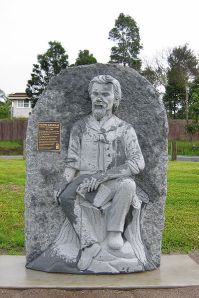
Statue of Henry Kendall, on an inclement day in Kendall, NSW

Statue of Henry Kendall, on an inclement day in Kendall, NSW

…is the Australian poet, Henry Kendall. Except, he’s not REALLY a son – he was not born there,  and he only lived there for 6 years, from 1875 to 1881, when he was New South Wales’ first Forest Inspector. But, you know the story, when you are on a good thing…! And, anyhow, as a lover of Australian literature, I’m not going to argue against naming a town after one of our favourite poets. Anything that keeps our writers front and centre is fine by me.

Henry Kendall’s most famous poem is “Bell-birds”. It’s not quite as famous as Dorothea Mackellar’s “My country” and Banjo Paterson’s “Waltzing Matilda” but it is definitely up there. It is, for example, included in last year’s anthology, 100 Australian poems you need to know. It was written in 1869, two years before he went to Camden Haven (ie, Kendall as it was then known) and it reflects his love of nature – the sort of temperate forest landscape he would have found around Kendall. You can imagine the bell-birds in this scene can’t you? The first verse goes like this:

Driving towards Kendall

Driving towards Kendall

By channels of coolness the echoes are calling,
And down the dim gorges I hear the creek falling:
It lives in the mountain where moss and the sedges
Touch with their beauty the banks and the ledges.
Through breaks of the cedar and sycamore bowers
Struggles the light that is love to the flowers;
And, softer than slumber, and sweeter than singing,
The notes of the bell-birds are running and ringing.

And I will close on this little Henry Kendall taster … posting from an iffy Internet Cafe in sunny Port Macquarie (about 30mins drive from the little village of Kendall).

A.B. (Banjo, to most of us) Paterson

Within the next few weeks I will be reviewing the Australian Classic Library’s re-release of Paterson’s The man from Snowy River and other verses, so this post is just a teaser. It was inspired by a column in The ABC Weekly (of 22 February 1941). Paterson died on 5 February 1941 – and less than three weeks later Australian novelist and critic, Vance Palmer, wrote a short item on Paterson’s impact on him:

I very well remember the excitement that filled me when, as a boy, I came across his new book, “The Man From Snowy River”, and I know that others around me shared the excitement. Here was the life we had known, suddenly given meaning, significance, a fresh interest. … It was as if a word had been uttered that was to awaken a dumb country, giving it a language of its own, and spreading a sense of fellowship between one man and another.

They were different times then – The man from Snowy River was first published in 1890, when Vance Palmer was 5 years old. We now have a language of our own, and we are a far more urbanised society than the one Paterson wrote about, and yet, I too have a soft spot for Paterson. Like Palmer, my love for Paterson also started when I was a child – when my father would read Paterson’s ballads to us. And in fact, I shared this Paterson-love only recently in an exchange with American blogger, Waltzing Australia, after she quoted “The Man From Snowy River” poem in full on her blog. We traded some favourite poems and lines, but I have to give her the award for the best response when she quoted these lines from his poem, “An Answer to Various Bards”, in which he responds to poets such as Henry Lawson with “their dreadful, dismal stories”:

If it ain’t all “golden sunshine” where the “wattle branches wave.”
Well, it ain’t all damp and dismal, and it ain’t all “lonely grave.”
And, of course, there’s no denying that the bushman’s life is rough,
But a man can easy stand it if he’s built of sterling stuff…

Yes, I can take a lot of Banjo – and so I greatly look forward to reading the recent re-release with its new introductory comments. Watch this spot!

Poet’s advice to Australian writers, 1940

In 1940, Ernest G Moll’s poetry collection, Cut from mulga, was chosen by the Commonwealth Literary Committee as the book of the year. In that same year, in a talk on the ABC, he exhorted Australian writers to stop being apologetic about being Australian.

So, who was Ernest G Moll? He was born in Victoria in 1900, but moved to the USA in 1920 and was appointed the Assistant Professor of English at the University of Oregon in 1929. He retired from there in 1966, and lived out the rest of his life – he died in 1997 – in California. However, he did return frequently to Australia during this time, including in 1939-40 when he lectured on exchange at Sydney Teacher’s College. I must admit that I am not familiar with Moll or his work but he is clearly of some note – one of his poems, “On having grown old” (don’t you love the way this title is worded?), was selected for the rather gorgeous anthology published in 2008, 100 Australian poems you need to know.

Moll, then, has a certain amount of cred – and presumably did back in 1940 when he gave his talk on the ABC. A brief summary of this talk was reported in The ABC Weekly of 28 September 1940. Here is an excerpt:

If we write of things as they affect us as individuals – imaginatively and not as adherents of a literary tradition or of a relatively impersonal discipline of scholarship – we must write as Australians.

There’s no other way.

Our skies, our seas, our birds and plants, our landscapes, the qualities of our men and women, surely we have an eye for these.

Scientists find them distinctive enough and surely the eye of the artist is not second to the microscope in delicacy, discrimination, penetration?

I’m not sure what specifically prompted this outburst. There were many Australians writing “as Australians” in the 1920s and 1930s – Katharine Susannah Prichard, M. Barnard Eldershaw, Henry Handel Richardson, and Frank Dalby Davison to name a few. However, it is possible that they were working against a backdrop of cultural cringe: M. Barnard Eldershaw, for example, could not find a publisher in Australia for their award-winning novel A house is built, and so it was first published in England (1929).  Perhaps there was some politics behind Moll’s exhortation?

(NB The ABC Weekly column attributes the talk to “Professor E J Moll”. However, my research has not turned up a likely EJ Moll and so, given EG Moll’s background and the fact that he was in Australia at the time, I have assumed that this was a typo.)

Florence James and journalism, 1940

Florence James, with Dymphna Cusack, wrote one of Australia’s most successful novels set in World War 2, Come In Spinner. She was also a literary agent and journalist – and wrote regularly for The ABC Weekly which I referred to in a post a few days ago. In the 23 March 1940 issue was her article titled “Writing for profit doesn’t always pay”. Like Zelda Reed, from my first post on the topic, she refers to women’s ambition to be journalists, but she takes quite a different tack. She commences with:

It seems that there is only one thing standing in the way of half my friends becoming journalists, and that is Cruel Fate.

She then lists how Cruel Fate has quashed her friends’ ambitions. There’s

  • Jean who “has always had journalism in her bones” but for whom the social round and her work in a beauty parlour have stopped her “get[ting] down to it”;
  • Margaret who writes tediously long letters but believes that she could write a book as against “those little articles of yours” that “can’t take much time to dash off” but doesn’t recognise the time taken in “writing and rewriting, cutting and altering and writing all over again”;
  • Anne who once read testimonials from people who had learnt journalism in two months from a correspondence college and thus wondered how James “could spend a whole day at so simple a job which was so clearly only a pastime for the more gifted”; and
  • the friend who beat her in English at school and who, if she didn’t have her 9-5 job as private secretary to an important businessman, could easily “lead the charming carefree, money-for-jam life of a freelance journalist”.
Writing (from Churl @ Flickr, under Creative Commons Attribution Noncommercial No Derivative License 2.0)

Writing (from Churl @ Flickr, under Creative Commons Attribution Noncommercial No Derivative License 2.0)

None of these friends, she says, will believe that as a freelance journalist she cannot write what she likes, when she likes. They don’t see the times a journalist must miss out on a special event like the ballet or a friend’s wedding because a job suddenly comes in from the editor who is her bread-and-butter. They don’t know the pain of having “your beautiful story … cut down to a quarter of its original size because a cable has just come describing the contents of Lady Muck Tuck’s 39 wardrobe trunks that she is bringing to Australia”. They don’t realise that no matter how good your essays were at school or how much your friends love your letters or how many poems or plays you have in your head, “you have got to write down your inspiration in a form which someone will think is good enough for them to buy”.

There’s the rub [she says]. Believe it or not few journalists are born, and most of them are made by the sweat of their brows. The only way to learn to write is to write and write and write, not at your own sweet will as Margaret writes her letters, not between cooking and serving dinner, not at the call of elusive inspiration, but regularly and faithfully, working towards a standard of publication day in and day out as regularly as you would have to practise the piano if you wanted to be a concert performer.

I like this. It makes me feel it’s okay to keep writing here. Not that I intend to be a journalist but I would like to improve my style. By writing here and by reading other blogs, surely I’ll get better. Better enough that people will want to buy – not with money, but with hits on my page!

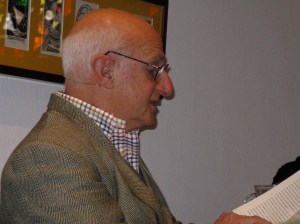
Breakfast with David, Malouf that is

Malouf reading from Ransom, National Library of Australia, 16 August 2009

Malouf reading from Ransom, National Library of Australia, 16 August 2009

“Exploring in the dark” is how David Malouf frames the process of writing. In other words, writing, he says, brings out what is within the writer but is not fully understood until the writing starts. Furthering this notion, he quoted Herman Hesse as saying that a writer needs to be “a sleepwalker with the absolute assurance that he will put his foot down in the right place”. These were the first thoughts David Malouf shared with us, this morning, at the National Library of Australia’s last Books with Breakfast event of the year. He was in conversation with academic Brigid Rooney.

This is the second time my friend and I have attended a David Malouf literary event, the first being in 1990 when The great world came out. Admittedly that was a bigger event but we both felt that he was more relaxed today. I guess that’s not surprising given nearly 20 years of literary events have passed since then.

The focus of the conversation was, not surprisingly, Malouf’s most recent book, Ransom, which essentially recounts the last 24 hours of Achilles’ and Priam’s lives at Troy. Malouf explained his fascination with Troy, from his first introduction to the story in 1943 when he was 9 years old, through a poem he wrote around 1969/1970 called “Episode from an Early War”, to this latest novel of his, Ransom. Explaining his obsession, he talked about Troy being a city under siege waiting for war, and how Brisbane had felt the same in 1943; and about the 1960s being a period of maximum anxiety about nuclear war, and how Troy reminds us of the destruction of a civilisation. He sees Troy as an important part of our cultural inheritance and as emblematic of many of the things that confront us today – particularly in relation to war and its victims.

The discussion returned several times during the conversation to writing and storytelling, things of major concern to Malouf and about which he is wonderfully eloquent. He recounted Henry James’ description of “experience” as being “threads suspended in the chamber of consciousness”. Henry James also said that “a writer is someone on whom nothing is lost”. Similarly, Malouf said that he sees our consciousness as “whole”, by which he means “all our experience is always with us”. Writing, he said, is about making connections in our experience and is “an extraordinary illustration of how our consciousness works”.

At one point in the morning, he discussed his book An imaginary life, which explores the exile of the Roman poet Ovid. He said it initially puzzled people as to why an Australian would write such a book, and that it was not really comprehended until European commentators started noticing that it dealt with the issue of “living at the centre versus living at the edge”. Just as the exiled Ovid was “living at the edge”, so do we in the New World. This recognition, he said, helped readers see it as a book that was indeed about and relevant to Australia.

Towards the end, the conversation returned to Ransom…but as I have only read 20 pages (after all, while I wasn’t concerned about spoilers, I didn’t want to go to the event completely unprepared) I will save discussing those comments until I review the book (probably next year the rate I’m going!) The event concluded with Malouf giving a brief reading from the book. Rather tellingly – and perhaps cheekily – he chose a section that ended with the words:

This old fellow, like most storytellers, is a stealer of other men’s tales, of other men’s lives.

Would that I could be such a stealer!

Some Australian literary classics

Lisa at ANZ LitLovers referred yesterday to ABC Radio National’s The Book Show program on Patrick White’s The solid mandala. This is in fact part of weeklong series they are doing on Australian classics. They have chosen an intriguing – but not unappealing – list of works to discuss:

Dare I admit it? I’ve only read two of these: the White and the Astley.

Although I haven’t read as much of White as I want (plan) to, I’ve liked everything I’ve read. I like his style; I like the things he talks about. The solid mandala’s style includes multiple points of view, sentence fragments, and a somewhat complicated time structure: I’m a bit of a sucker for these techniques as they tend to keep my brain in gear while I’m reading. And while it sounds terrible really, there’s an aridity to his characters that fascinates me. This aridity is well evident in The solid mandala. It’s there in the repetition of yellow-brown colours: the main characters’ surname is Brown, their neighbours are the Duns, and the colour yellow features regularly (“waves of yellowing grass”, “yellow fluctuating light”, “yellow feet”). It’s there in the description of characters as dry and brittle (Waldo is “dry and correct”, “felt as brittle as a sponge” and “had shrivelled up”). And, somewhat ironically, it’s even there in the colour blue (“the moons of sky-blue ice fell crashing” and “his heart contracted inside the blue, reverberating ice”). It’s a desperately sad book about failed ambitions and missed connections – and yet it’s also about kindness and about the “truth above truth” (that is there if you look for it).

As to Astley, I have been promising for a while to write my next Favourite writers post on her – and I will do it soon!  Since reading Chloe Hooper’s The tall man earlier this year, I have been wanting to re-read The multiple effects of rainshadow as it’s been a lo-o-o-ng time since my first reading. Both, as you probably know, deal with violence and racial tensions on Palm Island – Astley through fiction, Hooper through non-fiction. Hooper is interviewed briefly in The Book Show’s program. She says of Astley that:

I think that she was very much interested in the violence of the frontier and she wrote about it and was very brave, because she was one of the first writers of her generation to deal with this question.

And that was Astley. Fearless, forthright and prepared to be confronting. I will get to her soon…

As simple Arthur says to would-be intellectual Waldo in The solid mandala, “it doesn’t matter what you write about, provided you tell the truth about it”. White’s and Astley’s truths are often uncomfortable – but that didn’t stop them and we, I think, are the richer for it.

More Jolley

Elizabeth Jolley (Photo: Courtesy Fremantle Press)

Elizabeth Jolley (Photo: Courtesy Fremantle Press)

A decade or so ago my local reading group, with trepidation from some, decided to try a poetry night. The idea was that we’d all bring a favourite poem or two to share. What would I bring? I have some favourite poets from my student days – poets like Gerard Manley Hopkins, T.S. Eliot and William Wordsworth – but was that all I knew about poetry? Well, it just so happened that my brother had given me a few years earlier The Penguin book of Australian women poets (1986) so I hied me thither to see whether anything inspired. And what did I find but one of my favourite writers, Elizabeth Jolley, there ensconced.

Now, fair dealing provisions of the Australian Copyright Act are not clear for poems and anthologies so I won’t reproduce the full poem, “Neighbour woman on the fencing wire”, but here is its beginning and end:

So you’ve bought this place well let me tell you
straight away your soil’s no good all salt even a
hundred and sixty feet down and up on the slopes
is outcrops of granite and dead stumps of dead
wood nothing’ll grow there we know we’ve tried

dead and then there was that pig ate a woman’s
baby right in front of her door mind you I always say –

Says it all really…how can you not laugh along with a writer who writes a poem like this. (It is also published in her book Diary of a weekend farmer, 1993).

Elizabeth Jolley, My father’s moon

‘No one,’ she says, ‘can write anything till they’ve had experience. Later on perhaps. You will write later on.’ (Elizabeth Jolley, My father’s moon, 1989)

Although fiction demands imagination, it must be based on  some kind of genuine experience. (Elizabeth Jolley, “Only Connect”, essay first published in Toads, 1992)

My father’s moon is the first book in Jolley’s semi-autobiographical trilogy, the others being Cabin fever and The George’s wife. It won The Age Book of the Year Award in 1989.

I am an Elizabeth Jolley fan – and, along with Helen Garner, another Jolley fan, I enjoy the way she repeats and revisits stories and characters from one book or story to another. In this book is the chapter, “Night Runner”, which was published as a short story in Meanjin in December 1983, and again in a short story anthology, Room to move, published in 1985. The narrator of the story – and of the novel – typifies Elizabeth Jolley’s alienated protagonists and their often peculiarly self-centred and self-deluded ways of coping with their loneliness. Clearly Jolley decided that this was a character she wanted to develop further. And clearly she also drew a lot from her own experience to develop this character. Like Vera, Jolley was brought up as a Quaker, her parents sheltered refugees before and during the Second World War, and she trained as a nurse. Like Vera, Jolley probably experienced loneliness and alienation. However, this is fiction and so we need to be careful about how far we take these analogies between Vera and her creator. Much as I can empathise with Vera’s predicament, I must admit that I would hate to think she is Elizabeth Jolley.

It’s an uncomfortable novel. Vera, the first person narrator, is not a highly sympathetic character but neither is she totally disagreeable either. What she is, though, is lonely. The book has a somewhat challenging structure – and I had to concentrate to keep track of where I was. It starts with Vera, a single mother, leaving her parents’ home, with her young daughter, to live and work in a boarding school. Her hopes for a lovely life there among people “who feel and think as I do” are dashed. Such people “are not here as I thought they would be … I am by my own mistakes buried in this green-leafed corruption and I am alone”. In this first chapter are flashbacks to the past, and gradually the book moves into the past, providing us with insights into her character and how she has ended up where she is. Most of this past takes place in the hospital where she trains as a nurse during the war. The book finally returns to the beginning of the novel with Vera resolving to make a step towards alleviating her loneliness. However, we are by no means convinced she will.

Moon, by atomicshark @ flickr, licensed under Creative Commons CC-BY 2.0

Moon, by atomicshark @ flickr, licensed under Creative Commons CC-BY 2.0

The book comprises titled chapters, many if not all of which could be (and some have been) published separately as short stories. This gives it a somewhat disjointed feel – but seems appropriate for the story of a person like Vera. It is full of wonderfully drawn characters, with some very funny (if often dark) scenes and dialogue. Just think nurses and hospitals! There are many references to music – something that is common in Jolley’s works. Music is usually a comforting force for her characters, offering them respite from what is often a cruel world – and this is the case here, with Vera being drawn to characters who love and play music. There is a lot of irony, some of it subtle, some of it less so as in Magda’s comment to Vera who has fantasised about an affair with her husband: ‘You are so innocent and good … Don’t ever change’. Naive perhaps, innocent no!

So, what about the title? Funnily enough(!), it refers to Vera’s relationship with her father, a major stabilising influence in her life. He tells her throughout her childhood that wherever she is she can always look at the same moon he is looking at, ‘And because of this … you must know that I am not far away. You must never feel lonely’. A lovely concept and one to which Vera regularly returns in the book.

My father’s moon is not, I think, the easiest Jolley to read, and there are some things that might become clearer on a second reading. However, its concerns are very representative of her work – loneliness and alienation, homosexuality, parenting, memory, music and religion. While Vera is deeply lonely, while she often behaves selfishly, she can also be kind. She is also no quitter. For that I rather like her.
J.M. Coetzee, Diary of a bad year

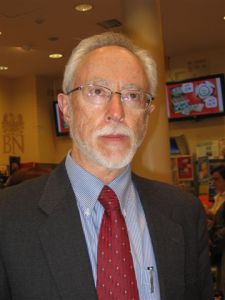
Coetzee, Poland, 2006 (Photo: Mariusz Kubik, from Wikipedia)

Coetzee, Poland, 2006 (Photo: Mariusz Kubik, from Wikipedia)

J.M. Coetzee is one of those rare novelists who pushes the boundaries of what a novel is. The progression from his mid-career novel, the spare but terrifying Disgrace (1999), through Elizabeth Costello (2003) to Diary of a bad year (2007) is so dramatic that there are those who question whether these last two are even novels. It’s actually been a year or so since I read Diary of a bad year but it is currently being discussed by one of my reading groups so now seemed to be a good time to blog about it here.

One of the first things to confront the reader who picks up Diary of a bad year is how to read it. It has three (two to begin with) concurrent strands running across the top, middle and bottom of the page. Some readers try to read the three strands as concurrently as possible while others read the strands sequentially. Following this latter path, though, means you risk missing the way the strands comment on each other. The three strands are:

  • the narrator’s formal voice, basically taking the form of essays he is writing
  • the narrator’s informal voice in which he talks about his life as he is writing the essays
  • the voice of Anya, his “little typist”, and, through her, of her boyfriend, Alan

The three characters represent three modes of viewing the world: the narrator’s is primarily theoretical, while Anya’s is more pragmatic and Alan’s rational. Through these modes, Coetzee teases out the moral conundrums of the early 21st century both in terms of the political (the events confronting us) and the personal (how are we to live).

Towards the end, Coetzee refers to his love of Bach. To some degree the book is a paean to Bach: its three-part structure in which each part counterpoints the others seems to be a textual representation of Bach’s polyphony. The essays running across the top of the page, while a little uneven and dry on their own, are counterpointed by the views of the characters in the other two strands, resulting in our being presented with different ways of viewing the same world.

The characterisation is interesting: Senor C, the writer of the essays, is the logical, moral but somewhat pessimistic thinker; Anya is practical, down to earth, but with a strong moral sense; and Alan is the economic rationalist for whom money is essentially everything. The views of the two men are strongly contrasted, while Anya is caught in the middle. There is a Darwinian sense in Alan of the survival of the fittest, while Senor C spurns competition as a way of life, preferring collaboration. For all his “moral” views, though, Senor C is not presented as a paragon and we are discomforted at times by his attitude towards the beautiful Anya.

The overall theme seems to be how do we live in a world full of paradoxes and contradictions, a world that seems to be pervaded by dishonour and shame (the things Senor C explores in the essays). He talks about ordinary people and how they (we) cope with things they (we) don’t approve of. He wonders why they (we) don’t do something about it, but suggests in the end that they (we) practise “inner emigration”. He says:

The alternatives are not placid servitude on the one hand and revolt against servitude on the other. There is a third way, chosen by thousands and millions of people every day. It is the way of quietism, of willed obscurity, of inner emigration.

I like that concept though it does smack of burying one’s head in the sand. He also talks about collective guilt, and about bearing the dishonour of what’s gone on before. Through choosing a “novel” form like no other, one which blends but in no way harmonises fact and fiction, Coetzee shows in a very concrete way that difficult times need new ways of presenting ideas. He offers no neat conclusions, no easy outs;  he is quite subversive really. Late in the book he ponders the value of writing, and says:

Are these words written on paper truly what I wanted to say?

This then is another step in Coetzee’s path of trying to find the best, perfect perhaps, way of saying what he wants to say. I, for one, will be ready for his next step.

Toni Jordan, Addition

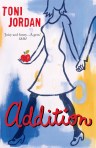
Addition Pb cover, Courtesy Text Publishing

Addition Pb cover, Courtesy Text Publishing

(SPOILERS: FOR WHAT IT’S WORTH)

Looks like, feels like, is it? Chick lit, that is. Toni Jordan’s first novel Addition has all the hallmarks of chick lit. The cover design with its line drawing of a female form invokes chick lit – albeit chick lit with an edge as the heels aren’t quite high enough and the colours not quite girly enough. The plot though is pure rom com and pretty much standard chick-lit: girl meets boy, girl loses (kicks out) boy, girl gets boy back. So why has this book garnered more attention and positive critical response than its sisters?

Well, Jordan is no Jane Austen (who is sometimes called the mother of chick lit) but she has produced something a little fresh. Her heroine, Grace, is not quite the standard chick lit heroine. She has had a breakdown, she is not in employment, she is not upwardly mobile and she is not focused on fashion and appearance (though it has to be said that she’s not oblivious to these latter either). Instead, she’s an ex-primary school teacher (not the most fashionable career, anyhow, in the world of chick lit) and she suffers from an obsessive compulsive disorder that results in her need to count, anything and everything, in order to maintain control over her life. And her hero, Seamus, a happy, ordinary dresser in an ordinary go-nowhere job, is “average”. Fortunately, though, with the help of her smart young niece, Grace realises at the end “that average can actually be unique”.

Grace’s voice is chick-lit-sassy and the book is genuinely funny a lot of the time, but there are also times when it is forced and tips over into being smart-alecky, such as her reactions to the psychiatrist and therapist. Her other hero is Nikola Tesla, the not-properly recognised famous inventor of many things electrical, who also had an obsessive compulsive disorder relating to numbers. It is the presence of Nikola in Grace’s life which sustains her at the beginning, helps ground her at the end and gives the book its real hook – that is, that being different is to be cherished and encouraged, as long as it doesn’t drag you down.

Jordan has a nice flair for language too. I liked the change in tone and pace when Grace’s panic rises, and a similar change in Jill’s speech to Grace when they are in hospital discussing their mother’s future. She’s lightly ironic in places and includes the odd bit of wordplay. It will be interesting to see where she goes next.

In addition (excusez-moi!) to its trying sometimes to be a bit too funny and its somewhat preachy ending (“Listen … Life is ..”), the book’s main problem is it’s too close adherence to the formula. You know she is going to lose him and you know she is going to get him back. It’s just a matter of how. Some level this same criticism at that favourite author of mine, Jane Austen, but her books encompass way more than plot to say some fundamental things about the human condition. I can read her again and again and see something new, or take away another perspective. I can’t see anything in Addition, as delightful as it is, that would afford me that pleasure on multiple readings.

So, read it, enjoy it – as I did – but if you want something a little more sustaining, try Jane.