Monday musings on Australian literature: West Coast Writers

Western Australian cities, towns, settlements ...

Adapted by Mark Ryan (Image from Wikipedia under the GNU Free Documentation License)

For the non-Australians among you, Western Australia is our biggest state and, for many of us, is further away from where we live than New Zealand. Moreover, its main population areas are on the coast: there is a lot of desert between the eastern states and where most Western Australians live. Consequently, it would be true to say that more eastern Australians visit places like New Zealand and Bali than visit Western Australia – and, conversely, more Western Australians visit Bali than visit the eastern states. Every now and then they rattle the cage and speak of secession!

Western Australia was one of the first parts of the Australian mainland to have been visited by European explorers. Dutch explorer Dirk Hartog famously (to Australians) affixed a pewter plate when he visited the west coast in 1616. The first white settlement though did not occur until 1826 in Albany, followed by Swan River (now Perth) in 1829, some 40 years after Botany Bay was settled on the east. But, I am not here to give you a history of Western Australia. Rather, I’d like to introduce you to some of the writers the state has produced.

The state’s most famous writer – past or present – has to be Tim Winton. He has won the Miles Franklin award four times (only the second writer to do so) and he is still producing. He writes novels, short stories and children’s books – and he is a significant advocate for the environment. If there is such a thing as the GAN, Winton is currently seen as a major contender. Winton loves the land, and particularly the Western Australian coast. Most of his books are set there and place is significant in the lives of his characters. He once said to an Australian literary editor that “The place comes first. If the place isn’t interesting to me then I can’t feel it. I can’t feel any people in it. I can’t feel what the people are on about or likely to get up to”. He is the writer to read if you want to “feel” the state. Here are a couple of excerpts from Dirt music, on the more remote northwest:

Fitzroy River

Aerial shot of the Fitzroy River

… and Fox [in a plane] sees how the land is with its crone-skin patterns, its wens and scars and open wounds. The plains, with their sparse, grey tufts of mulga scrub, rise into the high skeletal  disarray of the sandstone ranges where rivers run like green gashes towards the sea. All rigid geometry falls away; no roads, no fences, just a confusion of colour. Out at the horizon the jagged, island-choked coast.

AND

The water is like shot silk and he barely raises a crease. It’s so hot out there, so still and clear that the distances seem to expand until everything looks twice as far as it did on the map.

But he’s not the only writer to evoke life in the West. Robert Drewe, who moved to Western Australia when he was 6 and spent his formative years there, has also written evocatively about the place. His autobiographical-cum-fictional book The shark net is a pretty confronting story about his childhood and, in particular, the role played in it by serial killer Eric Cooke who committed 8 murders the late 1950s to early 1960s.

And then there’s one of my favourite writers, Elizabeth Jolley. She migrated to Western Australia with her husband in 1959. Her writing though tends to be more interior, with place and setting used symbolically, metaphorically. Alienation and marginalisation are big themes for her, so I can’t help surmising that her dislocation from England combined with the remoteness of Western Australia contributed to this sense in her work, but it mightn’t be quite that simple. Here she is in an essay titled “A small fragment of the earth”:

In a country where a 10-centimetre map would produce sheets of blank spaces, the emptiness and the silence are impressive.

At times, in this silence, the traveller is tempted to stop the car with the idea of walking. To get out of the car and to walk. The road between empty paddocks is quiet and deserted. When walking it would be possible to accept a different view of time and journey. It would be possible to feel small and safe, walking and then pausing to stand still.

The occupation of a small fragment of the earth is known only to the person who is alone in it. It is possible to imagine the feelings of being unseen and not known about while standing alone in one isolated place, low down under the immense, clear blue sky. It might even be possible to think that all anxieties and fears will disappear. They might dissolve, dissipate themselves into the silence.

There are other significant writers too – such as Katharine Susannah Prichard, Randolph StowSally Morgan, Dorothy Hewett, Gail Jones and Craig Silvey – but I can’t possibly write about them all without becoming rather tedious. They are all worth checking out though.
Marie Munkara, Every secret thing

They all nodded, not knowing what the hell curry* was but getting gist of the story all the same.

Marie Munkara leads us a merry dance with Every secret thing, her first book, which won the David Unaipon Award for an unpublished Aboriginal or Torres Strait Islander writer. What exactly is this “thing” she presents to us? A novel? A short story collection? Well, I think it’s a bit of both. It looks like stand-alone short stories, and can probably be read that way. But, the same characters keep reappearing in the stories and there is a chronological thrust to it with a conclusion of sorts in the final story, so I’d call it connected short stories.

Form, though, is not the only way in which she leads us a merry dance. This is a genuinely funny book – sometimes slapstick or ribald, sometimes more bitter, satiric and/or ironic, but pretty well always funny. However, her subject matter is desperately serious – the destruction of indigenous culture through contact with white culture, specifically in this book through contact with missions and missionaries.

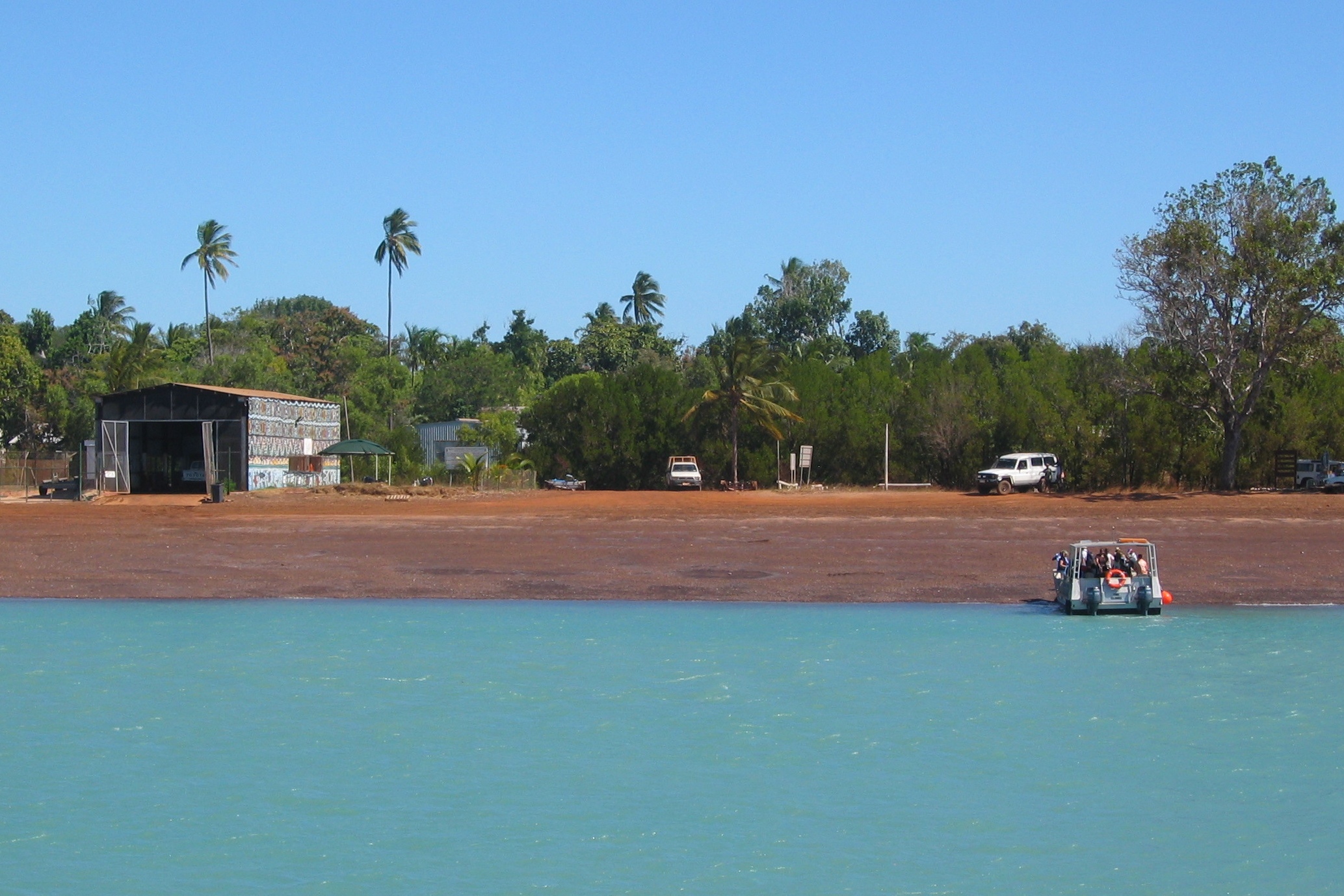
Bathurst Island (Tiwi Islands)
Approaching beautiful Bathurst Island (Tiwi Islands)

Marie Munkara was born in Arnhem Land and spent the first few years of her life on Bathurst Island in the Tiwi Islands. She left there when she was 3 years old, and didn’t return until she was 28. These stories, she says, are drawn from those told to her by friends and family, and are set, I think, in the early to mid twentieth century. She explores a wide range of issues reflective of indigenous-white contact at that time, including education and religion, the stolen generation, sexual abuse, the introduction of alcohol and disease, and anthropological research.

Munkara sees humour in everything (more or less) but her more biting humour is reserved for the “mission mob” because, of course, it is they who wield the power over the “bush mob”. The “bush mob” are shown to be intelligent and resourceful but no match for the power of the muruntawi (white people). Her language draws on a wide range of traditions – including indigenous storytelling, biblical, common clichés – and from these she tells stories that are only too believable. Here she tells us about one of the Brothers:

And so time passed and the natural progression of things came to be and the bullied became the bully, and the bully became the misogynist, and the misogynist became a Brother in a Catholic mission in a remote place in the Northern Territory… (“The sound of music”)

A too familiar story, told in a biblical tone. There is a funny story in which the “bush mob” tries to lead an anthropologist astray by feeding him incorrect information (such as obscene or silly names for ordinary objects), but their victory is Pyrrhic, as the end of the story conveys:

And after all, it was difficult sometimes to tell the difference between the missionaries and the madmen and the mercenaries because their eyes all looked the same and their tongues all spoke the same language of greed. If it wasn’t your soul they wanted, it was something else. Until it became an automatic response whenever a strange muruntani appeared to put out your hand for the specimen bottle to piss into or extend your arm for a blood sample to be taken or for the ungracious thought to pass through their mind that here was yet another who had come to take but as always gave nothing in return. (“Wurruwataka”)

Her stories about the stolen generations are particularly bitter, but again she uses humour. She tells the story of Marigold (née Tapalinga) who’d returned “home” after years away, only to find that she no longer fit, but:

Nor did Mrs Jones want the hussy back as their servant having sprung the little slut underneath Mr Jones in the spare room. The poor man was still traumatised by the ordeal. This wasn’t the first time she’d raped him, he claimed. (“Marigold”)

Only an indigenous writer could write something so patently ridiculous on this topic – and so drive the point home!

Munkara neatly tracks the Bishop’s behaviour and impact on his flock by constantly changing her epithet for him. In the first story, “The Bishop”, he is introduced as “his Most Distinguished” but is then referred to by various names including “his Most Garrulous”, “his Most Impatient” and “his Most Impious”. This changing of names for the Bishop is rather unsubtle humour but it carries a sly comment on the “mission mob’s” disrespect for indigenous culture by insisting on naming indigenous people, completely ignoring the fact that they have their own names. And so, in the first story, we are introduced to Matthew, Mark, Luke and John, to Epiphany, Lazarus, and John the Baptist, to name just a few of the cast of characters populating the book.

Another technique Munkara uses is to pepper her stories with white culture sayings and clichés, such as, “misery loves company alright”, “looking on the bright side”, “but you just can’t please everyone”, and this one:

And so it came to be that for the first time ever, the mission mob found themselves sitting where they’d never sat before – between a rock called ‘you didn’t see that one coming did you’ and a hard place called ‘bush mob’s indifference’. (“The good doctor”)

Overall, this is deceptively simple but clever writing that sets up and undermines its premises every step of the way. First “the mission mob” seems to be winning, and then “the bush mob”. However, while it could be said that “the bush mob” were “clever individuals who had learnt to sit on the wobbly fence of cultural evolution without falling off”, the real truth is that

They didn’t have to die to go to hell because the mission had happily brought that with them when they’d arrived unasked on the fateful shores of the place that was their heaven all those years ago. (“The movies”)

A spoonful of sugar, they say, makes the medicine go down, and that’s certainly true of this book. The sugar is not so strong though that you miss the medicine. Munkara makes sure of that – and the end result is a very funny but also very sobering book. I suspect and hope that Munkara has more … because the missions are only one facet of the history of contact in Australia. There is plenty for her to sink her teeth into.

Musings of a Literary Dilettante and Resident Judge have also reviewed this book.

Marie Munkara
Every secret thing
St Lucia: University of Queensland Press, 2009
181pp.
ISBN: 9780702237195

* Reference to the colloquialism “giving them curry”.

Writer-Artist Shaun Tan wins an Oscar

Shaun Tan 2008 Taipei International Book Exhibition

Shaun Tan, 2008 (Courtesy: Rico Shen, via Wikipedia, under CC-BY-SA 3.0)

Shaun Tan, whose Eric (an excerpt from Tales from Outer Suburbia) I reviewed here a few months ago, won the Oscar this week for Best Animated Short Film. (Tan shared the prize with British producer, Andrew Ruhemann). This is the third time, I believe, an Australian film has won this category, the previous ones being Adam Elliot‘s Harvie Krumpet and Bruce Petty‘s Leisure, both of which I’ve seen and would happily recommend.

Tan’s film is titled The lost thing, and is based on his 1999 picture book of the same title. Like Eric, it is (to be very simplistic) about difference and, accepting it or not, but unlike Eric it is set in a more dystopian, alien world. I need to see it now, clearly.

Shaun Tan was born in 1974 … he already has a swag of awards to his name. He also has a positive and flexible attitude to sharing his art. In an interview in 2009, he talked about directing The lost thing and its being a close adaptation of the book, and about how with other adaptations, he has said “Do what you want”. I like this, this willingness to be “precious” about some projects but let other things go and see where they are taken:

My approach has always been to remain very open to adaptations of my own work in other media, and trust in the vision of collaborators. This is partly because I see my own imagery as open-ended and ‘unfinished’. (Shaun Tan)

He is a man to watch.

Monday musings on Australian literature: The triumvirate

Flora Eldershaw

Flora Eldershaw, c. 1915 (Presumed Public Domain, from the National Library of Australia, via Wikipedia)

I’ve mentioned Marjorie Barnard in a couple of posts recently, but I suspect few Australians and even fewer readers from overseas (except of course Tony of Tony’s Bookworld) have ever heard of her. Rather than write specifically about her, though, I thought I’d talk a little about the Australian literary scene of the 1920s to 1940s, and about three writers in particular – Marjorie Barnard, Flora Eldershaw and Frank Dalby Davison.

I’m probably cheating here a little because, while I have read quite a bit about them over the last few years, I have read only a smidgin of their actual works. I’ve read (and re-read) Barnard’s The persimmon tree and other stories (1943) and Davison’s Man-shy (1931). I’ve dipped into Barnard and Eldershaw’s collaborative work A house is built (1929) and some of their other writings.

These three writers were part of a pretty active literary scene in Australia at the time. It included writers such as Vance and Nettie Palmer, Miles Franklin, Katharine Susannah Prichard (whom I reviewed recently), Eleanor Dark, Xavier Herbert and, yes, even, towards the end of the period, Patrick White. (Another contemporary, Christina Stead left Australia in 1928.) The reason I decided to start with these three is because of their friendship and “political activism”, mainly through the Fellowship of Australian Writers (FAW), which resulted in their being known for a time as “the triumvirate”. They were liberals who were concerned about the rise of Fascism in Europe – and the potential ramifications at “home”. Through them, in the late 1930s, the FAW engaged in political debate, particularly in relation to the protection of freedoms, such as that of speech. A topic, of course, dear to the heart of writers.

Barnard and Eldershaw wrote three novels, as M. Barnard Eldershaw, but they also wrote literary criticism and history. These days though, they are probably most read (when they are read at all) as early feminists. Neither Barnard nor Eldershaw married, though Barnard had an affair with Davison, and both lived independent lives supporting themselves through whatever work they could find. They were active in professional societies, judged literary competitions and edited anthologies. Eldershaw was a particularly skilled negotiator and worked hard to secure support for writers (via grants, pensions and other mechanisms). Vance Palmer admired Eldershaw for her ability to “neutralise conventional masculine expectations of the threat posed by women in ‘public life'”. At one stage they shared a flat, and held what could only be called a “salon”. It was attended by the literati of the day, including of course Davison.

That’s enough, though, of information you can pretty easily find in Wikipedia and other online sources. My aim here is to whet your appetite (I hope). I’ll finish with a quote from A house is built, which is set in mid-nineteenth century Sydney:

Her life was as full of ‘ifs’ as any woman’s. If she had not been so restricted, if her really considerable powers of mind and character had been given scope, Fanny would not have fallen victim to the first colourful stranger she met.

Barnard, it is reported, once said “Australia is still a man’s world”. I’d love to know what younger Australian readers of this blog think about Australia now – and whether anyone (besides Tony!) has read works by these three authors.

[Note: Some of the information for this post came from writings by Maryanne Dever whose PhD was on M. Barnard Eldershaw.]

Delicious descriptions from Down Under: Marjorie Barnard on the sun and heat

Marjorie Barnard

Marjorie Barnard (Courtesy: State Library of New South Wales, via Wikipedia)

My first Delicious descriptions post was from Barbara Hanrahan on the sun in Adelaide, so I thought we might travel to Sydney for this one. As it’s still in summer in our neck of the woods, here is Marjorie Barnard in The persimmon tree and other stories (1943), also on the sun – and its enervating effect:

In the wealthy suburbs of the North Shore and Vaucluse a change had taken place too. It was as if the earth had been squeezed so that all the fine houses that had nestled so comfortably in the contours and in the greenery, were forced up to the light. They bulged out, exposed, and the sun tore at them. The gardens that had embowered them were perished. Tinder dry, fire had been through many of them, scorching walls and blistering away any paint that remained. Most of these houses were empty or inhabited as if they were caves, by people who had come in from the stricken country. The owners had fled, not so much from present hardship, as from the nebulous threat of the future, the sense of being trapped in a doomed city. The shores of the harbour were lion-coloured or drab grey. Sandhills showed a vivid whiteness. Only the water was alive and brilliant. And it was salt. (from “Dry spell”)

I like her point that nature doesn’t discriminate (even though we know that, in reality, the well-off do often have the wherewithal to avoid its worst effects). And I love the last sentence – the short finality of it.

POSTSCRIPTS:

  1. I have been at the coast this week, and so scheduled my first two Delicious Descriptions for this time. I promise I won’t be bombarding you bi-weekly with these. (The dictionaries are confused! I looked up “bi-weekly” and it can mean both “twice a week”, as I mean here, of course, and “every two weeks”. How silly is that! Anyhow, perhaps “semiweekly” is the preferable term.)
  2. And Sarah (you Devoted Reader you), this one’s for you. May you experience no more such heat in Sydney this summer.

Delicious descriptions from Down Under: Barbara Hanrahan on the sun

When you read do you come across passages that you just want to hang onto forever – but (if you’re a blogger) when you go to write your blog review you can’t quite make them fit? I do, and have been pondering for some time what to do about it. Then, suddenly, it came to me. How about a series of posts comprising favourite bits from books (and other writing)? And so, “Delicious descriptions from Down Under” was born. The posts will be occasional – and some times more occasional than others – but I’ll just see where it takes me.

For my first one, I couldn’t go past Barbara Hanrahan‘s The scent of eucalyptus (1973) which I reviewed recently. It’s full of “delicious descriptions” but the one I wanted to share has to do with the Sun, with, specifically, hot sunny days in the city of Adelaide. I was in Adelaide on a scorchingly hot long January weekend many moons ago, and haven’t forgotten it. Here is Hanrahan:

Myilly Point, Darwin, shutters

Shutters

The sun is everywhere.

It is in the garden: peering huge-eyed over the berry bush, roosting behind the chimney, floating like a fried egg in puddles. It mocks me when I burn my bare feet on the earth and scorch my fingers on the iron fence. It peels my nose to jigsaw puzzles, gilds my skin with freckles, turns the hair on my arms to gold.

It is in the house: spangling the passage with leopard spots, turning the sheepskin rug tawny, casting zebra stripes through the shutters. It curdles the milk, melts the butter, shows the dust, fades the curtains. It steals into vases and drinks their water; creeps up the cold tap and turns it hot.

Such intense summer heat that goes on for days is typically – though not solely I know – Australian. I love the way she gives the sun life, the way she mixes up her imagery and yet consciously but not rigidly uses a symmetrical structure to make it read more like poetry than prose. It works beautifully – for me, anyhow.

Madeleine St John, The women in black

The women in black, Madeleine St John, book cover

The women in black bookcover (Courtesy: Text Publishing)

One thing mystified me as I started reading Madeleine St John‘s The women in black and that is why she would write a book in 1993 about 1950s? It seemed an odd choice. And then, as I read further, it started to become clear. The time period represents one of those cultural watersheds that nations experience. In this particular case, it was a time of social change: not only were things starting to change for women, but the “reffos” or “Continentals” (as the post-war European refugees were disparagingly called) were beginning to impact Australian culture.

St John chronicles these changes lightly, with warmth and gentle humour, but also with determination. It’s not a coincidence, I think, that St John, born in 1941, would have been around the age of the youngest character, Lisa/Lesley Miles, at the time the book is set.

Hmm … having introduced a character now, I’d better talk briefly about the plot. It centres around the women who work in the Ladies’ Cocktail Frocks and the more exclusive Model Gowns sections of a fictional (but thinly veiled DJs) upper crust department store in Sydney called Goode’s, and takes place over the few weeks before and after Christmas. Model Gowns is staffed by one woman, the Continental or reffo, Magda, while Ladies’ Cocktail is staffed by the middle-aged Miss Jacobs, the 29-year-old almost-on-the-shelf Fay Baines, the 31-year-old married-but-so-far-childless Patty Williams. There is also the buyer Miss Cartwright. Overseeing them all is, of course, a man, Mr Ryder. Into this mix is thrown 17-year-old Lesley (who changes her name to Lisa) Miles, who has just finished her Leaving Certificate.

The story is told in short chapters, each one devoted to one or more of these characters. The tone is (almost conspiratorially) conversational, which invites the reader in. St John draws her characters effectively through brief sections of perfectly caught dialogue and succinct but apt descriptions. The style is witty, with light wordplay and irony. Here are some excerpts from Chapter 2:

Mrs Williams was a little, thin, straw-coloured woman with a worn-out face and a stiff-looking permanent wave. Her husband Frank was a bastard, naturally.  [ …]

At the weekends she visited her mother or one of her sisters; Frank drove her there and fetched her, and while she was ‘jaw, jaw, jawing’ he played golf on the public course at Kingsford or drank in the pub. He was a bastard of the standard-issue variety, neither cruel nor violent, merely insensitive and inarticulate.

[…]  as she left the surgery, the physician looking idly at her back view thought, she’d clean up quite well with a new hairdo, some paint on her face and a black nightie; but the husband probably wouldn’t notice, the bastard …

By the end of chapter 2 I was hooked. In three and a bit pages we were told all we needed (and probably more than we wanted) to know about poor little Patty Williams and her bastard of a husband. But Patty’s is just one story. There’s also Fay Baines who’s desperate to be married but meets all the wrong men through her well-meaning night club manager friend, Myra; and Lisa Miles who expects to do well in her end-of-school results but whose father thinks women have no business at university. Into this mix are thrown the outgoing, confident (but “god awful” to the women in black) Magda and her also Continental/reffo husband Stefan.

Magda takes an interest in Lisa and invites her home. She also tries a little matchmaking with Fay. Meanwhile, Patty does try that black nightie, with consequences she would never have foreseen. It could all go horribly wrong but, without spoiling anything too much, I’ll simply say that St John’s book follows, loosely and more lightly, the Jane Austen tradition, that is, it’s a comedy of manners. Unlike Austen though, she’s writing in an historical, rather than contemporary, time-frame, and so has a slightly different goal in mind – and that is documenting the social change I mentioned in my opening paragraph.

Two simple examples of this are “kissing” between friends, and food. Here is Lisa on “kissing”:

And she [Magda] kissed her on the cheek. Lisa smiled shyly at her. I’ve heard she thought, that Continentals kiss each other much more than we do: it means nothing. They do it all the time, even the men. The men even kiss each other.  But how strange I feel.

This little paragraph struck me; I realised that my friends and I kiss each other in greeting but it was not, I think, the norm among my parents’ generation. In one or two generations, in fact, the often-maligned (in the book and in reality at the time) Continentals had effected quite a change. And then there’s the food. By the end of the book, Lisa, Fay, and even Lisa’s father had tasted and enjoyed such exotic foods as salami. And again I reflected on the immense change in diet from my parents’ to my generation.

I won’t tell you more of the story. It’s a gentle one, but there is a drama concerning Patty, and some little tensions surrounding Fay and Lisa, that keep the book moving while it observes a society in change. There are some perfect descriptions of Sydney, such as this of the women coming to do their last minute Christmas shopping:

From the wooded slopes of the salubrious North Shore to the stuccoed charm of the Eastern Suburbs, from the passé gentility of the Western ditto to the terra incognita of the Southern had they travelled by train, bus, tram and even taxi cab to this scene of final frantic activity.

It’s a book almost of vignettes than of fully realised stories, and there’s the odd clumsy or heavy-handed bit, but St John has nonetheless managed to convey a convincing picture of Australian society at the time, while also telling an engaging and generous tale. And, just to show she has a sense of humour, St John, who was a libertarian at university, injects near the end her own little in-joke. Here is Lisa’s father on the possibility of her going to university:

But I’ll tell you one thing: if I decide you can go, and you do go, if I ever hear of you being mixed up with any of those libertarians they have there, you’re out of this house like a shot and I never want to see you again, is that understood? Right then. If you go, no libertarians, not even one.

I wonder what St John’s father – the prickly politician Edward St John – said to her!

Lisa at ANZLitLovers has also reviewed the book.

Madeleine St John
The women in black
Melbourne: Text Publishing, 2010 (orig. 1993)
234pp.
ISBN: 9781921656798

(Review copy courtesy Text Publishing)

Monday musings on Australian literature: A dry or not so dry continent?

It’s rather ironic that  in the last week or two when I’ve written a couple of posts about Australia’s image* as a “sunburned land” (Barbara Hanrahan) or “sunburnt country” (Dorothea Mackellar), the image the world has been seeing is somewhat opposite – a raindrenched land. Then again, Dorothea Mackellar did also write that this is a land “of drought and flooding rains”.

So, I thought this week I’d share a few images from current poets – from The best Australian poems 2009 book which I was given a year ago. For most of these poets the imagery might come from the land and the weather, but the subject is not necessarily so …

Sarah Day‘s poem, “A dry winter (Some observations about rain)” is particularly poignant – though no less real – given current events:

… This rain moves on swiftly
leaving sun and silence in its wake …

And the poem ends with

Mostly too little rain falls here.
There is only the silence of the sun.

Even in winter after low skies
and the impression of rain

for days and weeks, the earth is dry as dust
under trees. Cracks refuse to close up

in the cold months. This makes rain exotic.
Something to pay attention to.

John Leonard’s “Rain in March” captures the cleansing effect of rain. His poem ends with:

Chirping crickets and autumn peepers
Trilling with the carolling of magpies
And currawongs, and a brief clamour
Of cockatoos.

In the muted darkness
The front passes, single drops
Spitting from a matt black sky –
Rain has washed through the world,
A faint, cool wind lifts
Branches heavy with wet leaves.

“Fred’s Farm” by Astrid Lorange is about more than the land, but it starts with

yes this is a field of gunmetal glinting like weather
an entire ecology of dead thistles mapping a drought

That imagery rather sets a tone doesn’t it … The poem is not so much about Fred’s farm – a self-consciously neutral title – as the poet’s stream of consciousness reflection on remembering a past. She’s a new young poet and one to watch…

Road to Hermannsburg, Central Australia

Road in Central Australia

For Robyn Rowland too, in “Is the light right?”, landscape and weather are closely related to mood, but there’s no simple polarity to the imagery. The water, for example, is “blood-warming” but “dark”. Her poem ends:

What if tomorrow, light is too big when it comes,
never a shadow to rest in,
no blood-warming pools of dark water to drink from,
sky never again boot-black and anxious,
and I forever driving through burning day
along ten thousand miles of loneliness.

In “The orchardist”, by Petra White, the tough needing-to-be-irrigated land breeds tough farmers. Here is a description of the landscape, with “we” being fruit pickers:

At night we walked the river, following its curves
that wound us out to where a redgum
stood marooned at water’s edge, fossilised in thirst

And then the farmer:

All day the farmer circled on his tractor, mad as a bull-rider,
lurching on thick dry mud-tracks…

Finally, a poem that harks back to the terrible fires in Victoria just two years ago, reminding us again of the extremes wrought by our “drought and flooding rains”. The poem is titled “Kinglake“, a town which bore the brunt of the Black Saturday fires. It’s by Fiona Wright and she concludes her poem about the devastation with:

Your orchard eaten into black dust.
I send you irises,
and try to write
some kind of greening.

This post is, I know, rather bitsy-piecy. The poems, which vary in theme and style, aren’t necessarily my favourites in the collection, but they show that sun and water still pervade the Australian consciousness even if the purpose to which they are put, poetically speaking, has diversified. I may return to this book in the future … but in the meantime would love to know if there’s particular imagery that represents your nation’s “being”, or, if you’re Australian, whether agree with what I’ve written?

* After all, wasn’t Bill Bryson’s book on Australia published overseas as A suburnt country?

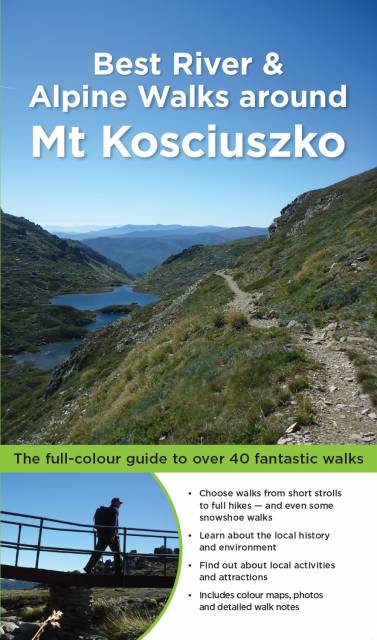
Matt McClelland, Best river and alpine walks around Mt Kosciuszko

Best river and alpine walks around Mt Kosciuszko book cover

Book cover (Courtesy: Matt McClelland, Wildwalks)

For many years now, Mr Gums and I have been going to Thredbo in Kosciuszko National Park for a few days in early January. In other words, instead of heading east to the coast, like many of our city’s residents, we head south to the mountains for a bit of R&R involving bushwalking, dining and reading. Over the years I have picked up various guides to help us – field guides to flora and fauna, general activity guides, and so on. But, until recently, I had not found a good comprehensive book on walks in the Park.

This has not totally deterred us. The Park brochures and the various guides I did find provided us with enough information for us to find and undertake walks. However, I’ve always wanted more and, when I was preparing for last year’s trip, I discovered – via Google – a wonderful website called Wildwalks. They had information on some of our favourite walks, but by no means all. However, I was in luck. Late in 2010, as well us updating and expanding their Southern Kosciuszko walks on their website, they published a book, Best river and alpine walks around Mt Kosciuszko, which details over 40 walks in the very area we like to walk, and so, of course, we bought it.

Along the Rennix Track, Kosciuszko National Park

Mr Gums walking through Derwent Speedwell on the Rennix Trail

The Wildwalks people are a generous bunch though: thorough descriptions, with maps, of each of the walks can be downloaded as pdfs from their website. Of course, unless you travel with a printer*, that means you must decide in advance which walks you plan to do. If you have the book, on the other hand, you can select a walk on a whim – or, on the basis of the weather, on how you feel after the previous day’s walk, on whether you are willing to drive to the starting point (as it is a very large national park), on how much of an appetite you want to work up …

But, enough of that, let’s get to the book. It is nicely produced on quality semi-gloss paper. It includes useful material about the park in general (including weather conditions), and about bushwalking (including safety tips) in particular. It has a map at the front with the walks marked on it, and an excellent table listing the walks so that you can see them all at a glance and check length, difficulty level etc. It has a small but useful index. And it is packed with enticing photographs. The bulk of the book is of course devoted to the walks and is organised (and colour-coded) by region, such as the Alpine Way, Guthega, and so on. There is a section, too, on Snowshoe Walks for those hardy people who go to the mountains in the winter.

For each walk the following information is provided:

  • At a glance inset box providing the Grade (difficulty level); Time; Distance and type of walk (one-way, return, etc); Ascent/descent (in metres); Conditions (amount of shade, water crossings etc); and GPS for beginning and end.
  • Brief description of the walk.
  • Finding the track. In other words, how to find the start!
  • Walk directions. Written directions for the walk, with numbered points which are shown on that walk’s map.
  • Map and relief diagram, on both of which are marked the numbers from the Walk directions.
  • Other information as appropriate, such as, for some walks, variations that can be taken.

Last week, we did four of the walks in the book – three we’d done before and one we hadn’t. We found the guide easy to understand and accurate – right down to timing and assessment of “grade”. We particularly valued the climb information provided – both textually and pictorially – for the ascents and descents involved in each walk. We did find the odd discrepancy – mostly a marker mentioned in the guide that we didn’t see on the ground. Perhaps we missed them or, more likely, they have disappeared (faded, fallen over, whatever!). We also noticed that the pdf descriptions of the walks provided a little more detail – such as distance/time information for each point on a walk – and a contour style map rather than the more schematic one in the book. This difference in maps is due, I presume, to space and page size factors – and is not a critical issue: the walks in general are easy to follow and, anyhow, you can print out the pdf in advance (at no charge) if you wish.

A good quality spiral binding, with an inbuilt book/page marker, would probably make the guide more user-friendly when you are on a walk, but spiral bindings (even good ones) are not as sturdy so the glue (perfect) binding style is probably best.

Overall then, a big thumbs up. This is a well-thought out guide prepared by people who clearly know bushwalking and what bushwalkers (particularly casual, recreational ones like us) want (and need). My sense is that the people at Wildwalks are doing this more for the love than the money – and for that I wave my hiking stick at them. If you walk – or plan to walk – in Australia (specifically, at present, in NSW and the ACT), check them out because they currently have over 900 walks documented on their site.

Matt McClelland and the Wildwalks team
Best river and alpine walks about Mt Kosciuszko
Warriewood: Woodslane Press, 2010
250pp.
ISBN: 9781921606045

* or have downloaded them onto some smartphone device in advance (as you can’t rely on reception once you are out on a walk).

Kate Holden, The Romantic: Italian nights and days

kate Holden, The Romantic book cover
Book cover (Courtesy: Text Publishing)

The romantic, by Kate Holden, is hard to categorise. In an interview with Richard Aedy on ABC Radio’s Life Matters she comments that, despite the success of her memoir In my skin, she was “a little bit uncomfortable with memoir” because it felt a bit “narcissistic”. And so this, her second book, she intended writing as a novel, albeit based heavily on her experiences in Rome. However, as she tells Aedy, her editor told her that most of what she’d written was not fiction, but “life” and so she decided to write it as memoir. So why my opening statement? Well, it’s because this memoir is told in third person.

Who, then, is Kate Holden? Today she is a professional writer living in Melbourne, but she was not always so. In my skin, which I read before my blogging days, is an astonishingly honest chronicle of her twenties when she was a heroin addict and sex worker. The romantic is a sequel of sorts. It tells the story of her year or so in Rome and Naples where she went to further her recovery, to, as she says, find herself. She tells Aedy that she decided on third person to enable her to maintain “critical distance from my own former self” (since the events in the book occurred around 2003) and to give the reader the prerogative of that distance too. Which, I think, is not a bad thing – as this is one very explicit book about, as she says, “the permutations of love, sex and romance”. Sex, though, predominates this threesome, if you get my drift.

Okay, that might be a cheap shot, because Holden is, again, fearlessly honest. The book, told chronologically, is divided into 7 parts, most of them named for a sexual/romantic partner, and some of these partners overlap a little. Throughout the book she alludes to poets – particularly the romantic poets, Byron and Shelley. In fact, each part of the book is introduced with a quote from a poet. In her interview with Aedy, she said that she wanted to be “honest, sincere and authentic like the Romantic poets”. Well, she certainly seems to be that, even if much of what she is being honest about is not exactly “romantic” – unless, that is, we define ongoing self-questioning as “Romantic”.

And here, in a way, is the rub. Holden is not only a fearless writer, she is also a good one. She knows how to string a sentence together, she describes character and evokes place well, and she expresses emotion clearly. But, I’m not sure what the point is for the reader. There is a lot of detail here about relationships – and sex in particular – that is not particularly positive for her. Around the middle of the book she writes:

She wishes to be free, virtuous, brave, joyous. The men around her say she is needy, neurotic, manipulative, disingenuous, hurtful, promiscuous. She knows she is deceptive, duplicitous and cynical. Somewhere in all of this is a portrait. She thinks this; and buries her face in the pillow.

This sort of self-analysis is the flavour of the book so that, in the end, it feels more like something that is therapeutic for her than enlightening for the reader.

The seventh part of the book – a short one named Kate – is introduced by the following lines from Byron:

I am not now
That which I have been.

I certainly hope so because the Kate in this book has, by the end, still not quite found herself. However, her interview with Richard Aedy in 2010 reveals a composed, confident and articulate woman. I look forward to seeing what this woman produces next.

Kate Holden
The romantic: Italian nights and days
Melbourne: Text Publishing, 2010
240pp.
ISBN: 9781921656743

(Review copy courtesy Text Publishing)