Helen Garner, Postcards from Surfers

Helen Garner is a fiercely honest writer – and a prolific one too. She has written novels, short stories, essays and non-fiction books. All are generally well-acclaimed, though not always without controversy (as I mentioned in my recent Monday musings). Certainly, I haven’t always agreed with her … but I do admire her honesty and the quality of her writing. The book I’m reviewing here, Postcards from surfers, is a collection of short stories and provides an excellent introduction to her writing and her (fictional, anyhow) concerns.

Helen Garner, Postcards from Surfers

The collection was first published in 1985, but it has been recently rereleased (2010) by Penguin in their Popular Penguins at a Perfect Price series. Penguin also did an edition in 2008. That says something, I think, about the standing of this collection.

Unlike the last short story collection I reviewed, Leah Swann’s Bearings, this one takes its name from one of the stories in the book, the first to be precise. There is nothing in my copy to indicate whether the stories were written for this collection or whether some or all had been published before. The Resident Judge in her review said that several of the stories had appeared elsewhere before being collected here. I’d like to know when and where: I’m one of those people who always reads that part of the front or end matter for short story collections.

Anyhow, on with the stories. There are 11 of them and while there is an overall theme – the theme that we expect of Garner, that is love and relationships, particularly from the point of view of failure and loss – they are surprisingly (and wonderfully) varied. They vary in length from the little 4-page “The dark, the light” to more hefty first one (the title story) that runs for over 20 pages. The point of view varies: six are told in first person, and five in third person. So does the voice, from a girl child to a male drunk in a bar, from a female friend to a rejected lover. And the style varies. This was its most surprising aspect for me. There is, for example, the seamless flow across place, time and ideas of the first story (which is the more typical Garner), the disjointed vignettes of “The life of art” chronicling a long standing friendship, and the nicely sustained drunken first person rave of “All those bloody young Catholics”.

The subject matter varies too. The title story is about an adult woman coming to visit her retired parents and aunt at Surfers Paradise, leaving a broken relationship and a not fully successful life behind her. I was ready for something more discontented in this story, but the sense we’re given is that she’s matured and has learnt to be content with (tolerant of, perhaps) her imperfect family:

If I speak they pretend to listen, just as I feign attention to their endless looping discourses: these are our courtesies: this is love. Everything is spoken, nothing is said.

(Doesn’t that have a lovely flow to it? Garner’s writing is delicious.) This being Garner, several stories are about broken or past relationships, but there are also stories dealing more generally with families and parenting (“Little Helen’s Sunday afternoon” and “A happy story”) and friendship (“The life of art”).

I once heard Garner in an interview express admiration for the way Elizabeth Jolley reused and retold stories. I felt (though my memory may be failing me here) that she admired Jolley’s risk-taking in doing this (would it irritate or bore readers?) as well as her ability to spin more out of a character or situation. It seems Garner decided that if Jolley could do it, so could she. There is a character, a previous lover, Philip, who appears twice in this collection. He sounds very much like the Philip in Cosmo cosmolino. He represents the lost true love and often appears in her work (under that name or others). Where he is, some pain is usually there too. Here are two excerpts from “Civilisation and its discontents”:

He [Philip] woke with a bright face. ‘I feel unblemished’, he said, ‘when I’ve been with you’. This is why I loved him, of course: because he talked like that, using words and phrases that most people wouldn’t think of saying.

and

I wanted to say to him, to someone, ‘Listen, listen, I am hopelessly in love’. But I hung on. I knew I had bought it on myself, and hung on until the spasm passed.

Helen Garner wears her emotions openly. She’s never afraid to hang out the dirty laundry, to show the darker, more unpleasant sides of human relationships – the selfishness, the jealousy, the unkindness, and of course the pain – but it is always underpinned by a willingness to understand and accept our humanity rather than condemn it. Garner’s world is very much the real world. It’s not hard, I think, to find something in it you recognise (whether you like it or not!)

Helen Garner
Postcards from Surfers
Camberwell: Penguin Books, 2010 (orig. 1985)
ISBN: 9780143204909
154pp.

POSTSCRIPT: I wrote and scheduled this a couple of weeks before my Monday musings post. When I came back to check it I was rather relieved to find that I had not contradicted myself.
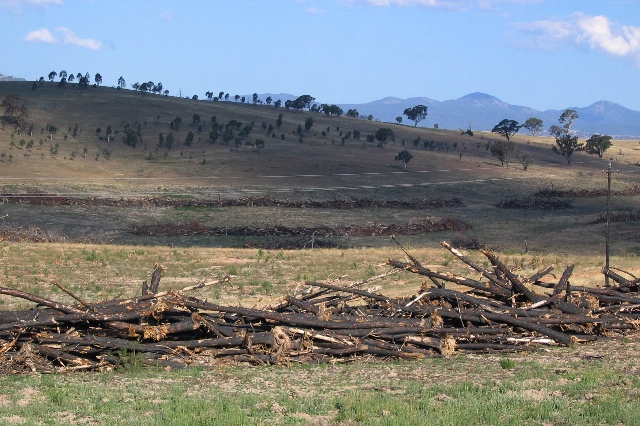
Delicious descriptions from Down Under: Alan Gould on the Monaro (and thereabouts)

Tharwa - Angle Crossing, New South Wales
Monaro country after the 2003 fires

While I love reading to escape to other places and times, other cultures and ways of being, I also enjoy reading about the familiar, about places I know and experiences I’ve had. Alan Gould, whose The lakewoman I reviewed recently, is a local writer. The lakewoman, in fact,  is primarily set in England, France and Germany, but  the hero Alec Dearborn does return to Australia towards the end, and before that often thinks or talks about it. His Australia is the country surrounding where I live, an area we call the Monaro, to be exact.

Here are some descriptions from The lakewoman that describe this region;

He went on to describe the Murrumbidgee River that flowed beside The Dad’s place, how it used to run flush after rain, with the brown waters mounting each other like so many panicky sheep in a pen. How it might be a trickle at the end of a summer without rain, like glassy infrequent spillages between rocks.

and

Sometimes he would try to describe his part of Australia, the streaky, silvery, airy, dry spaces of his pastured and lightly timbered country, sheep standing immobile in fog as the crows called mournfully through the whiteness.

and

How, for instance, a Monaro mist would transform a big brittlegum into a delta of pale grey veins against the white. Or how the last hour of sunlight in this airy woodland could angle so searchingly under the foliage to suffuse the planet’s surface with aureolin gold.

This is not verdant country, nor is it particularly welcoming. But, it is spacious, golden and airy – and it lifts my heart whenever I drive through it. Gould captures its particular variety perfectly.

Talking with Alan Gould

Joseph Conrad
Conrad, 1904, a favourite writer for Gould (Photo: George Charles Beresford, Presumed Public Domain, via Wikipedia)

I didn’t say in my recent review of Alan Gould‘s The lakewoman that Gould attended my reading group’s discussion of his book. I had so much to say – so many thoughts – about the book, that I thought I’d save a report on his comments for another post, so here goes … but first …

Becky of PageTurners wrote a post recently on the impact of having an author attend a reading group discussion of his/her book. She suggested that it can be hard for group members to be honest when the author is present. That’s true of course. Few of us are willing to “attack” an author face to face, particularly when we see what heart (not to mention sheer sweat) has gone into writing the book under discussion. Fortunately, being honest didn’t seem to be a big issue in my reading group’s discussion with Alan Gould. Some found it slow at the start, and some asked him about the resolution, but all seemed to have enjoyed the book and his writing as a whole. For me, having an author present can add benefits that outweigh this honesty concern. See what you think from this report of our meeting with an author, because Gould, like Halligan when she joined us for her book, was articulate and generous in sharing his ideas with us.

Gould on his influences

  • Joseph Conrad (and, before him, Emily Bronte), who taught him about timing, something Gould plays particular attention to in his writing. I particularly liked the timing and pacing in The lakewoman, but I wrote a little about that in my review so won’t go on about it here.
  • Thomas Hardy, who uses coincidence, arguing that it’s coincidence that makes a story a story, if you know what I mean. Gould did say though that Hardy tended to use coincidence in a realist setting, whereas for him coincidence helped create the sense of magic or enchantment. He said his aim was to use coincidence in a way that would be psychologically or practically plausible but that also added a sense of mystery. One of the things I enjoyed about the novel was its somewhat mystical tone – the sense that things were occurring on a slightly “higher” plane than pure logic.
  • Shakespeare, who taught him that the key to writing a novel is to quickly establish “the calibre of the character’s intelligence”, that is what makes that character tick, what his/her mind is like. He gave Iago as an example and explained how Shakespeare establishes early on “who” Iago is. This is certainly what Gould does with Alec Dearborn in the novel. We get into his head quite early and gain a clear understanding of what sort of person he is and why he might be open to Viva’s influence.
  • Roger McDonald, an Australian novelist, who encouraged him to try writing a novel (instead of poetry) by saying that “a novel begins with a sentence”. Gould then talked about a few of his books and how this idea works for him. This first sentence, he said, does not always end up being the first sentence of the book but it is the kernel that gets him going.

Gould on writing novels versus poetry

Gould started as a poet and now writes both. He told us that he writes them alternately, that he can’t write poetry and a novel concurrently, because it’s like “changing from an art form tilted to music to one tilted to history”. He further explained this as being related to “time”. Poetry is a case of “and now and now and now” while novels are more “and then and then and then”. I’d love to hear what you think of this. I found it an interesting concept, though my first reaction was to think “but…” And yet I think I see his point, at least in general terms because of course there are always exceptions. Poetry is, I suppose, often about capturing a moment, while a novel does usually cover a period of time with at least some elements of cause-and-effect (even those novels, like Virginia Woolf‘s Mrs Dalloway or McEwan’s Saturday that take place in a day).

Gould on The lakewoman

And of course, he talked about the book, in particular. It was inspired he said by the poet David Campbell, though Alec Dearborn is not Campbell. Rather, it is Campbell’s combination of physicality (he, like Dearborn, was a rugby player) and “a lyric sensibility” that Gould tried (successfully I think) to capture.

He also wanted to write a “romance” in the old sense of the word. He defines this as being about a hero on a quest, who thinks he knows what he’s about until he meets someone who shakes up this idea. Viva is this catalyst for Alec. She is an utterly practical woman – something we see played out through the novel from the way she saves Alec from drowning at the beginning to how she plans to conceive a child towards the end – and yet she has an aura of enchantment, starting from that first moment when she appears by the lake as he lands from the sky!

He said a lot more – particularly about some of the images and motifs he used in the novel – but I’ve probably written enough, so I’ll just share his answer to my last question, which was about his favourite contemporary writers. After prevaricating a bit on the definition of contemporary, he named the following Australian writers and books: Inga Clendinnen (not a novelist), Helen Hodgman’s Blue skies, Shirley Hazzard’s Transit of Venus, Kate Jennings’ Snake, Christina Stead’s For love alone, Randolph Stow, and Tim Winton’s Cloudstreet. No wonder I enjoyed his novel, he has great taste.

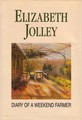
Elizabeth Jolley, Diary of a weekend farmer

Elizabeth Jolley's Diary of a weekend farmer

Bookcover (Image courtesy Fremantle Arts Centre Press)

I took 2 valium and went to bed early (Monday 12th October, 1970)

Elizabeth Jolley’s Diary of a weekend farmer is one quirky memoir (if you can call it that). And yet it is, really, exactly what you might expect from a writer who rarely wrote the expected!

It is a slim volume – illustrated with warm, shimmery paintings by West Australian artist, Evelyn Kotai. The diary entries were written by Jolley at irregular intervals from 1970 to 1974 (probably), and are accompanied by poems by Jolley, plus the occasional contribution from her husband Leonard and daughter Ruth. Some of the entries are reflective

… being on this piece of land makes me feel very much aware of the shortness of life, I mean our human life in comparison with the land and the big old trees. (from Monday 6th [September, 1971] continued)

while others are factual

Ruth and I tried to plant tomatoes ground too dry and hard. (from 10th November 1970)

As you can see, little care (or perhaps a lot of care – how are we to know?) is taken with punctuation.

Jolley’s trademark wry, or even wicked, comments are in evidence

Next door’s place has been well cleared and conquered I think the word should be … (from 11th November 1970)

There is, in fact, a tiny plot running through the book and it has to do with the “neighbour woman”. She appears regularly as a rather ambiguous presence who doesn’t respect Elizabeth and her city-slicking family, and their farming endeavours, but offers some useful advice at times. Much of this “plot” is carried though a poem (“Neighbour Woman on the Fencing Wire”) which continues in sections throughout the book:

I suppose you didn’t notice last Sunday evening
you left your rake and mattock out …
(from “Continuation from the Fencing Wire”)

This woman is a little thorn in Jolley’s side – always pointing our her failings – and yet at the end, Jolley’s underlying compassion becomes evident as she writes of the “neighbour woman’s death” and her husband’s grief:

… and I understood I was face to face with someone who really loved the neighbour woman and that he would never get over something that is brushed aside in the word bereavement. (from No date required)

But, what this little volume particularly shows is her love of the land – along with her recognition of its challenges. Here’s one example:

Is it an alien place resisting or is it retreating from all our human endeavour. And then the doves fly up glowing in the rising sun and the sound from their wings is like a tiny clapping. (from Monday 25th February, 1973).

There is a very Jolley-esque tension here between an almost mystical beauty and a power that is not always benign.

And here is a reference to gums and their widow-making capability:

The wind moves the trees great branches fall
In the wind or in the stillness
A few feet nearer and I should have been crushed
Into the greater stillness.
(from “Great Branches Fall”)

These diary entries were made before her first book, Five acre virgin, and other stories, was published in 1976, though she’d had individual short  stories published from the 1960s on. When I read memoirs by writers, I look (of course) for references to writing. There is not much here, though. Besides the mention of something her husband said as being “a very good 1st sentence”, the main reference to her writing is this:

I finished the story “Pear Tree Dance” for the BBC, an idyllic ending! The newspaper of Claremont Street contains the grim and sinister side of things. (from 19th August 1971)

She’s right about that. Newspaper is one of my favourites of hers but it is rather grim. It was not published until 1981 … and is about a woman who wanted her own piece of land. I think I’ll leave it here – and let you ponder that idea!

Elizabeth Jolley
Diary of a weekend farmer
South Fremantle: Fremantle Arts Centre Press, 1993
ISBN: 1863680438
95pp

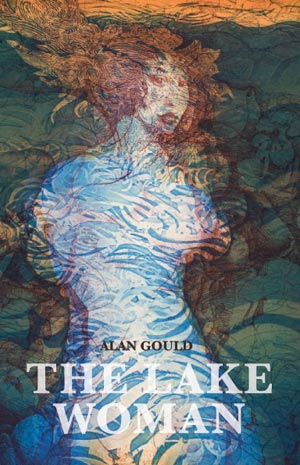
Alan Gould, The lakewoman: A romance

Alan Gould, The lakewoman

Book cover (Courtesy: Australian Scholarly Publishing P/L)

I’m a little embarrassed to say that until The lakewoman was shortlisted in the 2010 Prime Minister’s Literary Awards, I only knew of Alan Gould as a poet. Turns out, though, that he has written several novels, of which this one is his most recent. It is, ostensibly, a war novel, in that much of it is set in or around World War 2, but it is not in fact about the war.

It’s an intriguing book that slides literally and metaphorically between the solidity of the earth and the fluidity of water, between pragmatism and magic (or enchantment). It tells the story of Alec Dearborn, an Australian grazier’s son who was born in 1918. He goes to Cambridge in England and, when the war starts, decides to join up with the British Army rather than return home. The novel starts with his having landed in a lake, after parachuting from a plane for the D-Day Invasion. He is drowning, dragged down by his weapons bag and parachute, but is rescued by – yes – a lady in a lake. Ha! Now you see why it is called a “romance” because, while it contains “a” romance, it also hearkens back to the “romances” of yore, like the Arthurian legend. Here is the set up, pp. 2-3:

As he vomited he also wondered why this sudden young Mamzelle happened to be present at the exact, unlikely spot in France where his foolish body had come to earth. It was a question that would usefully occupy his mind later, when he was behind the wire with the austere leisure to brood on the magic that settled into his life following this, his fluky rescue. Magic? He was not a fellow given to outlandish notions, and would interrogate the dubious word, looking for its sense, not in mumbo jumbo, but as some friable quantity existing within the very crevices of everyday occasions.

In this passage, we see how carefully Gould has laid out his novel. He introduces us to the ideas of coincidence (fluke) and magic versus the everyday business of living, and he uses foreshadowing to distract us from plot issues (what will happen next) towards more interior ones (what is the meaning of what happens). As the novel progresses, this fellow who is not given “to outlandish notions” finds himself drawn, almost telepathically (it seems), to his rescuer. She , Viva, rather like the Arthurian lady-in-the-lake, frames the rest of his life, one way or another.

What happens on the surface of the novel is fairly matter-of-fact. Alec’s life runs its course in a mostly unremarkable way. One of the central questions of the book is that which Alec poses to his sister, Bell, a little while after he returns to Australia:

What I can’t work out is […] Well, how a person knows whether the existence he’s been given has been of value to anyone else.

This is Alec’s conundrum. He does not fulfil the traditional expectations of a grazier’s son (“Dearborn”, after all), despite his “prospects” : he’s intelligent, sensitive, and physically capable (“the dynamism in balance with the dreaminess”). Much of this failure stems from his being “disarmed” on June 6, 1944, by Viva. There are some lovely, appropriate wordplays in the novel, and one of these centres on the idea of disarming/arming, which works beautifully against the novel’s military background:

‘If you think about me, then, when you are gone, I will be arming you still,’ she assured him, mysteriously.

Soon after he leaves her, he ponders what has occurred:

‘I feel distress at having relinquished you,’ he supplied on consideration. For it was distress, he recognised, to be walking away from this sudden new claim on his life. ‘It is this that has disarmed me, I reckon,’ he explained for her.

I will be arming you, she reminded.

It is difficult with this WordPress theme to get the formatting right: this last statement by her is in italics in the novel and suggests either his memory of her words or an actual telepathic communication. Which one it is, is one of the lasting ambiguities of the novel. Italics are used throughout the novel for “communications” like this and for interior monologues/reflections, usually Alec’s, since this is a third person narrative, told mostly from Alec’s point of view.

By now you may be thinking that this novel is a fantasy, even a romantic fantasy, but not so. Neither is it magical realist. It’s simply that there is a sense that slightly mystical things may be happening, things that make sense psychologically but that also convey another plane of human thought and behaviour. It reminded me, at times, of Patrick White‘s Voss, but to suggest more than that would be to do it a disservice because it is not at all derivative. Rather, it is simply that the story focuses on a dimension of experience that can’t always be logically explained but that is nonetheless very real. Gould has, I think, pulled this dichotomy off, by careful manipulation of tone: through language that is poetic but not overdone; a pacing that is meditatively slow at the beginning and pragmatically faster at the end; evocative chapter titles (such as “To Fling the Lovely Foolish Body”, “Had You Down Dead”); the occasional light touch (“‘You are the invasion?’, she asked”); and timing that foreshadows just enough to make sure we stay focused on the ideas and not the facts.

And for me, the main idea (the one that provides an “undercurrent” to all the others) is that of completing the self, which is something Alec struggles  to do. In the end though:

…the joy, the completion was her presence, and the talk was strangely superfluous. Yet by convention they did talk from some region of the mind where the words did not especially matter but the proximity of the person created an entirety of being.

This is a rather melancholic, but by no means sentimental, book – and it moved me deeply.

Alan Gould
The lakewoman
North Melbourne: Arcadia, 2009
296pp.
ISBN: 9781921509346

Monday musings on Australian literature: Reverse expats

Several months ago I wrote a Monday musings post on Australian expat novelists, so I thought it was only fair to write one on reverse expat novelists, that is, writers from elsewhere who have settled in Australia. Because, yes, some people DO come here as well as leave!

For this post, I’m choosing a few writers who settled (permanently or semi-permanently) in Australia in their adult lives … they are all English or South African born. (I wonder what that says? We are, of course, all Commonwealth countries, which may have some bearing on it all … but after that, I’ll leave it to others to ponder.) And, because I need to choose some order in which to list them, I’ve chosen the order of their arrival in Australia.

Elizabeth Jolley
(born in England in 1923, arrived in Western Australia in 1959, died in Western Australia in 2007)

Regular readers of my blog will know that Jolley is one of my favourite writers. All her novels were published after her arrival in Australia. In fact, like many authors, she was rejected many times before her first books, Miss Peabody’s inheritance and Mr Scobie’s riddle, were published in 1983. All the books of hers that I’ve read, with the exception of the autobiographical novel My father’s moon, are set in Australia though travel elsewhere does occur in some.  Jolley clearly settled well into Australia – and in 1970, when still living in Perth, she and her husband bought a 5 acre rural property outside of Perth. She chronicles this in her delightful “memoir” (if you can quite call it that), Diary of a weekend farmer. It is very much diary-style and starts with the search for land. You might like this one (from 10 October 1970):

Told of another place Mount Helena drove there, like a place in a Patrick White novel 27 acres covered in scrub and burned trees old cars and trucks, washing machines, it was like a dump, several dogs so turned the car as quickly as I could.

A week later, though, they find just the spot. It sounds English by her description (17 October 1970):

Serene. A high verandah, a fig tree, a loquat, honeysuckle, a hedge of rosemary. A gentle slope of bush down to a meadow, stream on land at both bottom corners …

And on 6 November she says “You look across to Tolstoy country. A paddock with horses running …”

It is however Australian – the snakes and bushfires tell us that. And, it is clear, this land, this experience, informed much of her writing, including, specifically, The five acre virgin and other stories, and The newspaper of Clarement Street.

Peter Temple
(born in South Africa in 1946, arrived in Australia in 1980)

Temple is one of Australia’s best regarded crime writers. In fact, his latest novel Truth was, rather controversially, the first genre novel to win our top literary award, the Miles Franklin. As with Jolley, all his novels have been published after his arrival in Australia and they are, at least to the best of my knowledge as I’ve only read two, set in Australia and very much imbued with Australian landscape and culture. His description of the land (in Victoria this time) in The broken shore sounds a bit Patrick White too:

Early settlers planted cypress trees and hedges as windbreaks around their houses. It worked to some extent but the displaced wind took its revenge. Trees, shrubs, hedges, tanks, windmills, dunnies, dog kennels, chickenhouses, old car bodies – everything in its path sloped to leeward.

Nicholas Shakespeare
(born in England in 1957, first visited Tasmania in 1999 and now divides his year between Tasmania and England)

Unfortunately, I haven’t yet read any Shakespeare, but I have Snowleg on my TBR pile and I have been wanting to read The dancer upstairs for some time too. So, I’ll just report on him using an interview with Susan Wyndham in 2007. He said that  “the thing about Tasmania that’s exciting for a writer is how close to the surface history is”. And, guess what, Patrick White rears his head again. Shakespeare tells Wyndham:

In my shed, one of the discoveries I made was Patrick White and The Tree of Man. It is extraordinary the way he took a marriage through all its vicissitude; most writers don’t take on that challenge.

A commenter on Susan Wyndham’s blog described his book Secrets of the sea as “So Australian with a strong thread connecting to Britain”. I must, must, must get to this writer.

Coetzee, Poland, 2006 (Photo: Mariusz Kubik, from Wikipedia, using CC-BY-SA 3.0)

JM Coetzee
(born in South Africa in 1940, arrived in Australia in 2002)

Coetzee, of course, had an established literary career before he arrived in Australia, but his rather stellar career has continued unabated since then. Elizabeth Costello concerns an Australian novelist, and Diary of a bad year is set in Australia. These books tend to the intellectual or philosophical, yet they too reflect on Australian culture often counterpointing international concerns. Coetzee is a rather reclusive man, but I have managed to once hear him speak. He briefly introduced and read from Slow man, and then immediately left the podium. There was, in other words, no opportunity for questions and answers. While that was a pity, I bear him no grudges. He is a writer after all and doesn’t have to join the literary promotion juggernaut if he doesn’t want to!

I’ve chosen these four reverse expats because they are of particular interest to me. There are others, such as British comedian and writer Ben Elton, and best-selling South African born author Bryce Courtenay. Having lived overseas on a couple of occasions, I am fascinated by the decision people make to leave their homes permanently for another country. There are many reasons why people might do so – political (of course), economic, personal (such as having a partner from another country), cultural, and so on. Some of you who read my blog have, I know, made the jump. I’d love to hear your perspectives on being an expat.

Delicious descriptions from Down Under: Thea Astley on oddballs

Thea Astley is one of my favourite writers and so I thought my next Delicious descriptions should be from her. It won’t be the last because her writing is truly delicious. Up till now, my Delicious Descriptions have been of landscape/environment. This one  is about people. It’s from Drylands (1999), her last novel (or, really, a set of connected stories) and fourth Miles Franklin Award win. Its subtitle is “a book for the world’s last reader” and it’s based on protagonist Janet’s belief that “no-one’s reading anymore”,  that “smartarse technology” was invading people’s lives and resulting in alienation and disengagement. (What would she say about the rise of e-books?) Astley exaggerates, of course, but her belief in the social disintegration that inspired the book is palpable.

It is full of evocative quotable writing, but for this post I’ve chosen one that describes the characters of the town, Drylands, that Janet lives in:

What’s great about these godforsaken holes, Janet decided next morning, leaning over her small balcony and watching the place rub its eyes and start to wake up, are the oddballs. They stand out. You meet them. They enrich. No. More. They furbish the day.

Furbish the day! Thea Astley may have passed on to the big library in the sky, but she left behind an astonishing body of work that can’t help but furbish the days I choose to dip into them.

Leah Swann, Bearings

Bearings bookcover, by Leah Swan

Bookcover (Courtesy: Affirm Press)

When I read a collection of short stories, I look to see whether there is an overriding theme. It’s not essential that there be one, of course, but it can add to the satisfaction, if only because looking for a theme forces me to think a little more about what I’ve been reading. Well, I didn’t have to look too far with this most recent collection, as the title pretty well gives it away. Bearings, by Leah Swann, is a collection of seven short stories and a novella and, as the back cover blurb says, is about “challenging the course of our lives and keeping a foothold during unpredictable times”. That’s a pretty good description and, I must say, it’s appealing, for a change, to have a short story collection whose title is not that of one of the stories within.

Bearings is the fifth book in Affirm Press’s series, Long Story Shorts. (I reviewed the fourth one, Having cried wolf, a few months ago.) It’s a gorgeously produced series. The books are a little more squat than the usual paperback, and each has a cover designed by Dean Gorissen. They are books you want to hold (fondle even) and look at.

Anyhow, on with the show. This is a varied bunch of stories. Some are told in first person, some third, and the first story is told in the less common second person. The subject matter includes broken families, suicide, grief, foster children, and motherhood. That is, all those things that happen in people’s lives to challenge them. However, as the title suggests, the stories are not totally depressing. Sad at times, yes, but not hopeless. They are more about finding ways to survive the challenges.

The stories grew on me. It’s not that I didn’t like them from the start because I did, but I think the writing got surer and more interesting, less predictable, by the end. Whether, of course, they are presented in the order written I have no idea. Probably not, but that’s how it feels. Of the first few stories, I especially liked “All the mothers”, a first person story about a foster child. He starts off as a naive narrator, not quite understanding what is happening as he moves from “mother” to “mother”. Take, for example, Mr Gordon who sometimes gives him an Eskimo Pie “especially if I have a cuddle”. When Mrs Gordon catches him on Mr Gordon’s knee one day, she pulls him off but he’s mystified: “I keep saying I’m okay, but she doesn’t believe me. Or maybe she’s not listening”. Gradually, of course, he becomes less naive and, more angry. It’s a well realised, psychologically real, slice-of-life story.

The central novella, “Silver hands”, is a little predictable. You can see most of it coming before you get there, but it’s nonetheless a good read because the characters are engaging and the language is fresh. I enjoyed descriptions like this:

His laugh goes up and down the scale like a hammer on chimes.

And this one on a woman starting to see signs of aging:

My skin is drying like the pages of a manuscript lettered with childbirth, lovemaking, nicotine and alcohol, and under it all the bones are losing density. But the letters of my true being are not written here. I am not only my body. I’ve never believed that yet here I am mourning it, sucked into that great big lie, measuring myself by flesh more than ever.

This is (obviously) a first person story. The set up is a marriage in the process of breaking down, but it’s more about how experiences in our past can come back to bite us if we don’t properly address them at the time. There are some “mysteries” for the reader to uncover and Swann plots them nicely. An enjoyable read.

My very favourite stories though are the last two, “The Easter Hare” and “The Ringwood Madonna”. Many of Swann’s protagonists are artists – potters, musicians, painters, writers – and this is so in these two stories. “The Ringwood Madonna” is about an artist who is struggling with motherhood, about how she meets a homeless tagger and engages in her own little act of rebellion. She creates a Madonna poster which she pastes like graffiti on a railway cutting wall. It attracts a lot of attention but an art expert says that holy images should not be sprayed around town. However,

Her graffiti Mary was  – to her – a beautiful lamp in suburban ugliness. A gift. Subconsciously she’d hoped that by creating Mary she would create beauty inside herself, she could see that now. And she had felt warmth when she was creating. Yes. Even joy.

The story’s conclusion nicely resolves some of the conflicts in her life while also making a comment on art as being not only about expression but communication too.

“The Easter Hare” takes place over Easter (of course) and beautifully reflects on the Easter story of death and redemption through a loose parallel describing a suicide and the response of strangers to it. It’s a finely told tale, and its conclusion brought tears to my eyes.

Swann describes the mother in “The Easter Hare” as wanting to write an Easter story for her children that is not “bloody and harsh” like the Crucifixion story, as wanting, rather, to “create something gentler for them”. This seems also to be what Swann wanted to create for us. She chronicles the challenges, sufferings and miseries of life but, as her title suggests, her worldview is a positive one, one that believes we can all find our “bearings” if we just take the time to look for them. This collection would be a good place to start.

Leah Swann
Bearings
(Series: Long Story Shorts, 5)
Mulgrave: Affirm Press, 2011
198pp.
ISBN: 9780980790429

(Review copy supplied by Affirm Press)

Monday musings on Australian literature: Writers from our Deep South

Yes, Australia has a “deep south”, though we may not necessarily call it that. It’s Tasmania, an island hanging off the southeast of mainland Australia. Like Western Australia, it can sometimes feel like another country. You have to go over the sea to it – and when you get there, you sometimes find yourself saying, “In Australia …”. Very embarrassing when you catch yourself doing it, but it does reflect how “different” Tasmania can seem. It can feel a bit English – it’s cooler, greener and more compact. And, because of its relative insularity, there are, I have to say, jokes about the mental acuity of its inhabitants (like those you also hear of about places like Appalachia). Totally unfair of course! Not only does my brother live there, but Tasmania is home to some significant Australian writers, not to mention creators of all persuasions. Peter Sculthorpe, who is arguably our most famous composer, is a Taswegian.

Saltwater River penal settlement ruins

Ruins of penal settlement at Saltwater River

Tasmania has a rather dramatic history, from the early days of white settlement when it was home to some of our worst convict prisons to more recent times when it has been at the centre of some of our most dramatic conflicts over the environment. It is also where one of the worst shooting rampages in the 20th century occurred (in 1996). Add to this the fact that it contains some of Australia’s most beautiful and inaccessible wilderness, and you can see why gothic is part of its literary tradition.

Probably the state’s two most famous writers are Marcus Clarke and Richard Flanagan, and Gothic influences can be found in the writings of both. Marcus Clarke wrote what is probably regarded as the Australian convict novel, (For the term of) His natural life (published in 1874). It tells the story of a young man wrongly transported for murder, and it documents the worst of the convict system. It is an Australian classic – and has been adapted to film and television.

Richard Flanagan is a contemporary writer and environmental activist. Most of his books are set in Tasmania. Gould’s book of fish (2001) is another convict novel and is inspired by convict artist, William Buelow Gould. It’s some years since I read it but I’d recommend it for its evocation of the horrors of colonial Tasmania in a voice you don’t quickly forget. Here he is on George Augustus Robinson (Chief Protector of Aborigines in Tasmania, 1839 to 1849):

Robinson treated the savages as though they were his entourage, & the savages treated him like he was one of the many stray dogs they picked up on their travels. Neither seemed to notice the earth falling away beneath them as a breaking wave.

No indeed… Gould’s main subject, though, is not the plight of “the savages” but his own survival in a world not kind to the poor and powerless:

For as Capois Death said, if shit ever becomes valuable, the poor will be born without arseholes. That was our fate, & I didn’t pretend I could alter it. I only wished to survive as best I could …

It is hard to find excerpts from this wild novel that make sense out of context, but I hope these two will give you a sense of the language and black comic tone. Flanagan’s latest novel Wanting (2008) also deals with Tasmania’s early colonial days and is similarly worth reading.

As with my post on Western Australian writers, I’m not going to give you a long list, so I’ll just mention a few other writers. High on my TBR is Jessie Couvreur (or Tasma). She migrated to Tasmania with her family as a young child in the early 1850s and lived there until her marriage. The book I have is her A Sydney sovereign and other tales (1890), but she also wrote novels. Anyhow, the first story in my book is titled “What an artist discovered in Tasmania” and concerns one Richard (“who is an artist, perhaps, more in sentiment than in execution”) and his trip to Tasmania (from England) to find “the most hardened criminal on earth” to sit for a portrait. When he announces his plan, his sister Polly asks where Tasmania is, and here is the narrator’s response:

Kind Tasmanians – whose blossom garlanded isle is the original Eden of the Anthropoghagi; whose aromatous breezes greet the pallid stranger, and efface from his recollection the haunting odours of Yarra* bank noisomeness – do not stigmatise Polly for her ignorance. She had been through a course in  school geography, and had mastered, you may be sure, the latitude and longitude of Hobart Town, just as she had mastered the latitude and longitude of Acapulca; but somehow the whereabouts of Tasmania had escaped her.

There is a delightful tongue-in-cheek tone to the story of an artist who doesn’t quite find what he went looking for … I must read the rest of the book.

Other writers from Tasmania worth checking out (but they aren’t the only ones) include novelist-essayist Amanda Lohrey, poet Gwen Harwood, and novelist Helen Hodgman (who emigrated from Scotland with her family, when she was a teenager, and some of whose novels are now being re-released by Text Publishing).

How I dreamed of Paradise,
this southern land at the world’s edge,
weeks of blue water separating old from new.
I tasted air in my dreams,
faint hills, mounds of whales;
the beginning of things.
(from Jane, Lady Franklin, by Adrienne Eberhard)

For all its ferocious past, Tasmania is a place many Australians dream of as our little Paradise down south. If you never have a chance to get there, you could do worse than check out some of its writers.

* With apologies to Melburnians. This is Tasma writing, not me!

Monday musings on Australian literature: The Australian bildungsroman

Miles Franklin

Miles Franklin, c. 1940s (Presumed Public Domain, via Wikipedia)

I know the sad truth. About everything.
(Craig Silvey, Jasper Jones)

In past posts, I’ve talked of enjoying coming-of-age novels (aka bildungsroman) and so today I thought I’d share 5 (cos 5 seems like a manageable number for a list like this – and gives you an opportunity to contribute your own!) Australian novels in the genre.

In the introduction to a course on “The European bildungsroman” at Columbia University in the USA, there is a brief discussion on the definition of the term. The unnamed writer (so let’s call him/her Columbia) of the introduction says:

My particular approach to defining the genre … returns to Dilthey‘s original definition. According to Dilthey, the prototypical Bildungsroman is Goethe’s Wilhelm Meister’s Apprenticeship in which the hero engages in a double task of self-integration and integration into society.

Columbia then expounds a little on this definition arguing that, while Dilthey see this as an affirmative, conservative genre which aims to find the “hero” a productive place in a valid society, s/he sees it as involving a tension – that between “the priorities of self-integration and social integration”, between personal desire and social obligation. For Columbia this tension is a major criterion for the Bildungsroman genre. This makes sense to me … perhaps this tension isn’t an issue for every young person who is coming of age, but a coming-of-age story without that tension, without some conflict to resolve, is probably not going to be interesting to read!

(By the way, I’m not sure that this necessarily negates Dilthey’s definition. The difference between Dilthey and Columbia seems to me to be that Dilthey focuses on the end result, while Columbia focuses on the process which may or may not culminate in Dilthey’s goal.)

And so, five Australian coming-of-age novels (choosing from those I’ve read):

  • Miles Franklin‘s My brilliant career (1901) is probably Australia’s best known book of the genre. It’s a semi-autobiographical novel about Sybylla, a young girl on an outback property who must choose between her passion for a man and her passion to be a writer. It was made into a film by Australian director Gillian Armstrong.
  • Henry Handel Richardson‘s The getting of wisdom (1910) is another novel about a blue-stocking girl. Laura’s innocence and idealism are sorely tested by the city sophistication of her well-to-do peers. In this story, the awakening is more intellectual and philosophical than sexual. According to the Henry Handel Richardson Society, this novel was admired by HG Wells. It was also made into a film.
  • Melina Marchetta‘s Looking for Alibrandi (1992) is a young adult novel (and, later, a film) which adds an immigrant background to the heroine’s challenge. Not only is she a young intelligent girl who confronts her awakening sexuality but she must do so within the strictures of a conservative Italian family.
  • Tim Winton‘s Breath (2008) explores the youthful drive to prove oneself, to take risks, and the complications that arise from choosing an imperfect male role model and from becoming embroiled in a rather unhealthy sexual relationship with an older woman. Eva is no Mrs Robinson. The question left for the reader at the end goes to the heart of Columbia’s disagreement with Dilthey.
  • Craig Silvey‘s Jasper Jones (2009) is set in rural 1960s Western Australia and, with a nod to To kill a mockingbird, combines a somewhat Gothic mystery with a more traditional coming-of-age story. Racism (against immigrants and indigenous people), sexuality and learning who you can trust are some of the adult issues that Charlie confronts in his growth to maturity.

I’m intrigued by how many of these books have a rural or small town setting. (Even Laura, in The getting of wisdom, is a country child, though the book is set in a city boarding school. Looking for Alibrandi is the only truly urban novel here.) Is this because we equate country with innocence? Because rural life tends to be more conservative and therefore presents a greater challenge to a burgeoning self? Is it simply that the books I’ve chosen are not representative? Or? What do you think?