Monday musings on Australian literature: Writers from Victoria

Coat of Arms of Victoria (Australia)

Victoria's Coat of Arms (Presumed Public Domain, via Wikipedia)

Over the course of these Monday musings have been occasional posts on writers from specific geographic locations in Australia – but I have not done our two most populous regions, the states of Victoria and New South Wales. The time has come to confront there two – and so, today, I present you Victoria.

Now Victoria is a special state – not only does Mr Gums Jr live there, but its capital Melbourne was the second city to be designated as a UNESCO City of Literature! That’s a pretty impressive achievement. I have written some literary road posts on Victoria, which have mostly focused on writers and works from the past, so in this post I will, as I have done in other regional posts, list (in no particular order) five of my favourite current writers from Victoria – some were born there, some migrated there.

Helen Garner

Garner is one of our most controversial writers – and has been, really, since the publication of her first novel, Monkey Grip, which some critics argued was simply her writing her own life. They meant by this that it had no creative merit, no literary value. This didn’t deter our Helen though, and she has gone on to become one of our significant writers – of both fiction and non-fiction. She has also written some successful screenplays. She writes about relationships and the things that cause disconnects between people, no matter how much they wish it might not be so. As regular readers of this blog will know, I don’t always agree with Garner, but I am always happy to read her because the woman has style. I’ve read too many of hers to list here, but if you’d like a recommendation, please ask!

Elliot Perlman

You may not have heard of Perlman, particularly if you are not Australian, because he is not particularly prolific. The first novel of his that I read was the multiple point of view Seven types of ambiguity (which makes a sly reference to literary theorist William Empson‘s book of the same name). It’s a good, thoughtful book about love and obsession, and the ambiguities therein! I then read Three dollars which explores the question of what happens “when bad things happen to good people” and how consumerism challenges (compromises) our values. It was adapted for film, starring the gorgeous David Wenham (aka Diver Dan if you are a Sea Change fan). Both these novels are set in Melbourne. According to Wikipedia he has a third novel out this year.

Arnold Zable

If you have been reading this blog recently, Arnold Zable will need no introduction. His focus is human rights, with a particular interest in the migrant experience. I’ve read two of his novels – Cafe Scheherazade and The sea of many returns – and will happily read more. His prose is lovely, his attitude warm and generous. I’m looking forward to reading his new novel, Violin lessons.

Beverley Farmer

I’m going to throw in a somewhat forgotten, I think, writer here. Way back in 1988 when my reading group started, we focussed on Australian writers, particularly Australian women writers. One of those was Beverley Farmer. We read her collection of short stories Milk and not long after I also read her second collection of short stories, Home time. Both these were published in the 1980s. She has also written novels, and one of those writers’ notebooks, A body of water, in which she documented her ideas and thoughts over a year, the books she was reading, the people she met. I was drawn to her because of the evocative way she conveyed her experience of being a young Australian wife in a Greek village. Like Perlman, she’s not prolific, but in 2009 she was awarded the Patrick White Award (for writers who “have made a substantial contribution to Australian literature but … may not have received adequate recognition for their work”) which says something about the quality of her work.

Peter Carey

I’ll conclude on another controversial writer. People, it seems, either love him or hate him – and I fall more in the first camp. He is one of only two writers to have won the Booker Prize twice. I have by no means read all of his books but I like the fact that he takes risks in his writing. I think his Oscar and Lucinda is a worthy contender for the Great Australian Novel (should we take that notion seriously). His True history of the Kelly Gang makes a significant contribution to the Ned Kelly myth by attempting to tell the story in Kelly’s voice. It is not all “true” in the factual sense, but it contains a “truth” that Carey thought worth exploring. His most recent novel, Parrot and Olivier in Americatook more risks – in voice and subject matter. Carey, as many of you will know, now lives in New York, but he was born in Victoria – and that’s good enough for this post!

So there you are, five Victorian writers. Now’s your chance to tell me what Victorian writers you like – or simply whether the writers I’ve listed here interest you.

Leslie Cannold, The book of Rachael

Bookcover Leslie Cannold The book of Rachael

The book of Rachael (Cover image: Courtesy Text Publishing)

For someone who doesn’t seek out historical fiction, I seem to have read a lot of it lately. Leslie Cannold’s The book of Rachael is the third historical novel I’ve read in succession – and it’s the third with an author’s afterword/postscript, which suggests to me some uncertainty in the writers about historical fiction. Tansley quoted Doris Lessing’s statement that fiction is “better at” the truth than the factual record. Brooks addressed concerns that the imagined record might be interpreted as fact. Cannold takes a different tack. Her book, like Brooks’, involves an imagined heroine telling a story about some “real” historical people, in her case Joshua (Jesus) and Judah (Judas). Cannold writes:

I wonder now whether it really makes sense to call this sort of writing historical fiction. Can setting entirely fictional characters to roam in the landscape of a multi-authored, oft-redacted religious tale really be described as historical? Not if the criteria include scholarly examination of verifiable, chronologically ordered events. So, I don’t think of “The book of Rachael” as historical fiction. I think of it as the bringing to life of a fictional character by evoking the time and place in which the character’s story is set. In “The book of Rachael” I have set the fictional sisters to roam across the historicised terrain of the gospels.

Hmm … I’m not going to get into definition discussions here. It is what it is, regardless of what we call it, and in this case it’s a first person story of Rachael, the invented sister of Jesus and wife of Judas. The rest as they say is (more or less) history … at least as far as the Jesus and Judas story goes. But, of course, there’s more to it than this. Cannold creates a whole life for Rachael from her childhood in Nazareth, as the second daughter of Yosef and Miriame, to her life post-Crucifixion. She’s a girl out of her time – something even her rather hard mother recognises (“Oh Rachael … how hard the world is for you”). She chafes under the strictures of being female (learning “in no uncertain terms what it meant to be a girl”). Like Brooks’ Bethia she wants to learn and so she listens in to her brothers’ lessons when she can. Also like Brooks’ Bethia, she channels some of her intelligence and curiosity into studying to be a healer, as an apprentice of the old crone Bindy. Then she meets Judah, angry young rebel to the gentler, more humble Joshua, and the book seems to shift a little on its axis.

Leslie Cannold was named one of Australia’s top twenty public intellectuals in 2005, and this year she was named Australian Humanist of the Year. She’s an academic, activist and ethicist with particular interest in women’s rights. She wrote The book of Rachael because, she said, “what kind of world painstakingly records the names and stories of important people’s brothers but not their sisters”. She wanted, in other words, to place women in the history, much like Anita Diamant wanted to do in The red tent, but fiction is not her usual métier and I think it shows.

Don’t get me wrong: it’s an entertaining read, and her evocation of the times, her well-researched imaginings of how women’s lives went are engaging and engrossing, particularly in the first half of the novel. But, the writing is often forced. I’m never quite comfortable with first person narrators who describe their own behaviour in terms that are usually used by a third person, such as “sobbing as if my heart would break” and “hissing like a cat, I …”. The romance with Judah is also laid on a bit thick. Almost every time they meet – he is often away fighting – sex is explicitly described. I don’t think I’m prudish, but it did start to read more like a boddice-ripping romance than serious historical fiction. Here’s an example:

Judah blocked my mouth with a kiss. The sort of kiss that involved him sucking my lower lip until my breasts heaved and my skin seemed to sparkle like stars. The sort of kiss where I might forgive him almost everything.

This is just one of many episodes. “Enough already”, I wanted to cry. Yes, feminists are women too, but passion can be conveyed so much better through a little restraint. Just look at Jane Austen, whom Cannold must love, given her sneaky tribute: “It is a truth widely known that the desire of the amorously infatuated to hear their lover’s name, to speak it and hear it spoken aloud, make them tiresome company”.

There are, however, some beautiful descriptions, such as this:

Of these years, little is left to me by way of coherent memory. Instead, what I recall is like a mosaic, vividly coloured tiles affixed at different points on a large white wall: discrete scenes of colour and movement floating in a sea of empty whitewashed space.

Cannold handles the complex stories surrounding Jesus (Joshua) with a lovely subtle restraint, neither labouring their miracle aspects nor discounting them. I don’t want to give away the end – beyond what everyone knows of the biblical history. I found the conclusion for Rachael moving and redemptive but it didn’t have the feminist punch I expected from the way the novel started. Does that matter? Perhaps not. I’d love to hear what others say.

The book of Rachael
Melbourne: Text Publishing, 2011
328pp.
ISBN: 9781921758089

Review copy supplied by Text Publishing

Geraldine Brooks, Caleb’s crossing

Geraldine Brooks, Caleb's Crossing

Caleb’s crossing book cover (Courtesy: HarperCollins Australia)

In the Afterword to her latest novel, Caleb’s crossing, which was inspired by the first Native American to graduate from Harvard College, Geraldine Brooks describes the reactions of members of the Wampanoag Tribe:

Individual tribal members have been encouraging and generous in sharing information and insights and in reading early drafts. Others have been frank in sharing reservations about an undertaking that fictionalises the life of a beloved figure and sets down an imagined version of that life that may be interpreted as factual. This afterword attempts to address those reservations somewhat by distinguishing scant fact from rampant invention.

This concern – “an imagined version … that may be interpreted as factual” – should by now be familiar to readers of Whispering Gums. In fact, this book has several synchronicities with my recent and current reads. There must be something in the water! Firstly, the issue of fictionalising the life of a historical figure is something I have raised a few times, but most recently in my review of Tansley’s A break in the chain. And then there’s Scott’s That deadman dance which explores early contact in Australia between white settlers and indigenous people. Very different stories and yet several similar concerns and issues, such as those regarding land, education, and cultural attitudes to material possession and to hunting. And there’s more! My next review will probably be Leslie Cannold‘s The book of Rachael which is set in biblical times and features a fictional woman who loves learning and rebels against the strictures of her gender.

I love it when my reading interacts closely like this, when books enable me to explore and play off ideas against each other – so I thought, given this and the fact that there are already many reviews out there, that I’d tease these out a little instead of my more usual review. But first a brief outline of the plot, which provides a mostly imagined backstory to the real Caleb Cheeshahteaumauk through the eyes (journals) of the fictional white girl/woman Bethia Mayfield. The book starts in 1660 when Bethia is 15 years old, but it quickly flashes back a few years to when she met Caleb while out clamming and it describes the friendship which developed between them, forged by a mutual interest in learning about each other’s culture. Idyllic really, but of course it doesn’t last. Caleb is noticed as a young man with the potential to achieve in the white world and comes to live with Bethia’s family, so he can be taught by her father. Eventually, Caleb and another indigenous student, Joel Iacoomis, go to school and then Harvard along with Bethia’s not particularly clever brother, Makepeace. By a cruel twist of fate, Bethia goes with them as an indentured servant. She’s not too disappointed about this because she hopes to surreptitiously acquire a bit of learning too. That’s the gist of the story … and if you know the history, you’ll also know roughly how it all ends, but I won’t spoil that here.

And so to the first issue, fictionalising a historical figure. Brooks is upfront in saying hers is “rampant invention” inspired by “scant fact”. Like Grenville in The secret river, Brooks uses a real figure to explore how and why it might have been, though, unlike Grenville, she retains the name of her inspiration. This muddies the water for the unwary reader but it is common to historical fiction. How many novels have been written about, for example, Anne Boleyn? I have no problem with this. She and Grenville, unlike Tansley, are very clear about their fiction and are not afraid to imagine where there are gaps. Her Caleb may not be the Caleb of history but he is a Caleb whose motivations makes sense:

You will pour across the land, and we will be smothered … We must find favor with your God, or die.

And this brings me to the second synchronicity, that concerning early contact between white settlers and indigenous inhabitants. Brooks (a white Australian author based in the USA) and Kim Scott (a Noongar author from Western Australia) explore similar territory but from different points of view: hers is told in the voice of a white woman, and Scott’s has a more complex narrative voice but from an indigenous perspective. Both explore the complexity in motivations. In white society, we see the whole gamut from altruism through attempts to “get along”/cooperate to arrogance, cruelty and greed. And we see an equally complex response from the indigenous people, from Caleb’s “if you can’t beat ’em join ’em” to Tequamuck’s anger and aggression. The end result, as history shows us, is the same … and neither book (nor Grenville’s) is anything other than realistic about it.

Finally, there’s the gender issue. This – like Grenville’s writing about colonial attitudes to indigenous people – is where writers are often criticised for being anachronistic, for putting modern attitudes into the mouths of historical people. It’s a criticism I tend not to share (providing the character is coherent within the text). “New” ideas do not pop out of nowhere. They grow and develop over time, and they grow from exceptional people – not necessarily well-known people, but people who thought ahead of their times – and novelists, almost by definition, tend to explore the “exceptional”. I have no problem believing that a “Bethia” or a “Rachael” lived in their times … just as I have no problem with what some critics have called Thornhill’s “anachronistic sensitivites” in The secret river.

Enough rambling, back to the book! Did I enjoy it? Yes. Did I think it worked? Partly. Geraldine Brooks is a good storyteller and I read this book in quicksmart time. I was interested in the characters and I wanted to know what happened to them. Brooks evokes the era well, using enough vocabulary and phrasing of the period to immerse you in the time and place. Her physical descriptions are beautiful. You know exactly why Bethia would prefer her island home to the streets of Cambridge. The themes – colonial cross-cultural conflict, gender roles, coping with loss – are valid and clear. And her wide cast of characters realistically cover the gamut of attitudes you’d expect.

And yet, I’m not sure she quite pulls it off. My concern is not so much with her vision, with the ideas she puts in the mouths of her characters, but with her mode of telling. She is rather heavy-handed with the foreshadowing. It’s a valid technique given the story is told in retrospect but it feels overused, which somewhat devalues its dramatic impact. I also wonder whether telling Caleb’s story through Bethia’s eyes means we don’t get to know Caleb well enough, resulting in our not being as emotionally engaged with him as we could be. There are hints of sexual tension between Bethia and Caleb but they are never played out. Perhaps doing so would have turned it to melodrama and yet, once hinted, it needed some resolution. I tend to like first person stories and the immediacy they provide, but maybe a different narrative voice (even multiple points of view) would have been better here.

All that said, it’s an enjoyable read. Reasonably early in the book, Bethia writes:

this truth my mother had voiced … that it could not go on, this crossing out of one world and into another.

Near the end she wonders:

If I had turned away from that boy … and ridden back to my own world and left him in peace with his gods and his spirits, would it have been better?

Would it? Now there’s the million dollar question!

Geraldine Brooks
Caleb’s crossing
London: Fourth Estate, 2011
306pp.
ISBN: 9780007367474

Ginny Jackson, The still deceived

Brother Gums and his partner, who live in our southernmost state, Tasmania, often give me books by local writers, many of whom I may not easily come across on “the mainland”. Their offering last Christmas was one of these, The still deceived, a collection of poems by Ginny Jackson. It was published by one of Australia’s wonderful, small independent presses, the Ginninderra Press. Tragically, Jackson died before the book was launched, though she did, I am told, see a copy. The cover image is a somewhat cryptic lithograph titled “High noses” by Jackson – a talented woman clearly – and the cover design is by her son Evan Dowling.

The title is that of the last poem of the book, and it puts a seal on the overall theme of the collection which has to do with the challenges we humans face in trying to understand, to make sense of, the life we find ourselves in. The last three lines are:

Even the less deceived
don’t seem to get it –
mortality, eternity.

There is a melancholic (“the slow crank of a melancholic tune”), even bleak, thread running through the poems. I don’t think this means that all the poems were written in the shadow of her imminent death. However, the last poems in the book do confront mortality head on, which could suggest that the 65 poems are presented chronologically in the order they were written. But maybe not. The idea of death is also a logical way to conclude a collection that deals, as this one does, with the challenges of existence.

And so to look at the collection a little more closely. The first poems could be loosely described as vignettes from a life though they are not so much about particular experiences as about the ideas and feelings engendered by the things we experience. The first poem, “Scientific method”, rather archly sets the scene for her exploration of the ways we humans misunderstand or misinterpret the things we see and experience:

When you’re first sent to the frontier

the sketches you bring back
will really be of your own world

and in doing so we “miss the hum of truths”.

The middle poems are about life cycle – about love, pregnancy, motherhood, and middle age, and about aging relatives. Some of her lightest poems are here, such as in her descriptions of babies (“Joy comes combing up your limbs” in “Baby love”) and children. “Domestic” conveys the monotony of housework in a nursery-rhyme-like jingle: “In the kitchen with the grimy doors/the pot is calling the kettle black”.

Moth (Courtesy: Myriorma, from flickr, using CC-NC-BY-SA 2.0)

Moth (Courtesy: Myriorma, from flickr, using CC-NC-BY-SA 2.0)

And then of course are the final poems which deal very specifically with death. I particularly like “Getting off the bus”:

It’s hard to get off right,
with dignity, it’s hard to leave
as they pull off from the curb,
a swaying cargo, brightly lit
of all the living, trundling on,
into their future lives.

What a devastatingly apposite image. And “Moths” whose behaviour is described as:

Like the story of this life
which flings itself at timelessness
while overhead the speedy flash
of multiple sunrises clash
with quick uncomprehended dusks.

There is a welcome and refreshing variety in the poems – in form and tone, as well as in subject. She uses rhyme at times – including, even, rhyming couplets – which provides a lovely change of pace. Much of her imagery draws from nature (“even the flight of a bee/forms a tacking jig with destiny”) and several poems describe Tasmania albeit often contrasting the power and permanence of nature (“and yet the tree’s roots grasp the rock,/the sea forever smashes on the shore”) with change wrought by humans (“where forests, still, are daily trashed”) and “our insect brevities”. But then there’s the occasional more industrial image, as in “Metal”. There are poems that don’t quite work, which may be because the image is too obscure or the logic not quite right, or simply because the connections don’t work for me. Poetry is such a personal thing. I enjoyed this collection for its world view, its intriguing imagery and the challenges it offered me.

I’m tempted to compare Jackson with Dorothy Porter who put her collection, The bee hut, together as she, too, was dying of cancer, but they are different. There’s more action and anger, and, paradoxically, also more joy in Porter’s poems, than in Jackson’s quieter, more resigned poems which see humans as either powerless (at best) or foolish (at worst). I’ll end though on a positive image. It’s a poem (“On planting”) praising trees, and it ends thus:

I wish we could all be as loyal.
If we could talk
only as that bright rush of leaves,
a haze of sun or moonlight
on our heads, softly embracing
one another and the sky.

If indeed …

The still deceived
Port Adelaide: Ginninderra Press, 2010
72pp.
ISBN: 9781740276122

Monday musings on Australian literature: Reading about Australian women writers

Books about Australian women writers

Some favourite books about Aussie women writers

In the 1980s my interest in Australian literature, which had been initially kindled by my parents and school, was renewed.  In the 1980s, too, women writers started to flourish again. Consequently, this second wave interest of mine was drawn particularly to these women.

I read their books of course (I’m thinking particularly of Elizabeth Jolley, Olga Masters, Beverley Farmer, Jessica Anderson, Thea Astley, Kate Grenville and Helen Garner), I attended talks where I could, and I read books about them and their predecessors. I loved the books about them! Not all of these books will still be available for purchase but they will be in libraries (in Oz anyhow) and so I thought this week I’d share some of my favourites, listed in their order of publication.

  • Drusilla Modjeska‘s Exiles at home: Australian women writers 1925-1945 (1981) is the one I don’t have, but I have borrowed it a few times from the library. She looks at the challenges confronting the women writing in the earlier part of the twentieth century. I have reviewed and/or mentioned a few of these women in past posts. They include: Miles Franklin,  Marjorie Barnard and Flora Eldershaw (who also wrote jointly under the name M. Barnard Eldershaw), Eleanor Dark, Jean Devanny, Dymphna Cusack and Katharine Susannah Prichard. Most of these women were politically engaged, with Prichard (for one) specifically identifying herself as Communist.
  • Jennifer Ellison’s Rooms of their own (1986) which of course takes its title from Virginia Woolf’s wonderful, pleading book on behalf of women creators. This book comprises interviews Ellison conducted with significant writers at the time. I still dip into it every now and then. She interviews: Blanche d’Alpuget, Jessica Anderson, Thea Astley, Jean Bedford, Sara Dowse, Beverley Farmer, Helen Garner, Kate Grenville, Elizabeth Jolley, Gabrielle Lord, Olga Masters, and Georgia Savage. Naturally, the gender issue is explored, but other issues relating to writing, publishing and the role of writers in society are also discussed.
  • Debra Adelaide‘s A bright and fiery troop: Australian women writers of the nineteenth century (1988). The great thing about this book is that it shows us the depth of women’s writing in Australia. It comprises essays by literary experts, most dealing with specific writers like Louisa Atkinson, Catherine Helen Spence and Ada Cambridge. It also includes an essay by Elizabeth Webby on nineteenth century women poets.
  • Debra Adelaide’s Australian women writers: a bibliographic guide (1988) was published, appropriately, by Pandora Press. It’s the driest of the books I’m listing as it is a bibliography – but it is lightly annotated with a brief description of each writer. In the mid 2000s, I used this book to help populate Wikipedia’s listing of Australian women writers. I thank Debra Adelaide for making that task so easy!
  • Gillian Whitlock’s Eight voices of the eighties: Stories, journalism and criticism by Australian women writers (1989). This one is, really, an anthology of selected writings by the writers included but there’s a good  introductory essay and a brief introduction to each of the writers. The writers are, well, pretty much the usual suspects: Kate Grenville, Elizabeth Jolley, Barbara Hanrahan, Jessica Anderson, Beverley Farmer, Thea Astley, and Helen Garner. In her introduction, Whitlock quotes Jolley as describing the 1980s as “a moment of glory” for the woman writer, a time when as Whitlock writes, “women writers and readers … entered the mainstream”. What a shame it is that in terms of writers, at least, things seem to have slipped backwards (yet again).

There are more books and bibliographies on the topic – many dealing with individual writers. Just do a Trove (National Library of Australia) search on “Women authors, Australian” or “Australian Literature – Women authors” or similar keywords and you’ll retrieve a goodly list. Meanwhile, the books keep coming. The most recent addition to my little collection is Susan Sheridan’s Nine lives which was published this year and covers post-war writing by women in AustraliaI haven’t read it all yet but you will probably see a review in the future.

Do you like to read about writers and writing, and if so do you have any favourites?

Tangea Tansley, A break in the chain: The early Kozminskys

Bookcover for Tansley's A break in the Chain

Book cover* (Courtesy: Affirm Press)

In the postscript to her novel A break in the chain, Tangea Tansley quotes Doris Lessing‘s statement that ‘fiction is better at “the truth” than a factual record’. This gets to the nub of my challenge with this book, which is a fictionalised account of three generations of the author’s family, particularly her great grandparents and grandparents. As I was reading it I was reminded of Kate Grenville‘s discussion in Searching for the secret river on how she commenced writing The secret river as nonfiction and ended up writing fiction. But more on that anon.

There’s a lot to like about this book, particularly if you are interested in Australian social history. It starts in Prussia in 1856 with a young man, Simon Kosmanske (later Kozminsky), playing violin to the cows on his father’s dairy farm. His father, Moses, does not think Simon is taking his work seriously enough, and so orders him to “Go to Australia and make an old man proud”. Australia, at the time, was of course at the height of the gold rush and was many a man’s destination. Simon, though, didn’t want to go, but go he did – and he eventually established Kozminsky, the fine jewellery and objet d’art store that still operates in Melbourne.

The novel chronicles in five parts the story of Simon, his marriage to Emma, and of his son Israel and his marriage. The first part which describes Simon’s trip to Australia and his first years in the colony as he tries to establish himself is fascinating. And then the story moves into the main drama which gives rise to the title. This drama centres on Judaism, its observance, and decisions made to marry within or outside of the faith. It is an intriguing story with some strong and interesting characters. However, as Tansley explains in her enlightening postscript, there are many gaps in knowledge about some of the key characters, particularly Emma. She writes:

For a family of journalists and writers, my family has left behind a sad lack of primary source material: no journals or diaries or letters and a dearth of documents of any kind. This meant that what was originally planned as a documented biographical work became instead a hybrid – a family memoir laced with fiction.

Those of you who know the Kate Grenville saga regarding The secret river will see why I was thinking of it as I read this book. I’m not sure that Tansley has pulled it off quite as well as Grenville. I wonder whether, in fact, she kept too close to the “facts” while aiming to write fiction. She writes, again in the postscript:

I resisted the temptation to write Emma into a fictional background, although Kozminsky family stories present a number of alternative lives for Emma.

Grenville, on the other hand, moved more thoroughly into fiction, changing the name of her protagonist from that of her ancestor, which freed her to explore more creatively just what might have happened in the lives of settlers like her ancestor. She did this because she found her factual account wasn’t working. Grenville says:

I was determined to write a book of non-fiction, but the only parts of this ‘assembly’ that were interesting were the ‘flights of fancy’ where I’d created the flesh to put on the bones of research. Where, in a word, I’d written fiction.

Grenville started off researching Solomon Wiseman because she “needed to know” what had happened in the early settlement, particularly between the settlers and the indigenous inhabitants. Tansley wrote her book to search out the “truth”, for past and future generations of her family but also “to fill what I see as a gap in the settler history of Victoria”. These goals she achieves pretty well, particularly the latter one, but I think she has used the story-telling mode of fiction to give us the “facts” rather than get to those larger “truths” that we can find in fiction. And this is probably because the story’s drama is hampered by her decision to not tackle the central mystery: what was Emma’s past that affected her so, and why, without giving anything away, did the family react as they did to Israel’s marriage? It is in this, I think, that the “truths” can be found. Without them, we have an interesting story, a good social history, but we don’t understand the real “truth” behind the “break in the chain”.

Overall, though, Tansley’s style is sure. She uses a chronological narrative structure, with a third person point of view in which the perspective shifts occasionally from character to character. These work well for the story she wants to tell. While there’s the occasional misstep in the writing (a forced image, or a too-obvious statement), she also writes some lovely descriptions particularly as the novel progresses and she warms to her story. Take this for example:

Bending to the ground he pulled at a shoot of grass only to find  that an entire yard of runner came loose with it. He flung it away. Damned rhizomes. They had a lot in common with extended families. Not much to be seen on the surface, but underneath you could be sure there was a vast network of tentacles working away in their subterranean hideout, linked for the term of their natural lives in dark and closeted conspiracy.

My final assessment? Well, it’s interesting for its social history. It’s also engaging for Tansley’s generosity towards her characters despite their flaws and the mistakes they make. And I enjoyed the opportunity it has given me to further tease out my response to the history-as-fiction question. I’ll conclude though on another question. Emma says to Israel that “the past is only good for the experience it provides”. Does this imply a duty to share the past (something Emma herself doesn’t do)?

Tangea Tansley
A break in the chain: The early Kozminskys
Mulgrave: Affirm Press, 2011
315pp.
ISBN: 9780980790467

Review copy supplied by Affirm Press

* The cover image is a detail from Frederick McCubbin‘s Study in blue and gold. The subject is Eileen Kozminsky, Tansley’s grandmother.

Alexis Wright, Carpentaria

Alexis Wright‘s Carpentaria won the Miles Franklin Award in 2007 and I read it back around then but it’s a book that keeps coming back to me so I thought it was time I shared why. This won’t be my usual review, but rather random comments on the ideas that float around my head.

First though, you do need a bit of an idea of what it’s about. It’s a wild novel and the plot is complex with its interwoven stories of the inhabitants of a fictional town called Desperance (great name!) in northwest Queensland. The local Indigenous people, the Pricklebush mob, are engaged in a number of disputes – amongst themselves (the Westend and Eastend groups) and with various non-Indigenous people and groups including local police, government officials, and the large multinational mining company operating on their sacred land. But it’s also about personal soul-searching as some of the main characters work to resolve their place in the world. There’s a large array of colourful characters, including Normal Phantom (the ruler of the family), Mozzie Fishman (religious zealot), Will Phantom (activist and Norm’s son, who undertakes a spiritual journey with Fishman), Elias Smith (mysterious outcast saviour), Bruiser (by-name-and-nature town mayor), to name just a few.

It is fundamentally, but not only, about black-white relations in a small town. It doesn’t polarise the issue the way books dealing with this topic often do. The whites are presented pretty negatively, but the Indigenous people are not painted as saints either. They are flawed, and have conflicts within their own community as well as with the white occupants of the town. I like the honesty of this. Some of the problems within the Indigenous population are due to the European invasion and the impact of dispossession, but some are clearly just because they are human with all the normal arguments, jealousies, power plays etc that are found in any family or community. Wright is most interested in conveying the complexity of black culture: its struggles to cope with the colonisation, and the conflict within black communities about how to respond. Consequently, the novel touches on many contemporary issues – land rights, deaths in custody, mining rights, boat people, petrol sniffing to name just a few. It could almost be seen as the contemporary corollary of Kim Scott‘s That deadman dance.

Towards the end of the novel comes this:

Old stories circulating around the Pricklebush were full of the utmost intrigues concerning the world. Legends of the sea were told in instalments every time you walked in the door of some old person’s house. Stories lasted months on end, and if you did not visit often, you would never know how the story ended.

It’s from Will who is sitting on top of the pub, waiting for the cyclone to do its damage. I like it because it rather describes the way the novel is told – circularly more than linearly, and certainly rather disconnectedly. I am always interested in structure, and structure is one of the main challenges of the book. I suspect the structure has something to do with the Aboriginal world view and way of seeing stories – and that understanding this structure better might help better understand the book. It’s both circular and multilayered.

The centre or heart of the novel comprises Elias’ burial at sea and Norm’s being tested. The notion of ‘trespass’ is introduced specifically here. It’s a critical notion in Christian religion. It also alludes to European civilisation trespassing on Indigenous land and culture. And, of course, Indigenous people have their own sense of trespass. In some (many?) ways, trespass is a core theme of the book:

Pausing momentarily, he [Norm] tried again to recite the prayer, before stopping to linger once more on the perplexing word trespass. Trespass had been a big word in his life. It protected black men’s Law and it protected white men. It breathed life for fighters; it sequestered people. The word was weightless, but had caused enough jealousies, fights, injuries, killings, the cost could never be weighed. It maintained untold wars over untold centuries – trespass.

What makes the book special is its language, which is often playful. I chuckled many times as I read it: the wordplay, and the comic set pieces in particular were well done. The set pieces include Angel Day’s retrieval of a Virgin Mary statue from the town dump, and Elias Smith’s emergence from the sea. Popular culture and language (such as clichés) are incorporated, both through allusions and simply as part of the rather colloquial text. Added to this, is the mix of biblical (parting of the waters/mist, big flood, feeding with fish) and traditional imagery and symbolism. I don’t completely understand the meaning of the traditional imagery/symbolism, but it’s there, and can be felt even if it can’t be fully articulated by us who are not part of the culture: water (sea, lagoons, rivers), fire, fish, birds (seagulls, pelicans and others), serpents, land, music, and so on. It’s interesting how many of these images work in both cultures. The novel teems with imagery, most of it worthy of further exploration.

And while I’m talking of language, the names are highly evocative: Desperance, Uptown and Pricklebush, Normal Phantom, Angel Day (Agnus Dei?), Truthful (the cop), Bruiser (the town mayor), Mozzie Fishman, Joseph Midnight, Will (a very wilful young man), and Hope.

There is also surrealism (or is it magical realism?) mixed with the real, which adds to the challenge and fun of reading this book: it is sometimes hard to tell what is ‘real’ and what is ‘dream’ or ‘myth’ or ‘imaginings’. Much of this aspect of the novel explores connections between Indigenous and Christian religions and cultures, which makes sense given the strong role missionaries played in the first century or more of contact.

This is one of those novels that begs comparison with others and yet it is so itself that any comparison does neither it nor the other book justice. However, I’m going to throw a couple of ideas out there anyhow: Tim Winton‘s Cloudstreet, and Gabriel Garcia Marquez’s One hundred years of solitude. All three deal with family on an epic scale and with a level of inventiveness that can make you high.

Without giving the conclusion away, I will say it ends on a positive image for Indigenous people, on the idea of “singing the country afresh”. There is no simple solution, and many unanswered questions are left hanging, but there is hope – which is just about how a book like this should end.

Alexis Wright
Carpentaria
Melbourne: Giramodo, 2006
519pp.
ISBN: 9781920882174

Monday musings on Australian literature: Five fascinating fictional fathers

This week’s Monday musings has a personal, sentimental, genesis. Last Friday, my 91-year-old father underwent his third major abdominal surgery in 6 years. It’s a big ask for an older body but he’s hanging in there. My parents, not surprisingly I suppose, were instrumental in my becoming a reader. My mother introduced me to Jane Austen. My father would let me bring my “28 books” (why I thought there were 28 is lost in my childhood haze) to him in bed in the morning so he could read them aloud to me. It was also he who introduced me, through reading aloud again, to Banjo Paterson‘s ballads. I have a lot to thank my parents for – and my being a reader is one of them.

All this got me to thinking of fathers in literature, and particularly Australian literature. There are a lot of men – yes, really! – in Australian fiction, but how often, I wondered, is their role as fathers a feature of the writing? As it turns out, it’s more common than I thought, but I’ll just share five here.

Elizabeth Jolley‘s My father’s moon (1989)

My father’s moon is the first book in Jolley’s semi-autobiographical trilogy and, while it is really about Vera and her challenge to find a place in the adult world, the support provided by her father is critical in her life … and Jolley writes of it beautifully:

He always told me when I had to leave for school, every term when I wept because I did not want to leave, he told me that if I looked at the moon, wherever I was, I was seeing the same moon that he was looking at, ‘And because of this’, he said, ‘you must know that I am not very far away. You must never feel lonely,’ he said. He said the moon would never be extinguished. Sometimes, he said, it was not possible to see the moon, but it was always there. He said he liked to think of it as his.

Murray Bail‘s Eucalyptus (1998)

Eucalyptus is one of my favourite books. The writing is gorgeous and it explores fatherhood from a surprising angle – for a modern novel. It is in fact a rather traditional fairy story, with a modern twist. The father in Eucalyptus sets a task for his daughter’s wooers – they must be able to identify every eucalypt tree on the property in order to win her hand, but this modern father finds that managing his daughter’s future is not quite as easy as he thought. She might in fact want a say in it.

Joan London‘s The good parents (2008)

Joan London targets, among other things, the whole issue of parenthood by exploring three generations or so of parents and children. The central family is Jacob and Toni, with their two children, and Jacob is given reasonable “airplay” in his own right as he contemplates his missing daughter and his role as her parent, and along the way his relationship with his mother, Arlene. He wonders, as many parents do at some stage, whether the choices he made for his and his family’s life were the best ones for his children.

Steve Toltz‘s A fraction of the whole (2008)

The father-son relationship is the central idea of Steve Toltz’s big, loose, baggy monster of a novel as it explores Jasper’s rather typical desire to not be his father, the free-thinking-out-there Martin. After a rather wild ride in which Jasper learns many important things, he realises that he will never be his father, that he is the sum of more than one part.

David Malouf‘s Ransom (2010)

And then there’s Ransom, Malouf’s reimagining of Priam’s approach to Achilles to retrieve the body of his son Hector in order to give him a proper burial. The book has larger themes – about daring to dream, about humility, about the power of compassion, to name a couple – but at the heart of it is the love of a father for his son. Without that, there would be no book and we would have missed another beautiful read from Malouf.

This is a pretty quick introduction to some views on fathers in recent Australian literature, because my time right now is otherwise engaged – but I’d love to hear if you have favourite literary fathers. Who are they, and why do you like them?

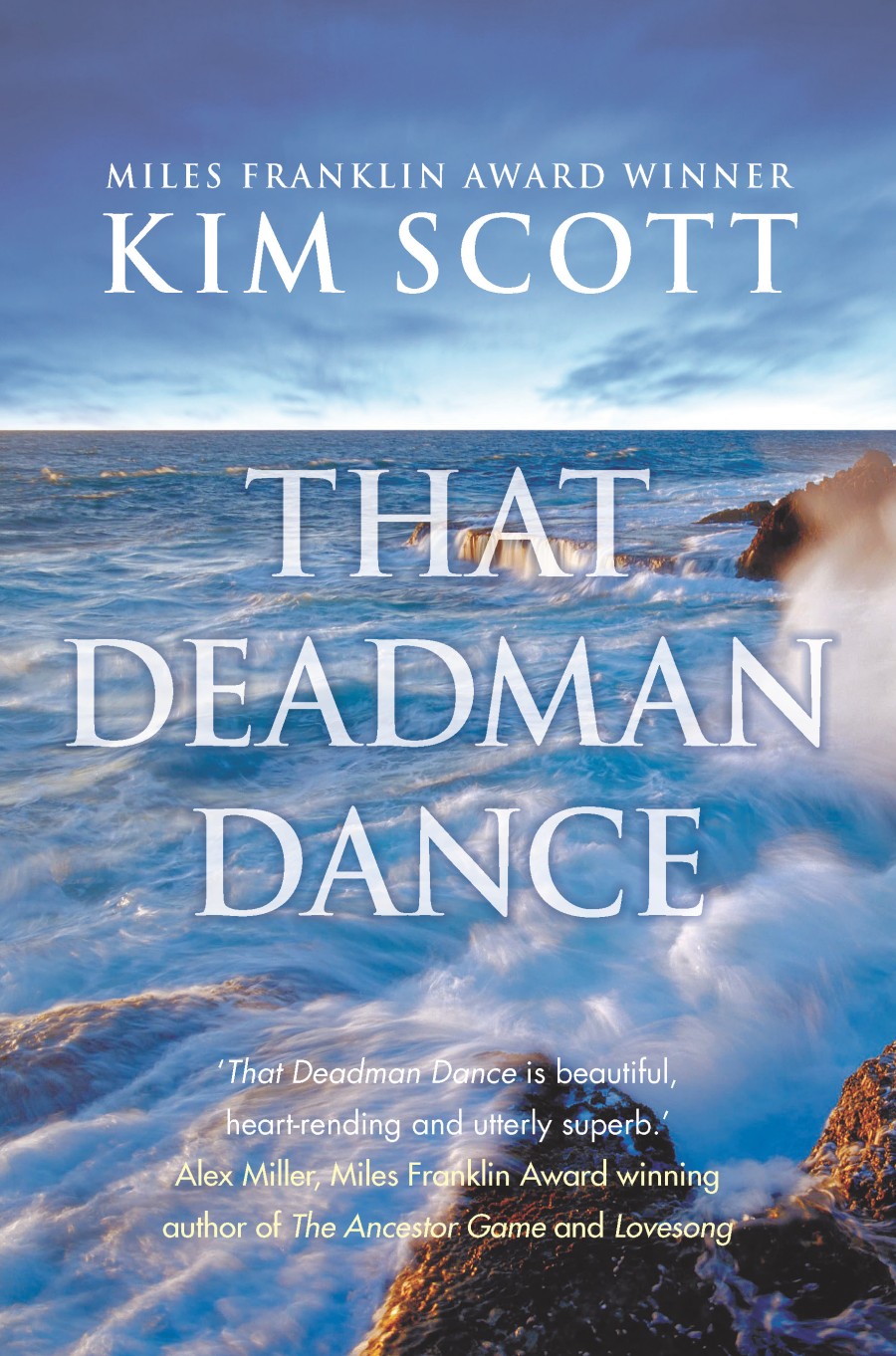
Kim Scott, That deadman dance

Kim Scott That Deadman Dance
(Image courtesy Picador Australia)

About a third of the way into Kim Scott‘s novel That deadman dance is this:

We thought making friends was the best thing, and never knew that when we took your flour and sugar and tea and blankets that we’d lose everything of ours. We learned your words and songs and stories, and never knew you didn’t want to hear ours.

And, it just about says it all. In fact, I could almost finish the post here … but I won’t.

That deadman dance is the first Indigenous Australian novel I’ve read about the first contact between indigenous people and the British settlers. I’ve read non-Indigenous Australian authors on early contact, such as Kate Grenville‘s The secret river, and I’ve read Indigenous authors on other aspects of indigenous experience such as Alexis Wright‘s Carpentaria and Marie Munkara’s Every secret thing. Kim Scott adds another perspective … and does it oh so cleverly.

The plot is pretty straightforward. There are the Noongar, the original inhabitants of southwest Western Australia, and into their home/land/country arrive the British. First, the sensitive and respectful Dr Cross, and then a motley group including the entrepreneurial Chaine and his family, the ex-Sergeant Killam, the soon-to-be-free convict Skelly, the escaped sailor Jak Tar, and Governor Spender and his family. The novel tracks the first years of this little colony, from 1826 to 1844.

That sounds straightforward doesn’t it? And it is, but it’s the telling that is clever. The point of view shifts fluidly from person to person, though there is one main voice, and that is the young Noongar boy (later man), Bobby Wabalanginy. The chronology also shifts somewhat. The novel starts with a prologue (in Bobby’s voice) and then progresses through four parts: Part 1, 1833-1836; Part 2, 1826-1830; Part 3, 1836-1838; and Part 4, 1841-44. And within this not quite straight chronology are some foreshadowings which mix up the chronology just that little bit more. The foreshadowings remind us that this is an historical novel: the ending is not going to be fairytale and the Indigenous people will end up the losers. But they don’t spoil the story because the characters are strong and, while you know (essentially) what will happen, you want to know how the story pans out and why it pans out that way.

What I found really clever – and beautiful – about the book is the language and how Scott plays with words and images to tell a story about land, place and home, and what it means for the various characters. His language clues us immediately into the cross-cultural theme underpinning the book. Take, for example, the words “roze a wail” on the first page:

“Boby Wablngn” wrote “roze a wail”.
But there was no whale. Bobby was remembering …
“Rite wail”.
Bobby already knew what it was to  be up close beside a right whale …

Whoa, I thought, there’s a lot going on here and I think I’m going to enjoy it. Although Bobby’s is not the only perspective we hear in the book, he is our guide. He is lively and intelligent, and crosses the two cultures with relative ease: just right for readers venturing into unfamiliar territory. He’s a great mimic, and creates dances and songs. The Dead Man Dance is the prime example. It’s inspired by the first white people (the “horizon people”) and evokes their regimented drills with rifles and their stiff-legged marching. There’s an irony to this dance of course: its name foretells while the dance itself conveys the willingness of the Noongar to incorporate (and enjoy) new ideas into their culture.

In fact there’s a lot of irony in the novel. Here is ex-Sergeant Killam:

Mr Killam was learning what it was to have someone move in on what you thought was your very own home. He thought that was the last straw. The very last.

And who was taking his land? Not the Noongar of course, but the Governor … and so power, as usual, wins.

The novel reiterates throughout the willingness – a willingness supported, I understand, by historical texts – of the Noongar to cooperate and adapt to new things in their land:

Bobby’s family knew one story of this place, and as deep as it is, it can accept such variations.

But, in the time-old story of colonisation, it was not to be. Even the respectful Dr Cross had his blinkers – “I’ve taken this land, Cross said. My land”. And so as the colony grew, women were taken, men were shot, kangaroos killed, waters fouled, whales whaled out, and so on. You know the story. When the Noongar took something in return such as flour, sheep, sugar, they were chased away, imprisoned, and worse.

I’d love to share some of the gorgeous descriptions in the book but I’ve probably written enough for now. You will, though, see some Delicious Descriptions in coming weeks from this book. I’ll finish with one final example of how Scott shows – without telling – cultural difference. It comes from a scene during an expedition led by Chaine to find land. They come across evidence of a campsite:

You could see where people camped – there was an old fire, diggings, even a faint path. Bobby was glad they’d left; he didn’t want to come across them without signalling their own presence first, but Chaine said, No, if we meet them we’ll deal with them, but no need to attract attention yet.

Need I say more*?

The book has garnered several awards and some excellent reviews, including those from my favourite Aussie bloggers: Lisa (ANZLitLovers), the Resident Judge, the Literary Dilettante, and Matt (A Novel Approach). Our reviews differ in approach – we are students, teachers, historians, and librarian/archivists – but we all agree that this is a book that’s a must to read.

Kim Scott
That deadman dance
Sydney: Picador, 2010
400pp.
ISBN:  9780330404235

* I should add, in case I have misled, that for all the truths this novel conveys about colonisation, it is not without vision and hope. It’s all in the way you read it.

MJ Hyland, Carry me down

MJ Hyland, Carry me down bookcover

Book cover (Courtesy: Text Publishing)

If you like writers who unsettle, then MJ Hyland is a writer for you. Carry me down is my second Hyland. I read, loved and reviewed a later book of hers, This is how, nearly a year ago, and said then that I’d like to read more. I finally have, and am not disappointed.

Carry me down is a pre-coming-of-age story. John Egan is an 11-year-old boy living in Ireland with his parents. He’s an only child and is keen to be special, different. He is clearly pre-adolescent – he’s naive, for example, about some of his 15-year-old cousin’s behaviours. He’s an unreliable narrator: the world he sees and describes is rather skewed but the unsettling thing is that we, the readers, know it is skewed but we are not quite sure in which way. What is going on in this family is the question in our minds from beginning to end.

Like This is how, the novel has a vaguely unsettling beginning. The first paragraph sets up what looks like a cosy family scene. The three are sitting, companionably it seems, around the table on a Sunday evening. The third and fourth paragraphs read:

From time to time we stop reading to talk. It is a good mood, as though we are one person reading one book – not three people apart and alone.

These kinds of days are the perfect ones.

That “alone” is a little jarring, though not dramatically so. But then comes this on page 2:

“John,” she [his mother] says, “please come with me. “She is taking me out to the hallway, away from my father. She is taking me out of his sight, as though I am rubbish.

“Rubbish”? Now, that’s a strong word. What she tells him in the hallway is to stop staring at her:

“You were staring at me, John. You shouldn’t stare like that.”

“Why can’t I look at you?”

“Because you’re eleven now. You’re not a baby anymore.”

There seems to be something slightly strange going on here, or is there? Is this just a pre-adolescent bumping up against the adult world he is about to join, or is something far more complicated going on? As the book progresses, John’s relationship with his mother verges on “too close”. He seems a little too emotionally and physically needy, and she seems unsure of how to manage it. Is his need normal, is the question we ask. Meanwhile, his relationship with his father seems more typically adolescent. He wants his father’s approval and love, but he wants to be independent too. And, he wants to be special. He is an avid reader of the Guinness Book of Records, and decides early in the novel that he has a gift for lie detection for which he’d like to be included in the Guinness. He reads up on lie detection, and starts his own Gol of Seil (Log of Lies).

The situation is complicated by a number of facts which come out in the first chapters of the novel. John is unusually tall for his age and is under medical care for this. He regularly scratches a spot on his head until it bleeds. And he is bullied at school, because he is clearly a little different. His father is out of a job and studying for exams to be admitted to Trinity College. The book his father is reading at the start of the novel is Phrenology and the Criminal Cranium. Is this a hint to us – or a red herring? His mother works with a puppet show. This is interesting, too, as the idea of puppets subtly undercuts the desire for control and independence that John, like any pre-adolescent, is starting to strive for. The family lives with the paternal grandmother, with whom John’s father has a prickly relationship, mainly around money. And, underlying all this is John’s growing obsession with truth and lies.  This obsession is the framing motif in the book. John catches adults lying and takes them to task for it, all the while telling lies himself. He does not, by the end, come to a real understanding of how lying functions, of the difference between white lies and more serious ones. For this reason I don’t see it as a true coming-of-age story.

And now I come to my problem. How do I write about this book without giving it away? There are events – powerful, troubling ones – that occur in the book and that can be “read” in different ways. I’d rather like to analyse or explore the possible meanings, but that would require giving away some significant plot points. I don’t want to do that because this is a book that you need to discover for yourself, sentence by sentence.

What I’ll say though is that this is one of those books that has an open ending. (Indeed, giving nothing away, the last word of the book is “open”). How we read it depends on our own world view, on the weight we give to the various events in the novel, on how we read the specific words and images used by Hyland to describe the events and characters, and our personal understanding of adolescent and family psychology. The way I see it, the book’s ending hints at a number of possibilities but we do not know, at the point in their lives that we leave these characters, which of these possibilities will eventuate. And that, as they say, is life!

MJ Hyland
Carry me down
Melbourne: Text Publishing, 2007 (orig. 2006)
313pp.
ISBN: 9781921145780