Zane Lovitt, The midnight promise (Review)

Zane Lovitt, Midnight Promise

Book cover (Courtesy: Text Publishing)

Zane Lovitt’s debut book, The midnight promise, is one of those books for which I can’t decide how to start my review. I could go with the point, previously made in this blog, that I’m not a reader of crime and so cannot speak with authority on the subject. Or, I could write about the fact that one of the chapters in the book, “Leaving Fountainhead”, won the SD Harvey Short Story Award in Australia’s top crime awards, the Ned Kelly awards*. I could start with how Melbourne-based Lovitt joins the growing number of lawyers who write fiction. Or, I could start with the topic that interests me most, its form.

Because, if you haven’t noticed, I didn’t use the word “novel” once in my opening paragraph. There’s a good reason for this: The midnight promise is, if I can draw from the main media through which I consume crime, more like a detective series than a movie. I could have described it as a book of short stories, but that would be misleading. The ten chapters or stories all feature the one detective or “Private Inquiry Agent”, John Dorn, and they are told chronologically. Moreover, even though the book comprises ten separate cases, rather than one main case as would be expected in a novel, there is an overarching, albeit not immediately obvious, plot, defined by “the midnight promise”.

This form may, in fact, be one of the reasons I liked it. Each story is complete in itself while also forming part of a greater whole if you keep reading. The form is also, however, responsible for my only real criticism, which is that, almost without exception, the stories are structurally the same. They follow a present-flashback-present-flashback (and so on) structure. In a “true” book of short stories, I like things to be mixed up a bit; I like to see variety in style, in voice, structure, tone, language. That’s not the case here – but neither, I suppose, would it be the case in a television detective series, so perhaps my criticism isn’t valid. Still, a couple of times, I felt myself saying “here we go again …”.

John Dorn is not, I think, a particularly original character, for the genre. Like many crime protagonists, he’s somewhat of an outsider, a loner with a broken engagement behind him. He’s also a man of some principle which is why his is pretty much a hand-to-mouth existence. In the early stories his fee ranges from $400 a day to $250 a day to nothing depending on whether he wants (or believes in) the job or not. The higher the charge the less he wants it! For this reason we like Dorn, and want things to work out for him, but somehow, more often than not, he manages to shoot himself in the foot.

Being a private eye, his cases are varied, from marital spying to finding missing people to protection (of the innocent or the guilty). But the theme is consistent. It’s “the shitty things people do to each other” or, as he puts it more colourfully when describing roadkill in the final story:

We drive over two foxes, parallel, like one of them couldn’t bear to live without the other. Though what’s more likely is one fox was eating a dead fox and got hit by a car because he didn’t see it coming because he was distracted because the other fox was so delicious.

Not a grammatically beautiful sentence but appropriate and effective in the context. In fact, I liked Lovitt’s writing. The voice is first person, and the writing is generally direct and spare with the occasional well-placed image which works partly due to its rarity. Like this, for example:

I’ve heard rumours about his shady GST schemes, but everything I know about tax offences wouldn’t rouse a chihuahua from its beauty sleep.

The dialogue is realistic. There is humour – mostly in Dorn’s sardonic view of the world – which varies the tone. There is irony, as in the name of the character, Comedy, who is anything but funny, and in the story “Grandma’s House” whose title belies the horrors within.

And this brings me back to the form, to the fact that while each story is complete there is a trajectory in the book, heralded by the occasional bit of foreshadowing. We know something is going to happen that will change Dorn’s life, and probably for the worse. The crisis occurs in the seventh story, “The Crybaby Technique” – and it’s ironic because he was, in this particular case, only a bit player. Things change gear from here, leading to the final crisis in the tenth story which is significantly titled “Troy”. It’s a gripping read with a beautifully controlled out-of-control last page. You’ll have to read it to see what I mean.

So, would I recommend this book? Yes, to non-crime readers, like me, who look for character and good writing, and to crime readers who, I’m presuming, like intriguing cases with a detective who keeps you guessing. If I were a crime reader, I’d be saying I hope this isn’t the last we see of John Dorn, or of Zane Lovitt. In fact, I’ll say it anyhow …

Zane Lovitt
The midnight promise
Melbourne: Text Publishing, 2012
283pp.
ISBN: 978192192230

(Review copy supplied by Text Publishing)

*In 2010. It also appeared in Scribe’s New Australian Stories 2, that same year.

Paddy O’Reilly, The salesman (Review)

I’ve been wanting to read Paddy O’Reilly for the longest time but somehow haven’t managed to get to her so, as is my wont, I decided to read a short story of hers in the Griffith Review. She made her name, I think, with her short stories, but has also written novels/novellas and a screenplay, and is a regular contributor to Australia’s best literary magazines.

I know you wouldn’t expect this of me, but I’ve just told a lie – just a white one, your honour – because I have read a couple of articles by Paddy O’Reilly, and I did read her opening story in Scribe’s New Australian Stories 2, published in 2010. The story was titled “How to write a short story”. It’s a very short piece, just over a page, but it was my first, albeit very short, introduction to O’Reilly. The piece is presented as a recipe, with a list of steps, such as:

Test whether the story is done by inserting a reader. If the reader comes out clean, the story is done. If the reader comes out sticky, place the story back into the situation for another 500 words.

This story suggested to me that O’Reilly is not afraid to let women’s experience underpin her writing. But, this doesn’t mean that she wants her writing to be labelled “women’s fiction”. As she asks in her recent post for the Australian Women Writers Challenge 2012, what is women’s fiction? Writing for women? About women? By women? I’m inclined to agree with her that it’s not a useful distinction. What after all is “men’s fiction”? Categorising works as “women’s fiction” has the potential to (and in fact does already) marginalise, trivialise even, women writers and readers. So, like Paddy O’Reilly, I tend not to think in terms of “women’s fiction”. I do, however, and I’d argue this is quite different, like to focus on “women writers”.  Hence, here I am, reading (more) Paddy O’Reilly …

“The salesman” is set in a working class suburb of Melbourne where there’s 80% unemployment. It features a salesman (obviously), a young woman named Marly, and her boyfriend and his mate. The story opens with the young woman alone at home. It’s hot and life is clearly not much fun. Her boyfriend Shaun and his mate, Azza, spend their days working on cars, their heads “under the bonnet like stupid long-necked emus”. And, the fridge is “moaning”. Such language in the first paragraph makes it pretty clear that Marly is not a happy woman. In fact, we learn a little later on that she has lost part of a leg, creating an effective metaphor for a life that is missing something critical. Pran, the salesman, appears in the fourth paragraph. He’s a Hindu from Delhi but Marly, and later Shaun and Azza, persist in calling him a Paki.

Pran insists he’s not selling anything, but after Shaun and Azza return, we finally learn that what he is “selling” is a free offer! Shaun and Azza, as (stereotypically) men often do in these situations, lead Pran on while Marly is conflicted. Shaun is an “attentive” boyfriend. “She would not do better than this”, not better, she thinks, than a man “who had not once in eleven months raised a hand to her”. But, she’s attracted to Pran, to his “rich burnt-toffee” coloured skin and his “runny dark brown” eyes. It’s not just the physical though.  She senses through him, through her questions about his beliefs, that there could be more to life than hanging around waiting for the men to bring home beer and pizza. She does not want his visit to end in violence as, we are told, has happened before.

I’ll say no more about the plot. This is a story about the underside of modern Australia. It’s about poverty and deprivation and how these result in an arid, goal-less life in which there is little empathy for other. It’s about racism, about how, if you are the wrong colour, years of study can lead you to peddling “free offers” to people who can’t afford them. The ending is clever. While we are told the general outcome, we have to guess what really went down. What we do know, though, is that no-one ended up a winner. This is just the sort of story I like – it’s accessible, it has a clear vision with a tight focus, and it raises more questions than it answers. You can read it online at the link below.

Paddy O’Reilly
“The salesman”
Published in the Griffith Review, Edition 29, August 2010
Availability: Online at the Griffith Review

Dorothea Mackellar, Elena Kats-Chernin and the Vienna Boys Choir

I’m guessing most of you have heard of the Vienna Boys Choir, but you may not, particularly if you’re not Australian, have heard of Dorothea Mackellar and Elena Kats-Chernin. Mackellar (1885-1968)  was an Australian writer, best known for her poem “My country”. Kats-Chernin (b. 1957) is an Australian composer who was born in Tashkent (in what was then the Soviet Union). She has been in Australia since 1975.

You’ve probably guessed now what this post is about. It’s about Elena Kats-Chernin setting Dorothea McKellar’s “My country” to music for the Vienna Boys Choir to perform (on their 2012 tour to Australia). According to the program, producer Andrew McKinnon, who commissioned the piece, wanted a poem that would both resonate with Australian audiences and “promote the beauty of Australia to international audiences on the choir’s future travels”.

And yet, as I sat down to the Choir’s concert on the weekend and looked at the 25 mostly European-born boys ranging in age from 9 to 14, I wondered what they could make of such a poem. For those of you who don’t know the poem, its most famous verse, the second, goes like this:

I love a sunburnt country
A land of sweeping plains
Of ragged mountain ranges
Of drought and flooding rains
I love her far horizons
I love her jewel-sea
Her beauty and her terror
The wide brown land for me

The program answered my question. After Kats-Chernin had drafted her composition, she went to Austria to workshop it with the boys. What fun that must have been. Kats-Chernin says that while that poem with that choir might seem an odd combination, it also makes sense:

The piece is about a country that’s still really young, but at the same time has been around thousands of years. At the same time they [Vienna Boys Choir] are only young boys, but the tradition they are part of is really old*.

Dorothea Mackellar's My country

Final two verses of Dorothea Mackellar’s My country (Public Domain from the State Library of NSW, via Wikipedia)

And so Kats-Chernin workshopped her ideas with the boys. Here is an excerpt from one of the choristers, Anton (12 yo), as reported in the program:

She read us some of Dorothea Mackellar’s poem. She said Australia is beautiful, and very dangerous. Which key did we think meant danger? Felix suggested B minor, David thought of F sharp. Immediately Ms Kats-Chernin started playing the right chords.

She gave each of us a word to sing, on a sequence of notes, floods, famine, sunburnt country. We were all doing it at the same time, and it was sounding like a fabric of music. That was a total surprise to me, and I could feel myself smiling. It just happened. I think some of this is in the finished piece.

It was a beautiful piece – not schmaltzy or cliched as it so easily could have been. She broke up the words at times, repeated some, left others out (if I remember correctly), all of which gave the poem new power for those of us who know it well. I like Kats-Chernin. She’s able to express a modern sensibility in her music (different or unusual rhythms and harmonic combinations, using my layperson’s language) while retaining lovely melody as well. (Hmm … that statement may imply more about modern music than I really intend, but you know what I mean!). The piece is called “Land of Sweeping Plains” but its most powerful, memorable section focuses on the first line of the 4th and 5th verses, “Core of my heart, my country”. “Core of my heart” was apparently the poem’s first published title. I like that … from “Core of my heart” to “My country” to “Land of Sweeping Plains”. It’s clever – or sensible, at least, I think – to give the piece a more descriptive, less nationalistic/patriotic title, if it is going to become an internationally performed piece. And I hope it does become so.

Meanwhile, if you are interested, you might like to check out this You Tube about Kats-Chernin and the Choir.

* Historians date the choir from 1498!

Monday musings on Australian literature: Australia’s pioneer novelists

David Unaipon

David Unaipon (1924) (Presumed Public Domain, via Wikipedia)

One of the reasons I started this Monday Musings series was to encourage me to read, think and/or learn about my country’s literature, but in doing so I mostly write about books and authors I know and have read. Occasionally though I explore authors and works that are not so familiar to me. Today’s post is one of these.

A few months ago I wrote posts on two books on Australian literature written by Colin Roderick in the late 1940s. As I researched these posts, I came across a reviewer who wondered how many Australians knew about “the first Australian-made novel”. The unidentified reviewer was writing in The West Australian in 1950. I suspect the same question could be asked now … and so today’s post will name some of our novelistic firsts (as best I’ve been able to identify them) in case there are others like me whose knowledge of our history is a little vague.

  • First Australian-made novel: Quintus Servinton, by convict (forger) Henry Savery (1791-1842). It was published in Hobart in 1830. The West Australian reviewer writes that “apart from being the first novel written, printed and published in Australia, [it] has several other noteworthy features. It was the first novel to give a participator’s impressions of life on a prisoner’s transport”. In fact it is a fictionalisation of Savery’s life.  (An etext is available from the University of Sydney’s SETIS project).
  • First Australian-born novelist: John Lang (1816-64), who was apparently born at Parramatta. He went to Cambridge in 1838 where he become a barrister, and returned to Sydney in 1841, before leaving again a few years later to live in India and England. According to The Oxford companion to Australian literature, “the enigma surrounding the life and personality of John Lang has not, even a century later and in spite of considerable literary research, been completely solved”. It is, however, believed he wrote the fiction work, Legends of Australia, which was anonymously published in 1842. The Oxford companion suggests that authorship of this “would entitle Lang to the distinction of being the first Australian-born novelist”. There is a biography of Lang by Victor Crittenden. Its title says a lot: John Lang: Australia’s larrikin writer: barrister, novelist, journalist and gentleman. I was interested to read that he was also a contributor to Charles Dickens’ periodical Household Words.
  • First Australian-born woman novelist to publish a novel in Australia: Louisa Atkinson (1834-1872), who was the subject of a previous Monday Musings. Her novel Gertrude, the emigrant girl: A tale of colonial life was published in 1857. (An etext is available from the University of Sydney’s SETIS project.) I should say that The Oxford companion (mentioned above) is a little less categorical about her place in Australia’s literary history, stating instead that she is “one of the earliest Australian novelists and the first native-born woman to fictionalise Australian domestic, pastoral and bush life”. Did, I wonder, another Australian-born woman fictionalise something else before Atkinson’s work?
  • First indigenous Australian writer to have a book published in Australia: David Unaipon (1872-1967), who was born at a mission in the Tailem Bend area of the Murray River. (His father was our first Aboriginal preacher.) Unaipon’s best-known work, Native Legends, was published in 1929. He wrote, apparently, in a classical style, much like Milton. I should say that Unaipon was not, technically, a novelist, but his pioneering role in Australian literature warrants his inclusion here, I think, particularly since the David Unaipon Award for Unpublished Indigenous Writers is often awarded to a fiction writer.

I wonder if there are Australian (or other) readers of this blog who have read any of these authors or their works? And if you’re not Australian, what do you know about your country’s pioneer novelists?

Toni Jordan, Nine days (Review)

Jordan's Nine Days

Book cover (Courtesy: Text Publishing)

Toni Jordan’s latest novel, Nine days, is somewhat of a departure from her first two novels which are more in the chicklit vein, albeit chicklit with a difference. The thing is, I don’t generally read chicklit, but I did enjoy Addition and Fall girl, so I was more than willing to read Jordan’s next offering. I was not disappointed.

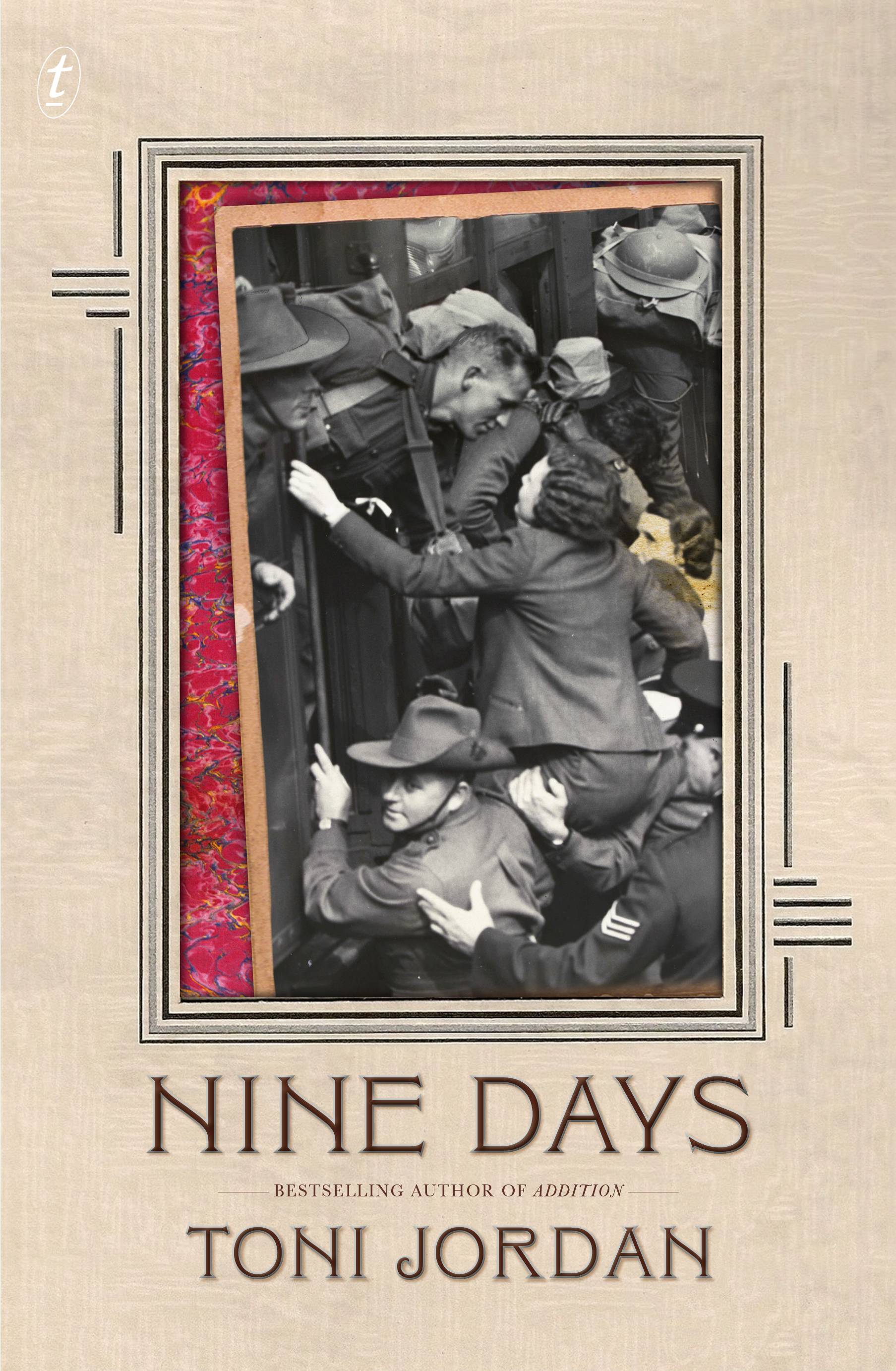
Nine days was, according to the Author’s note, inspired by a photograph from the State Library of Victoria’s Argus collection. The photograph forms the cover of the book’s first edition: it depicts an unidentified soldier leaning out of a train window to kiss an also unidentified young woman. Jordan has woven around this photo a multi-generational story that spans six decades or so from the eve of world war 2 to the present. The title refers to the nine days upon which the book’s nine chapters are built – with an added complexity. This is a multiple point of view novel like, say, Christos TsiolkasThe slap and Elliot Perlman‘s Seven types of ambiguity, but while those two novels progressed their narratives in a linear chronology via the changing voices, Jordan’s chronology jumps around in a seemingly chaotic manner. However, there is method to it, because careful reading reveals thematic or structural connections, even if not chronological ones, between each chapter.

That’s the basic structure, but the real interest of course is in what the novel’s about. How, though, to describe the plot of such a novel succinctly? The best way is to simply say that the novel tells the story of three generations of one family, which is, by the way, an impressive thing to attempt in 250 pages. There is a central mystery – for the reader and for the family though they aren’t necessarily aware of it – to do with the two figures in the photograph. Each chapter is named simply for the character in whose first person voice it is told. The first is Kip, a nearly 15-year-old boy in 1939, who has just had to leave school and go to work because of the recent death of his father. Other chapters are told by his twin brother Francis/Frank (who gets to stay at school), his mother Jean, and his much loved big sister Connie. Interspersed with their stories are those told by Kip’s wife, Jack who lives next door, Kip’s twin daughters, and even his grandson. For each person something happens – some choice must be, or is, made – in the particular day they describe, which impacts their life’s direction.

It’s an ambitious structure, but Jordan succeeds, for a few reasons. A big one is her ability to create strong, believable characters who are likable despite their faults. It helps that the first character, Kip, is particularly engaging. He’s easy-going and generous-hearted, but is also endowed with a good dose of wits and common-sense. He plays an important role in the denouement. His daughters, the overweight, rather uptight Stanzi, and the hippy-alternative-eco-warrior Charlotte, are clearly differentiated and provide a touch of humour with their (mostly) good-natured sibling bickering and point-scoring. Most contemporary female readers will see bits of themselves or people they know in these two. And, while I’m speaking of women, I can’t resist quoting Kip’s young, restless sixteen-year old grandson Alec:

I’ve wasted my whole entire existence up to now. I’ve done absolutely nothing with it. I’ve just been counting down the months of my life. Sixteen years, totally useless. I live with three women. A big night at my place is when the ABC runs a Jane Austen marathon. God I hate that Bennet chick. Marry him already, and spare us the drama.

Another reason the book works is that Jordan manages place and time well. Counterbalancing the seemingly erratic chronology is the fact that place is kept simple. The whole novel occurs pretty much in one suburb in working class Melbourne. This helps keep we readers grounded, as do two little motifs – a “lucky” shilling and a purple pendant – which appear on and off throughout the novel. I was initially concerned, after the first couple of chapters, that the shilling was going to be a little heavy-handed or mechanistic – particularly given the shilling graphic commencing each chapter – but it’s not. Like the pendant, it appears in some, but not other, chapters, and in so doing helps keep us focused without irritating us.

In other words, the book is handled very well technically. But, that’s not what makes a book, in the end, is it? What makes a book good is its heart – and the heart of this book is warm but real. Its particular subjects are war, abortion, religious and class difference, social conscience and social mobility, but it is also a universal tale about how love (marital, romantic, sibling, parental, and so on) forms the glue that keeps us going. This might sound corny, but that’s not how it comes across. The novel has its share of grittiness; and relationships have their tensions, conveying the message that love (whether marital, sibling or parental) is not a simple endpoint but something to be worked at.

This may not be the book for readers who like long family sagas they can lose themselves in, but for those like me who enjoy works which tease and leave ties undone, much like life really, Nine days has plenty to offer.

Toni Jordan
Nine days
Melbourne: Text Publishing, 2012
245pp.
ISBN: 9781921922831

(Review copy supplied by Text Publishing)

Anna Funder, Stasiland (Review)

Anna Funder's Stasiland bookcover

Funder’s Stasiland (Courtesy: Text Publishing)

Anna Funder‘s Stasiland, which won the Samuel Johnson Prize for Non-Fiction, is one of those books that can be reviewed from multiple angles, and I know that when I get to the end of this review I’m going to be sorry about the angles I didn’t get to discuss. But, I can only do what I can do, eh?

I found it interesting to read this book immediately after another non-fiction book, Brenda Niall‘s biography True north, because the contrast clarified for me why I liked True north but loved Stasiland. To put it simply, True north is a well-written but pretty traditional biography, while Stasiland is what I’d call “literary non-fiction”. In other words, in Stasiland, Funder uses some of the literary techniques – relating to structure, voice and language – more commonly found in fiction to tell her story. It’s not surprising really that this is the case, because when I heard her speak last month, she said that she had initially planned to write Stasiland as a novel but, having done the research and interviews, it “didn’t feel right” to turn those people’s stories to another purpose. She was also aware that there were things in these stories that might not be accepted, that might seem too far-fetched in fiction! Such is the fine line we tread between fact and fiction.

At this point, I should describe the book, though its broad subject is obvious from the title. Funder (b. 1966) has a long-standing interest in things German, from her school days when she chose to learn German, and has visited and/or lived in Germany several times. She writes of travelling through the former German Democratic Republic, a country that no longer exists, that comprises “tumble-down houses and bewildered people”, and she describes feeling a sense of “horror-romance”:

The romance comes from the dream of a better world the German communists wanted to build out of the ashes of their Nazi past; from each according to his abilities to each according to his needs. The horror comes from what they did in its name.

And so she decides to try to understand this dichotomy and places an ad in the paper:

Seeking: former Stasi officers and unofficial collaborators for interview. Publication in English, anonymity* and discretion guaranteed.

This is, depending on how you look at it, either a very brave or naively silly thing to do. Funder, who sees writing as an act of empathy or compassion, interviews several Stasi men who answer her ad, as well as other East Germans who suffered at Stasi hands. It might be coincidental, but essentially all her subjects who suffered were women, while the perpetrators were men. In fact, when she visits the Stasi HQ in Berlin, she’s told it only had toilets for men! All this is not to say, however, that men didn’t suffer (or, even, that there weren’t women perpetrators). Indeed, some of the Stasi men she interviewed were themselves bullied, blackmailed and otherwise stood over to keep them in line.

What makes this book compelling are the stories she gathers, partly because the stories themselves are powerful and partly because of Funder’s own voice. Funder places herself in the book. This is not a third person “objective” recounting of the interviews she conducted but a journey we take together to find some answers. When she interviews Herr von Schnitzler, who hosted the Black Channel, a television program in which he presented a Communist commentary on excerpted programs from the West, we are in the room with her, hearing not only what he says, but getting a sense of his personality alongside her. We see her being fearless in sticking to her questions in the face of a man who frequently shouts. “I recognise”, she writes, “this pattern of unpredictable shouting followed by bouts of quiet reason from other bullies I have known”.

It is particularly in the von Schnitzler section that the GDR paradox becomes most clear. Von Schnitzler was, Funder tells us, molded by the injustices of the Weimar Republic. We see how the drive to create a new society not bedevilled by the iniquities – that is, the inequalities – of capitalism (or imperialism as many of the Stasi men call it) resulted in the creation of an authoritarian society where freedom was minimal (or non-existent) and dissent not allowed. In stark contrast to von Schnitzler and his refusal to see any error in, or critique, the GDR, is Julia, one of the “victims”, who had believed in the GDR but, through having an Italian boyfriend, had become caught in the Stasi net. She discovered that the “state can be so dangerous, so very dangerous, without me having done anything at all” and was completely traumatised by the extent of surveillance and loss of privacy she experienced. And yet, having experienced the East and the West, she can still say

you see the mistakes of one system – the surveillance – and the mistakes of the other – the inequality – but there’s nothing you could have done in the one, and nothing you can do now about the other … and the clearer you see that the worse you feel.

The GDR story is, as Funder tells it, one of grand humanitarian aims but one also riddled by paradox and irony. She asks Herr Bock, a recruiter of informers, what qualities he looked for in an informer:

‘… and above all else,’ he says, looking at me, his eyes distorted and magnified through the glasses, ‘he needed to be honest, faithful and trustworthy.’

I look back at him. I feel my eyes too, getting wider.

How can you resist a writer who tells a story like this, who shows without telling exactly what is going on, who can inject sly touches of wit and humour into the tough stuff?

I can’t possibly relate all the stories – many quite horrendous – in this book. All I can say is that it is a book that manages to show how history writing can be intimate while at the same time conveying facts and hard truths. It is a memorable book, and worth reading if you have any interest at all in politics and human behaviour.

Anna Funder
Stasiland
Melbourne: Text Publishing, 2002
ISBN: 9781877008917
282pp.

* I’m intrigued by the promise of anonymity because it seems that in some, if not in all, cases, real names are used. I presume the people involved agreed to this.

Brenda Niall, True north: The story of Mary and Elizabeth Durack (Review)

‘Of course we are mad,’ Bet wrote to Mary, ‘but we live in a mad place.’

Brenda Niall's True North
Brenda Niall’s True North (Courtesy: Text Publishing)

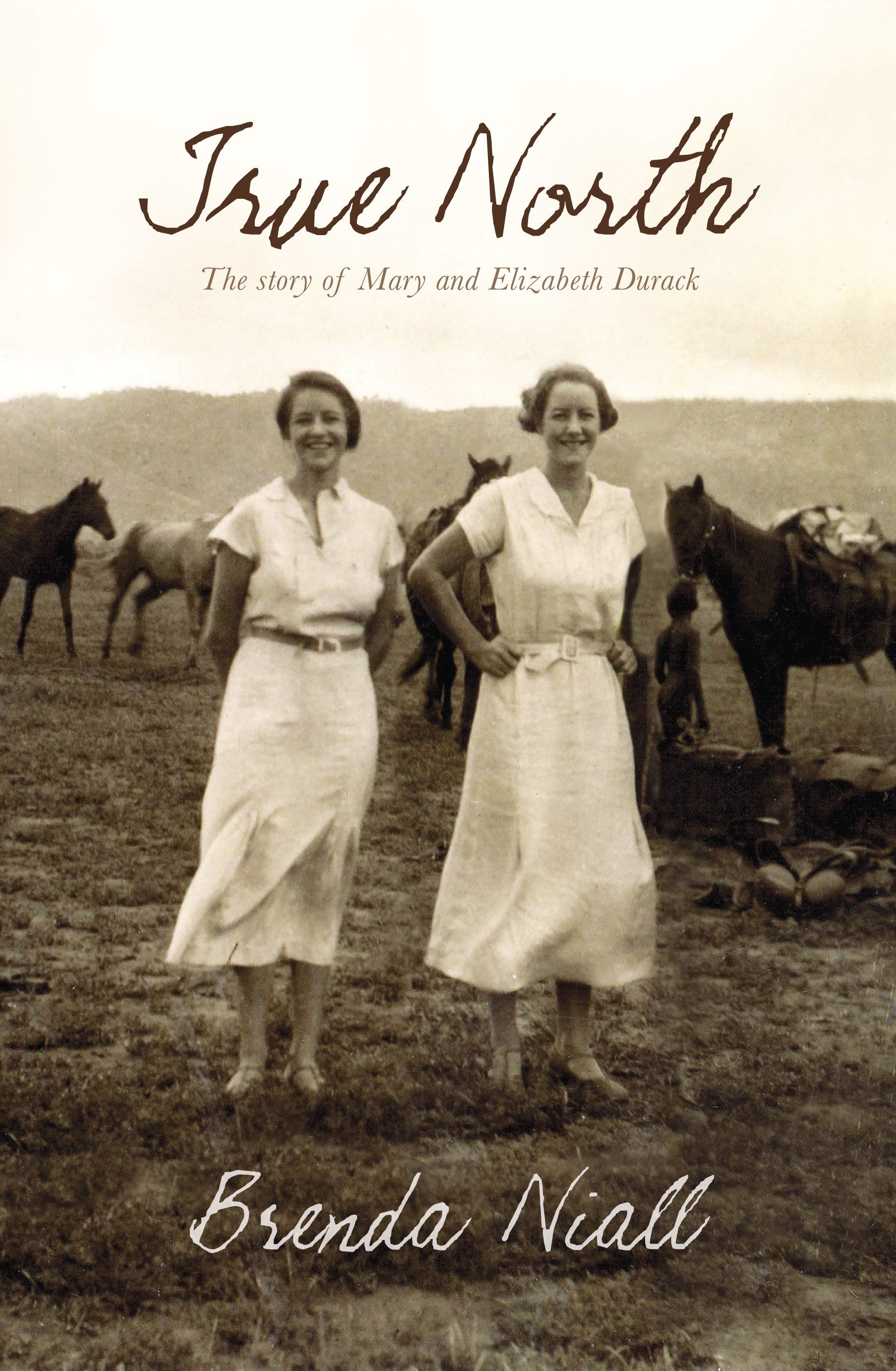
The mad place that Bet – Elizabeth Durack – refers to is the Kimberley region of north-west Australia and the book this quote comes from is biographer Brenda Niall‘s True north: The story of Mary and Elizabeth Durack.

Brenda Niall, along with the late Hazel Rowley, is one of Australia’s best regarded biographers. True North, her most recent book, tells the story of writer Mary Durack (1913-1994) and her younger sister, the artist Elizabeth (1915-2000). I must say that it took me a long time to read this book. I was fascinated by the story but it lacked, in the beginning at least, some of the punch that I found in Rowley’s Franklin and Eleanor: An extraordinary marriage which I reviewed last year. I think this is because Niall’s style here is a little flatter, a little more like reportage, than I found in Rowley’s book. Both books have two people as their subjects and both books have an overriding theme – the Roosevelts’ extraordinary marriage for Rowley and the sisters’ fascination with the remote north for Niall – but, for me, Rowley’s had a stronger narrative drive which resulted in a more cohesive “argument”. However, I did settle into True North and, in the end, enjoyed it for what it did do.

Mary and Elizabeth, for those of you who don’t know, belonged to the pioneer pastoralists, the Duracks, who had  emigrated from Ireland in the 1850s. They farmed in Goulburn (NSW), then moved to Coopers Creek (Queensland) in the late 1860s, before droving their cattle nearly 5,000 kms cross-country to settle in the Kimberleys (WA) in 1882. Mary told this story in her best-selling (now classic) history, Kings in grass castles, and its sequel Sons in the saddles.

Niall’s book, though, is not about that, but about the two sisters and their lives in the 20th century. Mary and Elizabeth spent most of their childhood and youth in Perth, while their father managed the northern properties, returning south each year in the off-season. However, both separately and together spent time on their father’s properties, particularly in their late teens and early twenties. Niall’s title, “true north”, expresses the sisters’ identification with the north. In 1929, for example, Mary said she returned to the north “like a homing pigeon”. Elizabeth described it, a few years later, as “that wild, wonderful country”. The north was, in fact, the inspiration for their creative output.

Niall characterises the two sisters well. Mary was the calmer, more sociable, reliable one who struggled to find time to write between raising children, supporting various family members, and playing a significant role in the literary life of Perth. Elizabeth was more unsettled, more fiery and perhaps more ambitious. She was frequently poor and depended on the family, particularly Mary, for monetary and emotional support throughout much of her life. Theirs was a close relationship, and included several collaborative books for which Mary wrote the text and Elizabeth did the illustrations. Neither made wonderfully successful marriages – and both, despite their challenges, produced significant bodies of work.

Several themes run through the book, but the most interesting one for me concerns the Duracks’ relationship with Aboriginal people. From early on the family employed indigenous people. According to Niall, the sisters’ father, Michael Patsy Durack, “stressed their value as allies”. For the sisters, their early experiences were positive and resulted in a lifelong interest in and awareness of indigenous people and their issues. Elizabeth spoke many years later about “how lovely it was to go walking with them and to learn about the bush” while Mary wrote of being disturbed by “the shadow people in their humpies on the river banks, humbly serving, unknowing, unquestioning”.  Mary wrote a short story, “Old Woman”, about the harsh treatment of an Aboriginal woman by a station wife. It was published in The Bulletin in 1939 and nearly resulted in a libel suit. Elizabeth wrote in a letter, around 1935,

It’s a question of either opening one’s eyes to the situation and grappling with it with whatever instruments lie within one’s reach or shutting one’s eyes to the whole business and getting the hell out of it.

I don’t have time to fully explore it all now, but I was intrigued by this comment on Mary late in her life:

She found the Aborigines surprisingly objective about the past ‘recalling events with no hint of bitterness’, talking about the white people with neither praise nor blame.’

This brought to mind indigenous writer Kim Scott’s That deadman dance, which I reviewed last year and in which he presents (albeit in a novel but borne out by the records, I believe) a similar generosity or openness of spirit. But, back to True north. Niall argues that the Duracks were respectful and sympathetic employers and friends. Big brother Reg in the 1930s was aware of “the social injustice of use of Aboriginal labour”. Mary, in the 1960s, argued persistently for equal pay, and even though, when it came, indigenous station workers were displaced in droves, she still believed in the principle. Ah, that tricky conundrum: principle versus reality, idealism versus pragmatism.  Why are they so often at loggerheads with each other?

Elizabeth, however, did get into hot water later in her life when, going way further than Mary who wrote a poem in the voice of an indigenous woman, she took on the name and persona of an Aboriginal man, Eddie Burrup, as a nom de brush. Niall discusses the issue at some length teasing out artistic and personal issues versus cultural trespass. She is sympathetic in the end to Durack and her somewhat mixed motivations. The situation was certainly complicated and, while some of Durack’s motivations give me pause, I’d rather not pass judgement, except to say that in the late 20th century it was not a wise thing to do.

The insight Niall gives into an albeit specific pastoral family’s experience of and response to their relationship with indigenous people makes this book worth reading. We do of course only get Niall’s presentation of the Duracks’ experience. Besides a few scattered references to indigenous people’s responses, we know little of the indigenous perspective. The sad thing is that we may never know their side, since few people are left to tell it, and not much is likely to have been documented.

Oh dear, I’ve written a lot about one theme and there’s so much more to tell, but I won’t retain you much longer. Two other major themes permeate the book. One revolves around love of and identification with place, with how place can get under the skin and drive one’s life. The other concerns the challenge women creators face in serving their art while juggling families and the need for financial support.

While I didn’t find Niall’s book as compelling as I’d hoped, the more I think about it, the more I appreciate what she has attempted to do. The Duracks’ story is a complex and somewhat contradictory one. Mary, Elizabeth and their brothers were the children of a “cattle king”, and being such their public image was “one of effortless privilege”. The reality was, in fact, rather different – and it resulted in lives that were challenged and challenging. Niall’s book will not, I suspect, be the last we hear of them – but it makes a valuable contribution.

Brenda Niall
True North: The story of Mary and Elizabeth Durack
Melbourne: Text Publishing, 2012
Kindle edition
272pp (Print ed.)
ISBN: 9781921921421 (eBook)

Dame Mary Durack, Lament for the drowned country (Review)

Lake Argyle with Crocodile

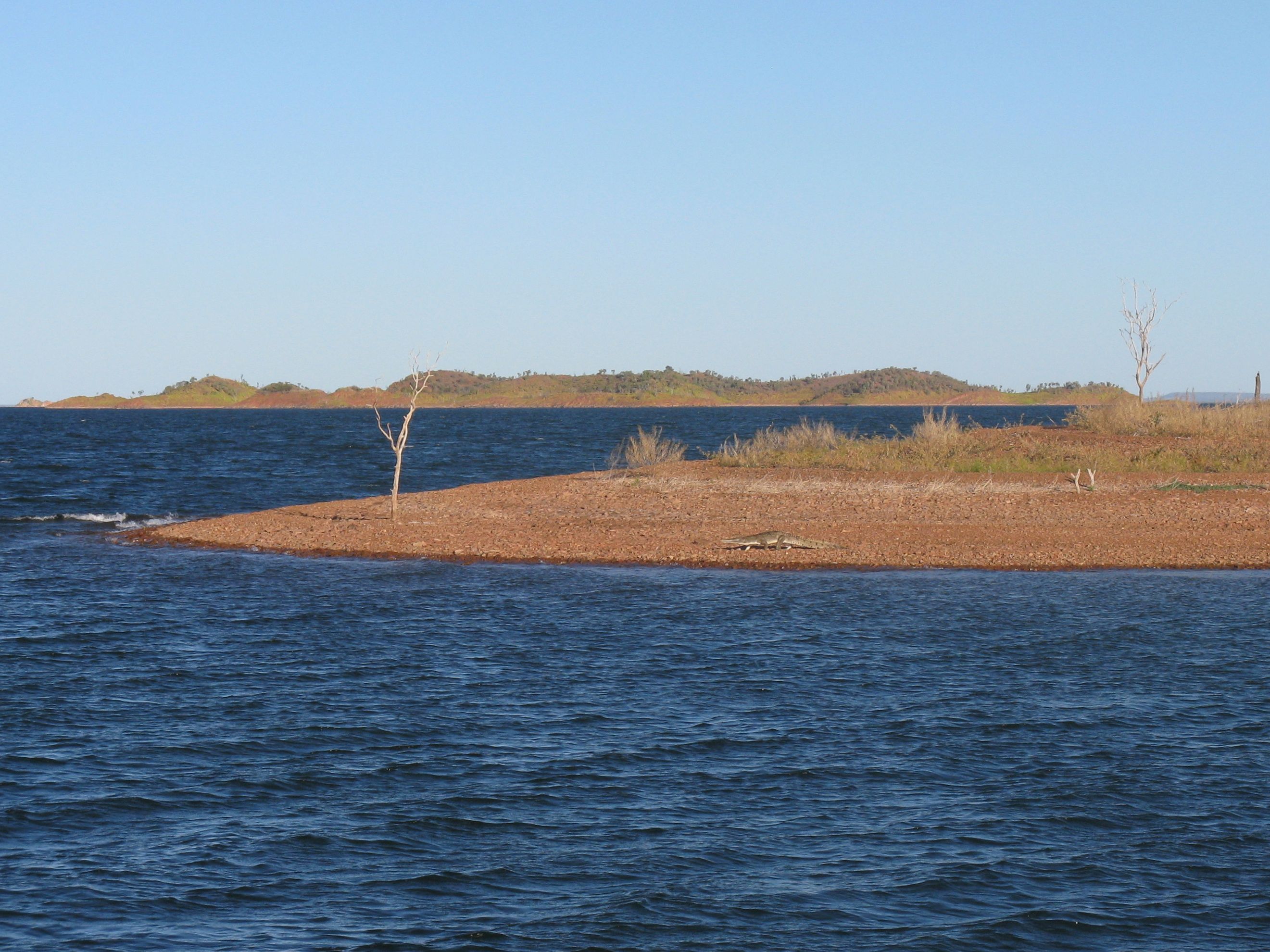
Freshwater crocodile heading into Lake Argyle

Near the end of her book True north about Mary and Elizabeth Durack, biographer Brenda Niall writes of Mary Durack‘s poem, “Lament for the Drowned Country”, which she says “has been judged her finest poem”.  Of course, with such a statement, I had to read it. I could have Googled* it, but I decided to check my Penguin Book of Australian women poets and, hallelujah, it was there. (Once again this book didn’t let me down!)

“Lament for the drowned country” is a long poem and is presented in the voice of an Aboriginal woman, Maggie, mourning the drowning (for the Ord River Irrigation Scheme) of her “born country”. It’s a poignant poem – for obvious reasons – as it’s about the loss of country (for the indigenous people) and home (for the Duracks, whose Argyle homestead went under the water). But, there’s something else too – an irony, because the idea of damming the Ord River was first proposed by Mary’s brother Kimberley Durack in the 1940s. Mary supported her brother** at the time … but the reality many years later, after her brother’s death, was sad for her.

The interesting thing about the poem is that Durack chose to write it in the voice of an Aboriginal woman. Niall writes of this that:

At a later time, her creation of a first person voice for Maggie Wallaby might have been questioned. In 1972 it was taken as she intended it, as a work of empathy and imaginative identification.

This made me think of Thomas Keneally‘s The chant of Jimmie Blacksmith which was shortlisted for the Booker Prize in 1972. It was written in the voice of the Aboriginal protagonist, but Keneally has since said that he wouldn’t presume to do that now, and would tell the story from a white point of view. This says something, I think, something positive, I hope, about Australia’s cultural development. In the 1970s and before, indigenous voices were hard to find. This is less so now – and will hopefully only get better bringing us more voices, and a greater variety of story representing the diversity of indigenous experience.

Anyhow, back to the poem. According to Niall, the poem was inspired by Mary seeing Maggie “catching fish and unaccountably throwing them back into the [new] lake”. Mary saw this – realistically or romantically, who’s to say? – as signalling hope. She has Maggie saying:

I sit along river coming down from my born country.
That heart place! I got to talk to that water.
I got to tell that fish: ‘You go back – you go back now –
talk strong my country. You tell him that spirit can’t leave ’em.
You tell him – Wait! Hang on! This is not the finish!
…’

Later in the poem, Maggie talks of the land drying, the sun coming once again to warm it, and the animals and birds returning. Maggie also makes a reference to the Durack homestead:

You go back up there, that old station – Argyle station –
(poor fella my old boss, my old missus. Nothing left that
house, where I sweep’m every day!) You look out that house,
you look out
windmill, tank, garden, kitchen, saddle shed.

The remarkable thing about the poem is how well – or so it seems to me – Mary Durack captures the cadence, the intonation even – of Aboriginal speech and story-telling. I shouldn’t be surprised though, because Durack spent much of her childhood playing with Aboriginal children and spent her adult life, when she could, not only arguing for but working with indigenous people in their fight for equal rights. According to Niall, as Mary Durack left the north for the last time, “the Aboriginal women, knowing they would never see her again, began to beat their heads and wail inconsolably”. We all know the psychology of master-servant/white-black relationships is a complex one, but that doesn’t deny the fact that amongst it all there can genuine feelings and mutual respect.

I’ll be writing more on the Duracks, and particularly on Mary whose love for the land of her birth was, like Maggie Wallaby’s, absolute:

she can’t forget ‘im, my country, she all day heart-crying.

Meanwhile I recommend this poem …

Mary Durack
“Lament for the drowned country”
In Susan Hampton and Kate Llewellyn (ed)
The Penguin Book of Australian Women Poets
Ringwood: Penguin, 1986
pp. 65-68.

* I did Google it too, to provide a link for this post, but I only found excerpts rather than the whole poem. Hence no link here. I guess it’s too recent to be in the public domain.

** Kim Durack was an agricultural scientist. He apparently loved the land and was committed to improving it after the damage caused by years of over-grazing.

Melissa Lucashenko, The silent majority (Review)

I have reviewed many individual short stories by Americans (through the Library of America), but not by Australians. Time to rectify that a little, and why not with a short story by Melissa Lucashenko, an Australian writer of European and indigenous Australian heritage. She is an award-winning novelist and an essayist, but I hadn’t read her – until now.

You might be wondering why I chose her and this story? But it’s obvious really. I was pottering around the web and came across this:

It is a truth universally acknowledged, Jo decided, that a bored teenager with a permanent marker is a pain in the bloody neck.

How could I go past it? I had to read it to see what it – and Lucashenko whom I was keen to read – was all about. It’s a short, short story, well suited, I suppose, to publication in a magazine like the Griffith Review. Jo is a single mum of indigenous heritage and during the course of the story is mowing the grounds of the cemetery in the small northeastern NSW town of Mullumbimby. Her teenage daughter Ellen is supposed to be babysitting her young nephew Timbo while Jo does her mowing but, like a teenager, gets bored and “tags” Timbo with slogans such as “Better Conditions or I ring DOCS*” and “Pay me a living wage”. The daughter is needling her mother, but there is of course double meaning for the reader in these slogans, messages about the conditions many indigenous Australians face.

The story mainly comprises Jo’s thoughts as she gets on with her mowing. She reflects on those who lie in the ground beneath her – the Protestants and Catholics, in their separate sections. They are the literal “silent majority” of the title, and she wonders about their stories, now lost with the erasure by time of their details on the gravestones. Jo wonders about

These stories that had once been so important to the town, that had needed carving in granite: where were they now.

Stories, though, are important to Jo – and, in my experience, are an important treasured part of indigenous Australian culture. Jo is a little worn by her “previous life and its discontents” in which an Eeyore-like man Gerry kept dragging her into “his tight white world”. In fact, she appears not to have much time for people, with her “favourite humans living in the pages of books” and her preferred living creatures being horses. She quotes Walt Whitman – I found that interesting – on horses:

They do not sweat and whine about their condition.
They do not lie awake in the dark and weep for their sins.
… not one is demented with the mania of owning things.

Hmmm … this certainly conveys to me a sense of cynicism about humans, of all colours. But the real point of the story comes in the third last paragraph, with her pondering on what the land was like before, when it was

not yet doomed by the axes and greed of men who – months and years from anything they thought of as home – had tried to slash and burn their way to freedom here.

So what we have here is a meditation, in a way, on stories and their importance, on animals and land, and on walking a line between white and indigenous culture. It’s not all melancholic, as what I’ve said here might suggest. There are some touches of humour. Overall, I was intrigued by her writing and I liked the story, though it felt a little undeveloped. I understand that Lucashenko’s next novel is set in the Mullumbimby area. I wonder whether this story is part of it – or, at least, whether Jo appears in it. I hope so.

Melissa Lucashenko
“The silent majority”
Published in the Griffith Review, Edition 26, November 2009
Available: Online at the Griffith Review

*The Department of Community Services which is feared by struggling parents for fear their children will be taken away.

Monday musings on Australian literature: Who is Colin Roderick?

Regular readers here will know that a couple of recent Monday musings were based on two books written in the late 1940s surveying Australian literature. At the time of writing those posts, I’d never heard of the man behind those books, one Colin Roderick. I soon learnt, though, that he was a somewhat significant figure in 20th century Australian literature. In fact, according to Peter Pierce*, in his obituary for Roderick in 2000, “no other figure has been more influential in giving intellectual rigour and self-belief to Australian literature”. Wow … this is clearly someone I should know at least something about I thought. And so I did a little research and discovered some interesting things.

I didn’t know, for example, that there is a Colin Roderick Award. It was established in 1967 by James Cook University’s Foundation for Australian Literary Studies which Roderick founded. The award is presented annually, and has been won by many writers I’ve reviewed here, such as Deborah Robertson, Peter Temple, Tim Winton, Ruth Park, Peter Carey, Alan Gould and Thea Astley. It is not limited to fiction, so, for example, Don Watson has also won for his book on Paul Keating, Recollections of a Bleeding Heart: A Portrait of Paul Keating PM, and Peter Rose for his memoir, Rose boys.

This is great – I’m a believer in literary awards – but, what struck me was the award’s criterion: “the best book published in Australia which deals with any aspect of Australian life”. Now, if you are an Australian literary award watcher, this will ring a bell – and the bell is the criterion for our premier award, the Miles Franklin Award. Its criterion is “the best Australian published novel or play portraying Australian life in any of its phases”. It’s not totally surprising, I suppose, that awards created in Australia be targeted to Australian published books about Australia. But there is something particularly interesting about this case, because …

Colin Roderick was one of the original judges for the Miles Franklin Award. In fact, the terms of Miles Franklin’s will set out the first judging panel for the Award. According to the Miles Franklin Award website, the panel was to include “the then Mitchell Librarian at the State Library of New South Wales; two representatives of Angus & Robertson publishers, Beatrice Davis and Colin Roderick; the poet Ian Mudie and George Williams, Miles’ accountant.” Colin Roderick remained a judge from the first award in 1957 to 1991 when, according to Peter Pierce, “he resigned in acrimonious circumstances over the definition of what constituted a work of Australian fiction”. Ah, awards controversies! Don’t you love them? Patrick Allington wrote an article about the award, including a discussion of this affair, in the Australian Book Reviewof June 2011. I won’t go into details – you can find Allington’s article (a pdf) online – but apparently Roderick felt that Nicholas Jose’s The avenue of eternal peace, that was on the 1990 shortlist, should not have been eligible (though he apparently felt it was a better book than the winner).

This controversy aside, Roderick played a significant role during his life in promoting Australian literature through much of the mid to late 20th century. Allington describes his “career long commitment to Australian literature”, a commitment that can be demonstrated through his:

  • work as an editor (and later director) of Australia’s then premier publisher of Australian literature, Angus & Robertson, for around 20 years
  • role in the movement to establish a chair in Australian literature at Sydney University
  • creation of the Foundation of Australian Literary Studies (and the associated annual Colin Roderick Award and Colin Roderick Lecture) in 1966
  • role as a Miles Franklin judge
  • prolific, wide-ranging writings on Australian literature including critical and biographical works on Rosa Praed, Miles Franklin (whom he knew), and Henry Lawson.

This is not to say he was universally revered. Even Miles Franklin, who chose him for her first judging panel, wrote to Angus & Robertson’s most famous editor, Beatrice Davis:

You can measure how much I miss you when I say that Roderick seems the flower of the flock to me there now, and I’m glad of his friendly welcome till he spoils it by some literary obtusity.

Oh well, we all have our feet of clay. I’ll be returning to Colin Roderick’s books on Australian literature in future – and when I do, at least we’ll all know a bit about him.

* The obituary was published in the Sydney Morning Herald, 17 June 2000.