Thea Astley, Hunting the wild pineapple (Review)

Thea Astley‘s “Hunting the wild pineapple” is both a short story and the title of a collection of connected short stories (that includes, of course, the title story). Today I am going to write on the short story as it’s one of the 16 included in the current Meanjin Tournament of Books – and it has made it through to the second round.

“Hunting the wild pineapple” is the third story of eight, which are all narrated by a man called Leverson. It is set in far North Queensland in a place called Mango, which she writes about again in her 1987 novel, It’s raining in Mango. In this story, Leverson, accompanied by the American Mrs Crystal Bellamy who is “impossibly researching the human geography of the north for a nonsense thesis”, is visiting a pineapple farmer called Pasmore. Pasmore, while waiting for a lobster to thaw for dinner, takes his guests on a somewhat alcohol-fuelled car-ride, first to hunt for wild pineapples and then to visit his two migrant farm workers, “the two”.

It is pretty vintage Astley, at least mid-career Astley as I know her, with its lush, evocative, “imagistic” (as she once described it) language and its focus on inequitable human relationships in which one group, usually white men, wield power over another – women, migrants, and (though not in this particular story) indigenous people.

The story is set in the 1970s, and is characterised by satire and irony. Leverson describes Pasmore as

a well-intentioned buddy who wanted to prove we’re not all grubbing away at soil up here, that we’re smooth, polished, and have swung quite nicely, ta ever so, into the sophisticated seventies.

So smooth that outside the house we are left gawking at a whopping heart-shaped swimming-pool filled with blue tears that blinked as a woman (his wife?) plunged from sight.

See what I mean about the language? It’s packed with images and ideas that rub somewhat uncomfortably against each other. In Astley, discomforting language is de rigueur; it, more than plot or characterisation, is the tool she uses to unsettle us, to shock us out of our comfort zone and force us to confront the unkindness, the viciousness, if not the downright violence that she sees lurking beneath the surface of human interactions. (I admit now that I don’t always get it on a rational level, but it rarely fails to move me.) In this story, the relationships she spears with her pineapples are those between husband and wife (Mr Pasmore and Tubs), employer and worker (Mr Pasmore and migrant workers, Tom and Georgy), and even between colleagues (Tom and Georgy).

And yet, it’s Astley’s language that has got her most into trouble, because it is heavily imagistic (not at all spare, until perhaps her very last works which were a little sparer, comparatively speaking) and some readers and critics don’t like it. Here, for example, is Leverson on Pasmore presenting his hunted down, “huge humped” pineapple to Mrs Bellamy:

… he tattooed her arms with spikes; the head spears stabbed her skin. He lit, post-coitally I think nastily, a cigarette.

Not very subtle, eh, but effective in its hints of sex, power and violence. Similarly, here is Pasmore knocking on the door of “the two”, he

drummed a neat riff on the wall beside the open front door, the over-familiar, paternalistic-presumptuous tat-a-tat, tat-tat, and emitted hearty cries of boss-lure …

Writer and critic Kerryn Goldsworthy, like me, likes Astley. She says*:

I love Thea Astley’s writing and always have. I love its densely woven grammar, its ingrained humour, its uncompromising politics, its demented metaphors, and its undimmed outrage at human folly, stupidity and greed. I love the way that even at its most savage and despairing, it has always had a suggestion of redemptive energy working away somewhere in the plot, no matter how subterranean, outmaneuvered or comprehensively beaten down….

This story is a good example of the Astley that Goldsworthy and I like. There’s a savage bite to it, but there’s also the slightest hint of the opposite. I wonder how far it will get in Meanjin’s tournament.

Thea Astley
“Hunting the wild pineapple”
in Hunting the wild pineapple and other related stories
Ringwood: Penguin Books, 1979, pp. 63-76
175pp.
ISBN: 9780140058437

* from “Undimmed Outrage”, Australian Book Review, Sept 1999, Issue no 214.

Meanjin’s Tournament of Books 2012, Matches 7-8

With this post, we finish the first round of this year’s Tournament of Books, so here goes … next post will look at Round 2.

Match 7: Henry Lawson’s “The drover’s wife” defeated Cate Kennedy’s “Static”

Book cover

Like most Australians I’ve read Lawson’s “The drover’s wife”. It’s probably one of Australia’s most anthologised stories so it was, really, a no-brainer for inclusion in the tournament. It would have been interesting to have seen this pitted against Barbara Baynton’s “The chosen vessel” but it is Baynton’s other well-known story, “Squeaker’s Mate”, that was chosen for the tournament.

Anyhow, the judge of this match, Canberra-based Indian poet Subhash Jaireth, gave the match “hands down” to Lawson’s story for, it seems, its power. He says Kennedy’s story is “a wonderful story composed by a writer who knows her craft, but I doubt if it would stir someone’s imagination to make a painting, a movie or a song” (as “The drover’s wife” has). I guess this is as good a criterion as any to choose between two respected pieces of literature but, as you would expect, the tournament’s comic commentators, Jess McGuire and Ben Pobjie, did poke fun at this judgement. As Jess wrote:

Sadly … the lack of a tie in with a celebrated paintbrush jockey [like Russell Drysdale for “The drover’s wife”] has quite possibly cost Cate Kennedy more than she could’ve possibly imagined when penning her work of fiction…

To which all I can say is, Such is life!

Match 8: Peter Carey’s “American Dreams’ defeated Tony Birch’s “The promise”

The final match of the first round pitted one of the grand men of Australian literature, Peter Carey – he whom many love to hate – against the up-and-coming Tony Birch, whose book Blood was shortlisted this year for the Miles Franklin Award. Again, I’ve only read the older story, which was published in 1974 in the collection A fat man in history. Lucky me, eh, that yet another story I’ve read has progressed to the next round. The judge, Melbourne-based poet, Sean M Whelan, writes that “American dreams” deals with “themes of globalisation, cultural cringe, and that old chestnut ‘be careful what you wish for'”. We probably wouldn’t have described it as “globalisation” in 1974 but that’s what it is – and is part of what makes this story still work nearly 40 years after it was written. Moreover, the concept of “American dreams” still works as a metaphor for dreams of wealth and success, even though the real America these days may be a little tarnished.

I’m not sure that Whelan makes perfectly clear why he chose Carey over Birch except by saying “I love this story”. I understand why. It is a well-constructed story that gets you in from the opening line and has you guessing, has you expecting big drama, only to turn out quieter, subtler than that, but no less hard-hitting. An effective, satisfying story. In a strange twist, Carey ended up moving to America in 1990 where he remains still. Life imitating art perhaps?

Recap

And so, we are left with eight stories for Round 2:

  • Thea Astley’s “Hunting the wild pineapple”
  • Barbara Baynton’s “Squeaker’s mate”
  • Peter Carey’s “American dreams”
  • Tom Cho’s “Today on Dr Phil”
  • Elizabeth Jolley’s “Five acre virgin”
  • Henry Lawson’s “The drover’s wife”
  • Nam Le’s “Love and honour and pity and pride and compassion and sacrifice”
  • Josephine Rowe’s “‘In the mornings we would sometimes hear him singing”

With several favourites of mine in the mix, this will be interesting. Watch this space …

Tim Flannery, After the future: Australia’s extinction crisis (Review)

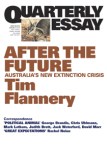
Quarterly Essay No 48 Cover

Quarterly Essay 48 cover (Courtesy Black Inc)

Tim Flannery is an Australian palaeontologist-cum-environmentalist who has been on the public stage for a couple of decades now. He has published several books on environmental issues, some best-sellers, including The future eaters and The weather makers. He was Australian of the Year in 2007, has starred in three television documentary series with comedian John Doyle, and is currently Chief Commissioner of Australia‘s Climate Commission.  With the environment being his passion, he is used to controversy, but many of us regard him as a national treasure. There, I’ve shown my hand!

Needless to say, I enjoyed his current Quarterly Essay titled After the future: Australia’s new extinction crisis. In it he analyses the causes of the second wave of extinctions, and suggests solutions.

The essay is divided into 8 short sections. Near the end of the second section, Flannery writes

I hope the message is loud and clear. Australian politics, and the bureaucracy that supports it, is failing in one of its most fundamental obligations to future generations, the conservation of our natural heritage.

It’s scary stuff. On the preceding page he discusses public ignorance, arguing that most people are unaware that a new wave of extinction is happening, and that those who are aware “commonly believe that our national parks and reserves are safe places for threatened species”. I fall into this latter camp, I’m afraid. I knew it wasn’t all hunky-dory but I had assumed that the parks and reserves were working. Apparently not. The reasons are complex. Funding is of course one aspect and underpins some of the issues he raises, such as the lack of resources and support for effective planning and management, and a decrease in scientifically trained staff able to research and monitor the situation.

However, Flannery argues there are more systemic issues, mostly relating to “politics”. One is the increasingly risk-averse behaviour of governments, resulting in their being prepared to do nothing rather than risk failure. Another is the fact that the environment is no longer the bipartisan issue it once was, with the right increasingly seeing the environment as a left issue. The conservatives are, paradoxically, losing interest in conservation! Environmental stewardship, Flannery argues, once inspired leaders of the right, like Theodore Roosevelt and Ronald Reagan in the USA, and Malcolm Fraser in Australia. It was Malcolm Fraser “who first used federal powers to prevent sand mining on Fraser Island, who proclaimed Kakadu a national park, and who ended whaling in Australia”. However, the rise of green parties (here and in other first world nations) is alienating the right, and yet are not always friendly to conservation. “Animal rights issues, such as opposition to the culling of feral species”, for example, “can sometimes get in the way of environmental stewardship”. The result of environmental issues being seen through the lens of party politics and ideology is that the effort to discredit conservation has resulted in the rejection of science as “a guide to action”. This, says Flannery, is dangerous territory.

While Flannery spends around a third of the essay setting out the problem and discussing the causes, his main thesis is that the current focus of environmental programs on preserving ecosystems is not working – and he presents some convincing arguments for changing the focus to saving individual species. He describes programs in the Kimberleys which are managed by the Australian Wildlife Conservancy (with which he is connected) in partnership with indigenous groups, using their fire management techniques. But his most impressive example is a privately managed program in Papua New Guinea, the Tenkile Conservation Alliance, focused on saving a tree kangaroo. He argues that it “is a prime example of saving an ecosystem by concentrating on saving a species”, and asks:

How is it that one Australian couple has almost single-handedly transformed the fortunes of a people and the biodiversity of a mountain range while trying to save  an endangered species of tree kangaroo? The answer is simple: the Thomases [zoologists] set clear goals, used scientific methods to monitor their progress, and reported back to the people.

I’m not sure I’d call that simple. Or, perhaps I’d say the process is simple, but deciding on environmental priorities and finding the right mix of people/organisations to manage it is not so simple. Flannery’s solution is there needs to be:

  • a legislative commitment to zero tolerance on further extinctions;
  • the establishment of a Biodiversity Authority [yes, I know, another bureaucratic body] that is independent of government, that has “unequivocal targets”, and which faces strong consequences [what, I wonder?] on failure to deliver; and
  • the acceptance and formal involvement of non-profit organisations in managing biodiversity programs.

The Conversation, an Australian academic and research sector blog, is currently running a weekly series on endangered species. A commenter on last week’s post suggested outsourcing the listing of endangered species to peak groups, pretty much mirroring Flannery’s argument regarding partnerships between the government and non-government sectors.

Overall, the essay is clearly argued, but occasionally Flannery makes a statement that jars. One is his statement that “even under Labor governments with a strong green bent, national parks are not always safe” which he supports using the example of the Bligh Government’s starting the process of de-gazetting a part of the Mungkan Kaanju National Park with a view to returning it to its traditional Aboriginal owners. He doesn’t elaborate on this. I wrote in the margin, “Is this wrong”? Not surprisingly, at least one indigenous leader, Marcia Langton, took offence. I suspect it was a case of Flannery finding a poor example to support his argument regarding national parks being threatened even by supposedly sympathetic governments, but I don’t know.

Despite odd moments like this, I did find his argument convincing. However, as I’m sure he’d say himself, it’s not a guaranteed solution. Early in the essay he makes a point of discussing scientific method, arguing that “science is not a search for the truth” but about “disproving hypothesis”.  The hypothesis he proposes here is surely worth testing given the failure of current methods. It begs his early questions, though, regarding political and social will, which may in fact be the critical variables that we need to resolve.

Tim Flannery
“After the future: Australia’s new extinction crisis”
in Quarterly Essay, No. 48
Collingwood: Black Inc, November 2012
107pp.
ISBN: 9781863955829

(Review copy supplied by Black Inc.)

Meanjin’s Tournament of Books 2012, Matches 3 to 6

As I promised in my first post on this year’s tournament – whether you wanted it or not  – I’m back with a progress report on the tournament. And, I must say, I’m rather thrilled with the results to date. I haven’t read all the contenders so my reaction is more than a little subjective but my favourite authors and some favourite stories are doing well.

Match 3: Thea Astley’s “Hunting the wild pineapple” defeated Tara June Winch’s “It’s too difficult to explain”

Thea Astley, as I’ve said before, is one of my favourite writers. I have read several of her novels, but she had a long and prolific career and so there’s still a lot for me to read. Her short story collection, Hunting the wild pineapple, is one I’ve yet to read. I also haven’t read the Tara June Winch story so I’m flying completely blind. I’d like to support the young, up and coming writer, but in my heart I’m glad Astley is through to the next round. I want to see her better recognised!

I loved the fact that the judge of this round, John Hunter, recognised (not that it’s relevant to this particular competition) Thea Astley’s Miles Franklin achievement when he says that she “single-handedly kept up the women’s quota of Miles Franklin Awards for decades. Even today I think not many people know this. Anyhow, he describes Astley’s short story as “social observation written with a razor blade”. I couldn’t describe Astley better myself.

Match 4: Elizabeth Jolley’s “Five acre virgin” defeated Sonya Hartnett’s “Any dog”

Of all the matches, this is the one that mattered most to me, not only because Elizabeth Jolley is another of my favourite writers, but because this short story is one of the few I nominated in Meanjin‘s call for nominations on its blog. Estelle Tang, who judged this one, starts by commenting on the humour. This is one of the reasons I love Jolley, her wit, satire and irony. She’s dark but she makes you laugh despite yourself. “Five acre virgin” was my first Jolley. It introduced me to her interest in and empathy for the underdog, the marginalised and the outsider in our society, issues that she explores regularly in her fiction. Tang describes the story as “the classic swimming duck, an unassuming facade masking the maelstrom beneath” which could be a good description for Jolley herself. On the outside, she looked like a sweet little old lady but underneath was something far sharper. She was one funny, cluey woman.

Match 5: Josephine Rowe’s “In the mornings we would sometimes hear him singing” defeated Murray Bail’s “A.B.C.D-Z”

Of the four matches I’m reporting on today, this is the one I have least vested interest in because I’ve read neither of the short stories. However, I have read a couple of novels by Murray Bail and like his writing so on a purely subjective basis, I’d have been happy to see him win. However, the judge Jo Case calls Rowe’s prose “exquisite”, describes the story as “a mood piece” and says it’s “a seductive read”. I must locate a copy.

Match 6: Barbara Baynton’s “Squeaker’s Mate” defeated Frank Moorhouse’s “The Annual Conference of 1930 and South Dada”

Regular readers of this blog will probably remember that I reviewed “Squeaker’s Mate” last month. It’s a great story and offers such a different perspective on the “bush myth” that, although I haven’t read Moorhouse’s probably very worthy story, I am very glad to see Baynton win. Patrick Pittman who judged this match said that Baynton was new to him, and that the piece came as “a complete surprise”. He comments on its “sparse and unrelenting prose” and on its gender politics which “is radical and unsettling, if not always pin-downable”. I know what he means. Baynton is not simplistic – and should be better known.

Recap

Did you notice that these four rounds, which involved 6 female and 2 male writers, were all won by women? This is not a gender war … but it’s good to see some under-appreciated women gaining recognition.

Nigel Featherstone, I’m ready now (Review)

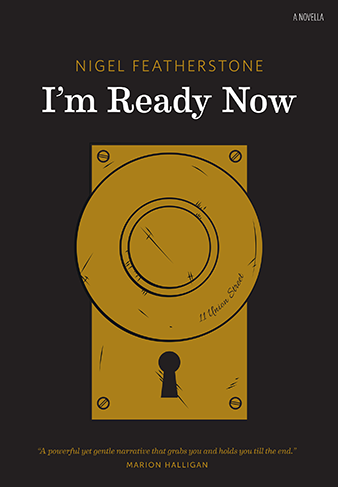
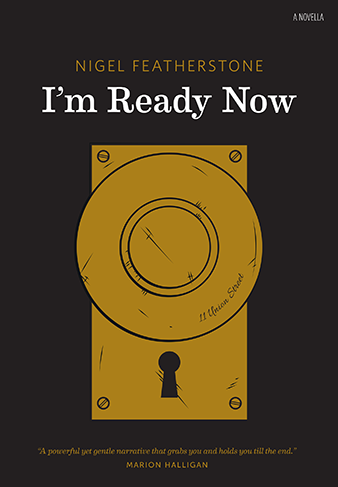
Featherston, I'm ready now, book cover

Book cover (Courtesy: Blemish Press)

Way back in my youth when I started studying literature, I thought I had to get the “right” interpretation. It made reading a little scary, I must say. However, as I gained confidence, I discovered that there are as many responses to a novel as there are readers, something I was reminded of when I attended this week’s launch of Nigel Featherstone’s novella, I’m ready now. And here’s why…

The book was launched by Canberra journalist and biographer, Chris Wallace. She spoke eloquently about the book telling us that it’s about how you can make a change in your life no matter how old you are – whether you’re 30 as Gordon is in the book or 50 as his mother, Lynne, is. She said too that it promotes the idea of living an imaginative life. I thought, yes, she’s right, it does do these things. And then Nigel spoke, and he said that for him the book can be summed up in one word, liberation. And I thought, yes, I can see how it’s that. But I had framed it a little differently from my reading.

Before I give you my different-but-on-a-similar-track take, I’d better tell you something about the plot. It has a small cast of characters, which is pretty much what you’d expect in a novella. They are Gordon, a gay man turning 30 who lives in Glebe and works as a photographer; his old schoolfriend Shanie, who followed Gordon to Sydney; Levi, Gordon’s boyfriend of a year or so; and Gordon’s mother Lynne who, recently widowed, comes up from Hobart to stay with Gordon for a short while. Lynne has put the large family home on the market, and the auction will be held while she’s away. Meanwhile, Gordon is almost at the end of his Year of Living Ridiculously, which is a year of rather self-destructive high living that he designed, and is doggedly keeping to, for his 30th year. He plans to crown this year with something he calls The Ultimate. But then Mum, Lynne, arrives, and puts The Ultimate at risk. What Gordon doesn’t know is that his mother has a grand plan herself, now that she’s free. (Ha! Liberation you see.)

This sounds pretty simple, really, doesn’t it? However, there are complications. Lynne’s husband, Eddie, was not Gordon’s father. Gordon’s father, Patric Finn, walked out on him and his mum when he was around a year old, and neither has completely resolved the abandonment. It’s not that Eddie wasn’t a good husband and father, because he was, but he never fully understood Gordon, and for Lynne he was “a head kind of love, not a heart kind of love”.

What is lovely about Featherstone’s writing – as I also found in his Fall on me – is that he manages to build tension and mystery around his characters’ behaviour without undermining their realness or humanity, and without alienating us readers. We warm to them even while we wonder about the wisdom of their decisions and motivations. Featherstone also uses imagery and allusions lightly. Water, for example, can be a cliched symbol in stories of change and growth, but here it’s appropriate and not laboured. What more logical thing is there to do on a hot night in Sydney than to go for a dip in the sea?

Besides the characterisation, I also like the novella’s voice and structure. It’s told first person in the alternating voices of Lynne and Gordon, and is effectively paced, largely through varying the length of the chapters*. The book opens with a mere half-page chapter in Lynne’s voice, and then moves to mostly longer ones in the main part of the book. They shorten towards the end as the pace builds, keeping us involved and wondering what these two will finally decide to do and what role Shanie and Levi might play in it all.

Now though to how I would describe the novel – and for me it is about coming to terms with the past. Both Gordon and Lynne have not had unhappy lives but both have in some way been damaged by their abandonment. Almost half way through the novel, they both say something significant. Lynne, reflecting with real generosity on Patric’s unheralded departure, says

I think he wanted to be free, a free young man. There have been times – many times – when I’ve found myself actually admiring his audacity to grab life, to run with it, to run as far as he could.

She then tells us that her plan is to leave Australia to live in “a farmhouse on a hill in the beloved country [Ireland] of my mother”. In the next chapter, Gordon’s, we learn in a flashback why he commenced his Year of Living Ridiculously. It’s to discover “what it is that makes me feel most alive”. He wants to “to lean over the cliff, figuratively speaking … to live as vividly as possible” – but his chosen method is clearly not working. The idea, though, reminded me of Fall on me in which the son tells his dad that “safety doesn’t always equal life”. Both these novellas, in a way, explore what Wallace described as “living an imaginative life”.

They are both, too, about something Lynne says towards the end, which is that “life must move forward; anything else is sacrilege”, and yet, paradoxically, her wish for Gordon could be seen to be the opposite: she wants him to go back to find what “hurt him all those years ago”.

And so for me, the book is about “living imaginatively” and about liberation, but it is also about how the past can stall us if we don’t get it in the right perspective. Featherstone opens the book with two epigraphs, one being TS Eliot’s “Home is where one starts from”.  I think that, in a way, says it all.

Nigel Featherstone
I’m ready now
Canberra: Blemish Books, 2012
156pp.
ISBN: 9780980755688

(Review copy supplied by Blemish Books)

* for want of a better word for the numbered parts.

Barbara Baynton, The chosen vessel (Review)

I’m blaming author and blogger Karen Lee Thompson again for this post, because she wrote a wonderful comment on my post on Barbara Baynton‘s short story “Squeaker’s mate”, and I’m going to quote it pretty much in full (I hope that’s ok from a copyright point of view – tell me if it isn’t Karen Lee):

Barbara Baynton wrote some wonderful stories and, had literary politics been a little more inclusive in the days of the Bulletin, I’m sure she would have received wider recognition. Many of Baynton’s short stories, like ‘Squeakers Mate’, turn ‘The Australian Legend’ on its head and, perhaps because of this, the male literary elite (A.G. Stephens, A.A. Phillips for example) chose to modify or explain her work in various ways.

An interesting example of this editorial intrusion is the politics surrounding Baynton’s ‘The Chosen Vessel’ (Baynton’s preferred title was ‘What the Curlews Cried’) which I have read, in its various forms, a number of times. Stephens published it as ‘The Tramp’. It is believed he wanted the title to shift the focus away from the central woman and it allowed for clarity between a ‘tramp’ (an isolated individual) and a ‘swagman’ (a virtuous kind of everyman of the bush). Stephens also cut a significant part of the story before publication.

For anyone who enjoys ‘Squeakers Mate’, I’d suggest a reading of ‘What the Curlews Cried’ (aka ‘The Chosen Vessel’ or ‘The Tramp’), preferably in its unabridged form.

“The chosen vessel” and “Squeaker’s mate” are Baynton’s best known and most anthologised short stories. However, I hadn’t read “The chosen vessel” before and so decided, on Karen Lee’s recommendation, to read the version in Bush studies. According to my brief research, and Karen Lee can correct me if I’m wrong, The Bush studies version is the final complete version Baynton presented for publication. However, it is not the same as the original version which was submitted as “What the curlews cried” and then significantly edited by the Bulletin.

Anyhow, if I thought “Squeaker’s mate” was tough, then this one is tougher. The female protagonist is left alone with her baby, rather like Lawson’s wife in “The drover’s wife”, but this woman faces a double whammy. Left by a cruel husband, she is terrorised by a “swagman” (not a “tramp” despite its first published title). She’s a town girl unfamiliar with bush life, but that’s not what scares her. I won’t detail the plot more because it’s a short story (around 8 pages) and you can find it in the online link below. The shorter Bulletin version, I understand, did not change what happened to the woman, but excised a whole section and thereby effectively changed the meaning of the story to suggest an isolated instance rather than something more systemic.

In the introduction to my Sydney University Press edition, Susan Sheridan confirms my statement in my “Squeaker’s mate” post that Baynton’s main concern was not the harshness or terrors of the bush and the land, which contemporary critics tried to argue, but male brutality to woman and, more significantly, “the impossible position that male culture constructs for ‘woman’ in the abstract”. She writes that woman is glorified as the Madonna, God’s “chosen vessel”,  but “at the same time the capacity for motherhood is regarded as confining her to the animal level of existence”. In “The chosen vessel” religious imagery – the mother and her baby are both mistaken for a ewe and a lamb and as a vision of the Madonna and child – is used to devastating ironic effect.

I’m not surprised that those late nineteenth century men found her writing confronting and that the Bulletin only ever published one of her short stories, but, for me, Baynton’s writing presents an alternative view of life in the bush that I’m glad we have available today.

Barbara Baynton
“The chosen vessel”
in Bush studies
Sydney University Press, 2009
ISBN: 9781820898953

Available online: in Bush studies at Project Gutenberg

Barbara Baynton, Squeaker’s mate (Review)

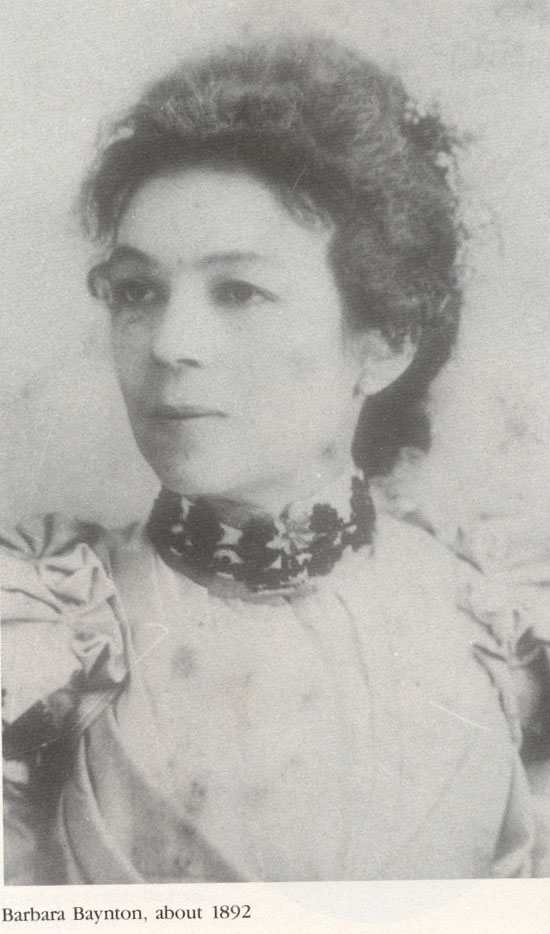
Barbara Baynton 1892

Baynton 1892 (Presumed Public Domain, via Wikipedia)

My last post was about this year’s Meanjin Tournament of Books which is pitting short stories against each other. One of the short stories is Barbara Baynton‘s “Squeaker’s mate”, which I’ve read before but a long time ago. I decided, though, to read it again, since I have easy access to a copy, on my shelves and online.

Author and blogger Karen Lee Thompson commented on my tournament post that she’d like to see a bout comparing “Squeaker’s mate” (1902) with Henry Lawson’s “The drover’s wife” (1892), and it would be delicious. I was tempted to do it here but I won’t. However, I did think of commencing this post with “Only a woman …” because, despite their broad similarities in subject matter and setting – the harsh life faced by pioneer women in the outback – there is a big difference in tone. Both stories chronicle the bravery and perseverance of bush women,  but Lawson’s story has an heroic, even somewhat romantic, tone. Not so with Baynton.

Squeaker’s mate, “the best long-haired mate that ever stepped in petticoats”, is a hardworking, taciturn woman whose mate, Squeaker, is a good-for-nothing. Here’s paragraph three:

From the bag she took the axe,  and ring-barked a preparatory circle, while he looked for a shady spot for the billy and the tucker-bags.

It’s not that there’s anything wrong with Squeaker, other than laziness, but “she knew the man, and her tolerance was of the mysteries”. However, things change dramatically early in the story when a tree falls on her, putting her out of action. Squeaker’s initial reaction is chilling – “he was impatient, because for once he had actually to use his strength” – and, a little later

he supposed he would have to yard them [the sheep] tonight, if she didn’t liven up. He looked down at unenlivened her.

It’s only in the last few paragraphs of the story that we learn “her” name. Significantly, it’s Mary.

The rest of the story chronicles his self-centred callous treatment of her, sometimes leaving her for days with no sustenance. All she has is her loyal dog which, for we readers, relieves, albeit slightly, our despair at her situation. There is no heroism in here, very little kindness even – but there is, on the part of Squeaker’s mate, resilience and, without giving away the story, a triumph of sorts.

Baynton is critical of men’s attitude to women – and this is a major theme of the story, though it’s not that simple either. Early on, a few men do show kindness to Mary – let’s dignify her with her name now – but their women put a stop to that. Mary had not been one for “yarnin'”, making her “unlikely” to be popular with them. Baynton writes:

It is in the ordering of things that by degrees most husbands accept their wives’ views of other women.

And so Mary is left alone.

The writing is compelling. It is told third person, but the perspective swaps between hers, his, and, later on, that of the woman he brings into their home. In some circumstances this narrative approach could provide an even-handed view of the characters, but here it only serves to reinforce our early opinion of them. In other words, Squeaker does not improve on acquaintance. Baynton plays effectively with the “word” mate, contrasting the roles, responsibilities and rights of mates as partners, alongside those of the Australian “mateship” tradition, with Squeaker’s un-mate-like, in all senses of the word, behaviour.

Imagery is used sparingly, but it’s pointed when it’s there. It is a tree that brings Mary down, and then late in the story Squeaker decides to clear some land:

So that now, added to the other bush voices, was the call from some untimely falling giant. There is no sound so human as that from the riven souls of these tree people, or the trembling sighs of their upright neighbours whose hands in time will meet over the fallen victim’s body.

A little melodramatic in that 19th century way maybe, but Baynton’s suggestion that there’s more solidarity among trees than the humans below is well made. In fact, while life is harsh, it’s not an unforgiving environment that is the main problem for Baynton’s characters.

It’s a grim but effective story that focuses mostly on gendered callousness in a world where survival would be best ensured by cooperation. In confronting gender issues, Baynton is part of a tradition of Australian women’s writing of the late nineteenth to early twentieth century that has, to a large degree, been forgotten a century or so later. It’s time to revive these early writers – and hopefully recent initiatives by Sydney University Press, Text Publishing and others, will do the job.

Barbara Baynton
“Squeaker’s mate”
in Bush studies
Sydney University Press, 2009
ISBN: 9781820898953

Available online: in Bush studies at Project Gutenberg

Kate Grenville, The lieutenant (Review)

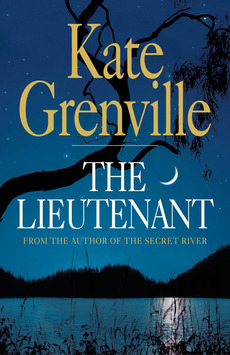
Kate Grenville, The lieutenant book cover

Bookcover (Courtesy: Text Publishing)

I first came across William Dawes, the inspiration for Kate Grenville’s The lieutenant, in Inga Clendinnen’s award-winning history, Dancing with strangers (2003). But this is not the only book that Grenville’s novel brought to mind, as it also reminded me of Kim Scott’s That deadman dance. (Intriguing that both these books use a dance motif, but it’s an historically valid one).

However, before I talk more about these connections and their relevance, I should briefly describe the plot. The novel is set during the first years of the white settlement of Australia. (The very fact that I write the “white” settlement says something about how far we have come in the last two centuries, though we still have some way to go). Daniel Rooke, the protagonist, is a young astronomer. He has been chosen for the First Fleet on the recommendation of the Astronomer Royal who believes that a significant comet will appear in the southern hemisphere in late 1788-early 1789. With this role in mind, Rooke manages to largely separate himself from the day-to-day hurly burly of the first year or two of settlement by creating an observatory, of sorts, for himself, on a hill (now called Dawes Point) overlooking Sydney Cove. Here, in his isolation, he is visited by a group of indigenous people, mostly women and children, and develops a particular relationship with the young 12-13 year old girl, Tagaran. They learn each other’s language, which Rooke chronicles in his journals. All this generally reflects the story of William Dawes whose journals Grenville (and Clendinnen) read, but, as Grenville writes in her author’s note:

Although I made use of historical sources, I departed from them in various ways. This is a novel; it should not be mistaken for history.

Meanwhile, back in 2003, Clendinnen wrote of Dawes, bemoaning his earlier-than-wished-for departure from the colony:

His departure cost us access to the local language as it was spoken at the time of contact. It possibly also cost us a brilliant ethnography, although his tender conscience  might not have allowed him to open the people to easier communication, and to more disruptive exploitation.

Grenville does a good job of imagining the Dawes described by Clendinnen as an “introspective, scholarly type” in her characterisation of Daniel Rooke. She introduces him as a socially awkward but sensitive and thoughtful young man who joined the military not for love of war but because it provided the best chance for a poor young man to make a life for himself. From this supposition she develops a credible character whose final actions in the book pretty closely mirror what we know of Dawes.

I will leave Rooke here for a moment, though, to talk a little more about the conjunction between the three books I mentioned in my introductory paragraph. The significant point they all make is what Clendinnen calls “acts of kindness” by the indigenous Australians in the early days of settlement (in the east, in the case of Grenville and Clendinnen, and the west in the case of Scott). All three writers describe a willingness to be generous that was not recognised or accepted by the colonial invaders. Now, I know that here I am speaking of history and fiction in the one breath and I know that, as Grenville wrote, novels should not be mistaken for history. However, modern readers can, I think, glean the truths, regardless of form or genre, if the writers provide the appopriate signposts.

Take The lieutenant. In it, Grenville is still smarting I think from the criticism she received from historians regarding her claims about the historical value of The secret river. The book contains many rather sly allusions to facts, reality and truths. I particularly liked Rooke’s contemplation about the value of his journals in which, as well as documenting the language he was learning, he described his interactions with indigenous Australians, telling stories that actually happened but whose meaning, he discovered, could be distorted. He considers omitting all but the dry documenting of language, but then realises:

Making an expurgated version of the notebooks would kill them. Like a stuffed parrot, they would be real, but not true.

With a little sleight of hand, Grenville uses a fictional character and his fictional journal to talk about the use of historical sources and the telling of stories from them. Do you simply present the “facts” or do you tell a story –  either factual as in history or fictional as in novels – from those facts in which you aim to draw out the truths as best you see them. Am I drawing too long a bow? I don’t think I am.

And so, as you can probably tell, I enjoyed the novel. It suffers from a little earnestness in tone but that doesn’t get too much in the way of a good story about how first contact in the first settlement played out. It’s not the only story about first contact but it is a valid one – and it helps us understand how an all too human inability to walk in the shoes of the other resulted in a catastrophe of major proportions that we are still working through today.

Kate Grenville
The lieutenant
Melbourne: Text Publishing, 2008
307pp.
ISBN: 9781921656767

(Review copy supplied by Text Publishing. An unsolicited review copy received in 2010 so I’m afraid I’ve taken my time to get to it.)

Monday musings on Australian literature: Guest post from Nigel of Under the counter or a flutter in the dovecot

This is embarrassing but I really can’t remember how and when I first met Nigel. Actually let me rephrase that: I do remember when I met him in person because I’ve only met him once (at a literary event earlier this year), but who stumbled across whose blog first I have no idea. I’m glad we did though, because in Nigel I’ve discovered not only a lovely writer (see my review of his novella Fall on me) but an active supporter of Australian literature through such activities as the online creative arts journal VerityLa and the arts forum, the Childers Group. I also enjoy his reflective blog, Under the counter or a flutter in the dovecot. And so I was thrilled when he said yes without apparent demur to my request for a guest post. Thanks Nigel …

Real or imagined, raising children makes a great story

The game now finished and the speeches in full swing, the camera panned left to take in the players who were standing off to one side and looked worn-out and knocked around, a few with mud on their faces, a bit of blood too, but smile they did because they’d won and were elated. After a moment, the camera went back to whoever it was that hadn’t yet finished his speech (why is it that a man with a microphone will always go on too long?). For the first time in my life I was grateful when the TV channel cut to an ad break.

When the NRL grand final coverage resumed – I’d not watched the actual game, and had only stumbled on the closing minutes of the concluding celebrations by lazy accident – the victorious players were wandering around the field, or ‘paddock’ as it’s apparently called, many with their young children in hand. It’s this that struck me: rugby league boofheads wanting to be with their kids in these lingering moments of sports elation.

It looked – it felt – amazingly non-sensical.

I’m not one for children; never have been, never will be. I am, in fact, the least paternal person on Earth. At no point in my life have I ever wanted children. Which is, now I examine my life with precision (the process of writing does that), a bit of a lie. I remember that as a teenager I did have day-dreams of raising children, except in those day-dreams my wife was always absent, to be accurate she was dead, which left me to be a hip young single father, and I was very good at fathering, and my kids adored me and I adored them back. Once I was old enough to understand why my wife was always cactus, my mind – my conscious mind – turned to things closer at hand, and much more real. Which is why, aged forty-four, I’m blissfully childless. When on the rare occasions something good happens to me (though for some reason these events are never televised), I reach for a bottle of nicely chilled verdelho and a slice of blue cheese on a cracker.

Not having children, not wanting children – now that I have a fine appreciation of the opportunities and constraints of my life, I desire children as much as I desire the idea of a car-alarm going off in the middle of the night, and if ever I find myself day-dreaming, which is, I should say, a lot, it’s about having a crumbling hut in some far-flung place that you can only access by barging a rusty old four-wheel-drive across seven creek-crossings – is problematic for someone like me, a writer of all things, that ridiculous trade that’s getting more and more ridiculous as each day goes by. For family is the guts of the contemporary Australian story – it is, to throw into the mix some suitably highfalutin French, its raison d’etre.

I’ve just finished having a private Australian literature festival, reading some blisteringly powerful novels by our nation’s finest (who too don’t get to parade their children in front of TV cameras). Kate Grenville’s Sarah Thornhill, Craig Silvey’s Jasper Jones and Gillian Mears’ highly distressing but remarkable Foal’s Bread. All three novels explore family and the impacts on children, but also the desire for children, that procreating is the usual path, the standard, the predictable, how it is just what you do. How the desire to continue your bloodline is simultaneously overwhelming and underwhelming. It is refreshing that both Foal’s Bread, which is largely set between the world wars, and Sarah Thornhill, which has as its backdrop our morally bankrupt colonial times, explore women who aren’t just mothers, whose dreams are bigger and wider and deeper.

*

In my own writing, my own attempts at making words come to life on the page – it always seemed so easy as a boy: you wrote what happened and that was that – I too explore family. My main characters are usually men and women (always a good start!) who have children, who want to be parents, who struggle to cope, who feel the pressure of internal and external expectation, who fail and fall into a heap but pat themselves down and have another crack at it.

Featherstone, Fall on me

Fall on me bookcover (Courtesy: Blemish Books)

My novella Fall on Me (Blemish Books, 2011) is about a single father who has to cope with his precocious seventeen-year-old son who insists on turning his naked body into an art exhibition. Lou and Luke: how through writing their story I’ve gotten to know them well, so well, despite everything how they created a family for themselves, and the addition to that family, Anna Denman, their housemate who became much more. To the point that I still think about them. And it’s always gratifying – and humbling – when readers say they think about them too.

In my forthcoming novella, I’m Ready Now, to be launched in Canberra on 22 November by Blemish Books, I write about a very different family. The story is a simple one, but it’s told from two points of view: a mother’s and a son’s. Lynne Gleeson is a fifty-year-old ‘corporate wife’ (that’s how she describes herself) whose husband Eddie, a man who inherited his family’s property-development business, has died of a heart-attack. Theirs was a perfectly functional if not loving relationship, one of considerable wealth and privilege – the family home is a daunting historic mansion called Gleeson House in Battery Point, Hobart. Now that Lynne is alone, she has decided to sell this property, and the family’s other houses, including an architect-designed getaway on Magnetic Island, Queensland. Effectively homeless, she leaves Tasmania to spend a fortnight in Sydney, staying with her son Gordon. But Lynne has plans. Big plans.

Nigel Featherstone, I'm ready now

Cover (Courtesy: Blemish Books)

Meanwhile Gordon, a professional freelance photographer, is thirty now, and despite being in a relationship of five years’ standing, is having what is described as a ‘Year of Living Ridiculously’ – it involves spending his weekends out in Sydney’s bars and clubs, taking drugs, and having promiscuous sex. For his thirtieth birthday, which his step-father’s death prevented the family from celebrating, Gordon has secretly arranged ‘The Ultimate’, which threatens to tear everything and everyone apart. It sounds heavy, it sounds grim, but it’s just about family. So it’s the truth. And, yes, I really think I can say that: the truth.

Family: there are plenty of other things to write about. Fighting wars amongst far-flung stars. Cornering yellow-teethed bad-guys. Hacking up zombies. Sex, which as I know better than anyone, doesn’t always have to result in something altogether gruesome nine months later. But still it’s family that I write about, the desire to raise someone in your own likeness, to have your best go at doing a decent job of it, to leave something worthwhile behind. All I’m going to leave behind is a handful of stories in the flickering fluorescent-light basement of the National Library of Australia.

*

Last month my older brother and his fourteen-year-old son dropped in on their way to the snow-fields. We went down to a café in the mainstreet for lunch and caught up on all that was happening in our various worlds. An hour later it was time for them to continue on their way south. The day was cold and blustery, the sort that makes my hands turn blue and my mood turn a similar colour. Dust was being flung around and as my brother and his son got into their brand-new four-wheel-drive I began to cough and splutter wildly.

My nephew, who’s not big on conversation and his favourite thing ever is his skateboard, wound down the window and stared at me fair-square in the face and said, ‘Are you sick?’ He looked genuinely concerned. ‘No,’ I said, ‘there’s a typhoon going on out here and it’s hit the back of my throat.’ His eyes brightened right up and he laughed. As my brother drove the two of them away, I sent my nephew a text message: ‘Have a great time on the slopes.’ He wrote back: ‘Have a good week.’ When was the last time someone had wished me a good week? I couldn’t remember. But I loved those words. They moved me. And they still do.

If I have a motivation to write, it’s to move people.

So, despite everything I know about myself, after forty-four years of determined self-direction, to the point that I’m now, to put a twist on something Quentin Crisp once said, one of the stately homos of Goulburn, I watch the dying moments of a rugby league season and can’t take my eyes off the men – proud, probably even gentle men (when they need to be) – who lead their children around a football field; it’s not the men who fascinate me, but the big hands holding the little hands. And I read great Australian novels about family and generations and personal history amongst the maelstrom that is the bigger political and social context. And I write stories about people who do their utmost to raise the best of kids. And I keep in my mind a simple text-message from my nephew.

But I also recall something the US poet and civil rights activist June Jordan once wrote: ‘In the name of motherhood and fatherhood…we threaten and suffocate and bind and ensnare and bribe and trick children into wholesale emulation of our ways.’ My unborn children should be grateful that they had me as a father. Hopefully the ones that live on the page are much more optimistic about their chances in the world.

Elliot Perlman, The street sweeper (Review)

Elliot Perlman‘s latest novel, The street sweeper, is a complex book with a pretty simple message. It’s complex because of its multiple interconnecting storylines that move back and forth between World War II, the American Civil Rights era, and contemporary times. It has multiple themes, about which I’ll write further, but the underlying message is simply this: history is important. Related to this is the idea that all things are connected. Let me explain …

The original characters in the novel, those from whom the connections flow, are two lawyers, the Jewish Jake Zignelik and African-American William McCay. Both were active in civil rights in the 1960s. However, as the novel starts, Jake has been dead for some time, and William is in his 80s. The baton, in a way, has been passed to their sons, Charlie and Adam who are historians at Columbia University. It is around 2008, and both men have lost their way somewhat. Charlie is a successful academic, so successful that his administrative duties are not only tearing him away from his main love, research, but also from the important relationships in his life, those with his father, wife and teenage daughter. Adam’s problem is different. His career has stalled. He hasn’t published anything for so long that he will not get tenure – and Charlie, who has been his mentor, but who has let that relationship slide too, can’t help. Adam, believing it’s the honourable thing to do, breaks up with his long-standing girlfriend, Diana, on the basis that he’s unable to be the husband and father that he believes she wants.

None of these characters, though, is the street sweeper of the title, because there is another significant character, the one who opens the novel. This is Lamont Williams, an African-American who has just started work as a janitor at a cancer hospital in a pilot program for ex-convicts. He, like Adam, is close to 40 years old. Lamont, we soon learn, is a good man to whom bad things happen, just like the hero in Perlman’s first novel, Three dollars. He is, in fact, innocent of the crime that put him in jail but his colour and poverty meant he didn’t have a chance – just like the Jews in war-time Europe.

The novel focus primarily on these two men – Adam and Lamont – as they struggle to get their lives on track. Lamont’s story sees him getting to know hospital patient and Holocaust survivor Henryk Mandelbrot who tells Lamont over a period of nearly 6 months of his experience under Nazism, particularly in Auschwitz. Mandelbrot wants his story known, and insists that Lamont learns and remembers it. Meanwhile, Adam, initially reluctantly, looks into a research project suggested by Charlie’s father William, one that sees him also learning about the horrors of the Holocaust. As the novel progresses, and more characters – from the past and present – are introduced, the connections and links between people multiply, rather like a Dickensian novel. There is, though, a point to these connections. Early in the novel, Perlman writes that

you never know the connections between things, people, places, ideas. But there are connections.

And these connections, whether we know it or not, can direct the trajectory of our lives – as they do for the characters in The street sweeper. There is also a central ideological connection in the book, and this is that there are “parallels between the situation of blacks in the United States and the Jews in Germany”.

A major theme of the novel – one of Perlman’s pet themes in fact – is that of moral responsibility, of what makes a “good” person. As so often happens, those who have the least but, paradoxically, the most to lose, are quickest to take the moral path. Early in the novel, and four days into his 6 months probation, Lamont is accosted by Mandelbrot who asks a favour. This favour is something Lamont is not supposed to do – it’s not his job – but, seeing the old man’s distress, he risks losing his job to do the right, the moral, thing. Late in the novel, a professional woman who has nothing to lose but a bit of her time is asked to do a moral thing. She experiences a jolt when, after a passage of time, she realises that she’d been prevaricating about an issue of justice. Not all characters though come to this realisation regarding their moral duty.

I said in my opening paragraph that the underlying message of the novel is that history matters. This is conveyed throughout the book by discussions about history and the role of historians, by showing historians going about their business, by reference to the “long causal chain” and to the importance of remembering, and most of all, by the refrain, “tell everyone what happened here”. You won’t be surprised to know that I loved the fact that Perlman explicitly and implicitly explores the theory and practice of history here, but it deserves a post of its own so watch this space … I’ll simply say now that Perlman explains in his author’s note which characters are based on “real” historical figures, and he provides an extensive list of the sources he used.

The question I always ask when reading historical fiction is why has the author decided to tell this story from the past? In Perlman’s case the answers are obvious. First it’s the one made explicitly in the novel, and that is to “tell everyone what happened here”. Then there’s the more implicit one to do with why we need to know what happened, and that is to ensure that the horrors visited upon the Jews in the Holocaust and the African-Americans in the US don’t happen again. And finally it’s to remind us of our basic moral responsibility which is, as William says to his son, to “Do what’s right here, Charlie”.

I could pick some holes in the novel. It’s big and a little baggy around the edges. It can verge on didacticism at times. And, to make the necessary connections, Perlman relies a lot on coincidence, which could seem contrived if you haven’t bought into the story. But, here’s the thing. I have read many good, even excellent, books this year. However, The street sweeper, like Rohinton Mistry‘s A fine balance and Margaret Atwood‘s The handmaid’s tale, is one that will stay with me long after I’ve forgotten the name of the characters, long, even, after I’ve forgotten how the plot falls out. And that, for me, is the best sort of read.

Lisa of ANZLitLovers also liked this novel.

Elliot Perlman
The street sweeper
Kindle edition
Random House, 2011
ASIN: B005LV7O4S