Meanjin’s Tournament of Books 2012 (2013), Semi-finals

And so Meanjin’s Tournament of Books rolls on – during a hot Australian summer that has been characterised by terrible fires and floods. “I love a sunburnt country” but this is ridiculous.

Anyhow, the tournament’s semi-finals have been played and the best short stories (sorta) have won. Here they are:

Semi-final 1: Thea Astley’s ‘Hunting the wild pineapple’ defeated Nam Le’s ‘Love and honour and pity and pride and compassion and sacrifice’

This match was judged by one Ronnie Scott, who is apparently a reviewer, writer, and PhD graduate among other literary-artsy things. His discussion of the two pieces is pretty thorough. He makes a few references to Nam Le’s creative writing school background – which is in fact the setting/background of this short story. He suggests, for example, that the story “invokes the fearsomely competent, ‘polished’ writing current writing schools produce”. He seems to admire Nam Le’s writing, arguing that while Nam Le uses “the (valuable) Creative Writing class trope that smell is the only unmediated route to memory”, he “does the impossible and makes the result break your heart”. However, Astley’s writing he says “feels dangerous, unruly, charged”. I think that’s it – that’s Astley in a nutshell, and you either like her or you don’t. This match was a hard call and I’d have been happy either way but, Astley has to be my sentimental favourite because of who she is, and because of the way she skewers the heart of people’s superficiality, self-centredness and intolerance.

Oh, and why did Scott give the award to Astley? Because, he argues quite logically really, that “the weirder work is the one deserving of the imaginary prize”! Can’t argue with that …

Semi-final 2: Tom Cho’s ‘Today on Dr Phil’ defeated Jennifer Rowe’s ‘In the mornings we would sometimes hear him singing’

Now this match is between two stories I hadn’t read, so after the Round 2 I decided to track them down. I did manage to obtain Josephine Rowe’s, which is in her collection Tarcutta Wake, but not Tom Cho’s. Oh dear! I really will have to find it now. Anyhow, this match was judged by book critic and Monash University academic, Melinda Harvey. I enjoyed her adjudication which she framed through tennis match metaphors, asking at one point “Will it drive you wild if I keep these tennis metaphors going a bit longer?” Not me, Melinda! “Like a Federer-Nadal match”, she writes, “this semi-final is a study in contrasts. Rowe’s story is nostalgic, lyrical, earnest, an evocation of a particular time and place […] Cho’s story is contemporary, colloquial, playful, a flight of fantasy about identity”. The metaphors continue in her comparing Rowe’s writing to “groundstrokes” and Cho’s to “the drop shot and the lob”. I’ve read the Rowe now – a lovely, somewhat nostalgic but not sentimental piece about the way art (in this case music) can help us transcend the daily grind – and from Harvey’s description can guess a little about the style of Cho’s story. The match could almost be a replay of Nam Le versus Thea Astley, methinks, from the sound of it. But, Harvey is less definitive than Scott and lets Hawk-eye decide … it’s close, but it’s Cho. Not having read the Cho*, as I’ve already said, I have no comment.

Recap

And so it’s down to the final round and it’s between an older story and a recent one, a long story and a short one, a female writer and a male one, but also, it seems, between two writers who are a little more “out there” in style and thinking than many of their opponents have been. It’s gonna be interesting!

Who will the winner be? Ideas anyone?

  • Thea Astley’s “Hunting the wild pineapple” (1979) OR
  • Tom Cho’s “Today on Dr Phil” (c. 2006)

* It’s in his collection Look who’s morphing which is available for the Kindle. I used my 1-click purchase option and lo and behold, I have it! I’m ready …

Frank Moorhouse, Cold light (Review)

As I reached around the two-thirds point in Frank Moorhouse‘s Cold light, the third tome in his Edith trilogy, I wanted to cry out “Enough already”! It’s not that I wasn’t enjoying (most of) it, and it’s not that it’s a bad book, but it does go on – and on. It’s a book, I think, that could do with a severe prune. But perhaps that’s just li’l ol’ novella loving me talking!

For those not familiar with Frank Moorhouse’s Edith Trilogy, a little summation. The first book, Grand days (1993) sees Edith Campbell Berry join the League of Nations as an enthusiastic, idealistic ingénue. She’s “plucky”, as most reviewers point out, which she needs to be because she wants to change the world. It was, as I recollect, a thoroughly engrossing  a thoughtful insight into Europe at that time. The second book, Dark palace (2000), I haven’t read, though it is in the TBR. Embarrassing eh? It won the Miles Franklin Award after Grand days had been controversially rejected for not being, according to the judges’ interpretation of the award conditions, “Australian enough”. Dark palace chronicles the failure of the League and, with it, of the ideal of internationalism. This ideal, or at least her desire to make the world better, is something that Edith still hankers for at the start of Cold light. Unlike the first two novels, which are set in Europe, Cold light is, until the last few chapters, set in Canberra. That of course gave it added interest for me.

The three novels cover the middle half of the twentieth century – from the early 1920s to the early 1970s – with Cold light “doing” 1950 to 1973. Edith must be in her 40s when the novel opens and is well into her 60s by its close. This can be a challenging time of life for a woman and Frank Moorhouse’s exploration of the issues women face – biologically, socially, and intellectually – is sensitively and authentically done. Edith’s challenges are compounded by the fact that she wants to work – in the public sphere – but in 1950s Australia married women, as she was, were not entitled to work for the government. Edith does manage to get around this in various ways, mostly by being employed under honorariums and the like. Not very satisfactory, but better than nothing.

What I most enjoyed about the novel was its coverage of some of the big issues of its time, particularly in relation to Australia: the planning of Canberra which was still in its infancy, the Cold War and the attempts to ban the Communist Party of Australia, and nuclear energy. One way or another, Edith becomes involved in each of these issues and serves as our guide. I particularly liked the discussions about Canberra and what sort of city it should be. Early in the novel it is described as a “toy city”, a “make-believe city”, an “unfinished city”, “a city that is not a city”. Some of those criticisms still hang over it now, though less so I hope. Certainly, Edith begins to warm to it and enthusiastically works for a few years with the Town Planning section. She initially envisions it as a place of “communal memory”, as “the living memory of the nation”. Fifteen years on, as the will-we-won’t-we-will-we-won’t-we artificial lake is finally “opened”, her thinking has moved on. She would like to see Canberra as a “social laboratory”, which would “try out all sorts of ideas for good living”, and as a “place for citizens to ask questions”. Moorhouse’s thorough research into Canberra’s planning shows through here, as it does in the other topics he covers in the book.

I also enjoyed much of his characterisation. The novel has a large cast of characters, so his list of “Who is who in the book” at the end, with the “real” people asterisked, is very useful. But, beware, because if you read Edith’s entry, you’ll find a potential spoiler. The best drawn characters are the fictional ones: Edith, her cross-dressing “lavender husband” Ambrose, and to a less extent her brother and Communist Party official Frederick, and his girl-friend-partner, Janice, for whom Edith has some confused feelings.

Edith is, of course, the focal character. The novel’s voice is third person subjective, that is, it is told through Edith’s eyes, her perspective. And Moorhouse does it well. Edith’s a living, breathing, believable human being – but there’s just too much of her. We spend too long with her questioning and ruminating on just about everything she confronts. She ponders, and wonders, she asks herself multiple questions – and it is all just too much. And yet, and I know I’m being contradictory, she’s an engaging character. But not “plucky”. Surely that’s a bit twee for a professional woman? I’d use the words resourceful and confident. Even when she doesn’t feel confident, she knows how to put on a show. Despite this, by the book’s end, she wonders if she’s “bungled” her life. She wonders, in fact, for many pages, and asks many questions (have I said that before?) in the process. She tries to recast her life as “a journey” rather than as a failure to achieve goals, which seems fair enough to me. She’s most concerned, at this point, with her personal rather than her professional life, and the fact that she’s had three husbands. Alluding to Othello, she concludes:

She had loved not too wisely, nor too well. But she had tried with all her might.

She sure had.

I also enjoyed the themes of the novel. There are many of them, in fact, but the two that interested me most are the failure of idealism and the challenges of aging. As the book draws to a close she wonders:

Perhaps she was wrong to assume that evolution was moving towards some humanistic paradise.

But she still believes that

Safety lay in candour – the open personality in an open society.

And I love her for it.

Finally, I liked the fact that this novel of uncertainties has a very certain end. Moorhouse was clearly determined to end with a bang, not a whimper. Overall though, I would have like some zing, some wit, or alternatively, something to wrench my guts. Instead, it was just a little too laboured for me to feel the “wow” that I’d hoped for. A good read? Yes. An interesting read? Definitely. But a great read? Not quite.

For a thorough and totally positive review, check out Lisa’s at ANZLitLovers.

Frank Moorhouse
Cold light
North Sydney: Vintage Books, 2011
719pp.
ISBN: 9781741661262

Suzanne Edgar, The love procession (Review)

Amongst the madness of last year’s silly season was a little oasis, namely the launch of local poet Suzanne Edgar‘s latest collection, The love procession. It was an oasis not only because the launch was for a book of poetry, but also because it took place in the peace of a garden. Poetry and gardens – a match made in heaven don’t you think?

And in fact, there are gardens in this collection of poems, but before I write about the poems, I’d like to mention the title and cover. As Edgar explained at the launch, the title comes from a painting she loved in the Renaissance Exhibition held at the National Gallery of Australia a year ago. The painting, “Love procession”, is attributed to Marco del Buono and Giovanni di Apollonio, from the 1440s. Apparently it took many months for Edgar and the publishers to negotiate the rights to use the painting, but it was worth it because the end result is a simple, yet rich and stylish cover.

It’s a good title because the collection is about love – romantic and other – and about procession. About the procession of our lives – about love, life and death, about work and the things that keep us going, about friends and family, about nature that travels with us. The subject matter reflects the poet’s stage of life, someone who’s lived more than a few decades, who’s travelled, worked, lost friends and family, managed homes, experienced passion and peace. Well, you know what I mean. I could mention for example a poem about clutter, which conveys the melancholy of time passing:

Wilting hats from our salad days
match skirts too small at the waist.
(from “Silt”)

Or one about the real ravages of age:

A patch of muddy clay could well betray
unwary folk who have a metal hip
and hope to play again another day.
(from “Winter Sports”)

The collection’s first poem is – as you might expect – titled “‘Corteo d’amore’ (Love procession)” and is Edgar’s response to the painting. She imagines the groom waiting at the other end of the procession, reflecting. It’s a cheeky poem that contains both a sense of excitement and uncertainty, setting just the right tone for the rest of the collection:

To bed the girl had always been his goal
but laughing in the square, she’d seemed less grand.

I particularly like the way Edgar varies her tone throughout the collection. There are wry poems, and downright funny ones, and there are the passionate, the sorrowing, and the resigned ones. The style varies too. There are poems that rhyme and poems that don’t. There are three-line poems, a four-page poem, and even a bunch of sonnets. There are story poems and there are ones I’d describe as reflections. The imagery is generally accessible – at least it is to those of us who have lived (are living) similar lives in similar places. She invests the places and objects of our lives with meaning. There’s the woman, for example, who upsizes –

She tries a sea change, a tree change,
an elevated view change
(from “The Leavings”)

– losing, in the process, “her ghosts/ghosts of her children’s cries”. The doggerel-like rhyme and rhythm here are perfect for what Edgar clearly sees as the woman’s silly decision. Other poems speak of chairs that know our lives (“The Life of Chairs”), roll-top desks that trace a family’s history (“A Family Servant”), and of course the gardens that provide “refuge from summer’s sultry hours” (“Two Gardens”).

The poems are unmistakeably Australian with their references to the bush and of course gums, to wattlebirds and magpies, to drought and the pleasures of rain that only dry places know.

My favourite poems, though, are those scattered throughout that chronicle her relationship, at least they feel autobiographical, with her husband/lover/partner/significant other. They are often addressed to “you”. These poems speak of a long and deep love, but one also peppered, as real love is, with differences and squabbles. These poems made me smile, even where they spoke of loss, because they are honest.

Nearly halfway through the collection is a poem that starts:

I wonder where the poems went,
I used to think them heaven-sent.
Life is cluttered with noise and news
(from “Turn Off the Noise”)

Well, the poems are still here and I’d happily recommend Edgar’s collection as the perfect one to dip into whenever you want a respite from “noise and news”. These aren’t difficult poems, but that doesn’t mean they are trivial. Try them, if you can, and you’ll see what I mean.

Suzanne Edgar
The love procession
Port Adelaide: Ginninderra Press, 2012
107pp.
ISBN: 9781740277754

Barbara Baynton, A dreamer (Review)

Finally, having reviewed three stories in Barbara Baynton’s collection Bush studies, I start at the beginning with the story “A dreamer”.

This story is a little different to the three* I’ve reviewed to date, primarily because men do not play a significant role in the action or denouement of the plot. The plot is a simple one: a young pregnant woman arrives at a remote railway station, at night, expecting to be met by someone with a buggy. When that proves not to be the case, she decides to walk “the three bush miles” despite the windy, rainy night because it was “the home of her girlhood, and she knew every inch of the way”. Except …

… as it turns out, on a dark rainy night, she doesn’t. Baynton recounts the drama of the young woman’s walk – a wrong choice at a fork, near drowning on a creek crossing – and in the process idealises the mother-child relationship against hostile nature:

Her mother had planted these willows, and she herself had watched them grow. How could they be so hostile to her?

How indeed? This story is another example of Baynton’s gothic, of her non-romantic view of the Australian bush which is, for her, alienating and forbidding, particularly for women. If the language of the opening paragraph is unsettling – “night-hidden trees”, “closed doors”, “blear-eyed lantern” – it only gets worse as nature seems to conspire against the woman. The wind fights her “malignantly” and the water is “athletic furious”, but the woman sees “atonement in these difficulties and dangers”. Atonement for what is not made quite clear but it might simply be that the young woman has been away for some time: “Long ago she should have come to her old mother”. Visions of her mother and memories of her childhood keep her going: “soft, strong arms carried her on”. To avoid spoilers, I’ll leave the plot here. You can read the story at the link below.

In my last post on Baynton, I wrote briefly on reading short story collections in the order they are presented, rather than in the ad hoc way I’ve done with this collection. Mostly, I do read collections from beginning to end. Had I done so with this collection, I would have had, with this story, an effective introduction to Baynton’s style and themes without being confronted with her full fury. In other words, “A dreamer” is the perfect first story in a collection which ends with “The chosen vessel”*.

Barbara Baynton
“A dreamer”
in Bush studies
Sydney University Press, 2009
ISBN: 9781820898953

Available online: in Bush studies at Project Gutenberg.

This review will count towards my Australian Women Writers Challenge 2013.

*For my first three reviews of stories in this book, click the appropriate title: Scrammy ‘and, Squeaker’s mate, The chosen vessel.

Rod Howard, A forger’s tale: The extraordinary story of Henry Savery, Australia’s first novelist (Review)

Rod Howard, A forger's tale

Cover: courtesy Arcade Publications

“Name Australia’s first published novelist” is, I think, a question that would trick most Australians at a trivia night. Rod Howard, who wrote the biography, A forger’s tale, about this writer would agree, as would the writer in the West Australian in 1950 to whom I referred a couple of months ago. Henry Savery, in other words, is not a household name in Australia though, as Howard says in his Author’s Note, there are a couple of minor streets and a biennial short story competition named for him which prevent his complete slide into obscurity.

Why is this? Besides describing Savery as “a son of fortune undone by folly and fate”, Howard argues that the book, Quintus Servinton, received little attention during or in the years after his lifetime, partly because “it had neither the ghoulish titillation of a Newgate novel nor the fashionable allure of a society saga”. Moreover, its publication year, 1830, was a time he says “when public debate was dominated by Arthur’s Black Line* – a brutal but farcical attempt to corral the island’s remaining native inhabitants into the island’s southwestern corner”. Howard concludes, in the Author’s Note, that  “once you have become obscure it can be terribly difficult to enter the limelight”.

And so, as was also characteristic of the author’s life, the book’s poor “fate” was the result of a combination of factors – Henry’s own history (about which I’ll talk more next), the work itself, and external issues like the political and social situation of the day.

Who, then, was Henry Savery and how did he come to write the first “Australian-made novel”? He was born in England in 1791, the son of a generally respected country squire and magistrate. His father, Henry claimed, believed his son’s future had been foretold by a gypsy. Unfortunately, much of what the gypsy foretold did eventuate. Henry was three times “in danger of sudden or violent death”, by his own hand it must be said, and he did, at least three times, “undergo great reverses of fortune”, as much by his own poor decisionmaking, particularly regarding money, as by bad luck or the actions of others.

It’s a rather tortuous story characterised by politics, naiveté, poor decisionmaking, loyalty and betrayal. Howard manages to keep the narrative clear, though you do have to concentrate to keep all the characters straight. The Savery Howard presents is intelligent, hardworking, often foolish or imprudent rather than dishonest (though dishonest he was), and sometimes just plain unlucky. Right until near the end, he had influential friends who somehow managed to soften the legal impact again and again of his failures and misdemeanours. Howard’s book, in fact, provides an interesting and useful insight into the often grubby workings of 1820s-1840s colonial Tasmania, albeit through the specific lens of Henry’s life.

Fortunately (for us anyhow), Henry’s life was a colourful one. When young, he apprenticed himself as a gardener, but he was also interested in literature and demonstrated a capacity for business. However, it was the failure of an early business venture and a conviction for forgery that resulted in his being transported to Van Dieman’s Land in 1825 where his career, as it had been in England, continued its eclectic path and encompassed, among other things, various business enterprises alongside newspaper writing and editing.

Henry was, apparently, a good satirist. The columns he wrote anonymously for The Colonial Times while he was in prison in the late 1820s, and which were later published as The Hermit in Van Dieman’s Land, resulted in his employer being tried and imprisoned for libel. Although protected to the end by his employer, Henry of course lost the job. He couldn’t, it seems, take a trick. As soon as he got himself up, something would bring him down. Nonetheless, there were successes, one being that he established the colony’s first vegetable market. That gardening apprenticeship clearly came in handy. Howard writes at one point that “more lyrebird than magpie his situation provided ample scope for reinvention”. How, one wonders, could such a creative, hard-working man come to the ignominious end that he did? I suggest you read the book to find out more!

But now, the novel, Quintus Servinton (available at Project Gutenberg Australia) which was written in 1830 after a stint in gaol for debt. It is an autobiographical novel in which, Howard writes,

Henry had taken the Hermit’s merciless gun, and turned it, with deadeye aim, upon himself.

Henry, himself, writes in his Preface:

Although it appears under this shape,—or, as some may perhaps call it, novel,—it is no fiction, or the work of imagination, either in its characters or incidents. Not by this, however, is it pretended to be said that all the occurrences it details, happened precisely in their order of narration, nor that it is the mere recital of the events of a man’s life—but it is a biography, true in its general features, and in its portraiture of individuals; and all the documents, letters and other papers contained in its pages are transcripts, or nearly so, of originals, copied from the manuscript, which came into the author’s hands ….

In his Author’s Note, Howard writes of the challenges he faced in researching the book due to the paucity of primary source material. He recognises the dangers in mining fiction for fact but he discovered that “many important aspects of Quintus Servinton (subtitled A tale founded upon incidents of real occurrence) could actually be verified as fact”. Fact in fiction, fiction in fact. It was ever thus, eh?

I would love to report that after writing this – our first – novel, Henry went on to have the happy, successful life that he envisaged for himself in his book and as had in fact been foretold by the gypsy, but that’s not quite how it turned out. Henry, described as “a man of talent” by the last judge to try him, ended his days in the notorious Port Arthur gaol.

Despite being published in an unusual, diminutive format, A forger’s tale is a traditional biography. I appreciated the Author’s Note and list of sources at the end, but would have liked an index. This though is a minor quibble. Howard has an engaging style making the book an enjoyable read for anyone interested in Australian literature, colonial Australia, convict stories or Tasmanian history. Thanks Brother Gums for a great Christmas gift!

Rod Howard
A forger’s tale: The extraordinary story of Henry Savery, Australia’s first novelist
Melbourne: Arcade Publications, 2011
197pp.
ISBN: 9780987171481

* The Black Line has been the subject of some recent Tasmanian fiction, including Richard Flanagan’s Wanting and Rohan Wilson’s The roving party.

Meanjin’s Tournament of Books 2012 (2013), Round 2

Methinks our Meanjin Tournament of Books judges partied a little too much over the silly season because it has taken a few weeks for the second round to be judged. However, the judging has now concluded and the eight stories have been reduced to four, as follows:

Round 2 Match 1: Thea Astley’s ‘Hunting the wild pineapple’ defeated Barbara Baynton’s ‘Squeaker’s mate’

From my point of view this was a hard one because I admire both these stories (which I have reviewed here and here). I would like to have seen them both go through to the next round. The good thing however is that I was not going to be disappointed with the winner. Judge, Australian crime writer Jennifer Rowe, starts her judgement by commenting that both stories “harbour a certain grotesqueness” and she’s right, what with Astley’s stabbing pineapples and Baynton’s oppressive poverty. She said she started by thinking ‘Squeaker’s mate’ would have an “easy victory” because it is “an impressive, unflinching work of Australian gothic” but, despite admitting getting lost at times in Astley (as I also admitted in my review), writes that “Astley’s verve for language is ultimately endearing (and possibly contagious) and despite the initial frustration I was won over …”. As I keep saying, there’s something about Astley.

Round 2 Match 2: Nam Le’s ‘Love and honour and pity and pride and compassion and sacrifice’ defeated Henry Lawson’s ‘The drover’s wife’

Another match-up of two stories I’ve read, and an interesting one that pits a much-anthologised Australian classic against a new kid on the block. The judge, Andre Dao, writes that “if Lawson is iconic of a certain type of Australian literature, then Nam Le’s ‘Love and honour and pity and pride and compassion and sacrifice’ is emblematic of something at the very other end of Aussie lit’. Le grapples he says with ‘intergenerational trauma, ethnic literature and appalling crimes against humanity’. Dao appreciates the complexity, as do I, of the story commenting on “the layers of metafictionality and murky autobiography” in it. In the end he gives it to Le because Lawson “represents our literary past” while Le’s “writing augurs well for our literary future”. I think that’s a good enough reason as any, though I do wish that Le had given some thought to we poor reviewers and given his story a shorter, easier to remember title! Oh, and, it would be good to see something new from Le …

Round 2 Match 3: Jennifer Rowe’s ‘In the mornings we would sometimes hear him singing’ defeated Peter Carey’s ‘American dreams’

Oh no, another long short story title! This match is harder for me to comment on as I have only read the Carey. Looks like I’ll have to seek Rowe’s story out now that it’s won through to the next round. Judge, editor Melissa Cranenburgh, says that she’s always rather liked Carey’s story “for its classic fairytale structure” and says that it is “deceptively simple – both charming and barbed”. She writes that Rowe’s story also has “a fairytale quality, but of a more transportative, mystical kind than Carey’s traditionally told tale.” She gives it to, as she says, “the new kid on the block”. Interesting … because, look what happens in Match 4 …

Round 2 Match 4: Tom Cho’s ‘Today on Dr Phil’ defeated Elizabeth Jolley’s ‘Five acre virgin’

Now this one did make me sad as the Jolley was, as I’ve said in previous post, one of my nominations for the tournament. I love this story, which was one of the first Jolleys I read. Of course, I haven’t read the Cho so I should reserve judgment. Then again, the judge was a dog (aka First Dog on the Moon) so is a bit suss wouldn’t you think! Seriously though … well, can I be serious about a judge who says the winner is Tom Cho’s “because it had the Hulk in it and anyway Elizabeth Jolley is dead so I’m not likely to run into here anywhere am I?” Hmm …

Recap

Now, have you noticed something? In every match it was the newer story of the two that won. A changing of the guard? A bias on the part of judges towards the new? Coincidence or conspiracy? (Just joking). Meanwhile …

… we are left with 4 stories to go into the next round:

  • Thea Astley’s “Hunting the wild pineapple”
  • Tom Cho’s “Today on Dr Phil”
  • Nam Le’s “Love and honour and pity and pride and compassion and sacrifice”
  • Josephine Rowe’s “‘In the mornings we would sometimes hear him singing”

OK, so I’ve read two of these – the Astley and the Le. I will try to track down (the rhyming pair) Cho and Rowe, before the next round. Watch this space, but don’t hold your breath …

Barbara Baynton, Scrammy ‘and (Review)

Barbara Baynton.

Presumed Public Domain: via Wikipedia

Back in November, Trevor at Mookse and the Gripes, decided that rather than write a single review of Alice Munro’s latest collection of short stories, Dear life, he would, over a period of time, read and review the individual stories.  Now, there’s something to be said for reviewing a collection of short stories as a collection because authors do put a lot of effort into the order of those stories. Reading them over a long period of time or, worse, out-of-order, could disrespect the author’s art. However, reviewing each story individually, enables us to give each one real recognition, and that has its value too methinks. Anyhow, this is what I’ve decided to do with Barbara Baynton‘s collection, Bush studies. I have, so far, reviewed the second story, “Squeaker’s mate”, and the sixth and last story, “The chosen vessel”. Today I’m going to review the third story, “Scrammy ‘and”, partly because Debbie of ExUrbanis likes it. Next, maybe, I’ll start at the beginning! I hope Baynton isn’t turning in her grave.

In her post on Australian classics for the Australian Women Writers Challenge 2012, Australian novelist Jennifer Mills wrote of discovering Barbara Baynton, saying that reading her was “an absolute pleasure”. She wrote:

Her work is distinguished by her rural character studies and a poignancy which verges on despair, and her stories are prototypes for the proliferation of outback gothic in our literature now. Baynton is part Henry Lawson, part Eudora Welty, and a master of the tension and texture of the short story form.

I couldn’t say it better myself! Mills’ comment that Baynton’s a master of “tension and texture” in the short story form is particularly true for “Scammy ‘and” because this story commences, quite deceptively as it turns out, with a fair dose of humour. It concerns an old shepherd and his dog Waderloo (Waterloo). The story starts with a flashback to a few weeks previously when the old man’s neighbours had headed into the nearest town to await the birth of their first baby (which, the old man thinks, “will be a gal too, sure to be! Women are orlways ‘avin’ gals. It’ll be a gal sure enough”.) The story then jumps forward to when the old man, having notched up the passing weeks, expects the young couple, who clearly provide some sense of security, to be back.

The humour in the first part of the story derives from Baynton’s description of the relationship between the man and his mate Waderloo as they go about their business. Here for example is the man talking to the dog about fixing a hat:

‘It’s all wrong, see!’ The dog said he did. ”Twon’t do!’ he shouted with the emphasis of deafness. The dog admitted it would not …

… and so on. The man and his dog resemble a Darby and Joan pair, dependent on each other, loyal to each other, but also having their little tiffs. However, underlying what seems like a light-hearted character study are intimations of something darker. First there’s the misogyny which features regularly in Baynton’s work. The old man is critical of the young woman despite her apparent attempts to help him, including fixing the hat. “‘The’re no good'” he says of women. This misogyny becomes more pointed in the parallel story of the man’s irritation with the ewe whose “blanky blind udder” means she can’t feed her “blanky bastard” of a lamb, and that he must feed it. Later on though the ewe is shown to be perfectly capable of teaching her lamb to drink.

But, there are intimations of other menace too.  Things are awry at the farm – including a tomahawk and an axe gone missing. Scrammy is mentioned in the second paragraph. The old man says:

”twarn’t Scrammy.’ But the gloom of fear settled on his wizened face as he shuffled stiffly towards the sheepyard.

As the story progresses, our disquiet increases, though for a while we are not quite sure where the problem is – is it an external threat or is it internal? The old man suspects “ther blacks”, “not poor ole Scrammy, ‘cos Scrammy wouldn’t ‘urt no-one”.  Baynton builds the tension slowly, but gradually, inexorably, it becomes clear – and halfway through the story the perspective shifts from the old man to the vagrant one-handed Scrammy, who’s seen the old man counting out his money. The menace grows. It’s melodramatic and almost a comedy of errors as Scrammy misreads clues … but I’ll leave the plot here.

Again, there’s none of Lawson’s pioneer romanticism here. Rather, this is a powerful story about refusing to see the truth –  or perhaps being scared of the truth. It’s not only the old man’s aloneness that makes him vulnerable but his prejudices. In the end, we see that wisdom is, in fact, more likely to be found in the ewe and the mother.

Barbara Baynton
“Scrammy ‘and”
in Bush studies
Sydney University Press, 2009
ISBN: 9781820898953

Available online: in Bush studies at Project Gutenberg

This review will count towards my Australian Women Writers Challenge 2013.

Delicious descriptions from Down under: Patrick White on men and sheep

A few months ago I wrote a Monday Musings on the representation of sheep – well, people who work with sheep anyhow – in Australian literature. I was therefore tickled when early in Patrick White’s Happy Valley, which I reviewed last week, he talks of men who work with sheep, as follows:

Men who work a lot in the open, especially men who work with sheep, have a habit of repeating things, even trivial things, several times, perhaps because conversation is scarce and it gives them a sense of company to have  a phrase coming out of their mouths, even if the phrase is already stated. Clem Hagan was like this. He repeated a remark ponderously, sometimes with different intonation just for variety’s sake. He stared out in front of him with an expression that might have been interesting if you didn’t know it was due to his having spent most of his life looking into the distance for sheep. Anyone who stares long enough into the distance is bound to be mistaken for a philosopher or mystic in the end. But Hagan was no philosopher, that is, he searched no farther than the immediate, sensual reality, and this translated into simpler terms meant a good steak with juice running out at the sides, and blonde girls with comfortable busts.

White then goes on to describe a man who thinks he’s God’s gift to women – and whom many women, though it beats me why they do, let think so.

Patrick White, Happy Valley (Review)

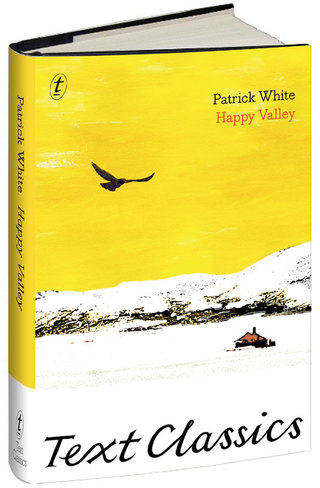
Patrick White, Happy Valley

Book cover (Courtesy: Text Publishing)

My love affair with Patrick White, figuratively speaking, began in my last year of high school when I studied Voss. Always partial to Aussie literature, I was, at 17 or 18, bowled over by White’s writing, passion and vision – and by his rather acerbic, though mostly compassionate, view of the way people submerge their “selves” in exterior trappings. I was consequently thrilled when Text decided to publish his first novel as part of its Text Classics series because this book, first published in 1939, was not published again in White’s lifetime. His decision, not his fans, I might add!

Why White refused its republication is a matter of some conjecture. He describes it in his autobiography, Flaws in the glass (1981), as “my first published, best forgotten novel”. Whatever the facts, being published in England and New York in 1939 probably made it easy to “lose”. All I can say is that it’s a great shame, because this is one helluva novel.

But let’s not conjecture, and get on with the book. It’s hard though to know where to start. As a newly released but first Patrick White, it’s going to be (and probably already has, but I’ve kept my eyes averted) the subject of much critical and literary analysis. How, this amateur blogger thinks, can I add to that? By, I suppose, just picking a few things that interested me.

There were several things that interested me in this novel, besides the fact that it is a good read. Perhaps I’d better explain that, the plot, first. It’s set in, yes, a town called Happy Valley, in the Snowy Mountains-Monaro region of New South Wales, just south of where I live and where Patrick White was a jackeroo for a year. If you know Patrick White, you’ll know the town’s name is ironic because White’s people are rarely happy. Life tends to be, for them, disappointing at best, sterile, depressing and/or meaningless at worst. In this book we have a large number of people and families, representing a cross-section of a typical country town: the doctor (Holliday), the teacher (Moriarty), the squatter (Furlow), the storekeepers (Quongs), the banker (Belper), the piano teacher (Alys Browne), the farm worker and “stud” (Clem Hagan), the “simpleton” (Chuffy Chambers). The novel begins and ends with the doctor, but its subject matter is the desire to escape. Many of the town’s residents don’t want to be there, and dream of ways out. Alys dreams of California, Hilda Holliday of Queensland, Sidney Furlow of anywhere-but-here, and so on. For the most part the novel chronicles the relationships between the people, explores the sources of their discontent, and teases them with future possibilities. It seems, until near the end, that nothing particularly dramatic will happen but then a shocking event occurs which precipitates decisions – some big, some small – that will change the lives of those concerned. For the better? Well, that’s a question for us readers to consider, but it’s important to recognise that for White the important decisions/shifts that have to be made are internal. Here is Alys near the end, seeing her escape dream for what it was:

I shall not hurry, she said, I shall shape time with what I have already got.

It’s a good story – and it’s clearly White.  There are a lot of characters, which can be the downfall of first novels, but White handles them well. The connections are clear and he keeps them all moving along so that we readers rarely, if ever, feel lost – once we have them in our heads.

What bowled me over most about the novel though is its style. It’s big – it’s inventive, expressive, rhythmic. As I was reading it, I was reminded of DH Lawrence (and his intense sensuality) and James Joyce (and his “stream of consciousness”). Peter Craven, who wrote the introduction to Text’s edition, agrees, and adds Gertrude Stein (whom I don’t know well enough) and Virginia Woolf (whom I should have picked too!). However, despite these pretty clear influences, the novel doesn’t feel slavish. Although this is (obviously) early in his career, his mature style is already evident. I was impressed by how he moves pretty seamlessly between description, dialogue and interior monologue, by how he shifts point-of-view, even within paragraphs, and by how, almost imperceptibly at times, he changes voice from third to second to first person. It’s spirited, gutsy writing. You feel, sometimes, that’s he’s strutting his stuff, but he rarely loses us and, while he may occasionally push a little too far, it doesn’t feel like showing-off but more like a writer with ideas bubbling out of him.

Earlier in the review, I mentioned writers that I felt influenced White, but now I want to mention one that I think was influenced by him, and that’s Thea Astley. She also had a pretty acerbic view of the world, and could skewer characters for their superficiality while maintaining, unless they really didn’t deserve it, compassion for them. White and Astley also use humour, usually wry or satiric rather than belly-laugh. I loved this description of a person in a bar early in the novel:

But another was an old man, one of those static old men you see in country bars, who seem to have no significance at all, except as recipients of drinks that they pour in through the meshes of a yellowish moustache, just standing and nodding, willing to listen to a story, but never giving much in return. They are generally called Abe or Joe. Though this one was called Barney, as a matter of fact.

That made me laugh; it’s the sort of writing that made me keep reading. But it’s not all quite this benign, because Happy Valley is a town where there “never was co-operation”, where “people existed in spite of each other”, where town “stud” Clem would like to “take a lump of wood, treat her almost like a snake”.

One of the threads running through the novel concerns the limits of language to express true feeling:

Both of them wanting to say something and then it only came in words.

White, I understand, would love to have been an artist, calling himself a “painter manque”, but oh dear, what words we would have missed had he done so.

Lisa of ANZ Litlovers, also a Patrick White fan, loved the book too.

Patrick White
Happy Valley
Melbourne: Text Publishing, 2012 (orig. published 1939)
407pp
ISBN: 9781921922916

(Review copy courtesy Text Publishing)

Fridays with Featherstone, Part 4: On writing and admired writers

Today, I bring you the final part of Susan Errington’s Wet Ink interview with Nigel Featherstone. In this part Nigel talks primarily about some of the writers he admires or who have inspired him – and how they relate to his writing. I love the fact that many of the writers Nigel admires are also favourites of mine, such as … but no, if I tell you now that will spoil the interview. Read on …

INTERVIEWER

You seem interested in troubled or fractured families, especially in Remnants. Is the family dynamic something you want to expand on in future writing and perhaps bring to the forefront?

FEATHERSTONE 

Families are both fascinating and frightening.  As a writer I’m asking, what makes up a family?  It’s not just husband and wife and two children.  A family can be a group of people living in a share-house.  It can be a rock band.  It can be three kids on a road-trip.  It can be an old woman and her twenty cats; Eva Hornung explored human-animal relationships as family in her extraordinary novel Dog Boy.  Families can be forces for good, and forces for evil; more often than not, they are both at once – this is what Anne Enright was doing in her Man Booker prize-winning The Gathering.  Whenever I hear someone say that family is ‘the bedrock’ of society I want to reach for my pen and get to writing.  Family might be the traditional bedrock in terms of procreation, but it certainly isn’t the emotional bedrock for many individuals.

INTERVIEWER

Your Australian families lack the hysteria of Patrick White’s and remind me more of the quiet honesty of Randolf Stow’s. What’s important to you in creating a family in your work?

FEATHERSTONE

You’re not the first person to mention Randolf Stow in relation to my stories, and it always fills me with a warm inner glow.  I read The Merry-Go-Round in the Sea back in high-school and I was rapt, and that rapture has continued after all these years – and I haven’t read it since, although recently I bought another copy and it’s on the bedside-table pile.  Quiet honesty.  I like that.  Is that what attracted me to Stow?  Who can tell?  In terms of technics, what’s important in creating a fictional family is life, depth of character, and conflict.  It’s also important, I think, for the family to want something, resolution, revelation, salvation, disintegration, even if they don’t know it.

INTERVIEWER

Who are the important novelists for you?

FEATHERSTONE

J.M. CoetzeeDisgrace is the perfect contemporary novel.  Colm ToibinThe Blackwater Lightship, a story about three generations of Irish women, is told in the simplest, most direct voice, but it dives so confidently into the depths.  Alan Hollinghurst – the language in The Line of Beauty never ceases to amaze me, and the author is invariably hilarious.  Kazuo IshiguroA Pale View of Hills and The Remains of the Day are two gorgeous novels, both being vast wells of intimacy.  Graham SwiftLast Orders is a novel I return to regularly.  Morris WestEminence is built around a terrific what if (what if the next Pope was agnostic?).  Truman CapoteIn Cold Blood is a book that has had a huge impact on me because it’s the portrait of friendship and family and landscape.  Harper Lee – the burning desire for justice in To Kill A Mockingbird.  The verse-novelist Dorothy Porter – what she could conjure on the page!  Helen Garner – although not fiction, Joe Cinque’s Consolation shows all the hallmarks of what makes a novel.  It may appear odd in this company, but Flann O’Brien’s The Third Policeman is the most audacious of stories.  The names Tolstoy and Chekhov have to appear in this paragraph.  As does Flaubert’s; Madame Bovary is the truly great novel.

INTERVIEWER

Writing is a tough and often lonely gig.  Where do you draw your inspiration?

FEATHERSTONE 

From the things that happen around me, or happen around other people.  That makes it sound easy.  You’re right: it’s not.  There are days when I’d like to chuck it all away, but my life would be dreary without writing and reading.  And music.

INTERVIEWER

What are you working on at present?

FEATHERSTONE

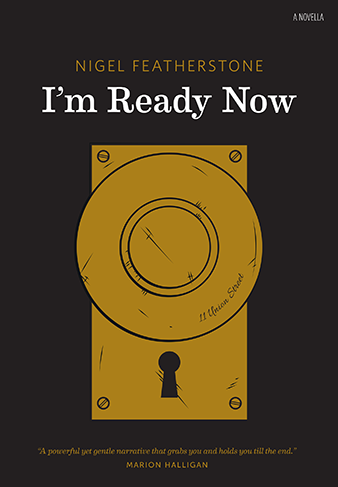
Nigel Featherstone, I'm ready now

Cover (Courtesy: Blemish Books)

Going back to where we started, the second of those Launceston novellas is being published by Blemish Books in November this year*, so over the coming months I’ll be working on the nips and tucks required by the publisher (it’s already been through quite a few rounds of these), getting the story as perfect as humanly possible.  What can I tell you about it?  Perhaps, after all this talk about men and their trials and tribulations of forming relationships and trying to have meaningful lives, it might be a surprise to tell you that this second novella, which is called I’m Ready Now, is a story about a mother and son.  The mother has reached a fork in her life, and so has the son, and both are in the midst of making decisions that will change the course of their lives and their relationship(s).  It’s told from both points of view, and I enjoyed writing the mother as much as the son, perhaps even more so.  And I’m always working on short stories, and creative journalism.  And, yes, there’s a bigger project but I can’t talk about that because I’ll jinx it.  But for the next few months, much of whatever brain-power I have will be occupied with bringing I’m Ready Now into the world.

* This interview was prepared many months ago for publication in Wet Ink during 2012. Readers of this blog will know that I’m ready now was indeed published in November and reviewed by me that month.

If you missed Part 1, click here, for Part 2 here, and for Part 3 here.

Thanks again to Susan Errington for supporting my running this interview after the demise of Wet Ink. I’m sorry that Wet Ink no longer exists, but it’s been a pleasure to share this great interview with readers here.

Fridays with Featherstone will finish next Friday with my follow-up interview with Nigel…