Kate Jennings, Moral hazard (Review)

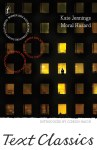
Kate Jennings, Moral HazardHow often do you read a book that connects in some ways with something you’ve recently read or thought about? Kate Jennings’ award-winning Moral hazard, my latest read, links pretty directly to our discussion about autobiographical fiction in my Monday Musings post on Robert Dessaix two weeks ago. Dessaix, you may remember, criticised Garner’s The spare room (and other works) arguing she was just writing her life, but defended his own autobiographical fiction because he changed things around. Garner, though, argues that in her novels she shapes and orders, plays with time, examines motives etc. What is all this about? Why does it matter? The reverse – calling something non-fiction that is in fact fiction – does matter, I think. You all know the cases, I’m sure. But, if a writer draws from his or her life and calls it fiction, does it matter? Really, does it matter? Well, in this case it does matter, because, while Jennings is another of those writers who draws closely from her life, there are parts of the story that could be very tricky, legally, if they were, in fact, “fact”.

I’ve reviewed two of her works here before – Snake, her first work of autobiographical fiction, and Trouble: The evolution of a radical, which she describes as her “fragmented autobiography”. Jennings, like Helen Garner, is a fearless writer, and I love her for it, so when Text Classics published Moral hazard, her second novel, I was ready and waiting.

Moral hazard is about a woman whose husband is diagnosed with Alzheimer’s and who, to obtain the money needed for his care in health-care expensive USA, gets a job as speechwriter for a mid-level investment bank on Wall Street. The wife’s name is Cath (not Kate) and the husband’s name is Bailey (not Bob Cato, the name of Jennings’ husband). Kate Jennings, though, did work as a speechwriter on Wall Street. Fictional Bailey and real Bob are both artists/designers, and both men were diagnosed with Alzheimer’s, but Bailey’s end has a particular drama to suit Jennings’ purpose.

From its very start, in fact, it’s clear that Moral hazard has been carefully written and structured, despite its closeness to Jennings’ life. Take the title, for example, and its pointed word play. Economically, “moral hazard occurs when one person [or organisation] takes more risks because someone else bears the cost of those risks”. Jennings, in the Wall Street component of her novel, explores this very condition with great – should I say scary – clarity. It is particularly interesting to read her description and analysis of escalating greed, because it is set nearly a decade pre-GFC. It’s all there, though, and the cracks were showing even then. For Cath the moral dilemmas are real. Not only does she need to rationalise her personal moral values as a lefty feminist against her financial district job, but she has to be the carer (also decision maker) for her increasingly ill husband. This is complicated care that encompasses not only economic and physical demands, but also emotional, mental and philosophical. And this care also has, not surprisingly, a moral dimension.

The novel (a novella, really) is told in short chapters that alternate, though not rigidly so, between Cath’s life with Bailey and her work life. It is told first person, and Cath tells us, on the first page:

I will tell my story straight as I can, as straight as anyone’s crooked recollections allow. I will tell it in my own voice, although treating myself as another, observed, appeals.

In other words, it’s from life, but there is artifice. The novel opens with this brief introductory chapter, which is followed by a chapter describing her first meeting Mike. He also works at Niedecker Benecke investment bank, and also, like her, is a square peg in a round hole, though he’s been doing it for longer! He becomes somewhat of a teacher to her, as well as a sounding board, and a welcome like-mind.

From this set up, we flash back to Cath, her husband Bailey and his diagnosis, and we don’t return to the bank until Chapter 6. The story continues chronologically following Cath. We watch her work out how to work within the company, and we feel her pain as she tries to manage Bailey as he becomes less and less stable and predictable. Cath chronicles the hedge-fund crisis – the increasing greed, the living on (the belief in) “zero capital and infinite leverage” – in parallel with Bailey’s decline. A true coincidence, perhaps, but a writing choice too.

I loved Jennings’ writing. It’s clear and direct, but has a poetic sensibility. She describes the bank as:

a firm whose ethic was borrowed in equal parts from the Marines, the CIA and Las Vegas. A firm where women were about as welcome as fleas in a sleeping bag.

She describes the financial district, New York’s skyscrapers:

I looked at them and didn’t see architecture. I saw infestations of middle managers, tortuous chains of command, stupor-inducing meetings, ever-widening gyres of e-mail. I saw people scratching up dust like chickens and calling it work. I saw the devil whooping it up.

She sees the New York Fed, after bailing out hedge-funds, behaving “as if afflicted with Alzheimers” sticking with deregulation, letting the industry police itself, despite evidence to the contrary.

Meanwhile, Bailey’s decline is inexorable, he moves from home to an institution. He has a “living will” but it is ignored, so, she writes:

Scar on my soul be damned. He’d asked me to take care of it when the time came. Now I would. Mrs Death.

But far be it from me to spoil Cath’s story – except to say that as well as tackling Wall Street, Jennings also quietly buys into the euthanasia debate.

The good thing about Text Classics, besides their existence and excellent price, is that each classic is accompanied by a commissioned introduction. For Moral hazard it is by sport and business journalist Gideon Haigh. He concludes his introduction, which focuses on the financial aspect of the novel, with the statement that “Modern working life is replete with unpalatable compromises and perverse incentives”. Cath would probably say that this is true of life too. Moral hazard is a rare book in the way it looks not just at our contemporary globalised financial world, but more widely at work, our relationship to it, and the moral choices we make in work and in life. Drawn from life, yes, but a very worthy winner of the 2003 Christina Stead Award for Fiction!

awwchallenge2016Kate Jennings
Moral Hazard
Melbourne: Text Classics, 2015 (orig. pub. 2002)
155pp.
ISBN: 9781922182159

(Review copy courtesy Text Publishing)

Delicious descriptions: Gerald Murnane’s landscape and imagination

A couple of years ago I reviewed Gerald Murnane’s The plains. I found it a mesmerising book, but a challenging one to fully get my head around, to grasp and hang onto what I’d grasped. Then a couple of days ago, I reviewed his memoir, Something for the pain: A memoir of the turf. It was quite a revelation – and among those revelations were some ideas that seemed to flesh out The plains, though he doesn’t specifically address those ideas to the novel in his memoir.

The main revelation relates to his feelings about landscape. Murnane hates the sea and doesn’t much like mountains either. What he loves are plains. In chapter 6 he refers to his “lifelong dislike of travel”, initially developed when he was still a boy. He also, as a boy

settled on what would be my ideal landscapes for the rest of my life: the green and mostly level countryside of south-western Victoria.

Mount Grapples

Mount Arapiles, Western Victoria (released on Wikipedia to Public Domain, without conditions)

Plains, in other words. In chapter 15, he talks about a horse owner P.S. Grimwade. (An aside. In this, as elsewhere in the book, he focuses on what he “imagines” Grimwade to be like, stating that he suspects he wanted “to keep in mind the ideal man rather than have in sight the actual man”! “Perhaps”, he writes, “I wanted to think of him as someone for whom racing was better imagined than experienced – someone such as myself”.) Anyhow, he goes on:

I would have envisaged P.S. Grimwade as owning an extensive property in what I consider the centre of the universe, in the quadrilateral bounded by Ballarat, Ararat, Hamilton, and Camperdown in the Western District of Victoria, which is a landscape of plains and low hills and vast skies. I’ve never felt comfortable when surrounded by steep hills, and I’ve always tried to keep away from mountains.

In fact, Grimwade, he discovered, lived in a different part of Victoria, one he’d never visited – but, it’s telling I think that he places this horse owner, who fascinates him, in a place comfortable to him. He writes that he’s entitled to his imagination about Grimwade:

In the unlikely event that this book should be read by some or another descendant of a man named P.S. Grimwade, and that the descendant should wish to tell me that my account of the man is untrue, inaccurate, preposterous, whatever, I urge that descendant not to waste energy, time, or ink on the matter. Nothing will keep me from revering my saint as he was revealed to me.

Are you getting the picture of this memoir? It’s the imagination that’s important …

Then we get to chapter 22, “Sir Flash and the Borderers”, the chapter that gave me a big ah-so moment. Early in the chapter, he writes again of his ideal landscape:

… the ocean itself repelled me, and I’ve kept well away from it all of my adult life. During my brief holidays on my grandfather’s farm in the 1940s, I was more interested in another sort of ocean. Whenever I stood on a tall cliff above some or other bay, I got inspiration not from the blue-green Southern Ocean reaching away towards the South Pole but from the yellow-brown ocean of land reading towards places I had seen only from a distance, if at all: the plains of the Western District to the north and the north-east of Warrnambool or, away to the north-west, a mostly level landscape …

This discussion introduces a story about a group of horse-owners and horse races in what he calls the Border District. It’s here that I was reminded of The plains, because of the way he imbues the Border Country – and the Borderers who live there – with a sense of “otherness”. These people and their horses came from a real part of Australia, obviously, but it’s a part that was unknown to him when he came across them, so he unfolded a map and “set not only my eyes but my imagination also roaming”. He gives it and its people the aforementioned names, and he awards the people – imagines, in other words – certain characteristics, including “the usual amount of shrewdness and sagacity attributed to people living far from the capital cities”. I won’t tell you all that he ascribes to them – it makes for wonderful reading – but here’s the final bit that brought The plains to my mind:

I would not have my Borderers thought of as wholly devoted to gain, however. They numbered among them many a man who wore his hair bunched above his ears and on his neck and who stood out on a racetrack on account of his elegant dress and proud bearing. Such a man owned a vast cattle or sheep property and lived in a mansion with a veranda on three sides and groves of deciduous trees all around. His mansion included a library and a study. The walls of the study were covered with photographs of the finishes of races won by his own horses. The walls of the library were covered, of course, with books …

This imagination, this creation of a place that seems both in and separate from the Australia we know, a place populated with people who have dreams and an artistic sensibility, is very reminiscent to me of The plains. Rightly or wrongly – but I hope the former – I now feel I understand Murnane a little more, his aspirations, how his imagination works and the absolutely fundamental role it plays in his life.

Many years later, Murnane moved to live in this very landscape – in Goroke where I believe he lives now – and discovered the people aren’t quite as he imagined. But that’s another story.

Gerald Murnane: Something for the pain: A memoir of the turf (Review)

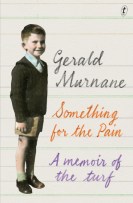
Gerald Murnane, Something for the painWhen I heard Australian author Gerald Murnane had written a memoir, and even more when I heard its title, Something for the pain: A memoir of the turf, I knew I had to read it. I am not a horse racing tragic, by any stretch, but how could I resist such an intriguing sounding memoir from one of Australia’s most erudite, though too little read, contemporary authors? With such a title, the book sounded unlikely to be a typical chronological story of his life – and this suspicion was indeed borne out in the reading.

Something for the pain is a dry book – but I don’t mean dry in terms of boring. I mean dry in terms of containing a wicked, wry sense of humour. Murnane is deadpan straight, and yet he knows exactly what he is doing, what he is telling us about himself, as he discusses this horse or that, this trainer or that owner, these colours or that racecourse. I enjoyed The plains which I reviewed a few years ago, but this is something else altogether. Where that novel was somewhat obscure and challenging to nut out, reading this memoir is like listening to Murnane talking. You could almost think he is ingenuous, but …

Bernborough, c. 1945 (Presumed Public Domain, via Wikipedia)

Okay, so what do I mean by all this? Let’s see if I can explain it. The book is, in a very real sense, exactly what Murnane says it is. In other words, it is about horse racing and Murnane’s love of it. It has twenty-seven chapters, and pretty well every one is titled with a specific reference to the turf – usually a horse or a racing personality. The novel’s second chapter, titled “The Drunk in the Dance Hall”, refers to an actual dance hall drunk who gave his father a great racing tip, while the following chapter, “A Bernborough finish”, includes the name of a particular horse (Bernborough, of course). But, while the chapter titles refer to horse racing, and while every chapter tells us something (quite a bit in fact) about horse racing, or, more accurately, about Murnane’s experience of and feelings about horse racing, the chapters also convey information about him. I found it absolutely delicious to read.

“The Drunk in the Dance Hall” starts, for example, with “I could never learn to dance”. We learn a little about his experience of dancing and something also of early to mid-twentieth century dance hall culture  – as well as the story of the aforementioned racing tip and its result. Even more interesting, though, is the next chapter about Bernborough. It starts with:

I was never one for hanging pictures or sticking up posters or postcards. I’ve always preferred to be surrounded by bare, plain surfaces and to have my desk facing a wall rather than a window.

However, in 1982, he tells us, when he was lecturing at a college of advanced education, he found a display board above his desk. Uncharacteristically – for him – he decided to stick up some pictures. There was space, he explains, for thirty to forty postcard-sized pictures, but he stuck up just three, neatly grouped together, surrounded by much bare space:

The first two were portraits: one of Emily Brontë and the other of Marcel Proust. The third was actually two linked scenes, the first showing a field of horses nearing the straight, and the second showing the winner of the race and his nearest rivals as they reached the winning post.

You can just see it, can’t you, the surprise of his colleagues and students when confronted by this. He continues, a couple more pages in:

During those years, I sometimes sensed that some or other visitor to my room was puzzled by the odd little group of images huddled together on the otherwise bare wall. To the few who enquired I was pleased to explain that the young woman from Victorian England, the eccentric Frenchman, and the bay stallion from Queensland were equally prominent figures in my private mythology and continued to enrich my life equally.

I mean, honestly, how can you not love that! He says no more, however, on this, following it instead with the story of Bernborough and how the term “Bernborough finish” was born. He concludes on his orchestrating his own Bernborogh performance. The next chapter (no. 4) whizzes back to the 1940s, Murnane being born in 1939, and some childhood memories – which of course include racing stories.

And so, in this lurching backwards-forwards way, Murnane tells us much about the history of Australian horse racing – about owners and trainers, and betting, and specific horses – which I found interesting in an arcane sort of way. Along the way, though, we also learn a lot about him, things that provide much insight into his work and what drives him. We discover his love of maps but hatred of travel, his favourite landscape, his love of names and colours, his preference for the spiritual over the material, his enjoyment of beer and his meticulous creation of personal archives, his discomfort with any sort of pretension or self-consciousness, and last, but by no means least, his vivid imagination. We discover his cheeky sense of humour. The way chapters are framed or introduced versus the content that follows is a good example. Take Chapter 10 in which he discusses psychoanalysis, religion and betting systems. It might just be my warped sense of humour, but the juxtaposition of these made me laugh. And we do learn some facts about his life – his various jobs, his parents and his uncle Louis, and his wife. What he doesn’t do is discuss his writing in any depth, though he frequently mentions his (autobiographical) first novel, Tamarisk Row, which makes many references to racing, and he does occasionally talk a little about his views on writing.

I’m going to leave it here, not because I have nothing more to say, but because I want to pick up one or two issues – relating to his writing – separately in a Delicious Descriptions. So, I will end with one little anecdote. Around halfway through the book, he discusses his search for his own racing colours and design. He has settled, he informs us, on some combination of brown and lilac but just cannot decide on a design. He writes:

I described the task as serious, and I do take it seriously. I’ve devoted myself to horse racing as others sorts of person devote themselves to religious or political or cultural enterprises, although I hope I can still make a joke at my own expense. I read once that certain musical compositions (by Bach? by Beethoven? I forget) sounded like the efforts of the human soul to explain itself to God. If ever I find my perfect combination of brown and lilac, I’ll feel as though I’ve thus explained myself. But I seem destined to never find my perfect set of colours. Is this because I’ve deluded myself for most of my life? Are racing colours not so eloquent as I’ve always believed? Or, is my soul too much of a mess for explanation?

Not likely, I’d say. Murnane is one very intelligent man – and his memoir is well worth reading. Don’t be put off by the stated subject matter. The turf does infuse it all, fascinatingly so, but it’s the mind behind it that shines through.

Lisa at ANZLitLovers also reviewed this book recently.

Gerald Murane
Something for the pain: A memoir of the turf
Melbourne: Text Publishing, 2015
251pp.
ISBN: 9781925240375

(Review copy courtesy Text Publishing)
Monday musings on Australian literature: Spotlight on Robert Dessaix

Courtesy: Annette Marfording

Courtesy: Annette Marfording

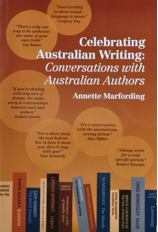
Last year, I published a guest post by Annette Marfording, who was, for many years, the Program Director of the Bellingen Readers and Writers Festival. At the time of this post, she had just self-published her book, Celebrating Australian Writing: Conversations with Australian Authors, containing a selection of interviews she’d conducted over many years with a wide range of Australian writers. Rather than review it, I’ve decided to use it for an occasional series within Monday Musings. I won’t be quoting large slabs of the text, or giving away all the content of the interviews. Besides the fact that that would break her copyright, I’d like to see people buy the book because not only is it a good read but Marfording is generously donating the profits (see the end of the post). My plan is to use Marfording’s interviews to springboard brief discussions about some writers who interest me. OK?

I won’t necessarily discuss my selected authors in the same order as Marfording’s book, but I am starting with the first author, Robert Dessaix. I haven’t reviewed Dessaix here because I haven’t completed any of his books since I started blogging. However, I have read his first book, the critically acclaimed memoir A mother’s disgrace (1994). I’ve also dipped into other books, including his collection of essays and articles As I was saying (2012), and I have enjoyed his thoughtful, engaging contributions on language to ABC RN’s old Lingua Franca program. He also presented, for many years until 1995, ABC’s Books and Writing program. Language and literature, as you’ve probably gathered, are his passion

So, who is Robert Dessaix? Wikipedia describes him as a novelist, essayist and journalist, but it would probably be more correct to call him an essayist, memoirist, journalist and novelist, because novels – of which he’s written two – form the smallest part of his output. He reminds me, in this regard, of writers like Drusilla Modjeska and Helen Garner (though Garner does have a good number of novels under her belt as well as other writing.) Anyhow, for a better bio than that provided by Wikipedia, it’s worth checking out his own website. He was born in Sydney, adopted as a young child, and was married, but now lives with a male partner. Much of this story is told in A mother’s disgrace. Here is an example of his writing from that book:

There’s something deeply comforting, after all, about the promise of a linear narrative: birth, school, university, marriage, family, career, onwards, upwards … the autumnal years a bit misty, perhaps, the phut as the fuse runs out, best not thought about too graphically but on the whole not a bad way to live out a sequence of years. The trouble is that, once you’ve set out on that alluringly straight track, it’s hard to swerve off it or come to a standstill. It’s hard to live what I’d call swoopingly.

I have tried to swoop and veer. I didn’t have the wit to veer away from marriage, I had to be sent packing. But I did curve away from teaching Russian literature to university students into working at the Stables Theatre in Kings Cross and then in radio, I did swerve sharply away from Canberra to experiment with being a Sydneysider again, I did deviate (after a messy start) from the heterosexual straight and narrow to try more fulfilling, multifaceted ways of loving …

But now, to Marfording’s interview. Marfording clearly researches her subjects and asks questions specifically relevant to each of her interviewees, rather than rely on a standard set of questions. She talked to him about some of his specific writings of course, and a bit about his writing practice. She also talked with him about travel, which features in much of his writing. He has some interesting things to say about what he looks for in travel, and how that has changed over time. What he now looks for, he tells Marfording, is conversation. It’s also one of the topics in As I was saying. He writes:

‘The grand business of our lives,’ the novelist Henry Fielding said, ‘the foundation of everything, either useful or pleasant’ is conversation. It’s quite a claim. His contemporary Samuel Johnson was hardly less emphatic: ‘There is in this world,’ he said, ‘no real delight (excepting those of sensuality) but the exchange of ideas in conversation.’ They were eighteenth century English gentlemen, so their enthusiasm is not surprising: the eighteenth century was the heyday of conversation in England …

He goes on to discuss those with opposing views. The Hebrews, he suggests, cared little for conversation, neither did Jean-Jacques Rousseau who saw it as “frivolous”, and Presbyterianism, he writes, “has never been good for animated intercourse”. He concludes by analysing the art of conversation then and now – but that’s a discussion for another day, because …

The part of the interview that particularly interested me stemmed from his contribution to the Little Books on Big Themes series (from which I’ve reviewed Dorothy Porter’s On passion). Dessaix chose his topic – On humbug! I enjoyed this section of the interview because it got into discussing truth and facts. He shares two of his epigraphs. For A mother’s disgrace, he used a line from Jeanette Winterson, “I’m telling you stories, trust me”, and for Arabesques, it was “When I invent things, it is to make the truth clearer”. He explains:

I try to distinguish between fact and truth […] things can be broadly speaking true without being absolutely factual, if you know what I mean.

Yes, I do, Robert! Marfording then questions him about his review of Helen Garner’s The spare room, a raw novel based on her experience with a friend who had terminal cancer. Dessaix, and he wasn’t the only one, said that it shouldn’t be described as fiction because it’s based on fact. Yet, Marfording questions, putting him on the spot, Dessaix’s own novel Night letters is also based on his life. Dessaix’s answer is that his was “partly fictionalised” and that he “changed the order”, implying that Garner hadn’t. Indeed he suggests that she simply publishes her notebooks and that “she should come out and admit what she does”. Hmm … all this said, the  interview does conclude with Dessaix talking about his favourite books and writers:

I do actually love Helen Garner’s writing; I love Michelle de Kretser’s writing, The Hamilton case and The lost dog; I was very taken with Thea Astley at the time, I mean I haven’t read her for years, but I just read book after book of Thea Astley’s …

His very favourite books, though, are the 19th century Russians.

Dessaix is an interesting, erudite – dare I suggest, Renaissance – man who’s well worth reading. Thanks to Marfording for an excellent interview.

Annette Marfording
Celebrating Australian Writing: Conversations with Australian Authors
Self published, 2015
273pp.
ISBN: 9781329142473

Note: All profits from the sale go to the Indigenous Literacy Foundation. You can purchase the book from its distributor, lulu.com.


Steve Toltz, Quicksand (Review)

Steve Toltz, Quicksand, soverAldo Benjamin, the anti-hero of Quicksand, accuses wannabe-writer-friend Liam of having “such little imagination”. You could not, however, accuse the novel’s author, Steve Toltz, of this. Quicksand reads a bit like a 19th century satirical novel transplanted into the 21st century. It is big in size (though not as big as his first, A fraction of the whole), broad in subject matter, and full of colourful characters. It’s wild, imaginative, and darkly funny. It’s the sort of novel that you can tackle from different angles depending on what interests you most. Religion, god and fate? Tick. Life and death? Tick. Love and friendship? Tick. Social commentary? Tick. Art (broadly), artists and the making of art? Tick.

“Bad luck is my pathology” (Aldo)

Before I tell you what interested me, though, a little about the plot. Quicksand is the story of Aldo Benjamin, told partly by his friend, Liam Wilder, and partly by himself. Meeting at high school, Aldo and Liam remain friends until the book closes when they are in their early to mid 40s. Together they reveal the ups and downs – mostly downs – of Aldo’s life as he tries to make his way against what he sees as the tide of fate or bad luck. The novel opens when they are in their early 40s and Aldo, a wheelchair-bound paraplegic, has just been released from prison. We don’t know how long he’s been in the wheelchair or how that came to be, and we don’t know why he’d been in prison. These come out in the course of the novel, which flashes back in chapter 2 to their schooldays and then moves between the past and present to tell the story. We also discover in the opening chapter that Liam is trying to restart his writing career by writing Aldo’s story, much to Aldo’s resigned disgust: “I’m nobody’s muse”, he says. Ironically, though, not only is he Liam’s muse but he’d also been one for his musician wife, Stella, and photographer lover, Mimi.

Aldo, “The King of Unforced Errors” as Liam calls him or a sufferer of “clinical frustration” as Aldo sees it, gets into all sorts of strife. He is regularly bailed out by friends (who cover “the full suite of professional services” such as policeman Liam, Doc Castles, his old school teacher Mr Morrell) and lovers. Nothing much works for him, particularly not his various get-rich-quick business ideas, like the device that was supposed to detect the presence of peanuts in food, or clothing for obese toddlers, or tanning salon taxis, or maternity clothes for goths (“a demographic with an 85% abortion rate”). Moreover, his marriage fails, his child dies, his multiple suicide attempts are unsuccessful, and, to rub salt into his wounds, he ends up in the two places he most fears, prison and hospital. As Liam says in response to Aldo’s question about why write his story:

Because you’ll inspire people. To count their blessings.

I love this sort of writing, this dark humour. It’s full-on to read because lines like this frequently fall over each other, sentence after sentence, leaving you wanting to stop and smell the roses for a minute. Still, I was hooked by page 5 when Aldo presents to Liam a long list of our 21st century insecurities, pretensions and self-deceptions, including

‘You know how people are worried their kid’s going to turn to them and say, What did you do to the biosphere, Daddy?

AND

‘And you know how there’s no replacement cycle too short for today’s consumer?’

AND

‘You know how while we’re enjoying reading dystopian fiction, for half our population this society is dystopia?’

These go on for three pages. Wonderful satire. No matter how superior we might feel about most of the pronouncements, there’s bound to be one or two that get us where it hurts! Toltz looks unblinkingly at our lives and shines them right back at us in the most direct, no-punches-pulled way. It made me laugh – but ruefully, if not guiltily at times – almost every page.

“To troubleshoot the human spirit” (Liam)

The other aspect I enjoyed was the thread about art, artists and art-making. The major focus of this is Liam’s novel about Aldo’s life. After years of failure and giving up, Liam finally decides that Aldo is his “natural subject”. Writing about him, Liam tells Aldo, would be “to troubleshoot the human spirit”. It would, he thinks, throw him “into a head-on collision with the meaning of fate, humanity’s sure, but Aldo’s strange specific one too”. Aldo and Liam discuss Liam’s progress frequently, with Aldo always ready with an astute comment or criticism. “Does my character in your book”, Aldo asks, “need to be more consistent than my character in real life?” “No,” says Liam, though in fact many readers do, I find, prefer it to be so!

Liam is not the only creator in the novel. Aldo’s musician wife Stella plunders Aldo’s life for her songs, and then there’s the art teacher from Liam and Aldo’s school, and the artists in the artists’ residence where Aldo lives for a time. Through all these the novel interrogates why we make art, what art is about. Early on, before he starts his Aldo novel and after years of failure, Liam decides to give up writing. He says

I had settled into a life I had always feared but secretly desired, a life uninterrupted and unencumbered by art.

Chapter 2, though, begins with art teacher Morrell’s statement that:

We make art because being alive is a hostage situation in which our abductors are silent and we cannot even intuit their demands.

Art is not, however, presented as something that is easy or even always right. Toltz’s artists struggle to achieve, are frequently self-obsessed, and unapologetically mine their friends and family for material, all the while, thinks Aldo at least, having a good time. “Their brains are all pleasure centres and no circumference”, he tells the court. They are not, in other words, unilaterally lauded, but this is, of course, ironic, if not subversive, since what we are reading is a novel, a work of art itself. The wheels within wheels in this novel – the ironies, the paradoxes, the self-reflexivity – sometimes make your head spin, but in the end, there is an end, and it’s a surprisingly positive one.

And here, I’ll end! This novel is so full of funny lines, so full of ideas, so full of biting commentary, that it’s hard to know when to stop so, as EM Forster* wishes novelists could do, I think I’ll just end, not because I’m bored which is the reason he gives, but because I might as well.

Lisa at ANZLitLovers also enjoyed it.

Steve Toltz
Quicksand
Hamish Hamilton, 2015
435pp.
ISBN: 9781926428680

* Aspects of the novel, by EM Forster

Halina Rubin, Journeys with my mother (Review)

Halina Rubin, Journeys with my motherI’ve read a lot of World War 2 literature over the years, but very little from the Polish point of view, so I was more than willing to read Halina Rubin’s Journeys with my mother when it was offered to me a few months ago. Rubin was born in Warsaw on 27 August 1939. Note the date: her mother, Ola, was still recovering in hospital when Germany invaded Poland a few days later. Within two months, her parents, secular Jews, had fled to the Soviet Union, and this is where the young Halinka and her mother saw out the war. It’s a fascinating story – and it’s told in a thoughtful way.

Rubin divides her story into two parts. Part 1 is mainly background. It provide some family history about her parents, Ola and Władek, and their parents before she was born, but it also describes the depth of anti-Semitism with which they lived, long before the war started. It tells how her parents were radicalised early, how for them “the ideals of communism offered a way to solve the twin problems of unemployment and poverty, and put an end to racial hatred”. Oh, such idealism … but her parents, despite experiencing political betrayal, never fully lost their values and commitment to social causes.

Anyhow, part 2, which conveniently aligns with the start of the war, tells the story of her nuclear family after she was born. “I try to imagine” she writes of those opening days of the war, “how abruptly, how without mercy, their world changed”. She describes how, with their faith in the Soviet Union, her parents fled to Białystok, once a Polish town but now under Soviet control, while other members of the family made different decisions or timed their flight decisions differently, with, in most cases, tragic consequences.

Halina and her family lived there for nearly two years, Ola working as a nurse, until Germany betrayed the Soviet, invaded – and the atrocities began. So, they fled again, heading further east for Russia itself. Władek was taken to join the Red Army, but Ola and Halina made it to Oryol where Ola worked again as a nurse. Later, mother and daughter, who were evacuated under German orders from Oryol, went to Lida in Belarus, and from there they escaped into the forests where they joined the partisans – because, remember, Ola was a committed communist. It’s astonishing, really, that Ola and her oh-so-young daughter survived the threats and privations of such a life, but survive they did:

Around us was a forest so dense that even wild animals – boars, deer and wolves – chose to follow the same known tracks. The myriad of lakes made the terrain marshy.

Only the locals knew how to get their bearings, how to keep away from the swamps ready to swallow you up; how to keep the wolves away. It was a perfect place to hide, but tough to survive.

They were wet, cold, and desperately hungry. A truly amazing story of survival against a backdrop of egregious political treachery.

Journeys with my mother doesn’t end with the war, however, but follows her parents as they return to Poland, then move to Israel, and finally, after her father’s death, her mother’s move to join her in Australia. Rubin describes the early days of peace – the adjustments that had to be made as people separated from war-time friends and connections, and reunited, if they were lucky, with family members; the impact of political decisions being made about governance and borders; and, shockingly, the continuing anti-Semitism. She asks:

Who could have predicted that peacetime would be so difficult?

Although a very different book about a different war, this reminded me of Olivera Simić’s book Surviving peace which I reviewed a year or so ago.

But I’ll leave the story here – to move onto the telling.

I’ve categorised this as an autobiography or memoir but it could also be described as biography, since Rubin’s prime focus is the life of her parents. And that required research, as she didn’t manage to capture all she could before they died. This is partly because she didn’t start thinking about (aka wasn’t very interested in) documenting her parents’ lives until after her father had died, by which time her mother was old, but also because the story was so stressful that her mother found it hard to tell. Rubin writes:

As always, whenever remembering her parents or sisters or the years of the war, eventually her voice would turn into a whisper and tears would well up her eyes. In the very last tape, I hear her say, ‘That’s enough, I cannot go on.’ The tape is still recording when I say, ‘Let’s have tea.’ The conversation was never resumed. I did not have the heart to put her through that ordeal again.

Rubin had done this taping before her mother’s death in 2001, but it was not until some years later, with the encouragement of her daughter, that she delved into “two boxes filled with papers, photographs, letters, notebooks and correspondence”. These plus her mother’s stories got her going, but there were gaps, so she travelled back to the places they’d lived, talked to old friends and a surviving cousin, trying to complete the story. She reports this directly and consciously in the book, switching between describing her fact-finding trips (revisiting places, meeting people) and recounting her and her parents’ lives in the places she visits. In other words, she takes us on her research journey – and I like that. It does give the story a disjointedness that might irritate some readers, but for me it adds to the interest and, yes, authenticity.

Like all such research, there are serendipitous finds and wonderful coincidences. One such occurs during a meeting with Valerii Slivkin from a museum in Lida. He shows her a document written by partisans after the war. They mention “the presence of ‘a four-year-old-girl'”. That girl of course was her! Earlier in the book, during one of her discussions of her mother’s stories, she says:

My mother was my first, albeit sketchy, narrator. When talking about the past she would get distressed so her storytelling could be convoluted, meandering around events, places, people. And I had not been a good listener. Perturbed, intent on not missing as much as my mother’s sigh, I could hardly concentrate. Later, however, I would discover how clearly she, in fact, remembered the events of the past.

Slivkin is one of those whose information confirms “how accurate she was”.

However, Rubin is also realistic about the limits of what you can know or discover. Looking at photo of her aunt who died early in the war, she wonders about the story behind the photo:

Ewa looks pregnant. I wonder if this is another family secret or simply a never told story. And if the complexities of our lives are at times impossible to unravel, how much more impossible are the events of the past. Nothing is certain.

It sure isn’t. But that doesn’t mean you shouldn’t look for the certainties – and Rubin, in this book, has given it a red hot go.

Lisa (ANZLitLovers) also enjoyed the book.

awwchallenge2016Halina Rubin
Journeys with my mother
Melbourne: Hybrid Publishers, 2015
251pp.
ISBN: 9781925272093

(Review copy courtesy Hybrid Publishers)

Phillip Stamatellis, Growing up café: a short memoir (Review)

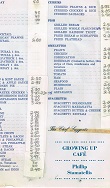
StamatellisGrowingFinlayLloydPhillip Stamatellis’ Growing up café is the third book I’ve read in publisher Finlay Lloyd’s fl smalls collection. Unlike the previous two, by established creators Paul McDermott and Carmel Bird, it is a debut work by an unknown writer. According to the author bio provided at the beginning of the book, Stamatellis is studying writing at the University of Canberra. What an achievement to have this work published, while still studying.

Growing up cafe is an enjoyable read. It tells the story of his growing up in his family’s cafe, the Radnor, in Goulburn, which is just 100km from Canberra. I used to visit cafes there regularly on trips to Sydney, that is, until it was bypassed by the highway. Now, if we go off the highway for a cuppa – and we do – it is not usually to the centre of Goulburn, but that’s another story. Back to the book …

Stamatellis has structured his short memoir cleverly. It is not told chronologically, and nor is it told in one voice. The story of his boyhood is told third person (“the boy”) via anecdotes that shift backwards and forwards across the years between 1965 and 1982. Reflections from adulthood are told first person, from the present, that is from 2014 and 2015. Whilst on the face of it the anecdotes from the past look rather higgledy-piggledy, careful reading shows that there is always a connection. There is method in the madness, in other words – and anyhow, as his friend says to him when he worries about his book making sense, “it doesn’t have to make sense, it’s not like life does.” Fair enough.

Things I enjoyed about the book include the nostalgia factor (the memories of Greek and Italian cafes or milk bars that I grew up with, though not “in” like Stamatellis) and the social history (the documenting of such cafes and the lives that surrounded them). Stamatellis captures all this nicely, from a young insider’s perspective. Phillip is, as far as this memoir tells us, the youngest of three boys born to Greek parents. The boys all grew up “in” the cafe, and they all worked in it from the moment they could. “I’ve lost count of the number of tables I’ve cleaned”, he writes, “I could do a three-plate carry by the time I was eight.”

The book opens at “Lunchtime, Summer, 1977”. The opening sentence – “The midday sun was stark in the street, and the small chirruping of cicadas almost drowned the rumbling of a passing Holden GT” – captures Australian country towns in summer perfectly, noisy cicadas and noisy Holden cars. It also reminded me of a song written in 1975 about another regional Australian city, Newcastle. The song, by Bob Hudson, includes the lines:

All the young men of Newcastle
drive down Hunter Street
in their hot FJ Holdens
with chrome plated grease nipples
and double reverse
overhead twin cam door handles,
sitting eight abreast in the front seat,
and they lean out of the window
and say real cool things to the sheilas
on the footpath, like ‘Aah g’day’.

Stamatellis, in his opening paragraph, describes teenagers in the cafe: “Cigarettes hung from their lips, the girls with their arms around their boyfriends’ waists.” It’s all so 1970s Australian – as is, unfortunately, the racism. “Thanks wog“, says a customer. A little further on is an anecdote in which “the boy’s” mother confronts racist graffiti on the cafe’s toilets, and then treats an indigenous person generously. All she says is to her son is:

‘Life is hard for some people but the sun shines for everyone, not just the wealthy’.

It’s not all serious though. There are funny, family anecdotes here too – brothers getting up to mischief, for example. There are stories about local characters, such as fun parlour owner Uncle Con, jeweller Ange Zantis, and the priest Father Sinesios, not to mention the challenge of serving the annual influx of an often unruly snow crowd. (If you are from this region you’ll know all about the trek to the snow through Goulburn, Canberra and Queanbeyan each winter). And there are the reflections from the present. These modern chapters round it out nicely. Through them we learn a little about where “the boy” is now, but overall I most enjoyed the chapters focusing on the past. They provide insight into a life now gone, and yet the lessons – such as tolerance, hard work, family cooperation – are timeless.

In the last chapter – set in 2015 – Stamatellis reflects on nostalgia:

I suppose at this very moment I’m feeling nostalgic and it seems that nostalgia makes a point of highlighting the good stuff and even finds positives among sadness – but my nostalgia is burdened by an unseen weight, a sense of entrapment …

Stamatellis doesn’t expand upon this, but I wonder if this little “small” is the beginning of something larger. It’s certainly a time and place that could do with some further scrutiny because we haven’t yet, I think, properly documented the experiences (and contributions) of that wave of southern European immigration.

(Note: I did find several typos, which is rare in my experience from Finlay Lloyd.)

Phillip Stamatellis
Growing up café
(fl smalls 8)
Braidwood: Finlay Lloyd, 2015
63pp.
ISBN: 9780987592972

(Review copy courtesy Finlay Lloyd)

Emma Ayres, Cadence: Travels with music (Review)

Emma Ayres, CadenceAlthough Emma Ayres’ memoir Cadence had been passed around my reading group with much enthusiasm over the last year or so, I wasn’t intending to read it – not because I wasn’t interested, but because there were other books I wanted to read more. However, when I found the audiobook at my aunt’s house while we were clearing it out, Mr Gums and I decided to listen to it on our trips to and from Sydney. It proved to be a great car book. However, a warning: we listened to it intermittently over two months, so this will be more a post of reflections than a coherent review.

Emma Ayres is probably known to most Australian readers of my blog, but perhaps not to others so let’s start with a potted bio. Born in England in 1967, Ayres is a professional musician – a viola player in fact – who has also worked as a radio presenter. She lived in Hong Kong for eight years, playing with the Hong Kong Philharmonic Orchestra, but in 2000 she rode a bicycle, fundraising for charity, from Shropshire, England, through the Middle East and central Asia, to Hong Kong. She moved to Australia in 2003, and worked as an ABC Classical Music radio presenter for eight years, from 2008 to 2014.

Now to the memoir. Cadence is ostensibly a travel memoir, but it covers a lot of ground within its seemingly narrow construct of chronicling her year-long bicycle journey. The ground it covers, besides the story of her travel, which is exciting enough given the regions she rode though, includes her childhood, her reflections on her life as a musician, and her analyses of classical music. Some of her technical descriptions went over my head, but I found her discussions of composers to be not only accessible and eye-opening, but deeply interesting. And it’s all told with a thoughtful philosophical underpinning.

Cadence is an excellent title for a musician’s memoir, and she plays with its meanings throughout, referring, for example, to a “perfect cadence”, or a “slow cadence”, or more frequently to  “interrupted cadences … moments when the direction is changed”. Indeed, the memoir could be seen as comprising almost continuous interrupted cadences because, although the bicycle trip provides her memoir’s chronological backbone, she skips around frequently, going backwards to her childhood and early years as a musician and forwards to her life after the trip when she briefly toyed with being a cellist. It can take a little concentration to keep track of exactly which part of her life she is writing about at any one time, but it’s not too hard. After all …

Cadences are waypoints in the music, places where you can take a breather, readjust your instrument and hurtle on to the next bit of the adventure.

I greatly enjoyed Ayres’ reflections on life and travel. The book is full of her insights, many learnt on the road. For example, regarding the challenge of deciding whether to do the trip she says:

If you are not sure whether or not you should do something, ask your ninety-year-old self.

At another point she discusses how much she loved Pakistan despite all the nay-saying she had received when she was planning her trip. She was treated, she writes, almost without exception, with kindness and generosity everywhere she went. “Do we make our own welcome?” she wonders, and goes on to suggest that before we criticise another country, we should perhaps look at ourselves first.

Being a woman cycling alone is risky business, particularly in some of those male-dominated countries through which she travelled. She frequently took advantage of her androgynous look, helping it along by keeping her hair very short and wearing non-feminine clothes (where she could). Consequently, she was regularly taken for a man. She discusses gender often, commenting on how we are ruled by it and its associated expectations. She sees herself as “a border dweller in the world of gender”, writing:

I do admire people who are by birth penumbral but have the courage and desire to be firmly one or the other and go through a sex change, but I like the fluidity of being able to float around the middle. I really to think that the basic this or that of male and female is shallow and limiting. How simplistic to think, with all those opposing hormones flowing in each of our bodies, that we are one and therefore not the other. And how much better in countries like India and Thailand that they recognise more than two sexes. More variations in the octave, more variations in gender.

Another theme that runs through the book is the idea of being in the moment. She tells the story of being taken to task for reading Anna Karenina when on a bus in Pakistan. Her young seat-mate is mystified by her passionate rendering to him of the story, saying to her “but you are here!” She genuinely sees his point, and puts the book down. Later in the trip, she regrets not spending more time with a fellow-traveller who crosses her path because “I was too focused on destination and again forgot the importance of the here and now”.

Cadence is a generous, warm-hearted book which abounds with travel anecdotes to delight any lover of travel literature. There are scary moments, and funny ones, and others that are just plain interesting. It also contains intelligent, considered insights into music, some of which I plan to share in a follow-up post. For now, I’ll conclude with a comment she makes early in the book:  “Travel”, she says, “goes inwards as much as outwards”. That is exactly what she demonstrates with this book. I can see why all those in my reading group who read the book urged it onto the next person.

awwchallenge2016

Emma Ayres
Cadence: Travels with music – a memoir
Sydney: ABC Books (by HarperCollins), 2014
284pp.
ISBN: 9780733331893

Emma Ayres
Cadence: Travels with music – a memoir (audio)
(read by Emma Ayres)
ABC Commercial, 2014
8 hours (approx) running time (on 7 CDs)

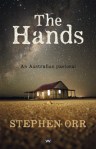
Stephen Orr, The hands: An Australian pastoral (Review)

OrrHandsWakefieldAs promised, here is my review of a farm novel, Adelaide-based Stephen Orr’s The hands: An Australian pastoral. It is his sixth novel but the first that I’ve read. Where have I been? The hands is such a good read I wonder why I haven’t read him before.

Among the review excerpts for his previous novels provided at the beginning of my edition is one for his fourth, Dissonance. It says the book prompts us “to ponder the deep nature of familial relationships and their hold over one’s life”. This must be Orr’s milieu because I could write exactly the same about this book. It is set on a remote cattle property called Bundeena, in western South Australia. At the start of the novel, six people live there: 74-year-old Murray who holds the deed to the farm; his sister Fay and her not-quite-right son Chris; and Murray’s son Trevor, his wife Carelyn, and their 11-year-old son Harry. The seventh member of the family, 17-year-old Aiden, is at boarding school. In the first of the novel’s three chronologically titled (2004, 2005, 2006) parts, we shift between the third person perspectives of those at Bundeena, and that of Aiden at school.

Like most farm novels I’ve read – such as Alice Robinson’s Anchor point (my review), Jessica White’s Entitlement (my review) and Gillian Mears’ Foal’s bread (my review) – The hands, depicts the hard life of the farmer, the struggle to survive, and the uncompromising emotions that often attend such lives. You have to be tough to survive is the implication. But, do you? Sometimes, perhaps, you can be too tough. Orr’s characters have to contend with much – not just ongoing drought and debt, but grief that is layered upon layer through the generations, from the World War 1 related suicide of Murray’s grandfather, through the farm accident which damages Chris, to another accident which rocks the family and sparks the tension that finally brings it all to a head. Secrets will out and truths, emotional and practical, must be faced.

This sounds pretty thickly laid on, doesn’t it? World War 1, suicide, farm accidents, drought, and more. How believable is it all? Fortunately, Orr’s control of his plot is sure, and the tone never shifts into melodrama. The story elements fit logically, with the necessary groundwork carefully laid. It pays to notice the details. Is there a hint, for example, in the first film we find movie-mad Chris watching, The Great Escape?

The hands is not a challenging novel to read, and it doesn’t break ground in terms of the form, but from the first page I was fully engaged – because it’s authentic. We reviewers can throw that term around rather loosely, but you’d better believe me when I use it for this novel. Orr’s ability to capture characters and the way they interact with each other is truly impressive. The uneasy relationship between Trevor and his unbending father, the love and loyalty between Aiden and Harry that lies behind the teasing and bickering, Trevor’s conversations with his sons. It’s pretty darn perfect.

Orr’s control of his story starts with the title. “It’s all in the hands” we read, and hands feature consistently throughout the novel – working on the farm, driving, sculpting. Sculpting? Yes, Trevor sculpts son Harry’s hands. Fittingly, the novel concludes as the sculpture is completed. And then there’s the subtitle. I love the use of the word “pastoral” and its multiple connotations. There’s the literal meaning relating to land used for grazing sheep and cattle. That describes this book. Then there’s the Christian church sense of providing spiritual guidance. Hmm, there’s a dearth of good guidance (spiritual, emotional, however you like to frame it) offered in this novel, particularly by patriarch Murray. In the end it’s Murray’s powerless, down-trodden sister Fay who comes good. And then there’s “pastoral” used to describe works of art which portray country life in a romantic or idealised way. But, this is not a romantic or idealised story, making the subtitle pointedly ironic.

This is a novel about a lot of things. Specifically, it’s about farms and farm families, about how farms and the responsibility for them are handed down through families. It’s about the expectation that succeeding generations will farm, and it’s about one generation letting go to allow the next to continue. The trouble is that at Bundeena, Murray will not let go. He holds the deed, and Trevor feels trapped. More than that, he feels unvalued and without autonomy. Aiden notices it too:

The word was with Murray, and Murray was the word … There wasn’t much love or compassion in him. He was a sort of farmer shell, a hollow man full of regrets and knowledge and skills he couldn’t use any more, except as a sort of walking opinion that no one wanted to hear.

Talking with him, feels Trevor, is like “arguing with a rock”.

The specific farm themes, though, encompass bigger themes to do with familial love and responsibility, choices and autonomy, guilt and shame. It is these that lift The hands from a good, but exotic to most of us, farm story to something that applies to us all. In this context, though, it must be said that women play only a small role, and the role they play could be seen to be a little idealised, in that much of the warmth or perception comes from them. However, this is not overdone. They are not sentimentalised, and their relative absence is not a flaw: this is a book about men, about generations of farming men, their lives and their decisions.

Still, it’s to Fay that I’d like to give the last word:

Family, she realised, was the most difficult thing of all. It never reached a point of completion and what was there never seemed satisfactory. But one thing, she realised: there was always a pivot, one person at the centre holding it all together.

In The hands, this turns out to be Trevor. It is he who must make the tough decisions for himself and his sons. This novel is satisfying on so many levels – story, style and subject matter. I comment it to you.

Lisa (ANZLitLovers) loved the novel too.

Stephen Orr
The hands: An Australian pastoral
Mile End: Wakefield Press, 2015
351pp
ISBN: 9781743053430

(Review copy courtesy Wakefield Press)

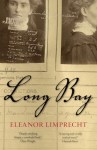
Eleanor Limprecht, Long Bay (Review)

LimprechtLongBaySleepersOne of the things that interests me about historical fiction, of which Eleanor Limprecht’s Long Bay is an example, is why the author in question chooses to write his/her story as fiction rather than non-fiction. As I’ve written before, this is an issue with which Kate Grenville grappled when she wrote The secret river. That book was initially going to be non-fiction about her ancestor Solomon Wiseman. However, for various reasons which she outlines in Searching for The secret river, the book ended up as fiction. Her reasons included gaps in the historical record, and finding the story – and particularly the voice – within the facts she had. I wondered, as I read Limprecht’s Long Bay, what her reasons were.

Long Bay, which draws its name from Sydney’s Long Bay Gaol, tells the story of Rebecca Sinclair, a young woman who in 1909, at the age of 23, was gaoled for manslaughter after a botched abortion. Limprecht describes on her website how she came to write the story: she was hunting for first person stories from the gaol when she came across two letters about Sinclair from the Prison Comptroller. Both those letters are reproduced in the book. Limprecht writes that she became obsessed with Rebecca Sinclair’s life, and started seeking out her story:

I found out everything I could and then began looking for living relatives in the hope they could tell me more. I joined an online genealogy site and made contact with a woman who had Rebecca on her family tree … she was Rebecca’s granddaughter.

Not only, it turned out, was she Rebecca’s grand-daughter, but the daughter of the baby Rebecca had had in goal. That baby, Freda, never did tell her daughter where she was born and why. Grand-daughter Christine

said that she wanted to honour her mother, who never felt she could share the story of her birth with anyone. She gave me permission to use her grandmother’s name and story for the novel, Long Bay.

Limprecht doesn’t specifically discuss why she chose to tell this story as fiction. Most likely it’s because she’s a fiction writer. Duh! (She does say on her site that Rebecca’s “story told me to look deeper, to understand bad choices, and to see beyond the razor wire, to the messy, real truth that fiction can reveal”.) But it may also be because, while there are several official records relating to Rebecca, there are major gaps in the record of her life. The lives of poor people, Limprecht implies, are not well documented. At the back of the novel, Limprecht notes the specific sources she quotes in the novel, but she does not, as some historical fiction authors do, discuss the historical basis of her story in any other detail – such as how much she has assumed, and how much she is confident of as “fact”. I’m interested in this, though it’s certainly not critical to analysis of the book as a piece of fiction.

So let’s get to the fiction! Limprecht tells the story straightforwardly. She starts with the letter – the one which inspired her story – from the Prison Comptroller to the Royal Hospital for Women advising of the arrangements for admitting Rebecca Sinclair. This is followed by a Prologue describing Rebecca’s admission and taking us to the beginning of labour. The novel then flashes back to her childhood (Chapter 1) and her story is told chronologically from this point.

Limprecht carefully sets up Rebecca’s character as a hard-working young woman who has a pretty good head and can be resourceful, but who in youthful naiveté let herself be taken in by Donald Sinclair, the only son of Nurse Sinclair, an abortionist, and a man who is, let us say, “an operator”. While there does seem to be love between them, Rebecca also slowly becomes aware that he is not to be trusted. Limprecht sets up a motive, to do with her sexuality, for Rebecca’s early willingness to accept Sinclair’s attentions. To modern minds, it could seem a little unrealistic but for the time it’s probably valid enough.

Rebecca is presented as responsible, and having integrity. As she imagines her trial, she realises that her

family will sit in that courtroom and watch her be led up into the cage. They will listen to all of the horrible things she has done. She did them with Don, for Don, but he did not force her hand.

I liked that self-awareness – though it’s true that her options if she did not go along with the plan, like those of poor women of her time, were few. I was intrigued to read in a contemporary newspaper report in Trove that she “caused a painful scene when she was sentenced. She sobbed and clung to her husband, the other prisoner, and appealed piteously to the court not to separate her from him.” Without giving too much away, this is not quite the Rebecca depicted by Limprecht, but perhaps her court-side Rebecca is drawn from what she knows was the trajectory of Rebecca’s life after her release.

Overall, while I enjoyed reading Rebecca’s story, she didn’t fully come alive for me – and I think back to Grenville’s challenge with her novel, that of finding the story, the voice, within the facts she had. I wonder whether having the permission of the family to tell this story hampered Limprecht in some way. Did she feel a little constrained to be sympathetic to Rebecca? Grenville decided to break free of her “real” subject and invent a character based on him. Not all historical fiction writers do this of course – Hilary Mantel didn’t for Wolf Hall (my review) and neither did Hannah Kent for Burial rites (my review) – but in this case, it may have freed Limprecht to fly a little more with the character, to have been, perhaps, a little less laboured about justifying her actions and decisions.

Nonetheless, the novel does make excellent reading. The plotting is confident and coherent, with the ground carefully laid for the “crisis” point. There’s some lovely imagery. Here, for example, is Rebecca feeling shame:

Like a hem on a dress that is too long, it drags behind her, gathering dirt, there for everyone to see.

And Limprecht’s description of turn of the century Sydney, and of the lives of poor women in particular, feels authentic. Rebecca’s mother, with six children, falls on hard times when her husband dies. She makes her money as a seamstress, which is a skill Rebecca learns. Her other daughters find different paths in life – one respectable, another not so. Limprecht is careful not to moralise on the abortion issue, preferring to show, rather than exhort. Nurse Sinclair is clear and unsentimental about why she does what she does – women need the service and they need it done safely, and she needs an income (“a trade that turns a pretty profit”). Rebecca sees the sorts of women coming through – servant women abused by their master, poor women with too many children, unmarried women. A prison guard shows rare kindness because she understands the issues.

Rebecca Sinclair’s story is a fascinating one. Notwithstanding my little equivocation, Limprecht has done it justice and brought to our modern times the story of a woman whose story is worth telling. A perfect one for the Australian Women Writers Challenge.

awwchallenge2015Eleanor Limprecht
Long Bay
Collingwood: Sleepers, 2015
313pp
ISBN: 9780987507044

(Review copy supplied by Sleepers Publishing)