Stephanie Buckle, Habits of silence (#BookReview)

Stephanie Buckle, Habits of silenceI have been champing at the bit to read local author Stephanie Buckle’s debut short story collection, Habits of silence, ever since I attended its launch in August by John Clanchy at the Canberra Writers Festival. The readings that both Clanchy and Buckle herself gave from the book grabbed my attention and convinced me that this would be a book I’d like. However, it had to wait its turn in my review copy pile. Finally its number came up – and I devoured it. I will never understand why some readers don’t like short stories. At least, I understand their reasons in my head, but I don’t in my readerly heart! (If that makes sense.)

John Clanchy, in launching this beautifully designed book, spoke about its title which is not, as commonly occurs, the title of one of the stories inside. When this happens, it’s logical to consider what the title means, and for Clanchy it reflects the book’s interest in communication, and particularly in the part played by silence. Silence, he said, can be positive or negative, and both of these are explored in Buckle’s stories. This is not to say that all the stories are specifically about, or even feature silence in a major way. But even in those that don’t, there’s usually some missed communication or miscommunication that might just as well be silence.

And now I come to that part that’s always a challenge with reviewing short story collections, which is whether to quickly survey all the stories or focus on a couple or try to do a bit of both. I usually opt for the last of these, and will probably do so again here. One day I’ll come up with an exciting new way to discuss short story collections, but I haven’t found it yet!

So, the survey part. There are fourteen stories, some of which have been published before, with a couple having won awards. There are both first-person and third-person stories – providing lovely variety – and the protagonists range in age, situation, and gender. It feels like a collection that could only be written by someone with a good few decades of life experience under her belt (but perhaps that’s denying what imagination can do). I’m certainly not saying that Buckle has experienced all she writes about, but the stories do feel imbued with a deep sense of knowingness.

One of the stories that is specifically about silence is titled, well, “the silence”. It’s about two brothers, Jim and his older brother George Clayton (love this cheeky last name), who live in a country town and have run the family furniture business for years, without speaking to each other. Each works alternate days and George communicates with Jim by letter, because, it seems

Silence is safe. Silence commits to nothing. Far easier to be silent than to speak.

Except, this silence is burning Jim up – that, and his brother’s complete inflexibility about changing anything in their increasingly anachronistic shop to bring it up to date. I liked this story, the beautiful realisation of the characters, and its tentative but by no means certain resolution.

Another story in which silence is central is “fifty years”. This is one of the stories read from at the launch, and it tantalised me. It concerns a woman who has been rendered mute by a stroke. She’s in hospital, attended by her husband of fifty years and her daughter, from whose point of view the story is told. Here’s part of the excerpt read at the launch. It comes after the husband has been prattling on with platitudes:

And that’s when I see it, the first time. It’s the expression you make when you think no one’s looking. The one you make to yourself, with your back turned. It’s the one that makes all the others look like masks, as if all the cups of tea, and all the ironed shirts, are just pretending. She turns from me and regards him quite steadily, but as if she sees him down the wrong end of a telescope, or as if he’s a fly buzzing still against the window, that she briefly thinks she might stir herself to deal with, but can’t be bothered. Are you still here? it says.

If that doesn’t make you want to read this book, then I’d say you’re a lost cause! Buckle’s insights into human relationships make you sit up and pay attention – and her honed spare writing is well-suited to her theme.

The second story in the collection, “sex and money”, is also about a lonely wife who feels unappreciated. Like the husband in “fifty years”, Frank appears to know little about the wife he lives with, and is more likely to help a neighbour than do something she’s asked. And yet, in his head, he loves – at least he desires – his wife. Rose meanwhile finds her own way of obtaining pleasure. It’s all to do with money, but not what you might be thinking. Buckle’s playing with ideas of lust, desire and money here is cheeky – and telling.

But not all marriages, not all relationships in the book, are poor. The woman in “the man on the path” has been grieving her beloved husband’s death for four years. She has come to the Lakes, a favourite holiday place of theirs, for a break, but feels out of place amongst all the happy holidaying couples. Then, out walking, she meets a man on the path, but a “failure of courage”, an inability to communicate appropriately, sees an opportunity to make a connection pass. She perseveres with her walking, however, and, well, you never know, there could be a second chance …

There’s nothing like mental illness to focus us on essential truths about humanity. Lillian, in the opening story “lillian and meredith”, is developing dementia – her “words scatter in all directions” – but, like many of the book’s characters, she’s lonely so when new patient Meredith appears she sees her opportunity. Meredith is welcoming, but when money goes missing, it all falls apart and poor Lillian is handled with less than kindness by the staff. This is just one of several stories which feature mental illness, with three of them – “us and them”, “frederick”, and “no change” – set in the same place, Cedar Grove Psychiatric Facility. There is no cross-over in characters, but there’s something nicely grounding in returning to a familiar place, even if when we get there we are confronted by questions about duty of care and our frequent failure, for whatever reasons, systemic or personal, to provide it.

Buckle’s stories, then, explore all sorts of relationships – between couples, siblings, parents and children, friends, teachers and students, and even staff and patients – showing that none are immune from communication challenges, from silences that hide true feelings to words which do the same, from convictions that relationships are true to realisations that they aren’t, from attempts to connect to refusals to do so. Although some stories impacted me more than others, I was engaged by them all, reminding me once again why I love short stories. It’s their little nuggety insights into human nature – and Buckle’s Habits of silence provides just that.
aww2017 badgeStephanie Buckle
Habits of silence
Braidwood: Finlay Lloyd, 2017
202pp.
ISBN: 9780994516534

(Review copy courtesy Finlay Lloyd)


Hoa Pham, Lady of the realm (#BookReview)

Hoa Pham, Lady of the realm

Hoa Pham was one of the participants at the recent Boundless Festival (my post), so it’s rather apposite that her latest work, Lady of the realm, popped up as my next review copy. The very brief author bio on the Festival site describes the novel as “about a Buddhist clairvoyant in Vietnam”. Well, it is, but it’s about far more than that too.

Vietnamese-Australian Hoa Pham was born in Hobart after her Vietnamese parents went there to study in the 1970s. She has written several novels, children’s books, plays and short stories, but her novella, Lady of the Realm, is the first that I’ve read. It’s a slim book, a novella in fact, told first person in a chronological sequence that covers nearly five decades from 1962 to 2009. If you know your south-east Asian history, you’ll realise that this time-span starts during the Vietnam or American War (depending on your perspective.)

It’s quite a challenge to cover such a long and tumultuous period in less than 90 pages, but Pham achieves it by keeping her focus tight – to the experience of the Buddhist monk Liên. Before we meet her formally though, there is a short prologue, which is also in her voice, albeit unknown to us at that point. She prepares us for the vignette-style in which she tells her story:

Looking back over the years, it seems that time stretches and contracts, depending on my experience of each moment. Some moments are etched in my memory, like the sunlight patterning the water in the river, ethereal moments captured only by my mind. Other longer stretches of time are a blur ….

This makes perfect sense to me in terms of how we remember our lives, and hence works for telling a story that covers a long life in a turbulent place. However, if you are someone who likes to get lost in a character and the ongoing drama of life, this book may not work for you.

So, Liên. She is introduced in 1962 as a young girl who has a prescient dream that the Viet Minh will come and destroy her fishing village. This marks her as the one to succeed her grandmother Bà as keeper of the shrine and mouthpiece for the Lady of the Realm (as she calls the Buddhist goddess of mercy, Quan Ám). Unfortunately, the village head ignores the warning, and the village is attacked with most in the village killed. Liên, however, escapes, and lives to chronicle the aftermath.

The book then takes us through moments in Liên’s, and therefore Vietnam’s, life in 1968, 1980, 1991 and 2007, before finishing in 2009 when Liên is now an old woman living in a Buddhist monastery. She has experienced much violence and oppression – through the war and the “fall of Saigon”, through the Communist regime which she “naively believed” would bring peace but which brought “re-education” and more death, and through later “reforms” which were supposed to open up Vietnam but saw her beloved Prajna Monastery destroyed. Liên survives it all, sustained by hope:

Ever hidden away the Lady could still bring hope, I thought. I had found the Lady in many guises, but the strongest seemed to be the Lady I had inside. (1980)

This hope is sorely tested, however, and in the last section she says:

Sanctuaries are an illusion, only suffering is real. I know that this is not what Buddha taught, and my experience has made my own sayings out of his teachings. I believe that any safety I find is temporary, any refuge is not permanent. But my teacher would say, all things are impermanent and change. I hope that our situation will change. Some days I cannot bear another moment of being under siege. (2009)

The tone, here, is typical of the book as a whole – calm, somewhat resigned, and sometimes hopeful.

Now, how to describe the writing? There’s the tone, and there’s Pham’s simple, direct language (which is also evidenced in the above excerpt). There’s also her preponderant use of short paragraphs. And there’s the episodic form, with each episode/year heralded by an epigraph, the last four by Buddhist monk and peace activist, Thích Nhất Hạnh. Together, these create a sort of prose-poem, and with that, dare I venture, a higher (or perhaps just universal) plane of truth!

In other words, Pham has contrived to tell a personal, human story through her character Liên, while also conveying a philosophical attitude to life based on endurance, compassion and most of all hope. A moving, inspiring read.

Lisa (ANZLitLovers) captures the book beautifully in her review.

aww2017 badge

Hoa Pham
Lady of the realm
Mission Beach: Spinifex Press, 2017
98pp.
ISBN: 9781925581133

(Review copy courtesy Spinifex Press)

Stan Grant, Talking to my country (#BookReview)

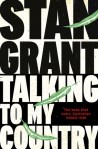
Stan Grant, Talking to my countryHistory is, in a way, the main subject of my reading group’s October book, Stan Grant’s Talking to my country. I’m consequently somewhat nervous about writing this post, because discussions of history in Australia are apt to generate more emotion than rational discussion. I will, though, discuss it – through my interested lay historian’s eyes.

However, before we get to that, I’d like to briefly discuss the book’s form. Firstly, it’s a hybrid book, that is, it combines forms and/or genres. In the non-fiction arena, this often involves combining elements of memoir with something else, like biography, as in Gabrielle Carey’s Moving among strangers (my review). In Grant’s case, he combines memoir with something more polemical – an interrogation of Australian history, and how the stories we tell about our past inform who we are and how we relate to each other.

Secondly, and probably because it’s not a straight memoir – Grant wrote his memoir, The tears of strangers, in 2002 – the book is structured more thematically than chronologically, though a loose chronology underlies it. For example, his discussion of the lives of his grandparents and parents doesn’t happen until Part 3, and then in Part 4 he discusses the government’s policies for handling “the ‘Aboriginal problem'”, particularly that of assimilation (or, more accurately, “absorption”.) This structure enables him to focus the narrative on his theme, so let’s now get to that.

The book opens with an introductory chapter titled, simply, My country: Australia. In it, Grant sets out why he wrote the book, which is to convey to non-indigenous Australians just what life is like for indigenous people, to explain that although history is largely ignored it still “plagues” indigenous people, and to tell us that the impetus for him to finally write the book was the booing of indigenous football player Adam Goodes in 2015. And here, in very simple terms, Grant states his thesis:

This wasn’t about sport; this was about our shared history and our failure to recognise it.

He goes on to explain that while some tried to deny or excuse it, his people knew where that booing came from. From my point of view, it’s pretty clear too.

“the gulf of our history”

Now, I’m not going to summarise all his arguments – or the stories of his and other indigenous people’s experiences – but I do want to share some of his comments about history. As Grant is clearly aware – and what Australian isn’t – history is politicised, sometimes consciously, sometimes unconsciously. My generation, the baby-boomers, grew up learning that Captain Cook discovered Australia and that Governor Phillip established the first settlement. If Aboriginal people were mentioned, it tended to be in passing. They were merely a side-bar to the main story. We may have learnt about the missions (and the “great” work they were doing) and we may have learnt in later years of schooling that many indigenous people lived in poverty, but we weren’t told about the massacres and violence that occurred, and nor was it ever suggested that we* had invaded an already occupied land. However, as we now know, these things we weren’t told are incontrovertible facts, supported by evidence.

Some, unfortunately, still ignore these facts and some try to interpret them differently, while the rest of us accept them but feel helpless about how to proceed. And this leads directly to Grant’s underpinning point, which is that we – black and white Australians – meet across “the contested space of our shared past”. Elsewhere he states it a little less strongly as “the gulf of our history”. I love the clarity of these phrases. They explain perfectly why discourse in Australia regarding indigenous Australians can be so contentious and so often futile. Grant’s point is that we can’t progress as a unified nation until this space is no longer contested, until the gulf is closed or bridged.

Grant puts forward a strong case based on experience, anecdote and hard facts (such as the terrible, the embarrassing, statistics regarding indigenous Australians’ health outcomes, incarceration rates, etc) to encourage all Australians, “my country” as the title says, to understand why, for example, when we sing the national anthem – “Australians all, let us rejoice” – indigenous people don’t feel much like joining in. What do they have to rejoice about? Where is their “wealth for toil”.

Suffice it to say that I found this a powerful book. While in one sense, it didn’t teach me anything new, in another it conceptualised the current state of play for me in a different way, a way that has given me new language with which to frame my own thoughts.

By now, if you haven’t read the book, you’ll be thinking that it’s a completely negative rant. But this is not so. It’s certainly “in your face” but Grant’s tone is, despite his admitting to anger, more generous. His aim is to encourage us white Australians to walk for a while in the shoes of our indigenous compatriots and thus understand for ourselves what our history, to date, has created. He believes that good relationships do exist, that there is generosity and goodwill but that, as the Adam Goodes episode made clear, bigotry and racism still divide us.

Late in the book Grant discusses the obvious fact that this land is now home to us all, that many of us have been here for generations and “can be from nowhere else”. Rather than rejecting “our” claims to love this place, he writes that this should make it easier for us to understand indigenous people’s profound connection to country. He writes:

I would like to think that with a sense of place comes a sense of history; an acceptance that what has happened here has happened to us all and that to turn from it or hide from it diminishes us.

And so, rather than telling indigenous people that “the past is past” and “to get over it”, it would be far better, far more honest, far more helpful, for us non-indigenous people to say, “Yes, we accept what we did and understand its consequences. Now, how should we proceed?” Is this really too hard?

Stan Grant
Talking to my country
Sydney: HarperCollinsPublishers, 2016
230pp.
ISBN: 9781460751978

* And by “we”, I mean, as Robert Manne explains it, not “we” as individuals, but as the nation.

Gabrielle Carey, Moving among strangers (#BookReview)

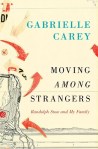
Gabrielle Carey, Moving among strangersEmma’s guest Monday Musings post last week on Randolph Stow provided the impetus for me to finally retrieve Gabrielle Carey’s Moving among strangers: Randolph Stow and my family from my TBR pile. I’ve been wanting to read it for the longest time, but … well, those of you with big TBRs will understand.

Moving among strangers, whose title comes from a line in Stow’s novel The girl green as elderflower, is an unusual book. It’s partly a biography of Stow, and partly a memoir of Carey and her family, but Carey wouldn’t call it either. She says in her prologue:

… this book is not a biography. Neither is it a work of literary analysis or scholarly enquiry. It is more like a ‘mostly private letter’, to use Stow’s phrase, written out of curiosity, and tenderness towards a man whom I have come to think of as an almost-relative, a dear friend of my mother’s, and the ideal literary mentor.

It all started when, as her mother was dying in 2009, Carey wrote to Stow in England letting him know of her mother’s condition. It was his response, which came four days after her mother’s death, which set Carey off. She’d known there’d been a connection, of course, but she didn’t know much about it. Stow wrote that Joan’s letters from London, when he was a schoolboy and undergraduate, “were like a window on the world”. Why, Carey wondered, did her mother correspond “with a young man, an adolescent, thirteen years her junior, who wasn’t even a relation?” This question is never properly answered in the book, not because there’s something salacious to discover (in case you were wondering), but because some connections made in life don’t have explanations beyond the fact that they occur. If that makes sense.

So, as the book progresses, Carey follows a Stow trail, “like a groupie”. She interrogates his novels and other writings, and reactions to them. She reads the letters Stow wrote to members of her and his family. And she visits the places in England where Stow had lived and meets some of the people who knew him there. One of the main strands in her story concerns Stow’s unease with Australia – with his feeling rejected by Australia and/or his rejecting Australia. There is no answer to this question either, but Carey’s exploration of the issue is enlightening (particularly given all those other Australian intellectuals who left in the 1960s – some well known like Germaine Greer and Clive James, others less so like Jill Ker Conway and Ray Mathew. Each story is different but there is probably a thread that links them too?)

There are many angles, in fact, from which I could write on this engaging but slippery book. There’s Carey’s sharing of her own history – the loss of her mother, her tricky relationship with her sister, the death by suicide of her father, and so on. There’s the form of the work and how it fits into what seems to be a new breed of biography-memoirs that is popping up. And of course, there’s Stow, himself. He comes across as an elusive character, and that’s probably because he was. When she, having made connection with him, enthusiastically tries to engage him, by correspondence, in a literary discussion about his and her mutual interest in James Joyce, he shuts her down, albeit politely, explaining that he was “old and ailing” which, in fact, he was. He died the next year.

This doesn’t deter her – for which we should be grateful because although the book is not, as she forewarns us, a biography, we do, nonetheless gain insight into Stow. She paints a picture, in the end, of a man at odds with the country in which he was born though exactly why is hard to say. Did he reject Australia – with its “depressing tolerance, even worship, of the second-rate” (his words) – or did Australia reject him with its inability to understand his work. Australian critics, apparently, panned his novel Tourmaline, for example, rejecting its combination of “fable and poetry” with “realism”. A later critic, Carey says, notes that Tourmaline represented a change, a move away from “bush realism … towards something more experimental”. However, at the time, as is so often the case with innovative creators, this was not recognised and Stow’s “too truthful, too confrontational of conventional attitudes” novel was not appreciated in his own country. Stow felt the rejection.

But, Carey is wary of coming to conclusions, as she constantly reminds us. At one point, when she has questions and no answers, she tells us that given there’s no one alive to tell her “the real story”, she “can only imagine”, but a page or two later, she says

But I could be wrong. Being wrong, I realised, is how I’ve spent most of my life: misinterpreting, misunderstanding, misjudging, miscommunication. Words slip and slide, as T.S Eliot said, or as Stow put it, ‘words can’t cope’.

A strange thing for a writer to say, perhaps? And yet, perhaps not. Perhaps, it’s something only a writer could say?

You are probably getting the gist now of this unusual book – and hopefully, realising what a delightful, engrossing and stimulating read it is. It is not a long book, and is therefore not comprehensive. If you want, for example, to read about the Stow book I know best, his first Miles Franklin winner, To the islands, you won’t find it here. What you will find though is an intelligent analysis of Stow the man and of his work. You will also gain, or, at least I did, some insights into literary Australia of the mid to late twentieth century – not a list of luminaries, or even a history, but a sense of the life and times, and of how one particular writer did (or didn’t) navigate it.

Near the end, Carey returns to a theme she introduced earlier in the book, that of twinning or duality of perspectives. She concludes that, in the Essex pub where she met people who had known Stow in the latter years of his life, she found “twin versions” of him, one “content in his lifestyle, in his aloneness, who was self-sufficient and independent” and one “who was uncomfortable in his own skin, internally and perpetually in conflict over his sexuality, his nationality and his identity.”

If you are interested in Stow, in Australian literary history more broadly, and/or in Carey herself, this is a book for you.

aww2017 badgeGabrielle Carey
Moving among strangers: Randolph Stow and my family
St Lucia: UQP, 2013
232pp.
ISBN: 9780702249921

Carmel Bird (ed), The stolen children: Their stories (#BookReview)

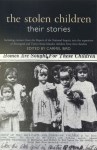
Carmel Bird, The stolen childrenCommenting on my post on Telling indigenous Australian stories, Australian author Carmel Bird mentioned her 1998 book The stolen children, describing it as her contribution “to the spreading of indigenous stories through the wider Australian culture”. It contains stories told to, and contained in the report of, the National Enquiry into the Separation of Aboriginal and Torres Strait Islander Children from their Families (Bringing them home)*. She offered to send me a copy, and of course I accepted (despite having read much about the Report at the time.)

Bird said in her comment that the book is “still regularly used in schools”. This is excellent to hear because it contains a history that needs to be told – forever, alongside all those other histories taught to Australian students. It needs to be as well (if not better) known by our students as the story of The Gold Rush or Our Explorers. We need to know it, we need, as a nation, to know our dark side, our failures, as well as our big adventures and achievements.

What makes this book particularly useful is Carmel Bird’s curation of it – and I would call what she’s done “curation” because of the complexity and variety of the writings she has gathered and organised. Bird has structured the book carefully to tell a story, with introductory front matter (including a preface from Ronald Wilson the National Committee’s prime commissioner); the Stories themselves; Perspectives from people at the time, including Hansard excerpts from politicians at the tabling of the Report; the Report’s Recommendations; and end matter comprising an Afterword from historian Henry Reynolds and a poem titled “Sorry” by Millicent whose story appears in the Stories section. Bird’s curation also  includes providing introductions to each of the stories to draw out important issues or points about that person’s situation, and adding other explanatory notes where appropriate.

This careful curation ensures that the book contains all the content and context it needs to stand alone as a resource for anyone interested in the Stolen Generations.

“It made no sense”

In her story, Donna says “It made no sense”. She’s describing her train trip away from her mother in the company of a white woman, a train trip she’d been initially excited about, thinking it was to be a family trip. However, with her mother staying behind on the platform and her brothers disappearing one by one as the journey went on, it just made no sense to her.

None of the stories make sense. And they are all heart-rending. Some children were given up willingly by their mothers, who believed it would result in better opportunities, and some, most, were stolen, often suddenly, with no explanation. Some were newborn, some pre-school or primary school-age, while others were 12 years old or more. Some found themselves in loving foster homes, but many found themselves in institutions and/or abusive situations. All, though, and this is the important thing, suffered extreme loss. They lost family and they lost language and culture. Fiona, for example, who will not criticise the missionaries who cared for her, says, on reconnecting with her family thirty-two years later:

I couldn’t communicate with my family because I had no way of communicating with them any longer. Once that language was taken away, we lost a part of that very soul. It meant our culture was gone, our family was gone, everything that was dear to us was gone.

Fiona also makes the point, as do several others, about the treatment of the mothers:

We talk about it from the point of view of our trauma but – our mother – to understand what she went through, I don’t think anyone can understand that.

The mothers, she said, “weren’t treated as people having feelings”.

The stories continue, telling of pain, pain and more pain. Murray says “we didn’t deserve life sentences, a sentence I still serve today”, and John talks of being a prisoner from when he was born. “Even today,” he writes, “they have our file number so we’re still prisoners you know. And we’ll always be prisoners while our files are in archives”. This is something that I, as a librarian/archivist, had not considered.

But, there’s more that makes no sense, and that’s the government of the time’s refusal to apologise, to satisfy, in fact, Recommendations 3 and 5a of the Report. This issue is covered in the Perspectives section, with extracts from speeches made by the then Prime Minister John Howard and the Minister for Aboriginal Torres Straight Islander Affairs Senator Herron who argue against making an apology, and from the Opposition Leader Kim Beazley and Labor Senator Rosemary Crowley, who made their own apologies. Crowley also says:

If ever there were a report to break the hearts of people, it is this one.

The Perspectives section also includes other commentary on the Report and the apology. There’s a letter to the editor from the son of a policeman who cried about his role in taking children away from “loving mothers and fathers”, and one from La Trobe Professor of History Marilyn Lake contesting the historical rationale for the practice of forcible removal. She argues that there had never been “consensus [about] the policy of child removal”. There’s also a long two-part article published in newspapers that year, from public intellectual Robert Manne. He picks apart the argument against making an apology, noting in particular Howard’s refusal to accept that present generations should be accountable or responsible for the actions of earlier ones. Manne differentiates between our role as individuals and as members of a nation:

we are all deeply implicated in the history of our nation. It is not as individuals but as members of the nation, the “imagined” community, that the present generation has indeed inherited a responsibility for this country’s past.

In the event, of course, an apology was made, finally, in February 2008, by Labor Prime Minister Kevin Rudd. This, however, does not mitigate the value of Bird’s book. It has value, first, as documenting our history and the voices of those involved – indigenous people, politicians and commentators. And second, it contains thoughts and ideas that we still need to know and think about, not only for historical reasons, but because in the twenty years since the Report we have not made enough progress along the reconciliation path. It is shameful.

I loved Carmel Bird’s introduction. It’s both passionate and considered, and clearly lays out why she wanted to do this book. I’ll conclude with her words:

I think that perhaps imagination is one of the most important and powerful factors in the necessary process of reconciliation. If white Australian can begin to imagine what life has been like for many indigenous Australians over the last two-hundred years, they will have begun to understand and will be compelled to act. If we read these stories how can we not be shocked and moved …

“There can,” she says, “be no disbelief; these are true stories.” This is why the stolen generations should be a compulsory part of Australian history curricula (Recommendation 8a). It’s also why, to progress reconciliation, we should keep reading and listening to indigenous Australians. Only they know what they need.

aww2017 badgeCarmel Bird (ed)
The stolen children: Their stories
North Sydney: Random House, 1998
188pp.
ISBN: 9780091836894

(Review copy courtesy Carmel Bird)

* For non-Australians who may not know this Enquiry, its first term of reference was to “trace the past laws, practices and policies which resulted in the separation of Aboriginal and Torres Strait Islander children from their families by compulsion, duress or undue influence, and the effects of those laws, practices and policies”. You can read the full Report online.

Monday musings on Australian literature: Guest post from ACT Lit-blogger Emma Gibson

With the ACT Lit-bloggers of the Future program in its closing months, I thought it would be lovely for you to hear directly from Emma and Angharad via a guest post, and they both agreed. First up is Emma  – and she chose to write about …

The great Australian writer you’ve (possibly) never heard of: Randolph Stow and Tourmaline

The sun is close here. If you look at Tourmaline, shade your eyes. It is a town of corrugated iron, and in the heat the corrugations shimmer and twine, strangely immaterial. This is hard to watch, and the glare of the stony ground is cruel.  The road ends here. – The Law, Tourmaline

Randolph Stow, TourmalineI was returning to Australia after two years of self-imposed exile when I first stumbled upon Randolph Stow’s Tourmaline.

It was July and I was spending a month writing poetry at an artist residency in Cadiz, Spain, an ancient city the shape of a fist that juts out into the Atlantic. I had chosen the location because it was almost as close to the antipodes as I could get – the actual antipodean point to Canberra is in the ocean – and because I’d spent my last two summers in Scotland or Iceland and wanted a taste of warmth before returning to Australia in August. I had forgotten heat. I was to discover that I did not miss it.

I did miss Australia, as reading Tourmaline made me realise. I read it twice in that month, hiding away from the afternoon sun, because the images it conjured up were so strong, even though it was not a part of Australia I knew.

Far from civilisation, the town of Tourmaline was once a prosperous gold mining settlement in Western Australia, where its potential for riches saw it imagined as having streets pathed with the very gold taken from the earth. It was, as Gabrielle Carey describes in her introduction to the new edition of the novel, ‘a colonisers fantasy’ until the gold was exhausted, and so too the water.

The book is narrated by the Law, the ageing sheriff of the town who lives in the crumbling gaol tower and fears his irrelevance. Now, he is little more than a bystander, who has appointed himself as the memory keeper for the town. It is his testament we read, although it may not be reliable, as his recollections are tinted by nostalgia, memories of rains that the younger generation have never known.

I have seen rain in Tourmaline. Can you believe that? How can you? You have not seen that green, that green like burning, that covers all the stones on the red earth, and glows, gently, upward, till the grey-green leaves of the myall are drab no longer, but green as the grass, washed in reflected light.

Stow writes in his author’s note that the novel is to be imagined as taking place in the future.

Something has happened in the outside world, something that has changed civilisation forever. The town’s war memorial plays host to an annual event that bears resemblance to an ANZAC day service, where the Law delivers the same sermon each year. Outside, where “wild beasts are loose upon the world”, Tourmaline has been forgotten in its isolation, thought long-buried by the drifting red sands that claimed the nearby settlement of Lacey’s Find. No one comes to Tourmaline, and no one in recent memory has left; those who did leave never returned. The exception is the monthly supply truck, and its arrivals are a town event.

Among those assembled for the truck one month are town publican Kestrel, Deborah, his young Aboriginal de facto, Deborah’s adopted parents, Mary and Tom, who run the town’s only store and Byrne, the acne-scarred drunk troubadour and Kestrel’s cousin. As well as the supplies, they are delivered a near-dead man, found fifty miles down the road. Deborah, Mary and Byrne nurse the man back to health. When the stranger recovers, he introduces himself as Michael Random and claims to be a diviner. In his promise of water and gold for the town, he becomes a messiah for the people of Tourmaline – but is Random’s promise of salvation as much of a mirage as water in the desert?

Tourmaline was Randolph Stow’s fourth novel, published in 1963. Stow was a prodigious writer. By the time he was 30, he has published two poetry collections and five novels, as well as working at an Aboriginal community in the Kimberly, as an assistant anthropologist on the Trobriand Islands, and stints as an academic.

But it’s likely that Randolph Stow is the great Australian writer you’ve never heard of. I had never heard of Stow until I found Tourmaline, and as I raved about it to friends over the ensuing months, they hadn’t either, except for one who recalled reading The Merry-Go-Round in the Sea as a student in Geraldton, where the book is set. I became obsessed with learning more about the man and his life.

Stow won the Patrick White Award and the Miles Franklin Award, as well as a fellowship from the Australia Council for the Arts (which he later terminated in a letter to Gough Whitlam). He was a contemporary of Patrick White’s and mates with Sidney Nolan, who designed some of the covers for his books.

Yet he is described as ‘the least visible figure of that great twentieth-century triumvirate of Australian novelists whose other members are Patrick White and Christina Stead’.

I wonder why this is. While it’s likely more complex, there are two reason I can see. One is that his work could be considered difficult. While others were writing social realism, Stow was instead interested in the symbolic, drawing on Taoism spiritualism in Tourmaline, which has been described as an ecological allegory. Patrick White himself professed that Tourmaline had “Come to grief in a lush labyrinth of poetic prose.” (Quoted by Bruce Bennet in Westerly 55:2, p. 152).

The other is that Stow himself was elusive. Always a solitary figure who had struggled with mental health issues and alcohol, he spent long periods travelling in the 1960s and then settled in England. Perhaps, in this exile to the home of his ancestors, was a reflection of a theme apparent in his work, of the tension around colonial identity and the impact of European settlement on Indigenous Australians.

After leaving Australia, Stow published few books, and over time, disappeared from our literary consciousness. When Stow died in 2010, most of his books were out of print in Australia – a forgotten relic like Tourmaline, perhaps, already thought long buried. But unlike his narrator in the novel, Stow need not fear lapsing into irrelevance. In recent years, there has been a renewed interest in his novels and poetry.

In 2015, Text republished five of Stow’s novels as part of its Text Classics series. Gabrielle Carey’s Moving Among Strangers: Randolph Stow and My Family, was published in 2014 and Suzanne Falkiner’s comprehensive biography, Mick: A Life of Randolph Stow, followed in 2016.

I hope then, that Stow’s work will find new readers.

***

About Emma Gibson

Emma is a writer and performance-maker here in Canberra. She’s particularly interested in writing about place (which of course appeals to me), and is currently studying a Masters of Creative Writing (Place Writing) with Manchester Metropolitan University.

Emma has written plays, some performed locally, such as Johnny Castellano is mine (Canberra Youth Theatre/Street Theatre), The Pyjama Girl (HotHouse Theatre), and Widowbird (The Street Theatre), and others performed internationally, including War Stories (24:7 Festival, Re:Play, Greater Manchester Fringe, Buxton Fringe), and Bloodletting (Bread and Roses Theatre, London).

Emma also writes prose, and has had short pieces published in the Skagastrond ReviewSeizure, and Iceview. She has created a site-specific poetry installation in Spain, helped run an artist residency in Iceland, and made an audio walking tour around Garema Place for Canberra’s You Are Here Festival.

Her posts for the ACT Lit-bloggers program can be found here on the Capital Letters blog.

Thanks, Emma, for this first piece on Stow in my blog. I appreciate it! And now, Emma and I would love to hear what you know or love about Randolph Stow …

Ellen van Neerven (ed.), Writing black (#BookReview)

Writing black: New indigenous writing from Australia is one of the productions supported by the Queensland Writers Centre’s if:book that I wrote about in a recent Monday Musings. It’s an interactive e-book created using Apple’s iBooks platform, and can be downloaded free-of-charge via the if:book page or directly from iBooks.

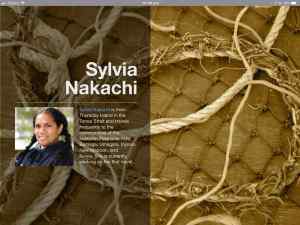
Title page for Ch. 16, Sylvia Nakachi

Ch. 16, Sylvia Nakachi (Using fair dealing provisions for purposes of review)

Writing black was edited (and commissioned) by Ellen van Neerven (whose book Heat and light and story “Sweetest thing”, I’ve reviewed here). It contains works by 20 writers, in a variety of forms, including prose by writers like Bruce Pascoe, Tony Birch, and Marie Munkara; poetry by Tara June Winch, Lionel Fogarty, Kerry Reed-Gilbert and Steven Oliver (most of which are presented in both text and video); and twitter-fiction by Siv Parker. For each writer, there is a “title” page which provides a brief biography, and the works are illustrated with gorgeous sepia-toned photography by Jo-Anne Driessens.

In her editor’s introduction, van Neerven states that, by the time of publication, there had not been a “digital-only anthology of Australian indigenous writing”. This book addresses that gap, but with a very particular goal. It was, she writes, “moulded by possibility”, by the fact that “the multimedia and enhancements a digital publication allows lifts the imagination”. Certainly, we see some of these possibilities in this production.

Her point, though, that particularly interested me was this:

Expectations of what we write about are changing, no longer the narrow restriction of life stories and poetry. Indeed, Indigenous writers do not need to write about Indigenous issues at all, if they choose not to. With more Indigenous books and authors comes a new generation of readers — open-minded to what Indigenous writers can write about, and across new forms and experiences.

Great point – just as it’s important that we see indigenous people on television and in movies, for example, without their indigeneity needing to be referenced or be part of the story. Anyhow, we see this broadening of content in Writing black – in Jane Harrison’s “Born, still”, for example – although, not surprisingly and completely understandably, given where we are on the reconciliation journey, many of pieces do have political intent.

This brings me to one of the appealing aspect of this production, which is its variety, not only in form as I’ve already mentioned, but in tone and content. The pieces span moods from the intensity of Tara June Winch (“Moon”) to the cheeky humour of Marie Munkara (“Trixie”), from the anger of Kerry Reed-Gilbert (“Talking up to the white woman”) and the frustration of Steven Oliver (“You can’t be black”) to the melancholy of Bruce Pascoe’s (“A letter to Barry”). Many of the pieces speak to loss of country and identity, and the emotional impact of these. What makes them particularly powerful is that they come from all over, from the tropical north to country Victoria to various urban settings.

Another appealing thing, which stems from its being an e-Book, is that we can hear poets perform their own work, as well as read the text ourselves. One of these is the new-to-me Steven Oliver. He has four poems in the collection – “Real”, “You can’t be black”, “Diversified identity” and “I’m a black fella” – with video of him reading each of them. He (or his poetic persona) is an urban dweller who regularly confronts questions concerning his indigenous identity. In “Real” he describes a discussion with another who refuses to accept he’s “black”, who produces those crass arguments like he’s “more of a brown” and “not really a full”, but who suddenly turns when our poet responds that his English name suggests he’s not “from here”. Oliver writes:

Listen here Abo, you know-it-all coon
It seemed that my friend has spoken too soon
Just moments ago I was not the real thing
Yet now by his words my heritage clings

This is a long-ish poem, but is accessible. Its use of rhyming couplets provides a light touch that keeps the reader engaged while the actual words drive home a serious point about Aboriginal identity. I hope it’s taught in schools.

Another poem of his, “You can’t be black”, also addresses assumptions others make about what being Aboriginal is:

You can’t be black
When the media shows Aborigines they live on communities
And struggle with petrol, poverty and disease
So you can’t be black
If you’re black you wouldn’t have nice clothes on your back.

Oliver’s poems are made to be performed, as are those of the next poet Kerry Reed-Gilbert.

She also comes out fighting, with five poems. She writes of being in a bar, waiting for the racist slurs (“A conversation and a beer”), or of being exploited by people who only want to know her to further their own aims (“Talking up to the white woman”). She speaks in the voice of a white racist in “Because my mum said so” to show how racism is learnt through families. This is a particular concern of mine. I’ve seen schools trying their hardest to teach tolerance and respect – but that role-modelling at home is mighty powerful stuff.

Another well-established poet who has been politically active for decades is Lionel Fogarty. His two poems in this collection focus more on caring for country, on sharing the land, on passing knowledge on.

The prose pieces are, overall, more diverse. There’s Tristan Savage’s cheeky short film script, “Gubbament man” about Freddy the indigenous “discrimination prevention officer”. Siv Parker’s twitter-fiction piece “Maisie May” was originally released as tweets over several hours on, note, 26th January, in 2014. It tells of a trip to country for the funeral of Aunty Maisie May who “could tell you about country and our ways that we lost over the years.” Marie Munkara is here too with her particular brand of humour to tell about “Trixie” who takes revenge on her ex. There’s also Tony Birch whose “Deep rock” clearly draws from (or fed into) his novel Ghost River (my review). And there’s David Curtis whose “What kind dreaming” tells of three young indigenous men, two already becoming familiar with the life and law of their country and the other a greenhorn from the city, who go bush. Our greenhorn soon learns a few things from the other two, who respect “them old people”.

In an interview in Sydney Review of Books, Ellen van Neerven comments briefly on why she wanted to do this “digital collection”:

For me it’s as much about audience and access. There is a really hungry international audience for Indigenous writing but also lots of roadblocks in getting the books out there. Being able to access work online is definitely an advantage and we’ve had a lot of feedback and contact from people overseas who have been able to find out about Indigenous writing and read content from 20 different authors that way.

And that’s exactly it. This oh-so-rich collection introduces readers to many of Australia’s current significant indigenous writers, not to mention the range of issues that interest them. And it’s free to download. That we should be so lucky! A big thanks to if:book and the Queensland Writers Centre for supporting such innovative and sophisticated projects as this one.

aww2017 badgeEllen van Neerven (ed.)
Writing black: New indigenous writing from Australia
State Library of Queensland, 2014
133pp.
ISBN: 9780975803059

Catherine McKinnon, Storyland (#BookReview)

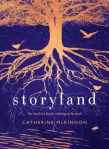
Catherine McKinnon, StorylandIt is still somewhat controversial for non-indigenous Australian authors to include indigenous characters and concerns in their fiction, as Catherine McKinnon does in Storyland. But there are good arguments for their doing so. One is that not including indigenous characters continues the dispossession that started with white settlement. Another is that such fiction brings indigenous characters and stories to people who may not read indigenous authors, which is surely a good thing?

However, such writing requires sensitivity, or empathy, on the part of non-indigenous writers. Indigenous author, Jeanine Leane says that this can only be achieved by social and cultural immersion (which can include informed reading of indigenous writing). McKinnon addresses this in a couple of ways. In her author’s note, she refers to discussing “stories and ownership” with local Illawarra region poet and elder, Aunty Barbara Nicholson, which resulted, for example, in her telling a brutal story from the convict perpetrator’s point of view rather than from the indigenous victim’s. She also acknowledges Nicholson “for reading, local knowledge and generous advice both early on in the process and nearing completion”. But now let’s get to the reason for all this …

Storyland is set in the Illawarra region south of Sydney, and tells the story of the Australian continent, post-white settlement, from 1796 to 2717. It has a nine-part narrative arc that takes us through five characters and six time periods: Will Martin 1796, Hawker 1822, Lola 1900, Bel 1998, and Nada 2033 and 2717. These form the first five parts of the novel. The final four parts return through Bel, Lola, Hawker, finishing with Will Martin, each picking up its character’s story where it had been left first time around. Got it? Two of these characters – Will and Hawker – are based on historical figures, while the rest are fictional.

… a tricksy plot

Will’s employer, the explorer George Bass, says early on that “the land is a book, waiting to be read”, and this, essentially, is what the book’s about. Will is a 15-year-old who sailed with Flinders and Bass in 1796 on their search for a river south of Sydney. On their trip they meet “Indians” whom they fear might be cannibals. We leave them at a nervous moment in their encounter to move to 1822 where we meet the convict Hawker. He’s a hard man, who believes you need “a mind like flint and a gristly intent”. He has his eye on a young indigenous woman, but also on improving his future. From him, we jump again, this time to 1900 and young hardworking dairy-farmer Lola who lives with her half-sister and brother Mary and Abe, both of whom have indigenous blood. There is racism afoot, with a neighbouring farmer suspicious of Abe’s friendship with his teenage daughter Jewell. We leave this story, with Jewell having gone missing, to meet Bel in 1998.

Bel, the youngest of our protagonists at 10 years old, spends her summer rafting with two neighbourhood boys on a lagoon that features in each of the stories. They befriend a couple, Ned and his indigenous girlfriend Kristie. Bel is a naive narrator, but adult readers quickly see the violence at the centre of this relationship. Meanwhile, down the road lives the slightly younger Nada, who is the pinnacle of our chronological arc, featuring in 2033 and 2717. In 2033, climate change has created havoc in the land, and a dystopia is playing out …

Country and connection

I hope this doesn’t sound too confusing – or fragmented – because in fact Storyland is a very accessible book. Superficially, it seems disjointed, but McKinnon connects the stories through links that gradually register as the narrative progresses. For example, the transitions between each story all feature birds, such as this one from Hawker to Lola:

The women are disappearing into the forest. And then they are gone. Lost in the dark trees. An owl

Lola
1900

calling boo-book, boo-book.

(My html skills aren’t up to replicating the layout I’m afraid.) Other links include the aforementioned lagoon, a creek, a cave which most characters reference, a big old fig tree and an ancient stone-axe. None of these are forced, or feel out of place. Instead these places and objects naturally connect the stories, despite their very different narratives, to provide a continuity that transcends the people to focus on the land itself – because, ultimately, this is a story about the land and our ongoing relationship with it.

McKinnon, the author bio says, has been a theatre director and playwright, as well as a prose writer. This is evident in the voices (all first person) and dialogue which beautifully capture the rhythms, vocabulary and grammar of the different characters and their times. Will Martin talks of “Indians”, Hawker talks of “forest”, while turn-of-the-century farmer Lola uses structures like “Jewell and me carry buckets of skimmed milk” and “When he were done”. Ten-year-old Bel is language-proficient, with a good vocabulary, but she sees things through a ten-year-old’s eyes, such as this on the abused Kristie, who “has her big black sunglasses on” and “looks funny, her lips look bigger or something”.  (In a delightful in-joke, her father Jonathan is writing his PhD on unreliable narrators).

The real star of the novel, though, is the land. McKinnon traces its trajectory from an almost pristine state at the dawn of colonisation through being farmed by Hawker and Lola to climate-change-caused destruction in 2033 followed much later by a mysterious post-apocalyptic world. She similarly traces our relationship with indigenous people from early caution, uncertainty and tentative goodwill, through 19th century brutality and ongoing dispossession, to the continuing racism and exploitation of the twentieth century.

The question to ask here is why did McKinnon structure the story the way she did, starting and ending with 1796? Here is Will at the end, exploring a beach on his own:

The white sand curves around the land; the dunes in the late night are dark mountains and valleys; the forest behind is thick and green to the sky. This is a wild place. Too wild for civilisation. It is a place for adventure.

And “the water is fresh” to drink! Is McKinnon, by ending with this more idyllic picture of the land, suggesting that there’s still hope? This is how it was, this is what could happen. Does it have to? Can we yet turn it around? Well, yes, perhaps. As Uncle Ray says to Bel, “it’s our job to look after all this land around here. If we don’t, bad things can happen.”

“To dare is to do”, George Bass tells Will, and this is what McKinnon has done in Storyland. She has combined historical, contemporary and speculative fiction to tell us a story about our land – and our relationship with it and with the people who know it best. This land, these mountains, creeks, lagoons and trees, were here first, Uncle Ray says, and this makes us “part of their history, not the other way around.” The message is clear.

Storyland is a beautiful book physically – in cover, design and construction – as well as being a moving and relevant read. I dare you to read it today.

Bloggers Lisa (ANZlitLovers) and Bill (The Australian Legend) liked this book too.

aww2017 badgeCatherine McKinnon
Storyland
Sydney: Fourth Estate, 2017
382pp.
ISBN: 9781460752326

(Review copy courtesy HarperCollins Publishers)

Heather Rose, The museum of modern love (#BookReview)

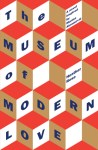
Heather Rose, The museum of modern loveAs I neared the end of Heather Rose’s Stella Prize-winning novel The museum of modern love, I slowed down. I wanted, of course, to know how it was going to resolve, but I wanted to savour it too. It doesn’t seem right to rush the end of thoughtful books like this.

But, I have to admit that I was initially hesitant about reading the book, as I am about any book inspired by a person or work I don’t know. I fear missing something important. However, I did want to read it and my reading group scheduled it. The die was cast. Then, as I was about to start reading, Brother Gums sent me a link to the documentary Marina Abramović: The artist is present about her and the performance piece which inspired this novel. I was set! As it turned out, I think Rose’s writing is evocative enough that it wasn’t necessary to have seen the film, but it did add a layer to the experience.

So, what is The museum of modern love about – besides love, that is? Its centre is performance artist Marina Abramović’s 75-day piece, The Artist is Present, which she performed at MoMA in the spring of 2010, to accompany a large retrospective exhibition of her work. The piece involved her sitting, still, quiet, at a table all day, 6 days a week (MoMA is closed Tuesdays), with gallery attendees invited to take turns to sit opposite her and share a gaze. It was an astonishing success, with, by the end, people camping out overnight to get the chance to sit. Many attended for days just to watch, creating, as Rose describes it, quite a community of spectators. In the end, over 850,000 people attended, with 1,545 people sitting (including Rose). (All are recorded at flickr.)

Anyhow, from this premise, Rose weaves an engaging, thoughtful story about art and love. It has two main narrative strands, telling the real Marina Abramović’s story and that of an attendee, the fictional musician Arky Levin, whose life is stalling, partly due to a restraining order made by his now-unresponsive terminally-ill wife that he not visit her. Interspersed with these, enriching the exploration of the themes, are smaller stories of other attendees, and family and/or friends of the protagonists. It’s narrated by a mysterious third person voice, who starts the novel with

He was not my first musician, Arky Levin. Nor my least successful. Mostly by his age potential is squandered or realised. But this is not a story of potential. It is a story of convergence.

This is a very particular omniscient narrator, some sort of artist’s muse who self-describes late in the novel as a “good spirit, whim … House elf to the artists of paint, music, body, voice, form, word”, one whose job is sometimes just “to wake things up”. This could be cutesy or forced, but it isn’t because Rose doesn’t overdo it. Mostly the story progresses without the intrusion of this narrator, so that when s/he appears we pay attention.

The moral conundrum at the novel’s heart is – is art enough or is love more important? It’s explored primarily through Levin, whose friends suggest he should appeal Lydia’s court order.

I know you’re going to say that she wanted you to do this; she wanted you to make music. But is that enough?

Music, it sounded feeble suddenly in the face of the yawning gap between life before Christmas and life these past four months. (p. 158)

So what does Levin do? Continue to live his increasingly lonely life making music, or follow his heart?

Levin’s story is off-set against other stories, notably that of Jane Miller, a friendly, recently widowed art teacher visiting New York from Georgia. She is lonely, like Levin, missing her husband “achingly, gapingly, excruciatingly. Her body hadn’t regulated itself to solitude.” She becomes one of the mesmerised watchers, but she also connects with others in the crowd, including Levin and Brittika, a PhD student from the Netherlands who is writing her thesis on Marina. Jane forms a natural link between the two themes of love and art.

What, then, is art?

The first time Jane attends the performance, she overhears people in the crowd questioning what the show is about, asking what is art, in fact. There are, of course, the naysayers, the ones who say that “art is irrelevant. If everything goes to crap, it won’t be art that saves us”. But Jane thinks differently, and turns to the man next to her who is, you guessed it, Levin, and says

I think art saves people all the time … I know art has saved me on several occasions.

As the novel progresses, various claims are made for art. Our muse, speaking particularly for artists, believes that “pain is the stone that art sharpens itself on time after time” and that “artists run their fingers over the fabric of eternity”. Marina’s art teacher says to her 16-year-old self that  “Art will wake you up. Art will break your heart”, which causes Marina to consider that “Art … could be something unimaginable”. At one point Marina is reported as saying “I am only interested in art that can change the ideology of society”.

Jane, the viewer, though, has her own epiphany:

And maybe this was art, she thought, having spent years trying to define it and pin it to the line like a shirt on a windy day. There you are, art! You capture moments at the heart of life.

But, I think it is art critic Healayas who makes the clearest, simplest point when she says during a discussion about Marina’s performance:

She simply invites us to participate … It may be therapeutic and spiritual, but it is also social and political. It is multi-layered. It is why we love art, why we study art, why we invest ourselves in art.

… and what has love got to do with it?

Everything, if art, as all this suggests, is about humanity.

Let’s look specifically at Levin. It would be easy to criticise him, as his friends and daughter gently do, for being passive. But, we do get the sense that Lydia encouraged his passivity in their life together, that she liked to be in control, not in a control-freak way but in that way that super-competent people can do. Moreover, Lydia made her order out of love for him, to let him continue creating his art, rather than look after her which she didn’t believe was in him. So, what’s Levin to do? How does he reconcile his love against hers?

The resolution when it comes is triggered by art, by Marina’s performance. And this, as Jane believes art can do, probably saves him. I say probably because Rose, clever writer that she is, leaves the ending uncertain. As she and Levin realise,

the best ideas come from a place with a sign on the door saying I don’t know.

This is an inspired and inspiring book that leaves you pondering. I’ve only touched the surface.

Lisa (ANZLitLovers) also liked the novel.

aww2017 badgeHeather Rose
The museum of modern love
Sydney: Allen & Unwin, 2016
284pp.
ISBN: 9781760291860

Monday musings on Australian literature: Memorable Australian characters

Image on screen as we waited for Kim Scott

Image on screen as we waited for Kim Scott

The inspiration for today’s somewhat fun post, came from something more serious, Kim Scott’s Ray Mathew lecture that I attended last week. As I was waiting in the National Library’s gorgeous theatre waiting for the lecture to start, I found myself thinking about Bobby in Scott’s novel That deadman dance. What I realised was that Bobby is still vivid in my mind, years after I read the book – and I started to think about other similarly vivid characters…

Because, I don’t know about you, but I have read many books over the years. Some have been forgotten, some I remember generally, and some in more detail for one reason or another. Those reasons can vary – they can be the emotion that was engendered in me, or the ideas the book inspired me to think about, or the language delighted me, or, even, the plot surprised me, but there’s only a few for which that reason is very specifically a character. I thought it would be fun to share those – and for you to share back. Of course, as this is my Australian literature post, I’ll be focusing on Aussie books only. In other words, you won’t find Darcy or Elizabeth here! You, though, don’t have to be similarly constrained, so go for it. Bring out your Atticus Finches and Emma Bovarys. Let’s see what happens.

I have another proviso for this post, besides my characters having to be from Australian books, and that’s that I have to have read the books at least five years ago. Otherwise, I’m not sure I could say they’ve stood the test of time. My earliest favourite character comes from my pre-teen reading.

I noticed something interesting as I was compiling this list: not only do the characters vary in terms of age, gender, role/position, etc., they also fall into types like “my favourite pioneer character” or “child character” and so on. There’s very little duplication of these categories.

I am a bit nervous about this post, because I know I’ll omit some memorable characters that have slipped my mind (briefly!), exposing my shallowness, but I’ve decided to screw my courage to the you know what, and jump in. Oh, and one final point before I do: while these characters come from books I’ve loved, those books won’t necessarily be among my top books, particularly now, years later (though some will be).

So, here is my list, presented alphabetically by the character’s first name!

  • Bobby Wabalanginy, from Kim Scott’s That deadman dance (published 2010, read and reviewed 2011) is a luminous, unforgettable First Contact character whose generosity of spirit is knocked back again and again by the colonial settlers. He represents all that could have been good and positive in our first indigenous-settler relationships in this country.

We thought making friends was the best thing, and never knew that when we took your flour and sugar and tea and blankets that we’d lose everything of ours. We learned your words and songs and stories, and never knew you didn’t want to hear ours.

  • The drover’s wife, from Henry Lawson’s short story “The drover’s wife”. As far as I remember, she doesn’t have a name, but stands for the archetypal 19th century pioneer woman who had to face the terrors of the bush alone while her husband was, well, droving. She, like the rest of her ilk, had to become “used to the loneliness”.
  • Joe Harman and Jean Paget, from Nevil Shute’s A town like Alice, survived much, particularly being POWs during World War 2, before finally realising their love for each other. Yes, they are my favourite romantic couple from my adolescence, and I had to share them here.
  • Judy Woolcot, from Ethel Turner’s Seven little Australians, is, in a way, Australia’s version of America’s Beth (from Louisa May Alcott’s Little women). She’s the tragic character of our childhood. However, where Beth was a sweet town-living girl, Judy was a courageous, feisty tomboy from the bush.
  • Patrick White, VossSybylla Melvyn, from Miles Franklin’s My brilliant career, has to be in the list of any Aussie female reader. How can she not be, with her independent spirit and her refusal to let a handsome, wealthy man distract her from her dream of a “brilliant career”.
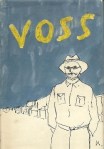
  • Voss, from Patrick White’s Voss, was inspired by Prussian explorer Ludwig Leichhardt and his expedition into the Australian outback in the 1840s. He’s tragic, mythic, romantic, and I first fell for him, and thus also for Patrick White, in my teens.
  • Weekly, from Elizabeth Jolley’s The newspaper of Claremont St, is a working class woman, a cleaner in fact (hence her “name”). She works steadily towards a dream that she will not give up, not for any anything.

And I think I’ll leave it there. I could go into families – like Tim Winton’s Lambs and Pickles (Cloudstreet) and Ruth Park’s Darcys (The harp in the south) but that would be diluting the theme which I don’t want to do. I’m aware that this is not at all representative of my favourite authors, but that’s because I love them for other reasons.

And now, over to you. Who are your most memorable characters?