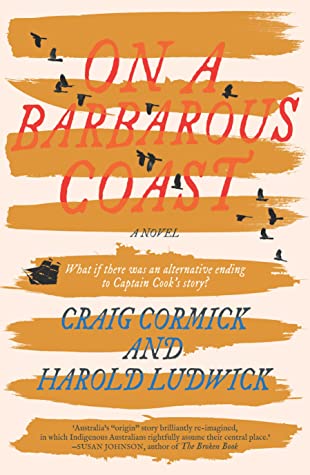
Craig Cormick and Harold Ludwick, On a barbarous coast (“BookReview)

Craig Cormick is a Canberra-based writer whom I’ve seen at various literary events around town, but not read until now, so I was especially glad when Allen & Unwin sent me this book to review. Titled On a barbarous coast, it was written collaboratively with Harold Ludwick, “a Bulgun Warra man whose traditional lands lie west of Cooktown”.

On a barbarous coast offers something a bit different for reviewers. Besides its collaborative nature, there’s its form or genre, which is that sub-genre of historical fiction called alternate (or alternative) history. In this case, it involves looking at a period of Australian history and asking “what if things had happened differently?” Those things, for Cormick and Ludwick, relate to Captain Cook’s exploration of Australia.

The story springs, then, from Captain Cook’s 1768-1771 voyage to Australia to observe the Transit of Venus. During that expedition, in late 1770, the Endeavour was seriously damaged around the Great Barrier Reef, but managed to limp on to Batavia. However, Cormick and Ludwick posit a different scenario, suggesting that the Endeavour was shipwrecked and that only a small number of the crew survived – including Cook, though he remains comatose though much of the story. The survivors make their way to land, and … the question is, as the cover states, “What if there was an alternative ending to Captain Cook’s story?” Would Australia’s history have been different, and how?

While I’ve not read many, I do quite like alternative histories. They encourage us to look at the past from different angles, which can illuminate the implications of decisions made and actions taken.

So, this is how it goes …

The story is told in two alternating first-person voices, Cormick’s being that of American Midshipman James Magra, and Ludwick’s being the young Indigenous boy, Garrgiil.

Magra chronicles the actions and fates of the shipwreck survivors, who very quickly break into two antagonistic camps, while Ludwick shares the thoughts and actions of the local Guugu Yimidhirr people. For the bulk of the narrative, the two cultures remain apart. There is quite a bit of humour in watching Garrgiil’s people trying to decide whether these strange “spirit things” are ancestors or just men. Initially, they feel they must be ancestors, but the way they stumble around, starving while “walking past food every day”, not to mention behaving incorrectly in sacred or special areas, suggests that this may not be the case.

… their presence gives our people great stories of their stupidity and clumsiness to tell around the fire at night. Like the one who stood in the river and let Gandhaar [crocodile] eat him …

Meanwhile, we watch Magra and his co-survivors bickering amongst themselves, trying to plan a solution to their predicament, and sensing the “natives” are out there but not seeing them. The stage is set for a meeting. The question is: how will it go? You will have to read the book for yourselves to find out.

So, how does it all come together?

Magra gets the lion’s share of the story, which could be seen as giving the invaders the upper-hand (yet again) in story-telling. However, I’m going to assume that this was all discussed and agreed between the two authors. Also, I think we could argue that the unequal number of physical pages doesn’t necessarily mean that the emotional impact of the two narratives is similarly unequal. Garrgiil’s voice is strong enough, and compelling enough, to be in our minds, even when he’s not centre-stage.

In the Authors’ Note at the end, Cormick says they “tried to stay as close to known history as possible, both within the known and imagined paths of the story”, which requires a bit of mind-bending but I get what they mean. They drew upon “many existing knowledges” including several journals, such as those of James Cook, Joseph Banks, Sydney Parkinson, and an anonymous journal believed to have been written by James Mario Magra, whom Cormick uses as his narrator. They also looked at the work of Indigenous and non-Indigenous historians, journalists and academics, and at historical accounts of several shipwrecked individuals who had lived with Indigenous people. Cormick notes that while their story divides easily into the two narratives, “it is not so easy to unpick how each of us influenced each other’s work”.

Ludwick adds that his aim was to pull readers into “the world of Guugu Yimidhirr language (which was first recorded in 1770 by Sydney Parkinson and Joseph Banks)”. He says that many of the practices and knowledge he describes in the book are still used by his people. He also says that he wove Dreamtime stories into his narrative to help readers understand his people’s traditional explanations of how the land became what we see today.

The end result is the sort of book I like to read, one that entertains me with its story, while also engaging my mind as I consider what the authors (plural, in this case) were trying to do, how they were trying to do it, and whether they pulled it off. It is an earnest book. Sometimes this comes a bit close to the surface when we are “told” things to make sure we get it (such as “I know the Captain controlled how the stories of our journey would be told”). This – and the strange though interesting little “magical realism” interludes where Magra talks to Gandhaar, the crocodile – creates a little unevenness in the narrative. Also, the use of parenthesis to translate the local language used by Garrgiil felt clunky. Yet, I applaud the book’s extensive use of this language. We need more of it in contemporary Australian literature. As Gandhaar tells Magra:

You create the landscape in your own words. If you don’t know the right words, you will never know the land properly.

But these are minor “picky” things. Cormick and Ludwick have attempted something significant in terms of story, intent, and process, and they pulled it off in a way that engaged me, right through to their considered ending which suggests possibilities, while being realistic about probabilities. Without irony, we could call this book “a grand endeavour”. It is certainly exciting to see such Indigenous-non-Indigenous collaborations happening in our literary sphere.

Lisa (ANZLitLovers) also found this book intriguing.

Craig Cormick and Harold Ludwick
On a barbarous coast
Crows Nest: Allen & Unwin, 2020
309pp.
ISBN: 9781760877347

(Review copy courtesy Allen & Unwin)

Sue Lovegrove and Adrienne Eberhard, The voice of water (#BookReview)

I had planned to post on this beautifully produced book, The voice of water, earlier in the year, but the events of the year threw me completely off track, and here I am at the end scrambling to finish off the posts I planned oh so many months ago.

Created by Tasmanians, visual artist Sue Lovegrove and poet Adrienne Eberhard (who has appeared here before), The voice of water was described by Hobart’s Fuller’s bookshop in their book launch announcement, as “a collection of 30 miniature paintings and poems which celebrate and pay homage to the beauty and ephemeral life of wetlands”. This is a good description of the content, but it doesn’t describe its exquisite production. You can tell that this book was a labour of love by two people who have both a passion for the Tasmanian landscape and an eye for beauty and design.

In their brief introduction, Lovegrove and Eberhard describe their aim as being “to reveal the fragility and fleeting nature of life in a lagoon”, to capture “the constantly shifting light”, “the soundtrack of place from frog call and scratching index legs to the tapping of grasses”, and “the calligraphy of reeds and sedges”. Not surprisingly, they also note the threat to wetlands posed by climate change. They name the wetlands that inspired them, and describe their process:

We spent days simply sitting together or apart, amongst the banksias and tea-trees at the edges, or lying in the sedges and reeds, letting these places seep into our imagination. We waded through ponds and swamps, working side-by-side, drawing and writing, and we had many conversations.

Interestingly, there was an exhibition of Sue Lovegrove’s miniatures at my favourite local gallery, Beaver Galleries, so you can see some (if not all) of the images on their website. The images are beautiful, some having an almost Monet-esque impression of light and water, others being a little more representational, particularly of reeds and sedge. (The original images are watercolour and gouache on paper.) One gorgeous miniature pair features a pond of deep blue with overhead clouds reflected in it. Eberhard’s miniature poem is (without her spacing though I tried):

enamelled sky
where clouds mop
and soak tumbrils
of luminous blue

The words “enamelled” and “luminous” capture the colours perfectly. Other poems convey different watery effects, such as “like textured silk like ruched folds of material”.

Another miniature pair features rows of reeds or grasses in a pond. The accompanying poem is presented on the facing landscape page in portrait mode so that it looks like spikes of grass too. So much attention has been paid to the design, and how design can help convey meaning as much as the works themselves – representing, for example, “the calligraphy of reeds and sedges”. Another poem is arranged in offset columns to encourage us, or so it seems to me, to read the lines in different orders – down one column and then the other, or leaping across the columns – producing slightly different meanings or effects depending on the order.

I’ll share just one more poem, which exemplifies the attention they also paid to the “soundtrack” of the landscape:

jostle of noise a cacophonous counterpoint to the artist’s mark-making scribble and scratch
castanet-clack the scratching of insect legs
ratcheting and tightening an orchestration that ricochets
and rasps phonetics of frog call an infiltration a metronome’s sustaining heartbeat.

The book chronicles the water cycle in the lagoons, the water coming and receding at different times – “lagoon shrinks to water lines washing through reeds” – but this is not a polemical book about climate change. Rather, it is a hymn to what we have now. At least, that’s how I read it.

However you read it though, The voice of water is a gorgeous book to get lost in and carried away by, and I’m sorry I didn’t write it up earlier in the year.

PS I have tagged this “Nature writing”, which reminded me that I have just received advice that submissions are now open for the 6th biennial Natural Conservancy Nature Writing Prize (about which I have written here before). It’s an essay prize, and is worth $7,500 for the winner. This year’s judges are literary critic, Geordie Williamson, and Miles Franklin Award winning novelist, Tara June Winch. Being selected by them would be quite a feather in the cap, I reckon. For more information check the website.

Challenge logo

Sue Lovegrove and Adrienne Eberhard
The voice of water
Published in 2019 with assistance from an Australia Council for the Arts grant
64pp. (unnumbered)
ISBN: 9780646802541

Carolyn Collins and Roy Eccleston, Trailblazers: 100 inspiring South Australian women (#BookReview)

South Australia, say the authors of the beautiful coffee-table book Trailblazers, “was an early leader in women’s rights, so it’s no surprise that it has produced an army of trailblazing, inspirational women”. However, they continue, their stories are not well enough told or known, hence this book!

As with any endeavour like this, it was a challenge to limit themselves to 100, but they did. The women they chose cover “an array of fields – from vineyards to laboratories, from the judiciary and politics to schoolrooms, charities and the stage”, with their influence ranging from local communities to the international stage. They make the point that not all the women they chose were born in South Australia or, alternatively, not all those who were born in South Australia made their mark there. They also make the point that although South Australia was the first Australian jurisdiction to grant women the vote and the right to stand for election, back in 1894, “the fight for a ‘fair go’ continues today”. This means, I’d argue, that the women in this book serve as both a record of what has been achieved and as inspirations for what still needs to be done.

Book cover

The women are ordered alphabetically, which is clever as it saves the need of an index (though an index would be good if you seek other information, like writers, politicians, activists, etc. There is an excellent bibliography at the back, organised by subject, so you can quickly check what sources were used for each woman. I was pleased to see, for example, that Desley Deacon who wrote the authoritative (I’d say) biography of Dame Judith Anderson (my review) was used for the Anderson piece. The sources include primary sources, like newspaper articles, from the subject’s time. The book – a heavy tome I must say – is also beautifully illustrated with plentiful photographs.

So, who is here? There are the feminists, of course, including 19th century born Muriel Matters (who was featured in Clare Wright’s You daughters of freedom) and 20th century born Anne Summers (author of Damned whores and God’s police). There are the social reformers, such as Catherine Helen Spence who was also an early Australian woman “novelist, journalist, preacher and teacher”. Born in 1825, she was, as well, an early campaigner for women’s rights. On her 80th birthday in 1905, she described herself as “an awakened woman”:

Awakened in the sense of capacity and responsibility, not merely to family and the household, but to the State; to be used not for her own selfish interests, but that the world may be glad that she had been born.

South Australia has produced many women who have made significant political careers in Federal politics, such as, from recent times, Julie Bishop, Julia Gillard, (the late) Janine Haines, Natasha Stott Despoja and Penny Wong (listed alphabetically to avoid bias!). What a powerhouse of women. What is in South Australia’s water?

There are Indigenous Australian women, such as the activists Ruby Hammond and Lowitja O’Donoghue, Alice (Alitya) Rigney, Australia’s first female Aboriginal school principal, and Faith Thomas, the first Aboriginal woman selected for an Australian sporting team (cricket)

Australia’s beloved cook, Maggie Beer, and fashion icon, Maggie Taberer, are included, as is the Olympian, “Lithgow Flash” Marjorie Jackson, who, among other achievements, was South Australia’s governor from 2001 to 2007.

Book cover

And there are the writers, artists and performers. Mem Fox, author of the children’s classic Possum magic is an example. She was, writes the authors, “fired up over the need for more Australian stories for children”. But also included are the aforementioned actor Judith Anderson, writer Nancy Cato, artists Nora Heyson and Margaret Preston, composer Miriam Hyde, to name just a very few. I knew some of these were South Australian, others, like Margaret Preston, surprised me.

However, there are also the unsung, or lesser-known achievers. Medical workers, lawyers, educators, charity workers, activists and campaigners of all sorts, churchwomen, and more. I’ve never heard of environmentalist Barbara Hardy, or Pearl Wallace who became Australia’s first female riverboat captain in 1947 after passing “a gruelling three-day examination”. Gladys Sym Choon, described, simply, as an “entrepreneur”, was born in Unley in 1905 to Chinese parents. She opened her own store in Rundle Street, Adelaide, in 1923, believing herself to be the first woman in South Australia to incorporate. Doris Taylor, the founder of Meals on Wheels, was called “one of the great unsung heroines of Australia” by the late South Australian premier Don Dunstan.

There are so, so many stories here of women who have strived and achieved, often, of course, against immense odds. Because of its alphabetical arrangement, Trailblazers works more as a reference book, or one to dip into, rather than one telling “a story”, which it might have been under, say, a chronological arrangement or if ordered by spheres of activity or influence. The approach is, in a sense, encyclopaedic, providing brief biographies relevant to each woman’s reason for inclusion. This is not the place for whole-of-life, warts-and-all stories. Nor should it be, as that’s not its intention. However, the writing is bright, engaging and accessible. These authors want you to read about these women, so the pieces launch right in:

Living eight months a year on the Nullabor Plain while your dad hunts foxes and rabbits gives you a great backstory if you’re a kid with ambitions to be a country singer. (Country-singer Kasey Chambers)

OR

When Mary Miller went to work for the war effort in 1942, she was surprised to find her co-workers at the munitions factory were more afraid of their bosses than of the explosives. (Unionist, activist and teacher)

Published just days before last Christmas, Trailblazers probably didn’t make it under many trees, but it would be a great Christmas present for anyone interested in Australia’s trailblazing women, in South Australia’s settled history, or, in fact, in that of Australia as a whole. An enjoyable read.

Challenge logo

Carolyn Collins and Roy Eccleston
Trailblazers: 100 inspiring South Australian writers
Mile End: Wakefield Press, 2019
311pp.
ISBN: 9781743056905

(Review copy courtesy Wakefield Press)

Julie Janson, Benevolence (#BookReview)

In a rather curious synchronicity, the last three books I’ve read have all had single word, multiple-meaning, titles, all relating to the colonial settlement of Australia – Gay Lynch’s historical fiction Unsettled (my review), John Kinsella’s memoir Displaced (my review), and now Julie Janson’s historical fiction Benevolence whose title drips with irony.

Recently, I commented that it would be good to see an Indigenous Australian novel responding to Kate Grenville’s The secret river. Well, it appears that Benevolence is that novel. In her Acknowledgements, Janson, of the Darug Nation, writes that Benevolence is “a work of fiction based on historical events of the early years [1816-1842] of the British invasion and settlement around the Hawkesbury River in Western Sydney, New South Wales”. Protagonist Muraging, renamed Mary by the colonisers, is based on the author’s ancestor, Mary Ann Thomas, just as Grenville’s novel, set around the same place and time, was inspired by, though not exactly based on, her ancestor, Solomon Wiseman. There, of course, the similarity ends, because while Grenville’s protagonist becomes a “big” man in colonial Sydney, Muraging’s experience is very different.

Benevolence starts in 1816, when the motherless Muraging is “about 12 years old” and handed over by her father to the British to be taught English at the Parramatta Native Institution. She is, says her father (naively we now know), “to be an important part of helping their people and she must learn their language and their ways”. Thus begins Muraging’s life of being caught between two cultures. Early on “she thinks she can be in two worlds and not have to choose”. However, she is never properly accepted by the British (of course) and, while accepted by her own Darug people, it is clear very early that Indigenous culture is being dismantled by dispossession, dispersal and death (through disease, murder and massacre), resulting in Indigenous people’s lives (already) becoming one of survival rather than of living fully.

And so, as the novel progresses through the years, we follow Muraging as she leaves or escapes the British settlement to find comfort, support and/or protection within Indigenous communities, only to return for one reason or another to the settlement, with the cycle starting all over again. Each time she returns to the settlement, the brutality and humiliations ratchet up. It’s a terrible story, but a credible one based on Janson’s detailed research, part of it done while she worked as a senior researcher for Professor Peter Read at the University of Sydney. This research resulted in the creation of the History of Aboriginal Sydney website.

However, this book is not history but historical fiction, so the characters are inspired by a mixture of historical fact and Janson’s imagination – and it is her imagination that brings these characters to life as authentic beings, particularly Muraging, her mixed-up friend Mercy, the weak-if-well-meaning reverend Henry Smythe, and to a lesser degree Captain Woodrow. The grotesque reverend Masters is another matter altogether.

Muraging is established from the start as a person with agency. She does not want to be a “servant” or “a fine maid”. Rather, she wants, she says, to ‘”improve my situation” … but she is ignored’. She never gives up her search for an independent life, and, though she makes poor decisions at times, she behaves courageously, loyally (sometimes at great risk to herself), and in a way determined to be true to herself and her people.

“You have no home” (Masters)

While the personal implications of colonialism and dispossession are conveyed through Muraging’s story, Janson reinforces this with historical fact, including references to documented massacres, discussions between characters about current events, and the occasional appearance of a governor (like Macquarie, like Gipps.) Janson also opens selected chapters with specific historical information. Chapter 4 (“1818: White people things”), for example, begins with an excerpt from the Sydney Gazette reporting massacres from, of course, the settler perspective. Chapter 20 (“1835: Deerubbin, The Hawkesbury River”) commences with a statement about Governor Bourke passing “the Proclamation of terra nullius”. And so on. These occasional documentary facts anchor Muraging’s story in the historical timeline.

The biggest villain of the piece is the appropriately named Reverend Masters. He represents the worst of British power, conveying or enacting British policy with little thought for the humanity of those he deals with. Like a certain world leader today, it’s all about him.

And this brings me to the writing. Janson’s descriptions are beautifully lyrical, though not always simply so. The novel opens with:

The grey-green eucalypts clatter with the sound of cicadas. Magpies and currawongs warble across the morning sky as the sun’s heat streams down. It is eaglehawk time …

Almost idyllic Australia, except “eaglehawk” time suggests the idea of violence … of hunter and prey!

There are also wry ironic touches, such as Captain Woodrow’s comment, “I have fought savages on the Indian frontier and I know that no honour exists among savages”. Hmm, who are the savages without honour here? Or, good guy ex-convict Ferdinand, with his Darug wife, defying Masters with “This is my land. My grant.” Whose land? In such ways, Janson encourages us to think behind the words of waibala people.

I also like the way Janson used local Indigenous language throughout the novel, enough to convey (and promote) local culture and language, but not so much as to impede understanding.

I was less comfortable, however, with the writing about actions and events. It can be quite cut-and-dried, with a disjointed or staccato feel that, for me, broke the flow of my reading. Maybe this was intended, as Lisa (ANZLitLovers) has suggested, to convey the violence – or, at least, the instability – of that world. I can see that, though I’m not sure it fully worked that way for me.

And finally, of course, there’s that powerful title. Who thinks they are benevolent, who pretends to be benevolent, who really is benevolent, not to mention what is benevolence anyhow, are the questions that confront us on every page of this timely novel.

“You won’t win, you know” (Masters)

Benevolence, then, is a compelling and worthwhile read. The history is good, offering First Nations readers something that more closely accords with their understanding of what happened, and non-Indigenous readers a corrective to the history we’ve been fed most of our lives. The story is engaging, with Janson treading a fine line between utter negativity and unrealistic hopefulness. I particularly liked the tone struck by the ending, but that’s for you to find out!

We need more books like this …

Challenge logo

Julie Janson
Benevolence
Broome: Magabala Books, 2020
345pp.
ISBN: 9781925936636

(Revieve copy courtesy Magabala Books)

Anna Goldsworthy, Melting moments (#BookReview)

Book cover

Melting moments is Australian writer and concert pianist Anna Goldsworthy’s debut novel, following her highly successful memoir of a decade ago, Piano lessons (my review).

Melting moments – for those not familiar with this Antipodean classic – are little shortbread-based biscuits (cookies) sandwiched together with buttercream. In titling her book by these little treats, with the added intimation of moments that melt our heart, Goldsworthy flags the tone and subject matter of her book. The tone is going to be gentle, and the subject matter domestic. The question is: does this make for an interesting book, or just a sweet one?

Overall, I’d say interesting. As a member of my reading group suggested, there is another connotation of the title, that of moments that melt away, of moments that don’t last. So, Goldsworthy’s Melting moments captures the life of a woman from the so-called “greatest generation”. Born between 1901 and 1927 (so my mother just misses it), they went though the Great Depression and World War 2. Sociologist Glen Elder suggests they came out of these experiences “with an ability to know how to survive and make do and solve problems”. This could describe Goldsworthy’s protagonist, Ruby, who marries Arthur, after a short courtship, on the eve of his heading off to the War. She might as well have the “war widow pension” he says, an idea that was, I think, behind a few marriages at the time. This social history aspect is one of the reasons for reading this book which takes us through the decades of marriage, children, empty nest, ageing parents, retirement village life, leaving us when Ruby reaches her early eighties.

This, I know, makes it sound like one of those big family sagas, but in fact it’s not, on two counts. First, it’s short, at just 230 pages, and second, it has no big dramas – just the little trials and tribulations of life.

“misplaced life”

However, this doesn’t mean the book is boring. Ruby lived in the pre-feminist world when women had few rights but many gender-prescribed responsibilities – stay-at-home, cook and house-keep, bring up the children, and keep the husband happy. Like many of her generation, she doesn’t rock boats, but knuckles down to it (using her consciously developed “resourcefulness” to help her along the way). But, she’s not blind to what all this means and, sometimes, she feels

the emptiness rush in at her, as if she were living on a road from nowhere to nowhere …

Or, occasionally wonders

whether life should be something more than a series of daily tasks, successfully dispatched.

Indeed, later in the novel, she considers a path not taken – one involving throwing it all in for the exciting man. But that way led to “briars … social condemnation; impecuniousness; the heartbreak of children”, and, anyhow, the man had removed himself. Nonetheless, she sometimes feels

as if she had missed a summons. As if she had somehow missed her life.

This situation, of course, is not unique to her generation, but it is true that making such a break in her era would have been more difficult. And, anyhow, Arthur, as Ruby recognises herself, was not a bad husband – just a “stolid” one – and their marriage was “more or less” successful.

The novel is written third person, but its focus is Ruby, meaning that the other characters are not significantly fleshed out. Most are nonetheless more than just simple stereotypes. The “stolid” but kind Arthur, for example, is more willing to accept daughter Eva’s grasping the freedom of the 1960s and 1970s than Ruby. And Eva, though frustrated with her mother’s conservatism and inability to understand the changing world, is a loving daughter who finds a balance between living her life her way and loving and supporting her mother.

Ruby’s parents have some individualised flesh on their bones too, but Arthur’s mother, Granny Jenkins who lives with them much of their married life, is rather more the stereotypical unsupportive, demanding mother-in-law. However, Ruby just gets on with that too – as most women did – organising things as much as she can to minimise the imposition .

Now, early in this post, I mentioned that this book, despite its chronological sweep, is not a saga. This begs the question of how Goldsworthy tells the story of such a long life in such few words. She does it by using an episodic structure, skilfully paced so that you always know where you are in Ruby’s life. The gaps are obvious, of course, but it’s also clear that we are getting the critical “moments” in Ruby’s life.

The end effect of all this is a quietly observed book, one unsatisfying for some, and perfectly satisfying for others, as my reading group discovered. Some of us wanted the gaps filled in. Why was Arthur released early from active service, for example. Others of us accepted that the focus was Ruby and what she thought and cared about. When the opportunity finally comes when Arthur might share his war story, she turns away and makes a cup of tea! “What’s done is done”, she says.

There is some humour in the book, and I did smile many times, but, while it felt like an Austen-ish story, it doesn’t have the sharpness of her wit. I must say that in a nicely observed story like this, I did miss that bit of bite.

Melting moments, then, did not exactly wow me, but neither did I find it trivial. Without being consciously political, it works as a reminder of those women who didn’t always identify what it was that caused their feelings of “emptiness”, but who just got on with it, and somehow managed at the same time to bring up the Evas who went on to grab the opportunities available. Goldsworthy has paid credit to them, in a warm-hearted and enjoyable book.

Challenge logo

Anna Goldsworthy
Melting moments
Carlton: Black Inc, 2020
230pp.
ISBN: 9781863959988

John Kinsella, Displaced: A rural life (#BookReview)

John Kinsella, Displaced

I haven’t talked about reading synchronicities for some time, but when I started reading John Kinsella’s memoir, Displaced, I couldn’t help but think of the book I had just finished, Gay Lynch’s historical novel Unsettled (my review). Both have one word titles which play with opposites; in both cases, those opposites refer to physical meanings and more abstract, intellectual, social and/or emotional ones; and, in both, these meanings draw significantly from the colonial act of settling Australia and displacing its original inhabitants. I enjoy such wordplay that forces us to consider multiple, and sometimes conflicting meanings because it encourages a deeper engagement with the ideas being explored.

Notwithstanding this, reading Displaced was a labour of love, because it is a demanding, and often confronting read. However, I wanted to know about this man who is one of Australia’s leading contemporary poets, so I persevered. My assessment? If you are interested in how one might live life as ethically as possible with regard to justice and the exploitation – of First Nations people and the environment – that is encompassed in the long tail of colonialism, Kinsella’s book is a good place to start.

This leads me, as I’m wont to do, to a consideration of form or genre. Displaced is characterised in promotions as a memoir, but I see it more as a manifesto with memoir elements. Events in Kinsella’s life underpin the book, including his stints in Ohio, Schull and Cambridge, but they are not the focus. Instead, they are used to explicate and exemplify his ethical beliefs and, more, to explore the paradoxes we all live with. These paradoxes provide the book’s main thread. They are expressed in such terms as “belonging and unbelonging”, finding a meaning for “home” that recognises Indigenous “dispossession” and doesn’t encompass the exploitative ideas of “ownership”, and feeling “displaced” while very definitely being in a place. He characterises this as “the ethics of presence”. It’s difficult to get your head around while also being very simple really. In other words, the idea is simple, but the living of it, not so!

Two-thirds through the book, Kinsella talks about conducting peace readings, and says that:

A poet has a job to do – art in itself is meaningless if it does not jolt us into self and collective action.

He then describes a sculpture in the British Museum comprising bits of AK-47s welded together. “The artwork,” he says, “jolts one out of apathy, if not out of complicity”.

For Kinsella then, art is not just for art’s sake. And so, here, this work of art, his “memoir”, has a very specific goal, to raise our consciousness regarding the lives we are living and how colonialism, and the accompanying capitalism, continue to damage both colonisers and colonised. He calls himself an “anarchist”, but not one who subscribes to chaos and disorder. His anarchism, he says, has

the social angle, it has the respect for individual difference. I do not attempt to tell people what to believe, but I do attempt to draw attention to the damage being done.

So now, let me return to my opening comment regarding the title and its multiple meanings. Early in the book, Kinsella talks about growing up in the Western Australian wheatbelt, and about the paradoxical, hypocritical love of nature and place he espoused. “Something didn’t add up”, he says, between the way he “felt about the world” and the way he “acted in it”, his actions drawing from “outdoorsmen activities and the attendant crisis of masculinity.” The things he did – farming, hunting, and so on – were counter to the things he loved. The book chronicles his realisation that

I was part of a colonial invasion force, and I belonged nowhere. What could I do about it? I wandered, displaced as an addict [literally as well as spiritually], and as someone trying to undo my own identity.

Learning a new way of being (“unbecoming what I was, becoming what I might be”) became his lifelong project, one he shares with his wife, the poet Tracy Ryan, and their son Tim. Kinsella puts this thinking into his work – in his writing (as mentioned above) and in his role as Professor of Literature and Environment at Curtin University. He speaks in the book of trying to create a new way of writing about place, “a system for working through the contradictions of presence, of time and space and catastrophe and catastrophising, of the failure of modernity and the consequences of colonial modes and modalities of presence”. That’s a mouthful, but it explains his wish to find a way of expressing how colonialism has negatively infiltrated our lives physically, spiritually and linguistically.

To explain his beliefs, he wanders between childhood, youth and adulthood, amongst relationships with other writers and thinkers, and between his current home, Jam Tree Gully back in the Wheatbelt, and those places he’s lived in overseas. Because – I think – of this to-and-fro structure, there is a lot of repetition of ideas and experiences, and these repetitions did become a little tedious at times. I get it John, I get it, I felt like saying a few times as I read. The other challenge for Kinsella was to not preach or virtue signal. He does come close, at times, but he makes clear that he understands the nuances – how does someone like him, for example, deal with feral cats or weed pests? “There’s plenty of mea culpa in my life”, he says.

In the end, this earnest, frank book is full of heart and commitment. One of the things I’ve taken away from it is a heightened awareness of how “colonialism” has infiltrated our language. Take, for example, an interpretive sign we recently saw on a bushwalk that described a tree trunk as providing “high rise living”. Or, a Wiradjuri country rural town’s proud sign promoting its “170 years of heritage”. Just 170 years? On its website, the Blayney Shire speaks more on this (colonial) heritage, and then mentions its natural environment and Aboriginal heritage. “Aboriginal relics and artefacts”, it explains, “are primarily protected under the provisions of the National Parks and Wildlife Act, 1974. Listed heritage in the Shire is mainly European in nature”. This sort of demarcation in thinking about heritage needs to change.

We can’t turn back the clock, which Indigenous Australians accept, I believe. However, they want and warrant the respect due any human being, recognition of their sovereignty and of their dispossession, and for us to listen to their wisdom and knowledge.

Kinsella, who believes that “poems can stop bulldozers”, includes many in this book. They make good reading. But I’ll end here on a positive note from halfway through the book:

The land is constantly being rewritten. We don’t have to be stuck with the damage. It can be undone.

John Kinsella
Displaced: A rural life
Melbourne: Transit Lounge, 2020
329pp.
ISBN: 9781925760477

Review copy courtesy Transit Lounge, via Scott Eathorne of Quikmark Media

Julia Baird, Phosphorescence (#BookReview)

Book cover

Much as I love watching Julia Baird on The Drum, and much as Mr Gums and I worried about her multiple cancer diagnoses and her extended journey to recovery over recent years, I’m not sure I would have read her book, Phosphorescence: On awe, wonder and things that sustain you when the world goes dark, if my reading group hadn’t scheduled it. However, we did schedule it, and I did read it. I found many of its ideas affirming or confirming, or, if not those, thought-provoking. In other words, although it feels like a self-help book which I usually avoid, I’m glad I read it.

Why? Her hope, which she shares late in the book, is pretty straightforward:

I wrote this book in the hope that it might be a salve for the weary, as well as a reminder of the mental rafts we can build to keep ourselves afloat, the scraps of beauty that should comfort us, the practices that might sustain us, especially in times of grief, illness, pain, and darkness. (p. 274)

She goes on to say that she understands that the things she’s shared, “stillness, kindness, the sea and ancient trees can hardly be a universal panacea for all the suffering on the planet”. This is true, but there is more to the book. In the Prelude, she describes her intention as being ‘to search for “the light within”, for what makes people shine’. What she shares, I’d say, will speak to each reader differently, according to our personal values, beliefs, and life experiences.

The book is divided into four main parts, focussing in turn on awe, wonder and silence; the importance of accepting and valuing failure and imperfection; the art and value of friendship; and the practice of looking and savouring, of paying attention to our inner strengths. Each of these explores its topic from three perspectives: documentary evidence from researchers, writers, philosophers; anecdotal evidence from people Baird knows or has spoken to; and, of course, her own personal experience.

It is an unusual hybrid of a book. Part book of essays, part memoir, and part quest (for “phosphorescence” or “the light within”), it sometimes felt more like a collection of random thoughts and ideas than the coherent argument I was expecting. This may be partly because several of the essays originated in previously published pieces, whose links are not immediately obvious. However, while this uncertainty was at the back of my mind as I was reading, it didn’t stop me enjoying each essay as it came along, because each had something interesting – and often heartfelt – to offer.

So, for the rest of this post I’m going to share some of the ideas that appealed to me and why.

Japanese thought, friendship, imperfection and doubt

First was the frequency with which she references Japanese thinking and aesthetics – and many of you know how much Mr Gums and I like Japan. The ideas, which are hard to put into Western words so my descriptions are loose, are Shinrin-yoku (or forest-bathing, the physiological/psychological benefits of being in the forest); Yūgen (mysterious or sublime, perhaps, experiences of beauty); Wabi-sabi (beauty in imperfection or transience, often characterised by asymmetry, roughness); Kintsugi/Kintsukuroi (repairing broken pottery visibly, so that the damage becomes part of its history and beauty); and Moai (the groups created among newborns in Okinawa to provide lifelong social support).

It’s not surprising that a nation that is generally known for values like stillness and stoicism, for preferring what novelist Juni’chirō Tanizaki calls “a pensive lustre to a shallow brilliance”, might have ideas relevant to a search for our “inner light”.

Moai is discussed in the section on friendship which is titled “We are walking each other home” (after Ram Dass). If there’s one image from the book that moved me it was this, the idea of “walking each other home”. It speaks of grace, tenderness and care, and of the way I’d like to think my friends, family and I are with each other. Baird’s section on friendship is beautiful.

In another evocatively titled section – “We are all wiggly” – Baird discusses failure and imperfection. Again, as in the other sections, she ranges over a wide range of ideas and examples, which are too numerous to share here, but they include honouring our failures, letting ourselves go (appearance-wise), and appreciating impermanence.

In the fourth section, Baird, a Christian, writes about faith and doubt. While I appreciated her discussion of her faith and what Christianity means to her, I most enjoyed her discussions of other forms of faith, hope and stoicism, and its corollary, doubt. Embracing doubt is valid, she argues, though she adds this aside:

(Although, seriously, if you can’t accept what the vast majority of scientists have to say about climate change, it’s not doubt that is your problem.)

I also enjoyed her exploration of the importance of searching for our “ert” (a term coined by marine biologist Lisa-ann Gershwin to oppose “inertia”).

In this section she also refers to Helen Garner and Tim Winton, Australian writers for whom faith is important, but whose thinking about it is personally rather than institutionally focused.

Setting a “low bar”

However, what struck me most was her articulation of a philosophy that I live by. It is, as described by psychologist Barry Schwartz, that “the secret to happiness is low expectations”. Or, at least, Baird adds, “realistic ones, erring on the low side”.

When it first dawned on me that this was how I managed my life, I was surprised. It didn’t seem to accord with my view of myself as an idealist, but I then realised that the two were not mutually exclusive. I could have high ideals of how we should all behave and treat each other but I could also not expect that we all would (all of the time). I worried that this might sound snooty, or holier than thou, but hoped not. For me, this approach encompasses the realisation that we don’t all come from the same place; we don’t all have the same experiences or values; we have not all had the same opportunities; and, perhaps most critically, many of the things that affect us are out of our control and that, to remain sane, I need to be able to accept them.

As I’ve been writing this post, it’s become clear to me that the book does, in fact, satisfy Baird’s goal of searching for “the light within” – even though, while reading it, I sometimes felt I was losing the overall plot as I followed her down multifarious paths. In retrospect, I’ve decided that this could be the book’s strength. Not only does it offer a variety of experiences and thinking, but it enables us to choose paths most suitable for us, paths that may change depending on our circumstances. I won’t be swimming with giant cuttlefish like Baird, but I’m very happy to bathe in the forest.

Challenge logo

Julia Baird
Phosphorescence: On awe, wonder and things that sustain you when the world goes dark
Sydney: Fourth Estate, 2020
310pp. (including 23 pages of Endnotes)
ISBN: 9781460757154

Book (Re)Launch: Sara Dowse’s West Block


Sara Dowse West Block

Way back when, I read Sara Dowse’s debut 1983-published novel West Block. It ticked all the boxes – it was by a woman, by a feminist, was set in Canberra (a rare thing), and was about the Public Service within which I also worked. I enjoyed it immensely and have often wanted to re-read it. I was therefore thrilled to hear that it was being re-published – and with a new introduction by Dowse.

This new edition, by For Pity Sake Publishing who published Dowse’s latest novel, As the lonely fly (my review), was virtually launched at a COVID-19-determined Zoom Event today.

The launch …

The launch comprised a conversation between Dowse and Michele Seminara who is a poet and managing editor at the Canberra-founded creative arts journal Verity La.

Sara Dowse, West Block

Seminara commenced by describing Dowse as a “legend of Australian literature”. She was also one of the Canberra Seven, about whom I have written before. The conversation, though, focused mostly on the book’s subject matter …

West Block, for the non-Canberrans here, is one of the original buildings in our Parliamentary Triangle. Built in 1926 it, and East Block, flanked what is now known as Old Parliament House. These buildings were the home of the public service.

So, Dowse’s novel, West Block, is about the bureaucracy. From 1974-1977, Dowse was the inaugural head of the women’s affairs section established to support PM Gough Whitlam’s first women’s adviser, Elizabeth Reid. Dowse became, she believed, the first femocrat.

Dowse spoke about her intentions for the novel which she started writing a couple of years after the 1975 Dismissal. She wanted to tell the story of what happened and how public servants coped in the aftermath. She wanted it not to be “just” a women’s story but a story about what women saw, about how women perceived government. “I wanted to nail them”, Dowse said, meaning she wanted to write about the male world from a feminist perspective.

The conversation, not surprisingly, also covered the politics then and now, particularly in terms of what was achieved and what has lasted. Dowse, describing the times as “unbelievably exciting”, talked about their focus being issues like child care. She said many reforms were introduced. Some were “tweaked” by the Hawke government, but they’ve been gradually whittled away since the Coalition returned to power.

She talked about the Australian federal public service, and of admiring its commitment to serving the people. She saw this public-good oriented value as being distinctively Australian, including amongst conservatives. (She couldn’t understand the antipathy with which Australians would speak of Canberra, their national capital.) However, she said, much of this value has been lost since PM John Howard turned governing into a business-style, economic rationalist, model. She talked about how private sector inflated salaries are being given as a reason why you can’t get good people into the public service, but her belief is that good people who know that the measure of their worth is not purely monetary will still work in the public service. (They’re not poor, in any event, she said.)

Dowse also told us that the main character, Cassie, is based on her, though Cassie is Australian – and unlike her, has red hair and green eyes! The joy of being a writer is that you can create characters you’d like to be! Cassie, like Dowse was, is also a single Mum juggling work and parenthood.

Seminara asked Dowse about her book’s structure with its five chapters focusing on different individuals. Dowse said she was influenced by two John Dos Passos works, Manhattan transfer and the USA trilogy. She was inspired by his telling a big story through overlapping individual stories, though he also married fiction with nonfiction which she didn’t do.

A point that came up a few times through the conversation related to the publishing and literary environment in Australia at the time she was publishing this book. For example, a fiction-nonfiction blend would not have been accepted then (though it would now.) She was also inspired by Dos Passos’ experimental writing, but that too she had to tone down for Penguin to publish the work. Upon the book’s release, one of the common questions posed about it was “is it a novel or is it stories?” This question is still with us, I believe, though writers are increasingly playing with this form (such as, most recently on my blog, Carol Lefevre’s Murmurations, my review.)

Seminara commented that she loves Dowse’s characters, with their commitment to public interest. They are, she said, “admirable as characters, flawed as people.” She also spoke of how Dowse had managed to make art out of traditionally boring subject matter. More art is now being made of such subjects, but Dowse, she said, was one of the first here to put humanity and drama into it.

Dowse briefly talked about this new edition, which was suggested by publisher Jen McDonald. Dowse said that this was her apprentice novel, and wondered how she would face having it out in the world again. However, she did not want a word changed. It had, she said, to live on its record. I am greatly looking forward to reading it again – and I fully expect it to appeal to me all over again, albeit with older eyes and understanding of how the world works.

Q&A

Dowse also read from the book, and answered a couple of emailed-in questions:

  • John Dos Passos’ influence. Dos Passos, she said, wanted to deal with the coming of mass society, and he did it by oscillating within a group of characters to build up a picture of society. This encompassed both the personal and the political, which, she reminded us, had been the feminists’ mantra: the personal is the political.
  • Susan Ryan‘s recent death and what has been left unfulfilled by it. Dowse expressed great sadness at Ryan’s death, as they had worked closely together. She said young girls now have the right to big dreams but there are still barriers. She believes the feminist voice has been rekindled through awareness of these barriers, injustices, domestic violence, and the ongoing childcare issue. While many things that were started under Whitlam have been truncated, whittled down, Ryan had achieved much, she said, including getting the ALP to accept Affirmative Action.

This was an excellent launch, and I’m glad it was on at a time that I could make. Do consider reading the book. It has much to offer.

Launch of West Block new edition
Online Zoom event by Barbie Robinson of Living Arts Canberra
25 October 2020

Delicious descriptions: Gay Lynch on place, in colonial South Australia

Book cover

In my recent post on Gay Lynch’s historical fiction novel, Unsettled, I spent so much time writing about it, that I didn’t share any quotes as I usually do, so I’m using a Delicious Descriptions post to share just a couple of descriptions of the setting, which is around Gambierton/Mt Gambier in South Australia.

In one scene, Rosanna is looking for a lost child – a deft use by Lynch of the “lost child” motif common in colonial Australian literature – and comes across “a formidable rock-face … pigface flowers rioting across its surface.”

Her head spins when she finally looks down, searching the red rings like the contours of cut gum that encircle the unbroken walls of the crater. A wagtail aggravates a flock of swallows, resting on their tails and diving off, riding invisible currents over the startling void. Not a flutter of childish frilly clothing. Father Woods and Skelly have long conversations about the Pleistocene period when molten lava cooled forming the solid parts of the south-east landscape and great seas retreated, leaving behind corals and small crustacaens. Moorecke has told Rosanna Booandik stories about giant Craitbul’s cooking mound, for that is what she calls it.

In this little excerpt Lynch not only describes the physical landscape, but she conveys Western and Indigenous understandings of it. She doesn’t presume to tell Indigenous stories but she lets us know that other stories about the land exist. She also conveys here the relationship Father Julian Tenison-Woods (a real historical character) and Rosanna’s brother, Skelly, have concerning exploring and documenting the natural environment.

My second choice describes a ride Rosanna takes, with Moorecke, to the shipwrecked Admella (which many of you know was also featured in Jane Rawson’s 2017 novel From the wreck):

Moorecke directs Rosanna due west. Up to his girth in water, skirting sinkholes, Lucifer crosses deep bogs. They pass through long grasses, scrub and stands of black-wood. He takes logs in his stride with Moorecke jolting like a post office package, hands on his haunches, and Rosanna standing on the balls of her toes in the stirrups. They curve their backs against the stiff salt wind like crooked trees–like carratum, Moorecke says. A swamp harrier drops before them and screams as it rises, a scrabbling creature dangling from its talons.

White mist settles like a ration-blanket around their shoulders. They approach the sea, making their way with caution past sink-holes and through limestone-littered clearings. Sea heath and spear grass cling to the dunes. Lucifer begins to flag. Fingers stiff with cold, Rosanna lengthens his reins. The hollow roar of the sea reminds her that she has seen these limestone cliffs undercut by ferocious waves on a ride with Edwin. ‘I know this place. There is a spring.’

‘No stopping here.’ Moorecke lifts Rosanna’s hair to bellow in her ear. ‘Blackfellas’ caves’.

Once again the landscape is described, but Lynch imbues it with a disturbing sense to prepare us for the horror they are about to confront. Again, too, there is reference to Indigenous culture, and the implication that some places are sacred and should not be visited. In such ways do historical novelists show rather than didactically tell the things they want us to understand.

Any thoughts?

Gay Lynch, Unsettled, ligatu.re, 2019.

Gay Lynch, Unsettled (#BookReview)

Coincidentally, my first review after this week’s Monday Musings on historical fiction happens to be a work of historical fiction, Gay Lynch’s cleverly titled Unsettled. Consequently, I’m going to start there, that is, talking about the form.

Well, more or less, because I should at least give you a sense of its subject. It is set primarily in South Australia’s Gambierton (later Mt Gambier) from the 1859 to 1880, with most of the action taking place in the 1860s. It’s the story of an Irish family, the Lynches, who migrated to Australia in 1848. The Lynches, as you might have guessed from the author’s name, are based on her husband’s family. Unsettled explores their story primarily through two fictional characters, Rosanna and her younger brother Skelly.

… in the spirit of the story

Which brings me to the genre. In her Acknowledgements, Lynch provides some useful insights into the book. Firstly, regarding intention, she says that she specifically wanted “to materialise Lynch girls, absent from every family anecdote and official documents, church, state and school, apart from their birth documents … the girls’ lack of documentation and therefore their invisibility reflect their early settlement status on the frontier.” The challenge, of course, in “materialising” invisible characters from the past is to make them real, and avoid anachronism. This is difficult when records are few, but I think there are enough records of frontier women in general to validate Lynch’s conception here.

Lynch also addresses where she has changed Lynch family “facts”, such as their and their employers’ names. She also says that her two main characters, Rosanna and Skelly, “exist only in [her] imagination”, but “her lived experience as Lynch wife and mother, verifiable historical events, and historical Lynch antecedents” offered her “the connective tissue” needed for their fictional lives.

She goes on to say that “in the spirit of historical fiction” she has kept close to official records so that the characters drawn from life are as “true” as she can make them, but that “in the spirit of story, some events may not be verifiable”. That, of course, is historical fiction; it’s about fleshing out lives and times with story, where the facts are not known or are minimal.

Finally, she addresses her inclusion of the local Boandik people, an issue we often discuss here. She writes that they “tell their own South-East story – they still live on that once dangerous frontier, on land they never ceded – of their attempted eviction and genocide”. She says she “benefitted from knowledge shared by Boandik custodian Ken Jones”, conversed “with Boandik linguist linguist David Moon”, and was supported in addressing “important questions about voice and Indigenous historicity”. As I’ve said before, it’s really up to the Boandik people to say whether they agree with their representation, but Lynch has, it seems, done the right thing: she has included them in her narrative (in an appropriate way) and has conferred with the people she ought about doing so.

I’ve spent a bit of time on this I know, but it’s important with historical fiction to be very clear about what it is we are reading. I’m not an expert in South Australian settler history, but I feel Lynch has provided me with enough here, in addition to the knowledge I do have, to reassure me that her story is a valid one, so let’s get to that …

“now that the country is settled”

Nearly halfway through the novel, Rosanna converses with her employer, the hard, English station-owner, Mr Ashby. He is searching for some local Indigenous people who, he believes, have been “filching” from him. Rosanna, who has befriended the young local woman, Moorecke, tells him that Moorecke “belongs on this land”. She adds, hoping to throw him “off the scent”, that she rarely sees “Blacks, now that the the country is settled.”

Here, and throughout the novel, Lynch layers meanings in brief exchanges. Implied in this little scene, for example, are multiple power imbalances – between settlers and the original inhabitants, between the landowning English and the oppressed Irish, and between man and woman. And of course, overlaying this is the fraught idea of being “settled” and all its connotations, political and personal, physical and emotional. “Now that the country is settled” implies of course that it was “unsettled” before. This novel, with its title, “Unsettled”, keeps this foundational wound front and centre in our minds, which, dare I say, “unsettles” us.

This layering of meaning is one of the reasons I found the book an enjoyable read, because I enjoy such thoughtful, provocative writing, but the enjoyment here is compounded by the characters, particularly Rosanna and Skelly. Both are well individualised, with the novel’s third person perspective shifting mainly between them.

Over the course of the novel, Rosanna is our guide to what happens on the frontier. She works for the landowning Ashbys; she spends time with and learns from Moorecke of the Boandik people; she rides with the poet Adam Lindsay Gordon and confesses to Father Tenison Woods. She falls in love naively, makes many mistakes big and small, can be mean and tender, but she is a warm, courageous young woman who is determined to make her way authentically through a world which pays little attention to the dreams, let alone rights, of women. A world, in fact, in which “men are dangerous creatures if thwarted”.

Skelly, her sensitive and somewhat frail younger brother, is both foil and support to Rosanna. Their relationship contains the typical sibling tensions, but love and loyalty underpin it. It is what happens to Skelly at a school in Melbourne that propels Rosanna’s actions which provide the novel’s opening drama.

As is common in historical fiction, Lynch uses a family drama to drive the narrative forward and engage our emotions and interest. Lynch also imbues her story with references to both Australian and English literature of the times. For keen-reader Rosanna, Anthony Trollope’s Irish heroine Feemy Macdermot, from his first novel The Macdermots of Ballycloran, offers lessons to heed.

The main work that threads through the novel, however, is Edward Geoghegan’s play The Hibernian father, which was a popularly performed tragedy in mid- to late-nineteenth century Australia. It tells a tragic story of the Lynches of Galway, whence our own Lynches had come. The tragedy distresses our young Lynches, and threatens to destabilise them as they struggle to forge their lives without failing in the same catastrophic way. Rosanna’s father Garrick Lynch reassures his family that “it’s an ancient story … from bloody times”, but the irony is that “bloody times” are still with them.

In the end, all of this has one goal, to serve the real point of Lynch’s story, the complicated politics of settlement, oppression and dispossession, the injustices of colonialism. As Rosanna becomes aware, during an interaction with her employer Mrs Ashby, “living on the edge of civilisation unsettles everyone”. Gay Lynch’s book does the same – and that, I’m sure, was her intent.

Challenge logo

Gay Lynch
Unsettled
Balmain: ligatu.re, 2019
421pp.
ISBN: 9781925883237

(Review copy courtesy the author.)