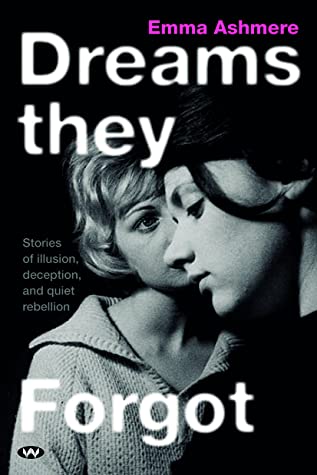
Emma Ashmere, Dreams they forgot (#BookReview)

Emma Ashmere’s short story collection, Dreams they forgot, is different again from recent short story collections I’ve read. Certainly very different from the most recent, Adam Thompson’s Born into this (my review). One of the things that makes it different is its breadth in terms of time and place. Thompson’s collection, for example, is mostly contemporary, with occasional forays into the past and a little jump into the future. It is also very definitely centred in Tasmania. Ashmere’s collection on the other hand, while having some grounding in South Australia, has stories set elsewhere in Australia as well as overseas, including London, France, Bali and even Borneo. Furthermore, a significant number of the stories are historical fiction, with some set in colonial Australia, or during the Depression, for example, or post war, or in the 1970s. This is quite unusual in my experience of short story collections.

Unusual I say, but not surprising, because Emma Ashmere’s debut book is an historical fiction novel, The floating garden (my review). It is one of those books that has stuck with me because it tells such a strong story of social injustices that occurred during the building of the Sydney Harbour Bridge.

I could, then, start my discussion with the story in this collection which concerns the Bridge during its construction (“The sketchers”), but instead I’m going to the final story, because it gave me a laugh. This story, “Fallout”, concerns the (not funny) nuclear testing at Maralinga and concludes with the narrator taking her mother to the National Film and Sound Archive (NFSA) in Canberra to show her some relevant treasures. What a great little promo for the importance of collecting institutions like the NFSA. But, that’s not what made me laugh. As some of you know, I spent most of my career at the NFSA, and this is how our narrator introduces it:

I tell her I live with my girlfriend in Canberra and work at the Film and Sound Archive with a bunch of other failed actors, part-time poets and overlooked opera singers.

I wish I could count myself as one of those, but I’m far too prosaic. However, there is probably an element of truth in what she writes. All I can say is that at least the NFSA offers gainful, and valuable, employment! This story, dealing as it does with the “fallout” from nuclear testing – great wordplay here – makes a fitting and strong end to Ashmere’s collection, which deals with all sorts of fallouts in people’s lives.

Take the first story, for example. Titled “The winter months”, it concerns a young woman who, like many young people, is uncertain about what she wants to do with her life, much to her mother’s frustration. She’s in England, and is doing a TEFL course (Teaching English as a Foreign Language) which, she believes, “is going to change everything. It will give me purpose. A goal. A life”. She meets and is attracted to a mysterious and seemingly confident young woman, Aveline, but, unbeknownst to our narrator, Aveline has her own challenges, and suddenly disappears.

“The winter months”, however, is more complex than I’ve described here. It introduces us to several types of characters and relationships which thread through the collection – uncertain young women, lepidopterists (would you believe), mothers-and-daughters, neglected wives, fledgling same-sex attractions, to name a few. The result is that, as the book progresses, some stories start to feel linked, even though in most cases the link isn’t actual. The effect though is to ground the collection because this feeling is supported by recurring concerns.

One of these is Ashmere’s concern for social justice, for overlooked people, for women in particular. “Nightfall” tells the story of a young Irishwoman who arrives in Adelaide during goldfields days:

Most of us here Behind the Wall sailed across the sea with our Billies, Jemmies or Toms. No sooner did they set their boots in the dust, they streaked off like a dog chasing a rabbit across a field, all glint and muscle and hunger and bragging about what they will become. I waited for my Billy to bring back rabbits and gold, but he didn’t come.

And so, girls like her were left behind:

It’s the same in every port for girls like us. You stand with the bones of your back pressed against the wall as sailors rope up their harpoons and aim them at your lower parts, or you go into a tavern for a drink.

She ends up working for an abortionist who is, of course, more concerned about not being caught than her health and safety … This story was shortlisted for the 2019 Commonwealth Writers Prize.

Other stories explore the impact on relationships of PTSD in times when there was no support or recognition (“Warhead” and “Seaworthiness”), and another, as already mentioned, looks at the aftermath of nuclear testing at Maralinga. Many of the more contemporary stories feature children and young adults who find themselves caught in worlds they don’t fully understand or don’t yet know how to handle. “The violin” is a carefully told story about a controlling young man and his bride-to-be.

There is a melancholic or, at least resigned, tone to many of the stories, but most are not completely depressing. While happy endings might be rare, little wins or rebellions or, in some cases, lovely acts of grace lighten the endings. As with most collections, there are stories that didn’t quite work for me, but those that did more than made up for the rest. I particularly loved “Seaworthiness” and “The violin”, but most read well.

This brings me to the title, which is not one of the stories in the collection. What does it mean? It’s certainly true that many of the characters had dreams, and it’s also true that in most cases these dreams do not come to fruition. Did they forget them? Not always, but, for better or worse, other dreams – or, at least events – replace them.

If you’d like a taste of Ashmere’s writing, you can read one of the stories, “Standing up lying down”, online at Overland. I’ll finish with a quote from it:

Apparently she’d heard Laurie’s conference paper on the omissions and silences in Australian history, how particular stories are concreted over, while others are constructed and celebrated in their place.

In Dreams they forgot, Ashmere retrieves some of these concreted over stories – those she feels able to, anyhow – and gives them a darned good airing.

Challenge logo

Emma Ashmere
Dreams they forgot
Mile End: Wakefield Press, 2020
239pp.
ISBN: 9781743057063

(Review copy courtesy Wakefield Press)

Monday musings on Australian literature: Defining the novel, in 1975?

During one of my forays into Trove, I came across an intriguing little piece by Canberra artist-educator-reviewer, Malcolm Pettigrove. Pettigrove was a regular arts reviewer in The Canberra Times through the 1970s and 1980s, but it was his article published on 31 January 1975 that particularly caught my attention.

It starts:

NO issue in the issue-filled business of literary appreciation has had as much wind and ink spent on it as The Definition of The Novel. Ironically, few issues are of less importance.

I like this, because I think definitions are fun, but ultimately unimportant. Actually, fun is not quite the right word. What I mean is that discussing definitions is a worthwhile exercise because it helps hone our ideas about form and can inform our understanding of creative works, but in the end, the important thing is the work, regardless of what category/form/type critics or reviewers slot it into.

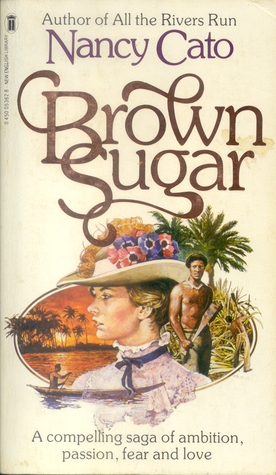
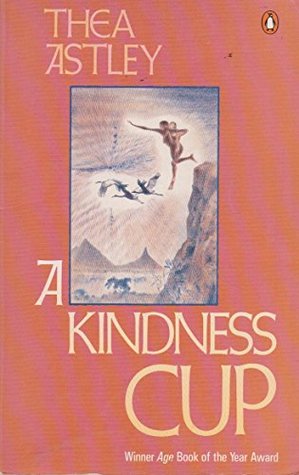
So, with that understanding, let’s look at what Malcom Pettigrove had to say – in his review of three Australian historical fiction novels, Nancy Cato’s Brown sugar; Maslyn Williams’ Florence Copley of Romney, and Thea Astley’s A kindness cup.

He starts, in fact, by saying a bit more about the novel:

Whatever theorists might make of it, the word “novel” remains in reality nothing more than a convenient label for those fictional works of narrative, descriptive, expository, dramatic, or didactic prose which no other label will fit. […] No more comprehesive [sic] definition has ever been coined, and it’s quite likely that none ever will.

Now, I’m not going to engage much more with this. Wikipedia’s writers simply describe the novel as “a relatively long work of narrative fiction, typically written in prose and published as a book”. I could check my various books, but I think I’ll find variations on this theme, so let’s move on. Pettigrove says that this says nothing about a “lack of imagination on the part of the definition-makers”. Rather, “it indicates that the novel has a life and a mind of its own and is determined not to surrender to the definition-makers until it has exhausted all the variations of form, content and style that are available to it”.

The Australian novel, he says, is no different. He writes:

Most novels, whether Australian or not, are conservative, courteous, sociable things, with established habits, moderate expectations, and only a limited inclination to experiment. The bold innovation, being rarely understood and seldom well received, is left to the adventurous minority, some of whom die in the attempt leaving the successful ones to proliferate their own image in more or less conservative, courteous and sociable offspring which are established in their habits, and given to moderating our expectations by being limited in their inclination to experiment further.

I do like this description of how innovation leads to the next “standard” – until, of course, the next innovation comes along. It happens in all the arts, doesn’t it? Of the three novels he’s reviewing, you won’t be surprised to hear that he says that Cato’s and Williams’ novels belong to the majority, while Astley’s is an “offspring of the minority”.

He then discusses the three novels. Nancy Cato has appeared in this blog a few times. Her historical fiction, Brown sugar, is a “novel” he says, and also “a foreshortened saga”, a “history of the rise and fall of the north-coast sugar empires”, and “a romantic tale”. He sees limitations in this novel, particularly in terms of depth of characterisation. The extent of her historical research is evident, he says, but “in the hands of a Martin Boyd this material would undoubtedly have given rise to characterisations of considerable depth and subtle complexity.”

Maslyn Williams’ novel, Florence Copley of Romney, he says, shares with Brown sugar, its “contrast of values”. Overall, though, this story is “pleasantly romantic” rather than offering something interesting and challenging about the Australia in which it is set.

Book cover

Then, he comes to Thea Astley’s A kindness cup (for which there are reviews by Lisa, Bill and Lou on Lisa’s Thea Astley page). Astley is described on the book’s fly-leaf, Pettigrove says, as “a prose stylist”. It’s clear he’s not a fan – or not entirely a fan – of Astley’s “prose-style”, for which he gives examples, but he writes that:

If this brief and bitter tale succeeds — and I believe it will — it will be in spite of its prose-styling, not because of it. When Miss Astley drops the prose of the stylist and begins to function simply as a writer with a tale to tell her work becomes stark, tense, and most effectively dramatic.

Astley’s writing, he says, would intrigue “the reader who enjoys examining the intricate and often unfathomable relationships between a human action, its setting and its motive”. She evokes her cane-country town setting “with potent economy” and the motives of its characters “are exposed with the precision of surgery”. Indeed, he says,

The total impact of the book is considerably greater than its brevity might suggest possible.

All three books, he concludes, discuss the nature of man in their own way – though their understanding “is wonderfully simplified when the men depicted inhabit the philosophical no man’s land that nineteenth-century rural Australia has become in the minds of so many contemporary novelists”. “Philosophical no man’s land”? A discussion for another day, perhaps?

As for defining the novel? He suggests these novels provide no answers … just, the implication is, more questions. In fact, his piece peters out in terms of its opening salvo, but I did enjoy his perspective on these three writers.

Thoughts, anyone?

Jonathan Shaw, None of us alone (#BookReview)

Some of you will know of Jonathan Shaw as the blogger at Me fail? I fly! If you read his blog, you will also know that he loves poetry: he writes it, he reviews it. None of us alone is his first commercially published collection, though he has self-published five collections and has had a number of poems published in journals like Quadrant, Going Down Swinging, and, would you believe, the European Journal of International Law. None of us alone, styled a chapbook, contains 24 poems, selected from his previous collections and published works.

I enjoy reading Jonathan’s* poetry reviews, because he takes us through the poems, sharing his thoughts as he goes. I also like the fact that though he sounds confident, he admits to not always being sure that he’s picked up the nuance or, say, understood all the “metaphorical dimensions” of a poem, so I know he’ll forgive my errors and misses here. Then again, I don’t plan to discuss particular poems in detail, the way he often does, so I may avoid big errors!

However, I will say that Jonathan plays with various forms including sonnets (which seem to be a favourite), free verse and traditional ABAB quatrains. His rhyming is confident and comfortable rather than forced, which is a great start. His allusions are accessible, and his resolutions are usually clear, with the sonnets mostly ending in a rhyming couplet, which make their point. Overall, the tone tends to be neutral or lightly melancholic, with touches of humour, even where the subject is serious. This sort of writing appeals to me.

The poems in None of us alone draw from Shaw’s life, his domestic, artistic and political interests, and so are easily relatable to Australians of a certain age and persuasions. There are gorgeous poems about dogs (“The dogs outside Orange Grove Markets”) and (“She looks out”), for example, that will speak to dog lovers. There are poems inspired by art exhibitions (“Sculpture by the sea”) or attending a play (“This is just to say”). And, most particularly, there are poems responding to the politics of the day (asylum-seekers, same-sex marriage, domestic violence, and climate change.) The first poem, in fact, is a climate change themed sonnet, “Demo”

… We
rallied, one link in a chain
of rallies all around Australia
crying out against the failure
of governments who play the role
of sycophants to Old King Coal.

I like the cheekiness of another sonnet “Unprecedented again”, which he wrote just last year. You can find it on his blog. However, while looking for it on his blog, I learnt something, which is that his favourite form is not, in fact, a sonnet, as I felt I had ascertained from this collection, but an Onegin Stanza. You’d have to be a poetry purist to know though! Anyhow, the poem plays on the idea that the “unprecedented” just keeps on coming, in one form or another, creating a fine line between the unprecedented and the precedented.

“A pronunciation lesson” – a free verse poem – is one of the poems that has been published before. It has also been read on ABC’s Poetica. I’m not surprised by its success because it lures us into a sense of calm before hitting us in the guts with a stand-alone last line. Its subject is Hiroshima, and it is followed by another free verse poem on Hiroshima, “Correspondence”, this one expressing the cynicism of one who knows how it goes. You can live too long! And indeed, there are poems here that recognise our mortality.

Before I finish, I must mention the beautiful design of this little series, with its classy front-papers, and the cover of this particular work. It features a photograph of a ceramic heart from the “Connecting Hearts Project” by potter (and Jonathan’s partner) Penny Ryan. The collection includes a poem inspired by these hearts, “2 July 2016”. The artwork and the poem address the pain experienced by asylum-seeker detainees, and the “malice” of governments refusing to open their hearts to them:

Unwrapped, this heart confronts that malice:
our beating hearts can face our fear –
Close down those camps, bring those hearts here.

And here I’ll leave it, because it’s a little book – a chapbook – and you can buy it, as I did, for $5 plus postage and handling. Check Jonathan’s post for details.

* I haven’t met Jonathan in person but have “known” him long enough in the blogosphere that I felt silly using my usual last name style, Shaw, to discuss this book of his.

Jonathan Shaw
None of us alone
Port Adelaide: Picaro Press (Ginninderra Press), 2021
28pp.
ISBN: 9781761091247

Stan Grant, On Thomas Keneally (Writers on writers) (#BookReview)

Book cover for Stan Grant, On Thomas Keneally

Stan Grant’s On Thomas Keneally is the second I’ve read in Black Inc’s Writers on writers series, Erik Jensen’s On Kate Jennings (my review) being the first. As I wrote in that post, the series involves leading authors reflecting “on an Australian writer who has inspired and influenced them”. Hmm … the way Keneally inspired and influenced Grant is not perhaps what the series editors envisaged, but certainly his essay meets some of the other goals: it is “provocative” and it absolutely starts “a fresh conversation between past and present.”

Most Australians will know immediately why Grant chose Keneally, but for everyone else, it’s this. In 1972, Thomas Keneally’s The chant of Jimmie Blacksmith was published. It is historical fiction based on the life of Jimmy Governor, an Indigenous man who was executed in 1901 for murdering a white family. Keneally is on record as saying he was wrong to have written the book from an Indigenous person’s perspective, but he did, and the book is out there (along with its film adaptation by Fred Schepisi).

That’s Keneally, but what about Stan Grant? Of Wiradjuri and Irish heritage, he is no stranger to this blog. He’s an erudite, thoughtful man, always worth listening to, but, here’s the thing. I find it difficult, with this book, to be a white Australian discussing a First Nations Australian writing about a white Australian who wrote a novel about a First Nations Australian. The politics are just so complicated. I’ll do my best, but will just focus on a few ideas. At 86 pages it is a short piece so, if you are interested, I recommend you read it yourself.

If you have ever listened to Grant, you will know that his thinking is deeply informed by history and philosophy, and so it is here. He is also palpably angry, and pulls no punches. He writes, just over half way through the essay that

This entire essay is about writing back to the white gaze. I need to write back to the white author who would steal my soul. I must prove I exist before I can exist.

Grant starts his essay by reminding us of Australia’s history and how “in a generation or two, my people were nearly extinguished.” He introduces us to Jimmy Governor, who was executed just three weeks after Federation. Jimmy becomes the lynchpin for his argument, because he, “that grotesque murderer”, is also, says Grant, “the memory of a wound. He is a scar on our history that runs like a fault line between black and white.” He is “a spectre that will not let us bury our history.”

The problem is, argues Grant, that the real Jimmy is nothing like Keneally’s Jimmie:

Keneally’s caricature of a self-loathing Jim­mie Blacksmith is a lost opportunity to explore the complex ways that Aboriginal people … were pushing against a white world that would not accept them for who they were; that would not see them as equal; that, in truth, would not see them as human.

But, of course Keneally’s novel is historical fiction, and, historical fiction, as most of us realise, says as much about the time it was written as about the time in which it is set. In Keneally’s case, The chant of Jimmie Blacksmith was written in 1972, a particular time in Australian history, Grant recognises, “a time of anti-Vietnam protests, the election of the Whitlam government and the Aboriginal Tent Embassy”. Grant continues:

Keneally was writing a protest story for a protest era; he needed Jimmie Blacksmith to be the freedom fighter that Jimmy Governor never was. Jimmy was a man who wanted respect. He bridled against injustice, yes, but this was a crime of anger, not an act of war.

Grant though wants something more. He wants exploration and understanding of how history, how Australia, has negated First Nations Australians’ very beings. He refers to Jacques Derrida’s coinage of

‘hauntology’, to describe how the traces of our past – our ghosts – throw shadows on our world.

Grant believes that “the West thinks it can vanquish history; that the past can be entombed”. I don’t personally ascribe to that. It’s not rational, to me. But I can see how the course of Western “progress” does in fact manifest that way of seeing, and it leaves people – like First Nations Australians – in its wake. This, really, is the theme of Grant’s essay.

However, at times Grant lost me. He says Christos Tsiolkas is “copping out” when he says that it is not for white Australians to write “a foundation story for the first peoples of this country”. Grant suggests Tsiolkas can, and that he could “look to the First Peoples to enter our tradition; to understand that story and his place in it before he writes a single word about what it is to be an ‘Australian'”.

I’m uncertain about how a white Australian can do this right now, but that is probably my lack of imagination. Regardless, I feel that Grant is refusing to recognise the respect behind Tsiolkas’ statement. It’s a respect many of us feel when we contemplate writing about First Nations Australians. We don’t want to presume we know what we can never understand. Grant says it himself, late in the book:

No one who has not lived through our interminable loss could capture what it is to be Indigenous in Australia.

In the last part of the essay, Grant discusses other Australian writers. Besides Tsiolkas, these include Patrick White, Joan Lindsay, Randolph Stowe, from the past, and contemporary Indigenous writers like Tara June Winch and Bruce Pascoe. His thoughts are often surprising. He clearly approves Eleanor Dark who “knew that blackness hovers over everything that is written in this country”.

The final part of essay reads like a manifesto. Grant states exactly what he will and won’t do and be. But, he also says he is glad Keneally wrote his book because it has stayed with him for forty years. In it, he felt “the weight of my history”. The results weren’t always positive, but the book has, I think he’s saying, kept him thinking.

And he says this:

Like me, Thomas Keneally made his own pilgrimage to the old Darlinghurst Gaol. Standing near where the real Jimmy Governor was hanged, he said he was sorry for “assuming an aboriginal voice”. He should have sought permission, he said. “We can enter other cultures as long as we don’t rip them off, as long as we don’t loot and plunder,” he said. I don’t think we can police our imaginations. I don’t think we need to ask permission. Australian writers have never done this and, frankly, I see them in my country more clearly because of it. It is like the debate about Australia Day; why move the date if it will only hide the truth.

I will leave you with that.

(My third post for Lisa’s 2021 ILW Week.)

Stan Grant
On Thomas Keneally: Writers on writers
Carlton: Black Inc, 2021
90pp.
ISBN: 9781760642327

Adam Thompson, Born into this (#BookReview)

When my brother gave me Tasmanian author Adam Thompson’s Born into this earlier this year, I told him I’d save it for Lisa’s ILW 2021, which I did – and which means I can now thank him properly for a yet another well-chosen gift, because this is a strong, absorbing and relevant read. If you haven’t heard of Thompson, as I hadn’t, he is, says publisher UQP, “an emerging Aboriginal (pakana) writer from Tasmania”. 

Born into this is a debut collection of sixteen short stories about the state’s Palawa/Pakana people, and based primarily in Launceston and islands in the Bass Straight. It reminds me a little of Melissa Lucashenko’s novel Too much lip (my review) because, like it, these stories are punchy, honest interrogations into the experience of being Indigenous in contemporary Australia. I say contemporary Australia, because most of the stories deal with recognisably First Nations Australia concerns. However, the collection is also particularly Tasmanian – in setting and in dealing with issues and conditions specific to that place.

They may live in two worlds, but they are still mob (“The old tin mine”)

I like to think about the order in which stories in a collection are presented, although I can never be confident of the assumptions I make about the reasoning. How can I, I suppose, as I’m not in the heads of the authors and their editors. The first story here, “The old tin mine”, is an interesting choice: it introduces various issues and ideas which are picked up through the collection and it sets a sort of resigned tone. The issues include the relationship between black and white in Australia, the introduction of city Indigenous kids to country and culture, the clumsy conscientiousness of white people who want to do the right thing, the politics involved, and the world-weariness of older Indigenous people in dealing with all of this. The story is told first person through the eyes of “Uncle Ben”, the Indigenous leader on an “Aboriginal survival camp”. He is tired, and cynical, and not particularly interested in dealing with these

Aboriginal teens. City boys. Three from Launceston, three from Hobart. “Fair split, north and south”, according to the organisation that had won the black money.

But it’s a job, and these jobs are becoming less frequent, so he takes it on.

The second story, “Honey”, is told third person, and concerns the interactions between white man Sharkey, who has a honey business, and his Palawa employee, Nathan. Sharkey is arrogant, condescending and oblivious of how his behaviour might affect Nathan. He asks Nathan for the “Aboriginal word for honey” because he thinks using it to brand his honey would “be a good gimmick for selling honey … ‘specially with the tourists”. Not all stories work out this way, but in this one, Nathan has the last laugh.

“Honey” also introduces another idea that peppers the collection, which is land rights, and non-indigenous Australians’ fear of losing land. The collection, in fact, references many of the issues confronting contemporary Australia’s relationship with its First Nations peoples: land rights; Invasion Day (or “change the date”); dispossession, the loss of Indigenous culture and attempts to reclaim it; social issues like incarceration, alcoholism and suicide among Indigenous people; and the Stolen Generations, to name some of them.

Some stories, however, respond to a particular Tasmanian issue, that regarding the definition of indigenity. As I wrote in my post on Kathy Marks’ Channelling Mannalargenna, Tasmania’s history has resulted in a specific set of circumstances regarding loss of identity, which has caused, and is still causing, complications and conflict over Indigenous identification in the state. One of the stories on this subject is “Descendant” about a bright, politicised but ostracised young schoolgirl who runs her school’s ASPA (Aboriginal Students and Parents) committee. Dorothy is assiduous about who is and is not “P-A-L-A-W-A”, and has family-tree records to prove it. Aboriginality, she says, is about “being”, not “choosing”. The story provides an excellent example of Thompson’s use of imagery to underpin his themes: Dorothy’s prized mug is accidentally broken, and Cooper, the supportive (of course!) librarian, tries to repair it, but

Bold, white cracks now intersected the Aboriginal colours like a tattered spider web.

Thompson’s writing in this collection is accessible but evocative. His dialogue varies appropriately from speaker to speaker, and the imagery, particularly that regarding colour – red, blue and white, representing white Australia, versus the red, black and orange of First Nations Australia’s flag – is pointed but not overdone. Thompson clearly knows his country. His descriptions of the islands, and the plants and birdlife endemic to them, take you there (or, at the very least, teach you about them.)

I would love to write about more of the collection’s stories, but I should leave you some surprises. I will say, though, that Thompson’s wide cast of characters – from young, disaffected palawa to smart activists, from genuine white people, who want to understand, to the smug and/or rich ones (as in the incisive “The black fellas from here“) – ensures that this collection hits home. No reader, really, can hide from the truths here because they touch us all.

White makes you wary (“Aboriginal Alcatraz”)

Born into this, then, is clearly political, but it is not all bleak. Some stories end with a bang or a twist, which skewer their points home, while others are more gentle. The title story, “Born into this“, is one of the more poignant ones. It tells of Kara, who works as a receptionist at an Aboriginal housing co-op. She’s jaded. Her boss is “a tick-a-box Aboriginal” who “could never prove his identity”, and she is tired of the struggle to survive. So, deep in the forest, where she had learnt about country from her uncle, she spends her spare time working away on her own quiet, little subversive project, a project that involves

Natural survivors, like her own family, born into a hostile world and expected to thrive. She took in the surrounding devastation and thought again about her own life.

“Born into this”.

She knows she won’t make a difference, but “fulfilling some cultural obligations in her own small, secret way” keeps her sane.

It would be great to think that books like Born into this could make a difference – and I think they could, if we all not only listened to Indigenous writers like Thompson, but also took on board, really took on board, what they tell us about ourselves.

For more reviews of this novel, please click Lisa’s ILW 2021 link in this post’s opening paragraph.

Adam Thompson
Born into this
St Lucia: UQP, 2021
210pp.
ISBN: 9780702263118

Steven Conte, The Tolstoy Estate (#BookReview)

Steven Conte burst on the scene in 2008 when he won the inaugural Prime Minister’s Literary Award with his 2007-published debut novel, The zookeeper’s war. I always intended to read it but somehow it never happened. Jump to 2020, and Conte’s second novel, The Tolstoy Estate, was published. That’s a big gap, but what he’s produced is a well-researched, carefully-crafted, thoroughly absorbing novel.

What intrigues me more than this gap, however, is that both his novels are set during World War 2, and both deal with Germany in the war. The zookeeper’s war is about how the Berlin Zoo’s owner and his Australian wife managed to keep it going through the war. I wonder what it is about war and Germany that attracts Conte? Or, is it just coincidence?

So many paths to follow

The Tolstoy Estate’s plot is not complicated. Most of the story takes place over the six week period – November-December 1941 – during which a German army medical unit established and ran a hospital in Yasnaya Polyana, Tolstoy’s estate, near Tula, south of Moscow. Arriving at the estate, the Germans, including doctor Paul Bauer, meet the site’s curator, Katerina Trubetzkaya, who is, not surprisingly, hostile. A relationship develops between Paul and Katerina, against a backdrop of deteriorating conditions both on the war-front and in the unit, as its commanding officer Metz’s behaviour becomes increasingly erratic.

Sounds straightforward enough? Yes, but as one of my reading group members said, the novel has so many paths to follow, so many ideas to think about, that it’s impossible to follow them all. I agree, so, here, I will focus on just a couple of them.

I’ll start, however, with a few comments about the style and structure. The novel is primarily told in third person through the perspective of Paul, so our understanding of what happens, our assessment of the characters and their relationships, come through his thoughts and feelings. Fortunately, he is quickly established as a humane, considered person, so we can trust him, as much as we can trust anyone.

SORT OF SPOILER (though not the ending)

Half-way through the novel we jump to 1967, and a letter from Katerina to Paul. This introduces a second chronology which covers nearly a decade from then. Most of it, until the last chapter, is conveyed though a few letters between the two, interspersed with the main wartime narrative.

Why does Conte do this? This is the question I always ask when an author plays with their narrative structure like this. My usual thought is that the author wants to de-emphasise the plot to encourage us to think about something else, but then the question is, what? I suspect that this is partly the case here, and I’ll talk about the “what” soon. Regardless of the “what”, however, the impact of revealing that Katerina and Paul have survived the war, is to slow us down. It encourages us to focus on the development of their relationship against the backdrop of this cruel war, rather than rushing to turn the pages to see what happens next.

As for the paths, the “whats”, there are many. The Tolstoy Estate is about war of course. The history part of this novel is true, in that Tolstoy’s estate was indeed occupied by the Germans for a military hospital, so there is that. And, there’s the exploration, through our two protagonists, of two unappealing regimes, Nazism and Stalinism. I could write more about the nuances of that, but I won’t. Then, there’s its evocation of how humans behave during war, of how some will and some won’t behave with humanity across the enemy divide. We see this in many war novels, so I won’t dwell on that, either, except to say that I liked Conte’s appreciation of the continuum of humanity’s behaviour from the worst to the best. One of the questions on Steven Conte’s website concerns whether we can forgive what we come to understand. I’ll leave that one with you too!

Love is an excellent motivator (Katerina)

Now, though, I want to turn to two paths that particularly interested me – love and literature. Let’s do love first. The Tolstoy Estate is a love story. Both our protagonists have lost their spouses, meaning both are currently free but have experienced love before. However, they are also, of course, technically, enemies, belonging to opposing regimes, both of which can be brutal to those who cross the line. This tests their love.

Love is not one-dimensional, as Conte knows, so he sets their love against other sorts of love, including master-race proponent Metz’s dutiful but ultimately sexless marriage because of the “physiological costs imposed by sexual congress”; the Soviet Government’s conservative, sexist attitude to romantic relationships, evidenced in its reaction to Katerina’s novel; a German officer’s homosexuality that brings about his demise; the bawdy conversations and behaviour of many soldiers. There’s also Bauer’s brief but pointed reference to the soldiers he treats:

Loves or is loved“, he thought constantly as he amputated, concerned less about the truth of the incantation than its usefulness to keeping him alert.

War and love, by definition, make strange bed-fellows. War heightens emotions of all sorts, and forces those who love to think seriously about it, as Paul and Katerina do. Paul’s bawdy but romantic colleague Molineux says that Paul and Katerina’s bond “transcends race, it transcends law”, and yet both Paul and Katerina are aware that the practicalities of love can spoil even a strong bond – which provides the perfect link to the literature path …

Writers document, great men do (Metz)

Contemplating the value and practice of literature underpins the novel, with Tolstoy’s War and peace, of course, providing the pivot. It links to the love path, because Paul and Katerina frequently consider Tolstoy’s evocation of love in the novel. In a letter to Katerina, Paul writes that War and peace reminded him

that love doesn’t always conquer but that, arguably, it’s better that way – that thwarted love is stronger, more enduring than the domesticated kind.

But, beyond love in Tolstoy, Conte’s characters also think about the value of literature. Again, here is Paul in a letter to Katerina, telling her that War and peace had restored his faith in

doing good in the world; because if, as Tolstoy argued, we are all specks in a vast world-historical drama, including those who think they’re in charge, it follows that everyone’s actions are potentially significant, that the humblest person can influence events as much as any general, emperor of tsar.

This counteracts Metz’s argument to Katerina early in the novel that

with his rifle our humblest “Landser” shapes the world in a way your Tolstoy never did.

The old “pen is mightier than the sword” discussion I suppose, but oh so engagingly told!

There are also discussions about the craft of writing – some of which reflect wryly on Conte’s interest, such as Katerina’s research focus being narratology.

But I will end with Katerina’s concern about the fading of the novel in the later 20th century:

Everything fades, I suppose, certainly everything made by human hands, and yet I can’t help feeling bereft to witness this diminution of the novel, which for all its inadequacies has trained us to see the world from others’ points of view. To borrow a Stalinist idiom, the novel is a machine, a noisy, violent thing whose product, oddly enough, is often human understanding, perhaps even a kind of love.

Love … and the novel. A good place to end my post on this compelling and intelligent novel.

Lisa (ANZLitLovers) also loved this novel.

Steven Conte
The Tolstoy Estate
Sydney: Fourth Estate, 2020
410pp.
ISBN: 9781460758823

Monday musings on Australian literature: Forgotten writers 2, Eliza Hamilton Dunlop

When I started my Monday Musings sub-series on forgotten Australian writers a couple of months ago, I had a few writers in mind, including the first one I did, Helen Simpson. However, a couple of weeks ago, The Conversation published the latest in their Hidden Women of History series, and the subject was an Irish-Australian poet, Eliza Hamilton Dunlop. I figured that, being a poet, she also qualifies for my Forgotten Writers series. I hadn’t heard of her, but she has become well-known in academic circles, because of … well I’ll let The Conversation explain.

Anna Johnston, co-editor with Elizabeth Webbey, of the recently published collection of essays Eliza Hamilton Dunlop: Writing from the colonial frontier, launches her The Conversation article with

Eliza Hamilton Dunlop’s poem The Aboriginal Mother was published in The Australian on December 13, 1838, five days before seven men were hanged for their part in the Myall Creek massacre.

Dunlop, Johnston continues, had arrived in Sydney in February and was “horrified by the violence” she read about in the papers. Her poem was inspired by the evidence given in court about an Indigenous woman and baby who survived the massacre. In it, she condemns “settlers who professed Christianity but murdered and conspired to cover up their crime”.

The poem made Dunlop “locally notorious”, but “she didn’t shrink from the criticism she received in Australia’s colonial press”. She hoped

the poem would awake the sympathies of the English nation for a people who were “rendered desperate and revengeful by continued acts of outrage”.

So, who was this outspoken, confident woman?

She was born in Ireland in 1796. Her father was a lawyer, but her mother died soon after her birth. Soon after, her father moved to India, to be a Supreme Court judge, so she was raised by her paternal grandmother. Johnston writes that she grew up in a “privileged Protestant family with an excellent library”, and “grew up reading writers from the French Revolution and social reformers such as Mary Wollstonecraft”. She started writing at a young age, and had poems published in local magazines in her teens.

These poems reflected her interest in the Irish language and in political campaigns to extend suffrage and education to Catholics. After travelling to India in 1820, she wrote poems about the impact of British colonialism. Then, in 1823 she married book binder and seller David Dunlop, in Scotland. His family history inspired poems about the bloody suppression of Protestant radicals in the 1798 Rebellion.

According to ADB, she had previously married an Irish astronomer in Ireland and had two children, one born in Coleraine, Northern Ireland, in 1816. They don’t mention what happened to this husband, but they concur with Johnston about her marrying Dunlop in 1823. Johnston says that Eliza and David had five children in Coleraine, and that they were engaged there “in political activity seeking to unseat absentee English landlords”. Clearly, Dunlop was politically engaged from an early age.

The family left Ireland in 1837, arriving in Australia, as mentioned above, in February 1838. Husband David worked first as a magistrate in Penrith, before, in 1839, becoming police magistrate and protector of Aborigines at Wollombi and Macdonald River, where he remained until 1847. ADB’s Gunson says that “as a minor poet Mrs Dunlop contributed to the literary life of the Hunter River circle” and that “her acquaintance with the European literary world gave her a place of prestige, and though neither as talented nor radical as, for example, Charles Harpur, her contribution was original”.

Songs of an exile

She may not have been, as “talented” or “radical” as others, but Sydney University Press deems her a worthy subject. Their promo for the above-mentioned book says that, after the publication of “The Aboriginal mother”,

She published more poetry in colonial newspapers during her lifetime, but for the century following her death her work was largely neglected. In recent years, however, critical interest in Dunlop has increased, in Australia and internationally and in a range of fields, including literary studies; settler, postcolonial and imperial studies; and Indigenous studies.

One of those interested is Katie Hansord, who has an essay in the book and who has written about her on the Tinteán online magazine website. Hansord’s article is titled – surprise, surprise – “a forgotten colonial woman poet”. Hansord says that in addition to being a poet she was “a playwright, a writer of short stories, and a passionate advocate of human rights with a keen interest in politics”. She writes that

Dunlop’s poetry reflects her concerns with both gender and nationalism. It should be remembered that in its original publication, ‘The Aboriginal Mother’ was the fourth poem in the series ‘Songs of an Exile’ which Dunlop published in The Australian from October 1838.

The poem is easily found on the web, and has been included in many anthologies, but it is also in Hansord’s article, linked above. The poem was, as were many of Dunlop’s poems, set to music by Isaac Nathan, and performed in concerts at the time.

However, the point I wish to end on concerns the reception of “The Aboriginal mother” because it was, of course, controversial. Leading the negative charge was, apparently, The Sydney Herald, which essentially believed that Dunlop had “given an entirely false idea of the native character”(29 November 1841), that, in effect, the Indigenous people were not capable of such deep feelings.

Hansord says more about this in her article:

Elizabeth Webby has also pointed out that the Sydney Morning Herald* ‘which had strongly opposed the execution of the men involved in Myall Creek was for many years very hostile to her [Dunlop] and her work’ (Blush 45). This hostility seems also to have reflected a growing white masculinist nationalist agenda.

Hansord briefly discusses the construction of “Australianness” during the nineteenth century, a construction that privileged white Australian-born men. For immigrant Irishwoman Dunlop – who was also actively engaged in capturing Indigenous language and translating Indigenous songs – this was clearly not good enough. (You can find an example of an Indigenous poem captured in the original language and translated by Dunlop, in The Band of Hope Journal and Australian Home Companion (5 June 1958)).

Dunlop died in Wollombi in 1880, and is buried in the local Church of England cemetery. There is clearly much more to this woman, but let this be a little introduction to another interesting, independent colonial Australian woman!

* The Sydney Herald, founded in 1831, was renamed The Sydney Morning Herald in 1842.

Malcolm Knox, Bluebird (#BookReview)

Malcolm Knox’s sixth novel, Bluebird, comes with some impressive endorsements. On the front cover is “Charlotte Wood, author of The weekend“, while the back features “Christos Tsiolkas, author of Damascus and The slap” and “Adam Gilchrist, former test cricketer and beach-goer”. Hang on, Adam Gilchrist? What the?

Some of you will know why, but I didn’t. However, I now know that as well as being a novelist, Knox is a respected journalist who has been a cricket correspondent, sport editor, and literary editor. Wikipedia reminded me that he was the literary editor who exposed “the fake Jordanian memoirist, Norma Khouri“. This won him and co-journalist, Carolyn Overington, a Walkley Award for Investigative Journalism.

The thing is, I knew Malcolm Knox’s name, but had read none of his novels or his many works of non-fiction. Consequently, I came to Bluebird cold. I have no idea whether it is typical of Knox’s writing, but, I did enjoy it.

Superficially, it looks like a satire on all those beach communities that pepper Australia’s coasts – the middle-aged men who prefer surfing to working, the country-club set, the councils which sell out to developers, small-town racism and gay-bashing, and so on. You can imagine it, I’m sure. Except that, in fact, it soon becomes clear that while a beach-town might be the setting, Bluebird’s satire is broader, reaching into wider aspects of contemporary Australian life – dysfunctional men and broken families, development, aged care, banking, local government, the list goes on. It’s more that given Australians’ love for the beach, such a town makes the perfect, relatable, setting for his tale.

However, satire can sometime be an intellectual exercise, engaging the mind more than the heart, but Knox achieves both, by creating flawed characters whom we recognise and can engage with, and by telling a story that is just that bit larger than life to make it exciting but not so much that it doesn’t feel real. At first, I was concerned that it was just a little bit too smart-alecky for me, that there were just a few too many biting lines, but I found myself drawn in because I cared about the seemingly hapless 50-year-old Gordon and (some of) his family and friends.

How did they get away with it?

The novel is told in four parts – First Part, Next Part, This Part and Last Part – with each introduced in an italicised section by “Bird’s eye”, a not quite disinterested truth-teller. The story concerns the recently unemployed, recently separated Gordon, and his attempts to keep Bluebird’s iconic house, The Lodge, intact. The Lodge, however, is more than a house; it’s a symbol of all that is both good and rotten in Bluebird, in Gordon’s family, in, I think we could say, Australia. It is a paradox. Bird’s eye, introducing First Part, says:

This house is not an answer but a question: absolute beachfront yet virtually inaccessible, sitting on premium real estate that is somehow not real estate at all, a historic abuse protected by custom.

And the question is, how did they get away with it, or, more pointedly, as Bird’s eye asks, what have they got away with, to, even more pointedly, will they keep getting away with it.

So, through Gordon, the novel explores how its characters (and, dare I say, Australians) have managed to maintain the good life. Gordon lives in his beloved Lodge, sharing the bunk room with his teenage son Ben, who has some sort of “Asperger-ish ADHD-sih, non-specific, nameless disorder-is Thing”, and his goddaughter Lou, who is, arguably, the most competent character in the novel. His soon-to-be ex-wife, Kelly, is also there, occupying the “queen room”. His many unemployed, or minimally employed, friends also hang around the Lodge – unless, that is, there is a surf. And, he has elderly parents, irascible father Ron, who is living, unwillingly, in aged care due to having terminal kidney failure, and mother Norma, “a model for pressing forward without an inward glance”. But, the centre of it all is Gordon, and he is floundering. He has no money, and is marooned by a secret concerning his brother’s death over 40 years ago. The problem is that he is likeable, “a good man” in fact, and people want to help him, even at risk to themselves.

And, of course, there are the bullies – including his soon-to-be ex-step-mother-in-law Leonie who pulls the family financial strings for her own purposes, Council heavy Frontal, and “big man” about town, Tony Eastaugh. None of these want to help Gordon save The Lodge, and thus Bluebird itself.

It’s a complicated story of financial skulduggery set against personal insecurities, jealousies, and just plain ineffectuality, but the novel holds together largely because of its language and humour, Knox’s ability to skewer Australian culture, and his insight into human nature. I loved for example his comment on Gordon and Kelly’s marriage:

Habit, over-familiarity, neglect and inaction killed more lives than cancer.

Change is what I’m ready for (Gordon)

Marriage, however, is not his main target. Rather, it’s Australian men and the way they are letting the side down. Bluebird’s men tend to be ambitious power-hungry bullies or ineffectual past-focused also-rans. There are few in the middle. Overall, it’s the women who are decisive, which is not to say that they are all “better” people. Knox’s attitude to most of his characters seems to be one of frustrated affection. These people, he seems to be saying, are hanging onto the past, but

The past was worn out, not as solid as it was made out to be. Past its best.

The ending, when it comes, is cataclysmic, but not hopeless. Knox wants us to believe that people – that Australia, which seems also to be wallowing in its past – can change. It’s not that the past is all bad, but it shouldn’t drive us.

Introducing the Last Part, Bird’s eye says

This is not the outsider’s story. This is the story of those who are in the middle yet on the margin, the hole in the doughnut, so close to the centre that they have fallen into the void.

The question is, can we get ourselves out? Bluebird is a warm and funny but also biting read. Recommended.

This review is featured by Twinkl in their blog about the latest must-read books. See more recommendations and get involved at Book Lovers’ Top Picks For Your 2021 TBR List.

Malcolm Knox
Bluebird
Crows Nest: Allen & Unwin, 2020
487pp.
ISBN: 9781760877422

(Review copy courtesy Allen & Unwin)

Monday musings on Australian literature: Memorable Australian fictional families

A bit of a fun post this week that I hope will engage you, regardless of where you live or what you read. This post is a sort of companion to one I wrote back in 2017 on Memorable Australian characters. I’ve had this post in mind ever since then, but have kept putting it off because – well – how many truly memorable fictional families are there in Australian literature? I have a few which I’ll share below, but first I thought to whet your appetite with some non-Australian ones like, of course, Jane Austen’s Bennets and Louisa May Alcott’s March family.

What makes a memorable family? Is it the relationship between the members? Is it the liveliness or some other strong characteristic of certain members? Is it the family’s ability to rise above misfortune or tragedy? Is it the chemistry of the family as a whole? Or is it all in the writing?

So, here is my list, presented alphabetically by the family’s name …

The Darcys: When I thought about this topic, Ruth Park’s Darcy family was uppermost in my mind. It comprises parents, daughters, a son-in-law and more as the books progress. I first read The harp in the south (1948) and its sequel Poor man’s orange (1949) in my mid-teens and I loved them because of the warmth of the family – they were real, they disagreed with each other, they struggled to make ends meet, but they fundamentally loved and supported each other. I also loved that nearly four decades later, in 1985, Ruth Park wrote a prequel, Missus (my review), in which she tells how the parents, Mumma and Hughie, met and got together. The thing about these books is that not only do they contain the story of an engaging family, but they tell an important story about early to mid-twentieth century Australia.

The Lambs and the Pickles: Winton’s two families, like the Darcys, have become classics of Australian literature – as is the house in which they live together, the titular Cloudstreet (1991). Park’s novels are very much about the Aussie battler, and so, in a way, is Cloudstreet, except that it’s a book of a different time and a different literary sensibility. Winton uses his families to confront us with our assumptions about who we are. Wikipedia quotes Australian picture-book author, Mem Fox, as saying “If you have not read Cloudstreet, your life is diminished . . . if you have not met these characters, this generous community, these tragedies, the humour. It is so wonderful.” Can’t say much better than that. For some, Cloudstreet is our GAN.

The Langtons: This family does not, I suspect, jump immediately into people’s minds, but Martin Boyd’s Langton Tetralogy, which started with The cardboard crown in 1952, and finished a decade later with When blackbirds sing (Lisa’s review), offers a fascinating insight into a very different sort of family to the Darcys, Lambs, and Pickles. The Langtons are well-to-do and are based on Boyd’s own, somewhat eccentric, intellectual and artistic family. They, the Langtons, think little of whizzing over to England when life is unsatisfying in Australia. I have read the second novel, A difficult young man (my review), and would happily read more. Wikipedia quotes academic Gillian Dooley on why these books may not as well-read today:

“Boyd’s subject matter is no doubt the principal reason for his neglect. By any standards, his prose is strong and luminous and his novels are beautifully crafted and immensely readable. But the late twentieth century had little patience with the scandals and vicissitudes of Anglo-Australian aristocratic families, with no apparent connections with convicts, sealers or whalers, or the indigenous people. Boyd was admittedly something of a good old-fashioned snob.”

Like Lisa, and I believe Dooley, I think Boyd’s novels are worth reading for their writing, their wit – and for their insights into a different place, time and people. I don’t agree with what seems to be a fairly common notion that the well-to-do are neither valid nor interesting to read about – particularly if the writing is of high calibre.

Ethel Turner, Seven Little Australians

The Woolcots: If you don’t know who the Woolcots are, you are probably not Australian! They are Ethel Turner’s family in her Seven little Australians series. These are children’s books so the family focus here is on the seven children, their relationships with each other, and what they get up to. Apparently, according to Wikipedia, Seven little Australians, the first in the series which was published in 1894, was an instant hit in Australia and overseas. Here is some praise from Rockhampton’s Morning Bulletin (7 November 1894) which suggests why it was popular:

Because there is no preaching, or homilies on the evils of wrong-doing, children will read the book more readily, and they will be dullards who will escape the moral tone of it. Our authoress gives us nice descriptions of Australian scenery, all the more attractive that they are truthful and not over-coloured. Old hands, we dare-say, will pick holes in the book, but on the whole it is truthfully realistic. 

So that’s my (very) little eclectic list. I know there are others but my aim is not to be comprehensive but to start a discussion about some of the “classic” families in literature and why we like them.

Now, over to you. Who are your most memorable families, Australian or otherwise, and why?

Irma Gold in conversation with Sarah St Vincent Welch

Like many bookshops, Muse Canberra offers a wonderful program of book events. Unfortunately, I get to very few, but I did get to this weekend’s conversation between local poet (among other things) Sarah St Vincent Welch and Irma Gold about Gold’s debut novel The breaking (my review).

Irma Gold, reading from her novel The breaking, with Sarah St Vincent Welch, Muse, 23/5/2021

The participants

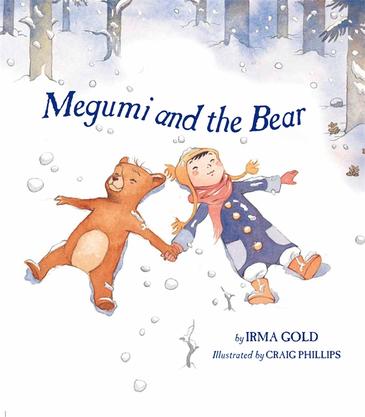
Irma Gold has appeared a few times on this blog, including for her collection of short stories, Two steps forward (my review), her children’s picture book, Megumi and the bear (my review), the Canberra centenary anthology she edited, The invisible thread (my review), and now, of course, The breaking. Irma is also a professional editor, and co-produces the podcast Secrets from the Green Room.

Sarah St Vincent Welch has also appeared in this blog, though more subtly. Besides having a piece included in The invisible thread, Sarah, a lovely past work colleague of mine, was the person behind my taking part in a public reading of Behrooz Boochani’s No friend but the mountains in March 2019. Sarah is a published poet and organises various arts events in Canberra, including a weekly poetry event, That Poetry Thing That Is On At Smiths Every Monday.

The conversation

Irma and Sarah know each other well – not just because they are both actively involved in Canberra’s literary scene but because they had been in the same short fiction writing group. This, I’m sure, helped make the conversation seem so effortless, but only partly, because Sarah’s natural warmth and Irma’s relaxed, thoughtful engagement with the questions made the conversation a delight. It covered a lot of ground, so I am going to use headings for the main questions Sarah asked. It started with a brief reading from the book.

Character or issue-led?

Book cover

Nothing like getting straight into the nitty-gritty, and that’s what Sarah did with her opening question. Character-led, said Irma, not the elephant cruelty issue. Indeed, she said, she didn’t know at the start that the book was going to be about elephants. It started with the two characters, Deven and Hannah, who arrived fully formed on the page. But, here’s the thing – it also started as a short story, which, with interest from her writers’ group, became two linked short stories. At this point, John Clanchy (whose writing I love) suggested that she was writing a novel. Irma said she’s glad it was the characters who drove the book, because if it had been the elephants, it would have been more polemical. (That was one of my potential questions gone!)

Can a novel effect change?

Another great to-the-point question. Irma, who admitted she loves fiction best anyhow, said she believes fiction can investigate complex issues in a way that non-fiction can’t. Readers can be put in the shoes of characters to “see” the issues. Through characters, fiction can explore complex issues, like the elephant situation, without offering answers.

Irma hopes that what her book (and fiction like it) can do is lead people to make different decisions, which, in this case, means not buying into the elephant tourism – not riding elephants, not attending elephant shows, etc. She feels that her novel is timely, because the current hiatus in travel gives us the opportunity to consider our travel decisions, and how we engage with another culture. This includes the practice of westerners volunteering (as she herself did). Are we helping or interfering? She mentioned the Instagram selfie culture, in which tourists take selfies with elephants, not seeing what’s going on behind them to keep that elephant in check.

Irma talked a little about the cruelty practised on elephants, but I won’t repeat that here. It is in the book, and is not pleasant reading, but is necessary knowledge, particularly for tourists to Asia. She also talked about how her love of elephants started in childhood.

Surpises as a debut novelist?

The best surprise has been the positive feedback, she said, as she’d steeled herself for criticism. She was particularly thrilled with an email from a long term Thai resident who thanked her for getting Thailand right, for avoiding cliches.

This led to a discussion about the work involved in writing the novel, because while she’d been to Thailand and worked in elephant rescue, she hasn’t lived there. She worked hard to get Thai life and culture right. She talked about working in the elephant sanctuaries where the two main groups of volunteers were young people in their 20s who have no strong sense of where their lives are going, and those in their 50s and 6Os.

On writing short stories versus novels

As a lover of both forms, I appreciated Irma’s practical responses. First, she said, you can hold all of a short story in head at one time. This is harder with a novel, so you need concentrated time, which she organised for herself. Then, she said, pacing is different in a novel, and, of course, a novel involves longer-term character development.

Place of her novel in the literary landscape

Another question up my alley! Irma said more novels are engaging with this sort of thing. She commented that one reader had asked her if her book was like We are all completely beside ourselves. She was surprised because it’s a very different book, but it was in fact an inspiration for her novel.

More books, she added, are engaging with animal rights. There’s a growing awareness she said, but she hopes, too, that the book is an enjoyable read.

Joy

Sarah ended by saying that as well as being about elephants, the novel is about madcap behaviour and the joy of love and life. Irma agreed, saying that everyone wants to talk about elephants, but she wanted to write about joy. She loved writing Deven she said.

Q & A

There was quite an engaged Q&A, but I will keep it brief:

  • On the aspect of the book most difficult to confront in herself: Irma likes to write from what she knows to doesn’t know, believing there is no black and white, but the most difficult thing was watching the “breaking”/phajaan videos.
  • On writing about “delicate” things: Irma understood the questioner’s not wanting to give plot points away, so let’s just say that she talked about how fiction, by definition, will involve writing about things that are not your lived experience, and that you have to consult.
  • On whether there is more Hannah or Deven in her: Irma is drawn to confident, intense people like Deven, so she has probably come out of that. However, she feels these characters came from nowhere, or, from the girls she saw at the sanctuary
  • On what we can do given the complexity of the problem: Irma said that the elephant industry only exists because of tourists, so the main answer is awareness! She hopes that not only will readers of her book become aware, but will talk to others. Tourists, though, need to make choices consciously and carefully because places will pretend to be what they are not. The Save Elephant Foundation is a good place to start.
  • On the editing process: There was quite a bit of talk about this. Irma, as an editor herself enjoyed the process – for the help it gave her book, and what it taught her about her own work as an editor. (I loved her comment about authors having “go to” words – bloggers do too – and the need to get those out!) Irma concluded by acknowledging John Clanchy for the immense help he gave her.

Irma Gold in conversation with Sarah St Vincent Welch
Muse (Food Wine Books)
Sunday 23 May 2021, 3-4pm