Jane Sinclair, Shy love smiles and acid drops (#BookReview)

Jane Sinclair’s hybrid biography-memoir, Shy love smiles and acid drops: Letters from a difficult marriage, is an unusual book. Covering around two years in her parents’ life, this book comprises, mostly, letters sent between her parents between April 1960 and July 1962 when Sinclair and her mother were in England while her father remained in Australia. Between the letters (and some entries from her mother’s journal), Sinclair adds explanatory information, which ensures the narrative flow.

Sinclair was 5 to 7 years old when these letters were written. Being so young, her memory of that time is scattered, but she has clearly thought much about her parents in her adult life. Also, she remembers family stories of those times told to her later, and she did discuss her parents’ relationship with them, though, as is the way with such things, not as much as she wishes she had. The book was inspired by her finding the letters that underpin this book.

What makes this book particularly interesting is who her parents are, the artist Jean Langley and music critic John Sinclair. You may or may not have heard of them, but these two were part of mid-twentieth century Melbourne’s arts and music scene. In particular, they had close connections with the Heide artistic community, which inspired Emily Bitto’s award-winning novel, The strays (my review), and which was created by two art-lovers and philanthropists, John and Sunday Reed. This community was famous for two things, the art produced there and the complicated personal relationships amongst its members.

Some of Australia’s best-regarded modernist artists were associated with Heide, people like Albert Tucker, Sidney Nolan, and Joy Hester, all of whom appear in this book. Artist Arthur Boyd was also close to these people, though not part of the community. However, Heide was just as well-known, as Wikipedia puts it, for “the intertwined personal and professional lives of the people involved”. Sunday Reed herself had affairs with several in the community, with her husband’s knowledge. This art history is what primarily attracted me to the book, but it was the background rather than the focus that I’d hoped. Instead, Shy love smiles and acid drops is exactly what it says it is, the story of “a difficult marriage”. As we are told on the back cover

when Jane Sinclair was five her mother Jean Langley followed her lover, Arthur Boyd, to London and took Jane with her. This book covers the two years they live there before returning to Australia in 1962, by which time her mother is three months pregnant to an Englishman.

“Your letter makes me cross” (Jeannie)

The letters are difficult reading because of the emotional pain and distress they contain. There are some fascinating insights into London and England at a time when many Australians saw it as a mecca for arts and culture. Indeed, while Jean Langley was there, living near the Boyds, so were their friends, Barry Humphries and his wife.

In her introduction, Sinclair speaks of how the letters caused her to “seriously question” her mother’s “version of herself as the aggrieved, wronged wife that she had cultivated and genuinely believe to be true”. Sinclair was also sorry that she had never allowed her father, who died twenty-five years before her mother, to tell his side of the story. This is understandable given when he died, she had probably not reached that age of (hopefully) wise reflection many of us do later in our lives, that age when we start to really see our parents as human beings, rather than seeing them through the prism of their relationship with us. I think this is so, in even the best of parent-child relationships?

Anyhow, Sinclair tells us that her parents’ relationship was “intense and difficult” from the start. They separated many times, but “there remained an irresistible attraction that kept them returning to each other”. Eleven years of age separated her mother and father, but it seems that personality difference (“not compatible emotionally”) was the essential problem. John Sinclair apparently tended to melancholy and depression, while Jean Langley was a romantic. “She could create sparkle and shine” and “wanted the world to be a beautiful place of happy endings”. All this comes through the letters. John expresses his sadness, his missing his wife and daughter, while Jeannie expresses her frustration with him, and her increasing disappointment with life and human beings, as things become more and more complicated. The England she adored at the beginning of her trip is not so great when it becomes cold and grey, and as the reality of never having enough money sets in.

“a riddle, muddle, fiddle, diddle” (Jeannie)

But what comes through even more is miscommunication, and particularly what seems to be Jeannie’s wilful misreading of John’s letters. When he invites her to return home on her terms – meaning she can live separately from him if she wishes – Jeannie seems to misread that wilfully, insisting again and again that she can’t be his wife, she won’t sleep with him, and so on. Readers wonder where she reads this, because we don’t.

At times, I put my feminist hat on and wondered whether there was something about John that we don’t know. Should I be supporting my down-trodden sister, I started to wonder? But, while there are, naturally, gender issues to do with women’s place in the mid-twentieth century, I don’t read a woman wronged by her husband here. I read a woman who, due to her own personality, and upbringing perhaps, regularly let emotion cloud her ability to reason – to her own detriment as well as those around her. She falls in and out of love twice during this English sojourn – besides the apparently abiding love for Arthur Boyd – and admits in June 1962 that, “I seem to have made a mess of my emotions”.

As the narrative progresses, daughter Jean notes that her mother, who liked to see herself as truthful, strayed often from it:

My mother believed in her emotional truth, and unfortunately for my father, it was sometimes very far from reality.

Reading this, I think I would say more than “sometimes”. I have known people like Jeannie, people who have such a zest for life but who wear their emotions so close to the surface that they can’t reason through what is really happening. They can be both joyful and draining to be around, and this is how Jeannie comes across.

This is not my usual review, because, in a sense, it’s hard to review such a personal book. Indeed it’s so personal that it’s worth thinking about its target. There’s some interesting social history here – life in the 60s, the experience of Aussie artistic expats in London, the challenges of communication in those pre-electronic communications days. There’s also a little about the the art world, the odd reference to a Boyd or Nolan exhibition, to the Blackmans, and to Brett Whiteley whom Jeannie calls “a shocking little upstart”. But, overall, this is a nicely presented but intense story of a “difficult marriage”, and it will appeal mostly to those interested in human relationships.

Read for #ReadIndies month (kaggsysbookishramblings and Lizzy’s Literary Life). Hybrid is a Melbourne-based independent publisher, with a special but not exclusive interest in Judaica. I have reviewed many of their books over the years.

Jane Sinclair
Shy love smiles and acid drops: Letters from a difficult marriage
Melbourne: Hybrid Publishers, 2021
279pp.
Cover art: from oil painting by Jane Sinclair
ISBN: 9781925736588

(Review copy courtesy Hybrid Publishers)

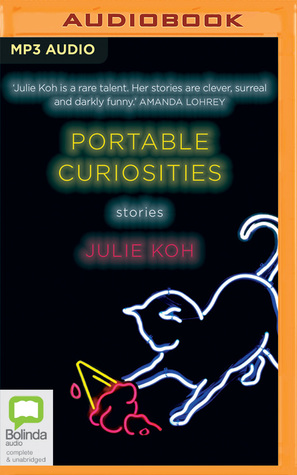
Julie Koh, Portable curiosities: Stories (#BookReview)

I’ve decided to try reading more audiobooks this year, despite not being a big fan of this mode of consuming books. I’m a textual person. I like to see the print on the page, how it is set out. I like to see the words. I like to see how the names are spelt. Given my reservations and the fact that I expect to “read” in short stints, I thought short stories might be the way to go. I think they are, though my overall reservations still stand.

My first book was one that was well-reviewed when it appeared in 2016, Julie Koh’s Portable curiosities. It won the SMH Best Young Novelists Awards in 2017, and was shortlisted for several other awards, including the Steele Rudd Award for Short Story Collections (Queensland Literary Awards) and the Glenda Adams Award for New Writing (NSW Premier’s Literary Awards). I checked to see who won the Steele Rudd Award that year, because Koh’s collection is great. It was clearly a strong year. There were co-winners, Elizabeth Harrower’s wonderful A few days in the country, and other stories (my review) and Fiona McFarlane’s High places, which I’ve also been wanting to read.

So, Portable curiosities. I had no idea what this collection was about, and was delighted to find a lively, engaged and engaging interrogation of contemporary Australia, particularly as it intersects with Chinese-Australian experienceIt is highly satirical, penetrating the myths and assumptions that underpin our shaky existence.

The order of stories in a collection is always worth thinking about, and it is notable that this twelve-story collection opens with a story called “Sight” which satirises immigrant Chinese mothers who are so ambitious for their children to fit in and achieve success that they discourage any sort of individuality or creativity. Many of the stories have a surreal or absurdist element. They start realistically but suddenly we find ourselves in another realm or dimension. “Sight”, starting off the collection, is an example. Here, we suddenly find our young narrator having a “third eye” painted on her navel. This eye represents her imaginative self, so her mother organises for it to be removed in an operation.

From here, having satirised Chinese immigrant culture, Koh moves on to critique, with biting clarity, aspects of Australian culture, from misogyny (in “Fantastic breasts” where our male narrator looks for “the perfect set of breasts to have and to hold” at a conference on “The difficulties of an objective existence in a patriarchal world”) to crushing, soulless workplaces that pay lipservice to their employees’ mental health (in “Civility Place”). “Satirist rising” mourns the end of the civilised world, with a bizarre travelling exhibition that aims to ensure the continuation of the “landscapes of our mind”, while the cleverly titled “Cream reaper” (you have to read it to see what I mean) tackles foodie culture, turning foodie-ism into an extreme sport. Along the way, it also skewers multiple aspects of our capitalist culture, like the housing bubble, the commercialism of art, institutional banking, and the plight of the tortured writer.

As a retired film archivist, I loved “The three-dimensional yellow man” which takes to task the stereotyping of Asians on film. There’s “no need for a back story”, our one-dimensional (yellow man) Asian actor is told, “you’re evil”. He belongs, after all, to the “cruel, meek blank-faced race”. Again, the satirical targets are broad-ranging from film festival panels to Pauline Hanson – and embarrassingly close to the bone.

Many of the stories, like “Two” and “Slow death of Cat Cafe”, explore success, materialism and power, while the 2030-set “The Sister Company” exposes a cynically commercial “mental health industry” through the application of androids to the problem. All these stories, despite, or because of, their laugh-out-loud moments and forays into absurdity, hit their mark. A couple, such as “Two” and “Cream reaper”, felt a bit long, even though I thoroughly enjoyed their imagination, but this might have been a product of listening rather than reading, so I’m reserving judgement on this.

My favourite, however, was probably the last, “The fat girl in history”, which opens on a reference to the popular (in Australia) CSIRO Total Well-being Diet. The narrator is Julie, and, although this story also moves into surreal realms, there is a strong sense of autofiction here. Remember, though, that autofiction is still fiction so … Our narrator is a fiction-writer experiencing a crisis of confidence. She has written about a depressed girl, androids and the future – all of which appear in this collection. She’s been told that she writes like Peter Carey, though she admits she’s never read him. She reads an article telling her that contemporary literature is “in the throes of autofiction”, that the “days of pastiche are over”, and then informs us that she’s going to write autofiction titled “The fat girl in history.” Australians will know that Peter Carey has written a short story, “The fat man in history”, and that his debut collection named for this story started his stellar career. I will leave you to think about the portents and threads of meaning Koh is playing with here, but her outright cheekiness in daring us to go with her made me laugh – particularly when I saw where she went.

Portable curiosities deals with serious, on-song subjects, and I so enjoyed seeing her address them through satire, absurdity and surrealism with a healthy dose of black humour. At times the lateral thinking in these stories, not to mention Koh’s interest in satire, reminded me of Carmel Bird. A most enjoyable collection, that was expressively read by Lauren Hamilton Neill.

Julie Koh
Portable curiosities: Stories
(Read by Lauren Hamilton Neill)
Bolinda Audio, 2018 (Orig. pub. 2016)
5hrs 48mins (Unabridged)
ISBN: 9781489440808

Monday musings on Australian literature: The Guardian Australia’s Unmissables (2)

Two years ago, I wrote a post on The Guardian Australia’s Unmissables series, which was initiated in 2019 and aimed to highlight 12 new releases they deem “significant”. The series was supported by the Copyright Agency Cultural Fund.

Randolph Stow, The merry-go-round in the sea

I wondered at the end of my previous post whether the project would continue after the initial twelve. It seems that it did, at least until August 2020. By that time, they’d added 15 more works, but there were some changes. The initial project was about “highlighting significant new release Australian books”, but, pleasingly to me, later selections include older books like Randolph Stow’s The merry-go-round in the sea, published in 1965. This is because, from the 15th selection on, they changed tack to offer books “you’ve finally got time for”. That is, Unmissables went from “new releases” to books recommended by writers “for your lockdown”. 

With this, they also changed how the books were presented. In the original series, there were two articles per book, one on the book and one offering some additional resource – an extract from the book, or an interview with or essay by the author. From the 15th selection, there’s just one article, written by the recommender.

I’m chuffed that I’ve read several of this more broadly focused selection. And now, before I list the books, I’ll share Christos Tsiolkas’ comments on making a selection:

Should I choose a novel that I think under-appreciated and undervalued? Should I use positive discrimination in my choice? Should I choose the contemporary and au courant? Or should I be deliberately anti-fashion?

My being disconcerted speaks to the obsession with the “curated self” that we all now have in the digital age: every choice must be scrutinised for its moral and political purport. But in the end, I decided to trust my instincts. I had returned home from overseas in mid-March of this year and, knowing I was to enter a fortnight’s quarantine and then a subsequent period of quietude, I picked a handful of books off the shelves that I just had to read again. The only Australian book I chose in that initial cluster was Randolph Stow’s The Merry-Go-Round in the Sea.

Now, the books …

(Listed alphabetically by author)

Book cover
  • Julia Baird’s Phosphorescence (nonfiction) (1/4/2020) (my review) plus essay by Bridie Jabour applying Baird’s book to living through coronavirus. Little did she know in April 2020, how far we had to go!
  • Peter Carey’s True history of the Kelly Gang (novel) (3/8/2020) (read before blogging) recommended by Caro Llewellyn. Clearly a Carey fan, she says she read it knowing she “was in the presence of a writer walking along a knife’s edge of daring and audacity, my stomach churning at Australia’s cruel past”.
  • Kenneth Cook’s Wake in fright (novel)(24/7/2020) recommended by Briohny Doyle who says the story is easy to explain but its “nightmarish tension not so much”. However, she gives it a red hot go!
  • Chris Flynn’s Mammoth (novel) (24/4/2020) (my review) plus essay by Paul Daley who explains how this book about which he was doubtful got him hooked good and proper.
  • Kate Grenville’s The secret river (novel) (20/7/2020) (read before blogging) recommended by Stephanie Wood who says that “we hold our breath as we read, hoping for the happy, harmonious ending we know cannot come”.
  • Clive James’ Sentenced to life (poetry collection) (28/5/2020) recommended by Vicki Laveau Harvie who calls this slim volume “the poetic equivalent of the tiny, concentrated energy rations marathon runners take to keep going, when the end is not yet in sight”.
  • George Johnston’s A cartload of clay (novel) (6/7/2020) recommended by Paul Daley whose comments are included in my recent Unfinished books post.
  • Elizabeth Jolley’s My father’s moon (novel) (10/7/2020) (my review) recommended by Carrie Tiffany, who opens her piece with “it is proof of a fine novel when its characters enter your spirit as you are reading and take up residence there”.
  • Melissa Lucashenko’s Too much lip (novel) (17/7/2020) (my review) recommended by Alice Pung, who supports this book with a passionate argument that ‘for those of us whose family survived genocide, slavery and stolen children (as mine did), this book is a triumph, brimming with love and wit”.
  • Frederic Manning’s The middle part of fortune (19/6/2020) (Lisa’s review) recommended by Jeff Sparrow who asks “Why hasn’t Anzackery’s ever-rising tide washed Frederic Manning and The Middle Parts of Fortune further up the Australian literary shore?”
  • Alice Pung’s Her father’s daughter (memoir) (27/7/2020) (my review) recommended by Melanie Cheng who discusses her choice, saying “escapism seemed facile”. She needed “a book that could speak to the existential emergency humanity was facing, but also offer a blueprint for how to get through it”.
  • Nevil Shute’s On the beach (novel) (21/5/2020) recommended by Chris Flynn who calls it “a dynamite isolation read”. A teen favourite of mine, it has dated I think, but is still a good apocalypse read.
  • Randolph Stow’s The merry-go-round in the sea (novel) (11/6/2020) (my review) recommended by Christos Tsiolkas. He appreciates that COVID-19 has provided “the opportunity for stillness”, and suggests Stow’s novel is perfect because “it unfolds at a composed, quiet pace”.
  • Alexis Wright’s Carpentaria (novel) (4/6/2020) (my post) recommended by Tara June Winch, who provides excellent insight into how to approach this wild novel. She says “it will change you, as long as you have the guts to read all the way through”.
  • Alexis Wright’s Tracker (collective biography)(13/7/2020) recommended by Tegan Bennett Daylight who summarises this Stella-winner as “a chorus of voices about one of the country’s most prominent Indigenous activists is a glorious kaleidoscope of testimony”
Alexis Wright, Tracker

I wish The Guardian provided more about this project. How did the funding get extended and why did it stop? Regardless, there’s good reading here, both the books and the articles about them.

Finally …

This is a simple post, but interesting I hope. I am currently in Melbourne where our second grandchild, a little girl this time, has just been born. She is Neve Jessie, named for my lovely Mum. I’m just so thrilled, and not entirely focused on blogging.

What would you have recommended, if asked?

Amy Witting, Isobel on the way to the corner shop (#BookReview)

My first reading group book of the year, Amy Witting’s Isobel on the way to the corner shop, nicely doubles as a (late) contribution to Bill’s AWW Gen 4 week. Winner of the 1993 Patrick White Award, Amy Witting is one of those much-admired Australian writers who had not then and still has not received the full recognition she deserves. In her lifetime (1918-2001), she was admired by Patrick White, himself, and Thea Astley. Australian poet Kenneth Slessor is recorded as having said “tell that women I’ll publish any word she writes”.

Another admirer, Australia critic Peter Craven, argued that her form of realism wasn’t really accepted by the reading public until Helen Garner appeared on the scene, but for him “Witting was a great master of realism, a naturalist who could render a nuance in a line that might take a lesser writer a page”. Take for example this two sentence paragraph from our socially unconfident protagonist early in the novel:

The prison of other people’s eyes. No prison narrower.

So now, the book. Isobel on the way to the corner shop (1999) picks up the story of Isobel Callaghan that Witting had started in I for Isobel ten years earlier. You don’t need to have read the earlier book to enjoy and appreciate this one, because enough of Isobel’s past is given for us to have a sense of why she is the person we meet here.

“I have to step out into space”

The person we meet is a 21-year-old woman who, having received some encouragement from an editor, is struggling to establish herself as a writer. She’s poor, starving and isolated, having left her job after screaming at a colleague in “a rage”. She fears she’s going mad. I was engaged from the start by her strong sense of self, her vulnerability, and her determination to be independent, and I enjoyed every moment I spent with her. I felt anxious, as anxious as she did when she felt she was going mad, and just as relieved as she was when her illness was given a name – tuberculosis.

The first third of the novel introduces Isobel and takes us to the moment of her admission into Mornington Sanatorium in the Blue Mountains. In this section, some of the novel’s themes become apparent – one being the artist’s struggle to survive. Another concerns love. The novel starts with Isobel stalled over writing a love scene, because she doesn’t “know the first thing about it”. Not about parental, family love; not about romantic love. This, and her sense of herself as awkward and unlovable, cause her to make a big – and hurtful – mistake when a young man makes a gesture of real affection towards her.

Over the rest of this section of the novel, Isobel meets some people who show genuine kindness – love – towards her. Although the hospital makes her feel like a “parcel”, the section closes with a comforting touch from hospital volunteer Mrs Delaney, “the first time anyone had touched her in kindness”. Through the remainder of the novel, Isobel observes and experiences all sorts of expressions of love (and its opposite), including through a delightful little poetry discussion group at the sanatorium, which starts when Doctor Wang asks Isobel to explain Gerard Manley Hopkins to him.

In the final two-thirds of the novel, another theme that was nascent at the beginning, comes to the fore, and it’s to do with “being oneself”. Isobel’s sense of self is challenged at the sanatorium. It’s an inspired setting because it encompasses a microcosm of society: patients of a disease that doesn’t discriminate between rich and poor, their visitors, and the doctors, nurses and other staff with whom the patients come in contact. Finding your place in such a world, where you can be stuck for months, is not easy.

Isobel is particularly tested by her room-mate Val, a peevish, inflexible, and, she thinks, illiterate woman. Val is unhappy, and like many unhappy people, is self-absorbed. She “felt for no-one”. Try as she might, Isobel cannot get their relationship onto a comfortable footing:

Is it possible to cause so much misery to another human being, simply by being oneself? she wondered, feeling a reflection of that misery. No help for it; she must continue to be herself.

Maintaining your self is difficult, though, when you are “different”, as our funny, resourceful, and compassionate Isobel clearly is. At one point, when her recovery is threatened, she realises that she must be tougher, and so creates a new mantra for herself, “bastards get better”.

There is, surely, a hint of autobiography here, for Amy Witting’s name is a pseudonym, chosen to remind herself to “never give up on consciousness’, not be unwitting, but to always remain ‘witting'”.

Gradually Isobel does get better, physically and emotionally. She discovers, for example, that people from her old workplace cared deeply about her:

I have to live as if…I have to assume that I have some importance to other people. I have to live accordingly. I have to step out into space.

With this comes debts and responsibilities, something new for her to accommodate.

Peter Craven described Witting’s work as “a form of realism”, and “realism” sounds valid to me. The novel contains minimal drama of the narrative-arc kind. Instead, there’s astute, warm and sometimes wry, observation of ordinary people living their lives. Witting looks into the hearts and minds of human beings to understand who we are, and how we get on together with all our differences. She also offers some subtle social commentary about gender, race, poverty, class. These are not the main game, but they inform the realism inherent in the setting.

Ultimately, Isobel on the way to the corner shop is about how a young artist learns to maintain her integrity, her authenticity, while also behaving responsibly and compassionately. It is, in a way, about growing up, but it encompasses far more too.

Amy Witting
Isobel on the way to the corner shop
Melbourne: Text Classics, 2015 (orig. pub. 1999)
311 pp.
ISBN: 9781922182715

Epiphany in Harrower’s “The fun of the fair”

With Bill’s AWW Gen 4 Week still in play, I hoped I’d find something relevant to share from Reading like an Australian writer. And there was, a discussion by novelist Emily Maguire of a short story by Elizabeth Harrower. The short story, as you can probably guess, is titled “The fun of the fair” and it opens Harrower’s collection, A few days in the country, and other stories (my review).

Epiphany

I love short stories, so love that Maguire chose to explore one in Castles’ anthology. Moreover, I was thrilled to see that her angle was the “epiphany”. I have loved that word since I first came across it. It has such a great sound and look.

In her essay, Maguire briefly discusses its meaning. She starts with its religious origins as “a moment of spiritual or divine revelation”, and then says that, in a literary sense, it describes “a different kind of realisation”. She gives examples from To kill a mockingbird, and from Disney’s Frozen and Dumbo. She doesn’t, I was surprised to see, mention the writer though whom I was introduced to the concept, James Joyce – and his novel A portrait of a young man.

So, I did a browser search to see if my memory was correct, and yes, it was, at least according to Wikipedia:

Author James Joyce first borrowed the religious term “Epiphany” and adopted it into a profane literary context in Stephen Hero (1904-1906), an early version of A Portrait of the Artist as a Young Man. In that manuscript, Stephen Daedalus defines epiphany as “a sudden spiritual manifestation, whether in the vulgarity of speech or of gesture or in a memorable phase of the mind itself.” Stephen’s epiphanies are moments of heightened poetic perception in the trivial aspects of everyday Dublin life, non-religious and non-mystical in nature. 

Wikipedia says more, including that “Scholars used Joyce’s term to describe a common feature of the modernist novel, with authors as varied as Virginia Woolf, Marcel Proust, Ezra Pound, and Katherine Mansfield all featuring these sudden moments of vision as an aspect of the contemporary mind”. And then the penny dropped. I suddenly remembered that Bill had decided to pop Harrower, who straddles his Gen 3 and 4 eras, into Gen 3, which we did last year, because she was “a modernist”.

But now, given the origin of “epiphany” is less important to us than its use and relevance to our reading, let’s get back to Maguire and “The fun of the fair”. Maguire makes a couple of points about epiphanies: they are internal, that is, they come as “a shift within the character”, and “they are not the result of logic or conscious reasoning”.

Indeed, Maguire says they can come “seemingly out of the blue”. In the rest of her essay she provides a close reading to show just how our 10-year-old protagonist’s epiphany comes about. I checked my marginalia for the story, and found that I’d written that the fakeness in the sideshow Janet attended had “shocked her into her own truth”. This is essentially true, but Maguire describes the build-up so eloquently in her analysis. She says that young Janet, who, at the end, “ran, not crying now, but brilliant-eyed” is “experiencing an extreme surge of emotion, so she wouldn’t, and doesn’t, stop to articulate this”. But, she has had a feeling, an epiphany, that we readers see as hopeful, as something that will take her forward into the next stage of her life. I thoroughly enjoyed Maguire’s analysis.

Now, I’ll bring this back to our AWW Gen 3 and 4 discussions. Maguire comments near the beginning of her essay, that ‘sometimes the epiphanic moment is obvious because it’s announced outright with a phrase like “She suddenly realised that”…’ However, she continues,

What this kind of signposting gives us in clarity it may take away in verisimilitude. In real life, a person may experience a powerful feeling or thought that, looking back later, they might call an epiphany. But in the moment itself, the person is probably so busy experiencing the insights or revelation that they don’t pause to note its occurrence.

Elizabeth Harrower, being a realist writer, Maguire says, won’t have her characters exclaim they’ve had an epiphany, but will show us, the readers, that something has changed. She certainly does this with Janet. This made me think of Margaret Barbalet’s Blood in the rain (my review), and Jessie’s epiphany at the end. Jessie is older than Janet, and reflects consciously about life, so her epiphany is more signposted, but elegantly so. Near the end, she sees a garden and finds herself “clamped in the cruel snares of memory”. Memory jolted, she comes to a realisation that, like Janet’s, is a hopeful one. It’s not a guaranteed “happy-ever-after” but the novel closes with a vision of a more positive Jessie than she had been for some time. The power of the epiphany!

I am enjoying this anthology.

Emily Maguire
‘”Not crying now, but brilliant-eyed”: Epiphany in Harrower’s “The fun of the fair”‘
in Belinda Castles (ed), Reading like an Australian writer
Sydney: NewSouth, 2021
pp. 233-243
ISBN: 9781742236704

Elizabeth Harrower
“The fun of the fair”
in A few days in the country, and other stories
Melbourne: Text Publishing, 2015
pp. 1-14
ISBN: 9781925240566

Margaret Barbalet, Blood in the rain (#BookReview)

When I thought about Bill’s AWW Gen 4 week, I knew I’d have some hard choices to make as I have many eligible novels on my TBR shelves. However, the choice wasn’t too hard because there was one author who just doesn’t seem to be talked about and I wanted to include her on my blog. Little did I know that Lisa had a similar idea, so this week you have not one but two posts on Margaret Barbalet’s Blood in the rain.

I am a bit embarrassed about it, though, because I must have bought my copy around the time it was published, as the “Aust. recommended” price sticker on my Penguin says $7.95! Indeed, I referred to this book, albeit not by title, when I wrote about Canberra’s Seven Writers of which Barbalet was a member. This is another reason I’ve been keen to read this novel.

Barbalet might have been part of the Canberra Seven, but she was born in Adelaide, grew up in Tasmania, and went to university back in Adelaide, before living in Canberra for many years. Blood in the rain is set in Adelaide and environs, and its descriptions of place reminded me at times of Barbara Hanrahan’s The scent of eucalyptus (my review), although the style is different. It might be just me, but I had a strong sense of Patrick White’s intensity in Barbalet’s book, particularly in the weight of her descriptions.

And this is probably a good time to tell you what the novel is about. The back cover tells us that it’s “about Jessie … a young girl growing up and reaching for maturity in the Australia of the Great War and the Depression, as she moves from country town to country town and eventually to Adelaide”. It also says that her life is “in may ways, ordinary” but that Barbalet “follows Jessie’s odyssey with a perception and compassion that reveals a person who is quite extraordinary”. This is accurate, but it misses a few salient points.

“she feels everything”

For example, the novel starts when Jessie, 4 years old, and her brother Stephen, 8, are living with their parents in a small coastal town. In the first chapter, their mother walks out, and we never hear from her again. Jessie adores her brother, but with their father deemed incapable of raising them – in the eyes of the local churchgoing women – the two children are taken in by different relatives. And through one of those twists of fate, Jessie is taken into a loving family, the Whaites, while Stephen goes to the home of a stern maternal uncle Theodore, and his cowed unmarried daughter. There is no affection here, and, indeed, there’s disdain from Theodore, because Stephen’s father was an Irishman – “Of course, Catholics, Irish, what can you expect”. In his opinion, Stephen “had never been checked”.

We spend a little time with Stephen – just enough to realise that his youth was miserable, and for us to see the contrast with Jessie’s life – but the book is Jessie’s. The war comes, and with the death of Mr Whaite in that war, Mrs Whaite can no longer afford to keep her, so Jessie is moved on to an unmarried relation, Miss Symes. Miss Symes doesn’t have the motherly warmth of Mrs Whaite but Jessie realises early on that she “would not be unkind”. A major theme of the book concerns, as Jessie ponders in adulthood, “what made a life good or bad”. One factor, this novel shows, is a secure, loved childhood, something Jessie had well enough, but not Stephen.

Anyhow, the story progresses from here, with Jessie going off to work as a domestic when she’s around 14 years old … and we move into the Depression. Meanwhile, Stephen, with whom she manages to stay in contact, goes to war, and returns with an injured arm, but it’s clear that Stephen’s greatest injury is emotional. The siblings reconnect after Stephen returns to Adelaide with a wife, Pamela, and baby – and some time after, Jessie moves in with them. I’ll leave the story there.

Since I read this for Bill’s week, I want to comment on how this book might or might not fit into his ideas about Gen 4. I’ll start with style, and return to my point about Patrick White. A little research into Barbalet uncovered that she was a fan of DH Lawrence. Guess who was also a fan of DH Lawrence? Yes, Patrick White. I rest my case!

Seriously though, White writes in his autobiography, Flaws in the glass, about missing Australia, and says “I could still grow drunk on visions of its landscape”. Well, you get the sense that Barbalet could too, as her descriptions of place – whether city, country, or coast – are so intensely evocative:

There was no one about but the smell of poverty remained.

The dew on the grass looks dirty, she thought, glancing through the pinched paling fence on the vacant block at the corner. Yellow light leant at corners, streaking the walls with new angles the colour of old flannel. Fingers of sun lifted new dirt in the glare.

There is also intensity in her descriptions of humanity, a Whitean (sorry!) sense of tough, hard lives that need resilience to survive. Jessie has resilience, seeking and enjoying, whenever she can, “manna in the dry waste of life”.

None of this is specifically Gen 4, but Blood in the rain does also embody its era. Barbalet, for example, plays with point of view, something that seems to start once Jessie is sentient. In other words, the novel is told third person, but at moments when Jessie’s feelings are likely to be strong we slip into second person. It begins when she is taken to live with Miss Symes, sister-in-law to her brother’s guardian. The mention of Stephen brings out feelings:

Your brother Stephen. If you skipped and walked even your feet would say the words. That dear face might suddenly slide in front of your eyes … You said the name over and over.

As does the awareness that, while Mrs Whaite had loved her, it wasn’t enough to keep her:

But, you, you, were someone who could be left.

It’s an intriguing technique, and a bit disconcerting at first, but it gives intensity to Jessie’s emotional self.

Besides style, though, is genre and subject matter. Blood in the rain is historical fiction, which was not particularly common in literary fiction, and it’s historical fiction about ordinary people, about ordinary women in fact. It’s a domestic story with little dramas, the sort of story that Gen 4 women made particularly their own.

Domestic, however, doesn’t mean trivial. This novel is about important ideas – about women’s resilience and stoicism in the face of poverty, about the raising of children, and in fact about love. Love, Jessie decides, is what makes the difference between a good life and a bad one. If that’s women’s fiction, it’s fine by me.

Margaret Barbalet
Blood in the rain
Ringwood, Vic: Penguin Books, 1986
204pp.
ISBN: 9780140089448

Janette Turner Hospital, The inside story (#Review)

Between 1985 and 1990, Janette Turner Hospital wrote four books which had one-word titles – Borderline (1985, novel), Dislocations (1986, short stories), Charades (1988, novel) and Isobars (1990, short stories). I’ve read the novels, and they imprinted on my mind Hospital’s love of metaphor. In these works, her titles clearly herald her concerns, and I love that. All this is to say that I thought I might kick off my contribution to Bill’s AWW Gen 4 week, with a short story, so I checked The Oxford book of Australian short stories. I found a few to choose from, but the writer who grabbed my attention was Janette Turner Hospital. I’ve read four of her novels, and have her latest short story collection, Forecast: Turbulence, on my TBR. I enjoy reading her.

The story is “The inside story” and it comes from the Dislocations collection, which was first published in Australia in 1986. I specify Australia because, at the time, and for many decades, Hospital was living overseas, primarily Canada and the USA, but elsewhere too. I note, however, that her website says that she returned to live permanently in Australia in 2019.

And now, the story. There is, as you’ll have realised, wordplay in the title. It is set “inside”, with the first person narrator being a teacher of a college literature course in a jail – an American one I presume, though it’s not specified. However, it is also about the “inside” of the characters, about their selves, particularly the narrator. The story involves this narrator, speaking from a later time, telling about the period she spent as a teacher in the jail, sharing her experience and some of the interactions she had with the inmates. So, she is also an outsider, coming from outside, and also an outsider in terms of not having shared experience with her students. For the first half of so of the story, her students are simply “they”, suggesting they are alike in their attitudes and reactions to her, but towards the end two, Jed and Joe, are differentiated.

For budgetary reasons, our narrator is limited in what she can teach to what’s available, so she chooses Malamud’s The fixer as a follow-up to Sozhenistsyn’s One day in the life of Ivan Denisovich which had not gone down well. She’s surprised, thinking they’d “enjoy the prisoner as hero”. Not this lot. After all, these are the people who had told her:

We can’t afford your romantic empathy … Please check your angst in at the cloakroom, before you see us.

Still, our narrator tries:

‘Kierkegaard suggested that we are all equally despairing, but unless we can write and become famous for our despair, it is not worth the trouble to despair and show it.

You people with a tragic world view, they sighed, you make like so difficult for the rest of us.

And so the story continues, with the narrator trying to understand their experience, and how they manage the brutality of prison life, while they fend off her desire to understand and “reform them with culture”. When she suggests reading Franz Fanon, they are not interested in “another tragic bloody humanist–because that would be the kind of invasion of our head space we can’t afford in here”. In other words, while she is concerned about their “moral survival”, eschewing the cynicism of her colleagues, their focus is pure survival.

She’s not the only one who started with “idealism and compassion”. Another is a guard, but he learns:

The institution could only operate in black and white, he said. Grey got it from both sides. Get out, he said, while you’re still human.

Inevitably, there is violence, and the job comes to an end.

I enjoyed the story, though my brief search of the internet suggests that it is not mentioned the way some others are from the collection. Anthology editor Michael Wilding, however, must have liked it, though he doesn’t mention it in his preface. There is a lot to think about here in terms of dislocations – the prisoners from their lives, for a start, and our narrator’s confrontation with ideal versus reality. Who is our narrator? Does she stand for liberal do-gooders that I can relate to from the 1970s and 80s. Why did she take this job, and is her closing answer completely honest?

On Hospital’s website is a link to an interview with literary editor, Steven Romei, in which she tells him that

All of my writing career is about how human beings negotiate dark matter. I am extremely interested in how people negotiate catastrophe, not because I’m morbidly interested in it but because I’m interested in the secret of resilience, that’s what I’m always exploring in the stories and the novels.

As for how this story fits into Bill’s conception of Gen 4 (see my first paragraph), I’m not sure. Hospital was an expatriate Australian writer when she wrote this, which places her at a remove from specific Australian movements, but – maybe – you could read it as occupying a transition between 196Os and 70s idealism and the cynical neoliberalism of the late 1980s. Then again, it could just be itself, and reflective of Hospital’s ongoing interest in “moral survival” and outsiderness, not to mention “dark matter”.

Janette Turner Hospital
“The inside story”
in The Oxford book of Australia short stories (ed. Michael Wilding)
Melbourne: Oxford University Press, 1994
Orig. pub. in Dislocations, 1987
pp. 288-294
ISBN: 9780195536102

Christine Balint, Water music (#BookReview)

Christine Balint’s Water music was a joint winner of the 2021 Viva La Novella Prize with Helen Meany’s Every day is Gertie Day (my review), but they are very different books. Meany’s is contemporary, perhaps even near-future, and tackles some up-to-the-minute issues regarding fact, truth and authenticity, while Balint’s is historical fiction, a coming-of-age story, albeit a very specific one.

Set in 18th century Venice, Water music tells the story of a young orphan, Lucietta, who is raised by a fisherman’s family until she’s 16 years old when she leaves to live in Derelitti Convent, one of Venice’s many musical orphanages for girls. This interested me, because when my children were young we loved listening to an audiocassette telling the story of Vivaldi teaching in a Venetian orphanage for girls, but I’d never researched it further.

Balint explains her inspiration in the Acknowledgements and on her website. The book, she says, draws on “the unique history of the musical orphanages” in Venice, which existed from around 1400 to 1797, and were run by and for women. They took in girls of any class or background, if they passed an audition, and provided them with an opportunity to pursue a professional career when this “was rarely possible elsewhere in the world”. In particular, they gave impoverished girls an opportunity “to earn an income and establish a career or save for a dowry—enabling them to forge a fruitful life”.

The obvious question is, how could impoverished girls learn enough music to pass the audition? There must have been a way, but in our Lucietta’s case, she was born illegitimately and placed in a “foundling home”. From here she was given to a wet-nurse, the woman who became her mother, but her “real” father had left instructions and money for her musical education. This sets her on the course that leads her to auditioning for and being accepted at Derelitti.

From the beginning, it’s clear that Lucietta, who has learnt the violin, is musically talented and that her parents have been conscientious about fulfilling these instructions. Her mother, Lucietta tells us, “believed that if she followed these instructions, my musical and marital future would be assured”. Notwithstanding this, the question the novella poses is, what is her future to be? A few options are available to, or possible for, Lucietta, ranging from the future her mother doesn’t want for her, being a fisherman’s wife, to one dreamed of by the orphanage girls of being married to a nobleman from the “Golden Book“.

The story is told first person by Lucietta, so we see it all through her eyes. She’s a sensitive, intelligent young woman who has loved her fishing family, which includes a brother Lionello, so it’s not surprising that she is initially disconcerted when she leaves her family to live in the convent. However, this seems to be a kind place were the nuns and music teachers are supportive and the other girls are friendly. There’s not a lot of drama here, which is counter to your typical historical fiction. Instead, we travel along with Lucietta as she absorbs the influences, ideas and life around her, as she grows and changes, and as she meets, under the eyes of her mentors Maestra Francesca and the Convent’s priora, her suitor and potential husband, Don Leonardi.

Lucietta has decisions to make … and the good thing is that she is supported in those decisions without pressure. Well, there is a little pressure, including from one of her Convent friends, the sweet but one-armed and therefore in those times unmarriageable Regina. She had been sent to the Convent by her father who didn’t want to waste money on her. This is a world, after all, where “a girl is only as worthwhile as her marriage prospects”. Through Regina, Lucietta sees all the

Unwanted, unmarriageable girls through centuries. Here in this vast echoing building. Creating sublime music, their souls lost to time. Their music remaining.

There is a little political barb here regarding all those women who created and produced in the past – but anonymously. These convent girls may have had more opportunities than many, but they were not individually remembered. Some may see it as anachronistic when Lucietta sees value in “restoring the music, in finding the music, trying to recover their stories”, but then again, why wouldn’t someone back then have thought of doing this?

Balint’s writing is lovely. She brings the settings Lucietta experiences – her fishing home and then her convent one – to life, and creates in Lucietta an engaging, believable character.

Water music didn’t excite me quite so much as Helen Meany’s book did, perhaps because it’s a gentle book that explores a familiar story, albeit in a different and thoroughly interesting historical setting. However, because of that setting, because of its feminist underpinning, and because the writing is sure, I’d recommend it to anyone interested in a good – and not bleak – story.

Theresa also enjoyed this book.

Christine Balint
Water music
Lidcombe, NSW: Brio Books, 2021
119pp.
ISBN: 9781922267610

Cindy Solonec, Debesa: The story of Frank and Katie Rodriguez (#BookReview)

Cindy Solonec’s Debesa is one of those curious hybrid biography-memoirs that are appearing on the scene. Its subtitle describes it as The story of Frank and Katie Rodriguez, implying biography, but in fact, Frank and Katie are Solonec’s parents and so the book also incorporates some of her own story as part of the family. I’ll return to this later, but will start with the main content, the biography.

Debesa spans four generations of the family, starting in the 1880s with Solonec’s maternal great-grandparents, but it centres, as the Media Release says, “on the unlikely partnership of Cindy’s parents: Frank Rodriguez, once a Benedictine novice monk from Spain, and Katie Fraser, who had been a novitiate in a very different sort of abbey – a convent for ‘black’ women at Beagle Bay Mission” north of Broome. The Release also explains that Debesa is a rewriting of Solonec’s 2016 PhD thesis which “explored a social history in the West Kimberley based on the way her parents and extended family lived during the mid-1900s”. What Solonec does in the book, then, is to turn her thesis into a readable history and a family memoir, a combination that is becoming an increasingly acceptable approach to historical writing.

There is some contention about this tree’s prison use, but not about its cultural significance.

I was keen to read Debesa for a few reasons, not least being that I’ve been to the Kimberleys (east and west) and am intrigued by this beautiful region and its complicated history. I grew up being aware of its pastoral history, particularly regarding the Durack family and the Ord River Irrigation Scheme, and I came to understand some of its colonial past when I saw such “sights” as the Boab Prison tree in Derby during my visits there. As Solonec’s family story is contemporaneous with the mid-twentieth century Duracks and the Ord River scheme, it was enlightening to see this world from a smaller and more marginalised perspective. I say “smaller” because Frank and Katie’s property, the titular Debesa, was a small pastoral holding, and “marginalised” because Katie’s “mixed descent” Indigenous (Nigena) background meant the family was always on the outer.

Solonec sets the scene in her Introduction by providing a brief history of the Kimberley’s colonial history, one founded on “the ideology that everyone must live like white people. Speak their language. Adapt to the ways. And marry lighter skinned people …”. It’s the same story that we’ve read before – people dispossessed, country spoiled, and children stolen. In her early chapters, Solonec documents the family’s story from the time of her maternal great-grandparents, Indian immigrant Jimmy Casim/Nygumi and his Nigena wife, Muninga. Their daughter, Solonec’s grandmother Jira, was born in 1900 and stolen with her cousin in 1909. Designated as orphans and renamed Phillipena and Francesca, they were taken to Beagle Bay Mission, leaving their mothers distraught.

Alongside the stealing of children was the stealing of the land:

On stations along Mardoowarra [lower Fitzroy River], land was fundamental to Nigena existence. They knew every part of that country intimately. Their neighbours and the broader Australian post people’s concept of ‘country’, their religious attachment, their awareness of food sources, was inherent to their way of life. They knew the call, cry, track of every living creature. Everything that breathed, every hill, every creek, crevice and outcrop and night sky with its myriad of galaxies, they knew by name. The seasons dictated their movements and their care for country within pliable boundaries. No-one ever got lost.

But, the Nigena had to watch, Solonec writes, as their land was taken for pastoralism and their sacred sites destroyed and/or renamed. Her extended family, “like refugees in their own country, lived in bush camps near the homesteads” and the women were preyed upon by “lecherous, irresponsible guide menfolk”. There is nothing new here, but Solonec puts flesh on the bone by telling it through the prism of her own family.

In chapter 3, we meet Solonec’s parents, Frank, who migrated from Galicia, Spain, in 1937, and Katie, whose parents were the stolen Phillipena and Fulgentious, a Nigena man with a white stockman father. Together they forge a life, drawing on their deep and shared commitment to Catholicism. They take work where and when they can, Frank as a trusted builder and Katie a respected cook and station-worker. They raise and educate their four children, acquire their own land, and slowly build a home and establish a small pastoral business, Debesa. Theirs was a partnership in every sense of the word. Solonec makes the interesting observation that Aboriginal cultures and European peasant cultures, from which Frank had come, have much in common, including a “strong sense of kin”. And, of course, Frank as a non-English migrant, had his own experience of bigotry and prejudice.

Biography? Memoir?

There’s excellent historical research here about life in the Kimberley, with illuminating “short histories” of subjects like mustering and wage disparity, and discussion of issues like the divisive and destructive “exemptions” from the Native Administration Act. (Tony Birch addresses similar exemptions in his novel, The white girl.)

To write this book, academic Solonec drew, rightly, on a large body of secondary sources and other life-writing about the region – all of which is documented in the thorough bibliography at the end – but she also had her father’s diaries, which provided the book’s “chronological framework”, and the stories of her mother and extended family passed on through oral tradition. She writes that, fortunately:

Aboriginal peoples still uphold past events through oral histories … I was excited to find that their stories were not that hard to cross reference with the literature. Their memory vaults with stories that have been handed down served them well, confirming the reliability of Indigenous intelligence.

(I suspect she means “intelligence” in both meanings here.)

As I opened this post, though, the book is a curious mix. The first half reads like a traditional biography while the second half slips more into memoir. This is heralded in the Introduction where Solonec describes her aim as

wanting to leave a documented account for posterity about the way marginalised peoples lived in the Mardoowarra (Fitzroy River) region during the middle of the twentieth century. A social history as experienced by my families. I wanted to leave an account of ordinary people’s everyday lives that would not otherwise be recorded. An account based on my parents’ joint biography.

This is perfectly valid, and she achieves what she set out to do. Her approach does, however, raise some questions, particularly towards the end, where there’s a risk of the subjective blurring the objective, making the truth potentially hard to discern. Solonec is justly proud of her parents’ achievements, and certainly they had much to contend with, but there’s a sense that all the problems they had were external, which seems unrealistic. I don’t believe, however, that this invalidates the critical historical truths contained here. In fact, the warmth of the story makes Debesa an approachable history which, given the significance of its subject, is a good thing.

Lisa also reviewed this book, engendering some good discussion.

Cindy Solonec
Debesa: The story of Frank and Katie Rodriguez
Broome: Magabala Books, 2021
264pp.
ISBN: 9781925936001

(Review copy courtesy Magabala Books)

Alison Croggon, Monsters (#BookReview)

Alison Croggon’s Monsters: A reckoning is a demanding but exhilarating read, demanding because it expresses some tough feelings, and exhilarating because of the mind behind it, the connections it makes and the questions it asks. Coincidentally, it has some synchronicities with my recent read, Sarah Krasnostein’s The believer. Both talk about “uncertainty”, and both conclude by talking about “love”, but beyond these two ideas are very different books.

Monsters is categorised on its back-cover as narrative nonfiction/memoir. However, it could also be described as an essay collection, albeit a linked-essay collection, because each individually-titled chapter seems to take up an issue – or return to an earlier issue – and riff on it, though riff is too frivolous a word for what Croggon does.

The book has an interesting trigger and an even more interesting trajectory. The trigger is the final breakdown in what had been a very difficult relationship with her sister. The trajectory is to explore this through the lens of colonialism, the “colonial project”. It’s audacious, really, and yet it makes a lot of sense. It certainly adopts the idea that the personal is the political with a vice-grip that doesn’t let go.

I’ll start with the memoir part. Threading through the essays are references to her white middle-class family. She starts, in the first two chapters – “The curse” and “Ancestors” – with a quick expose of the family tree. It goes back to the 1100s, but she focuses mostly on the 19th century’s Great Uncle Bee who was heavily implicated in “the colonial project”. Her thesis is that “colonisation is, necessarily, a process of traumatisation for everyone who is born in the system”. Croggon does not wish to diminish its greatest impact on the colonised but her point is that the “system” damages everyone. She argues, albeit using “a small, wonky, uncertain line”, that the attitudes and values inherent in the system can (even, perhaps, must) poison personal relationships. She writes, two-thirds through the book:

I was born as part of a monstrous structure – the grotesque, hideous, ugly, ghastly, gruesome, horrible – relations of power that constituted colonial Britain. A structure that shaped me, that shapes the very language that I speak and use and love. I am the daughter of an empire declared itself the natural order of the world.

The memoir part, the family part, particularly regarding her sister, is tough and hard – and I admit that I would not want to be her sister reading this book. However, although Croggon has the pen in her hand, so of course we feel her pain at “the fracture”, she does not absolve herself of her role. Indeed, at the end – and she means personally and politically, I believe – she talks of “attempting to understand my own complicities”.

“Are we irrevocably broken by our histories?”

Here is where the essay aspect of this intriguing work illuminates, because, in different but sometimes overlapping essays/chapters, she explores issues like patriarchy, whiteness, feminism, primarily as they play out through “the colonial project”. Take, for example, her analysis of patriarchy and its impact on the relationship between women: “how it distorts and destroys relationships between women: how it creates this deadly competition…” Competiton being, of course, fundamental to colonialism.

Now, I wanted to reject this because I do not feel in competition with women – I have always loved the sisterhood – but, I can’t ignore the overarching point she is making, one that’s bigger than my little world. She continues:

For centuries, our foundational cultural texts have said, over and over again, that women are without worth.

I could easily (but naively) dispute this by pointing to my life, but I have to admit to my privilege and, whether conscious or not, to the entitlement under which I live. I am therefore willing to accept Croggon’s thesis regarding colonialism – and its impact on the personal as well as the political:

We are both [she and her sister] the product of a machine that has spent centuries concealing its violence, that pours countless resources into disguising its greed for resources and power as an exercise in human progress.

This machine is fed, as Croggon sees it, by a faith in binaries: “good/bad, men/women, white/black, right/wrong, guilty/innocent”. These binaries “profoundly infected” her relationship with her sister but, as she explores through her essays, they also underpin the colonial view of the world that permeates so much of our thinking and behaviour still today. We have not, as we know, shaken off the bonds of our colonial past, and if there’s one thing Croggon rams home, with erudition and sophistication, it’s how deeply ingrained colonial thinking is in everything we do. To put it simply, colonialist cultures are racist, sexist, hierarchical, and rely on “conquest, erasure, entitlement” to survive.

One of my favourite, one of the most clarifying essays/chapters, is “The whiteness”. In one chapter she pulls apart denotation, connotation, implication, and more. She says that “whiteness isn’t really about skin colour. Like blackness, it’s a category”. She writes that “the savagery of whiteness, its pettiness, its hypocrisy, its dishonesty, its murderousness: these are hard things to understand about oneself.” She writes of the whiteness that is able to argue its own victimhood. And, she admits to discomfort with prodding the traumas of her white family in the face of Black anguish.

It is uncomfortable being white today, with all our privileges – and it is even more uncomfortable that such a weak word as “uncomfortable” probably adequately describes our feelings and uncertainties.

You can probably see by now that this is not a simple read. It’s certainly not one you can dip into and read an “essay” at random, because the argument is entwined through memoir. It’s fragmented, and draws on a seemingly random group of thinkers and writers against which she bounces her own ideas. It requires concentration to follow the links and connections, the slipping back-and-forth between the personal and the political, but, as I flip through the book to write this post, what I see are a lot of “Yes” marks in the margin.

Some of these “yeses” relate to sharing some experiences, such as a childhood love of reading, or to seeing the world similarly, but others relate to the questions she leaves us with, because there are no answers here.

Towards the end comes the admission that “I can’t see what I can’t see”. Of course! But this is also the cry of someone who wants to see more. Also near the end, she returns to her relationship with her sister, and the role of patriarchal norms and colonialism’s assumptions in its collapse. She says “I can’t see how it can be undone”. This is the biggest – and, to be honest, most confronting – question Croggon leaves us with. Can it be done? Can we unlearn colonialism’s cruel premises and heritage, so that we can undo what we have done?

Challenge logo

Alison Croggon
Monsters: A reckoning
Melbourne: Scribe, 2021
275pp.
ISBN: 9781925713398

(Review copy courtesy Scribe)