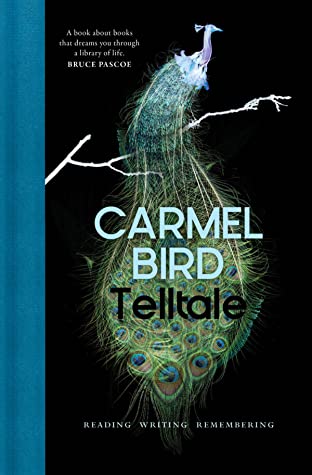
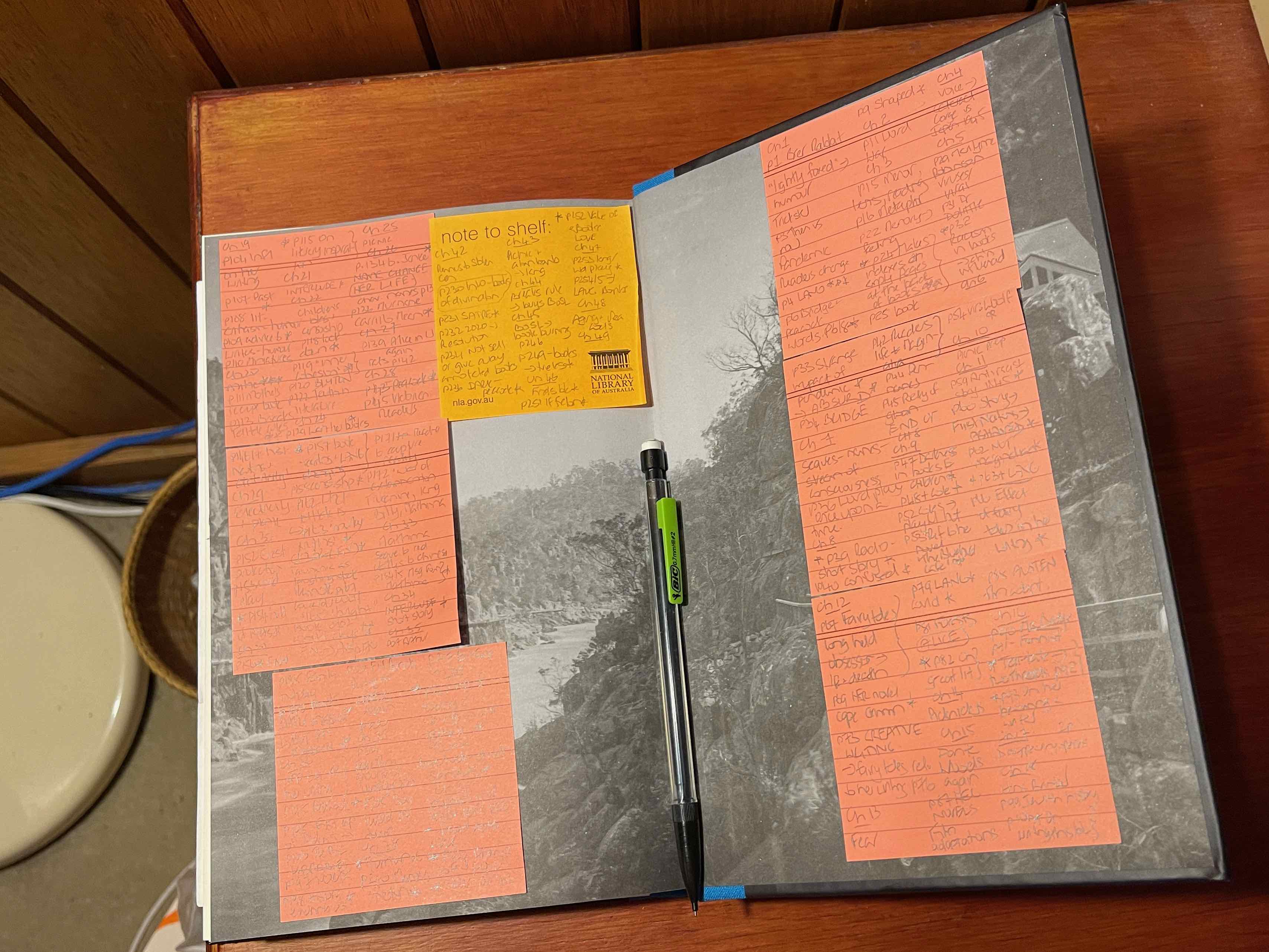
Telltale, Carmel Bird and me

In my recent post on Carmel Bird’s bibliomemoir, Telltale, I hinted that there could be another post in this book. There could, indeed, be many, but I must move on, and I must not spoil the book for others. However, given many blog-readers enjoy personal posts, I’ve decided to share a few of my particular delights in the book. I found myself frequently writing “Yes” in the margins …

“I’m glad, now, that I have always defaced books”

… because, like Carmel Bird, I have, since I was a student, “defaced” my books. Not only that, but my defacements seem to be of a similar ilk to hers. For example, I sometimes add an old envelope, or post-it notes, inside back covers to carry more notes. Like her, I love books with several empty pages at the back to accommodate note-taking.

Not enough blank pages at the end of Telltale!

Carmel Bird also loves indexes – and I love the fact that Telltale has a beautiful index, because such a book should, but often doesn’t. But, what really tickled me was her comment early in the book that “I also make a rough index on the empty pages at the ends of books I read” (or, as she also writes, “pencilled lists of key elements”). Yes! Sometimes, my indexes are more like notes, but other times my notes are more like indexes. Mostly, though, I do a bit of both, with exactly what depending on the book and on my response to it. This latter point is implied in Bird’s statement that:

In 2020, paying so much attention to books, I took particular notice of the differences in the ‘indexes’I had made at different times, how on each re-reading I had noticed different details.

Here, she not only shares her reading practice but also comments on reader behaviour, on the fact that each time we read a book we find something new. That can be for various reasons. On subsequent readings we already know the book at some level and so are ready to see more in it; on subsequent readings the world will have changed so the things we notice can also change according to the zeitgeist; and then, of course, the biggie, on subsequent readings, we ourselves have changed so we see the world differently. I love that Bird’s indexes reflect this – and that she saw it.

But, there’s a downside to all this “defacement”, which Bird also discusses. Writing about discarding books – the how and why – she says, “when I have annotated a book, it is not much use to anybody but myself, so selling it or giving it away are not possible solutions”. I know what she means, though I contest that hers would not be of use to anyone else. Who wouldn’t enjoy owning a book so defaced by her?

There is, however, a point at which she and I depart. When reading an outsize paperback becomes “too difficult … to manage comfortably” she will attack it “vertically down the spine with an electric carving knife” to divide it into manageable portions. I know some travellers tear out sections of travel guides they no longer need, but librarian-me finds destruction a step too far. Sorry Carmel, I understand, but …

“oh what a lovely word”

Like many authors, Carmel Bird loves words. It’s on show in all her work, but in Telltale, it’s front and centre. In her opening chapter, she writes that

Uncle Remus uses terms such as ‘lippity-clippity’. This is the kind of singing, onomatopoeic language I sometimes invent when writing.

And, so she does, even in this nonfiction bibliomemoir. Did it come from reading Uncle Remus “all that time ago”, she ponders. Was it “embedded” in her brain, back then, without her “even realising”? Probably.

Throughout Telltale, Bird discusses words – how they have changed over time (in meaning, for example, or in acceptability), how they look, where they come from, how they sound. As the daughter of a lexicographer, I would be interested in this. As a lover of Jane Austen whose wit and irony I adore, I would be interested in this. And, as one who loves writing that plays well in the mouth and sounds great to the ear, I would be interested in this. If you love words too, this book will be an absolute delight for you.

Other delights

As I said when opening this post, I really mustn’t spoil this book for others, so I’ll just add a few other delights:

  • her discussions of the many books and stories she chooses to share – those she found on her shelves that she felt illuminated her life and writing. I’ve mentioned very few of these because, really, this is the thing that most readers will want to discover and enjoy. Get to it … Meanwhile, I will name just two here. One is Dickens’ Bleak House which she writes “might” be her favourite Dickens. It might be mine too. The other is Marjorie Barnard’s “The persimmon tree” which she describes as “extraordinarily powerful”. Barnard’s “The persimmon tree and other stories” is one of the only short story collections I’ve read more than once. I concur!
  • silly little things like the fact that she loves green (as do I) and that she learnt that “lovely” word “tessellated” at the tessellated pavement at Tasmania’s Eaglehawk Neck (as did I).
  • she loves the internet and allowed herself to use it for this book. She was the first fiction writer in Australia to have a website. Like most of us, she prefers printed books, but she also sees the advantage of electronic books (including the ease of searching them – as an index-lover would!)

Finally, early in the book, Bird discusses memory:

As is often the case with memory, while some of physical details are clear, the principal element that has been retained is the feeling. Perhaps the feeling is the meaning.

Yes! This makes sense to me. I can rarely remember plots or denouements, but for the books that are special to me, I can remember how they made me feel – uplifted, melancholic, inspired, distressed, excited, angry, and so on. These feelings are surely associated with what the author intended us to take away, and therefore they must reflect the meaning?

Here, I will, reluctantly, leave Telltale, but I’ll do so on one of its three epigraphs, the one from her own character:

‘memory
is the carpet-bag
mire of quag
filled with light-dark truth-lies
image innation
and butterflies’

CARILLO MEAN,
Remembrance of Wings Past

How can you not love this?

Carmel Bird, Telltale: Reading writing remembering (#BookReview)

Finally, I have found something to thank COVID for – Carmel Bird’s Telltale. Best described as a bibliomemoir, Telltale may never have been written if Bird had not been locked down with her extensive library. What is a lively mind to do in such a situation? I can think of a few options, but what Bird decided was to revisit the books she’d read since childhood and, through them, look for patterns in her life and, because they are intertwined, in her writing practice. She would reflect on “the working of the imagination, the behaviour of the unconscious mind”.

Telltale, in other words, is more than a simple chronological run-through of her books, because the reading and writing life is not so easily compartmentalised. She writes that it

is composed of two different kinds of narrative.  One is warp and one is weft, and I am not sure which is really which. Will the threads hold? What patterns might I work across the surface? Will the metaphors crumble into useless dust? One thread speaks of books read and sometimes of books written. And also of things that happened in my life. The other speaks of a journey of the heart, a pilgrimage through a patchy history of the world, becoming a poetic thread that runs through the whole narrative.

A complex book then, but one told in such a personal, confidential come-with-me voice, that it reads like a lovely long conversation with an intelligent friend. Like any intelligent conversations, though, it requires the participants to be on their toes, to be ready for twists and turns, for surprising connections and conclusions, to be both confronted and delighted. Bird heralds this in her opening sentence:

As a child at the end of World War Two, I was introduced to the concept of the Trickster in literature.

That trickster was Brer Rabbit, whom I also remember from my childhood, but I was of a more prosaic mind than Bird, who has proven to be a bit of a trickster herself. Yes, the dictionary uses words like “dishonest”, “cunning”, and “deceptive” to describe “trickster”, but the trickster in literature, as Wikipedia explains, “is a character in a story … who exhibits a great degree of intellect or secret knowledge and uses it to play tricks or otherwise disobey normal rules and defy conventional behavior”. This is how I see Carmel Bird as a writer. The surface can look quite simple, but underneath there is usually something else going on. You only have to check out the epigraphs to her books, which frequently include bon-mots “written” by her own character, Carillo Mean. It’s apposite, then, that she starts her book with a “trickster”. It tells us to be ready for – well, anything.

So, Telltale. It looks like a bibliomemoir – a book about her reading and writing life – but as she explains in the excerpt above, it also encompasses “a patchy history of the world” as it has affected or appeared to her. To unite it all, she crafts her tale around a narrative heart, a loved book, Thornton Wilder’s The Bridge of San Louis Rey. She wants to write about it but can’t find it. This injects a mystery: will she find it? It also introduces a potential conflict: will she break the rule she set for herself to not buy books and only use those on her (clearly extensive) shelves. As the memoir progresses, we become party to her increasing concern about where it is and what to do.

Why of all the books, you might be asking, The bridge of San Luis Rey? But, that might be for me to know and you to find out.

“to move the heart and illuminate the mind”

Late in Telltale, Bird mentions reading Katherine Mansfield’s short story “The fly” when she was fifteen. She writes:

I suddenly saw how the surface narrative and the narratives and meanings below the surface could dance together with an electrifying elegance to move the heart and illuminate the mind. This was my first conscious lesson in style and structure.

See! It’s a lesson Bird clearly took to heart, and which is on display in all the works of hers I’ve reviewed. (As for “move and heart and illuminate the mind” – who could want more from reading?) Earlier in the book, she refers to another aspect of her style: “the pleasure I take in moving (drifting, spinning, flicking) from one topic to another”. This pleasure, she suggests, could have come from her father’s six-volume Harmonsworth’s household encyclopedia. Again, we see this approach in Telltale. It’s one of the things I love about Bird’s writing. It can be challenging, of course, but it is exciting to be so challenged – and to thus be respected as a reader.

Anyhow, the point is that while on the surface Bird seems to move or flick from topic to topic, her books are invariably held together by framing ideas and motifs. Here, it’s not only the search for The bridge of San Luis Rey, but two other narratives, which she draws together towards the end of the book. One concerns a childhood family picnic to Cataract Gorge in 1945, and the other, the gathering of American planes for the rarely-remembered firebombing of Tokyo in March 1945. Woven through these narratives is another, Bird’s growing awareness of the devastating dispossession of Australia’s First Nations people, starting from her acceptance, as a Tasmanian-born child, of their “extinction” in her state.

These are the main narratives that make up the aforementioned “patchy history”, and I fear this may be sounding disjointed. In fact, however, the “threads” hold, because the relationship between this “patchy history” and the books she has read and written is strong. Not only are there the obvious and expected connections between the “history” and her reading and writing, but there are also two recurring motifs that are real, historical, and literary – bridges, which can symbolise “fragile communication and union”, and peacocks which can signify “eternal life”.

Telltale is a delicious and revelatory read, and I’m not doing it justice. I’ve not, for example, touched on the quirky, often poetic, tapered chapter ends, or the neat segues between chapters. Nor have I said much about the writing which can turn from seriously descriptive or philosophical to whimsical or poetical in a paragraph. And nor have I shared the reflections about reading and writing, about truth and meaning, about words and language, that I specifically noted down to share, because, frankly, there are too many. There may be another post in this.

I took some time to read this book, and I’m not sorry. To read Bird, if you haven’t realised already, is to agree to join her on a sometimes merry, sometimes macabre dance. If we do, what we find is a compassionate heart that, despite it all, believes in love and calls us to hope, as that peacock that has accompanied us throughout darts and dances across the sky.

Lisa also enjoyed this book.

Carmel Bird
Telltale: Reading writing remembering
Melbourne: Transit Lounge, 2022
274pp.
ISBN: 9781925760927

(Review copy courtesy the author)

In conversation with Craig Silvey

I understand that literary conversation events in Canberra go best when the subject is political. I guess it’s the nature of the beast – that is, of living in the national capital. But for me, it’s the fiction writers that I want to see, and we do get some interspersed amongst the run of historians and journalists that we get. Even so, it’s been three years since I attended an ANU/Canberra Times Meet the Author event, due partly to the pandemic which halted the program for a while and partly because I have a pretty full dance card. However, Mondays are often free, so Mr Gums and decided to check out Craig Silvey. I’ve only read his best-selling Jasper Jones (my review) but that’s because you can’t read everything. I would like have read Honeybee. Tonight’s focus, though, was his latest novel, Runt.

The conversation was conducted by local author Irma Gold, who is no stranger to this blog. She’s always good in the interviewer’s chair, being both warm in manner and astute about writing – and so it proved again tonight.

The conversation

After MC Colin Steele did the usual introductions, Irma took over and introduced Silvey and the book we were there to hear about. Runt is, she said, a middle-grade children’t book. It features a solitary girl, Annie, with a penchant for fixing things, and the dog, Runt that she befriends. Irma found Runt a heart-warming book, which was lovely to read to her 11-year-old son. She believes it is destined to become a children’s classic. It would, both she and Colin Steele said, make an excellent Christmas gift. What a shame our grandson is only 4.

Irma Gold and Craig Silvey, 2022, ANU

After some light-hearted banter with Craig about a Fremantle biscuit artist – who knew? – Irma got down to business. Noting that Runt represents a new audience for Craig – that middle-grade age – she asked what his favourite book/s had been as a child. Craig replied that he’d been a voracious reader as a child. (Show me an author who wasn’t!) He loved a range of books, including those traditional classics like Lord of the Rings and the Narnia books, but then he made some points that were specific to him. For example, he liked books that made him feel things, and named a short story by Paul Jennings titled “Busker”. It was the first story, he said, that made him cry. Another favourite was Goodnight Mr Tom, which elicited sounds of agreement from the audience, and which, he later realised, might have partly inspired Honeybee.

He also liked books that made him laugh, and he mentioned Roald Dahl, Paul Jennings again, and the James Herriot vet series.

After this, there was some discussion of Runt, which is set in the perfectly named country town of Upson Downs. There are Annie and Runt of course, and some villains, including the farmer, Earl, who is also a collector. One of the things he collects is water! Earl is buying up farms to get the water, and wants Annie’s family’s farm. The plot revolves around Annie’s plans to save the farm. There was more chat about the story and the characters, which include the wonderfully named 13-year-old Fergus Fink, and then we moved onto setting and themes.

Irma noted that Craig had grown up on an orchard in a small country town, and asked whether this had inspired Runt. Craig responded that the novel was an “affectionate love letter to country life“. He loves country people – their use of understatement, and their dry humour – and the country makes for great fiction settings because it is “exposed to the whims of elemental forces”.

This led to a discussion about the relevance of climate change to the book. Craig observed that water policy and climate change are putting people under pressure, and that villain Earl’s avarice is boundless. There are subtle messages in the book, including the fact that people are more important than hoarding/collecting things!

Irma commented that Runt is very different to Honeybee, but it does encompass diversity. Craig responded that he writes about Australians in Australia, and that we are a diverse country. Irma then said that the book had a contemporary setting but a very classic feel. Craig replied that he wanted classical elements underpinning his text but that, for example, a 13-year-old boy’s aspiration now would be to be a YouTube star. Of course!

From here Irma turned to screenplays, because each of Craig’s books have or are being adapted to film, with Craig also writing the screenplays. There was discussion about the screenplay writing process, and how Craig, “wrote them sort of together”. Film development for Runt is already underway, with production possibly starting next year.

Craig had some interesting things to say about writing screenplays versus novels. There are rigidities to screenwriting that you don’t have in novel writing, he said. The screenplay format can be too restrictive to let your creativity fly, so he enjoys novel writing, but, conversely, writing screenplays reins him in as a novelist, which has benefits.

Irma’s next question concerned publishing and the fact that Craig has been published for 20 years now. How has publishing changed? Interesting question, responded Craig. For him, the biggest change is in the post-publishing aspect. Back in 2004 when his first novel, Rhubarb, was published, we were not as “connected” so you had no idea what was happening with your book. Now, with social media, you get immediate recognition and can see what is happening. Reviewing is democratised and it is “a really beautiful thing”, he said. (As a blogger, I appreciated this.)

Publishing, itself, though is still painful. You take this tender part of yourself and you expose it to the world. So, while his success means that he no longer has to do the “shitty jobs” he had to do when he was 19 and writing Rhubarb, in terms of writing, he still faces the blank page with the same uncertainty. This is essential, though, to being a writer: you need to “straddle the pain and struggle” but you need also to balance it with hope and pride. Such a mentally healthy attitude.

On whether he was always going to be a writer, Craig talked about meeting his first writer, Glyn Parry, at school, when he was 14. He realised, suddenly that writers were human beings and it could be a vocation. He wrote to Parry, and got some great advice: “Don’t become a writer, be a writer”. Craig didn’t go to university. Instead, he did menial jobs and read and read – and “forensically examined novels.”

After a delightful little interlude discussing his career as an electric ukelele player in a band called the Nancy Sykes (inspired by Dickens, of course). During the band’s short life, they apparently played Shaun Tan’s bride down the aisle! A little later in the interview there was another fun interlude, this time about his being a finalist in Cleo’s Bachelor of the Year contest and being described as “the thinking woman’s buttered crumpet”. It was an entertaining story, but I’m not going to spoil it just in case you get to a launch and hear it yourself. Instead, back to the writerly life.

Irma asked Craig whether he enjoyed book tours, and the response was immediate. He loves it and is deeply grateful to anyone who comes out to hear him. Novelists lead bifurcated lives. They tease stories out of themselves, then release them to the audience at which point they become each reader’s to appreciate and define. He said most authors, like himself, feel profoundly empty when they finish a book, but engaging with readers fills him back up again.

Q&A

These sessions are always well-run, resulting, always, in time for a Q&A. There were some excellent questions. Canberra didn’t let Irma down!

On getting the voice of a teenager, and whether he sees hope in younger people: Craig said that he has gravitated to teenage protagonists (though Annie is I think pre-teen), because everything is amplified at that age. The bubble your parents keep you in is pierced and you start to recognise the truth of things. It’s a time of profound change, when you start to define who you are, where you’re going. He likes to pair his protagonist with something opposite that can provide the catalyst for change. As for hope, he said that Runt‘s protagonist Annie’s hope is infectious. She inspires change, kindness, generosity, hope.

On diversity and the challenge of writing characters outside his own experience: (This would have been my question if I hadn’t been taking notes and had to get up and go to a microphone!) Craig responded that the further his character is from his own experience, the more responsible he feels. His practice is to connect with the appropriate community, as he did with the trans community for Honeybee. I loved Craig’s response to this question. He had three rules of thumb for writing ethically: do no harm; your purpose must have merit; and execute properly. Ethical writing is something we must discuss, he said. Responding to a follow-up question on Honeybee, he said that while the trans character doesn’t announce herself at the beginning, it was clear to all audiences that she was trans. His writing was informed by the trans community. The risks trans people take in disclosing themselves means that his character would not have announced their trans nature immediately. His character Sam is slow to trust, which is true.

On film adaptations and how he feels about giving over control: Craig said that he has screenwriter all his novels which partly answers the question! However, filmmaking, he continued, is a vastly collaborative process which is the opposite of writing a novel. He said that seeing Jasper Jones brought the screen was one of the most extraordinary moments of his life. It’s a communal artistic pursuit, and the result can be something larger than you are capable of conceiving on your own.

Irma closed by reiterating that Runt was a “really beautiful book” and that Craig had been compared to Roald Dahl. That is an accolade worth having. Having not read the book, I can’t say whether I agree or not, but I can say that Craig came across as a genuinely positive yet thoughtful and serious-minded person, and that Irma did a great job of bringing it all out. Thoroughly enjoyable – and there should have been more people there!

ANU/The Canberra Times Meet the Author
MC: Colin Steele
Australian National University
10 October 2022
Podcast available at SoundCloud

Kim Vanessa Scott, Growing up … Katherine style (#BookReview)

Growing up .. Katherine style is the second self-published book I have reviewed from this Katherine-based artist and writer, the first being her book about some of Katherine’s historical housing, Katherine’s tropical housing precinct 1946-1956. There are a few reasons why I have broken my no-self-published-books rule. One is that both books had some Northern Territory government sponsorship, which gives them some authority. Another is that this book speaks closely to my own experience of childhood that I couldn’t resist sharing them. Moreover, the book is being sold by established outlets like The Bookshop Darwin and the Katherine Museum. Finally, Scott used a desktop publisher/designer to ensure the book looks good – and it does.

So, with all that out of the way, I’ll get to the content, and why it appeals to me. Scott was born in the small outback Northern Territory town of Katherine in the 1960s, while I was born in a slightly bigger but still rural country town in Queensland in the 1950s. The first 14 years of my life were spent in Queensland, and over half of those in country towns, the last three being in the outback mining town of Mount Isa. From there I went to Sydney, where, although I enjoyed my high school and university days, I never really felt home. I left as soon as I finished my studies for Australia’s “bush capital”, Canberra, which has always felt like home. However, I’m getting off-track, so back to the book.

Growing up … Katherine style is both written and illustrated by Scott. It takes the form of a series of little illustrated vignettes from Scott’s life, each comprising an image accompanied by a short piece of text commenting or reflecting on the image. Scott’s art is delightful, bright but not garish, with strong outlines and a somewhat naive aesthetic suited to the childhood theme.

The vignettes take us from her babyhood in 1961 to Cyclone Tracy in 1974. Ending on this event is inspired because the cyclone, which occurred in Darwin a bit north of Katherine, was life-changing for the Northern Territory – and because, coincidentally, Scott would have been entering puberty by then, making it a good time at which to end a book about her childhood. Scott told the Katherine Times, linked below, that the book was at least partly inspired by the catastrophic Katherine flood of 1998 which

took away all our images and a lot of our family history, so I tried to think of a way to record the childhood without the images.

In the book’s introduction, she explains further that the “objects” she chose to illustrate her childhood “had many layers of meaning”. They demonstrate, she says, the way she “interacted with them on an emotional, physical and spiritual level”. What I so enjoyed is that many of them mirror memorable times in my own life – the family’s first car and tv, the importance of the radio, her first plane ride, not to mention those horrible sanitary belts we had to wear for our periods! There are also those little events from childhood that can remind us all of our own misdemeanours and accidents. Take for example, “Mulberries”, in which she describes finding a sixpence and carrying it in her mouth while running. The only trouble is that she then climbs a mulberry tree and puts mulberries in her mouth too:

I had my mouth full of fruit and the coin when I accidentally tipped upside down and swallowed the lot. Rather than tell Mum, I decided to just die.

Don’t you remember times like that? Anyhow, “fortunately”, she writes, “I woke up the next morning …”

I flagged many vignettes to share with you, like “Nursery Rhymes” in which she shares her “Little Miss Muffet” mondegreen. How many of us had those in our childhood (and, I have to admit in my case, beyond.) There’s another on “Slide nights” which tickled my fancy because last night we dined with two other couples and we had an impromptu slide night of both couples’ recent, separate holidays to the Kimberleys. The technology might have been different – thumb drives to the smart TV – but the impact was the same. Scott writes that:

I miss this form of entertainment where we built our oral family history with images.

There’s the reference to family history again.

In another blast from the past for me, she writes in “My first real jewels” of the “bluebird lockets earrings” that were given to her and her sister as their first piece of “grown-up, real jewellery”. As she writes, “they were considered a charm”, and oh, how I had wanted some bluebirds too. One birthday I thought I had been given a bluebird bracelet, but when I looked more closely, the little charms were blue angels. Not the same! I was most disappointed. I could go on but you are surely getting the drift. This book offers both a lovely trip down memory-lane (for most baby-boomers) and an engaging picture of childhood in a different place and time to now.

The book ends on Cyclone Tracy, as I’ve already said. Scott writes that “the path to self-government started on Christmas Eve, 24 December 1974. The warning sound on the radio is burnt into my psyche”.

You can hear an interview with Kim Scott on the ABC Radio Darwin website, and read an article on the book’s publication in the Katherine Times. The Times also advises that the illustrations were put on exhibition at Katherine’s Godinymayin Yijard Rivers Arts & Culture Centre. Scott is described as a local Katherine artist who enjoys “showcasing all facets of life in the NT through visual arts, poetry and story telling.”

I love histories told through objects. Scott has shared her childhood in a way that captures her personal experience while also speaking to the universal. Delightful.

Kim Vanessa Scott
Growing up … Katherine style
Katherine: Kim Vanessa Scott, 2022 (with sponsorship by the Northern Territory Government)
82pp.
ISBN: 9781642045444

(Copy received from the author via a mutual friend.)

Emma Viskic, Resurrection Bay (#BookReview)

Back in February, I said I planned to “read” more audiobooks this year, and slowly I’m achieving that goal with Emma Viskic’s Resurrection Bay being my third for the year. In fact, it makes a particularly special contribution, because it is the first book I wanted to hear when we bought our new car with Apple CarPlay functionality back in 2019. That might sound strange for someone who claims to not read crime, but here’s the thing …

While I don’t, as a rule, read crime, I do like to keep up with new Australian works. Emma Viskic’s 2015-published debut crime novel featuring a deaf investigator captured my interest at a time when we were looking for more fiction featuring differently abled protagonists. I wanted to read it, but I thought my best bet would be in audiobook form, because crime is the sort of writing that can work well in the car. The problem was that every time I checked my library audiobook catalogue there was no Emma Viskic, until a couple of months ago. Consequently, Resurrection Bay was the novel of choice for our last road trip. And it was a good choice, except …

There are certain things you need in a car audiobook, we’ve found. One is that straightforward narratives work best. After all, one of the listeners is a driver who should be focusing mostly on the road. Drivers do not need to be trying to follow multiple strands or unpicking abstract language, for example. Viskic’s novel worked well in this regard. However, another is that the sound needs to be good, and easy to hear above road and car noise. Here is where we struck problems. The reader for this audiobook, Lewis Fitz-Gerald, was a great reader – and I am fussy about audiobook readers – but he used a wide dynamic range to convey emotion and meaning through his voice. This made hearing in the car very difficult at times. It would not be a problem, I expect, if you were listening to it through ear-pods while walking.

And now, I really should get to the book – but one more proviso. Because I experienced it in audio form, my comments will be general and briefer than usual.

Resurrection Bay is the first in Viskic’s Caleb Zelic series. He is a private investigator who has been profoundly deaf since early childhood – from meningitis (which was also behind author Jessica White’s deafness). Unlike Jessica, though, Caleb did learn to sign. GoodReads describes the plot as follows:

When a childhood friend is murdered, a sense of guilt and a determination to prove his own innocence sends Caleb on a hunt for the killer. But he can’t do it alone. Caleb and his troubled friend Frankie, an ex-cop, start with one clue: Scott, the last word the murder victim texted to Caleb. But Scott is always one step ahead.

“silence safer than words”

Fictional detectives, I have come to learn, are not usually easy people. They tend to be loners, or to have some personal problem/s which add to the challenge and interest of the narratives featuring them. Caleb, of course, has his deafness. He’s an outsider, not because deafness necessarily makes him so, but because he, as his Koori ex-wife Cat tells him, lets it make him so. He refuses to admit his hearing impairment to others when communication difficulties occur, and this desire to “appear normal” not only impacts his ability to do his job, but it impacts his relationship with her. He also, frustratingly, refuses to “hear” what she is saying, jumping to the wrong conclusion because he is not listening. His deafness, in other words, is more than physical. It is also mental and emotional. Communication is, then, an underlying theme or motif in the work.

However, I’ve gone off on a tangent, because of course the main story is the crime investigation, which Caleb undertakes with his business partner, the aforementioned Frankie. She has her own difficult past which includes having been an alcoholic. This Caleb knows. Their investigations take them from Melbourne to Caleb’s childhood home, the fictional Resurrection Bay, and in the process Caleb discovers things he didn’t know about his friend, the murder victim; jumps to conclusions about his brother Anton; and learns more about Frankie.

Resurrection Bay is a page-turner, as you would expect. It’s well-written, with good crime-characterisation, and vivid evocation of place. It’s emotionally moving because Viskic makes you invest in her characters, but it also has some very violent and bloody moments. I guessed what the twist might be, but I was never completely sure until the end – and how it all actually fell out contained surprises.

Now, though, I want to address the elephant in the room – the deaf protagonist, the Koori wife, and the whole whose-story-is-it-to-tell issue? Here’s the gen, from The Age. Viskic

says being half-Slav gave her an outsider status that honed her power of observation.
Her husband was raised in a Koori family and they have two grown daughters. One of her primary school classmates was deaf and the disability – and particularly the refusal to accept it as a disability by the deaf community – has always intrigued her. She learned Auslan for the novels.

Later in the article, she is quoted as saying that

writing from outside your own experience is dangerous … not just because people can shoot you down, but because you can do the wrong thing by people. But I wanted my nieces and nephews to have characters like them in a book. And also, it would have felt cowardly not to have done it.

I am not a hard-and-faster on this whose-story issue. I do think that where longterm disempowerment is involved, own-stories are the better and fairer way to go, but it’s grey. If writers have reasons for writing a particular story that is not their own, then they wear the consequences, as Viskic is clearly aware. Ultimately, it’s not for me to say, but I felt Resurrection Bay was written with sensitivity and respect. The rest is up to those who own these stories.

In 2016, Resurrection Bay won the Ned Kelly Award for Best First Fiction; and the Davitt Award for Best Adult Novel. An impressive debut.

Kimbofo enjoyed this novel too, and Bill has posted on Viskic’s fourth Caleb Zelic novel, Those who perish.

Emma Viskic
Resurrection Bay
(Read by Lewis Fitz Gerald)
Wavesound from WF Howes, 2017 (Orig. pub. 2015)
Duration: 7hrs 9mins
ISBN: 9781510064140

Nigel Featherstone, My heart is a little wild thing (#BookReview)

In late May, I reported on the Canberra launch of Nigel Featherstone’s latest novel, My heart is a little wild thing – and now I bring you my thoughts on this finely-observed book about a man’s reaching for his own life.

I’m going to start with a reflection on a question authors of books like this commonly get, which is, is the book autobiographical? In his launch, Nigel said that the book is not about him, but that things in his life – particularly the death of his mother – did inspire him. The book’s protagonist Patrick is clearly not Nigel, as those who have followed Nigel through his various social media accounts will know. Nigel, unlike the semi-closeted Patrick, has been in a committed relationship for over two decades, and Nigel, unlike Patrick, broke away from home and did forge his own life. At the launch, Nigel said that this book explores what his life might have looked like had he “obeyed his mother”, who didn’t want him to be a writer or to love men.

This novel then, is not his life, but it nonetheless draws on much from his life. For example, like Patrick, Nigel grew up in upper North Shore Sydney and frequented that city’s northern beaches. I enjoyed this because I spent my teen years in the same area, albeit a decade or so ahead of Nigel. I am also familiar with the other two main settings in the novel, the Southern Highlands and the Monaro, and am drawn to both, as I know Nigel is. Like Nigel’s Patrick, I do not really know why I so love the Monaro except, perhaps, because the favourite landscapes of my childhood were those wide open plains of outback Queensland. There is something captivating about them, even though, as Patrick, somewhat prophetically, writes of the Monaro,

It was all wide-screen barrenness, the only embellishment the fence lines, which cut across the tussocky landscape like tripwires.

Patrick shares other interests with Nigel, particularly music. Again, if you follow Nigel, you will know how important it is to him. He has, in fact, composed his own song-cycle. So, when he describes the music created by Lewis, the man Patrick meets, these descriptions, too, feel authentic.

But, despite all these similarities which ground the book so well in lived experience, Patrick is clearly not Nigel. As I listened to Nigel speak at the launch, and as I read the book, I was reminded of a favourite quote from Marion Halligan’s wise novel, Fog garden. The narrator writes about her character Clare:

She isn’t me. She’s a character in fiction. And like all such characters she makes her way through the real world which her author invents for her. She tells the truth as she sees it, but may not always be right.

And this, too, is Patrick.

“a fence I had crossed”

My heart is a little wild thing starts dramatically with Patrick heading off from Bundanoon to the Monaro in a distressed state the day after he’d “tried to kill his mother”. The actuality isn’t quite as bad as it sounds but Patrick, in his mid-40s, had been pushed to the limit by his demanding mother for whom, of her three children, he had pretty much sole responsibility. He needed out, a break, and so after the incident referred to in the opening paragraph, he drives to a steading (or barn) on a place called Jimenbuen, where he had spent many happy family holidays as a child.

Nigel explained at the launch that Jimenbuen is based on a little heritage-listed barn in Bobundra, on the Monaro near the foothills of the Snowy Mountains. It was when staying there that Nigel’s book finally took shape, and it is at Jimenbuen that Patrick finally takes a step towards a new life, when he decides to offer to help a man he has spied planting trees on the other side of the fence. That man is Lewis, and the rest, as they say, is history – except, of course, it’s not quite as simple as all that, because the course of true love rarely runs smooth, in fiction or in life.

However, we follow Patrick as he experiences real love for the first time in his life, and we continue to watch as Lewis returns to his life in Ireland while Patrick returns to his mother. How will it all resolve? That is not for me to share here.

The novel is about many things, but an overriding idea is that of freedom. It is signalled on the third page of the novel when, en route to Jimenbuen, Patrick describes the “odd choices” he’d made of CDs for the trip. “Perhaps”, he wonders, “they reminded me of a time when I felt free”. Three pages further on, Patrick explains that, prior to the incident, he had been planning a short getaway to Sydney, because it was a place where he “could be free”. The idea of freedom recurs throughout the novel. Nearly two-thirds through, he remembers a past conversation with his father, who had told him, “We must live our own lives”. Patrick, at the time, doesn’t fully understand this, fearing it’s “selfish”. And yet, intriguingly, near the end of the novel, Lewis tells Patrick about having seen him, when they were still boys, at a waterhole. Given how Patrick’s life had proceeded, it’s ironic, but Lewis says:

I saw you as neither male nor female, just someone who looked free. I can’t think of anyone more attractive than a person who knows how to be free, and who’s taken risks to be free.

Related to this idea of freedom are those of happiness and living life fully, all of which are encompassed in the novel’s epigraph, Verlaine’s “To live again, undying”. Through Patrick, Nigel explores just what this means – the balances, compromises, and the lines we need to draw every day to live good but true lives.

The novel explores other ideas too, including ageing, and the responsibility of children for caring for ageing parents. Nigel makes clear that this is not a one-way street. Parents need to meet their children half-way. They need to recognise that no matter how loving or dutiful their child is, that child also deserves respect and to be able to live their lives. A balance must be struck. Patrick, we see, gives and gives and gives to his mother, and receives little in return.

Ultimately though, the book is about the power of love and friendship, something that is subtly underpinned by references to a favourite novel that Patrick rediscovers at Jimenbuen. The novel is – and some of you will also surely know and love it – Paul Gallico’s The Snow Goose, about a damaged man and the love he finds and expresses.

During the book’s launch, Nigel talked about the value of fearless writing, which he also wrote about in his essay on Christos Tsiolkas (my post). It’s about being audacious and true – to yourself, your characters and your writing. Nigel has achieved that here, particularly in the way he explores, explicitly but sensitively, the complicated relationship between sensuality and sexuality, love and desire as Patrick reaches for the life that will sustain him.

My heart is a little wild thing is another of Nigel’s warm-hearted, character-focused books that deal with the complexity of family and relationships, and how we live our lives. The heart might be a little wild thing, but this book is a little beautiful thing – and not so little at that.

Nigel Featherstone
My heart is a little wild thing
Gadigal Country/Ultimo: Ultimo Press, 2022
282pp.
ISBN: 9781761150135

Monday musings on Australian literature: Frank Moorhouse (1938-2022)

Frank Moorhouse was one of the grand old men of Australian literature, so when I learned that he’d died yesterday, I knew I had to change my plan for this week’s Monday Musings to feature him. Wikipedia’s introduction to him gives you a sense why I’ve described him as I have: “He won major Australian national prizes for the short story, the novel, the essay, and for script writing. His work has been published in the United Kingdom, France, and the United States and also translated into German, Spanish, Chinese, Japanese, Serbian, and Swedish”. Today, he is best known for his Edith trilogy – Grand days, Dark palace and Cold light – the middle of which earned him a Miles Franklin award, but his legacy extends deeper than that.

A major legacy

I first became aware of Moorhouse back in 1975 when I was beginning my librarianship career. It was due to a court case known as University of New South Wales v Moorhouse which concerned the use of photocopying machines to photocopy “infringing portions” of a work in copyright. Wikijuris summarises it nicely if you are interested. The High Court unanimously found that, although the copying was done by a student, the Unviersity was liable for “authorising” infringement. It was a groundbreaking case whose legacy continues today.

The Copyright Agency also tells the story. They explain that Moorhouse was determined to achieve “respect and financial recognition for Australian creators”. He gave permission for his book, The Americans’ Baby, “to be used in a copyright test case” which, the Agency says, has ensured that, today, nearly 50 years later, “creators are fairly remunerated for their work in a digital environment that provides millions of students with access to high quality educational material”. Moreover, the case also resulted in a recognition that “an agency would be needed to collect the royalties generated by the copying of materials to distribute payments to creators”. That agency was the Copyright Agency, which was established in May 1974 for this purpose.

You can imagine that this was exciting stuff for a new, philosophically engaged librarian – we wanted to support creators but we also believed in the importance of libraries being able to provide access to the material students needed. Good copyright law should achieve both and here a fair (acceptable) balance has probably been struck – though I’m sure both sides will have arguments for more.

But of course …

For most readers, Moorhouse’s legacy is in his writing. He was born in Nowra, New South Wales, a beautiful spot less than three hours’ drive from where I live. On leaving school, he began work in 1955 with newspapers, first as a copy boy, and then as reporter and editor. His first short story, “The young girl and the American sailor”, was published in Southerly magazine when he was 18 years old, and he went on to be published in some of Australia’s best literary magazines after that.

In the 1970s he became a full-time fiction writer but he also wrote essays, short stories, journalism and film, radio and TV scripts. He was also, with Clive James, Germaine Greer and Robert Hughes, part of the “Sydney Push” (about which I wrote in my review of Richard Appleton’s memoir, Appo.) It was a bohemian, libertarian movement with a strong anti-right wing underpinning. He has led or been heavily involved in many of Australia’s significant writerly organisations, including the Australian Copyright Agency, the Australian Society of Authors and the Australian Journalists’ Association. In 1985, he was appointed a Member of the Order of Australia for service to Australian literature.

Writing about his death in The Guardian, Sian Cain says this about his work:

Moorhouse wrote prolifically and with irreverence and humour of his passions – food, drink, travel, sex and gender. Early in his fiction, and later in his 2005 memoir, Martini, he wrote frankly about his own bisexuality and androgyny. In his writing, he said, he wanted to explore “the idea of intimacy without family – now that procreation is not the only thing that gives sex meaning”.

Tim Barlass wrote something similar in The Sydney Morning Herald:

Moorhouse lived and wrote about the good life – in both senses of the phrase, sometimes paradoxically. With a passion for fine food, cocktails and justice, he fearlessly wrote about the things essential to him.

Frank Moorhouse, Cold Light

If didn’t know all that about Frank Moorhouse, I have only to think back to Edith (particularly to Cold Light which I read after I started blogging) to see how it could be true! Edith, Ambrose and their friends knew how to work and play hard. My review of the novel was a little measured, but it is also one of those books that has remained with me. You never know, when you finish a novel, which ones will hang around in the mind for the long run.

I understand that a biography by Catharine Lumby is coming very soon. Barlass quotes her response to his death:

 “Frank Moorhouse was a literary legend. It was an incredible privilege to have a friendship with him and be his biographer. As always, Frank had to have the last word. I started writing the conclusion to his biography this morning and learnt that he had died.”

I can’t think of a better place to end, except to add that I look forward to her biography of this colourful but serious man. Vale Frank Moorhouse.

Stephen Orr, Sincerely, Ethel Malley (#bookreview)

Like Lisa, I’m a Stephen Orr fan, but for some reason it took me forever to finish his latest book, Sincerely, Ethel Malley, partly I think because while its characters are engaging, it’s a novel that deserves concentration which I seem to have in shorter supply this year. This is not meant to discourage readers, because it’s a fascinating, and wryly humorous read that explores a range of issues, to do with art and society, against a backdrop of war-time 1940s Australia.

As those who know the story will have guessed, Orr’s novel takes as its starting point the infamous Ern Malley literary hoax. To summarise Wikipedia, this hoax was perpetrated by two conservative writers, James McAuley and Harold Stewart, who created modernist-style poetry in the name of a fictitious poet, Ern Malley. They wrote the poems using random words from various reference books and rhyming dictionaries, and, in 1943 sent them, in the name of Ern’s sister Ethel, to Max Harris, editor of Angry Penguins, the journal of a modernist art and literary movement. This movement included some of the leading lights of the Heide art group, which was the inspiration for Emilly Bitto’s novel, The strays (my review). They were modern, confident, and prepared to tackle head on conservative Australia. It wasn’t long before the hoax was exposed, but that wasn’t the end of it, because Max Harris was then tried for publishing the poems, on the grounds of obscene content.

I have written about literary hoaxes earlier in this blog, and made some points about what hoaxes tell us. Among these are that they raise some fundamental issues for readers and critics about the nature of literature, about what we mean by authenticity and how we define quality. Is a work, for example, somehow less “authentic” and of less literary quality because the author isn’t who we believe s/he is? In other words, is the work the thing? These are some of the issues Orr explores in Sincerely, Ethel Malley.

The novel’s intent is also suggested by the four epigraphs, the first of which – with its own in-joke – is “ascribed” to Aeschylus. It suggests that Prometheus is the source of “every art possessed by man”, so, perhaps, why worry about anything but the art? Then there’s Frederick R. Ewing’s suggestion that the problem occurs from a misunderstanding over where “the truth left off and imagination began” – which, in a way, is the idea underpinning this book. The third comes from Max Harris arguing, essentially, against “playing god”. And finally, there’s Donald Crowhurst’s “it is the mercy”. I’ve never heard of Crowhurst but, according to Wikipedia, he was an amateur sailor who disappeared during a race. Wikipedia says that this statement, which he left behind “is obscure, [but] most commentators have accepted that it signifies his relief that, at last, he is leaving an unbearable situation”.

All this will tell you that Stephen Orr has big ideas in his sights. Fortunately for us, they are wrapped up in the engaging character of Ethel. She carries the novel. It starts in 1981, with her death, and then flashes back to 1943, which begins the main body of the novel and tells the story of Ern and his poems from Ethel’s (first-person) point-of-view. The novel’s last chapter returns to 1981, with Max hearing about Ethel’s death. Ethel (and Ern) are Sydney-based – which is where McAuley and Stewart were based – but most of the action takes place in Adelaide, where Max Harris was based.

In the 1970s, Adelaide was a beacon of progressive thought in Australia, but back in the 1940s it was a very different place. Orr is South Australian and captures the ambience of the place and time beautifully, as our Sydney-suburban housewife, Ethel, makes her way between the iconoclastic Max, the lively bookseller Mary Martin, and Adelaide’s conservative establishment.

I thoroughly enjoyed the explorations – many of them done with wit if not downright cheek – about truth and authenticity, about poetry not being meant to be understood but to be “interpreted”, and about the art versus the artist. It’s subversive in self-consciously confronting some of the things we say and think about art and literature. It tackles conservatism, our resistance to innovation – “Originality. If your writing’s worthwhile, most people will hate it”, Max tells Ethel. Early in the novel is a discussion within Harris’ theatre group about what play they will perform, one by Shaw or one by Cocteau. Most of the players argue that people won’t come to Cocteau, because they “want a story”. For boundary-pushing Max, “that’s their problem”. He wants to do something “modern” (hence, also, his interest in Ern). This dilemma is not confined to 1940s Adelaide, but is one arts communities grapple with constantly. What will audiences tolerate?

Orr’s skill is in presenting his “big” issues through “authentic”, engaging characters and strong narratives which draw us into their reality. Orr’s characters are always warm and authentic (even when fictionalising an already made-up person like Ethel) and his dialogue is so natural. The story of Ethel as she struggles to prove that Ern is real, and his poetry not obscene, is entertaining – particularly when people start questioning her existence too. It can get mind-bending some times, and quite rollicking other times, as Ethel flips between present and past, but it works.

All of this is in the service of issues Orr thinks are worth thinking about, but it’s the thinking and the questions that are, in the end, more important than the answers, with Ethel, of course, being our guide. Early on, she’s never heard of Sid Nolan, but by the end she can hold her own with the best of them as she struggles to defend herself, Ern and his art against those who question. It’s both heartfelt and funny.

There is a lot to this book, but fundamentally, I see it as being about conservatism. In addition to the whole modernist poetry debate, Orr makes pointed comments along the way about the press and academia, not to mention Australians themselves. Ethel tells Sid Nolan, she’s learnt that “Australians hate anyone who claims to be creative”. In Sincerely, Ethel Malley, Orr is teasing us, goading us even, into being open to new ways of seeing, just as Max Harris wanted to do in the 1940s – and he has done so with his usual skill combined with a good dose of fun.

Lisa (ANZLitLovers) loved this book and covered its essence very well.

Stephen Orr
Sincerely, Ethel Malley
Mile End: Wakefield Press, 2021
441pp.
ISBN: 9781743058084

Review copy courtesy Wakefield Press.

Book Launch of My heart is a little wild thing by Nigel Featherstone

A respite this week from Monday Musings because I did want to bring you the Canberra launch of Nigel Featherstone’s My heart is a little wild thing, which happened on Saturday. Normally, I would have published the post on the weekend, but I was otherwise engaged, and so have decided to usurp Monday Musings to post it now. The launch, which took the form of an interview with Featherstone by Anna Vidot, was to take place at Harry Hartog Bookseller’s ANU campus location. However, interest was so high that it was moved to a small lecture theatre next door. Such is the support for local author and arts activist Nigel Featherstone.

The participants

Nigel Featherstone is no stranger to this blog, as checking out the link on his name will demonstrate. I have reviewed his 2019 novel (Bodies of men), the three novellas that preceded that, and a song-cycle. I have worked with him as litblogging mentor for the ACT Writers Centre’s New Territory program. And I have reported on myriad events that he has organised and/or been part of, most recently F*CK COVID: An Online Literary Affair organised during you know what.

Anna Vidot is a presenter on ABC Local radio – since 2019 – before which she had been ABC Rural’s national political reporter. I enjoyed her questioning. She had clearly engaged with the work.

The conversation

Anna commenced by saying that this was one of those books she clasped to her chest on finishing … and then launched into the discussion.

On where the book came from

Nigel said that after completing his manuscript, he came across his writer’s journal from July 2007 which had the words “two people, farm, quoll”. This core had been with him since then but it hadn’t come together until he spent a week on the Monaro after the 2019/2020 fires. He had tried various ideas and locations, but this is when the novel clicked. (My post on the Monaro, which includes a mention of Nigel.)

As for the quoll, the Tiger Quoll has been extinct in the region for some time but conservation efforts are bringing it back. It is a quoll which leads his lonely protagonist Patrick to a meaningful relationship.

On how the Monaro bled into him

Nigel had gone to a remote little heritage-listed barn in Bobundra, in the Monaro/Ngarigo Country. While there, he realised, when he was more interested in a Stephen Fry book than in writing his novel, that it wasn’t working. So he walked, and walked, until his character Patrick came to him. He then wrote the main draft by hand in 14 days. It took 12 drafts, way less than the 40+ for his last novel!

On how much of Patrick is in him

It is a work of the imagination, Featherstone reiterated. He described it as being a “ghost writer” writing Patrick’s memoir, the story of a dutiful son who has denied his own self.

On “what if” or “sliding door” elements, particularly when you borrow from yourself

While the book is not about Nigel, things in his life did inspire it. When his mother died a few years ago, he immediately thought, he said, “who was she?” He wanted to write about a mother-son relationship. What would his life have looked like if he had “obeyed his mother”, who didn’t want him to be a writer or to love men, and who never came to one of his events? Patrick, to some degree, is that person. (At the end of the interview, Nigel told us that when he and his brother were clearing out their mother’s house, they found a scrapbook in which she’d kept all the articles he’d written, and all the articles/reviews/advertisements about him. It told him, “If you think I wasn’t paying attention, I was.” What a gift, he said!

On his understanding of being a good child

Nigel quoted novelist George Saunders who said that “our characters are better versions of ourselves”. Patrick was loyal and faithful to his mother. This is a three-way love story: man and his mother; a man with another man; and a man with a place. Nigel said that he also wanted the novel to be a loving portrait of a mother.

Continuing the discussion on family, Nigel noted that Patrick also watches his siblings’ relationships with their parents, which in turn affects his relationship with his siblings.

On how he found Lewis, the love interest

Nigel responded by mentioning an essay, “The opposite of glamour“, by  Delia Falconer, which discusses climate change, the extinction crisis and the loss of nature – and the deep impact this is having on our beings. He came up with the idea of Patrick seeing a man, Lewis, planting trees. But, he said, you can’t write, “Oh you’re planting trees, let’s shag”, though a poet could! He talked about the Tiger Quoll, again, encouragement from novelist John Clanchy, and finding the link with his character Patrick. He talked about the “revegetation” motif, with its layer reflectin the revegetation in Patrick’s heart.

He also laughed about The Saturday Paper review which described some of sex scenes as “a bit smutty”, but the reviewer had gone on to say that they were “perfectly appropriate for a man finding his sexuality”.

On finding Patrick’s voice

Voice, said Nigel, is a mystery. In fact, everything about writing is a mystery. He wanted the voice to be concise, simple, and had tried third person but it wasn’t working. He talked of being inspired by Tsiolkas’ fearlessness (and mentioned his essay in Reading like an Australian writer, on which I posted recently.) He also quoted Irvine Welsh’s advice that “it’s your page you can do whatever the f*** you want to”. And, he mentioned a residency he, Robyn Cadwallader and Julie Keys had had with Charlotte Wood. Discussing his opening sentence –

The day after I tried to kill my mother, I tossed some clothes, a pair of hiking boots, a baseball cap and a few toiletries into my backpack, and left at dawn.

– with Wood, she asked him, “has it got heat in it?” because “heat” should be an indicator.

On tackling being fearless

He said there was an element of being “shit-scared”, and that there was a balance between “caring and letting go”. He quoted Tim Minchin’s statement that any piece of art is about “How much time you had” combined with “how much energy you gave to it”.

He shared here that he’d given an early version to his agent, who called it “rubbish”. “Her business model,” he said, “is to follow people around with an axe.” Clearly though, she knows what she’s doing – and, she knows what Nigel can take!

On the role of music in the work (and Nigel’s life)

Music is one of the three loves of his life he said – which, anyone who knows Nigel’s work or reads his blog, would know. So, he realised Lewis would be a composer, and that it would create opportunities for him. Then he told us that he had just heard from London-based composer, Ben P Moore, who had written a suite of music inspired by the novel. Nigel was chuffed. Moore, he said, had never been to the Monaro, but had captured it beautifully.

On the book’s exploration of happiness

Anna suggested that the book grapples with “what do we decide is enough in our lives” and/or “what is enough for happiness”. Nigel agreed that his novel was partly driven by considering “happiness”. He had once heard Patrick White say that “happiness is a red herring. It’s not the point”, but Nigel disagreed. He said he’s always been interested in happiness, though it’s a fleeting thing.

This led to a little more on Lewis’ role. Nigel described Lewis as part-animal and the tiger quoll as part-human. Lewis gives Patrick permission to be himself.

Q & A

There was an engaged Q&A. Here are some highlights:

Do you find the words or do the words find you?: Both, said Nigel. He does love a dictionary, and a thesaurus. Writers are not just vessels, but do a lot of work to produce what they do.

It is the the absence or presence of joy/contentment that stimulates good writing?: (I might have lost the connecting thread here!) Nigel feels that readers are satisfied when characters get what they need more than what they want, but what do they yearn for? Nigel shared that he yearns to be an artist. A someone in the audience called out, he is. Patrick needs to get a life, said Nigel, he needs to live deeply, wildly (which reminded me a little of Nigel’s novella, The beach volcano.)

Did the two violent events in the book happen as a surprise or were they planned?: Nigel answered that the writing was very much a stream of consciousness process. He mentioned poet Melinda Smith’s idea of duende, of having two muses, an angel and a devil/goblin one. The “goblin muse” encourages you to say things people say you shouldn’t say, of going to “the dangerous place”. So, with his opening line, he realised the response was to “let’s follow that”. I saw a theme here – Smith’s dangerous place, Tsiolkas’ fearlessness, and Wood’s heat.

Do you depend on honest criticism to produce a work like this?: Nigel had already shared his agent’s response to an earlier draft, but he shared here David Malouf’s advice that there are no wrong steps, that if you go down one path, you needed to go there, and then it’s “now we are going here”. Tim Minchin, he said, talks of “spine tingles” (for Nigel it’s the “tummy buzz”) that tell you you are on to something.

How do outside stresses affect the ability to create art?: Paul Verlaine spoke about love, said Nigel, but for him it’s also about the hope to live in an environment that isn’t dying. The novel is about people, the environment and animals wanting to live again.

It was an intense and fully engaged launch – and I hope I got the gist. I can’t wait to read the novel now.

Book Launch of My heart is a little wild thing by Nigel Featherstone
Cultural Centre Kambri (organised by Harry Hartog Bookseller ANU)
Saturday 28 May 2022, 12noon-1pm

Shelley Burr, Wake (#BookReview)

Regular readers here will know a few things about me. One is that I don’t regularly read crime, and another is that for three years, before the pandemic struck, I was the litblogging mentor for an ACT Writers Centre program. One of the last two participants in that program was Shelley Burr, author of the just-published crime novel Wake.

In my post on that 2019 program, I introduced Shelley as follows:

Shelley Burr is working on a novel, and took part in the ACT Writers Centre’s well-regarded Hard Copy program last year … She is particularly interested in what she calls “drought noir”, which term sounds perfect for some of the crime coming out of Australia at present. Shelley has had her writing place well in the Stockholm Writers Festival First Pages program.

That novel she was writing was Wake. It won the CWA Debut Dagger in 2019. It was also shortlisted for the 2019 Kill Your Darlings Unpublished Manuscript Award, which gave her a Varuna fellowship, and the 2020 Bath Novel Awards, which is an international award for emerging writers. Judge for the Bath award, literary agent Jenny Savill, wrote of Wake:

With forensic attention to detail, the reader is effortlessly drawn into the small town, rural Australian setting and a community in mourning. Immersive and riveting.

Savill was right on all fronts. Burr’s attention to detail is forensic, and readers (even non-crime readers like me) are “effortlessly drawn in”. I was thoroughly engaged from the opening pages, and this is because, besides being a crime novel, it’s a novel about character, and what happens to people when terrible things happen to them. How do people respond, and why do different people respond differently? It confronts readers to think about our own responses. How would we respond if it happened to us? And, how would, or do, we respond when it happens to others?

Wake is about a cold-case that took place on a remote farm some twenty years before the novel opens. Nine-year-old Evelyn (Evie) McCreery disappeared from her bed one night, never to be seen again. This means the novel alludes to a longstanding Australian writing tradition, that concerning the lost child. However, this motif has layers of cultural complexity that are not central to this novel, so I’m just mentioning it and moving on.

Now, the plot … as the book’s promotion says, “no forced entry, no fingerprints, no footprints, no tyre tracks”. Evie’s twin sister, Mina, has grown up in the wake (pun intended!) of that disappearance. She has never fully recovered and is quietly trying to solve the mystery on her own. The novel opens with the clearly fragile Mina doing her shopping under the kindly eye of a local shopkeeper. A stranger, who turns out to be private investigator Lane Holland, approaches her, but she is not interested. The novel progresses from this point with the twists and turns typical of the genre until its inevitable – though not completely expected – resolution.

Wake is carefully plotted, with, for example, hints concerning Lane Holland and why he has chased this particular case being gradually shared. Wake is also well-paced, starting slowly, and gradually building intrigue until near the end when the pace hots up. Suddenly, the chapters become shorter, causing the alternating perspectives, which characterise the narrative, to become more urgent.

As I mentioned above, the characters are a major strength of the novel. Mina and Lane are sensitively developed. Both are driven by past trauma, and can be tough and prickly, but both also exhibit moments of vulnerability and tenderness which help us care about them. There are a few other characters, the main ones being Mina’s more together friend Alanna whose sister had also disappeared around the same time as Mina’s, and Lane’s much younger sister Lynnie. Though minor, they too have flesh.

The narrative is chronological, with occasional flashbacks filling in some gaps. Other gaps are cleverly filled in by entries on a social media forum, MyMurder, which open some of the chapters. They add a thoughtful layer to the story, by conveying how such mysterious cases catch the public attention and how obsession with them can play out. They show how crime aficionados, conspiracy theorists, and others, can spear wildly away from the truth and potentially, if not actually, cause mental harm to those most touched by the crime.

So, yes, I was impressed. The writing and plotting is so sure, and Burr’s exploration of the crime is considered, sympathetic, and grounded in reality. There is drama – of course – but it properly serves the story and the complexity of the emotions, reactions and consequences that Burr is exploring. This made for engrossing reading for a non-crime reader like me, but Wake is also, if the awards tell us anything, great crime reading. It’s a page turner, with depth.

Now, I’d better at least mention the setting, given I’ve referenced Burr’s interest in “drought noir”. Wake is set in rural central New South Wales. Burr, herself, grew up in regional New South Wales, and her grandparents had a farm in regional Victoria, so her writing of place and country life felt authentic. The setting adds tension because Mina and her father Liam’s property is remote, remote enough that they have installed alarms on the gates to announce the arrival of visitors. You can’t be too careful when you live so far away from help.

However, the property also neatly reflect the challenges being faced by Australian farmers in climate-change-affected times. It was a working farm, but the disappearance of Evie consumed the family’s energy so much that viable farming fell by the wayside. In a nice political touch that speaks to our times, Burr has Mina and her father moving into working it as a conservation project.

Wake earned Shelley a two-book deal with Hachette, and is about to be published in the USA. Having now read it, I’m not surprised. I recommend it.

Shelley Burr
Wake
Hachette Australia: Gadigal Country/Sydney, 2022
360pp.
ISBN: 9780733647826

(Uncorrected proof courtesy Hachette Australia)