Marie Munkara, Of ashes and rivers that run to the sea (#BookReview)

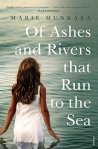
Marie Munkara, Of ashes and rivers than run to the seaThe stories keep on coming, the stories, I mean, of indigenous children stolen from their families and what happened to them afterwards. I’ve posted on Carmel Bird’s compilation of stories from the Bringing them home report, The stolen children: Their stories, and also on Ali Cobby Eckermann’s memoir Too afraid to cry. Now it’s Marie Munkara’s turn with her excruciatingly honest, but also frequently laugh-out-loud-funny memoir, Of ashes and rivers that run to the sea.

Late in her memoir, Munkara learns that she was born “under a tree on the banks of the Mainoru River in Western Arnhem Land.” But, what she writes next is shocking

‘Too white,’ my Nanna Clara said as they checked me out by the camp-fire light, and everyone knew what that meant. Back in those days any coloured babies in my family were given to the crocs because dealing with these things right away saved a lot of suffering later on. It was better that we die in our own piece of country than be taken by the authorities and lost to our families forever.

Does that remind you of anything? It did me – of Toni Morrison’s novel Beloved, and the slave mother’s decision there. Anyhow, knowing what we know now about the lives of many stolen children, we can surely understand her indigenous family’s actions. Luckily, though, for Munkara – and us – Nanna Clara saw something “special” in her, and she was kept. That was in 1960. Three years later, now living on the Tiwi Islands, the inevitable happened and she was taken from home one day when her mother was at work at the mission laundry. Her mother begged for her to be returned, to no avail.

All this, however, we learn near the end of the book. Munkara starts the book when, at the age of 28 and quite by accident, she came across her baptismal card tucked in a book in her parents’ library. It told her that she was born in Mainoru in Arnhem Land. “In the space of an instant,” she writes, “excitement was replaced with mortification as old geography lessons began to resurface” about a “wild and untamed place where Aborigines hunted kangaroos and walked around butt-naked.” However, she decides to find out more, and soon discovers that her mother was still alive and still living in the Tiwi Islands. She decides to go meet her, with no advance notice.

To say that she was shocked by what she found is an understatement. “This is not the tropical island I had imagined,” she writes, “with luscious vegetation and cute little palm-frond houses. It is a dump.” She tries hard to enjoy her time there, but hates it and three days later returns home. However, it’s not long before she realises that she has to return. This ends Part 1 of the four-part book. In Part 2, she goes back in time and tells of her life as the foster child of two unhappy but highly religious people. Her mother was strict, and cruel, but her father was worse. He molested her for many years. A sad, sad upbringing but Munkara, as she admits herself, is a survivor:

But aren’t human beings amazing creatures and even at an early age we can choose to let the bad things in life devour us and we sink or we can make the most of the good bits and swim. … I chose to swim.

Part 2, then, makes for hard reading, but Munkara’s sense of humour, her ability to believe that things will work out, and her independent mind bring her, and us, through. She’s a great story-teller, which makes this section more manageable than you might expect – but it still leaves you angry!

And then we come to Part 3 in which she tells of her return to Bathurst Island. This is where the real interest of the book lies because it is here that Munkara takes us on her journey into another culture. She is us – to a degree. She has been brought up white – albeit “a dusky maiden” version – and her expectations and initial reactions are very much as ours would be. She describes how she tries to apply her whitefella ways to her new life with her Aboriginal family. She expects privacy, cleanliness, order and, most of all, respect for her possessions. None of these sit well with traditional indigenous values as she found them on Tiwi, but she’s determined nonetheless. We can feel her horror and frustration – but she’s telling this story long after the events, and imbues them with a light touch of self-deprecation and a warmth for her family which encourages acceptance rather than judgement (in herself and us).

Some examples:

I spend the day scrubbing the kitchen and neatly place all my things by themselves on a shelf so everyone can see they belong to me, and then I have a well-earnt nap. I sleep soundly and wake up to the smells of cooking. Stretching and yawning I make my way to the kitchen to put on the billy for tea only to stop at the doorway in horror, my mouth still open from the yawn. The room in an absolute shithole of a mess. My stuff is strewn everywhere […] Everyone tiptoes around me now they know I’m in a bad mood and I’m fine with that, maybe they’ll learn not to touch things that they shouldn’t.

and

They are instantly awake when they see that I’m only dressed in my bra and underpants. Thankfully my underwear is matching…

Haha, as if they’d care! And,

… after going to the footy on the weekend with my family for protection I’ve gotten over my fear of big crowds of black people. I now feel quite foolish for thinking they could be harmful to me and reckon I must have gotten this irrational fear from my white parents.

So much of this section resonated with me because it reflected many of the things Mr Gums and I were learning and experiencing as I was reading it. I’ve already posted on the cars, but there’s also the mess, the confusing kinship (including her having to call various dogs her brother, her son, her uncle and so on), the trust in spirits, the lack of concern for possessions, all of which can result in decisions and behaviours mystifying to us whitefellas.

But Munkara also learnt more seriously confronting things, such as that her mother’s damaged leg was caused by leprosy, something she’d thought only happened in the Bible and poor countries:

I slide my ill-informed thoughts into the rubbish bin and slam the lid down tight, angry that our First World country can live in ignorant bliss of our Third World problems. … I bet there wouldn’t be too many white people afflicted with leprosy in Australia because if there were it would be front-page news.

However, while the memoir is, for us, an eye-opening, necessary journey into another culture, it is, ultimately for Munkara, a journey to her self. By the end of Part 3, she has come to a better understanding of who she is:

But they don’t realise that there is no stolen and there is no lost, there is no black and there is no white. There is just me. And I am perfect the way I am. And I know now that I have to leave this place because I’ve learnt all I can for the time being and this lesson is over now.

She only leaves as far as Darwin, however, so she can remain in contact with her family. And so it is that, late in the book, Munkara writes about her (biological) mother’s dying:

When I asked her if she had any regrets she said there were no words in any of our family languages for regret. To regret something was a waste of time so why make a word for something that you didn’t need.

Munkara’s mother’s comment that her language doesn’t have a word for “regret” encapsulates for me the value of reading this book, which is its chronicling of the meeting of two opposing cultures. I thoroughly recommend the book, because understanding what divides us is critical to reconciliation – and because it is a darned good read. She can tell a story, that one!

ANZLitLovers ILW 2018Lisa (ANZLitLovers) has reviewed this book, as has French blogger Emma (Book around the corner) and the Resident Judge. Read for Lisa’s (ANZLitLovers) Indigenous Literature Week.

AWW Badge 2018

Marie Munkara
Of ashes and rivers that run to the sea
North Sydney: Penguin Random House, 2016
179pp. (print version)
ISBN: 9780857987280 (eBook)

Ali Cobby Eckermann, Too afraid to cry (#BookReview)

ANZ Lit Lovers Indigenous Literature Week bannerHaving reviewed Yankunytjatjara/Kokatha woman Ali Cobby Eckermann’s poetry collection, Inside my mother (my review) for Lisa’s ANZlitLovers Indigenous Literature Week, 2017, I decided to also read her 2012 memoir, Too afraid to cry. It filled in a lot of gaps, which is not necessary to appreciate or comprehend the poetry but which does deepen the understanding.

The memoir’s dedication starts with the lines:

this is a poetic memoir
a story of healing
not burdened by blame

And that is pretty well what it is. It’s not an angry book, so much as a sorrowful one. Sorrow about the abuses and losses that affected her childhood and early adulthood, in particular. The sorrow starts early, when she’s young, and abused. She writes of her uncle rubbing her leg inappropriately, and progressing to assault, though she doesn’t say that because she’s only 7 years old. However, while she may not have the language to analyse what was happening to her, she does have the language to describe the feelings:

I felt the icy wind inside my head begin to blow. I could not move. The icy wind is very dangerous.

This “icy wind” becomes a metaphor throughout the book for the abuse, for her memory of it, and for its impact on her psyche until she can no longer cry – “the ice block had turned to stone, and now there was no moisture left inside me”. Hence the title of the memoir.

So, to summarise the book before I delve any further, Too afraid to cry is the story of a young indigenous baby adopted by a non-indigenous family. It’s a good loving family, with parents who, unable to have children, adopted four – two from the mission – and fostered another. But this family, as loving as it is, is a deeply religious one which does not understand the pain experienced by children from a different culture to its own. The result is that Eckermann is left to contend with racism and abuse that she, too, does not initially understand. Here, for example, is a schoolyard experience:

[I] didn’t notice that they had begun to form a circle around me, but I did notice that the icy wind was blowing inside my head and was starting to freeze my guts. Someone held me while other hands pulled my underpants down. There was a strange noise in my ears, like a faraway scream, but I could still hear the sounds of those doing the laughing and teasing. They said they wanted to know if I was the same as other girls. Someone laughed, saying they didn’t know if ‘boongs’ were different. I was frozen with the icy wind roaring through my body. I didn’t want to know what a ‘boong’ was.

Note the “icy wind” again. As childhood turns to adolescence, Eckermann, who had been an excellent student, begins to withdraw from her family and turns instead to alcohol and drugs to cope with the pain and sense of disconnect. It’s not a surprising story, but it’s a useful one for those who don’t understand what disconnection from one’s own culture can do, particularly in a society where difference is not tolerated. Eckermann learns much later, apparently, of the ridicule her adoptive mother had faced for having aboriginal children.

Anyhow, gradually, after many experiences, painful ones, risky ones and some more positive, Eckermann finds her way to her own culture, and healing begins:

Slowly the stone inside me turned to ice and then the ice began to melt. I felt real tears on my face for the first time in my adult life.

What’s remarkable about the memoir – something you may have guessed from what I’ve written – is her ability to get into her head at the time, to write from the point of view of the age and person she was when the things she describes happened, rather writing them as memory that she is now reflecting and commenting on. Of course the telling of the experience, the choosing of which experiences to tell, is a form of commentary, but I’m sure you get my point.

The memoir is remarkable for other reasons too. It’s told in 92 short anecdotal chapters, which are divided into four parts. The style is spare, with short, simple sentences. This is a book which shows rather than tells. Much of the commentary is conveyed through poems inserted between some of the chapters, such as “Heroin” between Chapters 45 and 46. It’s a short poem, like most of hers, and uses repetition and powerful wordplay on the word “arms”, to invoke prostitution, loving and heroin. The last stanza reads:

in their arms
they survive
a modern world.

Some of the poems appear again – the same or sometimes changed* – in Inside my mother.

Another aspect of the memoir, which adds to its sense of almost mythic universality, though is probably also done to protect individuals, is her minimal use of actual names. Her siblings, for example, include Big brother, Foster brother, and some relations are Aunty and Uncle. She does though name her mothers.

Too afraid to cry is an innovative and evocative memoir, which manages to convey hurt and pain, truthfully, but with a generosity that is humbling.

aww2017 badgeAli Cobby Eckermann
Too afraid to cry
Elsternwick: Ilura Press, 2012
224pp.
ISSN: 978-1-921325-29-8 (eBook)

* Changed, I think. I’m writing this in California, and my copy of Inside my mother is back in Australia.

Monday musings on Australian literature: Reading indigenous literature

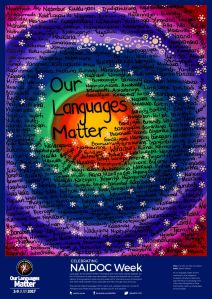
2017 National NAIDOC Poster (used under Creative Commons licence, CC BY-NC-N4 4.0)

Each July, as well as contributing at least one review to Lisa’s ANZLitLovers Indigenous Literature Week, I try to write a Monday Musings post related in some way to NAIDOC week which, as Aussies will know, is a week, usually the first full week in July, during which activities are planned to “to celebrate the history, culture and achievements of Aboriginal and Torres Strait Islander peoples”. Each year there is a theme, and this year it’s a good one, Our languages matter.

I have for as long as I can remember – since high school anyhow – been interested in social justice and civil rights (as we called it in the 1960s & 1970s). I read a lot back then about indigenous Australians and African-Americans in particular, such books as Douglas Lockwood’s I, the Aboriginal and Katharine Susannah Prichard’s Coonardoo. These books helped fire my feelings about injustice: they showed me some of the impacts of the inequities stemming from racism and of course they touched my emotions.

However, the only indigenous Australian writer I remember reading was Kath Walker as she was known then (or Oodgeroo Noonuccal as she became), until I read Sally Morgan’s My place in 1988. These writers started to help me see and feel, under the skin, the experience of being indigenous in Australia.

Now, if you keep up with discussions about the value of reading, you are sure to have read the various arguments for, or theories about, how reading can improve empathy. There was a Scientific American article in 2013 which reported that “Researchers [Emanuele Castano, a social psychologist, and PhD candidate David Kidd] in New York City have found evidence that literary fiction improves a reader’s capacity to understand what others are thinking and feeling.” Another article in The Washington Post in 2016 reported on cognitive psychologist Robert Oatley’s research of over a decade and his conclusion “that engaging with stories about other people can improve empathy and theory of mind”, resulting in improved “social ability”.

There are the naysayers to these arguments, of course, and I don’t know if reading fiction has increased my ability to empathise or not, but I can’t help agreeing with novelist Joyce Carol Oates’ statement that “Reading is the sole means by which we slip, involuntarily, often helplessly, into another’s skin.” “Sole” may be pushing it too far, but otherwise here’s my experience … and I fear I’m a bit clumsy in putting it but hope it makes sense!

I have become aware in recent years that my understanding and awareness of indigenous lives has deepened beyond the intellect and simple empathy, to a level of “knowing”.  In other words, I knew about – and could empathise with – the sense of loss, anger, disempowerment that those earlier, mostly non-indigenous writers described, but now that empathy is increasingly underpinned by knowledge of how dispossession plays out. I can never know what such historic dispossession does to a person’s psyche from personal experience but reading writers like Kim Scott, Alexis Wright, Jeanine Leane, Marie Munkara and many others, has given me the next best thing.

To labour it a little more: because I “know” my white anglo culture, I can can more quickly understand the context for a story about a gay man or an abused wife even though I’m neither of these. The leap to real empathy, which I’m arguing requires a thorough understanding of the underlying culture, is not a big one when people come from my own world. When they don’t, I can empathise at a human level – at the level any of us can when we see someone else in pain, struggling, angry, triumphant, and so on – but I sense that it’s a shallow empathy that doesn’t comprehend the forces behind that pain (etc). How do you get to comprehend those forces?

Well, Jeanine Leane, as I wrote in a recent post, says you need to immerse yourself in the “other’s” culture, in her case, indigenous Australian culture. For most of us, however, this is very difficult, if not impossible, but Leane argues that reading indigenous literature, that is writings by indigenous people about indigenous people’s lives, is a way in which we can engage with the culture. In her book, Position doubtful, which I reviewed recently, Mahood talks about the moments she waits for when, in a sense, a lightbulb turns on, when she experiences “a cognitive shift”. It’s that cognitive shift that I feel happening as I read more and more indigenous authors (of both fiction and non-fiction, particularly memoirs). It manifests in the fact that I don’t have to recalibrate my bearings so much when I open a book by an indigenous author. Certain things are givens – such as the original dispossession, the stolen generations, relationship to country. I don’t have to work to understand these, as I read, they’re there.

I hope this doesn’t repeat too much what I’ve written before, and I hope that it doesn’t sound arrogant, because it’s not meant to. I certainly know that I have much more to learn and understand. However, while I read and listen to commentaries in papers, on television, via the radio, it is through the indigenous writers I’ve read that what once felt more like information is now becoming a truth. I think that’s a powerful thing – and is why I’d argue that more Australians need to read more indigenous authors.

Larissa Behrendt, Under skin, in blood (Review)

ANZLitLovers ILW 2016In my last review – that for Ali Cobby Eckermann’s Ruby Moonlight – I shared the following lines:

Jack knows the remainder of the conversation
before it was spoke ya see any blacks roaming
best ya kill ’em disease spreading pests
(“Visitor”, from Ruby Moonlight)

Quite coincidentally, this point I was making, that it was not “the blacks” who brought disease, turned out to be the subject of my second choice for Lisa’s 2016 Indigenous Literature Week, Larissa Behrendt’s short story, “Under skin, in blood”. I chose it because I wanted to read at least something by Behrendt.

The story is told in first person by an older woman – called Nana Faye by Merindah, the granddaughter she’d raised – and is divided into three parts. The first and third parts are set in the present while the middle part flashes back to Faye’s past as she tells us why she no longer has her husband and son (Merindah’s father).

In the present, Faye (and Merindah) live in Faye’s grandmother’s country, Gadigal land, around Sydney. But Faye spent her married life, the place where Merindah was born, in Baryulgil on the land of the Bunjalung people. Faye’s flashback is inspired by a discussion she has with university student Merindah who is researching the Northern Territory’s Kahlin Compound, a place to which “half-caste children” (members of the Stolen Generations) were taken between 1911 and 1939. It had – and here you’ll start to understand my introductory paragraph – high rates of leprosy. Merindah is researching claims – claims which have indeed been made and researched – that children there were used as guinea pigs for leprosy drugs. Whether or not these claims are true – they may never be fully resolved due to lack of records – the case causes Faye to comment that the most lethal things white settlers brought to Australia were not guns and alcohol but “microbes” which were “flowing through their veins, floating in their blood, under that skin like bark from a ghost gum tree”. Leprosy, in other words, and malaria, small pox, syphilis, influenza. These killed more indigenous people in the first year of white settlement than bullets.

But these microbial-based diseases are not the main focus of Faye’s memories. It’s the mine in Baryulgil, the mine that opened in 1944 and which everyone thought made them lucky. Having lost their land to the pastoralists, but having decided to stay to be close to their country, the people suddenly found they had jobs – but, what were they mining? Asbestos! Faye tells of the tragic impact asbestos had on her husband Henry and son Jack:

… the mine we felt lucky to have, that gave us the benefits of work and kept the community together was slowly but surely killing us.

The scandal is that there was awareness of deleterious health effects of asbestos in the early 20th century, and certainly by the 1960s its relationship to mesothelioma was recognised. Australia’s best known asbestos mine, Wittenoom, was closed in 1966, ostensibly for economic, not safety reasons. It is telling though that Baryulgil was not closed until 1979. Faye says that the official enquiries that came later found

the mine was barely profitable and only continued to operate to prevent permanent unemployment among the Aboriginal workers in the area. Turned out this employment that was supposed to be doing the community a favour was actually a death sentence.

So, Wittenoom was closed more than a decade earlier because it wasn’t profitable, but different decision-making was used for Baryulgil. Now, normally, I’d approve of decision-making that took into account social values but this one is a bit suss.

This is, I have to say, a fairly didactic story. It could almost have been an essay, except that Behrendt has clearly thought, as she in fact says in her interview with Annette Marfording, that telling it as a story, showing the impacts of policy on human beings, would be the more effective way to go. So, while the story imparts a lot of factual information, Faye shares the devastating impact on her of losing her husband and son. She also tells how indigenous cultural practices work to their disadvantage in a white world. She says:

The hardest thing is to trust these people. These people who have the power of life or death over you, and use that power carelessly. These people we are mute to argue against. And our words never seem a match for what they wrote down, even though we have good memories and they make mistakes.

Now, that is probably the most important message in the story.

awwchallenge2016Larissa Behrendt
“Under skin, in blood”
in Overland (203), Winter 2011
Available online

Ali Cobby Eckermann, Ruby Moonlight (Review)

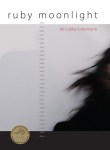
ANZLitLovers ILW 2016Ali Cobby Eckermann has been on my radar for a while, so when Lisa announced her 2016 Indigenous Literature Week, I decided Eckermann’s verse novel Ruby Moonlight would be my first choice. This novel won the poetry prize and the book of the year in the 2013 New South Wales Premier’s Literary Awards.

I enjoy verse novels but don’t read them often enough to build up a comprehensive understanding of the form. Eckermann’s Ruby Moonlight is the shortest and sparest of those I’ve reviewed on this blog, but its narrative is just as strong. It is set in colonial South Australia – the not-very-poetic subtitle being “a novel of the impact of colonisation in mid-north South Australia around 1880” –  and tells the story of Aboriginal teenage girl, Ruby Moonlight, whose family is massacred by white settlers. The novel reads like a classic three-act drama. It opens with the massacre and Ruby’s lonely wanderings, and then moves into a somewhat idyllic phase when Ruby meets the also lonely “colourless man”, Miner Jack. They become friends and lovers, giving each other the company and warmth they both so desire:

good friendships
blossom
slowly
(from “Friends”)

and

in the moonlight
solace is shared
in this forbidden friendship
( “Solace”)

But it can’t last, of course, not in that place and time, because neither the colonisers nor the Aboriginal lawmen will accept it: “it is the oasis of isolation/that tolerates this union”. Nothing else.

Ali Cobby Eckermann, Ruby MoonlightThe poetry, as you can see from my excerpts, is spare. There’s no punctuation, not even apostrophes, and no capitalisation except for proper names. Lines are generally short, and description is generally minimal. There’s a lovely but restrained used of repetition, and the rhythm is matter-of-fact, that is, it moves the story along with few flourishes (if that makes sense). The story is told through separately titled poems, each of which occupies its own page, though some only part of it. The titles are simple and to the point – “Ambush”, “Friends”, “Oasis”, “Hate”, “Cursed”, “Sunset”. You could almost track the trajectory of the story through its titles. This spareness, I think, enhances the emotional power. The poems say what they need to say without embellishment.

The excerpts above are from more narrative-focused poems, but there are also poems which provide context, describing the seasons as time passes, commenting on the landscape within which our characters operate, providing a sense of the country’s spirits watching, tending, ready to act. The novel opens on the poem “Nature” which sets the scene perfectly by conveying the opposing faces of nature – “sometimes/turning to/butterfly” or sometimes just to “dust” – which also subtly heralds the coming massacre. And, a few poems in, soon after the massacre, comes one describing nature’s nurturing of Ruby:

chirping red-browed finches lead to water
ringneck parrots place berries in her path
trust nature
(“Birds)

The words “trust nature” are repeated at the end of each couplet in this poem, providing a soothing mantra for Ruby.

Most of the poems are presented in couplets or triplets, but occasionally one uses a different structure, usually to mark a dramatic change. Early in the novel is the devastating, shaped-poem, “Ambush”, in which all lines but one comprise single words (“hack/hack/hack” it starts); and half-way through is another shaped-poem, “Tempo”, which marks both the passing of time and acts as a transition from a short time of idyll for Ruby and Jack to the appearance of others:

Jack knows the remainder of the conversation
before it was spoke ya see any blacks roaming
best ya kill ’em disease spreading pests
(“Visitor”, immediately after “Tempo”)

The irony of it! Who brought disease?

So, Ruby and Jack. One of the delights of the book is the sympathetic representation of these two characters. Bereft after the loss of her family, Ruby stumbles across Jack, a loner who scrapes a living out of fur-trapping. Both are outcasts in colonial Australia, Jack an Irishman, a hated “Mick” (“a music-less man stands aloof at the bar/scowling his hatred for the Micks”, from “Loose”) and of course Ruby, a lubra or black woman. These two cautiously find a “small trust … growing” (“Solace”) between them, but it is a “forbidden friendship”, forbidden from both cultures, so their times together are snatched carefully. Ruby is watched by members of another mob, people who are “slowed by fatigue” and “weary with worry” (“Signs”), and who know the dangers:

camp smoke whispers
tell story of the killings
(“Whispers)

Jack and Ruby become the target of the aforementioned “music-less man” – a man who’d lost his “music heart” after an act of barbarity – and his hired help, two brothers “with rotten teeth smirks” (“Scheme”). Hatred and greed fuel these men. And so the scene is set, but it doesn’t quite play out the way you expect, because Eckermann wants to focus more on our universal need for warmth, love and companionship, and also on survival.

The novel is imbued with indigenous presence, from the opening where Ruby’s family live in “Harmony” in their environment, through her meeting with the other mob, the Cloud people, “on their winter trek”, to the appearance of “Kuman”, her guardian spirit who guides her to safety.

Ruby Moonlight is a special read that adds another perspective and voice to colonial contact narratives, a voice that pays respect to indigenous law and traditions, addresses the politics of contact, but also recognises our personal and universal need for love and companionship. It’s a warm and generous book, but it doesn’t pull punches either. A good read.

awwchallenge2016Ali Cobby Eckermann
Ruby Moonlight
Broome: Magabala Books, 2012 (2015 reprint)
74pp.
ISBN: 9781921248511

Monday musings on Australian literature: Spotlight on Larissa Behrendt

Courtesy: Annette Marfording

Courtesy: Annette Marfording

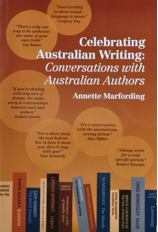
This is the fourth in my occasional series of Spotlight posts inspired by Annette Marfording’s Celebrating Australian Writing: Conversations with Australian Authors, and this time I’m featuring an indigenous author to coincide with Lisa’s (ANZLitLovers) Indigenous Literature Week.

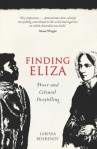
Larissa Behrendt is the perfect subject for what is also NAIDOC Week, not only because she has a few books under her belt, but also because her new book published earlier this year, Finding Eliza, explores how colonisers have written about indigenous people. Behrendt is a Eualeyai/Kamillaroi woman, and in her interview with Marfording describes herself as a Type A person. Looking at what she has achieved in her less that 50 years I can well believe it. She is currently Professor of Indigenous Research and Director of Research at the Jumbunna Indigenous House of Learning at the University of Technology, Sydney. She has won awards for her fiction, and been on the boards of various arts organisations including the Sydney Writers Festival, Bangarra Dance Theatre and the Museum of Contemporary Art. She was the National NAIDOC Person of the Year in 2009 and NSW’s Australian of the Year in 2011. As a lawyer, she has served on many boards, review committees and land councils, most of them indigenous-related. The list is impressive.

Marfording’s interview occurred in August 2010. As she does with each of her interviews, Marfording commences with a brief biography of her subject at the time of the interview, and follows the interview with a biography update to the time of publication. It’s nicely done.

I particularly loved this interview not only because Marfording asks, as she does in all the interviews, thoughtful, relevant questions showing her understanding of the subject, but because in this interview she covers some issues of particular interest to me. More on that anon.

Marfording asked Behrendt, as she tends to ask all award-winners, what winning awards means to her. Behrendt admits that it is affirming to win an award but also says that the richest prize is when a reader tells her that a book “touched” them or that it’s “like me and I never see myself in a book”.

Some of the questions Marfording asked relate to the autobiographical nature of her work, as her two novels, Home (2004) and Legacy (2009), both draw strongly on her family, with Home looking particularly at the stolen generation issue and Legacy being more specifically about her father and her relationship with him. She said that although Home was heavily fictionalised, her father found it hard to read. “It was flattering to me as a writer,” she said, “because it meant I’d got it right.”

Marfording also questioned Behrendt about the fact that her two novels also tend to be issue-based. As a fiction reader, I loved Behrendt’s response. She said that, as a lawyer, she has advocated and written factual pieces on many of the same issues, but that

telling a story that actually explains how a policy can impact on somebody’s life so personally, telling that story from a really human point of view, can influence more people than the most eloquent legal argument, especially when you can talk to somebody through the universals that they understand, like the love between siblings, the love between parents, etc.

I love this reference to universals – to the things that bring us all together. She mentions them again later in the interview, but here I want to share her gorgeous language. She said:

I’ve got very strong opinions, and I think it was a real learning process to learn that sometimes it’s through the whisper of a story that you can influence people more than through the louder, shouting style of activism.

There were other questions too, but I want to conclude on two that focused on her as an indigenous writer, one on labelling, and the other on the issue of non-indigenous people writing about indigenous people (which, as you know, I’ve raised here a few times).

Regarding labelling, Behrendt described it as a complex question. While she has no problem being identified as an indigenous writer, she said it can become problematical when writers are pigeonholed. For example, at the Byron Bay Writers Festival she was invited on a panel discussing “fathers”, a panel that recognised the diversity of perspectives, but in many festivals indigenous writers are lumped together on a panel about indigenous writing. She said that:

What we like to say is that within our writing – and I think that’s true of every Aboriginal author – there are universal themes about family, about love, about betrayal, about hurt, about anger and jealousy, and these are the things that actually unite us.

It’s a problem, in other words, when indigenous authors are seen to be writing only about indigenous subjects. Love it. The comment reminded me of Ellen van Neerven’s Heat and light (my review) in which some of the stories didn’t focus on or clarify race or ethnicity of the characters. They were just about people. For Behrendt, any story – whether the focus is an indigenous issue or not – is, essentially, about universals.

Larissa Behrendt, Finding ElizaAnd finally, that issue about non-indigenous writers writing on indigenous people. Again Behrendt is thoughtful rather than dogmatic. She says she’s always interested in how non-indigenous people portray indigenous people – hence, obviously, Finding Eliza – but that it’s difficult for them to do it authentically because they don’t know enough about Aboriginal life and culture. The reverse is a little different because Aboriginal people are “so bombarded with the dominant culture”. She identifies some writers who have not done it well – albeit she respects their hearts – and then names some who have impressed her. Kate Grenville in The secret river is one. Grenville, she says, doesn’t try an Aboriginal point of view. Instead

through using her non-indigenous characters, by showing their ignorance, their violence, their sense of entitlement, their fear, she tells a very strong story about Aboriginal experience. You read her book and you know exactly what it was like for Aboriginal people.

Grenville talks in Searching for The secret river about the issue of presenting the indigenous perspective. It was something she thought carefully about. Nice to see she’s been vindicated, in the eyes of Behrendt anyhow. The other effective portrayal she offers is Liam Davison’s The white woman. (Davison was tragically killed in the MH-17 disaster, and Lisa reviewed The white woman, as well as his other novels, as a tribute to him.) Behrendt says that Davison tells the story of massacres in Gippsland but relates

the story from the perspective of somebody who goes out as part of those hunting parties, and by getting into the psyche of the kind of person that can actually commit the most brutal aspects of a colonisation of a land, he tells a very strong story about Aboriginal people.

So, while she doesn’t see it as a no-go zone for non-indigenous writers, she does believe that the level of ignorance makes it a difficult challenge.

Another great interview with a writer who’s been in my list of must-reads for a long time. I’ll be starting soon with a short story. Watch this space.

Previous Spotlight posts:

Annette Marfording
Celebrating Australian Writing: Conversations with Australian Authors
Self published, 2015
273pp.
ISBN: 9781329142473

Note: All profits from the sale go to the Indigenous Literacy Foundation. To find out where you can purchase this book, please check Marfording’s website.


Monday musings on Australian literature: Recent books by Indigenous Australians

Next week, from 3rd to 10th of July, Lisa at ANZLitlovers is running her now annual Indigenous Literature Week. While she usually holds it during or near Australia’s NAIDOC Week in order to support that program’s goal of increasing awareness and understanding of indigenous Australian culture, she does in fact accept reviews of works by any indigenous authors worldwide. In other words, you don’t have to be or read Australian to join in, so if you’d like to raise awareness of an indigenous culture near (or not so near) you, do head over to her blog (link above) and make your contribution.

Lisa has included links to lists of indigenous Australian books, including her own, to get people started, so I’m not going to repeat that. But, for my own benefit as well as to support Lisa’s week, I thought I’d suss out and share some works – across genres and forms – that have been published in the last 12 months or so. It’s a serendipitous list:

  • Tony Birch, Ghost riverLarissa Behrendt’s Finding Eliza: Power and colonial storytelling (UQP, 2016): historical analysis of how indigenous people – in Australia and elsewhere – have been portrayed in stories by the colonisers.
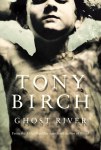
  • Tony Birch’s Ghost river (UQP, 2015) (my review): novel set in working class Melbourne in 1960s; long-listed for the 2016 Miles Franklin Award.
  • Ali Cobby Eckermann’s Inside my mother (Giramondo, 2015): poetry collection.
  • Lizzie Marrkilyi Ellis‘ Pictures from my memory: My story as a Ngaatjatjarra woman (Aboriginal Studies Press, 2016). (Yvonne’s Stumbling through the past review): memoir by a Central Australian woman.
  • Stan Grant’s Talking to my country (Lisa’s ANZlitLovers review): memoir, exploring the complicated experience of growing up black in a white dominated world.
  • Ambelin Kwaymullina’s The foretelling of Georgie Spider (Walker Books, 2015): the last in her Young Adult fantasy series, the Tribe trilogy, set in a post-apocalyptic world in which Aboriginal culture and philosophy play a significant role.
  • Marie Munkara’s Of ashes and rivers that flow to the sea (Vintage, 2016): memoir about her search for her origins. (I read her David Unaipon award-winning Every secret thing, and loved her voice)
  • Lesley and Tammy Williams’ Not just black and white (UQP, 2015) (Lisa’s ANZLitLovers review): won the David Unaipon Award in 2014

I decided to focus just on 2015 to 2016, but in my research I included the new biennial Indigenous Writers Prize in the New South Wales Premier’s Literary Awards, and found that the 2016 joint winners were books published in 2014, so I’m including them too:

  • Bruce Pascoe’s Dark Emu (Magabala Books, 2014) (Lisa’s ANZLitLovers review): analyses pre-colonial indigenous Australian culture suggesting that it was more “settled” than the common “hunter-gatherer” assumption. (I’ll be reading this with my reading group later this year.)
  • Ellen van Neerven’s Heat and light (UQP, 2014) (my review): collection of stories, some connected, some not, and including a longform speculative story, about living as an indigenous person in contemporary Australia.

But what am I hoping to read? First up, an older book, Ali Cobby Eckermann’s Ruby Moonlight, followed by, if I have time, a newer one, Stan Grant’s Talking to my country.

Do you make a point of reading indigenous literature? And do you have favourites?

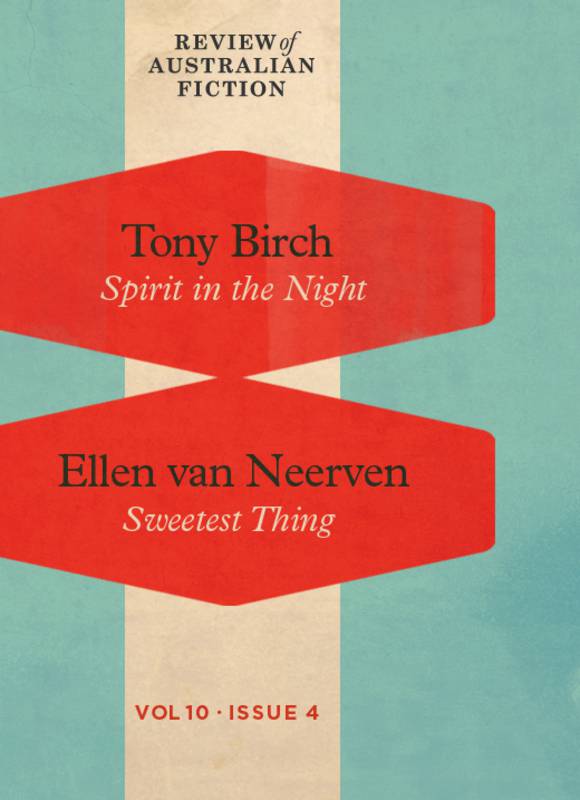
Tony Birch and Ellen van Neerven in Review of Australian Fiction 10 (4)


Review of Australian FictionI have been wanting to write about the oddly titled Review of Australian Fiction for some time. I say oddly titled because, contrary to what it might sound like, this does not contain reviews but short fiction. Established in 2012, it is published, electronically (or digitally), every two weeks. Each issue contains two stories by Australian authors: one by an established author, and the other by an emerging author, chosen by the established author. Funnily, in the issue I’m reviewing here, it’s the emerging author, Ellen van Neerven, whom I’ve read before, not the established one, Tony Birch. But, I’m so glad that Lisa’s Indigenous Literature Week has given me the opportunity to a) finally read something by Birch, and b) finally read Review of Australian Fiction issue.

Tony Birch, “Spirit in the night”

Birch’s story is told first person by a young indigenous boy, the 11-year-old Noah Sexton. He’s dirty, smelly, poorly dressed, and no-one wants to know him – except the new girl, Heather, who invites him to sit next to her. She’s “the cleanest person I’d ever seen” with “no pox rashes, bites or scars like I had”. At lunchtime, Heather offers the hungry Noah a sandwich and engages him in conversation. She asks him why he sits alone, and he gives the classic reply:

‘I sit here because I’m a Sexton.’

She doesn’t know what that means of course. When he discovers that her father is the policeman “in charge of the station”, he assumes:

Our mob was well known to the police, and I knew straightaway that as soon as her father got the story on the family name, she wouldn’t be sitting under any tree offering me a vegemite sandwich.

But, it doesn’t quite work out the way he expected. When he explains to the friendly Heather that he’s from “the only abo family left in town”, she tells him that “abo” is “a dirty word” and that “people like you, we call them half-castes. It’s more proper”. Noah disagrees, telling her that “an abo’s an abo, no matter how black or white he is … Far as whitefella is interested, the shit smells just the same.” Heather shows discomfort at this language, but Noah doesn’t care. He’s “beginning to think she was only another do-gooder”. He tells her about how his people have been treated in town, but Heather tells him her father will be different, that “he’s always fair, to both sides”. Not surprisingly, Noah is (silently) sceptical. Nonetheless, this little bit of kindness from Heather brings out a new sense of self in Noah – he doesn’t wolf down the sandwich, pretending he has a few manners, and when he gets up to go into school after that first lunch he dusts his pants off “for maybe the first time in my life”.

And so Heather spends most lunchtimes with Noah, because she’s a Christian and it’s “a sin to turn away from those in need”. Noah doesn’t like being seen as a “charity case” but is so enamoured of Heather that he’ll “put up with anything”. Understandable, given his treatment at school before.

I won’t describe any more. This is a clever story about do-gooders. Birch has astutely chosen for his protagonist a young boy on the cusp of puberty. Noah, straddling that line between childhood and adulthood, has a sense of his agency, and yet not quite the experience, nor the resources, to insist on enacting it. It’s a story about confused emotions, and about smugness and self-satisfaction. It’s about the right to dignity, and, of course, about power.

Ellen van Neerven, “Sweetest thing”

awwchallenge2015Unique, original, fresh are words I avoid when writing reviews, not only because they feel cliched but because they can be contested by anyone whose reading experience is wider than mine. So, instead, I’ll just comment on Ellen van Neerven’s capacity to surprise. I found it in her Heat and light which I reviewed earlier this year, and in “Sweetest thing”.

“Sweetest thing” is a third-person story about Serene, the child of an indigenous mother and the town’s Dutch baker. She is addicted to having her breasts suckled. It all started in puberty (“that pertinent time of a woman’s life”) with her first experience of having a man suckle her breast occuring with a male tutor when she’s nearly fourteen. He lifts up her shirt:

Beautifully out of herself, she was open and messy and dislocated like a bouquet being readied for a vase, flowers, stems, spores spread everywhere.

Nothing else happens besides this suckling, but Serene feels “bliss” and “knew then that this was what she had been programmed to need”. Slowly, as Serene schemes and positions herself to have her need met, we learn about loss. We learn, for example, about the Kedron pub, which “had refused Serene’s grandparents entry” but which is now

a haunt for women of her mother’s ilk: divorced, discarded, with loose threads of long silent and secret relationships carried under their shirts.

Under their shirts. A reference to their breasts? We learn about the gradual withdrawal of her father as he starts to focus on his “real daughter”. Serene feels anger at “the silence in her life, at his hypocrisy”.

Born into this in-between world – not quite rejected as her grandparents were, but not fully accepted either – Serene believes she deserves “comfort, worship, devotion. Trust and understanding”, but fears “hollowness”.

And so, her life progresses through school and early womanhood into mature adulthood. She has friends, she experiences casual sex, she becomes a masseuse – but still there’s the need for suckling, to have “the most basic of her needs met”. Again, I’ll leave the story here. It’s longer than Birch’s and spans a few decades of Serene’s life, which includes a meaningful relationship and a successful career.

“Sweetest thing” is an edgy story. Serene’s unusual addiction works as a rather confronting metaphor for what all humans need – love and acceptance. What I like about Van Neerven, here and in Heat and light, is that her indigenous characters are not “types”. Their indigeneity is part of who they are, and is fundamental to the challenges they confront, but her characters are also “universal” – that is, they are needy, flawed characters who muddle along, just as the rest of us do, in the lives they find themselves in. It’s powerful stuff.

ANZ_ILW2015Read for ANZLitLovers’ Indigenous Literature Week.

Tony Birch, “Spirit in the night”
and
Ellen van Neerven, “Sweetest thing”
in: Review of Australian Fiction 10 (4), May 2014

Monday musings on Australian literature: NAIDOC Week 2015

Australians will be aware that this week, July 5 to 12, is NAIDOC Week. NAIDOC originally stood for National Aborigines and Islanders Day Observance Committee, the committee that was once responsible for organising national activities during NAIDOC Week. However, this acronym has now become the name of the week, which suggests just how significant, and well-accepted, this week is now on Australia’s calendar.

The Week aims, as you would expect, “to celebrate the history, culture and achievements of Aboriginal and Torres Strait Islander peoples”, and in doing so, to encourage all Australians to recognise and better understand indigenous Australians. Each year the week has a theme, and this year it is We all Stand on Sacred Ground: Learn, Respect and Celebrate.

This theme, according to the NAIDOC website

highlights Aboriginal and Torres Strait Islander peoples’ strong spiritual and cultural connection to land and sea. The theme is an opportunity to pay respects to country; honour those who work tirelessly on preserving land, sea and culture and to share the stories of many sites of significance or sacred places with the nation.

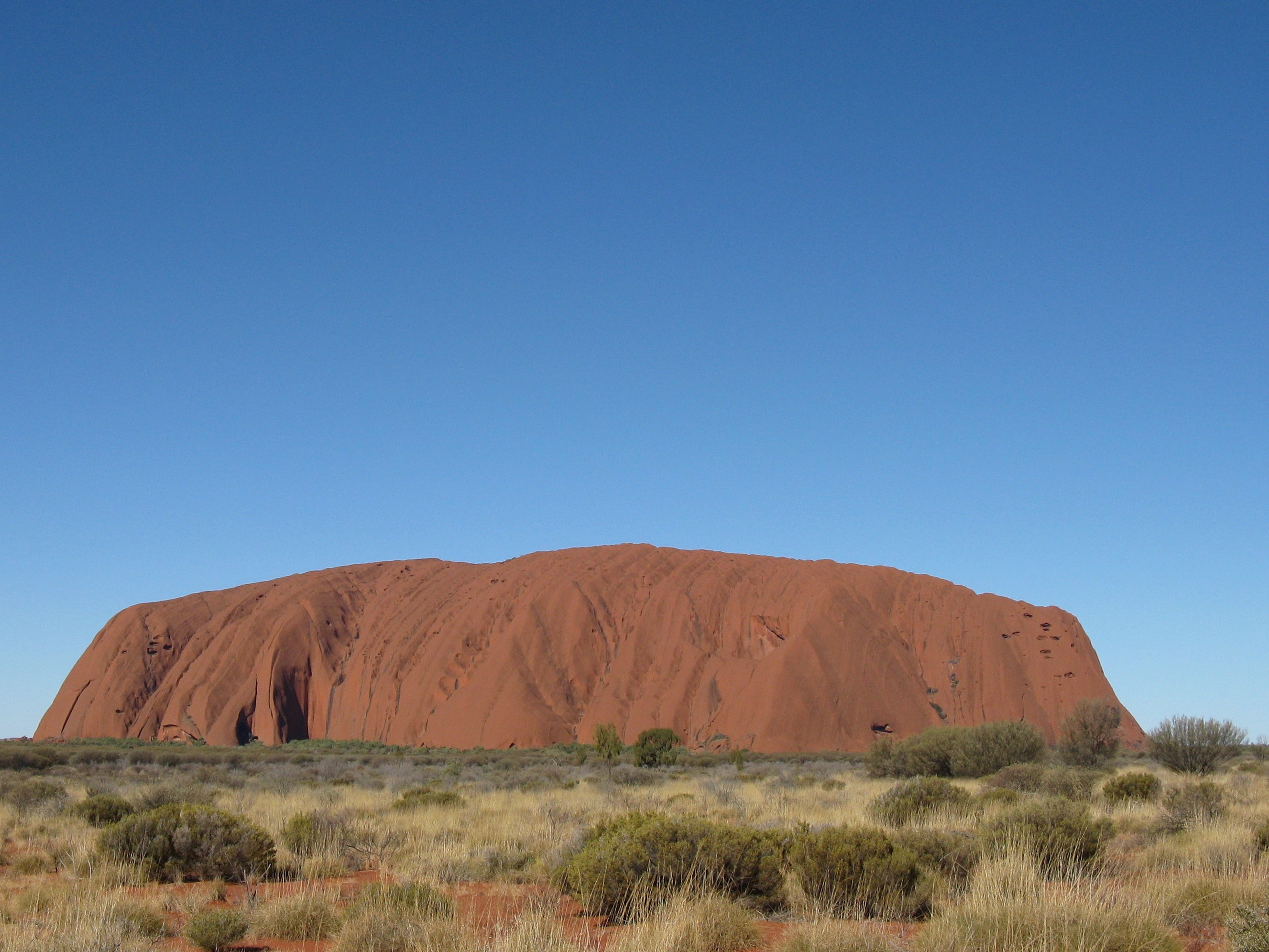
Uluru

Uluru, taken August 2009

The site also tells us that this theme was particularly chosen this year “to highlight and celebrate the  anniversary of the ‘Handback’ of Uluru, one of these sacred sites, to its traditional owners on 26 October 30 years ago”. To that I say, wonderful, as I am visiting Uluru for my third time later this month.

I know my ways of celebrating and supporting indigenous Australian culture are pretty tokenistic in the scheme of things, but in the spirit of this week I thought I’d share with you some of the rather eclectic things I do throughout the year as the opportunities arise:

  • engage with local indigenous culture when I travel, mostly through tours led by indigenous Australians;
  • attend exhibitions featuring indigenous Australian art and culture, ancient, traditional and contemporary;
  • donate to the Indigenous Literacy Foundation;
  • attend performances by the Bangarra Dance Theatre; and,
  • read Indigenous Australian literature (though I don’t seem to read anywhere near as much as I’d like to).

It’s this last way, of course, that is most appropriate to my blog, so to mark this NAIDOC Week, I’m sharing links to posts written by me, and, with her permission, Lisa Hill (ANZLitLovers), on Indigenous Australian literature:

Some of you will know that Lisa has for the last few years run an Indigenous Literature Week during NAIDOC week but, as she wrote recently, this year she plans to run it to coincide with the First Nations Australia Writers’ Network Workshop which will be held in Melbourne next month. Watch out for that.

Meanwhile, Lisa and I hope our links help you discover more about Indigenous Australian culture through literature.

Monday musings on Australian literature: Indigenous writers recommend …

Last week, to commemorate the beginning of NAIDOC Week, I devoted Monday Musings to Anita Heiss’s series of interviews with indigenous Australian writers, In conversation with BlackWords. I said then that this week’s post would also draw from the series – and so here it is.

I’m not 100% sure of Heiss’s process, but I think she sent the same set of questions to all writers, and they answered some or all of questions as they desired. I am focusing, in this post, on one of the questions. Seventeen of the twenty writers responded to it. The question is:

What book do you think every Australian should read?

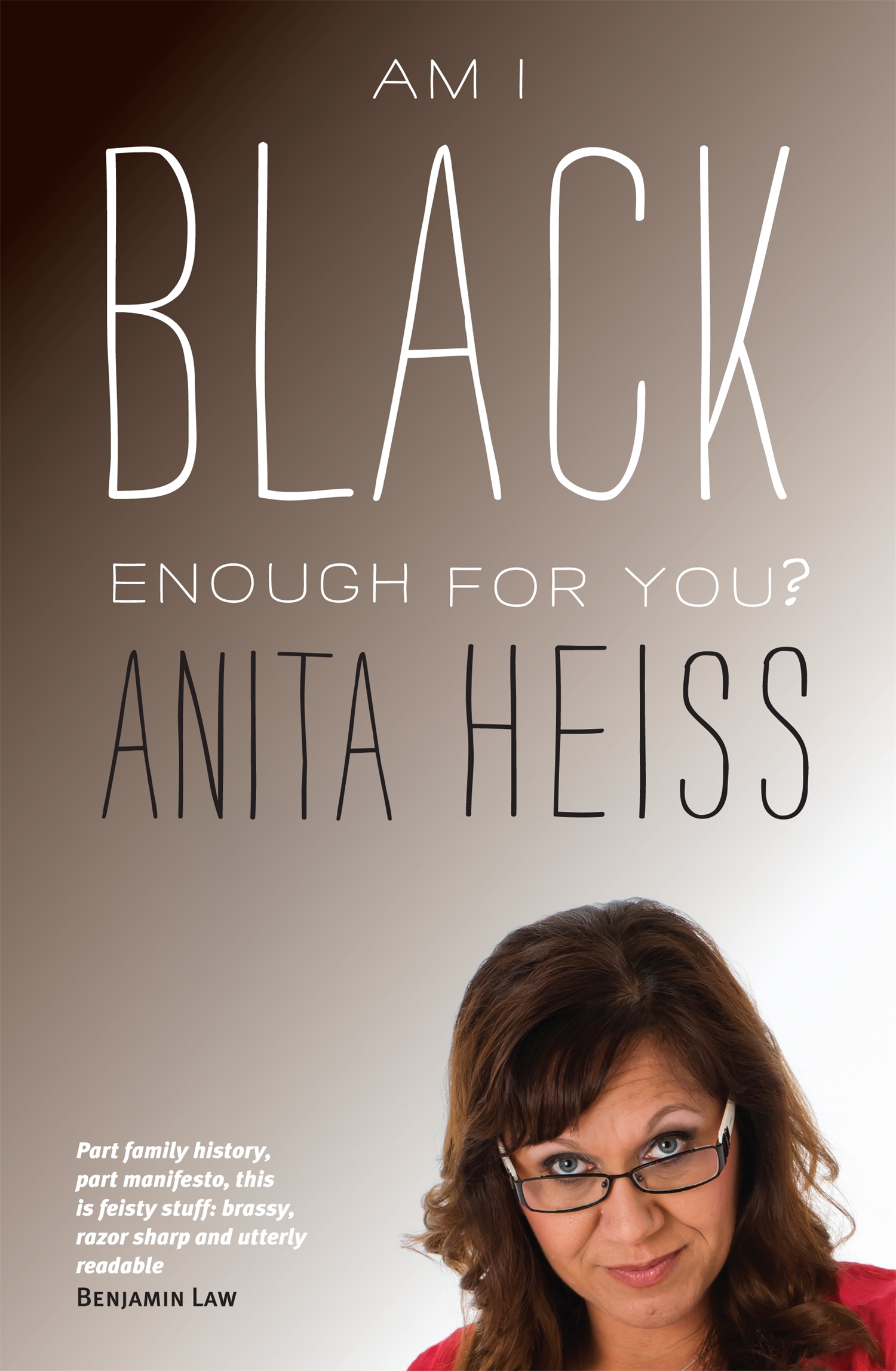
Anita Heiss, Am I black enough for you?

Courtesy: Random House

The answers are fascinating. Most, as you would expect, recommend books that would help all Australians learn and understand more about indigenous culture and history, and the books they recommend are mostly by indigenous Australians. But, the interesting thing is that there’s a lot less duplication than I expected. I like this. It suggests the existence of an active indigenous literary culture. No simple, easily defined cannon here! It provides a great list for us all to go to – both now, and when we are planning for ANZLitLovers’ 2015 Indigenous Literature Week.

Anyhow, I thought, when I decided to do this post, that I could tally up the recommendations and list them in popularity order. But, given what I actually found, I have decided instead to simply list them in alphabetical order by author/editor, with the name of the recommender/s and comments where appropriate.

  • Berendt, Larissa: HomeEllen van Neerven called this “A very important book.”
  • Carey, Peter*: True history of the Kelly GangJared Thomas said it “alerted me to class struggle – the fact that it is not only Aboriginal people who have endured persecution in this country.”
  • Chi, Jimmy: Bran Nue Dae (script). Kim Scott.
  • Eckermann, Ali Cobby and Fogarty, Lionel (eds): Southerly, Vol 71, No. 2, 2011, “A Handful of Sand: Words to the Frontline”. Lorraine McGee-Sippel described this as “An invaluable resource of Australia’s First Nations writers … Across all genres, ages and life experiences”. She believes is should be “compulsory reading … in all high schools and universities”.
  • Eckermann, Ali Cobby: Ruby MoonlightBruce Pascoe.
  • Gammage, Bill*: The biggest estate on earthKim Scott simply said “an important book”.
  • Gilbert, Kevin: Because a white man’ll never do itKerry Reed-Gilbert, his daughter.
  • Green, Evan*: Adam’s empireSue McPherson described it as “a good Aussie story. It should be made into a film.”
  • Haebich, Anna*: For Their Own GoodKim Scott said that it “focuses on south-west Western Australia, but the power relationship it articulates applies across the continent”.
  • Heiss, Anita: any book. Lionel Fogarty gave Heiss as an example in recommending “Indigenous-authored books such as those by Anita Heiss.
  • Heiss, Anita: Am I black enough for you? Jared Thomas, Bruce Pascoe (my review)
  • Heiss, Anita and Minter, Peter (eds): The Macquarie PEN Anthology of Aboriginal LiteratureKerry Reed-Gilbert.
  • Leane, Jeanine: Purple threadsMelissa Lucashenko (my review).
  • McMullen, Jeff*: any writing. Samuel Wagan Watson.
  • Maynard, John: Fight for liberty and freedom. Recommended by himself.
  • Munkara, Marie: Every secret thingBruce Pascoe (my review).
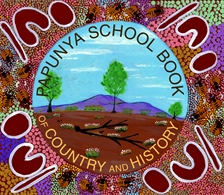
  • Papunya School with Nadia Wheatley and Ken Searle: The Papunya School Book of Country and HistoryAnita Heiss likes this because it is “accessible to all”.
  • Pascoe, Bruce: works by him. Recommended by himself.
  • Pascoe, Bruce: EarthMelissa Lucashenko.
  • Pilger, John*: A secret countryKate Howarth.
  • Reynolds, Henry*: any book. Kerry Reed-Gilbert argued that “it’s time for people to know the truth of this country”; Samuel Wagan Watson.
  • Reynolds, Henry*: Forgotten WarLorraine McGee-Sippel said that it “addresses Australia’s selective amnesia in relation to the wars fought between Traditional Owners and the Invaders. Where are our memorials?”
  • Reynolds, Henry*: This whispering in our heartsJackie Huggins.
  • Scott, Kim: Benang: From the heart. Bruce Pascoe.
  • Scott, Kim: That deadman danceKerry Reed-Gilbert; Bruce Pascoe (my review).
  • Scott, Kim: True countryMelissa Lucashenko.
  • Thiele, Colin*: Labourers in the vineyardBruce Pascoe.
  • Weller, Archie: stories by him. Bruce Pascoe.
  • Willmot, Eric: Pemulwuy: The rainbow warriorDub Leffler.
  • Wright, Alexis: CarpentariaBruce Pascoe (my review).
  • Wright, Judith*: stories and poems by her. Bruce Pascoe.
Kim Scott also recommended that people read an anthology of writing from the region in which they live, such as Those Who Remain Will Always Remember: an Anthology of Aboriginal Writing, edited by Rosemary van den Berg, Anne Brewster and Angeline O’Neill.

Tegan Chillcott and Samuel Wagan Watson were a little wary of being prescriptive. Chillcott said, simply, ““whatever book seems most interesting to them”.  Watson, though was a little more explanatory. He said:

Every Australian?’ Hmmm … It’s hard to say, and I know mature Australians who have admitted to having never finished reading a book because literature bores them. I can’t answer that question? I’ve never watched a cricket match in my 41 years either … So I must seem weird to people who don’t pick up a book. If I was on a ‘soapbox’, I’d say any writing by Uncle Henry Reynolds or Uncle Jeff McMullen.

But some people can be turned off literature – altogether – by books that are too confronting. And that’s the delicate balance that needs to be dealt by a writer when you’re thinking about audiences. I do believe some writers have no idea that they are either not engaging with an audience or they don’t care? As a writer, on the journey of composing your work or novel or music, you need to consider your audience at every turning point. If you don’t think about the needs of your reader, you are simply writing in a very tight vacuum.

Another respondent who didn’t seem keen to name specific titles or authors was Samantha Faulkner.

Papunya School Book

(Courtesy: Allen & Unwin)

I’d like to conclude with her lovely, generous statement. She wrote:

Any book by an Aboriginal and/or Torres Strait Islander writer. Reading a book by a First Nations Australian writer will identify similarities that connect us, and bring us together, rather than divide us. After all, we live on this beautiful country together.

* Non-indigenous author