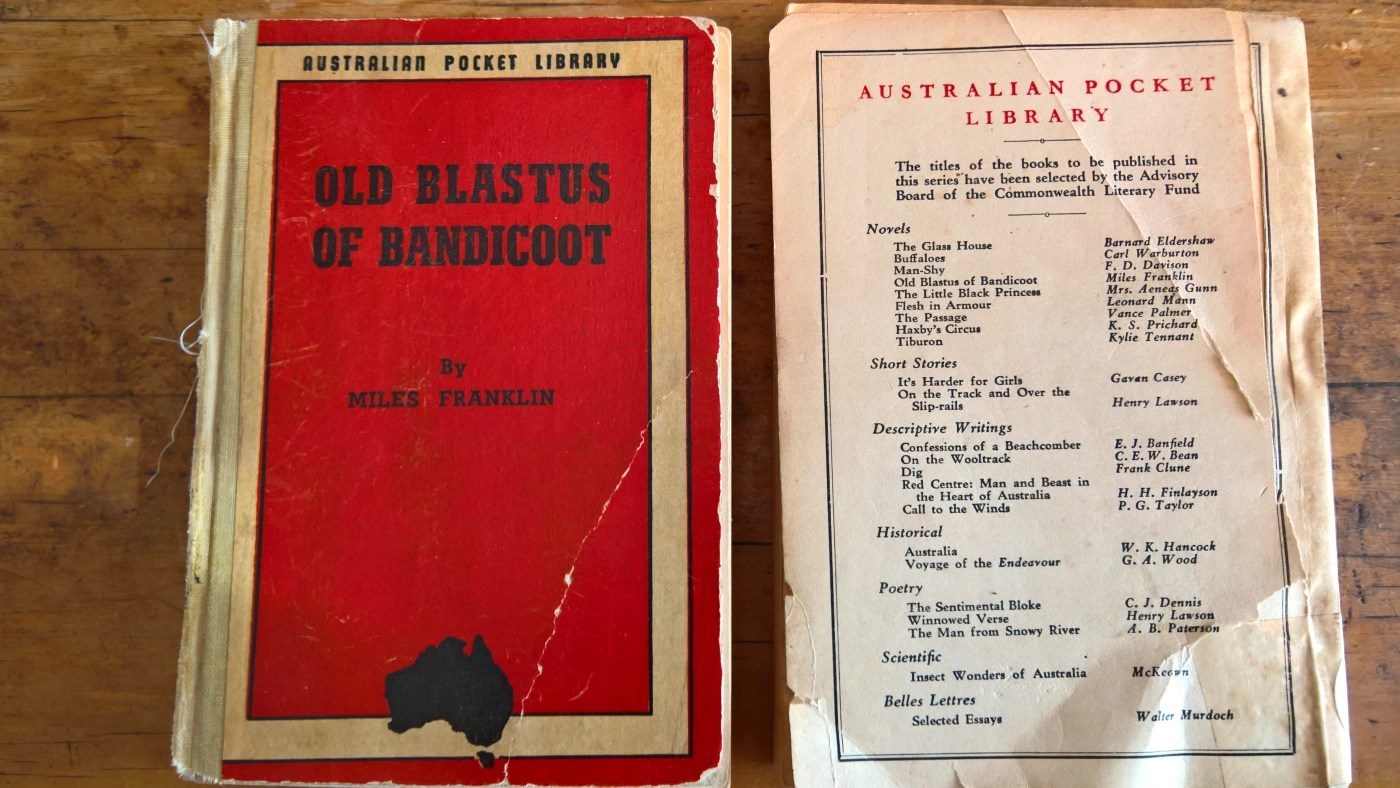
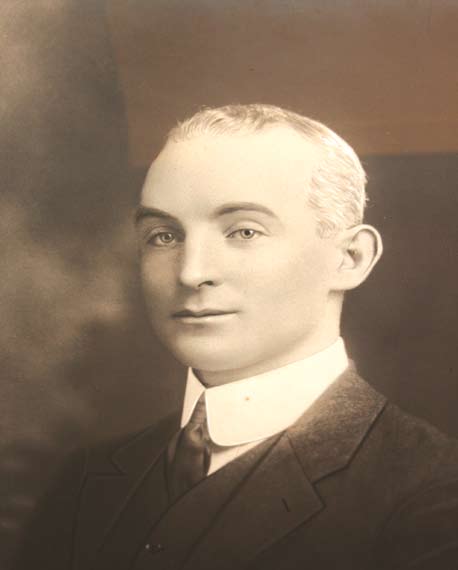
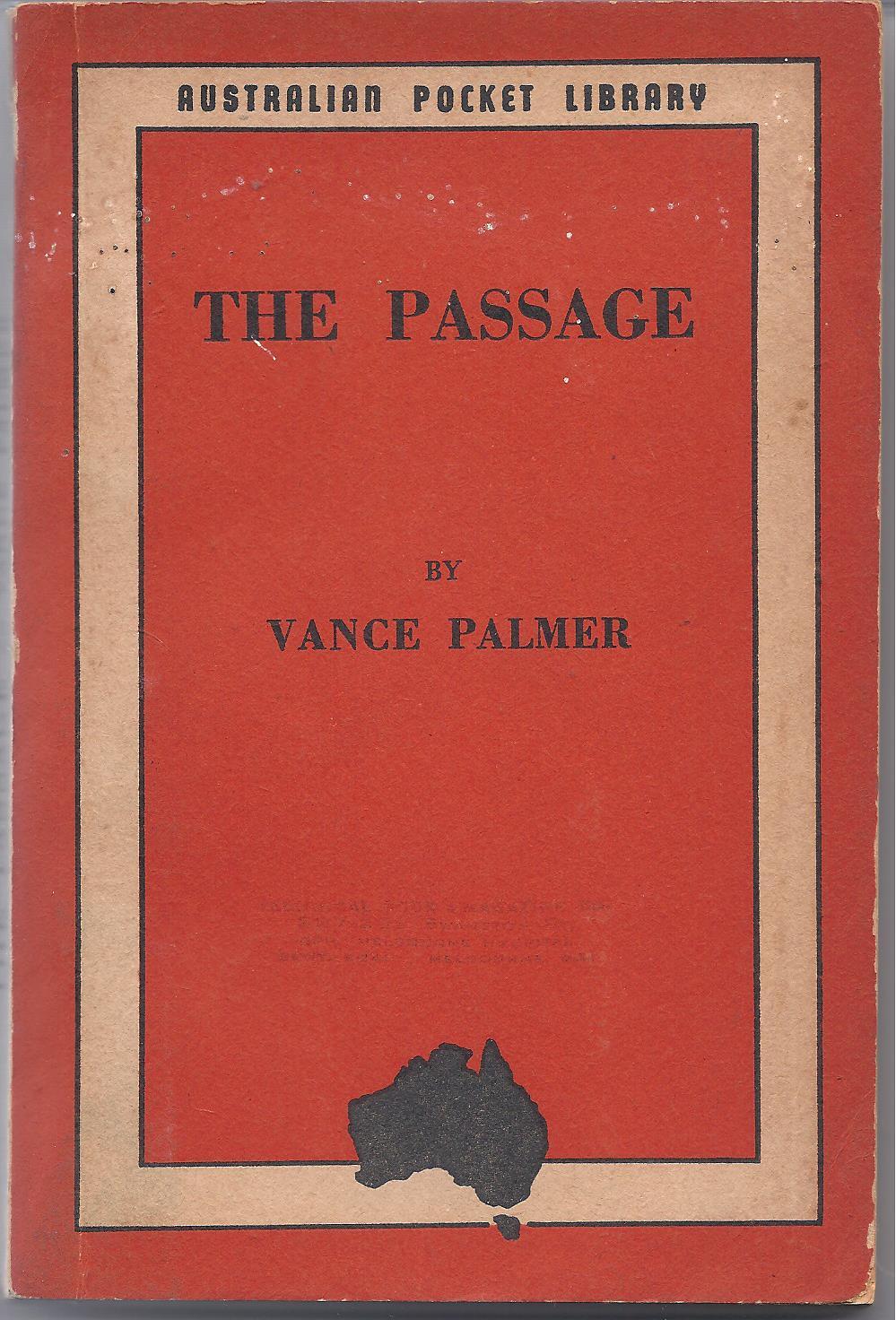
Monday musings on Australian literature: Australian Pocket Library (2)

Last Monday I introduced the Australian Pocket Library (APL) which was a series of cheap paperbacks produced under the auspices of the Commonwealth Literary Fund (CLF). Its initial purpose was to provide Australian reading matter to Australian POWs but, in its final form, was intended by the CLF to play a bigger role in promoting Australian literature at home too. Planning started in 1943, with publication occurring between 1944 and 1947.

In last week’s post I shared part of an article on the APL by academic, Neil James, and some thoughts on the selection by a contemporary critic and literary editor, RG Howarth who discussed the library, taking as his starting point that the library was intended to contain “standard” works. I will return to James, but first, more from contemporary commentators on Trove.

Standard?

I’ve chosen to focus on P.I. O’Leary (1888-1944), a journalist and poet who, like Howarth, was committed to promoting Australian literature, and who also took up the “standard” question. P.I.O’L (his by-line) wrote an extended article about the APL in the Books and Bookman magazine of the Advocate in 1944 (17 May). He commences his article, titled “We parade our masterpieces”, with:

What is a “standard” Australian book? How many of the books selected by the Advisory Board of the Commonwealth Literary Fund to form the nucleus of an “Australian Pocket Library” are “standard” works? These and other points in this commendable enterprise are here considered.

Overall, he commends the endeavour, because too many works have been out of print. He sees the Library as representing “a belated national appreciation” of Australian writers. He is “not heady with any enthusiasm for an attempted, forced growth of literature in Australia”, he says, arguing that you cannot force produce great novels or great poems. However, “Australia has, and has had, many subsidised industries—and there is no reason why the literary industry … should not have some assistance in the shape of grants to writers”. Then he gets onto the issue of “standard”.

He doesn’t really know ‘what entitles an Australian literary work to be styled a “standard” book’, he says, but supposes that

Robbery under arms has passed the test, together with, say, We of the Never-Never, On the track and Over the sliprail, Such is life, and a handful of other books.

However, the selection of some of the other books as “standard” works, “sets up an energetic speculation as to what special passport a book must carry in order to cross the frontier”. (Love the language.) He knows how difficult it is to make such choices, but writes that “some books selected do not appear to me to even be borderline cases”. Then, like Howarth, he puts forward his views on some of them.

He agrees with Howarth’s questioning the inclusion of Katharine Susannah Prichard’s Haxby’s Circus, asking “what standard does it set up?” He thinks it the weakest of her novels, and “not comparable to Working bullocks or Coonardoo as a skilful work of fiction”. (Howarth named Working bullocks and Pioneers as better.) Like Howarth, he also questions the inclusion of Brian Penton’s Landtakers (read it anyone?) as “standard”, describing it as “largely sound and fury”. 

P.I.O’L also discusses representativeness, asking whether the selection is “representative” of “our writers’ books”. He feels that “as a foundation selection it is … satisfactory”, arguing that “a start had to be made somewhere”. Howarth, he says, agrees, given the limitations the CLF was operating under. Moreover:

Allied Servicemen are not literary cognoscenti balancing niceties of literary values, characterisation, form. If you were to ask most of them in what order they would place the writers of their own polyglot land they would probably very honestly say that they were no judges—and had not read many books, American or otherwise, anyhow.

Then he tackles Howarth’s discussion of the gaps, the works that should have been included. Again, I loved his language:

And when you start offering a register of names of writers whose works should be included in the “Australian Pocket Library” you push your keel into a wide sea—one, sometimes of trouble. 

He disagrees with some of Howarth’s suggestions – we are mostly talking poets here – and makes his own, but you can read it yourself if you are interested. Overall, he agrees with Howarth’s support of the project, quoting Howarth’s statement that the CLF should be “congratulated on the vision and courage of the enterprise”.

Legacy?

Now, I’ll return to Neil James’ 2000 article because he has some interesting points to make about the selection, and the APL’s legacy.

Looking at the selection nearly sixty years later, James writes
The titles selected reflect clearly the nationalist agenda in Australian literature … `Representative Australia’ in 1943 derived from the Bush, and the democratic values which seeped into Australian culture from its historical struggle against the natural elements. Most of the titles were originally published in the 1920s and 1930s, but some went back to an earlier age to engage with the grand narratives of exploration, adventure and colonisation. The list sets up literary values, social values, and national-historical values as interchangeable. This is hardly surprising given the primary influence of Palmer, whose published and broadcast criticism sought to define an Australian literature in national terms … It was a nationalist canon in paperback set for a wide distribution, and it sat comfortably with the government’s war-time agenda.

James shares the many practical challenges the CLF confronted – acquiring rights to the books, cover design, production problems, and agreeing on price with the publishers. And he describes the project’s demise, ending up publishing 26 of the finally planned 39. It’s all interesting and you can read it in the article. I want to end with his discussion of the legacy because this is most relevant to us now.

First, he says, it “represents the first officially selected and endorsed canon of Australian literature” and one recognised at the highest level of government. Furthermore, the APL played a significant, though not recognised, role in the “unprecedented transformation in the publication and recognition of Australian literature” in the 1940s and 50s. However, the importance of the Library has been lost partly, he argues, because the “nationalist outlook” of the selection was rejected a decade or so later by the universities, resulting in the writers being expunged from the canon.

The failure of the venture also had an impact on publishing. The CLF withdrew from “acting as de facto publisher” and became more reactive than proactive in publishing ventures. Had it succeeded, and had the CLF ‘continued to foster a nationalist canon of writing, there would have been, at the very least, more than “one set of values [to rule] the entire roost”, as Max Harris put it’.

More significant, though, I think, is James’ argument that the failure of the APL “effectively delayed the literary paperback in Australia by two decades”. He believes that the 1930s Penguin revolution in Britain “could have been reproduced here in the 1940s” with the APL its “de facto trial run”. Unfortunately, its unappealing format, which was “far too compromised by wartime conditions … killed off any good will towards paperbacks amongst booksellers and publishers”.

How fascinating. It was not until the 1960s, James says, that the literary paperback returned to the Australian scene, and not on a major scale until the 1970s. This fundamentally influenced “the character and the accessibility of Australian writing”, by which he means that because mass cheap paperbacks were not available as they were in Britain and France, “the readership of Australian literature was to remain the middle classes rather than `the multitude’.”

James concludes – in 2000 – that the Australian Pocket Library is worthy of “further scrutiny as part of the assessment of individual authors, and in understanding the evolution of Australian cultural values”. He also suggests that, “given the current paucity of an available Australian backlist” it may contain lessons for a classics publishing program! Well, it may not be the same model, but the Text Classics imprint, which began in 2012, has picked up the baton of cheap affordable classics and run with it. As far as I can tell, ten years later, it is going strong, with a catalogue that is diverse but, like the APL, constrained at times by access to rights.

Sources

Monday musings on Australian literature: Australian Pocket Library (1)

Bill and Lisa have already posted today in recognition of ANZAC Day, Bill’s titled ANZAC Day 2022, while Lisa’s is about Martha Gething who is featured in the book, Australian women pilots: Amazing true stories of women in the air. My post, in fact, comes to you courtesy of Lisa who, last week, emailed me with the subject line, “A Monday Musings Topic?” She wrote that while reading Nathan Hobby’s soon-to-be-published biography of Katharine Susannah Prichard, she’d “learned about the existence of the Commonwealth Pocket Library, cheap paperbacks for distribution to POWs during the war”. She closed her email with, “Of course I thought of you…”.

Now, I’m always happy to hear ideas, particularly ones like this which come with a link to a scholarly article. I was especially grateful, this time, because I had been pondering a topic relevant to ANZAC Day, given Monday was going to be THE day. She handed me my post on a platter, so, thanks Lisa!

Australian Pocket Library

I should start, though, by saying that it appears it was called the Australian Pocket Library, not Commonwealth Pocket Library, as Hobby describes it. Wilde, Hooton and Andrews’ The Oxford companion to Australian literature says:

The Australian Pocket Library was a series of austerity paperbacks published with the help of the then Commonwealth Literary Fund during the economic restrictions imposed by the Second World War.

(The Fund’s involvement is probably where the “Commonwealth” confusion came in.)

There is, of course, far more to this story than The Oxford companion had time to tell, and I’m going to share some of it with you. In addition to reading the article from the Australian Literary Studies journal sent to me by Lisa, I also did a Trove search – of course! The project, it seems, generated quite a bit of excitement in bookish circles – and why not!

Neil James, in the article Lisa sent me, provides a history of the series. It started with an idea in 1943 and ended with publication of the last books in the series in 1947. Its active life, in other words, was short – but James argues that its legacy, both positive and negative, was significant. I’ll return to this in part 2, because there is so much to explore.

Origins

James explains that in 1943, Prime Minister Curtin had been approached by the AIF Women’s Auxiliary for Prisoners of War which wanted cheap editions of Australian books for Australia’s POWs. The Auxiliary had been choosing books for parcels going overseas, but were finding that “practically every Australian book we would wish to include is now out of print”. Prisoners of war everywhere, they said, ask for books about their homeland. The request was referred to the Advisory Board of the Commonwealth Literary Fund (CLF), and it ended up with Vance Palmer, who was on the Fund’s Advisory Board. He “immediately latched onto the idea”, not just for “the POWs, but also for the cause of Australian literature”. Never let a chance go by, eh! Vance and his wife Nettie Palmer, as many of you will know, were significant supporters and promoters of Australian literature, as well as being writers themselves. 

Anyhow, Palmer advised that the task was beyond private publishers: the paper would not be available, and, anyhow, “most publishers do not know what to print and how to get the copyrights”. It was, in other words, a job for the CLF. Indeed, writes James, the Fund had apparently had ideas since 1939 for “a standard library of Australian works”. Here was their chance.

Cutting to the chase, funding was granted and the process commenced. You won’t be surprised to hear that choosing the actual books was fraught. Various publishers wanted their books included, but Palmer was, says James, “sceptical of Australian publishers” because they’d proven themselves to be “cautious” regarding publishing Australian literature. A committee was formed to choose the books. The plan was that “the CLF would have editorial control but the publishers would pay for production and distribution”. Publishers “which had the rights to a book chosen would have first option to publish it in the Library” but they had to agree to “conditions governing cover design, format, royalties, and price”. James explains why publishers supported a scheme in which they took all the financial risk but gave “creative control to a Canberra committee”. The reason was, in a word, paper!

The list, primarily chosen by Vance Palmer and Flora Eldershaw, was not universally approved. James reports that CLF’s Board chair “was consulted only when the list was virtually set”. He was apparently a little put out, commenting that it “is possible that other considerations than merit have determined the choice”.

The books

And here, I’ll turn for a while to Trove, and what the critics, reviewers and journalists thought. One of those was R.G. Howarth. He was founding editor of the literary journal, Southerly, and literary critic for the Sydney Morning Herald. According to Lee, in the Australian Dictionary of Biography,  he “influence[d] Australian writing through deciding who would or would not be published in the 1940s and 1950s”. His sole criterion was “literary quality”, not “political and ideological considerations”.

Howarth wrote about the new initiative in 1944 (April 29), starting with the basic plan: it involves twenty-five “standard” Australian books, “designed for members of the Australian forces (including prisoners of war) and members of the Allied forces in Australia, as well as for the general public”, and to be sold at prices ranging from 1/3 to 2/. The list includes 10 novels, plus collections of short stories, “descriptive books”, histories, verse, a scientific work, and essays.

He comments that the poets, Lawson, Paterson, and Dennis, “will undoubtedly solace and stimulate the fighting-man” as well as “renew their own popularity”. He describes the novels, which included currently out-of-print books, Robbery under arms, We of the Never Never, and Man Shy; the best of Australian novels of the last war, Leonard Mann’s Flesh in armour, which is “unhappily little known because unobtainable”; and Katharine Prichard’s Haxby’s Circus, Brian Penton’s Landtakers, Vance Palmer’s Passage, Kylie Tennant’s Tiburon, Barnard Eldershaw’s The Glass House, and Miles Franklin’s Old Blastus of Bandicoot.

However …

Of course there was going to be a “however”! Howarth questions the definition of the selected works as “standard”, notwithstanding the CLF confronted issues concerning “copyright and competition”. He recognises that the Commonwealth Literary Fund is “at once serving the reading public, helping the Australian author, and reviving books undeservedly neglected”, then asks how far the list meets these purposes.

He questions, to take Prichard as an example, why Haxby’s Circus “and not her Pioneers or Working bullocks – much more Australian in spirit and setting?” Re Bernard Eldershaw, he asks, why “The glass house – a study of shipboard life during a voyage from Europe to Australia – rather than their prize winning A house is built?” Well, I don’t know, but Eldershaw was on the selection committee so …

Of Penton’s Landtakers and Franklin’s Old Blastus of Bandicoot he says that “much as one admires the authors in other ways one is compelled by honesty to say that their inclusion is at least questionable”. Old Blastus, he feels, ‘appears as a failure that might well have been a success; in it a true “character” is imperfectly realised’.

And of course, as all commentators do on lists, he identifies works not included, such as For the term of his natural life. He recognises that ‘opinions are now divided about this …but surely it presents a stage in our history and in the development of the human conscience that must be retained in mind. It is “standard”, too in the same sense as Robbery under arms‘. He names other gaps, such as novels by Eleanor Dark, Ernestine Hill, Norman Lindsay and Christina Stead.

But, he concludes:

Whatever one’s opinions of its selection, the Commonwealth Literary Fund must be congratulated on the vision and courage of the enterprise. It has here decisively shown its importance to Australian authors, hitherto largely unprotected and uncertain of the future; and its wish and power to foster the growth, and distribute the products of Australian literature.

Then, on 4 May 1944, he writes a letter to the editor passing on a playwright’s surprise at the omission of “the Australian playwright” from the list. Two days later, on 6 May, playwright Leslie Rees, who signs as “Hon. Chairman, Playwrights’ Advisory Board” responds in his own letter, saying that Howarth was “surely unfair in implying that the Commonwealth Literary Fund has done nothing for the Australian dramatist”. He defends the work of the Fund and says that “When the time comes for a second list of Pocket Library books”, plays “might well be included”. You gotta laugh really. Howarth merely passed on someone else’s comment – albeit in passing it on he must have agreed somewhat – while Rees defends the Fund suggesting that they “might” include plays in a later list! Sounds like some undercurrent there that we don’t know about.

Meanwhile, on 17 May, P.I.O’L. also took up the issue of “standard”, but I’ll leave that for next week … and simply say, here, that little of the discussion I read focused much on the poor POWs!

Sources

I spent Anzac with the Griffyns

While other Aussies were attending dawn services, or watching almost 24/7 ANZAC broadcasts on the box, this ANZAC Day, Mr Gums and I chose to remember it by going to the Griffyn Ensemble’s The Dirty Red Digger concert, which was devised by their musical director Michael Sollis. Even more audacious than usual, Sollis managed to create a thoughtful show that married the story of the Glebe Rugby League football team (the Dirty Reds) with that of the ANZACS in World War 1, framed by interviews with young rugby league footballers today. He – and his “team” of engaged and talented performers – had the audience glued to its seats.

In a program that ran for a little over 2 hours, with a short break for half-time (!), Sollis spun a story about men and war and sport, about loss and class war and conscription. The performance integrated music and song, much of it composed (and all of it arranged) by Sollis himself, with archival and documentary film footage. The amount of work involved in putting all this together, the research, the writing, the interviewing, not to mention the composing and arranging – well, let’s just say we are in awe. It certainly conveyed Sollis’ passion for the subject matter – music, history, politics and football.

The show comprised nineteen pieces of music (or eighteen if we count the reprise as one) that varied in style from “classical” to folk and rock, from music hall/vaudeville to ragtime. Between and during the musical numbers, this versatile ensemble recited letters and poetry, and enacted stories with barely a hitch, while on the screen we saw a diverse selection of mostly war-related historical footage interspersed with contemporary interviews with young footballers from the Gungahlin Bulls.

“Man’s blind indifference to his fellow man” (Eric Bogle)

Sollis teased out two main themes through the show: the relationship of football to the Australian labor movement and, by extension, class struggle; and the challenge of manhood and the value of brotherhood for soldiers and footballers, past and present. We shared in the grief for soldiers (including footballers) lost, the humour and pathos of vaudevillian propaganda, and the recognition that many young working class men today continue to find purpose, meaning and mateship in football.

“I cannot engage in the work of recruiting and urge others to enlist unless I do so myself” (Ted Larkin)

Ted Larkin

“ER Larkin” (Unknown) (Presumed Public Domain via Wikimedia Commons)

Rugby League football we learnt had its origins in northern England when working class clubs, unable to survive under the more affluent south’s “amateur” rule, broke away in 1895 to create the Northern Rugby Football Union. This form of football was established in Australia 1908. It represented, the Griffyns told us, a social movement which united young Australian working class men. It was also, from its start, closely aligned with the Labor party. Prime Minister Billy Hughes, who later earned the labor movement’s ire by attempting to introduce conscription in the Great War, was Glebe Rugby League Club’s patron in 1908. He was just one of several Labor politicians who aligned with the Rugby League movement because of its labor movement origins.

Another of these politicians was Ted Larkin. He was Australian Labor Party member for the NSW State Parliament, from 1913, and the paid secretary of the NSW Rugby League. He died at Anzac Cove on 25 April 1915, and, with his brother who died in the same battle, has no known grave.

You are probably starting to see now the story the Ensemble wove for us as they joined the history of Rugby League football to the progress of the War. It was told through music composed in various styles by Sollis (such as “Heartbeat”, “The Digger’s London Leave”, “Greater Game Rag” and “Conscription”) alongside propaganda songs of the era (such as “What do you think of the Kaiser?” and “Daddy’s in the firing line”) and more recent works like Eric Bogle’s heart-breaking “Green fields of France” and “Working Class Man” (made famous in Australia by Jimmy Barnes). The connections were palpable.

We also heard unfamiliar composers, such as Edouard (or Ede) Poldini, a turn of the century Hungarian composer best known for his miniature piano pieces, like “The Clock”, which featured Kiri Sollis on flute supported by the ensemble. It had a lovely, distinctive tick-tock motif.

“Footy’s my fix” (contemporary footballer)

Interspersed with footage from the Great War, including the Conscription Referendums and the Great Strike of 1917, were interviews with young Gungahlin Bulls footballers and one of their coaches. They talked of mateship, what football means to them, and how they’d feel about going to war should the call happen again. They spoke from their hearts about depression and alcohol, and with humour about the distance between them and those IT guys, the “keyboard warriors”, who are too smart to get themselves beaten up on a football field! Through their comments, and the accompanying footage, Sollis brought working class culture to an arts environment, and as the ensemble belted out “Working Class Man” we saw on the screen those (not really so) simple souls with hearts of gold in our complicated land. It was pretty spine-tingling.

I believe this program will tour nationally. Don’t miss it, if it comes near you. If you’re not moved by the story and impressed by the musicianship of the performers, not to mention challenged to keep up, well, your tastes are very different to mine!

Other (very different) YouTube versions of some of the music:

And you can see sheet music for “The Clock” online, though I couldn’t find a performance.

Team Griffyn: Michael Sollis (Musical Director and Mandolin), Susan Ellis (Soprano), Kiri Sollis (Flute), Chris Stone (Violin), Laura Tanata (Harp) and Holly Downes (Double Bass).