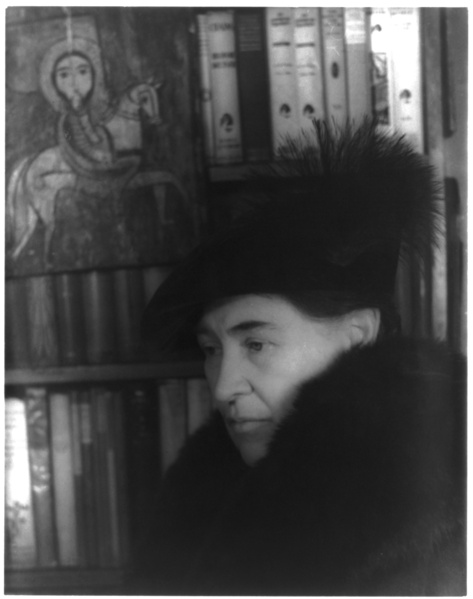
James Thurber, The lady on the bookcase

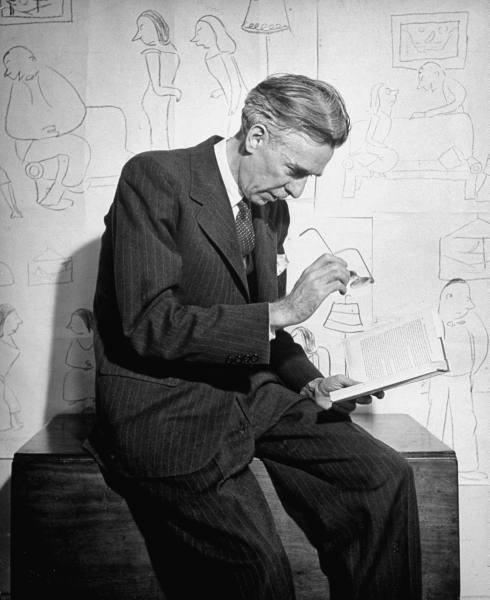
James Thurber, 1945

Thurber, 1945 (Courtesy: life.com, for personal non-commercial use)

If you like to think of yourself as a critic, read this. It is last week’s offering from the Library of America, and is an essay by James Thurber titled “The lady on the bookcase”; it was first published in The New York Times Magazine in 1945 under the title “Thurber as seen by Thurber”. I read it as a general spoof on the art of criticism; the Library of America says he “teases [his] colleagues and editors at The New Yorker.”

The scene is set in the first paragraph when he reports on a cartoonist complaining about being rejected:

“Why is it”, demanded the cartoonist, “that you reject my work and publish drawings by a fifth-rate artist like Thurber?” Ross came quickly to my defence like the true friend and devoted employer he is. “You mean third-rate”, he said quietly, but there was a warning glint in his steely gray eyes that caused the discomfited cartoonist to beat a hasty retreat.

Just this beginning, before I read any more, reminded me of why I had enjoyed Thurber in my baby-boomer youth when many of us read a bit of Thurber. Thurber was a writer and cartoonist, and in this essay he combines the two to poke fun at criticism … and at how editors tend to show a journalistic rather than a critical interest in his work by wanting to know the stories behind his work rather than analysing it.

He writes that:

I have never wanted to write about my drawings and I still don’t want to, but it occurred to me that it might be a good idea to do it now, when everybody is busy with something else, and get it over quietly.

… and, to continue his satire, he talks about “shoving” some of his originals around the floor until they “fell, or [he says archly] perhaps I pushed them, into five separate categories”. He goes on to describe the categories, illustrating each with some of his cartoons:

  • the Unconscious or Stream of Nervousness category
  • the space between the Concept of the Purely Accidental and the Theory of the Haphazard Determination
  • the theory of the Deliberate Accident or Conditioned Mistake
  • the Contributed Idea category
  • the Intentional or Thought-Up category

If you haven’t worked it out by now, you can’t take much of what he says seriously – and that is his point. Don’t, he tells us, try to categorise or apply psychological theories to someone’s work, go for a run instead. Then again, I wouldn’t take this too seriously either, because Thurber is also being disingenuous: in the tradition of the satirist, he sets us up at every point, only to pull us down again. After all, like any creative artist, he wants us to look at and respond to his work.

Have a look at it … I’m sure you’ll enjoy the ten cartoons reproduced even if you don’t want to read the essay.

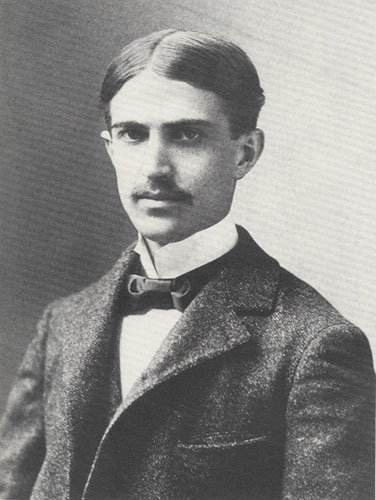
P.T. Barnum, In France

P.T. Barnum, by Matthew Brady

P.T. Barnum (Presumed Public Domain. By Matthew Brady, via Wikipedia)

When I saw that this week’s Library of America story was by P.T. Barnum, I knew I had to read it. Like most people I’ve heard of Barnum and his travelling shows, but had never read anything by him.

“In France” is not a short story, as most of the Library of America offerings are, but an excerpt from his 1869 memoir Struggles and triumphs. The whole memoir can be read online at the Internet Archive, here. While “In France” is the title of Chapter 12 in the memoir, the Library of America has not selected the whole chapter. Rather, they have published the middle of it, focusing on the story of how Barnum managed to present “General Tom Pouce” (ie Thumb), wearing his famed Napoleon Bonaparte costume, to the anti-Bonapartist King Louis Philippe. This was 1844, and Stratton (Tom Thumb) was just 6 years old!

You don’t read this for the writing. As memoir, or as travel writing, it is pretty prosaic. He doesn’t do much reflection – at least in this excerpt. You do not get a sense of how he felt about what he was doing, and you certainly get no idea of how his “exhibit”, General Tom Thumb, felt about being dressed up in costumes and paraded. However, it is interesting for its insights into Barnum’s modus operandi – particularly his economic and diplomatic nous. He knew how to work the system, though we are given the impression that he was a hard but not a dishonest negotiator. There is a funny little story running through this excerpt about the licence fee he needed to pay for exhibiting “natural curiosities”. Barnum felt the fee (25%) was too high and succeeded in negotiating a lower one, partly because the official involved did not believe that Barnum would make much money. When it came time for renewal, the official realised his mistake but was once again (legally) finessed by Barnum who argued that Tom Thumb should not be seen as a “natural curiosity” but as a “theatrical” performance (which incurred a much lower 11% tax)!

He also talks about how he worked his promotion – and makes this delightful comment on the French versus the English:

Thus, before I opened the exhibition all Paris knew that General Tom Thumb was in the city. The French are exceedingly impressible; and what in London is only excitement, in Paris becomes furor.

I don’t know when merchandising associated with the arts/performance first took off, but in Paris in 1844 it was in full flight. Barnum writes that:

Statuettes of ‘Tom Pouce’ appeared in all the windows, in plaster, Parian, sugar and chocolate; songs were written about him and his lithograph was seen everywhere. A fine café on one of the boulevards took the name of ‘Tom Pouce’ …

While this merchandising, generated by others for their own benefit, clearly also served Barnum well, there’s no mention of his licensing Tom Thumb’s image for promotional purposes. I can’t help thinking that the master showman missed an opportunity here!

Like the previous Library of America offering this is a short piece: it’s well worth reading for our “historical” if not “natural” curiosity!

George Jean Nathan, Baiting the umpire

I haven’t posted on the last few Library of America stories, mainly due to lack of time and the fact that they’ve been by well-known writers anyhow. However, the one that lobbed in this week, “Baiting the umpire” by George Jean Nathan, looked rather intriguing and so I read it. It is really an essay, but a satirical one, rather than a short story – and is about the “sport” of baseball.

According to the accompanying notes, George Jean Nathan (1882-1958) was an “acerbic theater critic” and worked, for some time at least, with “his partner in venom” H.L. Mencken.

Mad baseball player

Mad baseball player (Courtesy: OCAL, clker.com)

The essay starts with describing baseball as the “national side-show” and argues that “baiting umpires is the real big-tent entertainment”.  Using word play, hyperbole, rhetorical questions and mock-heroic comparisons (equating baseball with a Spanish bullfight and likening the “bleachers”/spectators to matadors, and in a cultural leap equating baseball promoters with Solons), Nathan goes on to suggest that the only reason Americans enjoy baseball is for the “sport” of baiting (“killing”) the umpire. He provides examples of countries where baseball hadn’t (we are talking 1909 here) taken off, such as Japan, and suggests that the reason for this is that the Japanese accept the umpire’s rulings!

In Australia, however, and here my ears picked up, he said they went about introducing baseball the right way:

In Victoria, Australia, where a determined effort is being made to popularize baseball, the prime movers in the campaign, appreciating full well the important and necessary relation that killing-the-umpire bears to the game, have tried the novel experiment of working up the hostile spirit towards the referee by playing the baseball contests – all or in part – before the huge football crowds. These crowds are demonstrative in the extreme, and it is hoped by the baseball promoters that part of the excess football emotional tumult may, in time, be directed against the umpires, thus insuring the success of the game…

Hmmm…well, 100 years later baseball is, I know, played here but I’m not sure to the extent that you’d call it a success. Maybe our football crowds decided they liked something more to their games than simply baiting the umpire! In fact, from my own admittedly superficial experience, I think it is a more popular game in polite Japan than it is here. His other example of a surefire success for baseball is the Sandwich Islands where … well, that will give away the punchline and I don’t want to do that. Read it … it’s short and will give you a chuckle if nothing else.

Meanwhile, I will conclude with one little observation. As an Australian, I have always been bemused by the notion of World Series baseball in which the only teams playing are from the USA and Canada. Now that would have been an interesting topic for Nathan to explore!

Saïd Sayrafiezadeh, Appetite

“Appetite” is a short story by Saïd Sayrafiezadeh, an American-born author of Iranian descent. It was recently published in The New Yorker, and you can read it here. It is, I have to say, a strange little story. The 25 year-old first-person narrator is a cook in a restaurant where he has been working since leaving school. The opening sentence of the story – “Things were not going as I had hoped” – applies, we soon realise, not only to the particular event he is describing, his request for a raise, but to his life in general.

Having been refused the raise, he ruminates on his life and wonders why he is still where he is:

Somewhere in my past, something had gone wrong for me.

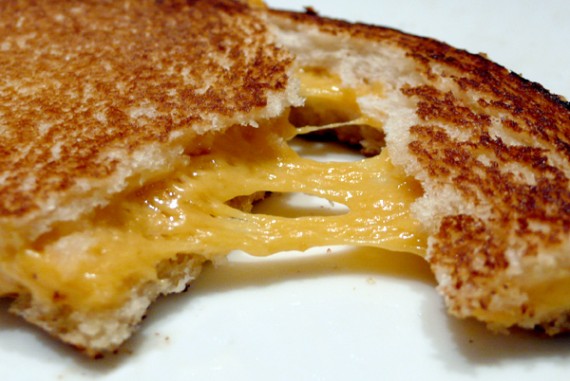
Grilled Cheese Sandwich

Grilled Cheese (Courtesy: quarrygirl.com using CC-BY-NC-SA)

He talks about how, at high school graduation, he felt that he “had already been consigned to a life of mediocrity” – because he was one of the indistinguishable five hundred other students and not the valedictorian! A bit of an over-reaction, eh? Anyhow, there are, essentially, only three characters in the story – the narrator, the newly arrived “anorexic waitress” and the manager (who is described – several times – as having a “kind” face, even though he does not give our man a raise, and in fact criticises his grilled cheese sandwiches).

The story is quietly compelling. We  want to know why he is the way he is. There are hints that he does not feel “grown up”. In one little anecdote, he describes watching two black boys riding by, one of whom notices him:

“What are you looking at, white man?” he yelled out … I was humiliated, not by the use of “white” but by the use of “man”. He sees me as a man, I thought.

And then remembers a time, when he was eight years old and a friend’s father sent a black boy home, with “Go home, boy”. He provides no further explanation as to why this story from the past comes back to him, but near the end of the story, when the anorexic waitress says “You’re a funny boy”, he wonders

When had I crossed the line from being boy to man? Whenever it was, the line had been so faint, so subtle, that I had missed it entirely. Maybe if I had been paying closer attention things might have turned out differently for me.

The story is full of little anecdotes and digressions whose prime intent is to show his disconnectedness. In fact, there is a slightly absurd air at times – such as the anorexic waitress picking him up on a rainy day just as he has reached home and driving him home after dropping off her other passenger on the other side of town. Many things don’t make logical sense in the story, but perhaps that is perfectly appropriate for a story about how easy it is to get lost in the crowd, to let life pass you by if you don’t do the expected thing of setting a goal and working towards it. Rather than give away the ending which is a little too open for comfort, I will close on a quote from the first paragraph:

Somewhere I had learned that it’s best to put your goals into clear terms, straightforward terms, and that once these goals had been thus stated all would follow accordingly. I think I heard this discussed on television. Or I had read it somewhere. The counsel had seemed wise at the time, and I had determined to remember it if ever an occasion presented itself.

The occasion turns out to be his plan to ask for a raise in his go-nowhere job! Need I say more?

Kate Chopin, A respectable woman

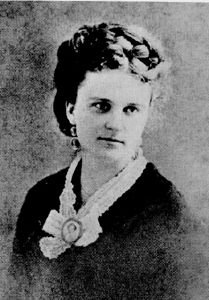
Kate Chopin

Kate Chopin: What a lovely face (Public domain, via Wikipedia)

Besides Jane Austen’s works, there are only a few novels that I have read more than once. One of these is Kate Chopin’s The awakening. I was trying to think of an adjective to describe it or my feelings upon reading it, but couldn’t think of anything that wasn’t clichéd. The best way to convey my response is, in fact, the way I have – and that is to say that I’ve read it more than once!

Kate Chopin’s short story, “A respectable woman” (1894), is this week’s Library of America (LOA) offering – and you can read it here. I haven’t read and blogged all of the LOA stories that have lobbed in since I subscribed, but I have done so rather more than I originally expected. This is because they have confronted me with:

  • Authors I’ve never heard of, but who, by LOA’s brief introduction, have intrigued me;
  • Authors I’ve heard of but haven’t yet read, and so have taken the opportunity to be introduced; and
  • Authors I’ve read before and loved (or at least liked a lot!).

As you’ve already realised, Kate Chopin falls into this last category. I was stunned by Chopin when I first read her back in the early 1980s – and this was because I hadn’t before read a 19th century novel that was quite so honest about women’s experience. Thank you Virago!

Written in 1894, 5 years before The awakening was published, “A respectable woman” made me laugh. That’s not quite what I expected when I started it. After all, it is by the author of The awakening! “A respectable woman” has a simple plot. Mrs Baroda (we never learn her first name, she being the woman of the title!) and her husband have just come to the end of the of a busy entertaining period, and she is looking forward to “a period of broken unrest, and undisturbed tête-a-tête with her husband”, but it’s not to be. Her husband, Gaston, has invited his friend Gouvernail to stay…

This is a very short story – just 4 pages – but Chopin is well capable, through some well chosen words, of leading us along. The title for a start sets us up with a number of impressions and expectations that tease us as the story progresses. Will she, won’t she, is the question that follows us. The introductory description of Gouvernail subtly tells us as much about her (and her life with her husband) as about him:

He had been her husband’s college friend; was now a journalist, and in no way a “man about town”, which were, perhaps, some of the reasons she had never met him.

Clearly they are a well-to-do couple moving in other circles. They have a good though not perhaps a passionate relationship: “her husband – who was also her friend”. The story is 3rd person, and told from her point of view – and it explores her reactions to this rather taciturn, self-possessed man who, towards the end, admits that all he now seeks is “a little whiff of genuine life”. What she is learning about herself though is something different:

She wanted to draw close to him and whisper against his cheek – she did not care what – as she might have done if she had not been a respectable woman.

This story is not as iconoclastic as The awakening, but it moves in that direction with Chopin exploring the inner workings of women and their hearts in an honest and sympathetic way. The story plays ironically on the notion of respectability and what that means for women. As for whether she does or doesn’t, well, that’s for you to find out. My lips are sealed.

Jack London, War

What do I know about Jack London? Not much really, except that he wrote adventure stories like Call of the wild and White fang, and, intriguingly, a study of London slums, People of the abyss. So, when this week’s Library of America story was “War” (1911) by Jack London, I decided to read it. You can read it too, here.

“War” is an adventure story, of sorts. It is also, obviously, a war story. The plot is a simple one: a young man of 24 or so is out on a scouting mission:

…his task was to find what he feared to find. He must go on, and on, until somewhere, some time, he encountered another man, or other men, from the other side, scouting, as he was scouting, to make a report, of having come in touch.

I like the way London universalises his story by using no names. There are only two characters that count: “the young man with the quick black eyes”, our protagonist, and “the man with the ginger beard” , whom he meets along the way. It’s a short, short story and is told in two parts. In the first we are introduced to the young man and learn that

He was no coward, but his courage was only that of the average civilised man, and he was looking to live, not die.

In this part he comes across “the man with the ginger beard”. In part two, still on his scouting mission, he comes across what appears to be “a deserted farmhouse” where, after being tempted (not biblically, but the allusion is biblical nonetheless) by apples, he has his second encounter with “the man with the ginger beard”. I am being purposefully vague here as I do not want to give away what is a quick and worthwhile read.

The story is sparely told. The language is simple and evocative, with minimal use of adjectives, giving a sense of a world pared to the elementals:

It was high noon of a breathless day of heat.

and

Twice he essayed to start, and twice he paused. He was appalled by his own loneliness.

and

Another day, hot and breathless.

and

Again outside, he led the horse around the barn and invaded [my emphasis] the orchard.

This is a story about the irony and inhumanity of war. It is not a new story really but, due primarily to the tight way in which London engages our imagination and builds to the climax, it is shocking nonetheless. Clearly there’s more to Jack London than I thought!

Willa Cather, The sentimentality of William Tavener

Willa Cather

Willa Cather, 1936 (Photo: Carl Van Vechten; Public domain, via Wikipedia)

Last week’s Library of America story was Willa Cather’s “The sentimentality of William Tavener” (1900). I can’t resist blogging about this one because it’s by the wonderful Willa, to whom I was introduced when I first lived in the US in the early 1980s. I have read only three of her novels (My Antonia, The professor’s house, and Death comes for the archbishop) but loved her from the beginning: for her robust, somewhat terse and yet not unsubtle style, and for writing so evocatively about the nation I was living in and keen to learn about.

The Library of America’s introduction says that this story is one of her earliest pieces and that it “combines recollections from her childhood years in Virginia, where she was born, with the atmosphere of her family’s later home in Nebraska”. It also introduces us, the Library continues, to “the strong-willed pioneers who would be so prevalent in her later, more famous fiction”.

“The sentimentality of William Tavener” might be an early piece but it demonstrates well her ability to tightly evoke character and mood. Its plot is flimsy: it takes place in one evening and concerns Hester Tavener’s plan to get her husband to allow their sons go to the circus. He, it appears, is hard and demanding of the boys; she, their ally in obtaining some of the pleasures of life (“No debtor ever haggled with his usurer more doggedly that did Hester with her husband on behalf of her sons”). In less than 6 pages, Cather provides a powerful picture of this couple – of their individual (equally strong in their own ways) personalities and the somewhat distant relationship between them. In the first paragraph is this:

The only reason her husband did not consult her about his business was that she did not wait to be consulted.

And yet, he, the William of the title, is not a pushover – but he does things his way:

Silence, indeed, was William’s gravity and strength.

On the night of the story though, he breaks his silence and the astonishing effect, the ending teases us, is that it just may augur a new balance of power in the family. We see the possibility of this coming as the evening wears on and the barrier between the couple starts to break down through the sharing of memories, but it is heralded by a sudden change in style from concrete, matter-of-fact almost staccato reportage to a descriptive interlude:

The little locust trees that grew by the fence were white with blossoms. Their heavy odor floated in to her on the night wind and recalled a night long ago, when the first whip-poor-Will of the Spring was heard …

There is irony in the title: William is not presented as a sentimental man and yet, we find, a little sentimentality can work wonders.

The story introduces us to the Willa Cather to come – to her direct, matter-of-fact style; to her strong characters who often survive by the force of their own will in a world that is hard (or they perceive as hard); to her exploration of relationships and the challenges of maintaining them (particularly in the long haul); and to her evocative, careful use of landscape and nature. If you enjoy this story, and have not read any other Cather … then do move on to her novels.

POSTSCRIPT: For an excellent analysis of Willa Cather’s writing, see AS Byatt’s article in The Guardian. It takes a writer to know a writer!

John Muir, A wind-storm in the forests

Giant Sequoia, Yosemite

Giant Sequoia, in the Sierras

Being rather partial to trees, I could not resist reading “A wind-storm in the forests” by Scottish-born American naturalist/enviromentalist John Muir (1838-1914) when it lobbed in by email today as this week’s Library of America story of the week. Anyone who has been to the stunning Yosemite – or visited the peaceful Muir Woods north of San Francisco – will have heard of John Muir.  Not only was he responsible for preserving many wilderness areas including of course Yosemite, but he founded the Sierra Club, an environmental organisation that remains today.

“A wind-storm in the forests” is more essay than story, but perhaps it is best described as a mood-piece: it uses a lot of musical imagery, not to mention sea imagery, religious imagery, and any other imagery that suits his purpose. And that purpose? To convey the grandeur and timelessness of the forests he loves and wants to protect. The story commences with a discussion of trees in the Sierra and how they variously respond to the wind, and then moves onto a description of a particular wind-storm during which he climbed a 100 ft Douglas Spruce to experience the storm first hand:

I kept my lofty perch for hours, frequently closing my eyes to enjoy the music by itself, or to feast quietly on the delicious fragrance that was streaming past.

Muir’s is a typically nineteenth century Romantic sensibility, and his prose is of the purple variety – but gorgeous for all that in its patriotic passion for the trees (“we are compelled to believe that they are the most beautiful on the face of the earth”) of the Sierras:

The waving of a forest of the giant Sequoias is indescribably impressive and sublime, but the pines seem to me to be the best interpreters of winds. They are mighty waving goldenrods, ever in tune, singing and writing wind-music all their long century lives.

AND

…the Silver Pines … wave like supple goldenrods chanting and bowing low as if in worship, while the whole mass of their long tremulous foliage was kindled into one continuous blaze of white sun-fire.

All eight pages or so are written in idolatrous prose like this. According to Wikipedia, Muir found writing hard, feeling that words were not really up to the task. Whether the problem is words or Muir himself, the prose is a little heavy-handed – and yet how wonderful it is to have the writings of such a man. We would, I think, have been the poorer without a written record of his passion.

POSTSCRIPT: Apologies to my Australian readers. I have no idea why, on Australia Day, I have chosen to write about American trees! I will, however, write one on a lovely book of Australian trees soon.

Don DeLillo, Midnight in Dostoevsky

Do reading synchronicities affect our comprehension? Well of course they do, since everything we do affects our comprehension to some degree doesn’t it? Anyhow, I have just read Don DeLillo’s short story, “Midnight in Dostoevsky” (you can read it here), and, as I read it, I couldn’t help bringing to mind Salman Rushdie’s The enchantress of Florence. Whether that’s valid or not is, I suppose, up to others to decide.

The plot concerns two college boys who spar, who indeed become disconcerted if they concur:

This was not supposed to happen – it unsettled us, it made the world flat – and we walked for a time in chagrined silence. Even in matters of pure physical reality, we depended on a friction between our basic faculties of sensation, his and mine, and we understood that the rest of the afternoon would be spent in the marking of differences.

At the beginning of the story the two boys see a man, and they start sparring about him. It starts with what sort of coat he is wearing but, over time, moves into less apparent things such as where he’s from. Interspersed with this are other scenes, including a few from their Logic class. Are you starting to get the connection with Rushdie? It’s the imagination-reality nexus I’m thinking about…the point where imagination and reality meet and merge.

Russian Ushanka Hat

Russian Ushanka Hat (Courtesy: Eugene Zelenko, via Wikipedia, under CC-BY-SA-3.0)

It’s a gorgeously ironic tale, with the boys attending a very dry Logic class (in the evocatively named Cellblock) taught by the rather inscrutable Ilgauskas “who was instructing us in the principles of pure reason … he challenged our reason for being, what we thought, how we lived, the truth or falsity of what we believed to be true or false”. This class nicely counterpoints the flights of fancy the boys engage in when they are alone:

“Think of the hat he’d be wearing if he was wearing a hat,” I said.

“He’s not wearing a hat.”

“But if he was wearing a hat, what kind of hat?”

As I said, this is a story about imagination versus reality… The boys’ fascination with the man continues, as their imaginings become more and more intense (but never moves into actual fantasy the way Rushdie does in his novel).

“Feel the air. I say minus nine Celsius.”

“We’re not Celsius.” [narrator]

“But he is, where he’s from, that’s Celsius.”

That did make me laugh – fiction becoming, in a sense, reality for a while!

We then discover that Ilgauskas reads Dostoevsky (“day and night”) and so our narrator starts to read Dostoevsky too, finding it “magical” that the book which he leaves open at a page in the library is there the next day, open at the same page. In a great leap, he decides that the man is Russian, and that Ilgauskas is his son. His friend Todd says, “Does he have to be Russian to read Dostoevsky?”. Our narrator answers:

“That’s not the point. The point is that it all fits together. It’s a formulation, it’s artful, it’s structured.”

Wow, is this DeLillo’s fiction manifesto? I love it and I love the way this fiction manifesto also works for reason and logic, even though Ilgauskas says that “we  invented logic to beat back our creatural selves”. Creatural? A lovely bit of wordplay: one dictionary provides several meanings including “a living being” and “an imaginary or fantastical being”; another dictionary says “anything created” and “an animate or living being”. Now, that word packs a punch in this story!

The story continues, with the inevitable desire to check the reality of their fiction…but I won’t give any more away. Suffice it to say that this is one delightful and very intelligent story, well worth the read.

(Oh, and as for reading synchronicities? It’s quite possible that had I not just read the Rushdie, I might have come at the story from quite a different angle, such as looking at the relationship between the two boys – but I’ll never know now!)

Jonathan Safran Foer, Everything is illuminated

Jonathan Safran Foer (Photo by Elena Torre, from flickr.com, under Creative Commons CC BY-SA 2.0)

Jonathan Safran Foer (Photo by Elena Torre, from flickr.com, under Creative Commons CC BY-SA 2.0)

He invented stories so fantastic she had to believe.

It’s hard to know where to start writing about Jonathan Safran Foer’s Everything is illuminated, so I’ll just start with a brief description of the plot. It concerns a search in the Ukraine by “the hero” (aka Jonathan Safran Foer) for the woman (Augustine?) who, he believes, saved his grandfather from the Nazis during World War 2. He is escorted on this trip by a translator Alex, a driver (Alex’s grandfather, also Alex), and their “seeing-eye bitch” dog, the absurdly named Sammy Davis, Junior, Junior. This narrative is conveyed to us through three streams:

  • Alex’s (the translator, not the driver) story of the search for Augustine and Trachimbrod;
  • Jonathan Safran Foer’s (“the hero” and searcher) novel-in-progress about the history of his family in Trachimbrod (from 1791 to 1942); and
  • Alex’s (translator, again) letters to Foer about their search and his novel.

So far, so good, but if you have read my introductory post on the book you will know that this is a postmodern book and therefore a bit “tricksy”! And the first bit of “tricksiness” is that overlaying these narratives is the fact that Jonathan and Alex comment on each other’s writing, though we only hear this from Alex who comments in his letters on Jonathan’s work as well as responding to Jonathan’s comments on his work. Alex, then, is the main character in the book – if, that is, it can be said to have a main character. Certainly, Alex is the one whose character develops through the novel – from a rather callow youth who is full of bravado to a thoughtful young man (or “premium person”) ready to take on serious responsibilities.

At first, it is pretty funny – which, if you knew when you started that its subject is the Holocaust, could discomfort a little. I believe though that humour can deal effectively with the dark side, so I didn’t find it disconcerting – and, anyhow, the humour decreases as the book wears on. As Alex writes early in the novel:

I am able to understand now that it was the same laugh … the laugh that had the same darkness as Grandfather’s laugh and the hero’s laugh.

Humour and the multiple strand structure (combined with a convoluted but comprehensible chronology) are just two elements of this novel’s style. There are many others – too many really to cover in a short(ish) review – but fortunately I did refer to several of them in my introductory post. However, one I didn’t mention is Foer’s (the author this time!) use of different linguistic styles to represent the different characters and their strands, and to convey Alex’s growth towards maturity. It is with some disappointment, really, that we see his malaproprisms and other word-misuse (“I wore my peerless new jeans to oppress the hero”) disappear! There is also the magical realism in “the hero’s” story of Trachimbrod: the stories he tells about this shtetl stretch our credulity, but no more perhaps than does the cruelty of the Holocaust which is the point to which the narrative leads us. As the woman (Augustine? Lista? Does it matter?) who shows them what’s left of Trachimbrod says:

It is not a thing you can imagine. It only is. After that, there can be no imagining.

The book covers a lot of ground, including memory, history, place, names and identity, but two ideas that run throughout and that caught my attention are love and truth. “The hero’s” novel-within-the-novel speaks much about love, while Alex’s story of their search explores the notion of truth (though this distinction is not completely rigid). Why this is is not hard to understand when you know their (and their family’s) respective roles in the story: Alex would like to see through the “facts” to the “truth” (for some sort of absolution) while “the hero” would, it seems, like to believe that love can transcend all (to glean something from the wholesale destruction).

You can see the progression in Alex’s thinking in the following:

I also invented things that I thought might appease you, funny things and sad things. (p. 54)

This is a nice story. It’s true, I’m not making it up. (p. 158)

We are being very nomadic with the truth, yes? Do you think that this is acceptable when we are writing about things that occurred? (p. 179)

I would never command you to write a story that is as it occurred, but I would command you to make your story faithful. (p. 240)

Meanwhile, “the hero” is writing of love: Brod (his great-great-great-great-great or, “very-great”, grandmother) and her love-match with the Kolker in early 19th century Trachimbrod; the time when all the people of Trachimbrod thought they had a novel in them with all these novels being “about love”; his grandfather’s love for the gypsy girl between 1934 and 1941 (the gypsy and the Jew!). One of the most poignant lines of the novel describes love messages made out of war-time newspaper headlines:

…each note a collage of love that could never be, and war that could.

Love – what people do and don’t do for it – is, really, the heart of the book.

It’s a full-on novel, and suffers somewhat from that new-writer problem of trying to do too much: you almost wonder what is left for his second novel. That said, it’s a rollicking read despite the seriousness of its subject – and provides plenty of challenges for the grey matter. I was taken by this little mind-twister about Brod:

She repeats things until they are true, or until she can’t tell whether they are true or not. She has become an expert at confusing what is with what was with what should be with what could be.

This conveys the essential problem of writing about the Holocaust: the sheer horror of it is almost beyond comprehension.

Early in the novel Alex asks “the hero”:

Are you being a humorous writer here or an informed one?

I see no reason why you can’t be both – and Foer, in this novel, has pretty well pulled it off.