Elia Kazan, Audience tomorrow: Preview in New Guinea (Review)

Photo portrait

Publicity still, c 1960, from the Elia Kazan Collection of the Cinema Archives at Wesleyan University (Photo credit: Wikipedia)

In my previous life I worked in a film library and film archive, so I was drawn to this week’s Library of America offering, “Audience tomorrow: Preview in New Guinea” by film director Elia Kazan*. My interest was strengthened by two more facts. Firstly, the title mentions New Guinea, which I visited twice in the late 1970s. Secondly, it was published in 1945 suggesting it might be about the war, and I am interested in reading about the two world wars. All up, it looked like an article for me.

Kazan, who made some great films including A Tree Grows in Brooklyn, A Streetcar Named Desire, On the Waterfront, and East of Eden, wrote “Audience tomorrow” about his visit to New Guinea during the war as an advisor to the military. “Our mission” he said, as quoted in LOA’s introductory notes, “was to set up self-entertainment units for the soldiers, to keep men from going nuts before they were shipped to other theatres of action or home. The soldiers didn’t think much of the USO shows”. Apparently, they liked the big name acts, but most shows were by “third-rate cabaret entertainers”.

Kazan’s visit to New Guinea was part of a wider Pacific tour. LOA’s notes state that while he was in the Philippines, his most recent film, A Tree Grows in Brooklyn, was screening. He was pleased that his film was being shown and that the soldiers seemed to enjoy it, but he wrote later in his autobiography that he was bothered by the “contrast between the terrible intensity and cost of what was happening around me and the sentimental fairytale I’d made”.

“Audience tomorrow” is a fascinating article, mainly for the insight it provides into Kazan. There’s very little of the horror of war here and it almost sounds like propaganda at times. The young soldiers are idealised:

The boys … were kids from around the block. You kept feeling that you recognised someone. They did not seem like soldiers. Their stance was easy and casual, their smiles shy and fresh, never arrogant or domineering. They were the citizen soldiers of a democracy: tow heads, red heads, Italians, Negroes, Greeks, Irish. The mood was congenial, the night soft, all about was harmony.

Also, “our army is beautifully organised, beautifully equipped”, and, after briefly mentioning the “ambulatory cases” and “the shell-shocked”, he praises the “New Medicine”:

I remembered with a start of joy that 97% of the wounded in our army recover. All thanks to the New Medicine.

He was there, after all, in the employ of the military.

It’s interestingly written. Its opening made me think I was about to read a short story – or a film script perhaps?:

Eddie Moran wasn’t going with us. He had a bad headache, and his bones ached. Someone suggested Eddie might have a touch of dengue fever …

But this is not a story about Eddie Moran, or any other character, in fact. The Eddie Moran reference enabled him to set the context: “the talk about dengue furnished a striking contrast to our ‘cocktails and dinner downtown’ before going to the theatre back in New York”. In other words, they were off to the theatre but one of a very different ilk to his usual experience. It was a “Soldier Show program”, that is, one produced by the GIs themselves. He was surprised about “the degree of hunger with which the men craved entertainment, the eagerness with which they offered to participate in programs”, both in front of and behind the scenes.

He describes the theatre (called “The Medicine Bowl” as it is at a hospital), the attendees (including the WACS who, my horrified feminist brain read, had curfews), and some of the acts in the show. Rain eventually forces the show to end – “there is hell in the bowels of the weather here” – but his article goes on to describe the post-show action in the Officers’ Club. Again he is positive about the quality of the young men whose:

language was highly technical, their faces new to a razor … these kids made me feel out of it. Something had passed me by. Folks, there’s a new generation.

Did I tell you that Kazan was 35 at the time? Anyhow, this “new generation” is the point of the article. He recognises that these men “are citizens, not soldiers” who want to go home. He suggests they have idealised the “States” but fears that the States “can’t hope to live up to the picture these boys have in their mind’s eye”. Interestingly, he argues that:

These twelve million men are potentially the greatest unified body of Public Opinion our country has ever known. They could, if brought together, insist that an organisation be found and made to function that would never permit a repetition and intensification of this nightmare.

This is an aside, though. His main argument is that these “fellows who come back will be demanding” of the entertainment industry. “We’ll have to be good to survive,” he says. “If we’re not, we’ll feel our failure where it really hurts: at the box office”. He concludes the article, which was published in Theatre Arts, with a plea to the industry

to make what is in the theatres a live experience for the people, not merely a kill-time. All the people of the nation have grown some during the war. Twelve million men have grown a lot. Some of us may not know it, but we are being challenged!

Kazan, Tennessee Williams and Arthur Miller went on to give it their best shot.

Elia Kazan
“Audience tomorrow: Preview in New Guinea”
First published: Theatre Arts, October 1945
Available: Online at the Library of America
*Kazan had a stellar but rather controversial film and theatre career. Wikipedia is a good place to start if you’d like to read more.

Willa Cather, My Antonia (Review of eNotated edition)

Portrait Willa Cather 1936

I am a Willa Cather fan, and have read some of her novels and short stories, so was intrigued when eNotated Classics offered me an eNotated version of Cather’s My Ántonia for review. eNotated? That sounded like something worth exploring so, although I’ve read the novel before, I decided to read it again. I wasn’t sorry. It’s still a wonderful read.

My aim here is not so much to review the book, though I won’t be able to resist saying a little, but to explore this eNotated edition that I read on my Kindle. I understand from the website that eNotated Classics produces books for the Kindle, the Nook and iBooks. The company’s aim is to take “advantage of eBook technology to extend and enrich books in a way that increases understanding, engagement and reading pleasure”. Did they achieve this aim for me? That is the question!

I’d say yes and no – and will explain by discussing what I see as the three main components of the eNotated version.

eNotation links

These are underlined text (words or phrases) that you click for added information, which can be dictionary-style definitions, brief encyclopaedic-like descriptions, or interpretations. The eNotations can also be read as a group by clicking a single link at the beginning and end of each chapter, and they appear at the end of the book. In fact, the novel finished at the 77% mark in the book, with the last 23% comprising the eNotations and other material.

I was disappointed that many of the eNotation links contained the same information that the Kindle dictionary contains. Since the latter is faster to access by simply moving the cursor to the word to be looked up, those eNotations were rather superfluous. However, perhaps this depends on the dictionary the e-reader accesses, making the experience different with different e-readers.

There were a few of the more interpretive style and I appreciated those. One concerned the relevance of the play Camille which the narrator Jim sees with Lena. This sort of notation can be useful to students who may not, for example, know the play.

A useful feature is their identification system, which comprises a bracketed number at the end of each paragraph and each eNotation, making them easy to cite and to find. The number is obvious as you read, but you soon get used to it.

Theme indications

Now this one bothered me somewhat. See what you think: here are the first lines of the novel as they are presented in this eNotated version:

Last summer I happened to be crossing the plains of Iowa (TIME) in a season of intense heat, and it was my good fortune to have for a traveling companion James Quayle Burden – Jim Burden as we still call him in the West.

Throughout the novel sentences or phrases are treated like this – formatted in italics followed by (TIME), (NARRATOR) or (ELEGIAC). The “How to read this book” section at the beginning of the book explains that these italicised passages are cited in the relevant theme essay – Time, Narrator or Elegiac – at the end.  These are not really “themes” in the literary analysis sense: “Time” is a theme but “Narrator” relates to voice, and “Elegiac” relates to tone. I did find these a little intrusive and wonder whether they would have been better handled as links to the essay they occur in without the bracketed upper case word to show the way.

Additional information

At the end of the book are several items designed to add value. Most of these are not unique to e-Books. They are the eNotations (which you can click on to go back to the text), the three theme essays, a History of Nebraska, a Willa Cather Timeline, a Key Event Timeline, a Bibliography and Images. These are all useful value-adds. I liked the fact that the 12 images can be enlarged, something I can’t do with maps and images in the travel guide I bought last year. It was fascinating to see an image of a Dugout house in Nebraska, though photo credits next to the captions would have been good.

I’m not a Cather expert, but I found the Theme essays interesting – and expect they’d help both students and general readers. The bibliography is short and looks useful, though the most recent citation is dated 1987 which seems a little old. The novel might be a classic, but scholarship continues …

And now to the book itself

How do I love this book? Let me count the ways! I love its meditation on the past, on how the past intrudes into the present. Jim Burden is, really, “burdened” by his past. He meets Antonia when he is a 10-year-old orphan arriving in Nebraska to live with his grandparents, and she a 14-year-old Bohemian immigrant arriving with her family to settle there.  They end up on neighbouring farms and become friends when her father asks Jim to teach Antonia how to speak English. The novel then follows the next 30 or so years of their lives – the first four “books” cover 10 years from the novel’s opening, while the last “book” jumps to 20 years later. Jim, the narrator, keeps an eye on what happens to “my” Antonia over the years, but the book is as much about him and his inability to move on from the past. He says near the end:

In the course of twenty crowded years one parts with many illusions. I did not wish to lose the early ones. Some memories are realities, and are better than anything that can ever happen to one again.

 I love its language and tone. It’s delicious to read. I’d probably describe it as “melancholic” or “meditative” but I wouldn’t argue with Bedell’s “elegiac”. Here is an early description as Jim arrives in Nebraska from the greener, more lush Virginia:

Between that earth and that sky I felt erased, blotted out. I did not say my prayers that night: here, I felt, what would be would be.

Lovely, simple, spare writing.

And I love Cather’s description of pioneer life, and pioneer characters. Much of what she writes could easily apply to 19th century Australia. The landscape is different – but is similarly bare and harsh – and the ethic mix is different – but the experiences and hardship are universal. It’s a life and environment in which character is writ large – and Cather draws her characters beautifully. Even the minor ones – such as farm hands Jake and Otto who disappear early in the novel – are vivid. Here is Jim on Ántonia, late in the novel:

She lent herself to immemorial human attitudes which we recognize by instinct as universal and true. I had not been mistaken. She was a battered woman now, not a lovely girl; but she still had that something which fires the imagination, could still stop one’s breath for a moment by a look or gesture that somehow revealed the meaning in common things.

This is one of those novels that stays with you and I’d recommend it to anyone. Would I recommend this eNotated edition? Yes. It’s a good attempt to take advantage of the eBook format and, while there are features that didn’t  work perfectly for me, at USD5.99, it’s hard to beat.

Willa Cather
The eNotated My Ántonia
eNotated by Barbara Bedell
eNotated Classics, V1.00 12/1/2011 (based on 1918 edition)
Kindle edition
ISBN: 9780982744864

(Review copy supplied by eNotatedClassics.com)

Bettye Rice Hughes, A Negro tourist in Dixie (Review)

"Colored" waiting room sign, Roma, Georgia, 1943

Colored Waiting Room sign, Roma, Ga, 1943 (Public Domain: Library of Congress, via Wikipedia)

I have plenty to read at the moment, but when I see a Library of America story come through that is set in the early days of the Civil Rights Movement in the American South, well, I can’t resist. I’ve never heard of  the author Bettye Rice Hughes, which turns out to be not surprising as the Library of America people don’t know much about her either. In fact, at the end of their brief, but always interesting, introductory notes they write “If any of our readers happens to have additional information about Bettye Rice Hughes, we’d love to hear from you at lists@loa.org.” So, if you do, please contact them!

Anyhow, the article. LOA starts with some background, describing the Freedom Rides which occurred in the American South in 1960-1961. Their aim was to test compliance with the September 1960 Interstate Commerce Commission‘s (ICC) rules prohibiting interstate carriers from using segregated bus terminals, and mandating that seating on buses be “without regard to race, color, creed, or national origin.” Despite this and an earlier Supreme Court decision prohibiting segregation in interstate bus terminals, several Freedom Ride buses had met with violence, two being firebombed. In the wake of all this, in 1962, Miss Hughes set out alone, on a bus

to see at first hand how many Southern states were complying with the ICC ruling; and I also wanted to see if a female Negro tourist traveling alone – unheralded and unprepared for – would receive a different reception from that which had greeted the Freedom Riders.

What a brave woman! She travelled through Arkansas, Tennessee, South Carolina, Florida, Alabama, Georgia and back home via Texas but, she writes

interstate passengers going from east to the west by Greyhound bus over the southern route never set foot on Mississippi soil.

In fact, the bus took a circuitous route to drive around Mississippi! I guess we ca guess why …

Without spoiling anything – after all this is an article not a piece of fiction – I can report that she returned home unscathed. But that’s not to say it was all smooth sailing. In most of the places she visited she found that the letter of the law was being followed. However, the segregated areas – waiting rooms, cafeterias and toilets – still existed and her black American co-travelers continued to use them. Hughes though always used the “main” facilities and while on occasions the staff tried to move her on to “the other restaurant where you belong”, she stood her ground and was (eventually) served. As her journey wore on, she felt she was being watched by her black travel companions:

The other Negro passengers, who went to the waiting rooms formerly designated as “Colored”, had started watching to see what I was going to do at rest and lunch stops. Several of them asked me, ‘Are you riding for us?’ I said that in a sense I was. But no one offered to go into the main waiting area with me.

She provides several anecdotes to describe her experience, and the article – less than 6 pages – is worth reading for these and for her reflections on them. While she made it through safely, she says, “the threat of violence was always there”. She concludes that “the advances that have been won through group action” now need to be “reinforced by individual action”. Southern white people need to “get used to seeing Negroes in waiting rooms, rest rooms, and cafeterias” and Southern Negroes also need “to get used to seeing other Negroes bypassing the segregated areas so that they may take courage and insist on the best facilities and services available for their money”.

All I can say, again, is, what a brave woman … and what a shame we don’t know more about her.

Bettye Rice Hughes
“A Negro tourist in Dixie”
First published in The Reporter, April 26, 1962
Available: Online at the Library of America 

Ana Menéndez, Celebrations of Thanksgiving: Cuban offerings

I love food and I enjoy reading about food. I particularly enjoy reading about food – and food traditions – from other cultures. And so, when Ana Menéndez’s story popped up on the Library of America last month I made a note to read it. The last piece of food writing that I read from LOA, John Duncan’s “A Virginia barbecue”, was also an example of travel writing. This piece, though, could also be described as immigrant literature: in it Menéndez describes her Cuban family’s Thanksgiving celebrations and how it changes over time as they become more American.

Menéndez commences by describing her how Cuban family celebrated Thanksgiving – what they called Tansgibin – with black beans and rice, fried plantains and yucca. They didn’t know, she said, that they were being “ethnic” or trendy” in eating this food! It’s all about perspectives, eh? She then describes how, as their stay in America lengthened, they went about transforming the meal. For Cubans that meant making pig (or roast pork) the central feature, rather than turkey.

The pig is marinated in mojo” which she describes as

the most important part of the equation and families lived and died by their mojo recipes. Today you can buy a strange chemical syrup in bottles labeled “mojo” – of which the best one can say about it is that it’s another sad example of the banality of exile.

To digress a little, this reminded me of my recent trip to Japan. Our host at a ryokan we stayed at told us that, traditionally, each family would have its own Miso Soup recipe but that now people tend to buy the instant variety in the supermarkets. He, however, wasn’t talking about “the banality of exile” but of the impact of commercialisation (and modernisation). It’s not only immigration, then, that sees cultural practices decline. Anyhow, on with the story …

The whole business, she writes – the preparing of the “mojo”, the digging of the pit and the preparation of the grill for the pig, the men tending to the meat with the women preparing the rest of the meal – was a ritual, and, more importantly, “a happy, bantering gathering”. In fact, she describes herself as

one of the few women of my generation who does not consider the kitchen a chore or an affront to my independence, but rather a place of warmth and sustenance.

I take her point – to a point! But that’s another story.

Menéndez then describes how, little by little, change occurred. Someone brings a pumpkin pie (breaching the wall, she says), then comes the cranberry sauce, and a stuffing … and the final blow, the pig is replaced by the turkey. Not only are there concerns that the pig might be unhealthy but it starts to seem like “an embarrassing extravagance, a desperate and futile grasping after the old days”. Our author admits to liking the change. As the younger member of the family, she had become annoyed by

my family’s narrow culinary tastes – which to me signaled a more generalised lack of curiosity about the wider world.

Fascinating how food (and attitudes to it), as she says a little earlier in the article, prefigures change. And yet, change doesn’t come easily. Her family didn’t know how to cook turkey so, what did they do? Well, they cooked it like they cooked their pig. And then they would bestow their best compliment on the cook: “This tastes just like roast pork”!

I enjoyed the article … it provides much food (sorry!) for thought. Even in my own Christmas celebrations I love to find a balance between maintaining family traditions – so that the meal feels like Christmas and not just another festive event – and injecting some change (or difference) each year so that the tradition doesn’t become stale. How much tricker though this challenge is for immigrant cultures. What do you keep? What do you let go? And why?

At the end of the article is her recipe for Mojo … so if you’d like your turkey next year to taste like pork (or, at least, Cuban), you can look it up (in the link below).

In addition to writing pieces like this, Menéndez has written two novels, Loving Che (2004) and The last war (2009). Before them, she published a short story collection, In Cuba I was a German Shepherd, which was a 2001 New York Times Notable Book of the Year.  LOA’s notes tell us that her overall theme, as in this story, is the experience of exile. I wonder if any readers here – Americans particularly – have read her? I’d love to know what you think.

Ana Menéndez
“Celebrations of Thanksgiving: Cuban offerings”
First published: US Society & Values, 9 (4), July 2004
Available: Online at the Library of America

Henry James, Paste

Photograph of Henry James.

Henry James (Presumed Public Domain, via Wikipedia)

It’s been a while since I’ve read any Henry James though, like many readers, I did a few years ago read Colm Toibin‘s The master and David Lodge‘s Author Author. I was pleased, therefore, to see James pop up as Library of America‘s author last week. The story is “Paste” and it is a bit of a riff on Guy de Maupassant‘s story “The necklace”, which I first read way back in my teens.

According to LOA’s introductory notes James met Maupassant several times, “and read his work avidly, but with mixed feelings”. James apparently described Maupassant’s Bel-Ami “as brilliant … [it] shows that the gifted and lascivious Guy can write a novel … [it] strikes me as a history of a Cad, by a Cad – of genius!” This brings us to “Paste” which James acknowledged was inspired by “The necklace” and which contains a character Mrs Guy who is lively but of somewhat worldly ethics. A back-handed tribute, perhaps, LOA suggests.

The plot revolves around a young woman, the governess Charlotte, whose aunt, the wife of a vicar, has recently died. Charlotte’s cousin Arthur, the stepson, offers her the aunt’s jewellery, which he readily admits is rather gaudy and cheap, belonging as they apparently did to the aunt’s previous life as an actress. Offhandedly, he says to her that if they’re worth anything, “why, you’re only the more welcome to them”. His sensibilities are clearly perturbed by the idea that his stepmother kept these “trappings of a ruder age” and become moreso when Charlotte questions whether the pearls may, in fact, be real. For Arthur that would be a double whammy – first that his stepmum might have been the sort of woman who had been given something of such value, and secondly that she’d then kept them, hidden away, after her marriage. No, they are definitely not real, says Arthur, with his apparently “nice” sensibility (though in the first paragraph we are told that his face contains “the intention …. rather than the expression, of feeling something or other”).

And so Charlotte takes home the “gewgaws”, and feels better after she has put them away “much enshrouded” beneath clothes, where they would have entered “a new phase of interment” if it hadn’t been for the suggestion of some tableaux vivants at a party in the house where she works. Such tableaux of course need decoration and Mrs Guy (with “the face of a baby and the authority of a commodore”), whose idea the tableaux is, lights upon Charlotte’s “things” … and the pearls appear again. Now, our Mrs Guy is a woman of the world, and knows a bit about pearls. She puts them on and Charlotte is surprised by how “the ambiguous objects might have passed for frank originals”. Well, Mrs Guy clearly thinks they are original, telling Charlotte that

” … That’s what pearls want; they want to be worn – it wakes them up. They’re alive don’t you see? How have these been treated? They must have been buried, ignored, despised. They were half-dead. Don’t you know about pearls?”

And thus commences Charlotte’s moral conundrum. Mrs Guy thinks that since they were a gift, Charlotte should remain silent and keep them, arguing also that Arthur was a fool not to recognise their value and that Charlotte should have no compunction about keeping them. Her reaction to Charlotte’s explanation of Arthur’s misgivings confirms her worldliness. At the supposition of their coming from an admirer, Mrs Guy responds, “Let’s hope she was just a little kind!”

I won’t tell you what Charlotte decides, and how the story pans out, because you can read it via the link below. But, I do like the way James has taken, and made more morally and psychologically complex, Maupassant’s original story. Like Maupassant’s story, there are issues of class – Charlotte is a governess, and therefore not rich, just like Maupassant’s heroine – and there is the question of “doing the right thing” versus keeping quiet. James though has added a few twists so that, by the end, while we know what Charlotte’s decision was, some questions are left hanging regarding what the ambiguous Arthur and worldly Mrs Guy did, and how this might impact Charlotte’s own future moral development. The result is something more layered than Maupassant’s somewhat melodramatic story … though both are still, I would say, the real thing!

Henry James
“Paste”
First published: Frank Leslie’s Popular Monthly, December 1899
Available: Online at the Library of America

J. Herman Banning, The day I sprouted wings

There are a couple of reasons why I decided to read  James Herman Banning‘s (1899-1933) short essay, The day I sprouted wings, which was this week’s offering from the Library of America. Firstly, it is about the first male* African-American who achieved his pilot’s licence, which ties in nicely with the novel, Caleb’s Crossing, that I recently reviewed, about the first African-American to graduate from Harvard. And secondly, his attempt to be, with Thomas Allen, the first African-American to fly cross-country, was partly funded by Franklin Delano Roosevelt’s presidential campaign, and I recently reviewed Hazel Rowley’s biography of Franklin and Eleanor. I like it when my reading criss-crosses like this, filling in gaps and/or expanding out from one topic into another overlapping one.

Banning’s essay was first published in the Pittsburgh Courier in 1932. According to LOA’s notes, the Pittsburgh Courier was one of the leading “race” papers of the day. The article is very short but worth reading, not only because he tells an entertaining story about his first solo flight but also because he has a lovely, natural and expressive storytelling style. I’ll just give two examples.

The first one occurs in the second paragraph where he describes the importance of the first solo flight for pilots:

This is the first time when the student pilot conclusively proves to the world at large that he has both nerve and ability. To himself he proves that he is nothing but a scared, witless fool who hasn’t had half enough flying lessons.

The second example comes near the end of the article when he is in flight:

I felt as only one who flies can feel – that here, at last, I have conquered a new world, have moved into a new sphere. I had sprouted wings, a rhapsody in air, but the stark realisation came to me that I had yet a landing to make!

“A rhapsody in air”! Love it. The article also chronicles how he “acquired” his first plane and the circumstances leading to his first flight. It’s a good story. Not surprisingly, racism is a factor in his life – particularly in the manner of his death – but it is not something he raises in his story here. I’d love to know why he doesn’t … but that is another story I guess.

J. Herman Banning
“The day I sprouted wings”
First published: Pittsburgh Courier, December 17, 1932
Available: Online at the Library of America 

* Bessie Coleman (died 1926) was the first female pilot of African-American descent and the first person of African-American descent to hold an international pilot licence.

Mary Austin, The scavengers

I’ve never heard of Mary Austin but when I saw this story (essay), “The scavengers”, appear as a Library of America offering, I had to read it, because it’s about the deserts of California – and I love those deserts. Mary Austin (1868-1934) was an early nature writer about the American southwest. LOA’s notes tell us that she moved in the literary/artistic circles of her times. She met Ambrose Bierce (whose work she admired though she was less pleased with the man!). She collaborated with Ansel Adams on Taos Pueblo, a hand produced photographic essay. And Willa Cather apparently wrote the last chapters of Death comes for the archbishop while staying in Austin’s home in Taos. Austin and her husband were also involved in the California Water Wars, that were documented so dramatically in the film Chinatown.

According to LOA, she was “among the first to write with careful attention about the desert, and to do so in a way that managed to capture its beauty without indulging in undue sentimentality”. This essay “The scavengers” was first published in 1903 in her book of essays and stories titled The land of little rain, a book that was so well received it enabled her to write for the rest of her life.

Coyote in Death Valley

Coyote in Death Valley, Dec 1992

And so to “The scavengers”. It is a short essay describing, unsentimentally, the buzzards, vultures, ravens (or “carrion crow”), coyotes and Clark’s crows (or “camp robber”) which survive on the death of others. The essay opens on a vivid image:

Fifty-seven buzzards, one on each of fifty-seven posts at the rancho El Tejon, on a mirage-breeding September morning, sat solemnly while the white tilted travelers’ vans lumbered down the Canada de los Uvas. After three hours they had only clapped their wings, or exchanged posts.

She was, clearly, a careful observer. A major theme of the essay is nature’s balance which, in this case, means that when there is drought some creatures die and others (the scavengers) thrive. She graphically describes the slow death by starvation of the cattle with the buzzards waiting patiently for the end (because they will not feed until the last breath is drawn):

Cattle once down may be days in dying … It is doubtless the economy of nature to have the scavengers by to clean up the carrion, but a wolf at the throat would be a shorter agony than the long stalking and sometime perchings of these loathsome watchers.

She goes on to describe vultures, comparing their qualities with those of the buzzards, and then moves on to the other previously mentioned scavengers. She sees the raven as the “least objectionable” of them, partly because “he is nice in his habits and is said to have likable traits”. I particularly enjoyed her observation on “the interdependence of wild creatures, and their cognizance of the affairs of their own kind”. She suggests we may never fully credit this, and she’s probably right, though she’d probably also be astonished by how far science has come in the last century in terms of ecological knowledge. Anyhow, I liked the following description of animal behaviour as coyotes bring down an antelope:

… Rabbits sat up in the chaparral and cocked their ears, feeling themselves quite safe for the once as the hunt swung near them. Nothing happens in the deep wood that the blue jays are not all agog to tell …

She wonders how much of this knowledge of each other is learnt by experience and how much is taught by their “elders”. Austin surely would have loved David Attenborough – or even been him (if you know what I mean!) – had she been born a few decades later.

As I said, a main theme is the balance (or economy, as she calls it) of nature but she concludes on another idea, and that is the role of mankind. Nature, she says, cannot account for the works of man:

There is no scavenger that eats tin cans, and no wild thing leaves a like disfigurement on the forest floor.

Mary Austin
“The scavengers”
Available online at Library of America
Originally published in The land of little rain, 1903

Willa Cather, When I knew Stephen Crane

American author Stephen Crane in 1899

Stephen Crane, 1899 (Photographer unknown; Presumed public domain, via Wikipedia)

I haven’t reviewed a Library of America offering for a while and so have decided it’s time I dipped again into its offerings. Willa Cather‘s essay/journalistic piece “When I knew Stephen Crane”, which they published last month, appealed to me because of a couple of synchronicities. One is that Lisa of ANZLitLovers reviewed Crane’s The red badge of courage a few days ago, reminding me that I have yet to read Crane. The other is a little more obscure. Colleen of Bookphilia wrote a post earlier this week in which she complained about Anthony Trollope‘s admission that he would, in order to meet a deadline, submit work that he believed was not very good. The synchronicity is that in her essay Cather writes that Crane

gave me to understand that he led a double literary life; writing in the first place the matter that pleased himself, and doing it very well; in the second place, any sort of stuff that would sell. And he remarked that his poor was just as bad as it could possibly be …

Not having read Crane, I don’t know whether he really did present poor stuff, but Colleen, I suspect, would not be impressed with this admission!

“When I knew Stephen Crane” was first published in 1900, two weeks after Crane’s death. It documents 21-year-old Cather’s meeting with 23-year-old Crane in 1895 at the offices of the Nebraska State Journal not long after the journal had published The red badge of courage. The introductory notes state that she changed some facts and suggests she did this “to foretell his tragic fate and to reflect [her] own interest in writing and literature”. I can believe this may be the case as the article is peppered with foreshadowings of his early death. Nonetheless, the notes argue that her report “sounds authentic”.

Certainly, she doesn’t try to present him in a heroic light. She describes him as “thin to emaciation, his face was gaunt and unshaven … His grey clothes were much the worse for wear … He wore a flannel shirt and a slovenly apology for a necktie.” He had, in other words, “a disreputable appearance”. She writes that she had read and helped edit, for the journal, The red badge of courage:

… the grammatical construction of the story was so faulty that the managing editor had several times called on me to edit the copy. In this way I had read it very carefully, and through the careless sentence structure I saw the wonder of that remarkable performance.

She writes eloquently of her moment of revelation from Crane, saying that

The soul has no message for the friends with whom we dine every week. It is silenced by custom and convention … It selects its listeners wilfully, and seemingly delights to waste its best upon the chance wayfarer who meets us in the highway at a fated hour.

Hmm … I think there’s a lot of truth in this, at least in my experience as a giver and receiver of such “messages”. Anyhow, Cather, on a night when “the white, western moonlight threw sharp, blue shadows below us”, felt lucky to have had such a moment with Crane, one in which he talks about his craft, “his slow method of composition”. He tells her that while The red badge of courage had been written in 9 days, he had been unconsciously working on it throughout his boyhood. He also tells her that it would be months after he got an idea for a story before he’d feel able to write it:

‘The detail of a thing has to filter through my blood, and then it comes out like a native product, but it takes forever’, he remarked.

Cather also briefly refutes the criticism by some that Crane is “the reporter in fiction”, arguing that his newspaper account of a shipwreck he’d experienced was “lifeless” but his “literary product” (“The open boat”) was “unsurpassed in its vividness and constructive perfection”.

She concludes the article on a somewhat sentimental note which is not surprising given its publication so soon after his death … but even this sentimentality is expressed in the robust language that we know Cather for:

He drank life to the lees, but at the banquet table where other men took their ease and jested over their wine, he stood a dark and silent figure, sombre as Poe himself, not wishing to be understood …

It is for Cather’s own writing and her insights into character, as much as for what I learnt about Crane, that I enjoyed reading this offering from LOA. I will still, however, read Crane one day.

Willa Cather, A Wagner matinée

Willa Cather's childhood home in Red Cloud, Nebraska

Willa Cather's childhood home, Nebraska (Public Domain, By Ammodramus, via Wikipedia)

Willa Cather‘s short story, “A Wagner matinée”, was Library of America’s “Story of the Week” back in May. However, I was busy then, but I like Cather, so I put it aside to read later. And later has finally come!

I’ve reviewed another Cather short story here, “The sentimentality of William Tavener”, which was published in 1900. “A Wagner matinée” was first published a little later, in 1904. Like the previous story, and the novels of hers that I’ve read, this short story deals with her favourite preoccupation, the tough life of the pioneer. It is not, though, set in the midwest, but in Boston. The plot is slight, and can be summarised in a couple of sentences. The first person narrator’s aunt comes to visit him in Boston from Nebraska to which she’d eloped, against her family’s wishes, some three decades previously. Our narrator, Clark, has “a reverential affection” for this aunt who’d provided him with “most of the good that ever came my way in my boyhood” and so he decides to treat her, an ex-music teacher, to an afternoon concert of Wagnerian music. The story chronicles the emotions aroused by this visit.

As usual, the Library of America’s brief introductory notes are illuminating. Apparently Cather attracted a degree of wrath after its publication, from Nebraskans and from her family. A Nebraskan editor slammed her depiction of prairie life suggesting that fiction writers who portray Nebraska should “look up now and then and not keep their eyes in the cattle yards”. If they did “they might be more agreeable company”. Take that, Willa!

Her family was upset because they felt she’d based the story’s Aunt Georgiana on her Aunt Franc who, like Georgiana, had lived in Boston and studied music before marrying and moving to Nebraska. Cather was apparently hurt by this as she’d maintained an affectionate correspondence with her aunt. Nonetheless, the notes say, when she revised and shortened the story for her 1920 collection, “she altered the portrait of Georgiana out of consideration for her Nebraskan family”. Hmmm … I should do my research and find the original as I believe the version provided by the Library of America is this 1920 one. In it, Georgiana seems a fairly sad case so I’d love to see what she’d written first. Regardless, it reminds me yet again of that fine line between fact and fiction that novelists who draw from life must tread.

Anyhow, the story. Aunt Georgiana arrives in a somewhat “battered” state, partly due to the arduous journey and partly, Clark implies, due to the hardness of her life. “For thirty years my aunt had not been farther than fifty miles from the homestead” which she had established side-by-side with her husband. Clark describes the time he’d spent out west with his aunt and the support and encouragement she’d given him. He also remembers her telling him once when he was “doggedly” practising a piano piece:

Don’t love it so well, Clark, or it may be taken from you.

What was taken from her? Her music? Her old life? Was it taken or did she, willingly at the time, give it up? Her pain made clear, nothing more is said on this point. And I like the writing for it. The rest of the story describes the matinée and how he and his aunt react. The language is clear and strong, as you can see from this excerpt roughly half-way through the story. It describes the first piece in the concert, the Tannhaüser overture, which is particularly meaningful for me as Tannhaüser was my first opera:

… When the horns drew out the first strain of the Pilgrim’s chorus, Aunt Georgiana clutched my coat sleeve. Then it was I first realised that for her this broke a silence of thirty years. With the battle between the two motives, with the frenzy of the Venusberg theme and its ripping of strings, there came to me an overwhelming sense of the waste and wear we are so powerless to combat; and I saw again the tall, naked house on the prairie, black and grim as a wooden fortress …

Pretty stark stuff … and it becomes more stark as he describes his aunt’s physical reactions to the music and draws his own conclusions from it. Here she is reacting to “The prize song”:

Her eyes were closed, but the tears were glistening on her cheeks … It never really died, then – the soul which can suffer so excruciatingly and so interminably; it withers to the outward eye only; like that strange moss which can lie on a dusty shelf half a century and yet, if placed in water, grows green again.

Why Wagner, I wondered when I saw this story? It would be anachronistic to invoke our era’s discomfort with the man and, in fact, LOA tells us that Cather was passionate about Wagner. His is powerful, emotional music: this seems to be its relevance here. It is music which can stir the soul – and Georgiana’s soul has been stirred. She is no longer “semi-somnambulant” as she was when she arrived. Clark leaves us contrasting his emotional aunt with the “black pond” and “unpainted house” of home. However, because the story is told through Clark’s – albeit loving and sympathetic – eyes we cannot know what this all means for her. Instead, we are left to think about the sacrifices that attend the decisions we make and whether or not we can live with them. A thoughtful, moving story.

Kate Chopin, A morning walk

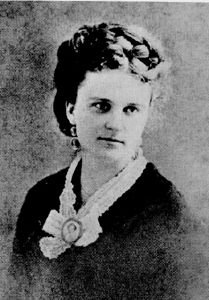
Kate Chopin

Kate Chopin (Public domain, via Wikipedia)

It’s been some time since I read (and therefore reviewed) a Library of America offering, but when I saw another Kate Chopin offering pop up a few weeks ago, I couldn’t resist it. And so, I printed it off, but have only just managed to read it. Well, what a surprise…

I thought about starting this post with “And now for something completely different” because this story, “A Morning Walk” (1897), is significantly different from my previous three Chopins – her novel The awakening, and the two short stories I’ve previously reviewed here. All is explained though in the brief but useful introductory notes from LOA:

Chopin gained fame (and notoriety) during the 1890s startling readers with her handling of topics considered bold for the era, but she also continued to publish light or pleasant fiction for local magazines. Among these latter stories are several holiday tales – a genre whose prevalence, along with its promise of good pay, proved attractive to writers during the nineteenth century on both sides of the Atlantic, from Charles Dickens and Washington Irving to Robert Louis Stevenson and Willa Cather (who published under a pseudonym).

And so to “A Morning Walk”. It is a short short story about Archibald’s morning walk. It was originally published under the title “An Easter Day Conversion” which gives a clue to its meaning. Archibald is around forty, not concerned about looking older than he is, and inclined to focus on the practical rather than emotional or sentimental things in life. In the fifth paragraph we are told that:

Archibald has started out for a walk, not because the day was beautiful and alluring but for the healthful exercise, and for the purpose of gathering into his lungs the amount of pure oxygen needed to keep his body in good working condition.

However, the language in the third paragraph hints at something else going on around him, even if he’s not consciously aware of it: the irregular streets “cuddle up” to the houses, “riotous colours” are abroad, and there is “a velvety gust” which “softly” beats his face. And in the fourth paragraph we are told that these sensations of spring “for some unaccountable reason … were reaching him to-day through unfamiliar channels”. Instead of his usual interest in flowers being “to dismember their delicate, sweet bodies for the purpose of practical and profitable investigation”, on this morning “he saw only the color of the blossoms, and noted their perfumes. The butterflies floated unmolested within his reach …”.

On this walk, and in this frame of mind, he meets a young woman, carrying lilies. His thoughts take a sensual turn as she reminds him of “peaches that he had bitten; of grapes that he has tasted; of a cup’s rim from which he has sometimes sipped wine”. The references to the lilies – which tend to symbolise innocence and purity – are even more pointed: their “big wax-like petals” risk being “bruised and jostled”.

And so he accompanies her to church, surprising the congregation with his presence, and hears the beginning of the traditional Easter sermon, “I am the Resurrection and the Life…”. Life seems about to change for Archibald, for the better, as he senses and accepts “the poet’s vision, of the life that is within and the life that is without, pulsing in unison, breathing the harmony of an undivided existence”. The aforementioned “lilies” – and their bruising – add a little edge which I’d expect of Chopin, but the reading is, I believe, intended to be a positive one.

Note: My other Kate Chopin reviews are A respectable woman and Désirée’s baby.