Favourite quotes: from the artist Hans Heysen

I started this little Favourite Quotes series some time ago, with a specific purpose in mind, but it fell by the way-side in the busy-ness of life. However, I regularly come across statements that I’d love to document somewhere useful so that I don’t lose them – and so I am resurrecting this series with a broader ambit.

This new plan was inspired by my visit to the Hans and Nora Heysen: Two Generations of Australian Art Exhibition this week, at NGV Australia, Federation Square, in Melbourne. Their art is very accessible and a joy to see, but also offers much to think about. Hans Heysen (1877-1968) focused largely on landscapes. He particularly loved gums – woo hoo – and has been described, in fact, as an early conservationist. His daughter, Nora (1911-2003), focused more on still lifes and portraits. She was also Australia’s first woman war artist. Lisa (ANZLitLovers) posted recently on Nora. Both were significant Australian artists. Hans won our prestigious landscape prize, the Wynne Prize, nine times, and Nora won our top portrait prize, the Archibald.

However, my goal here is not to review the exhibition, but to share two statements made by Hans Heysen which I think can apply to all art – not just the visual arts.

Quote 1

… while as an artist I love Australia, art has no country, but is in essence cosmopolitan.

Droving into the light (Hans Heysen, 1914-21)

Much of Hans Heysen’s work seems quintessentially Australian in content but his technique – obvious when you look at his work – is strongly informed by 19th century artists and movements, by, for example, the Pre-Raphaelites, the Impressionists, the Romantics like Turner, and artists like Van Gogh. Anyhow, I like his argument that, in essence, art is bigger than “country”. The Exhibition argues that Heysen disavowed nationalism, which is not surprising given the tough time that he, as a German-born Australian, experienced during World War 1. The label for “Droving into the light” argues that “not so much nationalist as pantheist, Heysen’s landscapes do not refer merely to what it is to be Australian but rather to explore what it is to belong to nature in a more holistic sense.” So, for example, Heysen biographer Klepac says that Heysen was “inspired by the light and the landscape of Hahndorf and the Adelaide Hills, which he transformed into an Arcadian vision that can still haunt us with its sense of timeless beauty”.

I like these interpretations of his work, and would argue that taking a broader perspective is the aim of many creators, regardless of how specific their settings are.

Quote 2

I am trying only to paint as truthfully as I can, and that which my eyes see and perhaps what I unconsciously feel. Truth to Nature after all is the goal, but Truth interpreted through temperament.

Hans Heysen wrote this to his artist friend Lionel Lindsay in 1919. I like his clarification that while his aim is “Truth”, it can only be a truth that he sees and feels. I may be drawing a long bow – and perhaps even mixing up different meanings of “truth” – but it reminded me that although “truths” can be universal, they are also individually interpreted. Why else, I suppose, would we keep looking at art, reading literature, listening to music, and so on? It would be pretty boring, if not meaningless, if everyone expressed these “truths” the same way. Just compare Heyson’s Australian landscapes with those of other artists and we can quickly see how differently the “truth” of the landscape can be conveyed – one seeing it as Arcadian (idyllic), for example, and another as Gothic (terrifying.)

Anyhow, the aim of these posts is to share some interesting ideas, rather than become too bogged down in explication. Hopefully, you can see why I wanted to “keep” these quotes?

Vicki Laveau-Harvie, The erratics (#BookReview)

Book coverTruth is that, while I like to read at least some of the Stella Prize shortlist, I didn’t have Vicki Laveau-Harvie’s memoir, The erratics, on my high priority list, though the more I heard about it, the more intrigued I became. However, it was winning the prize that tipped it over into my must-read category. What a challenging read it is.

The erratics is the story of how Laveau-Harvie and her sister responded to their estranged aging parents’ needs as infirmity caught up with them. Canadian-born Laveau-Harvie had, decades earlier, escaped the family home in rural Alberta moving, eventually, to Australia. Her younger sister had also escaped, though not so far. She lived in Vancouver. It all came to a head when their 94-year-old mother’s hipbone “crumbles and breaks” putting her in hospital. Laveau-Harvie and her sister regroup to help – their father, in particular, who, they discover, had been being systematically starved by their mother. The story of this dysfunctional family, and the sisters’ actions to save their father and ensure their mother is deemed incompetent, never able to return home, is arresting.

Equally arresting is Laveau-Harvie’s writing. It’s not surprising that she won the Stella (not to mention the Finch Memoir Prize and being shortlisted in the NSW Premier’s Literary Awards), because the writing grabs your attention with an impressive sureness of tone and language. It’s particularly impressive because it is, apparently, 70-something Laveau-Harvie’s first book.

The back-cover blurb of my edition concludes with: “a ferocious, sharp, darkly funny and wholly compelling memoir of families, the pain they can inflict and the legacy they leave, The erratics has the tightly coiled, compressed energy of an explosive device  – it will take your breath away”. It does all of that.

First, it’s an astonishing story of a mother who seems incapable of the love we expect from a parent. I’ll share the quote that you’ll have read before if you’ve read about this book:

One of the few coherent messages my mother repeated to me and my sister as we grew up, a message she sometimes delivered with deceptive gentleness and a touch of sadness that we weren’t more worthy prey, was this one, and I quote: I’ll get you and you won’t even know I’m doing it.

If you are a parent who feels guilty about mistakes you made in your parenting, you can rest easy after reading this (unless of course you are like Laveau-Harvie’s mother!) Most of us, I’m sure, made our mistakes inadvertently, not with the intent behind this woman’s behaviour. The problem in Laveau-Harvie’s family was compounded by the fact that their father, while not brutal like their mother, was weak, believing (or, at least accepting) everything his wife said about their daughters.

So, the story, itself, is compelling – in the strange behaviour of these two parents, and in the willingness of the daughters, despite being rejected by their mother, including being given no formal role in managing her affairs, to step in and do the hard stuff out of love for their father and, I guess, a sense of responsibility. But, in addition to the story, what makes this memoir particularly compelling is, as I’ve already said, the writing itself.

It’s a tight, spare read at just over 200 pages. It has stunning descriptions, but I’ll exemplify it with the metaphor contained in the title itself, a metaphor that draws from a geologic formation called the Foothills Erratics Terrain in the town nearest her parents’ home:

Countless years ago, the Okotoks Erratic fell in on itself and became unsafe to climb upon. It dominates the landscape, roped off and isolated, the danger it presents to anyone trespassing palpable and documented on the signs posted around it.

Unfortunately, Laveau-Harvie’s mother came with no such sign.

There is a deft handling of chronology, with the occasional bit of foreshadowing. And then there is the tone, which is achieved by a crisp story-telling style that is direct, colloquial, witty even, and that focuses on the facts with little explication, all the while conveying the challenges faced by the two sisters in negotiating their relationships with each other, their father and their mother. One of Laveau-Harvie’s techniques is to undercut a description or plan with a short, emphatic sentence like “That was the plan” or “I can’t fix this” or “I don’t do this”.

It’s an invidious situation, and you can’t help but feel their pain. She writes at one stage of not remembering certain events:

I do know this: where there is nothing, there must be pain; that’s why there is nothing. Be glad if you forget.

There’s another of those short concluding sentences – “Be glad if you forget”. It’s powerful.

The strongest part of the narrative concerns the relationship with her sister who, still living in Canada, is the person on-site, and who has always been less able distance herself from the pain. There’s a telling sentence about their choices of mementoes from the house:

I salvage a few other things … things from my childhood … my sister takes only things acquired by my mother after we had left home, heavy crystal goblets, silver serving plates, full dinner sets of translucent china. I want only the connection to the past, she wants never to feel it again.

So, this sister, the one who wants to distance the past takes on, at a cost to her health, more than Laveau-Harvie believes sensible: “I can see sinkholes of simmering resentment about to develop between us.” Laveau-Harvie explores the challenges of siblings negotiating the care of aging parents with the clear-eyed honesty she applies to the whole story, albeit, at times, I wondered how the sister felt about her depiction. Presumably, it’s ground they’ve well-covered between each other.

The book, then, is compelling and many readers, like Kim (Reading Matters), have found it a “compulsive read”. I did too. But, there was also something about the tone that disquieted me, as it did Kate (booksaremyfavouriteand best). This surprised me because I wasn’t expecting to feel this way. I love fearless honesty. It’s one of the reasons (besides her writing) that I like Helen Garner so much. She is not afraid to say the hard, unpalatable things. And yet, I found it difficult at times here. I think it’s because I felt some of this “honesty” was attended by an unkindness, by a willingness to laugh at another’s expense (though, admittedly, she also frequently laughs at her own).

An example is her description of the array of carers she and her sister put in place for their father. It’s funny, and has an element of truth, recognisable by anyone who has experienced the situation. But I bridle at name-calling, so “the gold-digger” and “the housekeeping slut” did not make me laugh. (I particularly hate women calling other women “slut”, even a “housekeeping” one – but that may just be me!) And then there’s the description of the breakage of some fine china freighted to Australia:

I imagine customs officers dropping the box because it has a label that says ‘Fragile’, satisfied at the sound of something delicate breaking.

Ultimately, however, although I couldn’t help reacting, occasionally, with the disquietude that I did – I realise I can’t judge. How can I, when the family life she experienced is beyond my ken? And, the ending is inspired. She draws on myths about the Okotoks to lay her mother – that “bitterly unhappy and vindictive old woman” – to a potentially more peaceful rest.

The erratics, then, is an impressive debut. It’s compelling and, significantly, it prompts us to think about the importance of love, responsibility and respect within all families.

AWW Challenge 2019 BadgeVicki Laveau-Harvie
The erratics
Sydney: Fourth Estate, 2019 (Orig. pub. 2018)
217pp.
ISBN: 9781460758250

Monday musings on Australian literature: Narratives from outside Australia?

In my post on this year’s Stella longest announcement, I quoted this from the judges’ comments:

We wished for more representations of otherness and diversity from publishers: narratives from outside Australia …

They followed this with other wishes like stories by and about “women of colour, LGBTQIA stories, Indigenous stories”. These are obvious desires, but I am intrigued about the specific request for “narratives from outside Australia”, given the writers themselves have to be “either Australian citizens or permanent residents of Australia”. Superficially, at least, this is the reverse of the Miles Franklin Award which stipulates Australianness in the content (“Australian life in any of its phases”) of the works to be considered. (Some might remember the questions about Shirley Hazzard’s The great fire winning the Miles Franklin in 2004. Its link to Australia was pretty tenuous.)

Now, I’m not arguing against reading books not set in Australia – far from it. It’s just that, as a reader, when I look for narratives from outside Australia, I tend to look to writers from those places outside Australia.

So … what specifically do they mean?

Book cover for Madelaine Dickie's TroppoDo they mean they’d like more narratives by Australians about Australian experiences abroad?

We have always had those. Henry Handel Richardson’s Maurice Guest, Christina Stead’s For love alone (my review) and Shirley Hazzard’s The transit of Venus are good examples from the past. Contemporary examples include Madelaine Dickie’s Troppo (my review) and Angela Savage’s The dying beach (my review). Both authors have spent significant time in the Asian countries they write about. Dickie says this about Troppo:

Some of the anecdotes are almost true, certainly stemming from my own experiences as a traveller and surfer … The texture of Troppo is also very true, the intoxicating smell of kretek cigarettes, the nights bleary on Bintang beer, and the way the call to prayer from the mosques drift down through mountain valleys.

Both these novelists use plot-driven novels to explore not only personal growth, but socio-political and environmental issues affecting the southeast Asian region, issues important for Australians to understand.

Other contemporary novels by Australians about Australians abroad include Murray Bail’s The voyage (my review), Diana Blackwood’s Chaconne (my review), Angela Meyer’s superior spectre (my review), and Tim Winton’s The riders.

Writer Irma Gold recently wrote a blog post titled “Literary adventures abroad”, and featured Angela Meyer, Angela Savage and Leah Kaminsky, whose book The hollow bones I haven’t read. Meyer references that issue concerning writers from the country itself:

I questioned my desire to do so, when there are so many great Scottish writers writing about Scotland. But the desire would not go away, and I knew that the lens I was applying would be Australian — my character, Jeff.

Savage says of her decision to write novels set in Thailand:

Writing fiction set in Thailand provided both a means to process my experiences and an outlet for the travel stories nobody would listen to.

Interestingly, but perhaps not surprisingly, several of the novels I’ve read that include Australians abroad are historical fiction works set during, or post, various wars, such as Alan Gould’s The lakewoman (my review), Joan London’s Gilgamesh, Richard Flanagan’s The narrow road to the deep north (my review). All of theses enhance our understanding of the personal, social and/or political impact of war on Australian life and culture.

Merlinda Bobis Fish-hair womanDo they mean they’d like to see members of our diverse population writing about where they came from?

There are many memoirs on this topic, but, while the Stella Prize encompasses all forms and genres, my focus here is fiction. A memorable example for me is Merlinda Bobis’ Fish-hair woman (my review), which is set in the Philippines during the civil unrest of the 1980s. It’s a strong, evocative piece about humanity and the stories we tell (or manipulate) in the name of it.

Other Australian writers who have written about the places they came from include Michelle de Kretser in The Hamilton case, Sara Dowse in Schemetime (my review), Kavita Nandan in Home after dark (my review), and, coming up this year I believe, debut author Elizabeth Kuiper with her debut novel about coming of age in Zimbabwe.

One of the things these writers can do is provide a unique insight into their home cultures, because they revisit them through their migrant (expat) eyes. That insight can be uncomfortable, though, for the home culture, as we Aussies have felt when our own leave and then write about us from elsewhere. Peter Carey is a good example. I like Sydney Review of Books reviewer Natalie Quinlivan’s analysis of the situation when she says that his “fiction often tries to rewrite and reframe Australia. The success of such a pursuit depends on whether thinking about Australia, rather than living in the country, provides Carey with objective clarity or rhetorical detachment.”

Marion Halligan Valley of graceOr, do they just mean they’d like Australian writers to set books elsewhere.

Markus Zusak’s The book thief is an obvious example (my review). But others are Eva Hornung’s Dog boy (my review) and Marion Halligan Valley of grace (my review). These are all great novels, in which their authors have used their imagination and experience to explore universal truths in places other than their own. Each has a reason for making that decision – Hornung, for example, being inspired by a news article – and each has created a book that I have loved for its heart.

Why seek Australian narratives set outside Australia?

Well, I think Angela Savage says it all on Irma’s blog:

I also wonder if there’s a market for books set in Asia written by non-Asian Australians, or if readers prefer Own Voices writing — in this case, stories set in Asia by writers with an Asian background. For my own part, I enjoy perspectives that both ‘insiders’ and ‘outsiders’ bring to fiction.

I don’t know what the Stella judges specifically meant, but I think Savage has nailed it. In the end, what we want to read is as many different perspectives as we can because diverse reading opens our eyes and minds to other ways of being and seeing. However, my point is one of degree. I welcome these books (as those of you who read my reviews will know), but I’m not sure that Australians writing “narratives from outside Australia” is a glaring gap that needs filling.

I do hope all this has made some sense!

What do you think? 

José Jorge Letria, If I were a book (#BookReview)

Book coverIf I were a book is one of those “gift” books you give to readers – and it was in that spirit that it was given to me for my birthday a couple of years ago. It’s a delight of a book, and is somewhat quirkier than these sorts of book-lovers’ gift books often are, which is why I’ve decided, finally, to share it with you. Or, have you seen or read it already?

My edition is a little hardback of 60 plus pages produced in San Francisco in 2014. The original, however, was published in Portugal in 2011, the author being Portuguese. The illustrator, André Letria, happens to be his son. Now I hadn’t heard of José Jorge Letria before, but he was born in the Lisbon District of Cascais, in 1951, and is apparently, says Google’s translation from a Portuguese biography, “a journalist, poet, playwright, fiction writer and author of a vast work for children and young people.” This biography also tells us that he has won many many national and international literary awards, including the Unesco International Prize (France), the Barcelona Classical Poetry Prize, the Plural Prize (Mexico), the Prize of the Paulista Association of Art Critics (São Paulo), and the Gulbenkian Prize. He has won prizes for “the environment in children’s literature” and the Manuel de Arriaga Prize for his contribution to the defense and dissemination of animal rights. He has been on many Portuguese, European and international literary boards, and his books have been translated into “over a dozen” languages. Yet, I hadn’t heard of him, until, that is, I was given this delightful ….

… love-letter to the book and reading. I fell in love with its passion and idealism. The book comprises two-page spreads, each one containing an image and the phrase “If I were a book” followed by a response. So, the first image shows a person looking at a book on a park bench, with the phrase “If I were a book, I’d ask someone in the street to take me home.” (What a nice sign that would make for a street library!) The next shows this same person opening a larger-than-life book, inside which there are stairs descending into unknown depths, with the phrase “If I were a book, I’d share my deepest thoughts with my readers”. And so it continues…

What makes this book so delightful is the personalising of the book (as in “if I were a book”), the ideas expressed in these personalised phrases, and the illustrations. I’m not sure what is allowed by copyright, but I’ve chosen three images to share with you, so you can see what I mean:


This slideshow requires JavaScript.

I’ve chosen these three because the one suggests the way I like to read – slowly, savouring the words and ideas – and because the other two contain aspirations that I’d love books to achieve. You can see how in some images the book is supersized, while in others its size is more “normal”. The images are simple but beautifully whimsical, the colour palette is minimalistic, and the text’s font feels a little worn and loved.

And here, I think I’ll leave it, because what more, really, can I say?

José Jorge Letria
If I were a book
Illustrated by André Letria
Translated by Isabel Terry
San Francisco: Chronicle Books, 2014 (orig. pub. 2011)
[64pp.]
ISBN: 9781452121444

Monday musings on Australian literature: Ashurst Business Literature Prize

Book coverMy, how dry does today’s topic sound? But read on, and see what you think. This prize was brought to my attention a couple of days ago by a tweet from author Michelle Scott Tucker announcing that her book, Elizabeth Macarthur: A life at the edge of the world (my review), had been shortlisted for the Ashhurst Business Literature Prize. Her tweet was followed up by Lisa (ANZLitLovers) posting the shortlist on her blog. I decided to save my post for Monday, as it seemed a perfect topic for musing on …

What exactly is this Ashurst prize?

Firstly, it has been going for FIFTEEN years, having been established in 2004 by Blake Dawson as the Blake Dawson Business Literature Prize, “for business and financial affairs writing”. The prize’s name was changed to the Ashurst Business Literature Prize in 2012. Ashurst Australia was previously called Blake Dawson, and is the Australian arm of an international commercial law firm. The prize has been administered by the State Library of New South Wales from the start.

The prize is currently worth $30,000, marking it as an award that means serious business! (Sorry, couldn’t resist that.)

Its aims, from the Prize’s site, are to:

  • Encourage business and finance writing and commentary of the highest quality; writing that brings with it the richness that can come from detailed research
  • Stimulate those writers with a knowledge of Australia’s business life and to encourage their continued production of insightful, well researched books that can be easily digested by the general reader
  • Enable all Australians and the general reader to be better informed about Australia’s commercial life and its participants
  • Add another dimension to Australia’s intellectual and cultural life

So the subject matter is clearly defined, as is the intended audience. The subject matter, though, has changed a little over time. Initially, it was restricted to Australian business and finance, but in 2013, this was expanded to encompass “international and global commercial life and its participants”. That explains why a book about the Lanes who started the Penguin publishing company was eligible. (See 2015’s winner.)

There’s also a wider aspiration about adding to our “intellectual and cultural life.” I like that – we need more good writing on some of the more practical topics affecting our lives.

The conditions of entry include the subject matter and the intended audience. Also:

  • the works must be in English, and can be in printed book or ebook form
  • the author/s must be Australian citizen/s or hold permanent resident status, and at least one of the authors must be alive at the time of nomination.

It doesn’t specifically say anywhere, but it seems that the works are expected to be non-fiction, so, for example, a book like Kate Jennings’ Moral hazard, which, as I wrote in my review,  “looks not just at our contemporary globalised financial world, but more widely at work, our relationship to it, and the moral choices we make in work and in life”, would not be eligible. A shame, I think, for such work not to be recognised. However, a wide variety of non-fiction genres are clearly accepted, including histories and biographies.

Past winners

The past winners, as listed on the State Library of NSW’s website:

  • 2004: Fred Benchley’s Allan Fels: A portrait of power (John Wiley & Sons Australia)
  • 2005: Darrin Grimsey and Mervyn K. Lewis’s Public private partnerships: The worldwide revolution in infrastructure provision and project finance (Edward Elgar)
  • 2006: Gideon Haigh’s Asbestos house (Scribe)
  • 2007: Caroline Overington‘s Kickback: Inside the Australian Wheat Board scandal (Allen & Unwin)
  • 2008: Leonie Wood‘s Funny business: The rise and fall of Steve Vizard (Allen & Unwin)
  • 2009: Peter Thompson and Robert Macklin‘s The big fella (Random House)
  • 2010: Paul Barry’s Who wants to be a billionaire? The James Packer story (Allen & Unwin)
  • 2011: Trevor Sykes‘ Six months of panic: How the Global Financial Crisis hit Australia (Allen & Unwin)
  • 2012: Peter Hartcher’s The sweet spot: How Australia made its own luck – and could now throw it all away (Black Inc)
  • 2013: Malcolm Knox‘s Boom: The underground history of Australia, from Gold Rush to GFC (Penguin Random House Australia)
  • 2014: Andrew Burrell‘s Twiggy: The high stakes life of Andrew Forrest (Black Inc)
  • 2015: Stuart Kells’ Penguin and the Lane Brothers: The untold story of a publishing revolution (Penguin Books Australia) (Lisa’s ANZLitLovers review)
  • 2016: Catherine Bishop’s Minding Her own business: Colonial businesswomen in Sydney
  • 2017: Michael Traill’s Jumping Ship: From the world of corporate Australia to the heart of social investment (Hardie Grant Publishing)

Has anyone read any of these? Several of the authors are known to me – including journalists Paul Barry, Gideon Haigh, and Caroline Overington – and I have heard of a couple of the books, but no, I’ve not read a one!

Shortlist for the 2018 prize

  • Ian D. Gow and Stuart Kells’s The big four: The curious and perilous future of the global accounting monopoly (La Trobe University Press)
  • Damon Kitney’s The price of fortune (HarperCollins)
  • Eleanor Robin’s Swanston: Merchant Statesman (Australian Scholarly Publishing)
  • Michelle Scott Tucker’s Elizabeth Macarthur: A life at the edge of the world (Text Publishing)
  • Brian Sherman and AM Jonson’s The lives of Brian (Melbourne University Publishing)

The judging panel is quite different to the usual composition: Richard Fisher AM (General Counsel and Adjunct Professor of Law at the University of Sydney); Narelle Hooper (business journalist, editor and author); Margie Seale (Non‐Executive Director of Telstra Corporation, Westpac Banking Corporation, Scentre Group and Australia Pacific Holdings).

The panel’s chair, Richard Fisher, described the 2018 shortlist:

… Four are biographies; two are concerned with pioneering business people, Elizabeth Macarthur and Charles Swanston whilst the others focus on James Packer and Brian Sherman. The fifth traces the evolution of accounting practice, and particularly The Big Four, from Medici to the modern day.

The winner will be announced on 15 May.

Any thoughts? Would you be inspired to read these sorts of books?

Julian Davies, Call me (#BookReview)

Book coverI wasn’t sure what I was in for when I started reading Call me, the latest offering from that tricksy duo, novelist Julian Davies and illustrator Phil Day. But, it soon became clear that what was before me was a coming-of-age story. What, I wondered, was Davies doing writing such a novel? Then I remembered that this was the author who gave us, most recently, Crow mellow (my review), so I decided to relax and go with the flow. Sensible me, because this is a sophisticated take on the genre, geared to an adult audience.

The story starts in the first person voice of a young woman called Caddie, who is in bed with a young man called Pip. They are both in their last year of school, and the story spans the last couple of months of that year, through their eyes. However, the tricksiness starts here, because Caddie’s voice is first person, while Pip’s is third person subjective. Why? An author doesn’t make these decisions lightly, so I usually want to know why. It’s particularly interesting here because this is a male author choosing to write his female character in first person, and the male in third person. I’ll come back to this because right now you are probably wanting to know more about the actual story than these technicalities!

“This is Australia” (Pip’s friend, Stu)

So, the story. Caddie and Pip have been in a relationship for around a year at the start of the novel, but it’s geographically challenged because Caddie lives in the city (in Canberra, in fact) while Pip lives in the country, an hour or so’s drive away. Davies knows whereof he speaks because he too lives about an hour’s drive from Canberra. Caddie’s parents see themselves, according to Pip, as “high middle class”. They both run businesses, her father’s being an investment business called Capital Capital, and her mother’s an art gallery called Sense and Sensibility (because, as she apparently told Pip, “she was lapping up Jane Austen while her friends were still  playing with their dolls”). They keep “upgrading” their homes, and they fight a lot. Pip’s parents, on the other hand, describe themselves as “feral middle class”. Sydney escapees, they live in the not-quite-finished house they built themselves; they take a loving but laissez-faire approach to parenting; and they get on well. All this introduces the city-versus-country theme that recurs in Davies’ works, including Crow Mellow and his Meanjin piece about building his own home (my review). It’s pretty clear where Davies’ preference lies!

The majority of the novel takes place over 15 days, and chronicles, in lovely nuanced detail, the tensions that develop in Pip and Caddie’s relationship due to Pip’s decision to leave school only weeks before the end. Their thoughts and feelings are told alternately in chronologically named chapters, like “Day One” and “Day Eight (Still Later)”. Although Caddie is critical of her parents, in the way that teenagers often are, she’s following the traditional path of working hard at school and planning to go to university. She is totally into mobile phones and social media. Pip is a more independent thinker. He’s not interested in social media, and only has a phone because Caddie gave it to him. And yet, in a neat paradox, Caddie records her thoughts in a diary, while Pip records his into his phone! This is pure Davies, by which I mean nothing is simple or straightforward.

So, we have the city-versus-country theme, plus a subtle questioning of modern technology, including our reliance on it and its potential for misuse. A third theme relates to education. Pip’s decision to leave school stems from his refusal to live by external expectations that don’t feel authentic to him. He hates the “petty rules” and, as Caddie explains it, “the kind of society we live in that the education system feeds”. He has no alternative plans but feels incapable of “passively endorsing” a system he doesn’t believe in.

“What kind of person am I?” (Caddie)

Accompanying these more sociological themes are personal, psychic ones. Both Caddie and Pip are deeply concerned with their identity, specifically with what it is to be “a person”. Caddie, living in her “sheltered” house and uncomfortably aware of the material benefits provided by her parents, wonders not only “what kind of person” she is, but, more broadly, “what does it mean to be a person.” This question of personhood is frequently burdensome to her. Pip, however, has a different take, recognising that “he is only one person”. One of the challenges they face is negotiating their own and each other’s personhoods. Late in the novel, when their relationship is floundering, Pip wonders “did the new, distant Caddie undermine and diminish his sense of her as the person he thought he knew?” Meanwhile, Caddie “wonders who Pip is that he can hold this view.”

Call me, then, is essentially a book of ideas that questions, in a lightly satirical way, aspects of modern Australian society, but it’s not boringly didactic, partly because the ideas are explored though some engaging characters. These include two we met in Crow Mellow, making this book a sort of “companion piece”. The characters are the wise Phil Day, a teacher who, cheekily, happens to share a name with the book’s illustrator, and the ridiculously named cynic, Dick Scrogum (aka Scrotes). Scrogum’s opinionated banter and Day’s quiet conversations encourage Pip to dig a little deeper into the reasons for his decision.

These characters, however, are only part of why the book doesn’t become mired in earnestness. Another reason is that, surprisingly, as the book progresses, it becomes apparent that there’s more to it than just Caddie and Pip’s relationship; there is in fact quite a plot developing. Who are the mysterious callers on Pip’s phone and what do they want? Should we be worried about them? And what about the gun that Pip has? It is pretty much de rigueur that once a gun is mentioned in a narrative it’s going to be used, but will it? Is this book not what it looks, but, really, some sort of crime-mystery-thriller? You’ll need to read it to find out.

And now, I’ll return to that question I posed at the beginning about voice. Both first person and third person subjective voices offer easy engagement with characters but can only offer limited perspectives. Telling the story through two such voices widens the perspective, by letting us see Caddie and Pip through each other’s eyes as well as their own. In other words, we get a little touch of omniscience alongside close engagement. But, why is one voice first person and the other third? I’m not sure really, but maybe it’s something to do with the fact that Pip is the main protagonist, and that Caddie, as the “I”, represents both herself and the reader (who is, perhaps, likely to be more like her – female, sincere, somewhat conservative, but also open-minded and keen to explore). By being more directly in her head, we are encouraged to question, as she does, certain assumptions and values. I suspect too that there may be something autobiographical about this novel. Is Pip like Davies’ younger self? And does putting Pip at one step remove provide him with a little space to interrogate the boy he was? Certainly Caddie seems to question who Pip is more than vice versa. I’m probably wrong about this, but at least I’ve given it a shot!

As I say all too often, there is so much to say about this book. I haven’t even touched on the gorgeous landscape descriptions of a region I love. Nor on the clever segues, nor Phil Day’s whimsical illustrations, nor the humour, nor, indeed, what a beautiful book is it to look at, hold and read. However, I’ve written enough for now.

Call me, then, is not only an engrossing story about the psychic growing-up of its protagonists, but one that also offers provocative commentary on both humanity in general and modern society in particular. Them’s big boots, but Davies pulls it off, resulting in a book that’s both intelligent and fun to read.

Julian Davies
Call me
Illustrated by Phil Day
Braidwood: Finlay Lloyd Publishers, 2018
363pp
ISBN: 9780994516541

(Review copy courtesy Finlay Lloyd Publishers)

ABIA 2019 Shortlists announced

I have not posted on the ABIA (Australian Book Industry Association) Awards here before, but it has a couple of categories that interest me, so I’ve decided this year to share them with you.

The process of selection involves, as I understand it, the longlist being chosen/voted for by the ABIA Academy of over 200 industry professionals, with the shortlist and winners then being chosen by judging panels. There are several categories, but I’m reporting on just three here. If you are interested to know more, do check out the ABIA awards website.

Books may only be entered for one award – except for the Matt Richell new writing award. This means, then, that submitters must choose whether to submit, for example, their books for the General Fiction Award or the Literary Fiction Award, or, say, for the the Small Publishers’ Adult Book or the General Fiction or Literary one. This must result in some interesting discussions.

The shortlist was announced yesterday, April 11, and the winners will be announced on May 2.

Literary fiction book of the year

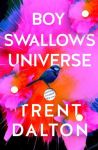
  • Trent Dalton’s Boy swallows universe (Fourth Estate) (my review
  • Melissa Lucashenko’s Too much lip (UQP) (my review)
  • Kristina Olsson’s Shell (Scribner) (Lisa’s review)
  • Tim Winton’s The shepherd’s hut (Hamish Hamilton) (Theresa’s review)
  • Marcus Zusak’s Bridge of clay (Picador)

Small publishers’ adult book of the year

(It’s great seeing small publishers getting their own little spot, albeit they’ve been doing pretty well, in recent years on bigger stages!)

  • Anita Heiss’s (ed) Growing up Aboriginal in Australia (Black Inc.) (my review)
  • Robert Hillman’s The bookshop of the broken hearted (Text)
  • Angela Meyer’s A superior spectre (Peter Bishop Books) (my review)
  • Sally Piper’s The geography of friendship (UQP)
  • Alison Whittaker’s Blakwork (Magabala)

The Matt Richell award for new writer of the year

(This award is named for the publisher of the Australian arm of Hachette, Matt Richell, who tragically drowned a few years ago.)

  • Trent Dalton’s Boy swallows universe (link to my review above)
  • Bri Lee’s Eggshell skull (A&U) (Kate’s review)
  • Heather Morris’ The Tattooist of Auschwitz (see link to Lisa’s review above)
  • Holly Ringland The lost flowers of Alice Hart (Fourth Estate) (Theresa’s review)
  • Christian White’s The nowhere child (Affirm Press)


This slideshow requires JavaScript.

Any comments or predictions?

Stella Prize 2019 Winner announced

The Stella Prize winner was announced tonight while I was at yoga so I had to wait, impatiently – oops, no, it was yoga, so I was very calm thanks to my wonderful neighbour and teacher – until I got home, to discover the winner. I only managed to read three of the six, which is one more than I had read by last year’s announcement, but I do have a fourth on my TBR.

Before I announce the winner, which most of you will have heard by now anyhow, here is a quick recap:

  • the longlist was announced on 7 February: check out my subsequent Monday musings post for an interesting conversation about the judges’ comments; and
  • the shortlist was announced, as is tradition, on International Women’s Day: Jenny Ackland’s Little gods; Enza Gandolfo’s The bridge; Jamie Marina Lau’s Purple Mountain on Locust Island; Vicki Laveau-Harris’ The erratics; Melissa Lucashenko’s Too much lip; Maria Tumarkin’s Axiomatic.

Vicki Laveau-Harvie, The erraticsAnd the winner, from around 170 books submitted, is a memoir, Vicki Laveau-Harris’ The erratics, a book that intrigues me, although I have to admit I wasn’t expecting it to win – but there you go, you never can tell. It is the third non-fiction book to win the award in seven years, nicely confirming Stella’s aim to be broad in the forms it encompasses. The other two were Alexis Wright’s collective biography, Tracker (2017), and Clare Wright’s history The forgotten rebels of Eureka (2014, my review).

The winner receives $50,000, and each shortlisted author receives $3000, as well as a three-week writing retreat on the Victorian coast, making it a generous prize.

Now, while I haven’t read The erraticsKim (Reading Matters) has, and found it “compulsive” reading. Kate (booksaremyfavouriteandbest) has too, and was less enamoured, but she explains her reactions in detail. These reviews are worth reading. Kim also has a postcript explaining book’s publishing trials.

Anyhow, here is an excerpt from what Louise Swinn, this year’s Judging Panel Chair, said at the announcement:

The six shortlisted titles all have something to say about the way we live today, two in the form of nonfiction and four novels. These books are very outward-looking and unafraid. They deal with complex and complicated issues. They can be unsettling.

The winning book elegantly tramples all over the Stella requirements: it is excellent, engaging and original in spades. It is moving and funny, and as powerful in what it leaves out as it is in what it includes. It is also a first book, and I hope it’s the first of many. It is my considerable pleasure to announce that the winner of the 2019 Stella Prize is Vicki Laveau-Harvie for her memoir, The Erratics.

She also made an interesting comment about the Stella Prize itself:

In this seventh year of the Stella Prize, the high quality of the general submissions could, for anyone not paying attention, make you wonder why we have this prize at all. But the Stella has never been about an actual lack of talent — it is about perception and how this has affected the amount of space women’s writing has been allowed to take up.

It will be interesting to see this year’s Stella Count, because that’s where we can see what progress (if any) is being made.

If you have any comments on the winner, I’d love to hear them.

Monday musings on Australian literature: Spotlight on Robert Drewe

Courtesy: Annette Marfording

Courtesy: Annette Marfording

In 2016, I wrote five Spotlight posts inspired by Annette Marfording’s Celebrating Australian writing: Conversations with Australian authors, and decided that was probably enough mining of her work for my blog. However, with over two years having passed since then, I wondered if it might be okay to do another. I emailed Annette, and she kindly agreed. But, who to choose from the 21 authors in her book? Well, of course, you know from the post title who I chose, so the next question is, why him?

The answer lies in an email correspondence I’ve had with Carmel Bird over the last week in response to my last Monday Musings posts on pianos. Carmel emailed me privately to mention an anthology she edited, Red hot notes, which includes many pieces about the piano. How embarrassing! I actually have that book. Anyhow, that got us talking about short stories and short story writers, including Robert Drewe whose The bodysurfers I have. Carmel exhorted me to read (or, to be precise, finish reading) it. I will, because what I’ve read so far I’ve loved. (Meanwhile, I plan a future post on short stories more generally, inspired by our discussion.)

Robert Drewe, The bodysurfersBut now, after that rather long introduction, on to Robert Drewe. Marfording’s interview took place in August 2009, at which time Drewe had published six novels, three short story collections, two non-fiction books and two plays. Since then he has written another novel and short story collection, both of which I have given as gifts in recent years, plus four more works of non-fiction. He has won two Walkley Awards, a Commonwealth Writer’s Prize, and several other awards. Wikipedia says that his novel The drowner made Australian literary history by becoming the first novel to win the Premier’s Literary Prize in every state”.  And yet, I have not reviewed him for my blog, though I did post on his Seymour Biography Lecture in 2015.

Given the multiple forms he has written in, Marfording started by asking him his preferred form. He said that he likes them all “at different times – sort of equally” but that at the time of the interview he was particularly enjoying short stories, a form he came to after writing a couple of novels. Now, that’s interesting because many people suggest short stories are a training ground for novels, an idea I don’t much like as I see short stories as a form in their own right. Anyhow, Drewe commented that he was “finding the short story more interesting and more contemporary and of the moment.”

Marfording then turned to his origins as a fiction writer, after his early work as a journalist. He talked about always wanting to be a writer, and what his career as a journalist gave him:

It taught me how to write simple declarative sentences, it took me out of a normal Australian middle-class background and showed me how the other half live, it showed me how courts work and crime and how people at the struggling end of the spectrum live. It was really a fascinating background for a writer.

The discussion then moved on to Drewe’s novels and short stories, and how they reflect or comment on contemporary Australian society, including, specifically, such issues as refugees, the environment, and Indigenous Australians. Drewe makes an interesting comment about using the novel versus short story form:

I’m interested in ideas which I try to get across in a novel, but I’m interested in more succinct, shorter forms like relationships and so forth, and conflicts between people are easier to deal with in a short story …

Not surprisingly, this led to a discussion about his treatment of relationships, before returning to the short story, and what he sees as the essence of a short story. For Drewe,

… a good short story makes you look at something about your own life or experience through the prism of what you’re reading. So a sense of identification or recognition is what matters, really.

I’d have to think about whether all “good” short stories need to do this, but certainly I’d agree that many or most do.

Marfording then discussed his writing process, which is something that interests most readers (or, at least, those who read or listen to interviews with authors), and also a little about film adaptations, given his Ned Kelly novel, Our Sunshine, was adapted for a film which starred Heath Ledger. But, I’m leaving those to move on to their discussion about his work as an editor of short story anthologies.

How, Marfording asked, does he choose short stories for his anthologies. Drewe said that he advertises in all the literary columns in “newspapers and so forth”, and, he said, “the stories arrive in their thousands.” He also reads published stories in literary magazines. He said that half the content will be pre-published stories like these, but the rest will be new – “that’s where the fun is for the editor, discovering new people.” I reckon that’s where the fun is for the people he has discovered as well. Imagine being selected by Robert Drewe!

He commented that some anthologies include “slabs of novels … which goes against the whole point of short story collections.” I have certainly seen that. It’s seems fine if it’s a story that the author later develops into a novel, but to excerpt a novel feels a bit suss to me. However, I don’t want to be absolutist about this because there are always exceptions, n’est-ce pas?

Then, of course, there’s that other question we readers all love, his favourite writers. Drewe’s include Gabriel Garcia Marquez, Raymond Carver, Alice Munro, Helen Garner, and Peter Temple. You can see a few short form writers in there can’t you?

Another behind-the-scenes question concerned judging literary awards. It’s not so hard, he said, to choose shortlists, but choosing the winner is something else:

I generally tend to go for the imaginative ones, the ones that strike me as being less like another story than I’ve read before. The more original, the better, really.

A good rule-of-thumb, methinks, though a risky one. It can result in the selection of books that many readers won’t like, and the work may not stand the test of time. But, if award-winners don’t push boundaries, where are we? We need brave judges.

I did say I’d pass by discussing his writing process, but I’ll conclude with a selection of first lines from The bodysurfers which exemplify his comment that “you owe it to the reader to engross them”:

“My father wasn’t in his element in party hats”. (“The manageress and the mirage”)

“It was possibly lucky my mother didn’t marry her first fiancé because he ended up in Fremantle prison”. (“The silver medallist”)

“The murders took the gloss off it.” (“The bodysurfers”)

Would these lines make you want to read on?

Previous Spotlight posts:

Annette Marfording
Celebrating Australian writing: Conversations with Australian authors
Self published, 2015
273pp.
ISBN: 9781329142473

Note: All profits from the sale go to the Indigenous Literacy Foundation. To find out where you can purchase this book, please check Marfording’s website.

Six degrees of separation, FROM How to be both TO …

I don’t think I’ve read one Six Degrees of Separation meme starting book yet this year! But that hasn’t stopped me giving it a go. Who said you have to read a book to write about it! Many a student has known that’s not necessary! (Never fear though, I always read the books I review on my blog. I’m not that brazen!) But now, before we get onto the post proper, I need to tell you to click on meme leader Kate’s blog name – booksaremyfavouriteandbest – if you don’t know the rules.

Ali Smith, How to be bothSo, this month’s starting book is Ali Smith’s How to be both, a book I’d love to read, particularly given I read and loved, long before blogging, her second novel, Hotel world. Smith is an inventive writer, and this book was shortlisted for and/or won several prizes, including, in 2015, the Bailey’s Women’s Prize for Fiction

Eimear McBride, A girl is a half-formed thingI have, over the years, read several of the winners of this Women’s Prize (under its various names), one of which being the 2014 winner, Eimear McBride’s moving, confronting, A girl is a half-formed thing (my review). It tells of a dysfunctional Irish family, comprising a mother, a daughter (the titular “girl”), and her brother whose mental capacity has been compromised due to surgery for brain cancer when he was young. Our girl is emotionally neglected as the mother struggles to care for her son’s needs.

Sarah Kanake, Sing Fox to meAnother novel exploring the impact on a sibling of living with a disabled brother is Sarah Kanake’s Sing fox to me (my review), though in this book the challenge is Down Syndrome and the brother is a twin. Kanake’s book is set in Tasmania, and with its forbidding – and mysterious – forest setting, it falls within a sub-genre we know here as Tasmanian Gothic.

Horace Walpole, The castle of OtrantoNow it just so happens that I’ve read, since blogging, the book generally regarded as the first Gothic novel, Horace Walpole’s The castle of Otranto (my review). It’s quite a story, about the lord of a castle who … well, I’m not going to spoil it here, am I?

Sonya Hartnett, Golden boysBut, we all love a castle don’t we – even scary Gothic ones. We don’t have many castles in Australia – not surprisingly, given our relatively short built-history – but Sonya Hartnett does use a castle motif in her novel Golden boys (my review). There’s no real castle in her suburban setting but one of the main characters starts to

see that the world is a castle, and that a child lives in just one room of it. It’s only as you grow up that you realise the castle is vast and has countless false floors and hidden doors and underground tunnels …

I liked that metaphor, particularly because it suggests that life can be pretty “gothic” at times!

Sofie Laguna, The chokeSonya Hartnett is an Australian author who has managed to successfully straddle writing for children and adults. Another Aussie who has done this is Sofie Laguna, and it’s to her most recent book for adults, The choke (my review), that I’m linking next. The choke refers, literally, to the Barmah choke in the Murray River – a place where the river narrows  and then pushes through, creating a paradoxical metaphor for both being squeezed and for pushing forward. It’s also, for protagonist Justine, a place of escape and tranquility.

Tony Birch, Ghost riverTony Birch’s Ghost river (my review) is a semi-autobiographical novel which, too, is set on a river – and a river which also has a physical presence as well as a spiritual and metaphorical one. This novel, though, has an additional environmental story about saving the river from a freeway development.

So, this month, I’m back to my usual gender division of four women and two men, and to my strong focus on Australia, with only two forays (excluding the starting book) to the United Kingdom. We’ve also spent almost all our time in the contemporary era, with a quick dip of our toes into Walpole’s 18th century. Not very varied I’m afraid, so

… over to you: Have you read How to be both? And, regardless, what would you link to?