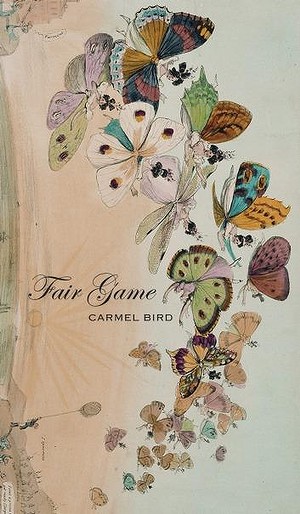
Telltale, Carmel Bird and me

In my recent post on Carmel Bird’s bibliomemoir, Telltale, I hinted that there could be another post in this book. There could, indeed, be many, but I must move on, and I must not spoil the book for others. However, given many blog-readers enjoy personal posts, I’ve decided to share a few of my particular delights in the book. I found myself frequently writing “Yes” in the margins …

“I’m glad, now, that I have always defaced books”

… because, like Carmel Bird, I have, since I was a student, “defaced” my books. Not only that, but my defacements seem to be of a similar ilk to hers. For example, I sometimes add an old envelope, or post-it notes, inside back covers to carry more notes. Like her, I love books with several empty pages at the back to accommodate note-taking.

Not enough blank pages at the end of Telltale!

Carmel Bird also loves indexes – and I love the fact that Telltale has a beautiful index, because such a book should, but often doesn’t. But, what really tickled me was her comment early in the book that “I also make a rough index on the empty pages at the ends of books I read” (or, as she also writes, “pencilled lists of key elements”). Yes! Sometimes, my indexes are more like notes, but other times my notes are more like indexes. Mostly, though, I do a bit of both, with exactly what depending on the book and on my response to it. This latter point is implied in Bird’s statement that:

In 2020, paying so much attention to books, I took particular notice of the differences in the ‘indexes’I had made at different times, how on each re-reading I had noticed different details.

Here, she not only shares her reading practice but also comments on reader behaviour, on the fact that each time we read a book we find something new. That can be for various reasons. On subsequent readings we already know the book at some level and so are ready to see more in it; on subsequent readings the world will have changed so the things we notice can also change according to the zeitgeist; and then, of course, the biggie, on subsequent readings, we ourselves have changed so we see the world differently. I love that Bird’s indexes reflect this – and that she saw it.

But, there’s a downside to all this “defacement”, which Bird also discusses. Writing about discarding books – the how and why – she says, “when I have annotated a book, it is not much use to anybody but myself, so selling it or giving it away are not possible solutions”. I know what she means, though I contest that hers would not be of use to anyone else. Who wouldn’t enjoy owning a book so defaced by her?

There is, however, a point at which she and I depart. When reading an outsize paperback becomes “too difficult … to manage comfortably” she will attack it “vertically down the spine with an electric carving knife” to divide it into manageable portions. I know some travellers tear out sections of travel guides they no longer need, but librarian-me finds destruction a step too far. Sorry Carmel, I understand, but …

“oh what a lovely word”

Like many authors, Carmel Bird loves words. It’s on show in all her work, but in Telltale, it’s front and centre. In her opening chapter, she writes that

Uncle Remus uses terms such as ‘lippity-clippity’. This is the kind of singing, onomatopoeic language I sometimes invent when writing.

And, so she does, even in this nonfiction bibliomemoir. Did it come from reading Uncle Remus “all that time ago”, she ponders. Was it “embedded” in her brain, back then, without her “even realising”? Probably.

Throughout Telltale, Bird discusses words – how they have changed over time (in meaning, for example, or in acceptability), how they look, where they come from, how they sound. As the daughter of a lexicographer, I would be interested in this. As a lover of Jane Austen whose wit and irony I adore, I would be interested in this. And, as one who loves writing that plays well in the mouth and sounds great to the ear, I would be interested in this. If you love words too, this book will be an absolute delight for you.

Other delights

As I said when opening this post, I really mustn’t spoil this book for others, so I’ll just add a few other delights:

  • her discussions of the many books and stories she chooses to share – those she found on her shelves that she felt illuminated her life and writing. I’ve mentioned very few of these because, really, this is the thing that most readers will want to discover and enjoy. Get to it … Meanwhile, I will name just two here. One is Dickens’ Bleak House which she writes “might” be her favourite Dickens. It might be mine too. The other is Marjorie Barnard’s “The persimmon tree” which she describes as “extraordinarily powerful”. Barnard’s “The persimmon tree and other stories” is one of the only short story collections I’ve read more than once. I concur!
  • silly little things like the fact that she loves green (as do I) and that she learnt that “lovely” word “tessellated” at the tessellated pavement at Tasmania’s Eaglehawk Neck (as did I).
  • she loves the internet and allowed herself to use it for this book. She was the first fiction writer in Australia to have a website. Like most of us, she prefers printed books, but she also sees the advantage of electronic books (including the ease of searching them – as an index-lover would!)

Finally, early in the book, Bird discusses memory:

As is often the case with memory, while some of physical details are clear, the principal element that has been retained is the feeling. Perhaps the feeling is the meaning.

Yes! This makes sense to me. I can rarely remember plots or denouements, but for the books that are special to me, I can remember how they made me feel – uplifted, melancholic, inspired, distressed, excited, angry, and so on. These feelings are surely associated with what the author intended us to take away, and therefore they must reflect the meaning?

Here, I will, reluctantly, leave Telltale, but I’ll do so on one of its three epigraphs, the one from her own character:

‘memory
is the carpet-bag
mire of quag
filled with light-dark truth-lies
image innation
and butterflies’

CARILLO MEAN,
Remembrance of Wings Past

How can you not love this?

Carmel Bird, Telltale: Reading writing remembering (#BookReview)

Finally, I have found something to thank COVID for – Carmel Bird’s Telltale. Best described as a bibliomemoir, Telltale may never have been written if Bird had not been locked down with her extensive library. What is a lively mind to do in such a situation? I can think of a few options, but what Bird decided was to revisit the books she’d read since childhood and, through them, look for patterns in her life and, because they are intertwined, in her writing practice. She would reflect on “the working of the imagination, the behaviour of the unconscious mind”.

Telltale, in other words, is more than a simple chronological run-through of her books, because the reading and writing life is not so easily compartmentalised. She writes that it

is composed of two different kinds of narrative.  One is warp and one is weft, and I am not sure which is really which. Will the threads hold? What patterns might I work across the surface? Will the metaphors crumble into useless dust? One thread speaks of books read and sometimes of books written. And also of things that happened in my life. The other speaks of a journey of the heart, a pilgrimage through a patchy history of the world, becoming a poetic thread that runs through the whole narrative.

A complex book then, but one told in such a personal, confidential come-with-me voice, that it reads like a lovely long conversation with an intelligent friend. Like any intelligent conversations, though, it requires the participants to be on their toes, to be ready for twists and turns, for surprising connections and conclusions, to be both confronted and delighted. Bird heralds this in her opening sentence:

As a child at the end of World War Two, I was introduced to the concept of the Trickster in literature.

That trickster was Brer Rabbit, whom I also remember from my childhood, but I was of a more prosaic mind than Bird, who has proven to be a bit of a trickster herself. Yes, the dictionary uses words like “dishonest”, “cunning”, and “deceptive” to describe “trickster”, but the trickster in literature, as Wikipedia explains, “is a character in a story … who exhibits a great degree of intellect or secret knowledge and uses it to play tricks or otherwise disobey normal rules and defy conventional behavior”. This is how I see Carmel Bird as a writer. The surface can look quite simple, but underneath there is usually something else going on. You only have to check out the epigraphs to her books, which frequently include bon-mots “written” by her own character, Carillo Mean. It’s apposite, then, that she starts her book with a “trickster”. It tells us to be ready for – well, anything.

So, Telltale. It looks like a bibliomemoir – a book about her reading and writing life – but as she explains in the excerpt above, it also encompasses “a patchy history of the world” as it has affected or appeared to her. To unite it all, she crafts her tale around a narrative heart, a loved book, Thornton Wilder’s The Bridge of San Louis Rey. She wants to write about it but can’t find it. This injects a mystery: will she find it? It also introduces a potential conflict: will she break the rule she set for herself to not buy books and only use those on her (clearly extensive) shelves. As the memoir progresses, we become party to her increasing concern about where it is and what to do.

Why of all the books, you might be asking, The bridge of San Luis Rey? But, that might be for me to know and you to find out.

“to move the heart and illuminate the mind”

Late in Telltale, Bird mentions reading Katherine Mansfield’s short story “The fly” when she was fifteen. She writes:

I suddenly saw how the surface narrative and the narratives and meanings below the surface could dance together with an electrifying elegance to move the heart and illuminate the mind. This was my first conscious lesson in style and structure.

See! It’s a lesson Bird clearly took to heart, and which is on display in all the works of hers I’ve reviewed. (As for “move and heart and illuminate the mind” – who could want more from reading?) Earlier in the book, she refers to another aspect of her style: “the pleasure I take in moving (drifting, spinning, flicking) from one topic to another”. This pleasure, she suggests, could have come from her father’s six-volume Harmonsworth’s household encyclopedia. Again, we see this approach in Telltale. It’s one of the things I love about Bird’s writing. It can be challenging, of course, but it is exciting to be so challenged – and to thus be respected as a reader.

Anyhow, the point is that while on the surface Bird seems to move or flick from topic to topic, her books are invariably held together by framing ideas and motifs. Here, it’s not only the search for The bridge of San Luis Rey, but two other narratives, which she draws together towards the end of the book. One concerns a childhood family picnic to Cataract Gorge in 1945, and the other, the gathering of American planes for the rarely-remembered firebombing of Tokyo in March 1945. Woven through these narratives is another, Bird’s growing awareness of the devastating dispossession of Australia’s First Nations people, starting from her acceptance, as a Tasmanian-born child, of their “extinction” in her state.

These are the main narratives that make up the aforementioned “patchy history”, and I fear this may be sounding disjointed. In fact, however, the “threads” hold, because the relationship between this “patchy history” and the books she has read and written is strong. Not only are there the obvious and expected connections between the “history” and her reading and writing, but there are also two recurring motifs that are real, historical, and literary – bridges, which can symbolise “fragile communication and union”, and peacocks which can signify “eternal life”.

Telltale is a delicious and revelatory read, and I’m not doing it justice. I’ve not, for example, touched on the quirky, often poetic, tapered chapter ends, or the neat segues between chapters. Nor have I said much about the writing which can turn from seriously descriptive or philosophical to whimsical or poetical in a paragraph. And nor have I shared the reflections about reading and writing, about truth and meaning, about words and language, that I specifically noted down to share, because, frankly, there are too many. There may be another post in this.

I took some time to read this book, and I’m not sorry. To read Bird, if you haven’t realised already, is to agree to join her on a sometimes merry, sometimes macabre dance. If we do, what we find is a compassionate heart that, despite it all, believes in love and calls us to hope, as that peacock that has accompanied us throughout darts and dances across the sky.

Lisa also enjoyed this book.

Carmel Bird
Telltale: Reading writing remembering
Melbourne: Transit Lounge, 2022
274pp.
ISBN: 9781925760927

(Review copy courtesy the author)

Monday musings on Australian literature: Bush Book Club (2)

Last week, I introduced the Bush Book Club. Established in Sydney in 1909, its aim was to get books out to remote areas of New South Wales not supported by other services like Schools of Arts and Mechanics Institutes. In my post I focused on its establishment and aims, but I found it so interesting that I’m back again, this time to share something about their book selections and early achievements.

The books

Not having independent funds, besides what they fundraised, the Club (B.B.C.) planned to focus on donated secondhand books, but that didn’t mean they accepted anything. While they wanted to cater for males and females of all ages, their goals were worthy, which meant, as I quoted last week, there was a censoring committee to ensure that “vulgar, trashy, novels, and morbid, unwholesome works” would not be sent. Indeed, as the Mudgee Guardian and North-Western Representative (30 June 1910) reported, the Club’s aim was

To provide high-class literature to the dwellers in the bush districts of New South Wales, who live beyond the reach of any School of Arts. … The books for the club are provided by people who are interested in supplying really good literature. The club is non-political, and non-sectarian.

So, its early aims were good quality literature, that was non-political and non-sectarian. However, it seems that as it got underway, the materials sent were more varied than these goals imply, albeit, as the newspaper reports continued to confirm, books continued to be censored. This censorship doesn’t seem to have been questioned, though, suggesting that the censor’s pen was light or that the recipients were undemanding.

I read many reports about the club over its first decade, mostly comprising newspaper reports on the Club’s annual meeting. The story was the same – the good work being done, and increases every year in the number of “centres” being supported; the call for donations of money and books to support the work; and references to the dullness of life in “outback” and the need to support the people who were “breaking the sods of our new country and bearing the burden and heat of the day away from the pleasures and comforts of civilisation” (SMH 17 April 1912). These comments sound condescending at times, but many remote people were desperate for reading matter, all the same. No mention, of course, of First Nations people. It seems that the patron was always a “Lady” – like Lady Poore, Lady Chelmsford, Lady Strickland – most of them, vice-regal. The role was presumably passed on as each arrived with her husband, but there is a sense from the reporting that they took on the role with relish.

There were also some references to the actual books. Reporting on a Club meeting in December 1911, two years after the Club’s establishment, The Sydney Morning Herald, noted that there was a tendency for book donors to send

too many “serious” books. The lighter style of literature, tersely written, and of ordinarily human interest, was preferable.

A few months later, The Sydney Morning Herald’s (17 April 1912) report (linked above) commented that it’s alright “if they [the recipients] are not great readers, and if Marie Corelli and E. P. Roe are appreciated above Ruskin or Carlyle”.

On 18 April 1917, the same paper reported that

the demand among bush readers was chiefly for wholesome fiction, but tastes are very varied; “anything and everything about the war” being eagerly devoured.

And a few months later, on 4 July, it wrote that the Club’s:

library is gathered together, being truly an “omnium gatherum” of all sorts and descriptions, from Bacon to Artemus Ward, from Dickens to Charles Garvice, from Shakespeare to Gordon, all acceptable and all sure of their readers. The only literature barred from the shelves are political and sectarian works. … The parcels are selected, so that there is a sprinkling of heavier reading, one or two of Thackeray or Dickens, or suchlike; two or three boys’ and girls’ books, and about 20 light novels, besides magazines and small weekly publications galore.

“I must read or I shall go mad”*

The Club lasted some decades and expanded beyond New South Wales, but I will write more on this later. Here, I’ll focus on its first decade. The Sydney Stock and Station Journal regularly reported on it, which is not surprising given its rural focus, but this must also reflect the Club’s significance. In January 1912, just over 2 years after the Club was founded, the journal reported that there were 125 centres operating, adding that

There is a “centre” within coo-ee of the Queensland border, and there are several out on the Castlereagh. The Riverina knows the B.B.C. well, and the Club’s books are working out towards the Darling. No place is too far.

The journal also notes that a centre could be as small as a few families. I imagine the Club’s willingness to be organisationally flexible played a role in its success. It wouldn’t have hurt, either, that, as this journal also said, the Club “is anxious to send just what the centre wants. Its desire is to please. Say what you want and the Club will do its best to satisfy.”

Some of the newspaper reports describe the sorts of “centres” that were receiving books. On 7 May 1914, the Clarence and Richmond Examiner reported that there were 309 centres, which included “railway camps, sleeper cutters ‘ camps, shearing sheds, and country hospitals”. A year later, on 29 April 1915, The Sydney Morning Herald reported that there were 370 centres, and named the Light Horse Camp at Liverpool as one of them. It was, of course, wartime, by now.

The annual meetings, on which the newspapers reported, often also shared some of the letters of appreciation received. On 21 June 1916, The Sydney Morning Herald shared some:

One lady wrote that for years she had not been able to read anything except a newspaper, books being out of reach but now she is making up for lost time with the help of the Book Club. Another correspondent described the pleasure given to the children of the household when the parcel of books arrived; a lighthouse keeper sent his warm thanks for (presumably) “light” literature, which relieved his solitude.

Very funny! 

By 1918, the club was still going strong, with many of the original volunteers still involved. The majority of them were women, and they included some interesting names – but I will talk about that in my next B.B.C. post.

* The N.S.W. Red Cross Record (1 July 1919)

In conversation with Craig Silvey

I understand that literary conversation events in Canberra go best when the subject is political. I guess it’s the nature of the beast – that is, of living in the national capital. But for me, it’s the fiction writers that I want to see, and we do get some interspersed amongst the run of historians and journalists that we get. Even so, it’s been three years since I attended an ANU/Canberra Times Meet the Author event, due partly to the pandemic which halted the program for a while and partly because I have a pretty full dance card. However, Mondays are often free, so Mr Gums and decided to check out Craig Silvey. I’ve only read his best-selling Jasper Jones (my review) but that’s because you can’t read everything. I would like have read Honeybee. Tonight’s focus, though, was his latest novel, Runt.

The conversation was conducted by local author Irma Gold, who is no stranger to this blog. She’s always good in the interviewer’s chair, being both warm in manner and astute about writing – and so it proved again tonight.

The conversation

After MC Colin Steele did the usual introductions, Irma took over and introduced Silvey and the book we were there to hear about. Runt is, she said, a middle-grade children’t book. It features a solitary girl, Annie, with a penchant for fixing things, and the dog, Runt that she befriends. Irma found Runt a heart-warming book, which was lovely to read to her 11-year-old son. She believes it is destined to become a children’s classic. It would, both she and Colin Steele said, make an excellent Christmas gift. What a shame our grandson is only 4.

Irma Gold and Craig Silvey, 2022, ANU

After some light-hearted banter with Craig about a Fremantle biscuit artist – who knew? – Irma got down to business. Noting that Runt represents a new audience for Craig – that middle-grade age – she asked what his favourite book/s had been as a child. Craig replied that he’d been a voracious reader as a child. (Show me an author who wasn’t!) He loved a range of books, including those traditional classics like Lord of the Rings and the Narnia books, but then he made some points that were specific to him. For example, he liked books that made him feel things, and named a short story by Paul Jennings titled “Busker”. It was the first story, he said, that made him cry. Another favourite was Goodnight Mr Tom, which elicited sounds of agreement from the audience, and which, he later realised, might have partly inspired Honeybee.

He also liked books that made him laugh, and he mentioned Roald Dahl, Paul Jennings again, and the James Herriot vet series.

After this, there was some discussion of Runt, which is set in the perfectly named country town of Upson Downs. There are Annie and Runt of course, and some villains, including the farmer, Earl, who is also a collector. One of the things he collects is water! Earl is buying up farms to get the water, and wants Annie’s family’s farm. The plot revolves around Annie’s plans to save the farm. There was more chat about the story and the characters, which include the wonderfully named 13-year-old Fergus Fink, and then we moved onto setting and themes.

Irma noted that Craig had grown up on an orchard in a small country town, and asked whether this had inspired Runt. Craig responded that the novel was an “affectionate love letter to country life“. He loves country people – their use of understatement, and their dry humour – and the country makes for great fiction settings because it is “exposed to the whims of elemental forces”.

This led to a discussion about the relevance of climate change to the book. Craig observed that water policy and climate change are putting people under pressure, and that villain Earl’s avarice is boundless. There are subtle messages in the book, including the fact that people are more important than hoarding/collecting things!

Irma commented that Runt is very different to Honeybee, but it does encompass diversity. Craig responded that he writes about Australians in Australia, and that we are a diverse country. Irma then said that the book had a contemporary setting but a very classic feel. Craig replied that he wanted classical elements underpinning his text but that, for example, a 13-year-old boy’s aspiration now would be to be a YouTube star. Of course!

From here Irma turned to screenplays, because each of Craig’s books have or are being adapted to film, with Craig also writing the screenplays. There was discussion about the screenplay writing process, and how Craig, “wrote them sort of together”. Film development for Runt is already underway, with production possibly starting next year.

Craig had some interesting things to say about writing screenplays versus novels. There are rigidities to screenwriting that you don’t have in novel writing, he said. The screenplay format can be too restrictive to let your creativity fly, so he enjoys novel writing, but, conversely, writing screenplays reins him in as a novelist, which has benefits.

Irma’s next question concerned publishing and the fact that Craig has been published for 20 years now. How has publishing changed? Interesting question, responded Craig. For him, the biggest change is in the post-publishing aspect. Back in 2004 when his first novel, Rhubarb, was published, we were not as “connected” so you had no idea what was happening with your book. Now, with social media, you get immediate recognition and can see what is happening. Reviewing is democratised and it is “a really beautiful thing”, he said. (As a blogger, I appreciated this.)

Publishing, itself, though is still painful. You take this tender part of yourself and you expose it to the world. So, while his success means that he no longer has to do the “shitty jobs” he had to do when he was 19 and writing Rhubarb, in terms of writing, he still faces the blank page with the same uncertainty. This is essential, though, to being a writer: you need to “straddle the pain and struggle” but you need also to balance it with hope and pride. Such a mentally healthy attitude.

On whether he was always going to be a writer, Craig talked about meeting his first writer, Glyn Parry, at school, when he was 14. He realised, suddenly that writers were human beings and it could be a vocation. He wrote to Parry, and got some great advice: “Don’t become a writer, be a writer”. Craig didn’t go to university. Instead, he did menial jobs and read and read – and “forensically examined novels.”

After a delightful little interlude discussing his career as an electric ukelele player in a band called the Nancy Sykes (inspired by Dickens, of course). During the band’s short life, they apparently played Shaun Tan’s bride down the aisle! A little later in the interview there was another fun interlude, this time about his being a finalist in Cleo’s Bachelor of the Year contest and being described as “the thinking woman’s buttered crumpet”. It was an entertaining story, but I’m not going to spoil it just in case you get to a launch and hear it yourself. Instead, back to the writerly life.

Irma asked Craig whether he enjoyed book tours, and the response was immediate. He loves it and is deeply grateful to anyone who comes out to hear him. Novelists lead bifurcated lives. They tease stories out of themselves, then release them to the audience at which point they become each reader’s to appreciate and define. He said most authors, like himself, feel profoundly empty when they finish a book, but engaging with readers fills him back up again.

Q&A

These sessions are always well-run, resulting, always, in time for a Q&A. There were some excellent questions. Canberra didn’t let Irma down!

On getting the voice of a teenager, and whether he sees hope in younger people: Craig said that he has gravitated to teenage protagonists (though Annie is I think pre-teen), because everything is amplified at that age. The bubble your parents keep you in is pierced and you start to recognise the truth of things. It’s a time of profound change, when you start to define who you are, where you’re going. He likes to pair his protagonist with something opposite that can provide the catalyst for change. As for hope, he said that Runt‘s protagonist Annie’s hope is infectious. She inspires change, kindness, generosity, hope.

On diversity and the challenge of writing characters outside his own experience: (This would have been my question if I hadn’t been taking notes and had to get up and go to a microphone!) Craig responded that the further his character is from his own experience, the more responsible he feels. His practice is to connect with the appropriate community, as he did with the trans community for Honeybee. I loved Craig’s response to this question. He had three rules of thumb for writing ethically: do no harm; your purpose must have merit; and execute properly. Ethical writing is something we must discuss, he said. Responding to a follow-up question on Honeybee, he said that while the trans character doesn’t announce herself at the beginning, it was clear to all audiences that she was trans. His writing was informed by the trans community. The risks trans people take in disclosing themselves means that his character would not have announced their trans nature immediately. His character Sam is slow to trust, which is true.

On film adaptations and how he feels about giving over control: Craig said that he has screenwriter all his novels which partly answers the question! However, filmmaking, he continued, is a vastly collaborative process which is the opposite of writing a novel. He said that seeing Jasper Jones brought the screen was one of the most extraordinary moments of his life. It’s a communal artistic pursuit, and the result can be something larger than you are capable of conceiving on your own.

Irma closed by reiterating that Runt was a “really beautiful book” and that Craig had been compared to Roald Dahl. That is an accolade worth having. Having not read the book, I can’t say whether I agree or not, but I can say that Craig came across as a genuinely positive yet thoughtful and serious-minded person, and that Irma did a great job of bringing it all out. Thoroughly enjoyable – and there should have been more people there!

ANU/The Canberra Times Meet the Author
MC: Colin Steele
Australian National University
10 October 2022
Podcast available at SoundCloud

Monday musings on Australian literature: Bush Book Club (1)

I came across a reference to the Bush Book Club during my research for those 1922 posts I’ve been doing this year. I flagged it for a post in the series – but then discovered that the Club was founded in 1910. It’s a fascinating project, and I haven’t reached the end of it yet, so am just starting here with an introduction to it.

What was it?

The Bush Book Club was not a book club in our contemporary, reading-group meaning of the word, but an organisation that was founded at the end of 1909 to send books to remote areas of New South Wales, specifically to those areas lacking a School of Arts (or Mechanics Institute). It was inspired by similar work being done by the England-based Victoria League in places like Canada.

The Club was formed by Mrs. Aubrey Withers during an “informal meeting” at Admiralty House, under the auspices of Lady Poore who became its first President. Several newspapers reported on it, including the Sydney Morning Herald (22 December), which explained that members of the first committee included women from the Women’s Branch of the Empire League (our version, apparently, of the Victoria League). The SMH added that the Girls’ Realm Guild had “been engaged in bush library work” for over a year, but “decided to join in the bigger movement” resulting in “no overlapping”.

The SMH also reported that some very clear principles were laid, which would make for success. These included that it would be “non-sectarian and non-political”, and for both men and women. There would also be

a censorship committee to see that only suitable literature is distributed. By “suitable” is not meant only standard works or books of a “goody goody” nature, but care will be taken that vulgar, trashy, novels, and morbid, unwholesome works are not amongst those sent out.

This sort of sensibility would be typical of 1909, but I do love the language used. In terms of practicalities, the SMH notes that railway authorities had “promised” to send the books without charge, and that the committee hoped that school-houses would become distribution points for the books. As far as I’ve read to date, distribution was handled by different groups depending on the location – from schools and libraries to community organisations. In Kyogle, for example, it was the North Kyogle Progress Association, while in the Mudgee area it was Erda Vale Subsidised School. The service was not to be free, with the rural readers to be charged pay 3d. a month (or 2s. per annum) to access the books.

The project was very much a grass-roots activity, founded on volunteering and good-will. The expectation from the start was that it would be based primarily on second-hand books. As the SMH writes, “There is hardly a household in Sydney which does not have periodical clearings out of old books and magazines, and it is mainly on these that the club will depend.” The new Club, then, immediately started promoting the project, asking Sydney-siders to donate used (and new) books and magazines to the cause. The SMH put it this way:

So, if any of you wish to send a parcel of books to the bush people, do not reject this because it’s too deep, or that because it’s too fanciful. Remember that there are intellects in the back blocks just us keen as yours, and minds far more hungry than yours can be for mental meat. And please, please remember that there are little children whose minds are opening every day, and to whom the fairy tales, which are so old in your nursery, will carry a world of delight, and open up the fairyland of romance and imagination.

The condescension is palpable … meanwhile, the seemingly indefatigable Lady Poore did organise fundraisers, for “incidental expenses”.

Lady Poore – and a little controversy

From G Vandyk Ltd, An admiral’s wife in the making, 1860-1903 (1917), via Wikipedia. Public Domain.

Which brings me to Lady Poore. Ida Margaret Graves Poore (1859-1941) was, according to Wikipedia, “an Anglo-Irish autobiographer and poet”. Her husband was the baronet, Sir Richard Poore, who became an Admiral in the Royal Navy, and was posted to Sydney from 1908 to 1911.

As you can see from those dates, Lady Poore was only formally involved for a year or so, though later reports occasionally mention that she continued to ask about the Club long after she’d left. She was, though, involved in a little controversy, which many papers reported on – and which she herself managed to treat with self-deprecating humour. (She really sounds like something.) Here’s what happened …

In April 2010, Lady Poore presided over the first annual meeting of the Bush Book Club, at Sydney’s Town Hall. The Sydney Morning Herald (6 April) reported on the meeting, and noted that Lady Poore was keen to “impress … the actual need of books”. She talked about the paucity of reading matter in many remote areas, and argued against the opinion held in some quarters that people who had little leisure for reading needed nothing more than the weekly newspaper. The Sydney Morning Herald‘s report of her speech continues:

If she as a temporary, and she honestly thought, sympathetic dweller, in their midst, might be allowed to offer a criticism, she should say that what the Australian national character lacked was imagination. Commonsense was really “common” here, and she knew no quality of greater practical value but fancy, vision imagination, call it what they would, was not common, and without books she did not see how it was to be awakened, fostered, and rendered articulate. There might be in New South Wales bush-poets in embryo as powerful as Lindsay Gordon, as humorous and pathetic as A B Patterson* (who she was glad to say, was one of their vice-presidents) – bush-novelists too and bush naturalists; but without the help and stimulus provided by reading they would … die full of unexpressed, because un-expressible, ideas. Apart from those who might succeed in literature, there were many whose hard, workaday lives would be made brighter and more beautiful by the reading of books. 

I’m going to put aside her examples of writers to emulate, and cut to the controversy chase. As you can imagine, there was quite a reaction to the idea that Australians lacked imagination, though there was some misreporting. One columnist, for example, thought she was only referring to children, and another to women. Then there was “Roseda” writing in the Wellington Times (14 April 1910) in central western NSW. She (I assume) says that Lady Poore might be right about reading stimulating imagination but, she writes,

To me it seems the Great Silent Bush has more imaginative influences than any book. It is all inspiration and should beget the fancy monger. If it lacks this the fault is in the individual and yet not his fault either. Bush dwellers are too much occupied to have leisure for imagination. Patience say I ’twill come. Are we not producing some of the best songsters in the world? Soon there will be a need of songs for them and then poets will emerge from their slumbers. Bush bards evolve yourselves please.

I love the light tone … indeed, the interesting thing is that while the reports I saw didn’t agree with her, neither did they take severe umbrage, suggesting to me that she and/or her endeavour were much appreciated.

Later in April, Lady Poore attended the birthday of The Optimists’ Club (which she was encouraging to support the B.B.C.). The Daily Telegraph (27 April) reports her referencing her little faux pas. She apparently told the gathering that the press certainly didn’t lack imagination, and that

If she could conveniently take off her hat she would take it off to the press in recognition of the extraordinary kindness, not to say leniency, with which they had treated her— a stranger. A weekly publication of great literary merit likened her to a seagull. Could imagination go further? That was before she was a month in Australia, and it earned her undying gratitude, by the pretty, if unmerited, compliment. A daily paper of high standing credited her with a handsome heliotrope satin gown and a riviere of diamonds — neither of which she possessed — and she had never forgotten the inventive kindness of the writer. Indeed, the press of Australia had invariably used her with a generosity far beyond her deserts, and their recent criticisms had only whetted her appetite for information concerning a country and a people she had a good reason to love. 

Ah Lady Poore, what a charmer.

I was going to write more in this post, including about the actual books and the early achievements, but I don’t want to try your patience so I’m going to hold that over until next week. You will be hearing more about the B.B.C.

* In my reading of newspapers in Trove I come across many misspellings, particularly of Banjo Paterson (as Patterson) and Katharine Susannah Prichard (as Katherine and/or Pritchard), suggesting that sub-editing was not necessarily better in the olden days!

Kim Vanessa Scott, Growing up … Katherine style (#BookReview)

Growing up .. Katherine style is the second self-published book I have reviewed from this Katherine-based artist and writer, the first being her book about some of Katherine’s historical housing, Katherine’s tropical housing precinct 1946-1956. There are a few reasons why I have broken my no-self-published-books rule. One is that both books had some Northern Territory government sponsorship, which gives them some authority. Another is that this book speaks closely to my own experience of childhood that I couldn’t resist sharing them. Moreover, the book is being sold by established outlets like The Bookshop Darwin and the Katherine Museum. Finally, Scott used a desktop publisher/designer to ensure the book looks good – and it does.

So, with all that out of the way, I’ll get to the content, and why it appeals to me. Scott was born in the small outback Northern Territory town of Katherine in the 1960s, while I was born in a slightly bigger but still rural country town in Queensland in the 1950s. The first 14 years of my life were spent in Queensland, and over half of those in country towns, the last three being in the outback mining town of Mount Isa. From there I went to Sydney, where, although I enjoyed my high school and university days, I never really felt home. I left as soon as I finished my studies for Australia’s “bush capital”, Canberra, which has always felt like home. However, I’m getting off-track, so back to the book.

Growing up … Katherine style is both written and illustrated by Scott. It takes the form of a series of little illustrated vignettes from Scott’s life, each comprising an image accompanied by a short piece of text commenting or reflecting on the image. Scott’s art is delightful, bright but not garish, with strong outlines and a somewhat naive aesthetic suited to the childhood theme.

The vignettes take us from her babyhood in 1961 to Cyclone Tracy in 1974. Ending on this event is inspired because the cyclone, which occurred in Darwin a bit north of Katherine, was life-changing for the Northern Territory – and because, coincidentally, Scott would have been entering puberty by then, making it a good time at which to end a book about her childhood. Scott told the Katherine Times, linked below, that the book was at least partly inspired by the catastrophic Katherine flood of 1998 which

took away all our images and a lot of our family history, so I tried to think of a way to record the childhood without the images.

In the book’s introduction, she explains further that the “objects” she chose to illustrate her childhood “had many layers of meaning”. They demonstrate, she says, the way she “interacted with them on an emotional, physical and spiritual level”. What I so enjoyed is that many of them mirror memorable times in my own life – the family’s first car and tv, the importance of the radio, her first plane ride, not to mention those horrible sanitary belts we had to wear for our periods! There are also those little events from childhood that can remind us all of our own misdemeanours and accidents. Take for example, “Mulberries”, in which she describes finding a sixpence and carrying it in her mouth while running. The only trouble is that she then climbs a mulberry tree and puts mulberries in her mouth too:

I had my mouth full of fruit and the coin when I accidentally tipped upside down and swallowed the lot. Rather than tell Mum, I decided to just die.

Don’t you remember times like that? Anyhow, “fortunately”, she writes, “I woke up the next morning …”

I flagged many vignettes to share with you, like “Nursery Rhymes” in which she shares her “Little Miss Muffet” mondegreen. How many of us had those in our childhood (and, I have to admit in my case, beyond.) There’s another on “Slide nights” which tickled my fancy because last night we dined with two other couples and we had an impromptu slide night of both couples’ recent, separate holidays to the Kimberleys. The technology might have been different – thumb drives to the smart TV – but the impact was the same. Scott writes that:

I miss this form of entertainment where we built our oral family history with images.

There’s the reference to family history again.

In another blast from the past for me, she writes in “My first real jewels” of the “bluebird lockets earrings” that were given to her and her sister as their first piece of “grown-up, real jewellery”. As she writes, “they were considered a charm”, and oh, how I had wanted some bluebirds too. One birthday I thought I had been given a bluebird bracelet, but when I looked more closely, the little charms were blue angels. Not the same! I was most disappointed. I could go on but you are surely getting the drift. This book offers both a lovely trip down memory-lane (for most baby-boomers) and an engaging picture of childhood in a different place and time to now.

The book ends on Cyclone Tracy, as I’ve already said. Scott writes that “the path to self-government started on Christmas Eve, 24 December 1974. The warning sound on the radio is burnt into my psyche”.

You can hear an interview with Kim Scott on the ABC Radio Darwin website, and read an article on the book’s publication in the Katherine Times. The Times also advises that the illustrations were put on exhibition at Katherine’s Godinymayin Yijard Rivers Arts & Culture Centre. Scott is described as a local Katherine artist who enjoys “showcasing all facets of life in the NT through visual arts, poetry and story telling.”

I love histories told through objects. Scott has shared her childhood in a way that captures her personal experience while also speaking to the universal. Delightful.

Kim Vanessa Scott
Growing up … Katherine style
Katherine: Kim Vanessa Scott, 2022 (with sponsorship by the Northern Territory Government)
82pp.
ISBN: 9781642045444

(Copy received from the author via a mutual friend.)

Tom Gauld, Goliath (#BookReview)

It’s probably just me, but I hadn’t heard of Tom Gauld until a member of my little volunteer indexing team sent me a link to some of his “cultural” cartoons in The Guardian. I was immediately enchanted. And then, he lent me one of Gauld’s graphic novels, the above-named Goliath. Being primarily a textual person, I am not a big graphic novel reader, but our son became keen on them in his teens, so I have some familiarity and have read a handful.

Now I’ve added Goliath to that elite bunch. It’s the sort of graphic novel I enjoy – spare, drily witty, a bit melancholic. It is also, as you will have assumed, a retelling of the biblical David and Goliath story. Like many modern retellings, Goliath is told from a different perspective, that of Goliath himself, who is seen as a pawn in the game of war. In a wry touch, Goliath is your quintessential gentle giant. When, out of the blue, he is approached to be measured for some armour, he says to the armour-maker, “Are you sure this isn’t a mistake? I mainly do admin”. As one who doesn’t mind a bit of admin, I’m with Goliath.

Gauld has published well over 20 books, starting back in 2001, but according to Wikipedia he is best known for Goliath (first published in 2012) and Mooncop (2016). I notice that his latest, published just this year, is Revenge of the librarians. Now, that’s one I’d love to read!

Anyhow, back to Goliath. Although he’d rather do admin work, destiny has other plans for him as we know – and so, he finds himself, under the Philistine king’s orders, waiting in a valley, armoured and armed up, issuing, morning and night, a challenge to the Israelites:

I am Goliath of Gath,
Champion of
the Philistines.

I challenge you:

Choose a man,
Let him come to me
that we may fight.

If he be able
to kill me
then we shall be your servants.

But if I kill him
then you shall be
our servants.

Poor Goliath. “I’m not a champion”, he says. In fact, he continues, “I’m the fifth worst swordsman in my platoon … I do paperwork. I’m a very good administrator.” But, in classic political spin, he’s told that there won’t be any fighting. He just has to “look like a champion” and “the enemy will cower”. We all know how that turned out … along came David (albeit in this version, after a very very long time of waiting for poor Goliath).

The reviews on the back cover sum it up beautifully. The New York Times says that Gauld uses “simple, clever images to explore the larger, more complicated issues of war and heroism”, while London’s The Times says, and I particularly like this, that “Goliath is a master class in reduction … a celebration of the Christian underdog becomes a subtle meditation on the power of spin and the absurdity of war”. The rest of the back cover review excerpts are similarly spot on.

Small reproduction, allowed for review purposes.

So, did I enjoy it? Yes, I did. I liked the spareness of the art and the text. The first five textless pages set the scene – that is, they show Goliath going about his day quietly, peacefully, doing his paperwork, having a stretch at his desk, and trudging down the hill on which the encampment is located to get a drink. One of my challenges with graphic novels is taking in the images and the text, without letting one distract me from the other, but in Goliath the spareness of both made this easy. Making it easy to comprehend, though, is not the main reason for the spareness! It also reduces the story to its essence, encouraging us to engage with Goliath and what he is experiencing.

I also liked the humanity of Goliath and the small boy whose job it is to support him. As they traipse to see the captain, the small boy carries Goliath’s oversize shield. “Are you OK with that?”, asks Goliath. “Sort of” replies the boy. These two, we clearly see, are pawns in the game, potential “collateral damage” as it were, though of course the Philistine leaders believe they have the winning hand.

I also liked the subtle humour, which you have hopefully picked up already. And, of course, I appreciated the anti-war message conveyed through a twist which shows the ostensibly powerful giant as the manipulated underdog – just by changing the perspective. Something we all need to do, eh? See and feel things from another side. Recommended.

Tom Gauld
Goliath
Montreal: Drawn and Quarterly, 2017 (orig. ed. 2012)
[96]pp.
ISBN: 978770462991

Monday musings on Australian literature: Community novels

Recently, I came across a blogger discussing what she described as “community novels”. The blogger is Liz Dexter at Adventures in reading, running and working from home, and the book she was discussing was an English novel, Small miracles by Anne Booth. It got me thinking, because I love community.

Community, however, is a word with multiple meanings and applications, but Liz’s concept of “community novel” is one which has “a range of other characters, each with their own story that intertwines with the whole”. These characters, if I understand Liz’s blog correctly, can belong to communities that can range from those as “compressed” as a nunnery to those more open like a seaside town. The point is that the characters are all connected by their community, and the novel incorporates the stories of several members of that community.

Of course, I searched the internet for community novels, and found our own Annette Marfording (who has appeared on my blog). Back in 2016 she discussed the topic on her blog in a post titled 10 Great Novels on Community. Annette writes:

Using a community in fiction has several advantages: a community almost invariably provides a hotbed of conflict between its members, and it is conflict that drives a story. Communities also provide the opportunity for the author to begin the story with a new person joining the community, which can serve as the springboard or inciting incident for the story. Furthermore, community allows authors to display their skill at conveying a strong sense of the place where the writing is set. 

So, a significant feature for her are the dramatic opportunities offered by having a new person join a community. To this I would add the opportunities offered by someone returning to a community, which seems a common trope these days. Anyhow, Marfording goes on to list ten “great” Australian community-based novels – at the time of writing – noting that they tend to be set in “small rural or coastal towns, but it would, of course, also be possible, albeit more difficult, to build such communities in a city suburb”. (Check her post for her thoughtful list.)

Both Liz and Annette point to the factors that make “community novels” interesting. The small community, for one, which means readers can quickly come to know and feel engaged with it. The opportunity for conflict and difference – and hopefully resolution at the end – is another. In my internet search I found reference to a book published in 2014 by J. Hillis Miller. Titled Communities in fiction, its subject is described on Amazon as

the question of how communities or noncommunities are represented in fictional works. Such fictional communities help the reader understand real communities, including those in which the reader lives. As against the presumption that the trajectory in literature from Victorian to modern to postmodern is the story of a gradual loss of belief in the possibility of community, this book demonstrates that communities have always been presented in fiction as precarious and fractured.

I’ll leave the trajectory issue to the academics, but I’d be interested in your perspective on whether communities in fiction are always presented as “precarious and fractured”. For me, it depends on the definition of “precarious and fractured”. If “precarious” means “likely to fall or collapse” (Oxford Languages), I’d argue that many fictional communities might be fractured, that is, “damaged” or “broken”, but are not necessarily going to succumb. Take a recent American case, for example, Where the crawdads sing (my review). That community was never going to fall or disappear, but it sure was fractured.

I also found another interesting article* on JSTOR, from 1988, which I scanned. It’s about a genre the writer, Sandra Zagarell, calls “narrative of community”, which she describes as “committed to rendering the local life of a community to readers who lived in a world the authors thought fragmented, rationalised, individualised”. Zagarell and others argue that these novels see community as important to survival in an increasingly individualistic – or, some say – capitalistic world. Zagarell comments at the end of her article on the progress of this genre into modern times, writing that

Embracing increasingly heterogeneous visions of the collective life, narrative of community is expanding the story of human connection and continuity.

Melissa Lucashenko, Too Much Lip

Notably, she sees this happening particularly in the writing of African-American authors like Toni Morrison and Alice Walker. Interesting. We can surely see some of this in First Nations Australian literature. In Melissa Lucashenko’s Too much lip (my review) Kerrie returns to her community because her grandfather is dying but she decides to stay to fight for Granny Ava’s island. This is, in fact, a precarious community. It’s respected leader, Uncle Richard, says near the end that

We had to grow hard just to survive … But the hardness that saved us, it’s gonna kill us if it goes on much longer.

This is a community learning how to live in modern rural Australia. It’s a similar story in Nardi Simpson’s Song of the crocodile (my review) which is also about a community being torn apart, and about the resilience of a culture that is, philosophically, community-based.

Karen Viggers, The orchardist's daughter

Besides these and other First Nations novels, I’ve read other several community-set novels in recent years, such as Malcom Knox’s coastal Bluebird (my review) and Karen Viggers’ rural The orchardist’s daughter (my review). Both are set in vividly delineated communities and explore the tensions, prejudices, greed and/or corruption that can tear communities apart, while paradoxically also conveying the potential in community for the opposite.

I opened this post by saying I love community, which means I also love novels set in communities, so my question of course is …

Do you like “community novels” and if so, what do you like about them and would you like to share some favourites?

* Sandra A. Zagarell, “Narrative of Community: The Identification of a Genre” in Signs, 13 (3) Spring, 1988: 498-527

Six degrees of separation, FROM Notes on a scandal TO …

It might be spring but it’s not a particularly appealing one here, with so much grey and rain, which is unusual for my corner of the world. But, Daylight Savings starts this weekend, which is always a plus, and the spring blossoms and bulbs are out which cheer up the grey. What also cheers up the grey is that it’s Six Degrees time again, which is a time of reconnecting with bloggers I don’t always catch up with over the month. As always, if you don’t know how it works, please check meme host Kate’s blog – booksaremyfavouriteandbest.

The first rule is that Kate sets our starting book, and in September it is another book I haven’t read, though I did see the movie, Zoë Heller’s Notes on a scandal. It was also published under another title, What was she thinking? If I’d realised that before – I only discovered it when I was searching for the book cover – I might have started my chain with the idea of different titles, but I didn’t and so I’m not!

As I said above, I have not read the book but have seen the movie, which stars Cate Blanchett and Judi Dench, so I’ve decided to go with a book that was adapted to a film in which Judi Dench played a role. There are of course many many such books in her long career but I couldn’t resist the opportunity to include a Jane Austen novel again. Judi Dench played Lady Catherine de Bourgh in the 2005 Pride and prejudice (a post on the novel), so that’s what I’m linking to.

Fyodor Dostoevsky, Crime and punishment

Next up is a simple link, another book with a three-word-title with “and” in the middle. I think I’ve done this sort of link before, but no matter, it works and my time is limited. The books is Fyodor Dostoevsky’s Crime and punishment (my review).

In Crime and punchishment, our antihero protagonist,  Raskolnikov, is sentenced to Siberia for eight years. Diego Marani’s protagonist in his The last of Vostyachs (my review) is Ivan, who is the eponymous last of the Vostyachs, an ancient Siberian shamanic tribe – hence my link!

Vincenzo Cerami, A very normal man

My next link is a more usual one, the nationality of the author. Diego Marani is Italian, and so is Vincenzo Cerami, whose novella, A very normal man (my post) has remained in my mind ever since. Perhaps because ….

… its protagonist was a civil or public servant, as I was (though in libraries/archives rather than a government department.) This public-servant subject matter, and the fact that it’s set in Canberra, is partly why my next book also remains memorable for me, Sara Dowse’s West Block (my review). It also happens to be an excellent read, and a novel with a slightly different structure that I found enjoyable to think about as I read. However, that’s not what I’m linking on next.

Dorothy Johnston, Through a camel's eye

My final link is on publisher. Both Dowse’s book and Dorothy Johnston’s Through a camel’s eye (my review) were published by a small and, I gather, highly personal publishing company For Pity Sake Publishing. I wanted to mention this because I did once meet the publisher, Jen McDonald, and found her a lovely, warm person. Tragically, however, she died this year, way too young. Sara Dowse has written a beautiful tribute on her blog. (I should add that I could also have linked Johnston to Dowse through their joint membership of Canberra’s Seven Writers group).

This month, we’ve traveled from England through Russia to Italy and across to Australia. We’ve stayed mainly in the 20th and 21st centuries but have also popped into the nineteenth century. Oh, and we’ve read a few translated novels. This month the gender split is 50:50.

Now, the usual: Have you read or seen Notes on a scandal? And, regardless, what would you link to?

Julian Barnes, Elizabeth Finch (#BookReview)

Julian Barnes’ Elizabeth Finch is a curious book. It’s my fourth Julian Barnes, and the third I’ve read with my reading group. In 1995 we read A history of the world in 10 1/2 chapters, and in 2012 it was his Booker Prize winning The sense of an ending (my review). (I have also read his curious but enjoyable Pedant in the kitchen.) All have intrigued me, for different reasons.

Elizabeth Finch tells the story of a man’s fascination with an inspirational teacher, the eponymous Elizabeth Finch, who taught an adult education class on Culture and Civilisation. This man is Neil, our first person narrator, and he maintains a friendship with EF (as he refers to her), through semi-regular lunches, until her death some two decades later. Through Neil’s memories of the class and his reading of EF’s papers that she’d bequeathed him, Barnes explores various ideas, including how we live our lives (particularly in terms of friendship and love), and the impact and thrust of history (primarily through considering the so-called last pagan emperor, Julian the Apostate). (Interestingly, the protagonist in The sense of an ending is also bequeathed personal writing.)

The novel, while told chronologically, is quirky in form. Part One comprises Neil’s introduction to EF, up to her death; Part Two contains Neil’s “essay” on Julian the Apostate (who was significant to EF’s ideas); and Part Three returns to Neil, now focusing on trying to understand EF with a view to possibly writing a memoir/biography. Here, he also catches up with old student friend, and ex-lover, Anna, who does enliven the book. In a sense, the novel reminded me a little of J.M. Coetzee’s tricksy books, like Elizabeth Costello and Diary of a bad year (my review), because they also tread this strange fiction/nonfiction, novel/philosophy ground.

At this point, I’m going to depart a little from my usual approach, and share some of my reading group’s discussion, because the book book engendered widely divergent reactions. They fell into three groups. One member loved it, describing it as a dense, compact novel which takes readers down interesting paths. She enjoyed thinking about Julian the Apostate, and what might have happened had he prevailed, and she enjoyed reading about the wide range of thinkers who have pondered Julian over time. A couple actively disliked it or were “very disappointed”. They felt the novel had some interesting threads but found it simplistic, repetitive, disjointed. They didn’t like the EF character, and one described the novel as “an ordinary study of a crush on an ordinary woman”. The rest of us, including me, had mixed feelings. Our reactions varied but we all found things to like (or be intrigued by) as well as dislike (or be mystified by). I won’t share all our ideas, but a couple of us felt that the book read like something that Barnes wanted to “get off his chest” at this stage in his life. (He’s 76). A couple of us particularly enjoyed the discussions of Epictetus and of history.

The book’s narrator, Neil, was problematic for some, but I rather liked his self-deprecatory tone, the sense of bumbling along as a middle-aged British male. Neil is not Barnes, but I wondered if he reflects Barnes’ self-assessment or, at least, a recognition of how he and his peers are viewed in the current age. It is tempting, actually, to see an autobiographical element to the novel, because EF was apparently inspired by the late British novelist Anita Brookner. She had beaten Barnes in the 1984 Booker Prize, but they had subsequently become friends and had lunched semi-regularly after that. I have read (and enjoyed) several of Brookner’s novels and can imagine her being somewhat like EF, who was “high-minded, self-sufficient, European” and “whose vocabulary was drawn from the same word-box she used for both writing and general conversation”. (Brookner’s books aways send me to the dictionary!)

What might Barnes have wanted to get off his chest? This is where I came unstuck a little. As I started reading the book, it felt like the elder Barnes wanting to work through long-pondered ideas, but what exactly were they? As the novel progressed, I felt less certain. Is Barnes – ironically perhaps – emulating EF, and throwing out seemingly random ideas for us all to consider. However, there are, actually, recurrent threads. One concerns whether the world might have been better had “history” fallen out differently. This is where Julian the Apostate comes in, because early in the novel EF poses the idea that Julian’s defeat in 363 was “the moment when European history and civilisation took a calamitous wrong turn” (p. 31), it being the moment when Christianity defeated paganism/Hellenism. I wondered if the novel was going to be an anti-Christianity treatise, but it’s not exactly. EF raises many questions – but she also draws some long bows. I think Barnes challenges us to think about this.

Anyhow, history is one of the book’s central concerns, which is not surprising, given Barnes’ age and the ideas that have underpinned his writing to date. I have only read three of his novels but from those, I’ve gathered that he likes to interrogate, often playfully, the slipperiness of life and relationships, culture and history. So, in this novel, he explores what we believe and who we rely on, when it comes to history (and that related field, biography). In his Julian essay, which some in my group found lifeless, Neil describes how perspectives on Julian’s role and significance varied over time. He’s been either completely ignored, or seen as the cause of all ills, or held up as a model for good thinking.

History, in other words, is “fallible”. It’s “for the long haul … not inert and comatose … [but] active, effervescent, at times volcanic”. This is not new, but worth repeating all the same.

EF also shares with the class an idea she attributes to Ernest Renan, which is that “getting its history wrong is part of being a nation” (p. 33). Renan, she points out, does not say part of “becoming” a nation. This point was appreciated by my reading group, given where Australian “history” is right now. I’m guessing it may also reflect Barnes’ own reflections on British history.

Another recurrent thread in the novel is EF’s interest in the Greek Stoic Epictetus‘ statement that

Some things are up to us and some are not up to us. Our opinions are up to us, and our impulses, desires aversions – in short, whatever is our own doing. Our bodies are not up to us, nor are our possessions, our reputations, or our public offices, or, that is, whatever is not our doing. (p. 21)

Epictetus’ point, as Anna clarifies with the often obtuse Neil in Part 3, is that learning to distinguish between the two, and understanding that we can’t do anything about what is not up to us, “leads to a proper philosophical understanding of life”. My reading group discussed this, with one member suggesting that “a proper philosophical understanding of life” means “not being neurotic”, that is, “not expending energy on the things you can’t influence”. Made sense to us!

The novel does meander a bit, but that’s not all bad if you find the ideas you are meandering through interesting. Ultimately, I’d say that Elizabeth Finch is part homage to the people who inspire us, part a discussion of the business of living, and part an exploration of the fallibility of history and biography. It is not Barnes’ most exciting book, but I found it compelling enough all the same.

Lisa (ANZLitLovers) also enjoyed this book, which in fact she generously sent me. Thanks so much Lisa. Her post commences with an interesting discussion of its cover.

Julian Barnes
Elizabeth Finch
London: Jonathan Cape, 2022
181 pp.
ISBN: 9781787333932