Andrea Goldsmith, Reunion

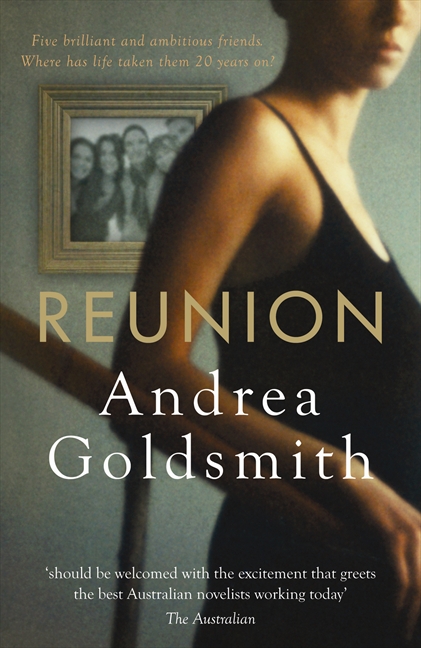
Andrea Goldsmith, Reunion bookcover
Reunion bookcover (Courtesy: HarperCollins Australia)

I wanted to love Andrea Goldsmith’s Reunion. And I expected to, as I remember enjoying the last book of hers that I read. But, somehow, I found it a bit of chore to read, though it did pick up towards the end. I think I understand why it was not listed for the 2010 Miles Franklin Award.

Friendships become swaddled in invisible protective layers and nothing short of a cataclysmic blow can break through to the inevitable stress points beneath.

The plot is fairly straightforward. Four university friends (three students, borderline baby-boomers and now in their mid-40s, and a lecturer, now around 60) find themselves all living in Melbourne again after some 20 years apart. All four had met in Melbourne, had moved together to England to continue studies and work, but had then gone their separate ways. At the beginning of the novel Jack, an academic and Islamic expert, is single and still in love with Ava; Ava, a novelist, is married to the unpopular Harry; Helen, a scientist, is a single parent; and Connie/Conrad, a philosophy lecturer, is on his third marriage but still philandering. Harry, who met them in England, is on the outer, but it is he who has engineered the reunion under the auspices of an organisation he has created, NOGA (Network of Global Australians).

The novel, then, is about this time of reunion: it explores who they are now, and the state of their relationships with each other. Sounds like the sort of thing that would interest me – Melbourne setting, characters with whom I would expect some level of identification, themes exploring love and friendship, and a writer whom I’ve enjoyed before. None of these, I should add, are essential for my reading enjoyment – I also like books set in exotic places and about very different characters – but familiarity often appeals too (doesn’t it?).

And yet, for me the book fell a little flat. It just didn’t feel quite original enough – in either ideas or language. It felt a little same-old-same-old. That said*, I found the characters interesting and convincing, although only one, Jack, changed in any significant way as the novel progressed. The narrative mode is multiple 3rd person subjective, with Jack’s perspective starting and ending it. It is told, chronologically, but with flashbacks to fill in the past. All this is well controlled and keeps the story moving nicely.

Goldsmith ranges across a lot of themes – love and friendship (of course); truth and fiction; secrets and memory; passion and obsession; modern communications; revenge and forgiveness; and science, ethics and politics. It is probably here that the novel palled most for me because many of these themes seem to go nowhere. Take the truth and fiction one. Those of you who read my blog know that I enjoy seeing this issue explored, but in this novel it’s raised, often with a nice level of irony, but is not really developed. For Ava, the novel writer, “there was no better vehicle for truth” than fiction, whereas for the scientist, Helen, “Ava’s work is only fiction – none of it is true”. Well, I thought, Goldsmith will unpack the ironies contained in these, but she doesn’t really. Perhaps that’s OK, perhaps it’s enough for us to notice them, but I wanted more.

At other times, the themes seem more like the author’s soapbox than ideas fully integrated into the story, albeit that the characters are her mouthpieces. Here, for example, is Jack expressing a rather stereotyped view of modern communication:

Whenever Jack looked back to his university experience and compared it with today’s university student life, so much seemed to have changed – even friendship itself. Without computers and mobile phones, face-to-face communication ruled the day.

The implication is that modern friendships are somehow less meaningful, but what does he really know and, further, what does the novel show us about it? Nothing really. Similarly, Helen rages about political interference in science, but the issue, while valid enough, seems a little fabricated in the context of the novel.

There are some funny set pieces, such as the young television make-up artist trying to hide Connie’s aging neck. Goldsmith does irony well – something I, as a Jane Austen aficionado, rather enjoy – and she peppers the novel with a lot of effective literary allusions – to Waugh, Wharton, James, and others. Moreover, there are some lovely descriptions, such as this one on Ava’s discomfort during her first weeks in England: “It was like being stranded on a sheet of clear glass with nothing but blackness underneath”. I’m not sure why I like this, but I do.

I’ve struggled to write this review, really, because there are things to like about this book. I decided to do a quick review of reviews out there and what I mostly found were positive reviews that each had some little reservation: “despite that minor misgiving”, “a rich and at times frustrating novel”, “despite a few stylistic glitches”, and “the novel was marred but not spoiled for me by …”. None though explored these reservations in any depth.

And so, rather than labour any more, I will close with the words of Helen’s teenage son, Luke. He says, in that simple, direct way that the young can do:

The truth can hurt. But that doesn’t make it less right.

The final irony is that Harry is hurt by a truth – but the truth he is hurt by and the real truth of the matter are two quite different things. And that, in the end, made the novel an interesting if not totally engaging read.

For a more positive perspective on this novel, check out Lisa’s at ANZLitLovers.

Andrea Goldsmith
Reunion
London: Fourth Estate, 2009
414pp.
ISBN: 9780732287832

*See my previous post on words to avoid!

Thea Astley, The multiple effects of rain shadow (Review)

There are two main reasons why I like – actually love – to read Thea Astley. One is her language, her wonderful way with words that may, at times, be over-the-top but that is never clichéd. The other is her passion for the underdog, and thus for social justice in a world where it is often conspicuously absent.

Island, Palm and Sun

Island with palm, because Penguin will not answer emails regarding bookcover use (Courtesy: OCAL, via clker.com)

The multiple effects of rainshadow is Astley’s second last novel. Its overall subject matter is, as one character says late in the book, “the unmoored behaviour of humans”, an effective image given the book’s central motif is an island. It has a very loose plot which is based on an actual event that occurred on Palm Island in 1930. Palm Island was, at that time, essentially a dumping ground for Indigenous Australians deemed to be “problems”, but the event in question concerned the white superintendent, mad with grief at the recent death of his wife, running amok and setting fire to buildings (including his own home in which his children were sleeping). He was eventually shot (and killed) by an Indigenous man under the (cowardly) order of the white deputy superintendent. The novel explores, through multiple points of view and over a period of around 30 years, the impact of this event on six white people who were present on the island at the time – but interspersed between these voices is the voice of Manny, the man who shot the super. This is, I think, a pretty risky thing to do but Astley is not one to shy away from risks in her writing.

The voices are, in chapter order:

  • Manny Cooktown, first person, the indigenous “shooter” and main narrator who commences the story and appears between each voice, but does not conclude the novel
  • Mrs Curthoys, first person, landlady on Palm Island at the time of the incident
  • Gerald Morrow, third person, writer/editor who had gone to the Island to work as a foreman, for which he had no skill or experience, and who was in fact escaping the Island in a boat at the time of the incident
  • Captain Brodie, third person, the Superintendant who ran amok and was shot by Manny
  • Mr Vine, third person, a school teacher on the Island at the time of the incident
  • Father Donellan, third person, priest who visits regularly from the mainland and is responsible for the Island’s religious “needs”
  • Leonie née Curthoys, first person, daughter of Mrs Curthoys and so on the Island at the time of the incident
  • Omniscient author who carries the last chapter

Looks complex eh? But in fact it’s pretty straightforward in terms of knowing who is who, as each voice “manages” its own chapter. The chronology is a little trickier as many of the characters (let’s call them that from now on) flip between their present (some are writing from many years after the event) and the past. Did you notice that the first person voices belong to the two groups most recognised by Astley as disadvantaged: women and indigenous Australians? A subtle but clever use of her narrative structure to give them a voice!

The setting is, after all, very much a white patriarchal world, and marriage is seen in that light. Vine, for example, is told to get a wife  for

‘The boring bits. You know. Meals. Washing. Shopping. Kids. All that sort of thing. A man hasn’t time for that sort of thing.’

‘Why not a housekeeper, then?’

‘You are green. Cost too much …’

Not surprisingly Mrs Curthoys and Leonie do not find marriage much to their liking. The main underdogs in this novel though are the indigenous people, many of whom are brought to the Island – and therefore separated from their country – as problems, and are treated with disdain at best and real cruelty at worst by most of the white residents (from 1918 when the settlement begins to 1957 when the book closes). Astley offers, I’m afraid, little hope. She is not a cheery writer: her goal is to shock us into attention – and that she does. However, I can imagine some critics accusing her of putting contemporary views about feminism and indigenous relations in characters’ mouths. I would argue though that contemporary ideas do not spring from a vacuum, and that therefore the occasional more sensitive/egalitarian views expressed in the novel are historically valid.

I said at the beginning of this review that one of the main reasons I like Thea Astley is her language, so here are some examples of her imagery:

…whistlestop hamlets scattered along briefly tarred roads that led to further sprawls moated by loneliness …  [from school-teacher Vine, heading to a country school]

And I am weary of  a Celtic charm that is shaken like spice over any dish within gulping reach. We bore each other rancid. [Leonie on marriage and her philandering husband]

At least I’ll have tried. At least I’ll be learning to decline the gumleaf, conjugate the seasons. [Vine’s “do-gooder” son Matthew]

She also effectively mixes up the rhythm to make points or convey feeling, using short snappy sentences, repetition of phrases (such as Morrow’s “swing dip drag” as he sails across the sea), and punctuation-free streams of consciousness:

There was an unalterable plane geometry to his movements: the clock the tea/toast the clock the bell the classroom the toted piles of exercise books the bell the repeated texts the stale jokes the texts the bell the common-room bitchings the clock the bell … the … the … [schoolteacher Vine]

Astley is often quite self-conscious about the act and role of writing, and this is certainly the case in this novel. I’ll give just one example, the bitter rant of failed writer Gerald Morrow, who is jealous of the success of another, to him, lesser writer:

There must be a million readers out there who crave boredom! Who love the dangling participle! Who wallow in truisms and fatuous theorisings! … Slap in your popular aphorisms, buddy, but don’t make ’em think!

You could never accuse Astley of not making you think, but there has to be some irony here, some little sense of self-deprecation even, in the fact that she put these words in the mouth of a failed writer, as if she knew that for all her passion there’s only so much you can achieve with words. That may be so, but Astley has given it a darned good try!

Thea Astley
The multiple effects of rainshadow
Camberwell: Penguin, 1996
296pp.
ISBN:  9780143180265

Jane Austen: Conservative or progressive?

I must admit that, fan as I am of Jane Austen (of her wit and clear-eyed observation of humanity), I have sometimes been conflicted about whether she is, as this post title asks, conservative or progressive.

She was innovative in terms of the history of the novel – her sure use of the third person omniscient narrator and her psychological and social realism were progressive for her time. But, what about her plots and their resolution? The fact that her heroines tend to marry well? Or, well enough, anyhow. I have often felt ashamed about my sorrow that sensible Elinor in Sense and sensibility did not “catch” as wealthy a husband as her emotional sister Marianne did. It’s not the money so much, but the fairness of it! Elinor deserved … but, she got what she deserved didn’t she? The man she loved!

But, I digress. The point is – and this is what seems to put some readers off – that Austen’s heroines always do marry, and they always marry within their class or slightly higher. They don’t throw it all to the wind to follow some passion; they are usually materially “sensible” even though they also determine to follow their heart. And so, there’s the conundrum. Austen’s heroines are independent of mind enough to hold out for a marriage of affection, but they don’t cast their net outside their kind. They seem to affirm the status quo.

However, as I also wrote in a recent post, I and many others see Austen as a protofeminist: while her plots and their resolution can be seen, superficially, to be conservative, there is something else going on. And this was presented from a fascinating perspective the other night by academic Glenda Hudson who spoke at the public library. Her topic was “Sibling love in Jane Austen, revisited” and was an updating of an article she published in 1989. She explored the role of sibling love and incest in Jane Austen – not that “actual” incest ever occurred in her books, but some of the highly sanctioned relationships, such as Fanny and Edmund in Mansfield Park, and Emma and Mr Knightley in Emma, have incestuous overtones (that are consciously articulated in the books).

Hudson claims that Austen promotes the value of fraternal (sibling) love in her novels – and defines this love as being based on shared moral and intellectual values and ideas. She argues convincingly that in many of Austen’s novels this idea is extended to encompass conjugal love, and that marriage in Jane Austen is presented as a meeting of like minds, as an egalitarian partnership between two people who, through the course of the novel, have come to love and respect each other. In fact, she argues that, through these marriages, Austen redefines gender roles in marriage.

Here is a description of Fanny with her brother, in Mansfield Park:

Fanny had never known so much felicity in her life, as in this unchecked, equal, fearless intercourse with the brother and friend [brother William] who was opening all his heart to her, telling her all his hopes and fears, plans, and solicitudes  … An advantage this, a strengthener of love, in which even the conjugal tie is beneath the fraternal. Children of the same family, the same blood, with the same first associations and habits, have some means of enjoyment in their power, which no subsequent connexions can supply … (Mansfield Park, Ch. 24)

Here is Edmund, realising at the end that Fanny just might be the one for him. It is interesting in to look at in light of the above, since Edmund and Fanny were, from the time Fanny was 10 years old, “children of the same family”:

… it began to strike him [Edmund] whether a very different kind of woman might not do just as well, or a great deal better: whether Fanny herself were not growing as dear, as important to him in all her smiles and all her ways, as Mary Crawford had ever been; and whether it might not be a possible, an hopeful undertaking to persuade her that her warm and sisterly regard for him would be foundation enough for wedded love. (Mansfield Park, Ch. 48)

Hudson’s conclusion is that Austen is both conservative and radical – that she confirms the validity of the traditional family in what was a changing world, but that her vision of that family incorporates something new. I found this argument pretty convincing – but then, of course, it doesn’t take much to convince me that Austen was ahead of her times in thought and writing.

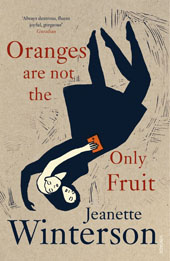
Jeanette Winterson, Oranges are not the only fruit

Winterson, Oranges are not the only fruit, book cover

Book cover: Used by permission of the Random House Group Limited

As I was reading Jeanette Winterson’s novella Oranges are not the only fruit, the question, rightly or wrongly, that was uppermost in my mind was “What is it with the oranges?” Is there something about oranges that I don’t know? Something specific that they symbolise?  I racked (wracked) my brain for something in my literary past that would give me a clue, but I came up with nothing. I guess she wanted to choose a motif to represent her mother’s limiting interactions with her and an orange seemed as good as anything? Certainly oranges are a recurring motif, and her mother regularly insists they are “the only fruit” until the end when a “pineapple” makes its appearance. I’m not sure, however, that this change heralds anything in their relationship other than compounding the paradoxes that seem to underpin this novel.

This is an intriguing book. It is a semi-autobiographical coming-of-age novel which tells the story of the first person protagonist, Jeanette, who was adopted by a religious zealot and is being brought up to be a missionary. However, around the age of 16 she discovers that her (homo)sexual leanings do not meet her mother’s (or her church’s) approval and, well, the plot is slim but perhaps I will leave it here nonetheless…

The novel exhibits some of the hallmarks of postmodernism, of which the most obvious is its metafictional elements, the way it contains stories within stories and plays around with the idea of stories in relation to “truth”. It all begins with Winterson naming the main character after herself and modeling that character’s life on much of her own, resulting in our being, from the start, teased by notions of what is “true” and “real”.

The book is divided into chapters titled appropriately, given Jeanette’s upbringing, by books of the Bible, such as Genesis, Joshua and Ruth. These titles are descriptive but also symbolic and even a little satirical; Jeanette, for example, has walls to confront just like Joshua. And the narrative, while roughly chronological, intermittently leaps from “reality” to “fantasy” as Jeanette tries to escape or make sense of her experience of life. Sometimes these stories – such as the Winnet story near the end – represent a parallel fantasy life for what is happening to her, but other times the reference point is more indirect, and draws on history and myth such as the King Arthur legend (and Sir Perceval’s search for the Holy Grail).

And this brings me to “story” and “history”. Readers of my blog will know that these notions, and the related one of “truth”, fascinate me when they are played out in fiction. I tend to enjoy reading books that deal self-consciously with them, that recognise the challenges and ambiguities inherent in them – and this is one of those books. Jeanette, the character, has some interesting things to say on these topics around the time the “truth” of her life, her sexuality, is becoming clear. She says in the short chapter titled Deuteronomy: The last book of the law:

Of course that is not the whole story , but that is the way with stories; we make them what we will. It’s a way of explaining the universe while leaving the universe unexplained … People like to separate storytelling which is not fact from history which is fact. They do this so they know what to believe and what not to believe. This is very curious …

And she goes on to discuss how history, the past, “can undergo change” because “the lens can be tinted, tilted, smashed”. She recognises that “perhaps the event had an unassailable truth” but we all see it through our own lens. Tellingly, near the end of the book, in the chapter titled Ruth, she runs into Melanie, her first lover (now married with a child):

…she [Melanie] laughed and said we probably saw what had happened differently anyhow … She laughed again and said that they way I saw it would make a good story, her version was just the history, the nothing-at-all facts.

Melanie, it seems, does not have the imagination to re-vision her “story”.

So, did I enjoy this book? Yes, pretty much. I like her attempt to make sense of what was a very particular childhood, and to try to draw from it some larger “truths” about how we might all manage the “stories” of our lives. It is not a straightforward read – and it is first novel with, perhaps, a little of the overdone in it. I’m not sure why, for example, she suddenly decides to include a little rant against Pol Pot. It usefully supports a point she is making about the uses of history, but it is odd in a story that is nowhere else political. Perhaps that’s just being post-modern!

In her introduction to my 1991 Vintage edition, Winterson claims to have written an experimental, anti-linear novel. Well, it is a bit of that I suppose, though not dramatically so. I would have called it reasonably linear – at least in the chronological sense – but perhaps the ideas in it do “spiral” (as she calls it) a bit in the way she toys, through the various narratives, with the idea of “story” and what it means to us. What it means, I think, is not always clear – we like stories but we cannot (perhaps need not) always draw conclusions from them. That is the paradox of our lives. As she says near the end

…not all dark places need light. I have to remember that.

Jeanette Winterson
Oranges are not the only fruit
London: Vintage, 1991 (orig. 1985)
171pp.
ISBN: 9780099935704

Jane Austen’s letters, 1811-1813

Mansfield Park book covers

Mansfield Park book covers - Penguin wins

Early in my blogging career I wrote a post on the letters Jane Austen wrote (well, those remaining anyhow) between 1814 and 1816. This was to coincide with my local Jane Austen group’s reading of Emma. This year we are reading Mansfield Park and so decided to read the letters she wrote during her writing of that novel, which was published in 1814.

These letters are less rich than the later ones in terms of containing specific information about her writing style and process, and they can be somewhat demanding to read as they are full of the names of people met and places visited. Le Faye, who edited the edition I read, provides excellent annotations and indexes to the letters so that you can look up the people and the places, but this can be tedious if you just want to get on with it. However, if you go with the flow, not worrying too much about all this detail, you can in fact glean a lot.

The most significant thing you learn, besides her biting wit as you will quickly see from the quotes below, is what a keen observer of people she was. This becomes very clear in a letter written from London in 1811, in which she speaks of visiting some museums:

… I had some amusement at each, tho’ my preference for Men & Women always inclines me to attend more to the company than the sight.

The letters are, consequently, full of her observations of people, and it’s easy to tell that they come from the pen of Jane Austen:

They have been all the summer, in Ramsgate, for her health, she is a poor Honey – the sort of woman who gives me the idea of being determined never to be well – & who likes her spasms & nervousness & the consequence they give her, better than anything else.

And I can’t help thinking that this woman provided the model for Miss Bates in Emma:

Miss Milles was queer as usual and provided us with plenty to laugh at. She undertook in three words to give us the history of Mrs Scudamore’s reconciliation, & then talked on about it for half an hour, using such odd expressions & so foolishly minute that I could hardly keep my countenance.

Many readers of Jane Austen, and I am one of them, see her as a protofeminist. There is a lovely, very Austen-ish, comment in an 1813 letter which supports this view. It regards the poor treatment of the Princess of Wales by her husband, the future George IV:

I suppose all the World is sitting in judgement upon the Princess of Wales’s Letter. Poor Woman, I shall support her as long as I can, because she is a Woman, & because I hate her Husband – but I can hardly forgive her for calling herself “attached and affectionate” to a Man whom she must detest…

And there is this on the education of the children of Reverend Craven:

…She looks very well & her hair is done up with an elegance to do credit to any education … & the appearance of the room, so totally un-school-like, amused me very much. It was full of all the modern Elegancies – & if it had not been for some naked Cupids over the Mantlepiece, which must be a fine study for Girls, one should never have Smelt Instruction.

As many of you probably know, her first novels were not published under her name, but during these years it was becoming harder for her to maintain her anonymity. In 1813, she writes to her brother Frances:

… but the truth is that the Secret has spread so far as to be scarcely the Shadow of a secret now – & that I believe whenever the 3rd [her third novel published, Mansfield Park] appears, I shall not even attempt to tell lies about it. – I shall rather try to make all the Money than all the Mystery I can out of it. – People shall pay for their Knowledge if I can make them.

As the poor daughter of a deceased clergyman, Austen highly valued the money she made from her books.

All this said, she does say a few specific things about writing. I found this one particularly interesting. It’s related to her finally receiving her “own darling Child” (that is, Pride and prejudice). She writes that:

There are a few Typical [typographical] errors – & a ‘said he’ or a ‘said she’ would sometimes make the Dialogue more clear – but ‘I do not write for such dull elves/As have not a great deal of Ingenuity themselves’*.

Hmm … perhaps that’s what Hilary Mantel would like to say to those readers who can’t cope with her use of “he” in Wolf Hall.

Another comment that gives us a sense of what she sees as important in a novel is this on Mary Brunton’s novel Self control:

I am looking over Self Control again, & my opinion is confirmed of its’ being an excellently-meant, elegantly-written Work, without anything of Nature or Probability in it.

Jane Austen, you see, was a realist. And in this section of letters we also discover the amount of research she did to get her facts right in Mansfield Park – ships, hedgerows in Northamptonshire, and buildings in Gibraltar are all things she wanted to get right.

These letters are full of other things too – family, food, and fashion feature heavily, as do the books she’s reading and the theatre she attends. If I have piqued your interest you can read them online here. In the meantime I’ll end with one of my favourite quotes from this section:

By the bye, as I must leave off being young, I find many Douceurs in being a sort of Chaperon for I am put on a Sofa near the Fire & can drink as much wine as I like.

Is it any wonder I like Jane Austen?

* Jane Austen here paraphrases Sir Walter Scott’s lines from his long poem Marmion.

Deirdre Le Faye
Jane Austen’s letters (3rd ed)
Oxford: Oxford University Press, 1995
642pp.
ISBN: 9780192832979

Note: The spellings, punctuation etc used in the above quotes come from Le Faye’s edition.

Helen Garner, The children’s Bach

I’ve said a few times now that I rarely reread books, and then go on to write about something I’ve re-read. I must look like a liar, but the fact is that if I’ve liked a book so much that I’ve reread it it’s likely to find its way here. The funny thing is, though, that my reason for rereading The children’s Bach was not so much because I loved it first time around (though I did enjoy it) but because I read a critic who described it as one of the four best short novels – ever! It’s hard to ignore a commendation like that, isn’t it? And so I read it again …

It’s set in Melbourne, and concerns a couple, Athena and Dexter, who lead a self-sufficient life with their two sons, one of whom is severely disabled. This apparently comfortable life is disrupted by the arrival of Elizabeth, from Dexter’s past. With Elizabeth come her sister Vicki, her sometime lover Philip, and his prepubescent daughter Poppy. Through them, Athena and Dexter are drawn into a world whose ideas and values test the foundations of their relationship.*

This sounds like a pretty standard plot, but from it Garner draws something quite special, something tight and marvelously observed, and something, in the way that Garner has, that is brutally honest. This is the thing that I admire about her most – even though I don’t always agree with her: she doesn’t flinch from unpleasant “truths”. And so, in this book, she tackles the challenge of parenting a severely disabled child. While there are people who talk about the joy and meaning a disabled child brings to their lives there are others who feel quite differently. This is the shock at the centre of this book.

Garner introduces a sense of uneasiness right at the beginning with a photo of Tennyson and his family (why Tennyson, I’m not quite sure) which shows them together but not quite together and which is described simply as “the photo of a family”. The photo is old but Dexter keeps sticking it back up again. This beginning is followed by a fairly idealised image of Dexter and Athena as a loving, supportive couple – “she loved him. They loved each other” (p. 4) – and then Garner slowly reveals the cracks. Dexter’s idealisation of Athena is one cause, but the disabled child who holds Athena back, is another. The arrival of Elizabeth and her entourage – with their different and challenging ways of viewing the world – is just the catalyst.

Athena’s harsh attitude regarding Billy, her disabled son, is psychologically real, but is shocking to see in a character who is idealised as the earth-mother. Our readerly assumptions take a knock! Early in the story Athena looks at handprinted cards of places for rent:

… Athena was … scanning the window covered in handprinted cards on which people advertised rooms to let in their rented houses. Athena lived, for as long as it took to read a card, in each sunny cottage, each attractive older-style flat, spacious house, quaint old terrace, large balcony room with fireplace, collective household with thriving veggie garden. Her children dematerialised, her husband died painlessly in a fall from a mountain. What curtains she would sew, what private order she would establish and maintain, what handfuls of flowers she would stick in vegemite jars, how sweetly and deeply she would sleep, and between what fresh sheets.

This could be typical daydreaming but it’s pretty specific in detail (children dematerialised, husband dead): it’s Garner telling us that Athena feels trapped and is ready for change. Then Philip comes along and she is attracted to him; she’s not morally repulsed the way Dexter is by his behaviour: “Dexter lay rigid as a board … but Athena slept, and dreamed that she was in a garden….”.

And so, Garner writes, “The edifice crumbles”. The cracks have been there, in the edifice, but Dexter is (has been) oblivious to them. He’s a kind man but he’s pretty unaware of how other people feel; he expects them all to see life as simply, as happily as he does. But this is not the case – as he finds out …

All this is told in tight, expressive language.  Here is a delicious description of Dexter’s mother:

Like many women of her age whose opinions, when they were freshly thought and expressed, had never received the attention they deserved, Mrs Fox had slid away into a habit of monologue, a stream of mild words which concealed the bulk of thought and knowledge as babbling water hides submerged boulders. (p. 101)

Garner focuses on the gap between appearance and reality, particularly regarding the problems of idealisation (of self and/or of other). Athena is idealised but is shown to have feet of clay; Dexter is also idealised and idealises himself – until his own fall from grace: “he was in its moral universe now, and he could never go back”.

We can read this book in two – not totally exclusive – ways. One is psychological and relates to the realisation of self, particularly for Athena. The other is social and relates to role definitions, again particularly for Athena in terms of the expectations of her as wife and mother. One of the things that Garner tends to do well, in fact, is explore the point where social expectations of how we should feel meet and often clash with our real emotional selves. We see this clearly in The spare room where the character Helen shocks us with her anger at her dying friend.

I have really only touched the surface of this book – there is the music motif to consider, and the conflict of values represented by the intrusion of Elizabeth and her entourage into Dexter and Athena’s world – but I have talked about some of the issues that grabbed my attention and that, I think, will do!

* This is, essentially, the plot summary I wrote a couple of years ago for the Wikipedia article on the book.

Helen Garner
The children’s Bach
Penguin Modern Classics, 2008 (first published 1984)
180pp.
ISBN: 0869140299

Dorothy Porter, The bee hut

The bee hut, by Dorothy Porter

Cover image (Courtesy: Black Inc)

The most powerful presence
is absence
(from “Egypt”)

The above lines open Australian poet Dorothy Porter‘s The bee hut, a collection of poems mostly writen in the last five years of her life. The lines are prophetic … and they appropriately open a collection which deals very much, though not exclusively, with the tension between life and death. The poems are, in turn, angry, resigned, beautiful, humorous even, and philosophical. Some draw on Christian and other mythology, some allude to other poets, and some are simply founded in the unembellished here-and-now. And, despite the fact that we and she know that death is coming sooner rather than later, they are life-affirming.

The collection is divided into eight groups:

  • Head of Astarte
  • The enchanted ass
  • Poems: January – August 2004
  • Smelling tigers
  • Jerusalem
  • Africa
  • The freak songs
  • Lucky

The title poem, “The Bee Hut”, is in the “Poems: January – August 2004” group:

But do I love the lesson
of my thralldom
to the sweet dark things
that can do me harm?

In her brief introduction to the collection, novelist Andrea Goldsmith, Porter’s partner, writes that:

The bee hut became a metaphor for these last years of her life … She marvelled at the bees, as she had always marvelled at life, but she was also aware of the danger amid the sweetness and beauty.

Danger in life, the darkness that is found alongside beauty, is the defining paradox of the collection: “In living there is always/the terror/of being stung” (from “Bluebottles”). Not all poems explore this idea but many do.

There is some sort of thematic underpinning to the poem groupings, and there is a strong autobiographical flavour. The “Africa” section, for example, clearly relates to travels in Africa; “Poems: January – August 2004” were written about her time undergoing chemotherapy for the breast cancer that was to kill her; while “The Freak Songs” are “a song cycle written for performance with the music of Jonathan Mills“. These last are older poems, and therefore predate her diagnosis, but are an apt inclusion. They are wild and defiant: “I bite the apple/I lick the fire/I kiss the sweet sweet snake” (from “The Fruits of Original Sin”). But even here there’s recognition that death, in the end, has the upper hand: “You live your life/as if there’s a secure cage/for the clipped wings/you’re planning” (from “The Bluebird of Death”).

Even more than with a short story collection, it is impossible to discuss every poem in a collection – and, to be honest, I would find it hard to do so since while  some spoke to me easily and some I could grasp with a little thought, there are others that elude me, mostly because their allusions are not familiar to me. I am not, for example, an expert on French poets like Rimbaud, Verlaine, Baudelaire, so when she invokes them I can guess at their meaning but am not totally sure I “got” it. Consequently, I’m just mentioning a few of the poems which particularly appealed to me.

Her poem “Blackberries” in “The enchanted ass” deals with the imperative to write poetry and the urgency to get it down, to locate and express the idea:

and your pen slashes ahead
like a pain-hungry prince
hacking through
the bramble’s dragon teeth
to the heart’s most longed for
comatose, but ardently ready
princess.

Most of the poems are like this – strong, vivid and comprised of short active lines. There are quite a few recurrent images – blood, birds, incense. All very concrete and yet all highly evocative as well. I think that’s what I like about most of the poems – they work well on a visceral as well as a philosophical level. You feel them as well as hear them.

Also in “The enchanted ass” are “Three Sonnets”. The first refers to Byron, the second to Woolf and the third to Blake. In the Woolf one, she writes:

Life is so dangerous,
but this morning you can take
the wave
right to the sparkling shore

You can bear knowing
the street will one day dump you.
(from “What a plunge!”)

One day she finally is dumped … and yet, even then, just two-and-a-half weeks before her death she can write:

Something in me
despite everything
can’t believe my luck.
(from “View from 417”)

There are poems here that are a little obscure to me – that I will need to read again with Google at my side to check the allusions – and there are no amazingly new revelations about life and death, but their passion and vigour engaged me from the get-go! I’m glad I’ve finally been introduced to Dorothy Porter.

Dorothy Porter
The beet hut
Melbourne: Black Inc, 2009
146pp.
ISBN: 9781863954464

Kate Chopin, A respectable woman

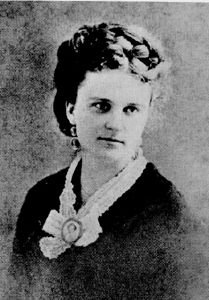
Kate Chopin

Kate Chopin: What a lovely face (Public domain, via Wikipedia)

Besides Jane Austen’s works, there are only a few novels that I have read more than once. One of these is Kate Chopin’s The awakening. I was trying to think of an adjective to describe it or my feelings upon reading it, but couldn’t think of anything that wasn’t clichéd. The best way to convey my response is, in fact, the way I have – and that is to say that I’ve read it more than once!

Kate Chopin’s short story, “A respectable woman” (1894), is this week’s Library of America (LOA) offering – and you can read it here. I haven’t read and blogged all of the LOA stories that have lobbed in since I subscribed, but I have done so rather more than I originally expected. This is because they have confronted me with:

  • Authors I’ve never heard of, but who, by LOA’s brief introduction, have intrigued me;
  • Authors I’ve heard of but haven’t yet read, and so have taken the opportunity to be introduced; and
  • Authors I’ve read before and loved (or at least liked a lot!).

As you’ve already realised, Kate Chopin falls into this last category. I was stunned by Chopin when I first read her back in the early 1980s – and this was because I hadn’t before read a 19th century novel that was quite so honest about women’s experience. Thank you Virago!

Written in 1894, 5 years before The awakening was published, “A respectable woman” made me laugh. That’s not quite what I expected when I started it. After all, it is by the author of The awakening! “A respectable woman” has a simple plot. Mrs Baroda (we never learn her first name, she being the woman of the title!) and her husband have just come to the end of the of a busy entertaining period, and she is looking forward to “a period of broken unrest, and undisturbed tête-a-tête with her husband”, but it’s not to be. Her husband, Gaston, has invited his friend Gouvernail to stay…

This is a very short story – just 4 pages – but Chopin is well capable, through some well chosen words, of leading us along. The title for a start sets us up with a number of impressions and expectations that tease us as the story progresses. Will she, won’t she, is the question that follows us. The introductory description of Gouvernail subtly tells us as much about her (and her life with her husband) as about him:

He had been her husband’s college friend; was now a journalist, and in no way a “man about town”, which were, perhaps, some of the reasons she had never met him.

Clearly they are a well-to-do couple moving in other circles. They have a good though not perhaps a passionate relationship: “her husband – who was also her friend”. The story is 3rd person, and told from her point of view – and it explores her reactions to this rather taciturn, self-possessed man who, towards the end, admits that all he now seeks is “a little whiff of genuine life”. What she is learning about herself though is something different:

She wanted to draw close to him and whisper against his cheek – she did not care what – as she might have done if she had not been a respectable woman.

This story is not as iconoclastic as The awakening, but it moves in that direction with Chopin exploring the inner workings of women and their hearts in an honest and sympathetic way. The story plays ironically on the notion of respectability and what that means for women. As for whether she does or doesn’t, well, that’s for you to find out. My lips are sealed.

Sawako Ariyoshi, The doctor’s wife

The doctor’s wife is the third Ariyoshi novel that I’ve read. The other two – The River Ki and The twilight years – I read well over a decade ago. According to Wikipedia The doctor’s wife is considered her best novel. All, though, are fascinating reads providing an insight into a culture which is so different from my own but in which, at the same time, people experience similar desires, pressures and emotions.

The twilight years is set in 1970s Japan and beautifully captures the cultural changes that were occurring around the time as Japan was (and still probably is) moving from  feudal/traditional parent child relationships to our more modern independent ways, with women caught in the middle. The River Ki chronicles three generations of women from the late 19th to mid 20th century, exploring changing attitudes and expectations of women. You are probably getting a picture here and you’d be right: Ariyoshi’s overriding theme concerns the role of women in Japanese society, both historically and in modern times. (Ariyoshi died in 1984.)

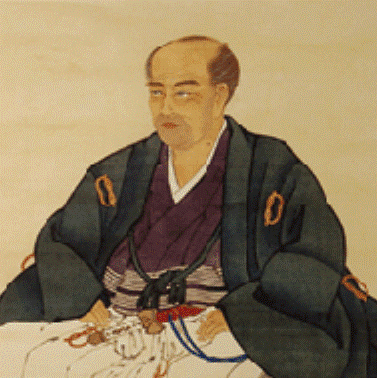
Hanaoka Seishu

Hanaoka Seishu (Public domain, via Wikipedia)

The doctor’s wife is an historical novel, spanning 70 years from around 1760 to 1830 and based on the life of famous Japanese doctor Hanaoka Seishu. A quick plot summary. The doctor’s wife is Kae, a young woman from a wealthy family, who is lured to become Seishu’s bride by his ambitious mother Otsugi, herself a woman married from a wealthy into a poorer family. The novel then chronicles Kae’s life in this extended family household as Seishu develops his medical skill and training until, near the end, he performs the world’s first surgery under anaesthetic (1804, breast cancer)*. While Seishu’s development as a doctor frames the novel, the real plot concerns the relationship between Kae and Otsugi.

The novel is told in third person, mostly the more objective omniscient voice, but occasionally we feel we are specifically in the heads of Kae or Otsugi. According to my edition’s introduction, Ariyoshi had access to Seishu’s personal records, diaries and books. However, being a man of his time and a doctor focused on his research, he did not, I assume, document much of his family life. The story, then, of the women is largely fictional. Mostly through dialogue, with description as needed, Ariyoshi describes how the loving supportive role Otsugi initially presented towards her daughter-in-law changes when her son (who had been married to Kae in absentia some three years before) returns home from his medical studies in Kyoto. Overnight, the relationship, to Kae’s shock and distress, changes into a competitive one – a competition that has serious consequences as they vie to be guinea pigs for his experiments in anaesthesia. Both women are presented as flawed, but as it is Kae who opens the novel and is the more powerless, it is with her that we are most keen to identify and empathise.

Why has Ariyoshi chosen to tell this story of conflict and competition within an historically based story of a great man? Does the historical “truth” add credibility to her exploration of familial power discrepancies? I’m not sure it’s necessary, but perhaps it helps … It is a very human tale – the grand gestures made by the women to support his research are small in the scheme of things though the impact on them, particularly on Kae, is immense. Ariyoshi realistically explores the nuances of their relationship through the normal day-to-day patterns of life (weaving, cooking, house management, childbirth) suggesting that this sort of conflict doesn’t have to be but that it often (traditionally, even) is. In fact, we readers are lulled into seeing it as the norm – the lot of women – until we are shocked out of that frame of mind near the end by Seishu’s unmarried sister who says (in broken speech because she is ill):

I think this sort of tension among females . . . is . . . to the advantage . . . of . . . every male.

She continues to explain her particular perspective on women’s secondary lot, and pronounces that:

as long as there are men and women side by side on this earth, I wouldn’t want to be reborn a woman into such a world.

Clearly, given the story Ariyoshi has told, she rather agrees  – or, at least, agrees for such societies as she depicts here in which women’s lot is not only an inferior one but which work to discourage them from cooperating and supporting each other. The novel may be set in Japan, but the fundamental truths, unfortunately, are not so confined.

What I have described here is the main story, but there’s more here that can be discussed, including the development (or history) of medicine in the east and west, the experimentation on animals and humans, and Japanese social life and customs in the Tokugawa period.

It’s a short but engrossing read. It falters a little I think right at the end when the historical facts are presented so prosaically that they threaten to overwhelm its novelistic achievements, but the last line fuses the two so beautifully that you forgive this.  The doctor’s wife is a fascinating and keenly observed novel that deserves to be read.

*Ironically, in 1811, novelist Fanny Burney underwent a horrific mastectomy without anaesthesia because it was unknown in the west!

Sawako Ariyoshi
The doctor’s wife
(trans. by Wakako Hironaka and Ann Silla Kostant)
Tokyo: Kodansha International, 1966 (orig ed), 1978 (trans)
174pp.
ISBN: 0870114654

Sarah Waters in conversation with Marion Halligan

Sarah Waters
Sarah Waters, 2006 (Courtesy: Annie_C_2, via Wikipedia, under Creative Commons CC-BY-2.0)

In a delightful coincidence, Sarah Waters was in town tonight for a literary event, just one night after my reading group discussed her novel The little stranger – and so, naturally, those of us who were free turned up to hear her converse with Canberra novelist and literati, Marion Halligan.

It can be very special hearing one novelist interview another – and this was one of those occasions. Marion and Sarah appeared very comfortable together, respectful of each other’s skills, and Sarah was generous and open in her answers – except when it came to the ending of The little stranger! All she said on THAT score was that she left it deliberately open but that she tried to lead the reader to a certain conclusion. She’s been fascinated, she said, by the discussions that have ensued about the ending. Don’t we know it!

That said, she did share some things about The little stranger, and these may or may not throw light on the mystery! Its subject is of course class, and the changes that were occurring in post-war England. She said that her original plan was to use Dr Faraday as a straightforward, transparent narrator, someone who was firmly in the middle class and a friend of the family, and who would chronicle their decline. But as she started writing, she decided to make him more uncomfortable class-wise with some lingering class resentments. A little later, she talked about poltergeists and how they represent the release of unresolved tensions, conflicts and frustrations. Hmmm … if we accept poltergeists, then I think we have to see that more than one “person” is implicated in what happened at Hundreds Hall.

Some interesting issues were raised during question time. I’ll just dot-point the ones that grabbed me in particular:

  • Echoes of and homages to other works. Waters said that she does a lot of research for her novels and that that research includes reading fiction of the era she’s researching. It’s not surprising then, she said, if people see echoes of works like Brideshead revisited, The yellow wallpaper, Rebecca and The fall of the House of Usher in this novel. She doesn’t mind people seeing these in her work.
  • Genre. She was asked how the demands of genre shape her work, and her response was that she likes to see how you can both bend genre and surrender to it at the same time.  You can certainly see her doing that in The little stranger in the way it takes the conventions of the ghost story and yet does not resolve it in any way that you could call traditional.
  • Setting a novel overseas. For some reason, someone asked whether she would ever consider setting a novel outside of England. Her flippant response was that she thought she did well to move The little stranger from her usual London to Warwickshire!  But, then she answered seriously, and I found her response interesting. She didn’t give us that old chestnut about “writing what you know”. Rather, she said she likes “to have dialogues with the traditions of British fiction”. Good for her; she has a PhD in English literature and is clearly imbued with its traditions. The Roger Federer of the literary world perhaps?

Interspersed throughout the hour were some light-hearted interactions between Sarah and Marion. One concerned the fact that Sarah writes historical novels while Marion focuses on contemporary subjects. Marion said she admired all the research Sarah does, and suggested that lazy people write in the present. Sarah quickly rejoined that writing in the present is terrifying. Where, she said, is the security of the research. Vive la différence, I say!

There was more, as you can imagine, but that is the gist of it…except of course to boast that I do now have my very own signed copy of The little stranger.

ANU/The Canberra Times Meet the Author