Kate Jennings, Snake

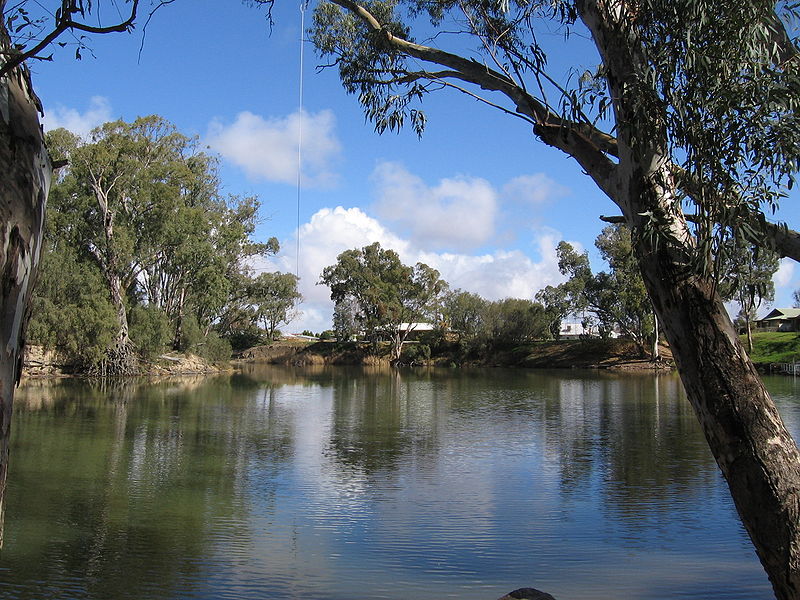
Murrumbidgee River

Murrumbidgee River in the Riverina (Courtesy: Mattinbgn, via Wikipedia, using CC-BY-SA 3.0)

In her “fragmented autobiography”, Trouble, Kate Jennings used excerpts from her first novel, Snake, to convey her childhood experience of growing up on a farm in the Riverina region of New South Wales. She had, she wrote, an “unhappy mother, diffident father”. Snake is the story of such a mother and father. While the novel is not totally “true” to her life in the factual sense, I have read enough novels and memoirs (such as Jill Ker Conway‘s The road from Coorain) about rural Australian life to know that it is “true” to the sort of experience it describes.

The blurbs on the back of my edition include the following descriptions: “a string of prose poems” (Times Literary Supplement) and a “domestic dystopia” (Sydney Morning Herald). The novel – novella in fact – is intriguingly structured. It has 4 parts. Parts 1 and 4 are short bookends, told in second person: the first part is addressed to the father and the last to the mother. The middle two parts are told in the more traditional third person voice and chronicle the life of the family: Rex the ironically named father, Irene the mother, and Girlie and Boy, the children who are caught in the middle. The chapters are short, some being only a paragraph or two long, and present vignettes of the family’s life rather than a simple this-then-that chronology. Dystopian is, unfortunately, an accurate description of their life. As Daphne, Irene’s sister, guesses on the wedding day,

Rex was a nice enough chap but about as interesting as a month of rainy Sundays. Irene will be bored with him before they arrive at the Blue Mountains guesthouse for their honeymoon.

While we never hear from Daphne again, she was not wrong. Rex is a “good man”, “decent”, a farmer of simple needs, while Irene, as her father realises, “dances to a tune no one else hears”. Not a likely recipe for success.

I thoroughly enjoyed this novel. Despite its unusual mix of voice and rather episodic form, it has a strong narrative that drives us on to its inevitable (but no spoiler here) conclusion. The snake motif runs through the book. Snakes are a fact of rural Australian life and so are a natural, real presence in the book, but their symbolic allusion to temptation, deceit and danger lurks behind every reference. Early in the novel, we are told of Irene’s youthful romantic tendencies – her love of

… smoky-voiced singers and innuendo-laced lyrics. Tommy Dorsey and Benny Goodman, Frank Sinatra and Peggy Lee, they were the snake charmers and Irene the snake.

Later, Girlie looks at snakes in a book on Australian fauna: they are “fanged, flickering, unblinking”.

Kate Jennings is a poet – as well as novelist and essayist – and it shows. The language is accessible but full of imagery. This is particularly apparent in the chapter titles, most of which are obvious in meaning, though some are more cryptic: “Home is the first and final poem”, “Send my roots rain” and “My mother has grown to an enormous height”. They are fun to think about as you read. There are some beautifully apposite descriptions. Here for example is Rex experiencing misgivings about his new wife:

The sight of her caused his nature – practical, honourable – to assert itself … What was done was done. Without being conscious of it, he coughed importantly – I am a man, I have a wife – and squirmed inside the jacket of his uniform until it sat better on his shoulders.

And here is Girlie reading:

Girlie read books like a caterpillar eating its way through the leaves on a tree.

Their town is, ironically, called Progress. However, very little “progress” occurs in the book. Rex struggles to keep the farm going in the face of mice and locust plagues, hail and dust storms. Irene tries to make a life that suits her romantic, imaginative spirit – she creates a garden, seeks friendships with interesting people, looks for work – but in the end nothing works:

Rex and Irene had given up arguing. He no longer bothered to tell her that he wasn’t asking much – harvest his crops, care for his animals, share it all with a good woman, tra-la – and Irene didn’t reply that far from not asking much, he was asking everything.

Such is the life of a mismatched couple. We’ve read of such couples before, and we will again, but for a clear-eyed, finely balanced, while also touching, portrayal, this one by Kate Jennings is hard to beat.

Kate Jennings
Snake
Sydney: Picador, 2003 (first pub. 1996)
153pp.
ISBN: 9780330364003
Kate Jennings on Gutless Fiction

Did I say in my review of Kate JenningsTrouble that she’s not backward in coming forward? If not, I do now and will cite as an example her essay “Gutless fiction” which was first published in The Australian Financial Review in 2005. The article was inspired by her becoming aware of  “prejudices against so-called business fiction”.

Business fiction? Have you ever heard of – or thought about – business fiction? Must say that it’s not something I’ve thought enough about to have a prejudice against. Apparently neither had she until she wrote Moral hazard, her novel drawing from her experiences on Wall Street. So, she did some research and among the writers she read were Anthony Trollope,  Theodore Dreiser, Zola, H.G.Wells, William Dean Howells, Sinclair Lewis, Upton Sinclair, Louis Auchincloss and Christina Stead. Hmmm…maybe I do have a subconscious prejudice against business fiction because, with a couple of notable exceptions, these are not writers I’ve read or read much of. I have not read, for example, Christina Stead’s House of all nations which, she says, is one of the best novels ever written about banking.

As I was reading her article, the novel that popped immediately into my head was Tom Wolfe’s Bonfire of the vanities. Sure enough she mentions this one a little way into the essay. She says that her research suggested that “as the century [20th I presume] progressed, fiction where business or businesspeople were either subjects or drove the plot was all but abandoned by serious novelists” but she does recognise that there have been satires “that fall under the business novel rubric”. Other modern satires she mentiond, besides Wolfe’s, include Money by Martin Amis, England England by Julian Barnes, and Nice work by David Lodge. Oh-oh … I’ve read these three authors but not these particular books! Am I one of the prejudiced ones (without knowing it?)

Satires are all very well, she says, but her concern is that “sober [my stress] fictional treatments of business are scarcer than conservatives who are pro-regulation”! “How,” she asks, “did we go from Trollope, Dreiser, Lewis and Zola to Sebold, Eggers, Foer and Cunningham, from full-blooded questioning fiction to a tottery, homogenised, gutless, ingrown ‘produce’? Not to put too fine a point on it.” Tell us what you feel Kate!

She believes, quite rightly I’m sure, that there are fashions in fiction and that this particular issue can be partly explained through the long-running argument between HG Wells and Henry James over what was “the proper stuff” of fiction. Wells, she says, was about the “larger world” whereas James argued for “feeling and characterisation”. One, I suppose, you could describe as more exterior, and the other interior. James won she says, and so our fiction turned to “dysfunctional families, psychological malaise, affairs of the heart, eccentricities, freaks”. As a result, the exterior – or the “scene” as she calls it – which still interests us has become the province of non-fiction, of memoir in particular. But, she says, as good as some of these works are, these books

are no substitute for unflinching works of fiction that engage our public and private selves, our intellect and emotions. More able to inhabit the skins of its characters, fiction can capture the ambiguity and caprice inherent in human behaviour and then give it context and causality in ways that nonfiction rarely can.

She gives some reasons why she thinks fiction has lost its punch – writing schools, an over reliance on irony, and marketing – but I won’t go into those here. I’ll just leave you to think about whether you agree with her. Is contemporary fiction gutless? Is it all “too self-aware, too self-conscious, too knowing. Too clever“? While I can see her point, I don’t totally agree, and wonder if she has looked too narrowly. Sebold and Cunningham, for example, would not be among the first authors off my tongue as my pick of contemporary “literary” fiction. What about you?

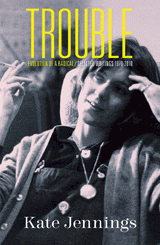
Kate Jennings, Trouble: Evolution of a radical

Kate Jennings, Trouble, bookcover

Bookcover (Courtesy: Black Inc)

I’m not going to beat about the bush but tell it like it is: I absolutely gobbled up Kate Jennings’ Trouble: Evolution of a radical: Selected writings 1970-2010. It took me a fortnight to read it, partly because I’ve been pretty busy but also because there was so much to savour and take in that I did a lot of stopping and thinking. That said, I do have one whinge, so I’ll get it over with now: it has no index. The book is described as an “unconventional” or “fragmented” autobiography and it is chock full of content. She mentions people, she discusses books and genres, she talks about politics, economics and feminism, not to mention all sorts of enthusiasms including, would you believe, swimming pools and shopping! I can see myself wanting to refer to it again and again but each time I’ll have to flip through it to find the idea or topic that I want to explore. Just as well I’m a marginalia person is all I can say!

So, who is Kate Jennings (b. 1948)? She is an Australian-born writer (poet, novelist, short story writer, essayist) and feminist, who stunned Australia with her Front Lawn speech in 1970, confronting progressive men, in particular, with their sexism. She moved to New York at the end of the 1970s and, in one of her iterations, worked as a speechwriter for a couple of large Wall Street firms in the 1990s. Somehow, she seems to have managed to do that without losing her critical eye. I have not yet read her novels, but will (finally, and rather coincidentally) be reading Snake in the next month or so.

Why did I like the book? This is how Jennings describes it in her preface:

This book, then, is a stand-in memoir. I’ve assembled pieces  – essays, speeches and poems, along with short stories and passages from my novels that actually happened – so that a reader might have a narrative of sorts.

On reading this you could be forgiven for fearing a mish-mash but fortunately that’s not what you get. The book is divided into 9 parts, each introduced by Jennings with a current reflection on the aspect of her life and career covered by that part. These parts move more or less chronologically through her life, though the readings themselves jump around a bit. This is because, like most of us really, she revisits some parts of her life many years after they occur, while others are documented at the time of their occurrence. The press release which came with my copy describes it in the following terms: “no-holds-barred” and “pull-no-punches”. What’s that, you say? They’re clichés! They are, but they describe the book perfectly, because this is a fiercely honest book written by a rather formidable woman. How else to describe someone who defiantly affirms, in almost one breath, her commitment to feminism and Jimmy Choo shoes, who calls herself a pragmatist but also argues passionately that “these are times of moral poverty”.

I think at this point I will just dot-point the parts to give you a sense of what she covers, because I fully intend to explore many of her ideas in more detail in the coming weeks/months.

  • Presumption: the making of her intellect, covering the years from 1970 to the late 1980s.
  • A child of grace, a landscape of progress: her childhood in the Riverina area of New South Wales, told mainly through excerpts from her novels and poems.
  • Cause and not symptom: her youth, focusing particularly on her introduction to alcohol (and subsequent joining of AA).
  • You don’t understand! What do you know! You don’t live here!: the life of an Australian expat in the USA explored mostly through her interviews with three other expat writers: Sumner Locke ElliottShirley Hazzard and Ray Mathew.
  • Catching a man, Eating him: her romantic life, which, with some self-mockery, she views through the songs of Dusty Springfield.
  • Crazed, delinquent fabulousness: an eye-opening sampler of her essays from 1990 to 2009 showing what a hard woman she is to pin down!
  • A bright, guilty world: more essays, these ones about her life as a speechwriter on Wall Street during the 1990s, including the full text of her Quarterly Essay 32, titled “American revolution: The fall of Wall Street and the rise of Barack Obama“. She has much to say about the GFC.
  • Irrelevance is deadly: how literature has (or hasn’t) dealt with the issue of business and finance.
  • Cut the shit: two no-holds-barred (yep, bring on the cliché!) essays which, she says, bring us back full circle to her main themes: “The first, a foray into my dusty childhood and Aussie alcoholism and masculinity through the re-release of the movie Wake in Fright, and the second, into poetry and the reasons I forsook it – or it, me – and a pet peeve: closed minds”.

I know it’s a bit of a copout, but I feel I can’t do justice to this book without writing my own Quarterly Essay and so, as I’ve already said above, I will return to it in future posts. In the meantime, the question to ask is: How does it work as an autobiography or “stand-in memoir”. I say very well. It does the things I look for: it tells me the main facts of her life, it shows me her interests, beliefs and values, and it gives me a sense of her personality (which is intelligent, opinionated, fearless and principled). Fragmented it might be in structure, but coherent it is in portraying a life.

In one of the poems she includes in the book, she writes:

… Saying simple things

well or complicated things simply is an art
that is fast disappearing …

Fortunately it is an art that Kate Jennings has not lost.

Kate Jennings
Trouble: Evolution of a radical: Selected writings 1970-2010
Melbourne: Black Inc, 2010
319pp.
ISBN: 9781863954679

(Review copy supplied by Black Inc.)

Helen Garner, Cosmo cosmolino

When I returned to seriously reading Australian writers back in the 1980s, there were four women writers who caught my attention, and I have loved them ever since. They were Elizabeth Jolley (1923-2007), Thea Astley (1925-2004), Olga Masters (1919-1986) and Helen Garner (b. 1942). Garner, the youngest by a couple of decades, is the only one still here, still writing novels, short stories, non-fiction and journal articles. I say I love her, but I can’t say I always agree with her. In fact, sometimes she makes me mad – but I admire her honesty and love her writing.

Cosmo cosmolino is not her most recent work. It was published in 1992 and has been on my TBR pile since my brother gave it to me in 1995. How embarrassing! But it finally managed to scramble to the top and I’m glad it did. It’s an intriguing book: it looks like two short stories (“Recording angel” and “Vigil”) and a novella (“Cosmo cosmolino”), but nowhere on the cover or the title page does it say “a collection of short stories”. This means, I think, that we are meant to see it as a novel.

So, how does it work as a novel? Each story would, I’m sure, stand perfectly well alone, but the two short stories also work as back stories to the novella. The tricky thing though is that the connections between these three are only obvious if you are an attentive reader – or, if you re-read it. For me it was a bit of both. I got some of the connections first time around, and others when I flicked through it to prepare this review. This is not a big problem but there is more depth if you have “got” the back stories when you read the final story.

And so, what are the three stories?

  • “Recording angel”. A recently separated woman (who is clearly Janet in the final story) visits an old friend and his wife in Sydney. This friend is seriously ill with brain cancer. He has not only been an important support and rescuer for her but the one who has “recorded” her life. And, he is never backward about telling her his view of what that is. She doesn’t always like or agree with this view, but she nonetheless fears the possibility that in sickness he will “forget everything” and that she will thereby lose an important connection with herself. There is a brief mention in this story of Ursula, who is the mother of the girl in the second story.
  • “Vigil”. A young woman, who is clearly “out of it” and waiting for her father to rescue her, has a boyfriend Ray(mond), who appears to be there more for the “good times” than for a mutually supportive relationship. When things go wrong, he’s not there for the count. This, we discover in the final story, is something he’s been trying to rectify ever since.
  • “Cosmo Cosmolino”. Three rather lonely people – the aforementioned Janet and Ray plus the rather fey artist, Maxine – find themselves sharing Janet’s house. It’s an uneasy grouping.  Ray is waiting for his big brother Alby (who once lived in Janet’s house) to arrive and take him away; Maxine would like a baby but is running out of time; and Janet is recovering from a broken marriage and doesn’t really know what she wants.

These are not strongly plot-driven stories. However, quite a bit happens on the emotional front, and this is Garner’s real subject.

Which brings us to the themes

Taken together, these stories are about the muddles people get into, particularly regarding their relationships with each other. Poor decisions, missed opportunities and the never-ending seeking for meaningful connection are the stuff of her fiction. But there is a departure in this book: the introduction of a spiritual (and at times magical) element, often involving some sense of “visitation”.

Angel Wings

Angel wings(Courtesy: OCAL via clker.com)

In the first story, the distraught woman is visited at the end by “a small, serious, stone-eyed angel of mercy”. In the second story Ray is dragged into a rather ghoulish underworld-like scene, after which he is told “You’ll be right … Things’ll be different now”. And in the final story there are all sorts of hints of spiritual happenings, including the “dark column” that shadows Janet, and Maxine’s “magical realist” flight “into the blinding upper sky” where “nameless souls and sacraments outrageously disport themselves”.

It all feels very un-Garner-like. She is usually firmly grounded in the real world of messy relationships where people struggle to connect and find meaning. But I should have been prepared: the novel’s epigraph from Rilke reads “Every angel is terrible”. “Terrible”, of course, has two meanings, and I suspect Garner is playing on both here – on the fear angels engender and the awe. As this paradox implies, there is no suggestion here of easy answers but more of possibilities. Here is Janet at the end:

Our minds are not hopeful, thought Janet; but our nerves are made of optimistic stuff.

I was intrigued by the use of “nerves” rather than “souls” or “spirits” given what had gone before, but I rather like her use of that word. It’s effectively ambiguous.

Finally, the style

The thing that marks Garner out for me is her expressive language. Her books are rarely long. This isn’t because she doesn’t have much to say but because she doesn’t waste words. Read this:

… The heart of the house was broken. It ought to have been blown up and scraped off the surface of the earth.

But houses as well as their owners must soldier on …

and this:

… and the architraves had lost their grip on the walls, and slouched this way and that …

and, finally, this:

The room contracted around Ray again, fitting itself tightly to the shape of him, squeezing …

I love the atmosphere and emotion conveyed by language like this.  Garner uses a lot of imagery and symbolism – but never simply. Birds, for example, can augur wonder and hope, or, particularly when “the failure bird” appears, something completely different. There are also biblical allusions, such as when Ray denies three times that he knew his girlfriend. No wonder he’s dragged into the underworld for a bit of shock therapy! From beginning to tend, the language never sways from conveying a sense of things being awry because the characters’ lives are so.

Cosmo Cosmolino is one of those books that is both accessible and challenging – and that is just the sort of book I like to read.

Helen Garner
Cosmo cosmolino
Ringwood, Vic: McPhee Gribble, 1992
221pp.
ISBN: 0869142844

M.J. Hyland, This is how

Bookcover (Courtesy: Text Publishing)

If you want to read a book that is quick (and seemingly simple) to read and yet satisfyingly complex, then MJ Hyland’s This is how is for you. I’ve been wanting to read Hyland for a while and, having now done so, this won’t be the last.

So where to start? The novel is a first person story told by a young, somewhat disengaged 23-year-old man, Patrick Oxtoby. It is set in the late 1960s, perhaps early 1970s, but the setting and period barely matter really, as this is very much a book about character (and, humanity in general).

Now, my problem is what to say about the plot without spoiling the first third of the novel, so I think I’ll say nothing except what the back cover tells us. It says that “it is a novel about crime; though not a crime novel” and that “it has an almost stately pace and yet it’s thrilling”. These, together with my opening comment that it is simple but complex, should convey what a rather paradoxical read this is. The novel opens with the following:

I put my bags down on the doorstep and knock three times. I don’t bang hard like a copper, but it’s not as though I’m ashamed to be knocking either.

Who is this? Why does he describe his knocking in such terms? Well, we soon learn that Patrick, newly jilted by his fiancée, has come to this little seaside town to start a new job as a mechanic. He’s intelligent – though dropped out of university – and comes with good recommendations as a mechanic from his previous employer. But he is a very singular person, one who is not totally comfortable in his own skin. This is apparent from the beginning: here is more from the first page:

‘I thought you’d be here hours ago.’
It’s after ten and I was due at six. My mouth’s gone dry, but I smile, friendly as I can.
‘I missed the connection,’ I say.
I’ve not meant the lie, but she’s forced me.

Hmm, now I really was wondering who this is and, given the suggestion that the novel is about a crime, I wondered whether he is the criminal and whether he had already committed a crime? I also started to wonder as I continued to read the first few pages whether he was an unreliable narrator. But no, he is essentially reliable; he is, in fact, very much himself – but himself is a complex (aren’t we all) human being who carries quite a bit of baggage. I’m not quite sure how Hyland does it but throughout the novel she manages to unsettle her readers and keep us that way: at times we empathise with Patrick and feel sympathy for him and then suddenly he distresses if not horrifies us – and we wonder anew, Who is this man?

MJ Hyland

MJ Hyland, London, 2008 (Courtesy: MJ Hyland via Wikipedia, using CC-BY-SA 3.0)

In my opening para I said it was a quick and seemingly simple read. This is because the style is simple and direct. Patrick tells his story in present tense, with just the occasional flashback. Sentences are mostly short and simple, and the paragraphs tend to be short too. There is quite a lot of dialogue and not a lot of description. And what description there is tends to be short, sharp and vivid (“This blow is like a dose of poison in my veins, a hot sharp shot through my legs and arms, through my bowels and bladder”). Patrick is introspective at times but he doesn’t wallow in it. All this gives us a picture of a pretty simple character, which he is – and isn’t at the same time. There is, we are aware, quite a gap between what he says and thinks (most of the time) which could make him seem coldly manipulative. Yet, he’s not that. It’s more that he’s a somewhat damaged soul trying to survive in a world that doesn’t seem to go the way he would like – and it is this that leads to his trouble.

He likes to be in control (“I wanted her to go, and now she’s gone it’s like rejection, feels like it was her idea and not mine”) but he doesn’t try to bend others to his will. He has an uncomfortable relationship with the truth (“She put her hand on her heart and gives me a big smile and I’m reminded of when I told the girl in the theatre foyer that I was nervous and how the truth got a good reaction out of her as well”) but it’s more to do with self-protection than with any specific desire to deceive others. He has a complicated relationship with his family and they with him, but most of what we know is from his perspective so it is difficult to know the “truth” (if  a simple “truth” there can be in families). As he says:

I’m not sure if the truth will make any sense. The truth is, I thought I was rejecting my mother when I left home … But it turns out she was the one doing the rejecting and it’s just the same with my father.

The “real” truth, though, is probably somewhere in between.

Does he* grow throughout the novel and is there a resolution? To some extent he does get to know himself better but the resolution seems to be more that he learns to live with his situation (“life’s shrinking to a size that suits me more”) rather than grow as a person. But maybe that’s what maturity/development is really about?

Whatever the case, this is one of those truly original creations – a character who, as the back blurb says, “is fully himself and yet stands for all of us”. I haven’t been so intrigued by and engrossed in a character for a long time. The plot is slim but I barely noticed. I’ll definitely be reading more Hyland.

MJ Hyland
This is how
Melbourne: Text Publishing, 2009
376pp.
ISBN: 9781921656484

Review copy supplied by Text Publishing.

* An aside. I couldn’t help wondering at times whether Patrick, with his social awkwardness and slightly obsessive behaviour, might be autistic to some level, but this never comes out and I am uncomfortable ascribing a pathology to a character when the author hasn’t done so.

Hilary McPhee on Australian writing

I was going to write my next post on why I like short stories – as a prelude to my next review – when I heard on the radio today that Hilary McPhee has just edited a book of Australian short fiction. To most Australians, Hilary McPhee is – and if she’s not she should be – a literary giant. With her friend Diana Gribble, she founded in 1975 a small independent publishing company called McPhee Gribble. Together they filled a major gap in Australian publishing at the time by introducing new Australian authors like, oh, you know, Tim Winton, Helen Garner and Murray Bail! Writers, in other words, who have gone on to be giants themselves. McPhee Gribble survived for 14 years before being sold in 1989 to Penguin.

Some years later, McPhee wrote a part-memoir part-history, titled Other people’s words (2001), of her experience as publisher/editor. For anyone interested in publishing, editing and the booktrade, particularly in the Australian scene, it’s an eye-opening book. And, I’d happily write a mini-review of it right now if I had a copy to hand – but unfortunately it’s one of those few books I’ve read that I don’t own myself. What I remember about it is her thorough description of the publishing industry and booktrade in general, and of the role of editors in nurturing and developing authors. She particularly details the problems in the booktrade at that time of getting books out there in an increasingly commercialised and commodified market. She was also concerned about the fact that, in the late 70s and 80s, British publishers and reviewers in general did not give much credence to Australian writers and writing, whereas the same Australian writers were generally well reviewed in the US. In today’s interview, she indicated that Australian writing still seems to not be a part of the world, and said that our writers are instead “cherry picked”.  From my experience of the blogosphere, I’d say she’s not wrong.

And this brings me to the new book. Titled Wordlines: Contemporary Australian writing it contains pieces of Australian short fiction that, as McPhee said in the Radio National interview today, meet her criteria of being “international, engaged and political”. She doesn’t define these, particularly “political”, narrowly but in terms of exploring a “different moral universe”. In other words, she doesn’t look to Australian literature to define what being Australian is, but to its ability to offer a particularly Australian sensibility or perspective on the world.

The writers in this collection include those she has loved (and often nurtured) from her publishing days – such as Gerald Murnane, Drusilla Modjeska, Carmel Bird and Cate Kennedy – and new authors she has discovered since her return from a stint overseas – such as Nam Le, Amra Pajalic and Abigail Ulman. The pieces include some that have been previously published and others written specifically for the volume.

It sounds a fascinating collection. Having been compiled by McPhee, it is, as some of the promos suggest, likely to be idiosyncratic; and it includes some writers I haven’t yet read and some I’ve barely heard of. But the main reason I’d like to read it is because she believes there is a new sensibility in Australian writing, a new way of looking at and being part of the world. I’d like to see exactly what she means by that.

Louann Brizendine, The female brain

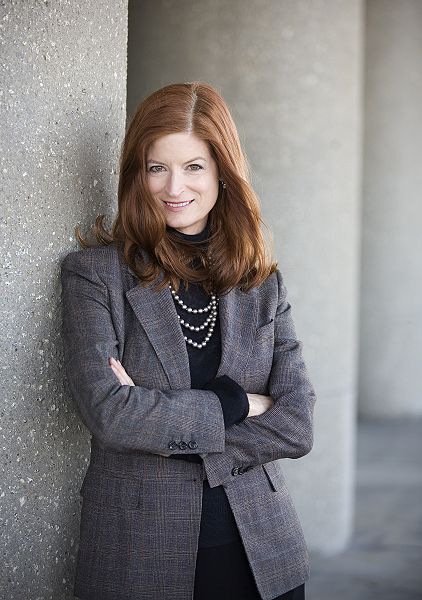
Louann Brizendine (Courtesy: Andy Feinberg)

Louann Brizendine, 2009 (Image: Andy Feinberg released into the Public Domain, via Wikipedia)

Beware – the F-word is coming! Yes, Feminism. It might be a dirty word in some quarters, but I regard myself as a feminist – 1970s style – and so I approached Brizendine’s best-selling book, The female brain, with my cautionary antennae out. It’s not the sort of book I would necessarily have chosen myself but it was a bookgroup read and my number one reading priority is my bookgroup’s schedule. And, really, I’m glad I read it because it is good to keep up with the various arguments and debates going on.

The way I see it – and it’s pretty obvious really – the influences on our behaviour are threefold:

  • biological/biochemical
  • genetic
  • environmental/social

The BIG question is, then, in what proportion do these play out in our lives? Clearly men and women are not the same – you just have to look at us to see that – but as a young woman I believed that environmental factors were the strongest in determining the course of women’s lives. And I still think that’s largely the case. Environmental (or socio-cultural) factors may not necessarily be the determining factors in our individual behaviours but I believe they still do play a major role in the trajectory of women’s lives. As I’m sure they do for men too – but I believe that women still tend to draw the shortest straw.

And yet, there’s a niggle. Statistics – and the obvious evidence around us – show that the proportion of women in leadership roles, for example, in boardrooms, in politics, and so on, is way below what would be pro rata. Why is this? Is it the glass ceiling? Or, is there something else going on? Brizandine suggests women have “superior brain wiring for communication and emotional tones”. Does this discourage us from seeking these leadership roles which, in our current western capitalistic environment at least, tend to be adversarial if not downright aggressive. And then, the thinking and the niggles get murkier. What happens in non-western-capitalist societies? And in indigenous societies? In these (with some notable matriarchal exceptions), women also tend not to be the leaders. Why? Is human society inherently adversarial and aggressive – or is it just that men have made it so. If the latter, can women – with their superior emotional wiring! – change the nature of society?  You see, what happens? Round and round in circles.

And this brings me back to Brizendine, neuropsychiatrist and founder of the Director of the Women’s Mood & Hormone Clinic (which rather suggests where she is coming from). Her book focuses pretty much exclusively on biology. The backcover blurb describes the book in these terms: Brizendine “reveals how the uniquely flexible structure of the female brain determines not only how women think and what they value, but how they communicate and whom they will love”. It’s all in the biology you see! We are “programmed” to seek out the most symmetrical (yes, really, or so she says) good-looking male because it is all about reproduction of the species. Occasionally she qualifies her statements, such as “Humans are not quite so biologically determined [as Syrian hamsters, for example!]” (p. 132) but the  qualifications are minor and infrequent.

It all reads a little simplistically. Like any good non-fiction work, the book is comprehensively referenced with 23 pages of citations/notes and nearly 80 pages of references. However, she herself agrees that it is difficult to properly research the workings of the brain and so many of her arguments are made using either anecdotes, drawing conclusions from the animal world, or based on one-off studies. I don’t have the resources to check all her citations but the Nature magazine reviewer found them wanting in terms of  “scientific accuracy and balance”*. A quick search of the ‘net brings up counter arguments, such as those of Insitut Pasteur neurologist Catherine Vidal, who states that “the differences [in brain development] between individuals of one and the same gender are so great as to outweigh any differences between the genders”. And regarding male versus female test results in, say, mathematics, she says that the main factor is socio-cultural:

The second study, conducted last year with a sample of 300,000 in 40 countries, showed that the current socio-cultural environment is conducive to gender equality. ‘More girls are getting good test scores in maths,’ Dr Vidal highlighted. ‘In Norway and Sweden, the results are comparable, and in Iceland, the girls beat the boys.’ It should be noted, however, that the boys beat the girls in Korea and Turkey.

Of course, she’s talking more about intellectual/academic skills/achievement rather than behaviour which is more Brizandine’s focus – but it serves nonetheless to sound a warning about ascribing causes too simply.

I’m late reading this book which apparently caused quite a flurry when it was published in 2006. I’ll end with Deborah Tannen’s conclusion to her review in the Washington Post (2006):

Paleontologist Stephen Jay Gould once said he despaired of the constant question “Is it nature or nurture?” because “biology and environment are inextricably linked.” Ideally, readers will sift through the case studies, research findings and scientific conjectures gathered in this non-technical book and be intrigued by some while questioning others, bearing in mind the caution that hormones and brain structure play a role in gender differences but are not the whole story. And if this book joins a “nature” chorus that has swelled as a corrective to the previous pendulum swing toward “nurture,” we can assume that another corrective will follow. But given the character — and rancor — of our dichotomous approach to the influences of biology and culture, readers likely will be fascinated or angered, convinced or skeptical, according to the positions they have staked out already. That would be a pity.

Fair enough … and meanwhile, for me, the bottom-line remains: regardless of how similar or different we are, and why, all humans deserve to be respected and treated equally regardless of gender, race or religion.

*Nature, Vol. 443, 12 October 2006.

Louann Brizendine
The female brain
London: Bantam Books, 2007 (First pub. 2006)
352pp.
ISBN: 9780553818499

Eva Hornung, Dog boy

Eva Hornung, Dogboy

Dog boy cover (Courtesy: Text Publishing)

I first read Eva Hornung when she was writing as Eva Sallis. It was her second novel The city of sealions, which is a pretty passionate and evocatively written exploration of cultural alienation and dislocation brought about primarily by migration.

In some ways Dog boy explores similar concerns, but its alienation is played out in a different way – through that fascinating archetype of the feral or wild child. In the novel, Hornung refers to a few modern examples of feral children, such as Oksana from the Ukraine; in an interview on the Literary Minded blog she says that the novel was inspired by a news story about a child living with dogs in Moscow. Guess where this book is set? You got it – Moscow! This intrigued me somewhat. Why would an Australian novelist read about a feral child in Moscow, go there to research and then write a novel? But Eva Hornung seems to be no ordinary novelist. She did her PhD in the Yemen and her settings – even if not her overriding theme – range rather widely.

And so to Dog boy. At the beginning of the novel Romochka, 4 years old, is alone in an apartment. He hasn’t seen his mother for a week or more and suddenly his uncle does not return. He senses the apartment building is being emptied and so after a couple of days being alone he heads out, and manages to get himself adopted by a dog, Mamochka, who lives with her four young puppies and two older offspring. How and why he is left alone is not the concern of this novel (which reminded me a little of Cormac McCarthy’s The road in which the cause of the devastation is also not the point). The novel tells the story of his life with the dogs and of what happens when he, four years later, comes to the attention of humans, specifically two scientists/doctors working in a children’s rehabilitation centre.

[WARNING: MINOR SPOILERS]

The story is told chronologically, and is divided into 5 parts. The first two parts cover Romochka’s first two years in the lair and how he gradually learns “to be a dog”. In the third part, Mamochka introduces a baby to the pack – to provide human company for Romochka. The baby is, ironically, called Puppy (by Romochka). Without giving any important plot points away, the final two parts deal with the boys’ renewed contact with the human world. It’s told in 3rd person but the perspective does shift, particularly in the last two parts where we see what’s happening through different eyes – the two scientists, Dmitry and Natalya, and Romochka himself. But even before this, we occasionally move between Romochka’s and the author’s perspective. It’s a technique that encourages us to understand, if not empathise with, the various experiences as they play out.

As I read this book, I felt I was in the hands of someone who knew what she was doing – even though at times I wondered exactly why she was telling this story. Not only does she viscerally describe Romochka’s gradual acceptance into the dog clan, his learning to hunt and his slow rise to dominance, but she starts to introduce humans at a time when our interest in an ongoing dog story would start to pall. This shift starts with Romochka’s increasing interest in people and builds up to the more or less inevitable conclusion – but that conclusion is not simple and is open-ended.

The language is evocative – sometimes beautiful but more often earthy and confronting to our senses. Hornung evokes Romochka’s life with the dogs with such attention to detail that it is entirely believable. She describes his animality, without being heavy-handed – he moves in “a wide lope”, uses his “paws”, and carries with him a horrible “stench” – but also shows his ability to use human logic and reasoning. At the time of his first capture, Romochka’s inner dog-human conflict is obvious:

Romochka wished bitterly … for true doghood. Were he really a dog, he would understand only their bodies, and not their words. Were he really a dog, he wouldn’t know their names, and their kids’ names. He wouldn’t … be paralysed by these lives that stretched before and after the station: he would know only their smell, only their aggression and torments; and what they ate.

The fight went out of him altogether. He stared dumbly, balefully without growling or snapping, unresistant even when he was pushed around. He was no longer sure that hiding his human side would get him released, but he remained a dog …

The big question to ask is, Why did Hornung choose to tell such a story? There is the obvious reason, that of our ongoing fascination with the wild child phenomenon and what it might tell us about what it means to be human. But there is also Hornung’s ongoing interest in alienation and, related to that, the abuse of humans by other humans (particularly where there is social disintegration). For all our horror at the way Romochka lives, we also see that he is not only safe but well nurtured in his life with the dogs. Was this boy, Natalya and Dmitry ponder, “better off living with dogs than with humans”. This question, that comes towards the end, represents a big shift from Dmitry’s earlier “proper awareness of the philosophic and scientific divide between man and animal”. The second part of the novel, in fact, explores this question at some depth. How big is the divide really? And to what extent is man a beast? All this is explored with more than just a little skepticism about scientific research and the tension between nice neat theory (and the chance it offers for professional glory) and messy reality. There is a lot in this book for keen readers to consider. It’s one that I will remember for some time.

Dog boy is Sallis aka Hornung’s 6th novel. She has won or been nominated for awards for many of her novels and yet she is not particularly well-known. Her change of name may have contributed to this but, whatever the reason, I think it’s a shame. Her writing is clear, accessible and evocative – and yet has a depth and passion that is worthy of the prizes she wins. May we see more of her.

Eva Hornung
Dogboy
Melbourne: Text Publishing, 2009
293pp.
ISBN: 9781921656378

(Review copy supplied by Text Publishing)

Margaret Atwood, The Penelopiad

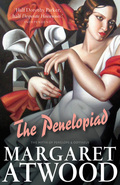
Margaret Atwood, The Penelopiad

The Penelopiad bookcover (Courtesy: Text Publishing)

This is the second time I have read Margaret Atwood’s The Penelopiad. Much as I enjoyed it the first time around, I probably wouldn’t have read it again if it hadn’t been scheduled for one of my online bookgroups. However, given that scheduling and the fact that I had recently listened to Simon Armitage’s dramatisation of The odyssey, I didn’t mind reading it again – and it is short! My rereading though ended up being a little disjointed as I was trying to finish off a number of competing contracts at the time as well as prepare for a ten-day trip to our warm Top End. This review may be similarly disjointed!

The book is part of Canongate’s Myths series in which recognised writers were asked to retell well-known myths. At the time of publication, Atwood said that she tried a number of myths and had nearly given up when she suddenly recollected the story of Penelope and her hanged maids – and her childhood reaction to it. The result is a rather fresh – and cheeky – look at the story told through Penelope’s and the hanged maids’ eyes, from, not surprisingly, a feminist (or at least female) perspective.

The story is told through a large number of short chapters in Penelope’s voice, and these are interspersed with commentary from the hanged maids, emulating, appropriately enough, the idea of a Greek chorus. The way Atwood uses it, the chorus provides a satiric perspective on Penelope’s view of the story. The story is told in flashback, with the narrators all speaking from Hades, where they now reside. It is not a standard revisionist feminist treatise that simplifies the world to one of gender power discrepancies (even though that is what underlies it all). We get to “feel” what it might have been like to have lived then. Atwood’s characters are “real” and operate in a complex world where game-playing and manipulation are de rigueur if you are going to survive.

In Homer, Penelope is presented as “the quintessential faithful wife” (Atwood’s introduction) who brings up their son and cleverly fends off suitors while waiting patiently for Odysseus’ return. When he returns, he kills the suitors and twelve of Penelope’s maids. Atwood, again in her introduction, says that in choosing to tell the story through Penelope and the maids she wanted to focus on “what led to the hanging of the maids, and what was Penelope really doing?”. Her Penelope is something rather more than the constant wife of The odyssey. She, the part daughter of a watery Naiad, is a slippery character to pin down. She is highly jealous of her beautiful cousin Helen (she of Troy fame) and she is capable of making her own power plays. She is of high birth, contrasting her with the twelve maids who, by their own admission “were born to the wrong parents. Poor parents, slave parents, peasant parents, and serf parents…”.

What I enjoyed most about this book – besides the story Atwood tells – is its sly humour. It is genuinely funny, albeit in a dark or sometimes gruesome way. Much of the humour arises out of Penelope’s playing with the truth. In fact the book plays continually with the idea of “stories”. In the first chapter, Penelope says:

Now that all the others have run out of air, it’s my turn to do a little story-making. I owe it to myself. I’ve had to work myself up to it; it’s a low art, tale-telling … So, I’ll spin a little thread of my own.

A little further on in the book, she says, when reporting one of the prevailing stories about her, that “there’s some [my emphasis] truth to this story”. And so, as we read we need to remember that she too is telling us a story, and that there’s no guarantee that her story is any more “true” than another’s. This idea is reinforced by the fact that the maids comment on what Penelope tells us. Their and Penelope’s perspectives are not always the same. That is, their truths are different. This notion of stories versus stories is made even more clear in the chapter titled “Waiting” in which Penelope recites all the opposing stories and rumours about what Odysseus was doing/what was happening to him during the 10 years of his return. Reader beware, I say. In fact, at one point in the book where Penelope questions whether the “maids were making some of this up”, I wrote in the margin “Where is the truth”? I love the way Atwood plays with myth-making in a book about a myth – and, in doing so, also calls into question her own storytelling. Very postmodern!

I won’t go on. It’s a little uneven, with the maids’ story in particular being not quite as well integrated as it perhaps could. And yet, I’d recommend it, if you haven’t already read it. It’s clever, funny and compassionate – but its compassion is not a naive one. Rather, it has wide open eyes and knows that nothing is ever as simple as it looks – particularly when you find yourself in a situation where there is imbalance of power. Games will be played – and the powerless, such as women and particularly poor maids, will usually lose. And this, in the end, is Atwood’s (somewhat heavy-handed) point. As Penelope says in her last chapter:

Even with my limited access I can see that the world is just as dangerous as it was in my day, except that the misery and suffering are on a much wider scale. As for human nature, it’s as tawdry as ever.

Margaret Atwood
The Penelopiad
Melbourne: Text Publishing, 2005
199pp.
ISBN: 9781920885953
NB: Cover image used above is from the new 2007 edition.

Shirley Jackson, Charles

Before I start this review, I have a technical question. Does anyone know why advice to bloggers about maximising your site always say not to use something like “here” for a hyperlink but, rather, to add the link to the actual name of what is being linked to? In other words, to make the link so – Shirley Jackson’s Charlesrather than so – Shirley Jackson’s Charles can can be read here? I have done both but I have tended to prefer the “here” approach when I am making a link to the actual text of the item I am reviewing. Otherwise, the chances are – and this has happened – that the blog’s readers miss it because they will not know that the link under the title is the actual story and not just a link to an article about (or a source to buy) the story. My preference is to go for the unambiguous approach – but is there a really BIG reason why I shouldn’t? Enquiring minds – well mine anyhow – would love to know.

Anyhow, on to what will be a brief review of this week’s Library of America story. It’s by – well, if you’ve read the first para you’ll know by now – Shirley Jackson. Another American writer I’ve never heard of! Apparently she is best known for her “tales of psychological horror” (LOA introductory notes) but this one that they’ve presented to us, “Charles”, is an ordinary domestic life story. It was published in Mademoiselle magazine in 1948 and, again according to LOA, “is one of the first of her numerous semi-autobiographical stories of life as a 1940s housewife raising children who sometimes seemed one step outside her ability to control them”.

Well, that certainly seems to the the case in “Charles” because it is clear that the young protagonist of the story has it all over his parents. It’s a nice little story but rather predictable. I’d be surprised if any experienced reader didn’t “get” it some long time before the end. This spoils the story a little – although perhaps Jackson is playing a game with the reader, willing us to see what the parents clearly don’t? Whatever her intentions,  it nicely shows the wiliness of children and the gullibility of many parents. I think though, that to properly assess Ms Jackson, I should read one of her psychological tales rather than this little slice-of-life piece.