Jane Austen, The Watsons (Unfinished)

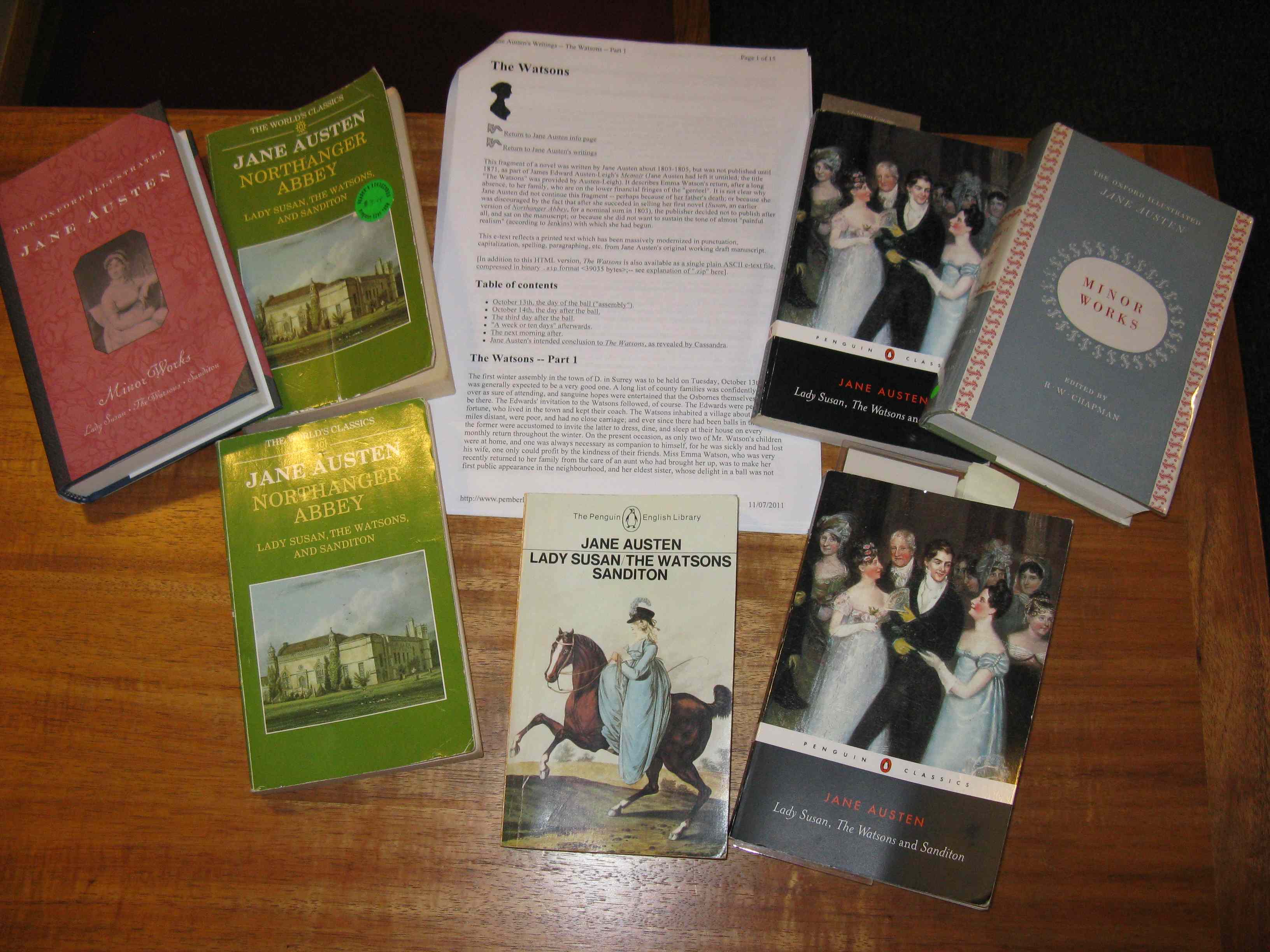
Book covers for Jane Austen's The Watsons

Book covers for Jane Austen's The Watsons

In one of those coincidences that we often bother about in fiction, my local Jane Austen group scheduled Jane Austen’s unfinished novel, The Watsons, for our July discussion. A coincidence because, if you are an Austen fan, you’ll know that just this week the manuscript was sold at auction for nearly £1 million. Thank goodness it was bought by an institution – the Bodleian at Oxford. Next time I’m in England I know where I’ll be going!

Anyhow, onto The Watsons. This unfinished novel was written in Bath probably around 1803-1805, though there is not consensus about this. A common belief is that she abandoned it after her father’s death due to sadness and the resultant uncertainty in her living conditions. Whether this is true or not, it is a fact that she didn’t take up serious writing again until she settled in Chawton in 1809 – which gives rise to the more interesting challenge. That is, why didn’t she take this one up again as she did with other early works such as First impressions which became Pride and prejudice. Enough of that, however, as all we can do is speculate. Let’s look at the work instead.

English novelist Margaret Drabble describes The Watsons as “tantalising, delightful and highly accomplished”. And it certainly is tantalising. We have only 68 pages (manuscript count). The story concerns 19-year-old Emma Watson who has returned, after living with her well-off aunt and uncle for 14 years, to her “poor” family. At the time of her return, just her oldest sister, the 28-year-old Elizabeth, is at home with their invalid father. The family however comprises four daughters and two sons, of whom only one son is married. The main plot-line is, of course, likely to be marriage, and so in these first chapters we are introduced to three men who could vie for Emma’s hand. We are also introduced to the characters belonging to Austen’s favourite subject, “3 or 4 families in a Country Village”. We know, from her sister Cassandra, how Austen intended the plot to play out. So tantalising that we never saw her do it!

Drabble’s next word is “delightful” and it is that too … because it contains those wonderful character descriptions and social observations that we have come to expect of Austen. I’ll share just a couple. The first one describes Emma (at the Ball where we meet three potential beaux):

… a lively Eye, a sweet smile, & an open Countenance, gave beauty to attract, & expression to make that beauty improve on acquaintance …

Contrast this to the following description of her sister Margaret:

Margaret was not without beauty; she had a slight, pretty figure, & rather wanted Countenance than good features; – but the sharp & anxious expression of her face made her beauty in general little felt.

There are also those delightful little set pieces we are used to finding in Austen, pieces that illuminate character as much as they move the plot along. One concerns Emma’s offer to dance with a 10-year-old boy when the snooty aristocrat Miss Osborne, doesn’t follow through on her promise to dance with him. “Oh Uncle”, the young lad says to one of the possible beaux, “do look at my partner. She’s so pretty.”

Sweet as she is, Emma proves herself to be well able – rather like Elizabeth Bennet – to hold her own. She refuses to pander to the flirtatious Tom:

Emma’s calm curtsey in reply must have struck him as very unlike the encouraging warmth he had been used to receive from her Sisters, & and gave him probably the novel sensation of doubting his own influence, & of wishing for more attention than she bestowed.

The last sentence of The Watsons starts, “Emma was of course uninfluenced …”. How sad we didn’t get to see more of this resourceful, delightful heroine.

Finally, “highly accomplished“. I’m not sure I totally agree with Drabble here. What we have is intriguing, tantalising us with its potential. It demonstrates much of what we know and love about Austen – and yet, despite evidence of extensive editing in the recently auctioned manuscript, it has (to my mind anyhow) an element of clumsiness. I find this particularly in an overuse of dialogue to convey information which the characters involved would surely already know – such as Elizabeth’s saying to her sister, Emma, “though I am nine years older”. It works well enough in the context but I believe the later, experienced Austen would have better conveyed this through authorial comment.

Nonetheless, it is accomplished. Its realism is remarkable and, like all her novels, it is clear from the beginning just what the targets are going to be. In this case, I see a major theme being the contrast between exterior and interior “refinement”. The fragment we have focuses heavily on the distinctions of class, often contrasting the superficiality of those who possess this so-called “class” with Emma whose refinement is more of the interior kind. This has the makings of a fascinating novel.

And yet, while it was not to be, we can point to many characters in later books who seem to draw, albeit with variations, from the characters here: the invalid father in Emma, the money-fixated brother in Sense and sensibility, the independent-thinking heroine in Pride and prejudice, the flirty young man of means in Mansfield Park, to name just a few. For whatever reason, Jane Austen did not return to this manuscript, but it’s obvious that she did not forget the characters nor some of the ideas behind their creation.

Jane Austen
“The Watsons”
in The Oxford illustrated Jane Austen. Vol VI, The minor works (ed. R.W. Chapman)
London: Oxford University Press, 1969
pp. 315-363

Willa Cather, A Wagner matinée

Willa Cather's childhood home in Red Cloud, Nebraska

Willa Cather's childhood home, Nebraska (Public Domain, By Ammodramus, via Wikipedia)

Willa Cather‘s short story, “A Wagner matinée”, was Library of America’s “Story of the Week” back in May. However, I was busy then, but I like Cather, so I put it aside to read later. And later has finally come!

I’ve reviewed another Cather short story here, “The sentimentality of William Tavener”, which was published in 1900. “A Wagner matinée” was first published a little later, in 1904. Like the previous story, and the novels of hers that I’ve read, this short story deals with her favourite preoccupation, the tough life of the pioneer. It is not, though, set in the midwest, but in Boston. The plot is slight, and can be summarised in a couple of sentences. The first person narrator’s aunt comes to visit him in Boston from Nebraska to which she’d eloped, against her family’s wishes, some three decades previously. Our narrator, Clark, has “a reverential affection” for this aunt who’d provided him with “most of the good that ever came my way in my boyhood” and so he decides to treat her, an ex-music teacher, to an afternoon concert of Wagnerian music. The story chronicles the emotions aroused by this visit.

As usual, the Library of America’s brief introductory notes are illuminating. Apparently Cather attracted a degree of wrath after its publication, from Nebraskans and from her family. A Nebraskan editor slammed her depiction of prairie life suggesting that fiction writers who portray Nebraska should “look up now and then and not keep their eyes in the cattle yards”. If they did “they might be more agreeable company”. Take that, Willa!

Her family was upset because they felt she’d based the story’s Aunt Georgiana on her Aunt Franc who, like Georgiana, had lived in Boston and studied music before marrying and moving to Nebraska. Cather was apparently hurt by this as she’d maintained an affectionate correspondence with her aunt. Nonetheless, the notes say, when she revised and shortened the story for her 1920 collection, “she altered the portrait of Georgiana out of consideration for her Nebraskan family”. Hmmm … I should do my research and find the original as I believe the version provided by the Library of America is this 1920 one. In it, Georgiana seems a fairly sad case so I’d love to see what she’d written first. Regardless, it reminds me yet again of that fine line between fact and fiction that novelists who draw from life must tread.

Anyhow, the story. Aunt Georgiana arrives in a somewhat “battered” state, partly due to the arduous journey and partly, Clark implies, due to the hardness of her life. “For thirty years my aunt had not been farther than fifty miles from the homestead” which she had established side-by-side with her husband. Clark describes the time he’d spent out west with his aunt and the support and encouragement she’d given him. He also remembers her telling him once when he was “doggedly” practising a piano piece:

Don’t love it so well, Clark, or it may be taken from you.

What was taken from her? Her music? Her old life? Was it taken or did she, willingly at the time, give it up? Her pain made clear, nothing more is said on this point. And I like the writing for it. The rest of the story describes the matinée and how he and his aunt react. The language is clear and strong, as you can see from this excerpt roughly half-way through the story. It describes the first piece in the concert, the Tannhaüser overture, which is particularly meaningful for me as Tannhaüser was my first opera:

… When the horns drew out the first strain of the Pilgrim’s chorus, Aunt Georgiana clutched my coat sleeve. Then it was I first realised that for her this broke a silence of thirty years. With the battle between the two motives, with the frenzy of the Venusberg theme and its ripping of strings, there came to me an overwhelming sense of the waste and wear we are so powerless to combat; and I saw again the tall, naked house on the prairie, black and grim as a wooden fortress …

Pretty stark stuff … and it becomes more stark as he describes his aunt’s physical reactions to the music and draws his own conclusions from it. Here she is reacting to “The prize song”:

Her eyes were closed, but the tears were glistening on her cheeks … It never really died, then – the soul which can suffer so excruciatingly and so interminably; it withers to the outward eye only; like that strange moss which can lie on a dusty shelf half a century and yet, if placed in water, grows green again.

Why Wagner, I wondered when I saw this story? It would be anachronistic to invoke our era’s discomfort with the man and, in fact, LOA tells us that Cather was passionate about Wagner. His is powerful, emotional music: this seems to be its relevance here. It is music which can stir the soul – and Georgiana’s soul has been stirred. She is no longer “semi-somnambulant” as she was when she arrived. Clark leaves us contrasting his emotional aunt with the “black pond” and “unpainted house” of home. However, because the story is told through Clark’s – albeit loving and sympathetic – eyes we cannot know what this all means for her. Instead, we are left to think about the sacrifices that attend the decisions we make and whether or not we can live with them. A thoughtful, moving story.

Margaret Mendelawitz, Charles Dickens’ Australia. Book 1, Convict stories

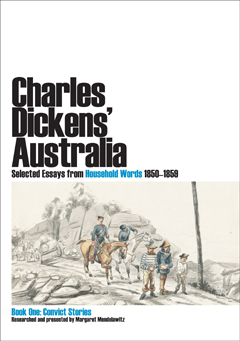
Charles Dickens' Australia, Book 1

Book cover (Courtesy: Sydney University Press)

So true may fiction be in the hands of a genius
(from “Convict in the gold region”, by Richard Horne)

Richard Horne, in his article “Convicts from the gold region”, describes a scene from Don Quixote in which Quixote meets and sets free some convicts by driving away their guards, only to have his generosity (which included delivering them “a noble speech”) met by ridicule and “a volley of stones”. Horne suggests that the convicts he met would do “the same thing to any eccentric philanthropist in a broad-brimmed hat who should set them free and make them an address on liberty and humanity”. An interesting analogy to draw and one, I might add, that he doesn’t test, but I did like the way he used it to see the truth in fiction!

Anyhow, I have now read Book 1 in this fascinating set of books from the Sydney University Press, and it pretty well does what Mendelawitz says in her introduction. That is, it provides a first-hand, informative and entertaining insight into mid-19th century Australia – in this case, relating to the role of convicts in that society. The focus is on social conditions and social justice but there’s no heavy-handed proselytising. Dickens’ aim was to create a magazine that would be “cheerful, useful and always welcome” but that would also “assist the reader’s judgement in his observation of men”. Badness and wrongdoing aren’t glossed over but, wherever possible, mitigating circumstances are also provided.

There are 15 articles in the book, written by 9 different authors, some in collaboration. The last 6 are written by Australian-born barrister, journalist, novelist John Lang and are short case studies of individual convicts, including those who were unjustly (or, at least, unfairly) transported, those who deserved what they got but made good, and those who couldn’t give up their criminal ways. Representing this last group are the convicts described in “Three celebrities”. Fox, Pitt and Burke were three thieves who were “transported under the names of the three most celebrated orators of their time”. For whatever reason, they did not knuckle down to honest work in the colony, but instead escaped and operated as bushrangers. Even in their story, though, a positive is given: by the time they were captured they had set up a well-stocked farm with an abode that “was in the neatest order” and land that “was very well-tilled”. At the opposite end of the spectrum is the rather melodramatic tale of star-crossed love and a stolen horse resulting in the transportation of young “Kate Crawford”. Noticed by Mrs Macquarie, the wife of Governor Macquarie, and placed in the home of the chief constable in Parramatta, she was pardoned within three years and (eventually) died a very wealthy woman. These 6 stories are told with a light touch and in a conversational tone as tales relayed by a woman who knew the convicts in question.

A few of the articles are set in – or tell of – the Norfolk Island penal colony, a colony I have written about before in reviews of Jessica Anderson‘s The commandant and Price Warung‘s Tales of the early days. Both of those were written after the events and people they describe, and it is reassuring to our search for the “truth” that the articles here basically confirm the worst and best of the colony as conveyed by Anderson and Warung in their fictional pieces.

The centrepiece of this volume though is the story of William Henry Barber, who was transported to Norfolk Island in 1844. The story, told over two articles “Transported for life [Part One]” and “[Part Two]”, chronicles his imprisonment, trial and conviction for a crime he claims he did not commit,  his transportation to Norfolk Island (including details of the long boat journey) and subsequent removal  to Van Dieman’s Land from where he was, in 1847, released. Not long after, he received a free pardon with acknowledgement of his innocence. The articles are told first person but in fact were written by journalist and novelist William Moy Thomas. The Notes on Contributors suggest that the articles were based on the account Barber wrote in 1853 of his experiences, an account which is known to have been in Dickens’ library. The aim, as stated at the beginning of the first part, was to show “what transportation, at the present time, really is”.

In my overview of this set I wondered whether Dickens’ tight control over style would result in the articles being somewhat formulaic but I’m pleased to say that they aren’t. While the tone is overall more light than heavy and the content informative with a light persuasive edge, the style does vary. Some are factual chronicles of a life or situation while others have a more literary bent, some use dialog while others comprise descriptive prose, some are a little more obviously didactic while others simply present the situation for the reader to draw conclusions. The message, though, is always there, whether stated or not, and it is essentially this:

It is no miracle that has been here performed; men bred to crime in England by the ignorance and filth we cherish, are bred out of crime again in Norfolk Island, by a little teaching and a little human care. (from “Norfolk Island”, by Irwin and Henry Morley).

I must add, in the services of “truth”, that Norfolk Island had a mixed history regarding treatment of convicts but there was a short period, under Alexander Maconochie, when rehabilitation was taken seriously.

To conclude I can’t resist a quote from pickpocket Barrington in another of John Lang’s case studies, “An illustrious British exile”:

There was a time when ladies boasted of having been robbed by Barrington. Many whom I never robbed gave it out that I had done so; simply that they might be talked about. Alas! such is the weakness of poor human nature that some people care not by which means they associate their names with the name of celebrity.

And we thought the celebrity culture was new? Once again history tells us otherwise!

Margaret Mendelawitz
Charles Dickens’ Australia: Selected essays from Household Words 1850-1858. Book 1, Convict stories
Sydney: Sydney University Press, 2011
187pp
ISBN: 9781920898670

(Review copy courtesy Sydney University Press)

MJ Hyland, Carry me down

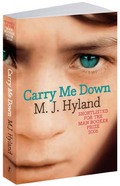
MJ Hyland, Carry me down bookcover

Book cover (Courtesy: Text Publishing)

If you like writers who unsettle, then MJ Hyland is a writer for you. Carry me down is my second Hyland. I read, loved and reviewed a later book of hers, This is how, nearly a year ago, and said then that I’d like to read more. I finally have, and am not disappointed.

Carry me down is a pre-coming-of-age story. John Egan is an 11-year-old boy living in Ireland with his parents. He’s an only child and is keen to be special, different. He is clearly pre-adolescent – he’s naive, for example, about some of his 15-year-old cousin’s behaviours. He’s an unreliable narrator: the world he sees and describes is rather skewed but the unsettling thing is that we, the readers, know it is skewed but we are not quite sure in which way. What is going on in this family is the question in our minds from beginning to end.

Like This is how, the novel has a vaguely unsettling beginning. The first paragraph sets up what looks like a cosy family scene. The three are sitting, companionably it seems, around the table on a Sunday evening. The third and fourth paragraphs read:

From time to time we stop reading to talk. It is a good mood, as though we are one person reading one book – not three people apart and alone.

These kinds of days are the perfect ones.

That “alone” is a little jarring, though not dramatically so. But then comes this on page 2:

“John,” she [his mother] says, “please come with me. “She is taking me out to the hallway, away from my father. She is taking me out of his sight, as though I am rubbish.

“Rubbish”? Now, that’s a strong word. What she tells him in the hallway is to stop staring at her:

“You were staring at me, John. You shouldn’t stare like that.”

“Why can’t I look at you?”

“Because you’re eleven now. You’re not a baby anymore.”

There seems to be something slightly strange going on here, or is there? Is this just a pre-adolescent bumping up against the adult world he is about to join, or is something far more complicated going on? As the book progresses, John’s relationship with his mother verges on “too close”. He seems a little too emotionally and physically needy, and she seems unsure of how to manage it. Is his need normal, is the question we ask. Meanwhile, his relationship with his father seems more typically adolescent. He wants his father’s approval and love, but he wants to be independent too. And, he wants to be special. He is an avid reader of the Guinness Book of Records, and decides early in the novel that he has a gift for lie detection for which he’d like to be included in the Guinness. He reads up on lie detection, and starts his own Gol of Seil (Log of Lies).

The situation is complicated by a number of facts which come out in the first chapters of the novel. John is unusually tall for his age and is under medical care for this. He regularly scratches a spot on his head until it bleeds. And he is bullied at school, because he is clearly a little different. His father is out of a job and studying for exams to be admitted to Trinity College. The book his father is reading at the start of the novel is Phrenology and the Criminal Cranium. Is this a hint to us – or a red herring? His mother works with a puppet show. This is interesting, too, as the idea of puppets subtly undercuts the desire for control and independence that John, like any pre-adolescent, is starting to strive for. The family lives with the paternal grandmother, with whom John’s father has a prickly relationship, mainly around money. And, underlying all this is John’s growing obsession with truth and lies.  This obsession is the framing motif in the book. John catches adults lying and takes them to task for it, all the while telling lies himself. He does not, by the end, come to a real understanding of how lying functions, of the difference between white lies and more serious ones. For this reason I don’t see it as a true coming-of-age story.

And now I come to my problem. How do I write about this book without giving it away? There are events – powerful, troubling ones – that occur in the book and that can be “read” in different ways. I’d rather like to analyse or explore the possible meanings, but that would require giving away some significant plot points. I don’t want to do that because this is a book that you need to discover for yourself, sentence by sentence.

What I’ll say though is that this is one of those books that has an open ending. (Indeed, giving nothing away, the last word of the book is “open”). How we read it depends on our own world view, on the weight we give to the various events in the novel, on how we read the specific words and images used by Hyland to describe the events and characters, and our personal understanding of adolescent and family psychology. The way I see it, the book’s ending hints at a number of possibilities but we do not know, at the point in their lives that we leave these characters, which of these possibilities will eventuate. And that, as they say, is life!

MJ Hyland
Carry me down
Melbourne: Text Publishing, 2007 (orig. 2006)
313pp.
ISBN: 9781921145780

Monday musings on Australian literature: Writers from our north

David Malouf picture at book meeting. (Taken b...

David Malouf, 2006. (Courtesy: Dariusz Peczek, via Wikipedia, using CC-BY-SA 3.0)

Queensland is the state of my birth, and that makes it special to me! It is a large state and one of our most geographically diverse, ranging from the tropical north to the arid west, from the subtropical south to the temperate inland southeast. It has one of Australia’s most popular tourist destinations, the Great Barrier Reef, and our best-known commercial tourist (and, retirement) mecca, the Gold Coast. It is unlikely, though, to be the first state people think of when asked about Australian writers …

Nonetheless, many significant writers have come from Queensland, including the indigenous poet Oodgeroo Noonuccal.

Of our contemporary writers, though, the best known Queenslander has to be David Malouf. Like most Queenslanders, he “emigrated” from there long ago and has lived in England and Tuscany as well as Sydney, but that doesn’t mean that his ties aren’t strong. Johnno, his first novel and the first one I read, is, like so many first novels, somewhat autobiographical. It describes a young boy growing up in Brisbane in the 1940s and 1950s and, as I recollect, evokes the place and time well. One of my favourite novels of his, Fly away Peter, is partly set in the (above-mentioned) Gold Coast and partly on the Western Front during World War 1. It’s a beautiful novella which explores friendship, love and life, not only against the challenges of war but also of class. And, while his most recent novel, Ransom, re-explores the story of Priam and Achilles, it was inspired by his introduction to the story of Troy in his schoolboy days. It seems, with Malouf, that you can take the boy out of Queensland but you can’t take Queensland out of the boy!

Like Malouf, Janette Turner Hospital left Queensland in early adulthood, and has spent most of her life in the United States and Canada, though she does return down under occasionally. She’s a writer who’s not afraid to take risks, and can push metaphors, sometimes to their limits (as in Charades and Borderline). Her novels range over the countries in which she’s lived, including for example, southern India in The ivory swing. Due preparations for the plague is one of those post 9/11 novels that deals with terrorism, and Orpheus lost also explores what happens when people get caught up, inadvertently for the most part, in political action. Few of her novels are set in Australia, but there’s often an Australian character.

By contrast, Andrew McGahan has remained in Australia, even if not in Queensland. He currently lives in Melbourne (I believe). His first two books, Praise and 1988, are the only books I’ve read in the “grunge” style – and I liked them. His Gen X characters are pretty aimless, and were an eye-opener for baby-boomer me. They are primarily set in Queensland. His novel The white earth won the Miles Franklin award, and is set in the Darling Downs of Queensland. It’s a coming-of-age story in which the protagonist is caught between his (white) uncle’s obsession with land and his growing awareness of indigenous people’s connection to land.

And this brings me to Alexis Wright, an indigenous Queensland writer whose larger-than-life wild-ride of a novel Carpentaria also won the Miles Franklin award. It deals with indigenous disenfranchisement, with how disconnection from the land results not only in conflict with white society but also within indigenous groups. Wright cleverly marries tragedy with comedy, and tosses in a little surrealism and magic, to demonstrate just how complex the situation is. The following excerpt captures something of the tone of the novel:

Old stories circulating around the Pricklebush were full of the utmost intrigues concerning the world. Legends of the sea were told in instalments every time you walked in the door of some old person’s house. Stories lasted months on end, and if you did not visit often, you would never know how the story ended.

That’s probably enough really, except I can’t finish without briefly mentioning two writers who were not born in Queensland but have strong associations with it. One is Thea Astley who wrote several novels set in Queensland including The multiple effects of rainshadow which I reviewed some time ago, and the poet Judith Wright about whom I must post in future. Wright used poetry not only to celebrate the landscapes she loved, but to promote issues of concern to her, including indigenous rights and environmental degradation.

Have you noticed the high proportion of women writers in this post? Queensland is often the butt of jokes in Australia for being conservative and yet, without design, I have come up with more women than men to represent writing in this state. Go figure (as they say)!

Kate Chopin, A morning walk

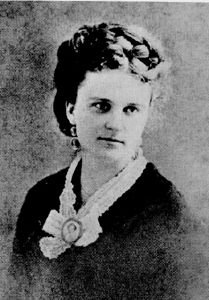
Kate Chopin

Kate Chopin (Public domain, via Wikipedia)

It’s been some time since I read (and therefore reviewed) a Library of America offering, but when I saw another Kate Chopin offering pop up a few weeks ago, I couldn’t resist it. And so, I printed it off, but have only just managed to read it. Well, what a surprise…

I thought about starting this post with “And now for something completely different” because this story, “A Morning Walk” (1897), is significantly different from my previous three Chopins – her novel The awakening, and the two short stories I’ve previously reviewed here. All is explained though in the brief but useful introductory notes from LOA:

Chopin gained fame (and notoriety) during the 1890s startling readers with her handling of topics considered bold for the era, but she also continued to publish light or pleasant fiction for local magazines. Among these latter stories are several holiday tales – a genre whose prevalence, along with its promise of good pay, proved attractive to writers during the nineteenth century on both sides of the Atlantic, from Charles Dickens and Washington Irving to Robert Louis Stevenson and Willa Cather (who published under a pseudonym).

And so to “A Morning Walk”. It is a short short story about Archibald’s morning walk. It was originally published under the title “An Easter Day Conversion” which gives a clue to its meaning. Archibald is around forty, not concerned about looking older than he is, and inclined to focus on the practical rather than emotional or sentimental things in life. In the fifth paragraph we are told that:

Archibald has started out for a walk, not because the day was beautiful and alluring but for the healthful exercise, and for the purpose of gathering into his lungs the amount of pure oxygen needed to keep his body in good working condition.

However, the language in the third paragraph hints at something else going on around him, even if he’s not consciously aware of it: the irregular streets “cuddle up” to the houses, “riotous colours” are abroad, and there is “a velvety gust” which “softly” beats his face. And in the fourth paragraph we are told that these sensations of spring “for some unaccountable reason … were reaching him to-day through unfamiliar channels”. Instead of his usual interest in flowers being “to dismember their delicate, sweet bodies for the purpose of practical and profitable investigation”, on this morning “he saw only the color of the blossoms, and noted their perfumes. The butterflies floated unmolested within his reach …”.

On this walk, and in this frame of mind, he meets a young woman, carrying lilies. His thoughts take a sensual turn as she reminds him of “peaches that he had bitten; of grapes that he has tasted; of a cup’s rim from which he has sometimes sipped wine”. The references to the lilies – which tend to symbolise innocence and purity – are even more pointed: their “big wax-like petals” risk being “bruised and jostled”.

And so he accompanies her to church, surprising the congregation with his presence, and hears the beginning of the traditional Easter sermon, “I am the Resurrection and the Life…”. Life seems about to change for Archibald, for the better, as he senses and accepts “the poet’s vision, of the life that is within and the life that is without, pulsing in unison, breathing the harmony of an undivided existence”. The aforementioned “lilies” – and their bruising – add a little edge which I’d expect of Chopin, but the reading is, I believe, intended to be a positive one.

Note: My other Kate Chopin reviews are A respectable woman and Désirée’s baby.

Monday musings on Australian literature: Where are our women writers?

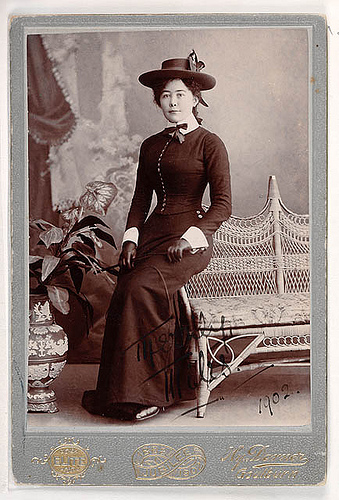
Miles Franklin, 1902, by H.Y. Dorner (Presumed Public Domain, from the State Library of New South Wales)

It might be just me, but it seems that women writers (I know the adjective should be female but it just doesn’t feel right in this context where “women writers” is short-hand for “women who are writers” or “writers who are women”) are somewhat thin on the ground in Australia at present, at least in terms of major visibility on the literary scene. There have been two, I think, significant flowerings of women’s writing in Australia in the last century. The first occurred in the first three to four decades of the twentieth century, and the second from the 1970s to 1990s.

My simplistic – read, not thoroughly researched but off the top of my head – explanation for these two bubbles is that they represent responses to the two major phases in the women’s movement of the last century – the suffrage movement of the late ninetheenth-early twentieth century, and the second wave of feminism which occurred in the 1960s-1970s. Certainly, in Australia, women writers were highly visible in the 1920s to 1940s, with writers such as Miles Franklin, Katharine Susannah Prichard, Marjorie Barnard, Eleanor Dark,  and Christina Stead. And again, in the 1970s to 1990s, we had Thea Astley, Elizabeth Jolley, Jessica Anderson, Kate Grenville, Helen Garner, to name a few. These women were all highly visible in literary circles and they managed to win some of the prizes going. In the last decade or so, though, women seem to have fallen behind again … though they are there, such as Eva Hornung who took out last year’s Prime Minister’s Literary Prize, Joan London, Gail Jones, and Amanda Lohrey to name a few. Grenville and Garner are still around. And yet, overall, these writers are just not highly visible. And visibility is the clue. I would hazard the “wild” guess that the first names off the tip of the tongue when people think current Australian literary writers would be Malouf, Winton, Carey, Miller, to name a few. Great writers all, but not, I think the only great writers we are producing.

I’m not the only one concerned. After deciding to write a post on this, I did a little research and there’s been quite a bit written recently on the issue. In fact, just earlier this month Angela Meyer of Literary Minded wrote a post titled Let’s read writing by women in which she reports on a new committee being set up:

to pursue equal rights for women writers in Australia. Besides research, lobbying and setting up mentorships, the committee is looking at establishing a literary prize for Australian women writers, along the lines of the UK’s Orange Prize. The steering committee (including novelist and publisher Sophie Cunningham, critic and former Miles Franklin judge Kerryn Goldsworthy and novelist Kirsten Tranter) feel the move is unfortunately, necessary, due to the unequal recognition of books by women in major literary award shortlists and in the book pages of the major newspapers in this country.

It’s unfortunate that this is needed … but I agree that it is needed. Gender shouldn’t matter. After all, what we like to read is good writing. But it’s hard, when you look at the facts (percentage of women published, shortlisted for awards, winning awards, being set for study) not to feel that there is some gender bias going on in the literary fiction world. I’m not going to second guess here how it happens, or what’s the chicken and what’s the egg, but I don’t like feeling that I may be missing out on good writing. Nor do I like to think that women writers are missing out on the opportunities their male peers are obtaining.

Do women only become “visible” – and achieve accordingly – when feminist movements flourish? Do you agree there is an issue regarding women writers on the literary scene (that is, not the genre scene) if you are Australian and, if you’re not, how do you see the situation in your country*? Do you agree that “affirmative” actions like gender-based awards are the way to go? Let’s get talking…

* Back in February, I reported on the VIDA Report on book writing and reviewing in the UK and the USA, so the “problem” is being noted elsewhere.

Helen Garner, Postcards from Surfers

Helen Garner is a fiercely honest writer – and a prolific one too. She has written novels, short stories, essays and non-fiction books. All are generally well-acclaimed, though not always without controversy (as I mentioned in my recent Monday musings). Certainly, I haven’t always agreed with her … but I do admire her honesty and the quality of her writing. The book I’m reviewing here, Postcards from surfers, is a collection of short stories and provides an excellent introduction to her writing and her (fictional, anyhow) concerns.

Helen Garner, Postcards from Surfers

The collection was first published in 1985, but it has been recently rereleased (2010) by Penguin in their Popular Penguins at a Perfect Price series. Penguin also did an edition in 2008. That says something, I think, about the standing of this collection.

Unlike the last short story collection I reviewed, Leah Swann’s Bearings, this one takes its name from one of the stories in the book, the first to be precise. There is nothing in my copy to indicate whether the stories were written for this collection or whether some or all had been published before. The Resident Judge in her review said that several of the stories had appeared elsewhere before being collected here. I’d like to know when and where: I’m one of those people who always reads that part of the front or end matter for short story collections.

Anyhow, on with the stories. There are 11 of them and while there is an overall theme – the theme that we expect of Garner, that is love and relationships, particularly from the point of view of failure and loss – they are surprisingly (and wonderfully) varied. They vary in length from the little 4-page “The dark, the light” to more hefty first one (the title story) that runs for over 20 pages. The point of view varies: six are told in first person, and five in third person. So does the voice, from a girl child to a male drunk in a bar, from a female friend to a rejected lover. And the style varies. This was its most surprising aspect for me. There is, for example, the seamless flow across place, time and ideas of the first story (which is the more typical Garner), the disjointed vignettes of “The life of art” chronicling a long standing friendship, and the nicely sustained drunken first person rave of “All those bloody young Catholics”.

The subject matter varies too. The title story is about an adult woman coming to visit her retired parents and aunt at Surfers Paradise, leaving a broken relationship and a not fully successful life behind her. I was ready for something more discontented in this story, but the sense we’re given is that she’s matured and has learnt to be content with (tolerant of, perhaps) her imperfect family:

If I speak they pretend to listen, just as I feign attention to their endless looping discourses: these are our courtesies: this is love. Everything is spoken, nothing is said.

(Doesn’t that have a lovely flow to it? Garner’s writing is delicious.) This being Garner, several stories are about broken or past relationships, but there are also stories dealing more generally with families and parenting (“Little Helen’s Sunday afternoon” and “A happy story”) and friendship (“The life of art”).

I once heard Garner in an interview express admiration for the way Elizabeth Jolley reused and retold stories. I felt (though my memory may be failing me here) that she admired Jolley’s risk-taking in doing this (would it irritate or bore readers?) as well as her ability to spin more out of a character or situation. It seems Garner decided that if Jolley could do it, so could she. There is a character, a previous lover, Philip, who appears twice in this collection. He sounds very much like the Philip in Cosmo cosmolino. He represents the lost true love and often appears in her work (under that name or others). Where he is, some pain is usually there too. Here are two excerpts from “Civilisation and its discontents”:

He [Philip] woke with a bright face. ‘I feel unblemished’, he said, ‘when I’ve been with you’. This is why I loved him, of course: because he talked like that, using words and phrases that most people wouldn’t think of saying.

and

I wanted to say to him, to someone, ‘Listen, listen, I am hopelessly in love’. But I hung on. I knew I had bought it on myself, and hung on until the spasm passed.

Helen Garner wears her emotions openly. She’s never afraid to hang out the dirty laundry, to show the darker, more unpleasant sides of human relationships – the selfishness, the jealousy, the unkindness, and of course the pain – but it is always underpinned by a willingness to understand and accept our humanity rather than condemn it. Garner’s world is very much the real world. It’s not hard, I think, to find something in it you recognise (whether you like it or not!)

Helen Garner
Postcards from Surfers
Camberwell: Penguin Books, 2010 (orig. 1985)
ISBN: 9780143204909
154pp.

POSTSCRIPT: I wrote and scheduled this a couple of weeks before my Monday musings post. When I came back to check it I was rather relieved to find that I had not contradicted myself.

Jay Griffiths, A love letter from a stray moon

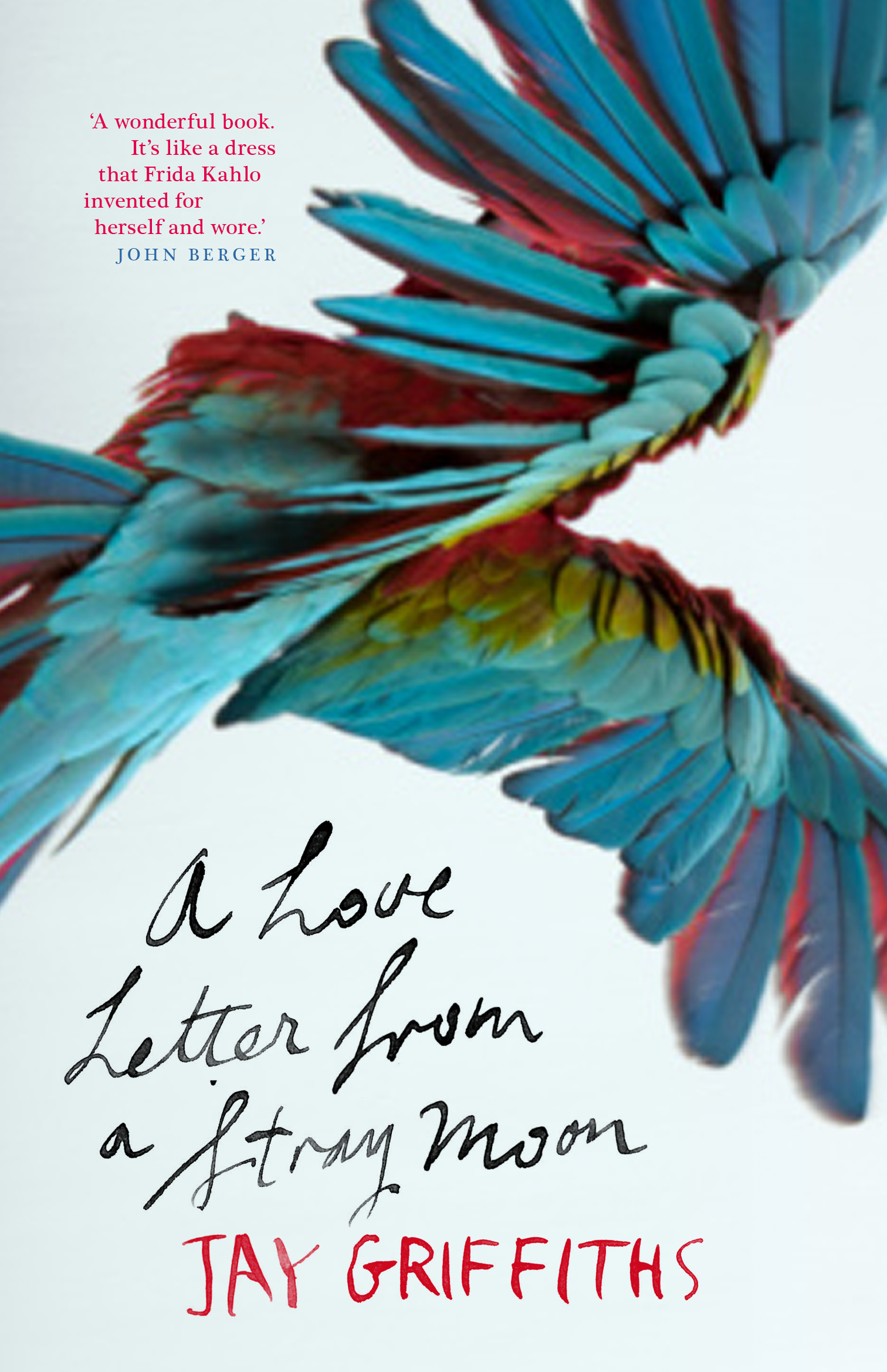
Jay Griffiths, A love letter from a stray moon cover

Book cover (Courtesy: Text Publishing)

I have always wanted wings. To fly where I belong, to become who I am, to speak my truths winged and moon-swayed.

I’m not sure I can do justice to this poetic, passionate novella by Jay Griffiths. Titled A love letter from a stray moon, it’s a first person outpouring in the voice of Mexican artist Frida Kahlo. I don’t use the term “outpouring” pejoratively, but rather to describe the full-on passion with which it is told. This is a book with confronts the senses with its power – the imagery is strong but beautiful, the story raw and honest (or so it seems to me.) It’s a book you want to describe as a “tour-de-force” but that would be too clichéd.

The opening lines of the novel quoted above introduce us to its two main metaphors – wings/flight and the moon. For Frida, flight equates with hope and with magic. The moon, though, is a far more complex image, and I’ll try to tease it out a bit as I go on. First though the story. This is biographical fiction (historical fiction?) in the form of a prose poem, told in the first person voice of Frida. The facts of Kahlo’s life are conveyed – such as the terrible accident when she was 18 which left her unable to bear children; her falling in love with, marriage to and divorce from Diego Rivera; her relationship with Trotsky; and even her death and cremation which requires some suspension of disbelief but that’s not hard to do given the novel’s style and tone. If you didn’t know much about Frida you could, I think, read this piece of fiction and feel you’ve got the basic facts, as well as a good understanding of the woman who “lived” those facts.

Woven through all this is the Mexican Revolution which started in 1910 (three years after she was born), discussions of the rise of Fascism, and her ideas on love, art and life (and particularly on how they interrelate). There are also, though this seems a bit anachronistic, some strong references to climate change. In fact, at the end of the novel, Griffiths dedicates her book to two groups of people, climate change activists and Zapatistas. Frida died in 1954. Was climate change an issue then? In the book Griffiths has Kahlo expressing concern about the Amazon and Tuvalu:

But the  Amazon will die of thirst, she will seize up with drought … One island nation, five atolls and four islands, pacific and named by doves, Tuvalu, is silently submerged as the quiet waters lap its shores, past the fishing boats, up its beaches, up, to the houses at the coastline, on, on, the gentle sea, the sea murmuring in quiet amazement at itself, on, until the centre where it can see itself coming, reflecting its rise, it meets itself in a full circle of embrace and Tuvalu will only be a story of mythic islands beneath the waves.

Let’s though get back to the moon. The motif is sustained throughout the novel. It’s appropriate of course for a woman, with its implications for women’s reproductive cycle, but Kahlo draws so much more from it than this single meaning. She layers meaning upon meaning for the moon, some of them superficially paradoxical but together they form a whole. Throughout the novel, for example, she opposes the ideas of gold, earth, sun and matter to silver, moon, and myth. The moon represents for her the mythical, the immaterial and creativity but it also connotes coldness and barrenness. I did say it was a complex symbol – but it’s fittingly s0 for a complex woman. In the first chapter, “Exiled from Casa Azul” she talks of wanting to fly to the moon, describing it as “pure idea” versus the sun which, more pragmatically, “lights the earth”. In the next (very short) chapter, “The moon’s instructions for loss”, she expands on her idea of the moon a little further:

And the moon? In the revolution of the earth’s turning – and I was a revolutionary – a shard of earth was flung off, coalescing, reforming further and later, far off as the moon. But shard is the wrong word, too hard and substantial; so immaterial was this moment, so unearthly the earth, so unanchored the moon, what word could be better? The moon was more like Idea, more like Metaphor, or Time, Flight, or Potential or Longing. A highly strung intensity of latency.

In the rest of the book, these ideas about the moon are explored, teased, stretched as far as they will go to convey the wild, free essence of her life. In her mind the moon is closely related to the idea of flight. She refers to Icarus (whose downfall of course was the sun), arguing that the important thing was not the fall but that he dared to fly.

In one of many references to flight she says:

… flight’s true reality was never in its being made material. What is real need not be material at all.

Given the challenges of her physical life (polio as a child and a leg amputation late in life in addition to her accident), it’s not surprising that Frida found significance in the life of the mind, the spirit and the soul.  “The mind needs myths, good ones”, she says.

And then there’s art. She was known for her self-portraits, in which she painted her passion and her pain. Her art was an extension of her “self”:

…so I make this as a votive painting, a prayer, a vow, a plea, painting to win him back to me…

Frida was a rebellious soul … whose passions were personal and political. Somehow Griffiths has managed to capture all this in a novel which could so easily have been over-the-top. It isn’t, because her Frida’s voice sounds authentic. Frida says, towards the end, ‘I would re-enchant myself with mankind, nothing less … I will promise to find the god of new beginnings.”

I have not done justice to this wonderful, complicated little book – but I hope I have conveyed something of its magic. After that, it’s up to you.

Jay Griffiths
A love letter from a stray moon
Melbourne: Text Publishing, 2011
117pp.

(Review copy supplied by Text Publishing)

Joyce Carol Oates, Beasts

Joyce Carol Oates @ The Belmont Library

Creative Commons licensed image by San Mateo County Library via Flickr

If we wanted to be writers we must examine the world with fresh, sceptical eyes.

Beasts is, I’m ashamed to say, my first Joyce Carol Oates. She’s one of those writers who has kept crossing my path but whom I’ve never quite got to read. I bought Beasts a couple of years ago when I saw it on the remainder table of my favourite independent bookshop – and still it took me some time to get to read it, but I’m glad I finally did. I didn’t really know what to expect – and I’m not quite sure what I got – but I nonetheless found it a compelling read that is staying with me.

Take the opening quote, for example. On the surface it makes perfect sense, and yet when we know who says it we see a whole different layer of meaning to it, a layer that doesn’t necessarily remove the fundamental truth but that certainly shows how such a truth can be twisted or, at least, complicated.

The plot concerns a young college student and her obsession with her poetry writing class teacher, Andre Harrow. The novel (novella, in fact) starts some 25 years after the main events of the novel, when our narrator is at the Louvre in Paris and sees a piece of sculpture that reminds her of the work of Harrow’s wife, Dorcas. The sculpture is an earthy totemic piece that is “primitively human” or, in fact, rather beast-like. In this short three page chapter we are introduced to the notion that something not quite right has happened. “It wasn’t burned after all”, the narrator says, and then soon after mentions the horrible deaths some quarter of a century earlier, of “two people I’d loved”. The final sentence of the chapter is:

This is not a confession. You will see, I have nothing to hide.

As soon as you see a statement like that you can be pretty sure you are in the hands of an unreliable narrator, and this is so here – though she’s cleverly disguised and could be taken to be reliable. It’s all a matter of perspective really! The novel is told first person, in flashback, so we do need to be aware that what she is saying may very well be coloured by her knowledge and experience, that what she says she was feeling at the time, may not be quite right. This adds to the complexity of the book. The structure, though, is pretty straightforward. There’s the first chapter in Paris in 2001, followed by a chapter, set in 1976, describing the night of the house fire (in which the two people died). The third chapter takes place four months before that. From this, the novel works chronologically forward again to the fire.

The novel has a smallish cast of characters – there’s the narrator (Gillian), Andre Harrow and Dorcas, and the girls of the poetry class. Gradually a complex picture is built up of surface friendships with secrecy and jealousy lying just beneath. The reason for this is that pretty well all the girls are obsessed with Andre and each it seems, in turn, have their way with him (or, should I say, vice versa). But here the plot thickens … though perhaps I’ll leave it there for you to discover for yourselves.

Let’s just say that this book is an unsettling exploration of the (sexual) games people play, games in which people can and do get badly hurt. It’s easy to see the young women as the victims – and I must say that to a large degree I think they are. Whenever there is a power imbalance (and this is why I disagree with Helen Garner‘s take in her non-fiction book, The first stone), I see the major wrong as being with those in power. However, that does not mean that the less powerful are not complicit in some way, because often they are, and this seems to be the case with Gillian. She says “I was not predator seeking prey, I was myself the prey. I was the innocent party”. But she has choices, and she makes them, knowing ….

I was in love now. I took strength from my love for Mr Harrow. Though knowing, for I was no fool, that it could never be reciprocated.

And yet, she of course, like the girls before her, lets herself be drawn into a situation that is both thrilling and destructive. Harrow is an aficionado of DH Lawrence – Lawrence was big on campuses in the 1970s as I recollect – and tells his students (with terrible irony) that:

Lawrence is the supreme poet of Eros. No recriminations, no reproaches, no guilt, no ‘morality’. For what’s ‘morality’ but a noose around the neck? A noose? What’s ‘morality’ but what other people want you to do, for their own selfish unstated purposes.

Hmm … this sounds a bit like the Nietzschean conundrum explored in The immoralist doesn’t it, but Oates plays it out in a very different way by exploring its implications across gender, age/experience and power differences to see what falls out.

The novel starts with an epigraph from a DH Lawrence poem:

I love you, rotten
Delicious rottenness

… wonderful are the hellish experiences

Wonderful for whom one may well ask? The ending – or is it the beginning – provides no definite answer but it sure teases out the complexity of “love” running rather amok amongst people who think little about the ramifications of their actions. Damage, as it usually does in such situations, ensues. What price morality, eh?

Joyce Carol Oates
Beasts
London: Orion, 2002
138pp.
ISBN: 0752855921