Dorothy Porter, On passion (Review)

Do you read “little” books? You know those small books that are carefully placed on bookstore sales counters where you are buying the book you really came for? I don’t often, but every now and then one catches my eye. Today’s review is of such a book from Melbourne University Press‘s Little books on big themes series. It’s by Dorothy Porter and is titled On passion. She finished it just before she died in December 2008. I think I could be justified in calling that poignant, don’t you?
Australian Women Writers Challenge 2012 Badge

Australian Women Writers Challenge (Design: Book’dout – Shelleyrae)

Dorothy Porter was (is, really) a well-regarded, successful Australian poet. I reviewed her last collection, The bee hut, a couple of years ago. It’s a wonderful collection full of the pains and joys of living. It is, you could say, a passionate book. One of the poems I quoted in that review is about the passion for writing, for finding the perfect way to express an idea:

and your pen slashes ahead
like a pain-hungry prince
hacking through
the bramble’s dragon teeth
to the heart’s most longed for
comatose, but ardently ready
princess.
(“Blackberries”)

So, writing, of course, was one of her passions but in this little essay Porter explores all sorts of meanings of the word (for her). She starts with her adolescent passions – her youthful religious faith which was replaced by her “dark gods, Janis Joplin, Jim Morrison and Jimi Hendrix” whose “daemonic songs” were her “new hymns”.

From here she explores the various ways passion has been part of her life … woven always with poetry, hers and others, and music:

Music has been my draught of intoxication since the very moment I first heard the Beatles in early 1964 […] I have been a Beatles pop/rock music maniac ever since, and have written virtually all my poems to rock riffs and rhythm – the catchier, the darker, the louder, the gutsier the better.

She talks in one section of Dionysus and moderation, strange bedfellows, eh? She argues that Euripides best understood the Dionysian, by exploring “how best to respect and live with it”. She admits, though, that “moderation was not something I embraced with Delphic calm, but something I gutlessly and gracelessly caved into” because, for example, she and drugs did not mix!

Nature too features, snakes in particular. “Real and living snakes are sacred to me” she says and then explores Minoan snake worship versus “the debased and diabolical serpent-demon of the Judaeo-Christian Garden of Eden”. She talks of the Rainbow Serpent in Australian Aboriginal Dreaming but admits that, when she actually confronts a King Brown snake in the desert, her worship did not stop her getting “the shock of my life”. She also refers to DH Lawrence‘s poem “Snake”, which I fell in love with in my teens. Lawrence describes the visit of the snake  as “a sacred event”. Porter says she always forgets the ending, how Lawrence’s fear gets the better of him so that he scares the snake away. She remembers only the vision of the wild thing being watched (and appreciated) by the poet.

There are other passions, but I’d like to conclude on the one dear to the heart of readers. She writes

I wonder if some of the most deeply passionate experiences of my life have happened between the covers of a book.

Not only do I love the idea that books have such an effect on us, but I also like her qualification: “some”, she says! Life is, after all, important too!

She describes Wuthering Heights as “the most scorching novel in the English language”; says that “there is, paradoxically, much more convincing grown up sex in Jane Austen than in Emily Brontë“. Oh, yes! She talks of Sappho’s love songs; admires one of my favourite poets, Gerard Manley Hopkins, for “pushing language as hard as it will go into ecstasy – and despair”; and describes Ginsberg as convincing her “of the power of language to shock”. She talks of love and desire, of wanting “to find and deliver scenarios, characters and poems that are magnetic with sexual energy” but asks, provocatively,

… how many readers have we lost because we have ignored the ancient silent cry: ravish me.

Near the end she wonders if reading had been the greatest passion of her life. She says – reminiscent of Francesca Rendle-Short and Michael Sala’s comments that writing/reading is dangerous – that

… at a more profound level I recognise that there is something very unsettling about a book.

Absolutely … but what say you about books, reading, passion?

Porter, Dorothy
On passion
Carlton: Melbourne University Press, 2010
(Series: Little books on big themes)
96pp.
ISBN: 9780522858358

Delicious Descriptions from Down Under: Francesca Rendle-Short on writing

In my recent review of Francesca Rendle-Short’s fiction-cum-memoir, Bite your tongue, I concluded on the suggestion that for Rendle-Short the act of writing, as well as of reading, “changes things”. Today I thought I’d share two excerpts from her novel that confirm this, one from her fictional persona of Glory, and the other from her writing as herself.

First, Glory:

Glory decides writing is a way of thinking: to think, to write, is dangerous. Transgressive. It is no small thing for Glory to tell this story in Glory’s way, to put into words things that until now have been left unspoken, to pin her heart to the page. Writing changes things, changes everything. It’s a risky business. (end Ch. 9)

And then, Francesca:

Looking at photographs is a bit like reading books; they invite acute feeling. You reveal yourself in the most intimate of moments. They elicit desire; illicit desire. Because in my family desire was illicit, like alcohol, like dancing. If you pay enough attention to small things, there is a chance for connection, a chance for transformation and transfiguration to occur. Writing grows skin, grows bones, a new heart. Just watch. D. H. Lawrence knew this. He attests that Lady Chatterley’s lover* was a beautiful book, that it was tender like a naked body. (end Ch. 25)

This is pretty raw stuff … and it tells us a bit about what sort of writer Rendle-Short is, about why she writes, about what literature means to her. It also, by-the-by, gives a good sense of her rhythmic, evocative style. I did like this book.

* Lady Chatterley’s lover was, of course, on her mother’s “burn a book a day” death list.

Bettye Rice Hughes, A Negro tourist in Dixie (Review)

"Colored" waiting room sign, Roma, Georgia, 1943

Colored Waiting Room sign, Roma, Ga, 1943 (Public Domain: Library of Congress, via Wikipedia)

I have plenty to read at the moment, but when I see a Library of America story come through that is set in the early days of the Civil Rights Movement in the American South, well, I can’t resist. I’ve never heard of  the author Bettye Rice Hughes, which turns out to be not surprising as the Library of America people don’t know much about her either. In fact, at the end of their brief, but always interesting, introductory notes they write “If any of our readers happens to have additional information about Bettye Rice Hughes, we’d love to hear from you at lists@loa.org.” So, if you do, please contact them!

Anyhow, the article. LOA starts with some background, describing the Freedom Rides which occurred in the American South in 1960-1961. Their aim was to test compliance with the September 1960 Interstate Commerce Commission‘s (ICC) rules prohibiting interstate carriers from using segregated bus terminals, and mandating that seating on buses be “without regard to race, color, creed, or national origin.” Despite this and an earlier Supreme Court decision prohibiting segregation in interstate bus terminals, several Freedom Ride buses had met with violence, two being firebombed. In the wake of all this, in 1962, Miss Hughes set out alone, on a bus

to see at first hand how many Southern states were complying with the ICC ruling; and I also wanted to see if a female Negro tourist traveling alone – unheralded and unprepared for – would receive a different reception from that which had greeted the Freedom Riders.

What a brave woman! She travelled through Arkansas, Tennessee, South Carolina, Florida, Alabama, Georgia and back home via Texas but, she writes

interstate passengers going from east to the west by Greyhound bus over the southern route never set foot on Mississippi soil.

In fact, the bus took a circuitous route to drive around Mississippi! I guess we ca guess why …

Without spoiling anything – after all this is an article not a piece of fiction – I can report that she returned home unscathed. But that’s not to say it was all smooth sailing. In most of the places she visited she found that the letter of the law was being followed. However, the segregated areas – waiting rooms, cafeterias and toilets – still existed and her black American co-travelers continued to use them. Hughes though always used the “main” facilities and while on occasions the staff tried to move her on to “the other restaurant where you belong”, she stood her ground and was (eventually) served. As her journey wore on, she felt she was being watched by her black travel companions:

The other Negro passengers, who went to the waiting rooms formerly designated as “Colored”, had started watching to see what I was going to do at rest and lunch stops. Several of them asked me, ‘Are you riding for us?’ I said that in a sense I was. But no one offered to go into the main waiting area with me.

She provides several anecdotes to describe her experience, and the article – less than 6 pages – is worth reading for these and for her reflections on them. While she made it through safely, she says, “the threat of violence was always there”. She concludes that “the advances that have been won through group action” now need to be “reinforced by individual action”. Southern white people need to “get used to seeing Negroes in waiting rooms, rest rooms, and cafeterias” and Southern Negroes also need “to get used to seeing other Negroes bypassing the segregated areas so that they may take courage and insist on the best facilities and services available for their money”.

All I can say, again, is, what a brave woman … and what a shame we don’t know more about her.

Bettye Rice Hughes
“A Negro tourist in Dixie”
First published in The Reporter, April 26, 1962
Available: Online at the Library of America 

Kyung-Sook Shin, Please look after mom (Review for the Shadow Man Asian Literary Prize 2011)

Shadow Man Asian Literary Prize 2011 Badge
Image by Matt Todd of A Novel Approach

Am I right in thinking that mothers are more often the subject of novels and memoirs than fathers? Or, is it just that I’m a woman and am subconsciously (or even consciously, if I’m honest) drawn to the topic? Of course, with the Shadow Man Asian Literary Prize reviewing project I didn’t really have a choice. Kyung-Sook Shin’s Please look after mom (or, mother in the British edition) has now been shortlisted for the prize. So, here I am again, reading about a mother!

And I liked it – for a number of reasons. But, before I explain that, a quick overview of the plot. The book commences with the line “It’s been one week since Mom went missing”. We learn pretty quickly that the mother and father had been in Seoul to visit some of their children and had become separated when trying to board the subway together, with the mother being left behind. The rest of the book chronicles the family’s search for the mother and, as they search, their reflections on her life and their relationship with her.

So, what did I find fascinating? Firstly, of course, is the fact that it is set in South Korea. I haven’t been there, and I don’t think I’ve read any Korean literature before, so I was predisposed to be interested before I started it. I wasn’t disappointed. The novel is contemporary but spans a few decades, decades in which many of the current parental generation were still living fairly traditional rural lives while their children were being educated and moving to the city to chase “bigger” dreams. Through flashback reflections of the various characters we learn about this time of transition, and the challenges both generations faced in coping with the change. We learn of the mother’s determination that her children be educated, the lengths she went to to obtain the money to pay for this education, and her disappointment when one daughter trained to be a pharmacist but then married and had three children in pretty quick succession. It’s a story that’s been repeated around the world over the last century or two, and the usual universals are there – the economic challenges and all those big and little conflicts that attend social change – but each situation has its particularity. In this book it’s in how this specific family functions – the mother’s determination springing from her own lack of education, the self-centred father’s unreliability resulting in increased poverty for the family, the sibling relationships characterised by a mix of mutual responsibility, love and exasperation.

The next thing of interest is the form. Readers here know I like books which play around with form and voice, and this is one of those books. The story is told in five parts, using four points of view and three different voices. Got that? To make it easy, I’ll list how it goes:

  • “Nobody knows”, told by the elder daughter (but second eldest child), Chi-hon, in second person
  • “I’m sorry, Hyong-chol”, told by the eldest child, son Hyong-chol, in third person
  • “I’m home”, told by the father/husband, in second person
  • “Another woman”, told by the mother, Park So-nyo, in first person
  • “Epilogue: Rosewood rosary”, told by Chi-hon (again), in second person.

As is common in multiple point-of-view novels, the main narrative, the story of the search, progresses more or less chronologically through these parts, with each part also incorporating some back-and-forth flashbacks in which we learn about that person’s relationship with “mom”. This multiple point-of-view technique provides a lovely immediacy to the different perspectives. The choice of different voices – first, second and third – though, is an intriguing one. Here is how I see it. First person for “mom” makes sense since she is the subject. Second person feels like a half-way house between the intimate first person and the more distant third person. Using it for Chi-hon and her father, to speak about themselves, subtly conveys a tension between their responsibility for “mom” (which would be expected of their roles as elder daughter and husband) and their regret and guilt for their failings. Third person, on the other hand, seems appropriate for Hyong-chol who, as the oldest in the family, carries the major weight of familial responsibility into the future. It’s the most distant voice and gives, I think, a layer of gravitas to his role.

And last is the theme – or, should I say, themes? The lesser, if I can call them that, themes include the country-vs-city one, particularly in relation to values; literacy and education; and our mutual responsibility for others (something, the family discovers, “mom” took seriously for friends and strangers as well as her family throughout her life). The overriding theme, though, is that of guilt and regret, of having taken “mom” for granted. They all assumed she liked cooking and being in the kitchen, day in day out. The children forgot to call her regularly and didn’t always come home for special occasions. Her husband remembers all the times he failed to help her, while she would put herself out repeatedly for him. It’s a pretty common story but the way Kyung-sook Shin tells it – the form, the reflective tone, the characterisation, the setting – makes this universal story about respect, a very personal one. I admit to being a little choked up at the end!

I have one little query though, and that relates to the invocation of Catholicism in the end. “Mom” does, early in the novel, ask about a rosewood rosary, thus providing a link to the Epilogue, but where did this interest in the rosary come from, given the frequent references to the more traditional ancestral rites during the book? Mom doesn’t explain it – “I just want prayer rosary beads from that country”, “the smallest country in the world”, she says. I assume it has something to do with the recent growth of Catholicism in South Korea. It didn’t spoil the book for me, but it provided a somewhat odd note. All I can say is read the book for yourself, and see what you think.

Please click on my Man Asian Literary Prize page link for reviews by other members of the team.

Kyung-Sook Shin
Please look after mom
(trans. by Chi-Young Kim)
New York: Alfred A. Knopf, 2011
237pp.
ISBN: 9780307593917

Monday musings on Australian literature: Australia’s first Children’s Laureates

Australian Children's Laureate logo

Logo Courtesy: Australian Children's Laureate

It has been so busy here at Monday Musings that I am late with this announcement … but that doesn’t mean it’s not worth making! On December 6th, 2011, the idea of an Australian Children’s Laureate was inaugurated with the appointment of not one, but two, children’s authors to the role. They are

Alison Lester and Boori Monty Pryor

and they will be our laureates for two years, 2012-2013. I understand that the idea of a Children’s Laureate was instigated in the United Kingdom in 1999. In 2008, the Library of Congress inaugurated a similar role, but called theirs National Ambassador for Young People’s Literature. What’s in a name, eh? The main point is that these initiatives promote reading among children. The Australian program is organised by the Australian Children’s Literature Alliance and on their Laureate website they describe the laureate’s role as follows:

The Children’s Laureate will be an Australian author and/or illustrator of children’s and/or youth literature who is making a significant contribution to the children’s literature canon of this country. The Laureate will be appointed on a biennial basis and will promote the transformational power of reading, creativity and story in the lives of young Australians, while acting as a national and international ambassador for Australian children’s literature.

So, a little about Australia’s inaugural laureates …

Alison Lester (b. 1952)

I became aware of writer-illustrator Lester through my own children when, like most parents who are readers, I sought out good books to read aloud to them. Lester is an author/illustrator best known for her picture books, though she has also written a couple of young adult novels. My favourites were two of her picture books, Imagine (1988) and Rosie sips spiders (1989), and the “chapter” book (as new readers like to call them) Thingnapped, written by Robin Klein and illustrated by Lester. She has a lovely sense of fun while also conveying important values to children (such as respecting difference, a critical value at a time when rejecting other seems to be on the rise again.)

Boori Monty Pryor (b. 1950)

I did not know of Boori Monty Pryor – writer, artist, performer, storyteller – when my children were growing up. In fact, I only heard of him a couple of years ago when a friend lent me his memoir Maybe tomorrow which I reviewed in the early days of this blog. I came across him again last year when he was on the Prime Minister’s Literary Awards panel I attended. He impressed me – in both “meetings” – with his strength, his humour, and his ability and willingness to overcome his anger at the way his people have been treated. He’s an indigenous Australian, and he’s committed to forging good relationships among all Australians while at the same time shoring up traditional culture and values among indigenous people. No easy task, but his appointment to the laureate role is testament to his achievements.

To conclude, I must note that our inaugural laureates are a woman and an indigenous Australian. I’m sure there are many worthy white male contenders out there, but I believe that Lester and Pryor were not token appointments. They are worthy recipients who have proven track records in the quality and significance of their contributions to encouraging reading, story-telling and self-expression among Australian children.

Francesca Rendle-Short, Bite your tongue (Review)

Francesa Rendle-Short book cover Bite your tongue

Bite your tongue Bookcover (Courtesy: Spinifex Press)

How much do you think about the first sentence of your review? Like me, you probably try to find some anchor or point of interest to lead off from, but my problem with novelist-journalist Francesca Rendle-Short‘s fiction-cum-memoir, Bite your tongue, is that I have too many angles to choose from. Which one do I use? Do I go with the unusual form of this fiction-cum-memoir? Do I talk about my old friend synchronicity and how one of my first reviews in 2011 was a (semi)autobiographical novel about an Australian childhood, Barbara Hanrahan‘s The scent of eucalyptus? Or, do I talk about how I’m sure Spinifex Press had no idea how close to my heart this book would be when they offered it for review – how I (more or less) share a late 1950s/early 60s Brisbane childhood with Rendle-Short and how the very word “spinifex” is nostalgic for me due to my mid-1960s years in the mining town of Mount Isa? There, I’ve covered them all … so now I can get on with the review!

This is a mother-daughter story. How many of those have you read? I’ve certainly read a few in the last decade or so, including straight memoirs (such as Jill Ker Conway‘s The road from Coorain) and thinly veiled fictional pieces (such as Kate JenningsSnake). These books can be challenging for daughters to write, particularly when there is significant pain involved. Rendle-Short’s solution is to (mostly) tell from a “fictional” standpoint. She creates names for the family, including MotherJoy for the mother, Glory for herself, Gracie for her nearest and youngest sister, and Onward for her father. The last-name she devises for this family is Solider, which is an anagram of “soldier”. With the father being Onward, and the family being devoutly Christian, the hymn “Onward Christian Soldiers” must surely have inspired her naming. Rendle-Short writes, in the introduction, about how she chose to tell the story:

Some stories are hard to tell, they bite back. To write this one, I’ve had to come at it obliquely, give myself over to the writing with my face half-turned; give my story to someone else to tell. My chosen hero is a girl named Glory …

Australian Literature Month Platypus logo

Reading Matters’ Australian Literature Month

Why is this story so hard to tell? Well, Glory’s (Rendle-Short’s) mother was “a morals crusader, an ‘anti-smut’ campaigner. An activist. She was on a mission from God to save the children of Queensland” (from the Prologue). This mission involved banning “lewd” and “pornographic” books (of which 100 are listed at the back of the book in “Dr Joy’s Death List: Burn a Book a Day”). Clearly Rendle-Short (aka Glory), the fifth of six children (all girls in the book, five girls and a boy in reality), had a painful childhood. It’s not that she and her siblings weren’t loved – they clearly were – but it was a hard love, a love based too much on a narrow Christian ideology and too little, it seems, on the needs of children. One of the most painful scenes in the book is when Glory visits her mother in hospital after heart surgery and wants to kiss her but can’t bring herself to do so! Can’t kiss her old mother! That shows more than words ever could the pain in this relationship.

The book pretty well covers the story from Glory’s birth to MotherJoy’s death in her 80s, though it focuses primarily on Glory’s school years. There are 100 chapters in less than 250 pages. Most of these chapters are told third person, from Glory’s point of view. What makes this book particularly interesting form-wise, though, is that 14 chapters are written in first person, memoir-style. That is, Francesca speaks of herself and her mother, Angel, using their real names. In these scattered first person chapters, Francesca writes on her research, on how she pieced together her mother’s story through, for example, research at the National Library of Australia and the National Archives of Australia. She also occasionally comments on where the “fact” diverges from the “fiction” such as:

Unlike Glory, I wasn’t in Brisbane when my mother died, I was at home in Canberra where I was living at the time – because there was a scene. There was always a scene with Angel, especially where her children were concerned, the ‘jewels in her crown’, and on her deathbed it was no different. All six children had been at her bedside while she was dying …

And then, without describing exactly what happened, she tells us that, despite all of them having made the effort to get there, including from overseas, “seven days before she took her last breath, all six of us walked out on her. We had to do it …”.

Australian Women Writers Challenge 2012 Badge

Australian Women Writers Challenge (Design: Book’dout – Shelleyrae)

Now, if you are a reader who likes closure, who wants to know exactly what happened, you are not going to get it in this book, not specifically anyhow, but you will, if you read the clues, know what life was like in that family, at least what it was like for Glory/Francesca. You will know that she loved her mother, and wanted her mother’s approval, but that she had other attitudes and other feelings that were clearly not in accord with her mother’s. We are given enough “scenes” involving her mother (directly or indirectly) to tell us all we need to know. A particularly excruciating example is when Glory is cruelly bullied by her school “peers” (one can’t say  “mates” in the context) because of her mother’s views. (Where her father, an academic in pediatrics and a creationist, stood in all this is unclear. He’s there in the book, but we see little active parenting from him.)

Oh dear, I have so much to say on this book that I could easily turn this post into an essay, so I will finish here. I thoroughly enjoyed this book … on multiple levels. The writing is good, comprising many of the things that appeal to me – wordplay, lovely rhythm, effective imagery (such as the “tongue” motif). The story is easy to follow, despite changes in voice and chronology (as we flip backwards and forwards from childhood to MotherJoy/Angel’s old age). There are universals about love and forgiveness (real and wished for) between parents and children. And, there is love for books (in all their glory!):

Books show us how to love, really love body to body between the pages. Love perhaps where we’ve never loved before. That’s what Glory hopes.

Reading changes things …

… as, I suspect for Rendle-Short, does writing!

Francesa Rendle-Short
Bite your tongue
North Melbourne: Spinifex Press, 2011
246pp.
ISBN: 9781876756963

(Review copy supplied by Spinifex Press.)

Review to count towards the Australian Women Writers 2012 Reading and Reviewing Challenge.

Monday musings on Australian literature: Guest post from Kim of Reading Matters

This week’s Monday musings brings you my fourth guest post, this time from Kim of Reading Matters. Like Guy, Kim started commenting on my blog in its infancy and I soon discovered that this blogger from England was actually an Australian. Naturally we developed a rapport. I have appreciated Kim’s support of my blog – through regular commenting  (particularly in my fledgling days) and through inviting me to be a Triple Choice Tuesday guest. She is one of England’s top litbloggers and this month is hosting an Australian literature month as I advised in last week’s Monday Musings.

I’m thrilled that Kim decided to write on children’s literature. Her guest post on children’s classics beautifully complements Louise’s recent post on current writers/illustrators.

Australian classic books from an Australian childhood

When you are an Australian expat who’s lived overseas for as long as I have (13 years and counting…) it’s easy to think you’ve never lived anywhere else. Then you have little “cultural blips” that rudely remind you that you grew up on the other side of the world.

For me, these “blips” usually occur when friends and colleagues start reminiscing about sweets (or should that be lollies?) from their childhood that are no longer available, or British TV shows they watched when they were growing up which were never screened in Australia. Once I had to sit in on a lengthy discussion about children’s literature where many of the references went completely over my head.

This got me thinking about my favourite books from childhood, all by Australian authors, which do not appear to have ever attracted an international audience. Here are three classics, none of which have been out of print in Australia, that mean a lot to me:

Blinky Bill by Dorothy Wall

Dorothy Wall (1894-1942), a New Zealand-born Australian, originally illustrated books for other writers before creating her own series about a mischievous male koala called Blinky Bill. The first book — Blinky Bill: The Quaint Little Australian— was published in 1933 and two others followed — Blinky Bill Grows Up (1934) and Blinky Bill and Nutsy (1937).

My aunt had three books in one beautifully bound volume. I still remember the distinctive red cover and the cheeky little picture of Blinky Bill, wearing bright orange trousers, toting a swag and billy can on a stick slung over his shoulder. It was always a real treat when I was allowed to take the book down from the shelf and look at the colour-plates inside. I remember turning the pages with awe and being very careful not to mark the book in any way.

Funnily enough I can’t really remember what the stories were about, but I remember the pictures with almost perfect clarity, they were so vivid and funny.

I’m delighted to say that you can read the text online at Project Gutenberg Australia

The Muddle-Headed Wombat by Ruth Park

The muddle-headed wombat by Ruth Park, book cover

Ruth Park (1917-2010), yet another New Zealand born author who called Australia home, also turned to Australian wildlife for inspiration.

Her main character was a wombat — a creature with which many non-Australians may not be familiar, think of a very cute furry pig with a cheeky face and short stumpy legs — whom was very muddle-headed.  He spoke in spoonerisms and misused similar sounding words — for instance “sensibubble” instead of “sensible” — which meant he often said very funny things without realizing it.

Wombat, as he was officially known, had two friends — a skinny grey cat called Tabby and a practical female mouse called Mouse — whom accompanied him on all kinds of adventures.

I can only recall vague details of particular stories — there were more than 16 in the series, all written between 1962 and 1971 to accompany an ABC radio show, which was cancelled by the time I was born. For instance, in one story Wombat bought a bicycle with shiny red wheels and in another he ate some chalk that made him sick.

But it was the quite hilarious illustrations that I remember most — along with the cute red jacket and floppy purple hat Wombat used to wear!

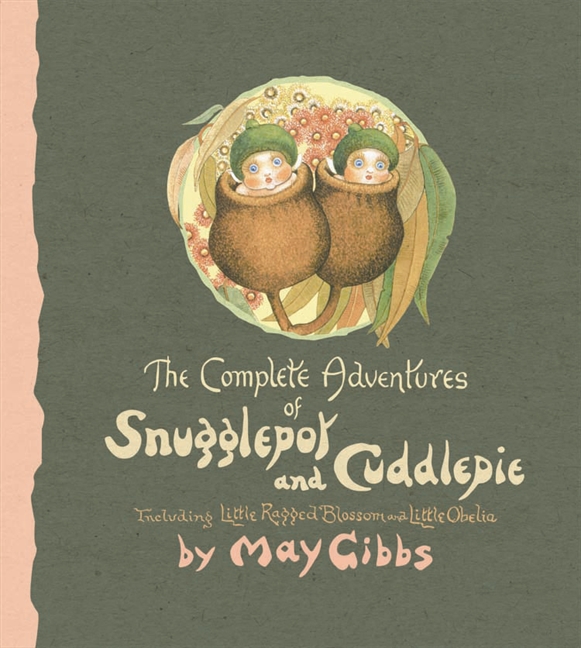
The Adventures of Snugglepot and Cuddlepie by May Gibbs

May Gibbs' Snugglepot and Cuddlepie

May Gibbs (1877-1969) was an English-born Australian writer and illustrator whose stories were inspired by Australian native flora.

She’s probably best known for her gumnut babies, Snugglepot and Cuddlepie, who are cute little foster brothers that resemble eucalyptus nuts.

The pair go on an adventure in the Australian bush, but they have to take care not to run into the big bad Banksia men — horrible creatures modeled on banksia cones, which are a bit like hairy pinecones.

As a child I remember being physically scared of the Banksia men, but as ever in the world of children’s literature, good overcomes evil and they sink to the bottom of the sea!

The best part about Snugglepot and Cuddlepie, which was first published in 1918, are the truly beautiful illustrations by the author. To this day these illustrations are used on all kinds of merchandise, but what I hadn’t realized until I started writing this piece is that all profits go to UNICEF, the Spastic Centre of NSW and the NSW Society for Crippled Children (now the Northcott Society), according to the wishes of May Gibbs’ bequest.

May Gibbs home Nutcote, on the shores of Sydney Harbour, is also open to the public.

I suspect that all three books, with their emphasis on Australia’s unique plants and animals, may be responsible, not only for my love of Australian literature, but my love and respect of the Australian bush, too.

Monday musings on Australian literature: Some Australian Literature online events for 2012

What better way to kick off Monday Musings in 2012 than by heralding some exciting Australian Literature initiatives from around the ‘net. Here they are, in no particular order:

Australian Women Writers Challenge 2012 Badge

Badge (Design: Book'dout - Shelleyrae)

Australian Women Writers Challenge 2012 by Elizabeth Lhuede. Her aim is to promote women writers across all fields and genres of writing. The challenge involves signing up to read books – in any genre – by Australian women writers. You can focus on one genre or many, you can choose a level that suits you. I don’t usually do challenges, but this one is a no-brainer for me since I always try to read a goodly quantity of Australian literature each year and I love to read books by women. Last year I reviewed at least 14 Australian women writers and, in addition, wrote several posts on specific women writers and women’s literature issues. My aim will be to achieve a Franklin-fantastic Dabbler, that is, I’ll read (and review) at least 10 books by Australian women writers in more than one genre.

Australian Literature badge, by Reading Matters

One of the Australian Literature Month badges (by Reading Matters)

Australian Literature Month by Kim of Reading Matters. She plans to read lots of Australian books during her cold northern January (she would leave Australia!) and encourages readers of her blog, to do the same. As an incentive she has created several gorgeous badges for bloggers to attach to their posts reviewing Aussie books. Since seeing a platypus in the wild is on my bucket list, I have chosen her platypus badge for this post.

Australian National Year of Reading 2012 by WeLove2Read. This project is “a collaborative project joining public libraries, government, community groups, media and commercial partners, and of course the public. As well as creating specific new campaigns for the National Year of Reading, we’ll be using our joint efforts to bring together and showcase the wonderful projects and organisations across Australia which already exist to promote reading and literacy”.  (From the website) Keep an eye on the website for activities and events as they occur during the year.

2012 Aussie Author Challenge by Booklover Book Reviews. The challenge is to “read and review books written by Australian Authors – physical books, ebooks and audiobooks, fiction and non-fiction” (from the blog). There are two challenge levels and, like most challenges, a badge to add to your site. (I added this challenge after the post was published, as the result of Tony‘s recommendation. Thanks Tony.)

And so …

As you start your 2012 reading, do consider including some Aussie Lit into the mix and please let the people above know when you do. They will appreciate knowing that their work has hit some paydirt.

If there are other initiatives that I haven’t listed here, please let me know in the comments below and I will update this list.

Ana Menéndez, Celebrations of Thanksgiving: Cuban offerings

I love food and I enjoy reading about food. I particularly enjoy reading about food – and food traditions – from other cultures. And so, when Ana Menéndez’s story popped up on the Library of America last month I made a note to read it. The last piece of food writing that I read from LOA, John Duncan’s “A Virginia barbecue”, was also an example of travel writing. This piece, though, could also be described as immigrant literature: in it Menéndez describes her Cuban family’s Thanksgiving celebrations and how it changes over time as they become more American.

Menéndez commences by describing her how Cuban family celebrated Thanksgiving – what they called Tansgibin – with black beans and rice, fried plantains and yucca. They didn’t know, she said, that they were being “ethnic” or trendy” in eating this food! It’s all about perspectives, eh? She then describes how, as their stay in America lengthened, they went about transforming the meal. For Cubans that meant making pig (or roast pork) the central feature, rather than turkey.

The pig is marinated in mojo” which she describes as

the most important part of the equation and families lived and died by their mojo recipes. Today you can buy a strange chemical syrup in bottles labeled “mojo” – of which the best one can say about it is that it’s another sad example of the banality of exile.

To digress a little, this reminded me of my recent trip to Japan. Our host at a ryokan we stayed at told us that, traditionally, each family would have its own Miso Soup recipe but that now people tend to buy the instant variety in the supermarkets. He, however, wasn’t talking about “the banality of exile” but of the impact of commercialisation (and modernisation). It’s not only immigration, then, that sees cultural practices decline. Anyhow, on with the story …

The whole business, she writes – the preparing of the “mojo”, the digging of the pit and the preparation of the grill for the pig, the men tending to the meat with the women preparing the rest of the meal – was a ritual, and, more importantly, “a happy, bantering gathering”. In fact, she describes herself as

one of the few women of my generation who does not consider the kitchen a chore or an affront to my independence, but rather a place of warmth and sustenance.

I take her point – to a point! But that’s another story.

Menéndez then describes how, little by little, change occurred. Someone brings a pumpkin pie (breaching the wall, she says), then comes the cranberry sauce, and a stuffing … and the final blow, the pig is replaced by the turkey. Not only are there concerns that the pig might be unhealthy but it starts to seem like “an embarrassing extravagance, a desperate and futile grasping after the old days”. Our author admits to liking the change. As the younger member of the family, she had become annoyed by

my family’s narrow culinary tastes – which to me signaled a more generalised lack of curiosity about the wider world.

Fascinating how food (and attitudes to it), as she says a little earlier in the article, prefigures change. And yet, change doesn’t come easily. Her family didn’t know how to cook turkey so, what did they do? Well, they cooked it like they cooked their pig. And then they would bestow their best compliment on the cook: “This tastes just like roast pork”!

I enjoyed the article … it provides much food (sorry!) for thought. Even in my own Christmas celebrations I love to find a balance between maintaining family traditions – so that the meal feels like Christmas and not just another festive event – and injecting some change (or difference) each year so that the tradition doesn’t become stale. How much tricker though this challenge is for immigrant cultures. What do you keep? What do you let go? And why?

At the end of the article is her recipe for Mojo … so if you’d like your turkey next year to taste like pork (or, at least, Cuban), you can look it up (in the link below).

In addition to writing pieces like this, Menéndez has written two novels, Loving Che (2004) and The last war (2009). Before them, she published a short story collection, In Cuba I was a German Shepherd, which was a 2001 New York Times Notable Book of the Year.  LOA’s notes tell us that her overall theme, as in this story, is the experience of exile. I wonder if any readers here – Americans particularly – have read her? I’d love to know what you think.

Ana Menéndez
“Celebrations of Thanksgiving: Cuban offerings”
First published: US Society & Values, 9 (4), July 2004
Available: Online at the Library of America

Meanjin’s Tournament of Books 2011, Finale

… and now we have a winner! Those of you who have been following the tournament will know that the two books facing off in the Finale were Helen Garner‘s The children’s Bach and Joan London‘s Gilgamesh. I would not have guessed this at the beginning (and neither, they say, did the organisers). Not because these aren’t great books – I’ve read them both – but because they are not the ones on the top of people’s tongues (like, say, My brilliant career) or the ones with critical weight behind them (like, say, The man who loved children or The fortunes of Richard Mahony). That said, I’m surprised but not sorry, because it’s no bad thing to expose other works to wider attention. The question is, will they get it?

Anyhow, onto the finale. It was judged a little differently: there was a panel of 5, with each giving a brief reason for his/her vote. You can read their reasons on the Meanjin site, because here I’m simply going to announce that the winner.  And it is, drum roll please, with 3 votes to 2,  Zombie Round returnee, Helen Garner’s The children’s Bach.  I’m happy – after all it’s one of the few from the original list that I’ve reviewed on this this blog. It was a reread too, which tells you something: Garner is a great writer.

The real question, though, is what happens next? Has the Tournament achieved anything for Australian literature, and Australian women’s writing in particular? Is it worth doing again next year? Well, I’m not sure. Leaving off the question concerning the merits of judging books, and looking at it from a consciousness-raising point of view, which were, I believe, its main goals, did Meanjin‘s Tournament achieve what it set out to. I fear it didn’t … and that I suspect is due less to the tournament itself than to lack of promotion of it. I didn’t see or hear much buzz about it around the traps – in neither the formal print and electronic media nor in less formal places like blogs.

Appropriately, the following quote from The children’s Bach has some application here:

Like many women of her age whose opinions, when they were freshly thought and expressed, had never received the attention they deserved, Mrs Fox had slid away into a habit of monologue, a stream of mild words which concealed the bulk of thought and knowledge as babbling water hides submerged boulders.

I fear that, like Mrs Fox’s wisdom, the submerged boulders of good Australian literature have stayed submerged … what must (can) we do to expose them?