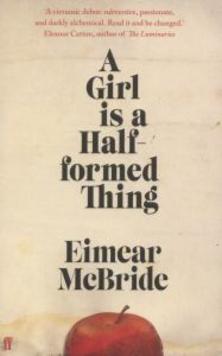
Eimear McBride, A girl is a half-formed thing (Review)

Eimear McBride, A girl is a half-formed thingI try very hard when writing reviews to avoid clichés and superlatives, like, say, “achingly beautiful” or “masterful”. But I think I’m going to use one for Eimear McBride’s multi-award-winning debut novel A girl is a half-formed thing when I describe it as “searing”. I can’t think of a more apposite word. Yet I fear it too has been over-used to the point of meaninglessness. So, let’s try something else …

Once again I’m coming late to the read, and once again this is partly because it was scheduled by my reading group. All I can say is, wow. I’m not sure I’d go so far as Eleanor Catton’s “read it and be changed” commendation on the front of my edition, but I do agree with her  “virtuosic” and “subversive”. It’s a gut-wrenching read.

The plot itself is simple enough. It’s the story of a family – a pious one-could-say-religiously-fanatical mother, a son who survived a serious brain tumour as a toddler, and the younger daughter. The tumour leaves the son somewhat brain-damaged and, of course, it returns. This tumour, the trauma of it, shapes their behaviour and defines their relationships. The story, which spans around 20 years, is told through the daughter and could, in one sense, be seen as coming-of-age. But. This. Tells. You. Nothing. Because …

This is not your typical first-person voice. Instead, we are in the head of the unnamed “girl”. We are there in her conscious unconsciousness (or, is it her semi-consciousness?) in which we hear what she’s experiencing in language that is – here’s another cliché – raw. By this I mean that the language is stripped of the mediation of a formalising narrator’s intellect. Instead it captures the immediate emotional truth of the girl’s experience as she grapples to make sense of her world. This is a book in which the style conveys the meaning as much as the words do.

How does McBride do this you are probably wondering (unless, of course, you’ve already read the book). Well, mostly by breaking, consistently, the rules of grammar and syntax. We are in the girl’s head, a place where, I believe McBride is saying, we rarely think in coherently formed sentences but in what I would call “impressions”. Take, for example, this description, on the first page, of the brother before his diagnosis:

I know. The thing wrong. It’s a. It is called. Nosebleeds, headaches. Where you can’t hold. Fall mugs and dinner plates she says clear up. Ah young he says give the child a break. Fall off swings. Can’t or. Grip well. Slipping in the muck. Bang your. Poor head wrapped up white and the blood come through. She feel the sick of that. Little boy head. Shush.

To orient you, “she” is Mammy, “he” is the father who disappears two pages later, and “you” are the little boy, the girl’s brother. Most of the novel is addressed to him (that is “you”). One of the challenges of reading this book, and it is a challenge to read, is its pronouns. Once you’ve got a handle on them, and once you realise that they are all from the perspective of the girl, you are half way there.

Anyhow, there is easier syntax than the above when life is relatively calm but, when our “girl” is distressed such as when the truth of her brother’s situation can no longer be avoided, it collapses almost completely:

I walk the street. City. Running through my mouth. Running in my teeth the. My eyes are. All the things. The said the done what there what’s all this? That stuff. I could do. My. I walk the street. Who’s him there having a look at me he. Look at my. Tits. Ssss. Fuck word. No don’t. Fuck that. No. Will. Not that. Not. That. But. If I want to then I can do.

This is not the most extreme example – I don’t want to spoil too much – but it should demonstrate what I mean by the language mirroring/enacting/even being her state of mind.

In addition to the idiosyncratic syntax, McBride draws on wide range of literary techniques to keep us focused on, grounded in the emotions of the here and now. The imagery is visceral, returning again and again to  “muck”, “dirt”, “blood”, and “puke”. She alters her rhythms to match the tone, not only through the syntax as evident in the examples above, but through allusions to and repetitions of prayers and hymns, lines from children’s games, literary works and sayings. She makes up new words (“I trup trup off behind her”), mangles existing words (“swoll” for “swollen”), and twists common expressions (“There’s a foul there’s a wind where’s the air”). McBride was inspired by Joyce she says, but her fresh, fearless, urgent language reminded me too at times of Gerard Manley Hopkins.

The novel is clearly set in Ireland and there are odd references to 1980s technology like Game Boys, but overall place and time are unspecified, and none of the characters are named. All this keeps the focus squarely on the emotional core of a family in pain, and the girl in particular. She is abused by her uncle at the age of thirteen and begins a strange love-hate, violent-tender, but sick, relationship with him. Sex becomes for her a weapon, a tool and a punishment. But the book is not about this, that is, it’s not yet another book about abuse. It is about the girl’s inability to handle her emotional pain, and her family’s inability to see her need, it’s about growing up unsupported. She is complicit in her own degradation because for her physical pain is better than the emotional. Like those who self-harm, she seeks out abuse again and again because

… what’s wrong here is me me me. Me the thing but I. Think I know. Is that the reason for what’s happened? Me? The thing. Wrong.

I know this all sounds unremittingly bleak and it largely is, but there are light touches – blackly comic scenes, surprising word plays, and chuckle-inducing descriptions (like her mother’s friends, “they polyester tight-packed womanhood aflower in pink and blue”).

A girl is a half-formed thing is hard to read style-wise and painful to read content-wise. But it is a book that, if you let it, reaches deep into your core and makes you understand the lives of others in a way that only the best literature can. I’m so very glad I read it.

John at Musings of a Literary Dilettante also liked it.

Eimear McBride
A girl is a half-formed thing
London: Faber and Faber, 2014
203pp.
ISBN: 9780571317165
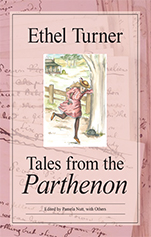
Ethel Turner, Tales from the “Parthenon” (Review)

Ethel Turner, Tales from the Parthenon

Courtesy: Juvenilia Press

Hands up if you’re an Aussie and didn’t read Ethel Turner’s Seven little Australians in your childhood. Surely no hands have gone up? Seven little Australians, her first novel, was published in 1894 when she was 24, and was an instant hit, eventually becoming a classic. According to Wikipedia, it was, in 1994 (and may still be), “the only book by an Australian author to have been continuously in print for 100 years”. It seemed only right then that I should choose Ethel Turner‘s Tales from the “Parthenon” for my third foray into the bundle of juvenilia books I bought back in April from Juvenilia Press.

Like Juvenilia Press’ other publications that I’ve read to date, Tales from the “Parthenon” contains a wealth of supporting material besides the actual juvenilia, including an in-depth introduction, notes on the text, endnotes and footnotes, an appendix, and a list of references.

Ethel Turner (1870-1958) and Mary Grant Bruce (1878 – 1958), whose juvenilia was the first I wrote on, were contemporaries, and, according to the Introduction, “dominated the market for children’s fiction in Australia”. However, while Bruce focused on the bush, and the national character as exemplified by bush living, Turner, whose career started earlier, had, says the Introduction, “already moved away from that tradition and firmly established her fiction in suburban Sydney”. The Introduction also tells us a little about Turner’s early writing career, at school and then immediately post-school. At school she and her sister, Lilian, established a magazine Iris when the school’s newspaper, Gazette, which was edited by another Australian writer-in-training, Louise Mack, rejected Ethel’s contributions!

Turner left school in 1888, and in 1889 she and her sister established another magazine, the Parthenon, which ran from 1 January 1889 to 4 April 1892. An impressive effort methinks for two young women. As you will have now gathered from the title of this volume, it is from this magazine that Pamela Nutt and her team have chosen works to represent Turner’s youthful writing.

While the focus on urban/suburban life and settings is one point of interest in Turner’s writing, another is her awareness of gender issues (though she wouldn’t of course have used such language). This is made clear in the Parthenon’s first issue in which they identified their goals. They wrote that their great grandmothers had learnt to write and spell, and their grandmothers had added “French, the harp and pianoforte, and the use of globes”, but

now the desire for knowledge in rapidly growing: deeper and deeper, woman goes into the mazy labyrinth, untrodden before by any but men’s footsteps,—culling the flowers of knowledge,—yes, and enjoying them, and appreciating them even as much as men do.

Ethel Turner was active during the first wave of feminism in the late 19th to early 20th centuries. While this early wave didn’t reject women’s domestic role and function, it did argue for women’s rights and recognition of intellectual equality. Turner fits within this paradigm. The Introduction suggests that her novel Miss Bobbie, of which an earlier serialised version appeared in Parthenon, promotes “vigour and independence” in young women but situates this within a world still framed by “patriarchal expectations”.

The Introduction mentions a third way in which Turner contributes to Australia’s literary tradition: incorporating Australian elements into traditional English fantasy. The pieces in this volume have been well-chosen to reflect all these aspects of her writing. They are all children’s pieces – “Gladys and the fairies” (in 2 chapters), “A dreadful pickle” (in 3 chapters), both published in 1889, and chapter 3 of “Bobbie” from 1890. And all feature spirited if not naughty girls. Jane Gleeson-White, in her Australian classics: 50 great writers and their celebrated works, quotes Turner’s opening to Seven little Australians:

Before you fairly start this story, I should give you just a word of warning. If you think you are going to read of model children, with perhaps a naughtily inclined one to point a moral, you had better lay down the book immediately … Not one of the seven is really good, for the very excellent reason that Australian children never are.

Gleeson-White’s point is that Turner may have been called Australia’s Louisa May Alcott, but her children are very different. And these juvenilia pieces show her moving down that path. Gladys is “dreadfully spoilt” and behaves tyrannically. However, time in Shadowland and Fairyland, forces her to rethink her ways, though not before she collapses in a typical Victorian faint! It is here we find English fairies in a new environment. Turner’s fairy queen rides in a chariot comprising “part of an emu’s egg, wondrously carved” with elfs* following, “dressed in yellow and riding locusts”.

Midge, the protagonist of “A dreadful pickle”, is also spoilt, and, like Gladys, treats her governess badly. However, she has a kind heart along with her independent spirit, and “wants to help poor people like those in London”. The story takes a Dickensian turn when Midge finds herself out of her depth and alone with some of these poor people. There’s some fun wordplay in this story – and I was intrigued by the note on the word “pallor” telling us that Turner used the American spelling that was popular in Australia at the time. The things you learn!

Then there’s Bobbie. We only have one chapter of her story. Bobbie, like Gladys and Midge, is in a household of boys, but in her case she’s been left there by her father who is travelling in Europe with his new wife. From the little excerpt we have, she seems to be a more developed character than Gladys and Midge, that is, less the typical spoilt child, but she too gets in a pickle when her perverse behaviour brings on teasing from one of the boys, with disastrous results. The notes on this story point out that Turner and Mary Grant Bruce “created strong female characters who challenged the Victorian stereotype of the submissive female”.

So, once again, I’ve enjoyed reading a well-known writer’s juvenilia, not just for evidence of the writer to come, but also for the insight provided into Turner’s times and the role her work plays in the development of Australian literature. These may be stories for children, written by girls, but the value of material like this for students of literature shouldn’t be underestimated.

My previous Juvenilia Press posts are on Mary Grant Bruce and Eleanor Dark.

awwchallenge2014Ethel Turner
(ed. Pamela Nutt, with students from Year 11, the Presbyterian Ladies College Sydney)
Tales from the “Parthenon”
Sydney: Juvenilia Press, 2014
62pp.
ISBN: 9780733433740

* Turner’s plural form, not mine!

Jill Sanguinetti, School days of a Methodist lady: A journey through girlhood (Review)

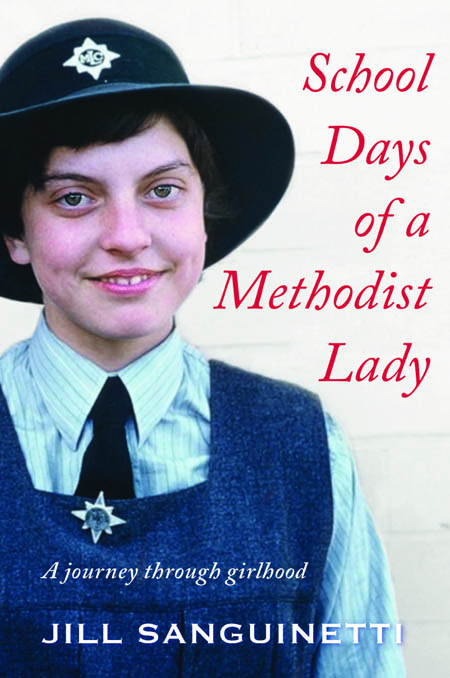
Jill Sanguinetti, School days of a Methodist ladyWhen I read a memoir, particularly one by an unknown person like Jill Sanguinetti’s School days of a Methodist lady, my first question is why was this memoir written? Sally Morgan’s My place, for example, explores how she discovered her indigenous origins and why her family had kept this hidden, while Frank McCourt’s Angela’s ashes chronicles the extreme poverty of his childhood. Not surprisingly, many memoirs, like these two, examine the writer’s childhood – that formative time in our lives – and Jill Sanguinetti’s is no exception.

So, why did Sanguinetti write her memoir? In her opening letter to the reader she says she’s written it for the MLC community, for young people “struggling to grow through life’s complexities”, and for herself to air “a dark and musty corner of my soul”. This breadth is a bit of a shame because it means the memoir doesn’t have a core purpose that propels it along like, say, Morgan’s and McCourt’s. Nonetheless, I did enjoy the book, mainly because of its subject, Sanguinetti’s school days. The main focus is her four years as a boarder at Melbourne’s prestigious MLC (Methodist Ladies College), but it starts with her childhood in the small country town of Kyabram in northern Victoria.

Now, I wasn’t a boarder and I didn’t attend a prestigious private school, but I am a baby-boomer, as is Sanguinetti. This means that, although I went to government schools in two Queensland towns and then Sydney, and although I’m a later baby-boomer, we shared a similar world, and I enjoyed wandering down memory lane with her. I remember the freer childhood of a 1960s country town, and singing hymns with my sister after church. I remember the Billy Graham Crusades (though unlike Sanguinetti, I didn’t attend one). Elvis was well established by the time I was a teen, so my rock ‘n roll memories are of the Beatles, Credence Clearwater Revival and the Stones, but our ways of enjoying them through our radios was similar. And I remember the formality of schools in those post-war decades. Sanguinetti tells all this with a simple, straightforward clarity.

What helped keep my interest, too, was the memoir’s structure. While it is roughly chronological, starting with the family’s move to Kyabram in 1951 when she was 6, and ending with her leaving MLC in 1961, most of the chapters in between are thematic allowing her to explore these aspects of her life in more depth. And so there’s a chapter on church (“My family at church”), and one on friendships (“The gift of girlfriends”), a chapter on school discipline (“Discipline and resistance”), and another on boys (“The embarrassing problem of boys”). And so on. I particularly enjoyed her chapter on four inspirational teachers (“Matriculation: Four Great Teachers”). Don’t we all have them? This departing from a formal chronological structure, yet still moving the time on, enables the book to function as a meaningful social history of the time within the broader narrative.

I started my post with “my first question”, but I do have others about memoir-writing, a major one being how writers manage to remember so much. My memory of my childhood is woeful, patchy at best. I appreciate that when you get down to it memories come, but still … Well, Sanguinetti covers this issue both directly and indirectly in her book – within the main text and in her Acknowledgements. Her own memory is of course critical, but she was lucky that her parents kept the letters she (and her sister) wrote home while at boarding school. How useful for a childhood memoir, methinks, to have gone to boarding school! There is a trap in this, though, because your memory can be swayed by what you wrote in your letters. Indeed, Sanguinetti quotes, from one of her letters, an experience from her schooldays, and then writes:

I have no recollection of the dormitory prayer circle and doubt that it lasted long.

What significance, then, should we grant this experience in her memoir? How often, I wonder, does this happen in memoirs without our knowing? The significance depends a bit on the intention of the memoir. If it is intended to be a social history of a place or time, or a nostalgia piece, then it’s probably just as significant as events more clearly remembered, but if the memoir’s focus is the experiences that formed the writer, does something not remembered carry equal weight as one consciously remembered? (Hmm … let’s not answer that lest we become mired in psychological theory!) I should add here that Sanguinetti had other sources  – written and oral – for her work. Some are mentioned in her Acknowledgements, and others in her useful, well worth reading, Chapter Notes.

Now, let’s return to my original question: why did Sanguinetti write this memoir? Throughout the book she hints at or foreshadows something darker, and we gradually realise it is depression of some sort. Around the middle of the book (“Angst”), she says that “I believe today that it was the sustained stress that harmed me in the long term, rather than separation from home or the privations of boarding”.  This chapter ends with:

I was up and down like a yo-yo, revelling in the buzz and stimulation of school life one moment, and languishing in anxiety, regulation and grey ordinariness the next. I knew that other girls whose marks were not brilliant did not tackle their work with the same intensity as I did, nor did they get in a muddle, or be all up and down as I was. And why was I blighted with ever-stiffening fingers and crazy handwriting. What was it about me?

While she suggests misery, and mentions that her sister “too, started to show signs of depression”, she doesn’t develop this or make us “feel” her pain, which makes it easy for us to dismiss it as “typical” adolescent ups and downs. However, from a reference, in the post-school concluding chapters, to a breakdown, it was clearly more than that. For her, she says, the memoir “would free myself from that particular set of ghosts” left from her MLC experience, but for us it is a well-written, analytical, and yes, interesting story about Australian school and society in the 1950s to early 1960s.

Thinking about all this, I was reminded of Carolyn Heilbrun’s Writing a woman’s life in which she worries that in autobiographies “nostalgia, particularly for childhood, is likely to be a mask for anger”. This is not a nostalgia piece, though – it’s too real in her evocation of boarding-school hunger, cold and lack of freedom to be that – but it does feel as though she throttled back. Indeed, she says as much through her choice of epigraph:

Perhaps the only point about autobiography is to remember a world which, by the time of writing, has changed so much as almost to vanish, and to record the succession of changes … How to look back, not in anger, but in reflection, is a problem I had to solve. For the small, enclosed world I began in had its concealments and anguishes as well as joys. (Judith Wright)

Sanguinetti, I realise, headed me off at the pass, before she began. She’s done what she intended – and done it well. Still, a little anger mightn’t have gone astray.

awwchallenge2014Jill Sanguinetti
School days of a Methodist lady: A journey through girlhood
Melbourne: Wild Dingo Press, 2014
239pp.
ISBN: 9780980757095

(Review copy courtesy Wild Dingo Press)

Monday musings on Australian literature: Guest post by Dorothy Johnston, writer and Barbara Jefferis Award judge

Literary awards, their role and import, have come under frequent discussion here at Whispering Gums. So, when writer Dorothy Johnston, whose The house at number 10 and Eight pieces on prostitution I’ve reviewed and, more relevantly, who was one of the judges for this year’s Barbara Jefferis Award, suggested a guest post on the Award, I was more than happy to take her up on it.

I have never met Dorothy but I have “known” her for a long time as she was one of Canberra’s famous Seven Writers who published the anthology Canberra Tales in 1988. I became “reacquainted” with her more recently via blogging and her appearance in The invisible thread anthology edited by Irma Gold for Canberra’s centenary last year. It’s been a lovely rediscovery. Dorothy has published nine novels – literary fiction, and crime-mystery novels, mainly. Two of her novels – One for the master and Ruth – have been shortlisted for the Miles Franklin Award. Dorothy blogs at her website Dorothy Johnston.

For those who haven’t heard, this year’s Barbara Jefferis Award was shared by Margo Lanagan’s Sea hearts and Fiona McFarlane’s The night guest. Here is Dorothy’s story about her experience as a judge.

***

The idea of splitting the Barbara Jefferis Award between The Night Guest and Sea Hearts did not come up before the three judges (myself, Margaret Barbalet and Georgia Blain) met at the Australian Society of Authors (ASA) in Sydney, at the end of September.

LanaganSeaHeartsI enjoyed working through the 72 entries, making notes, keeping in mind the selection criteria, (a work of literary merit that showed women and girls in a positive light), starring the books I knew I would want to go back to. I had no idea whether my favourites would find favour with Margaret and Georgia.

After about 6 weeks, we exchanged our long lists. One novel was common to all three of us – Fiona McFarlane’s The Night Guest, a brilliant study of a woman who believes there is a tiger in her house. Others on my long list didn’t show up on those of the other two judges, but both had included Margo Lanagan’s Sea Hearts. I went back and re-read it more carefully, and was, as the saying goes, blown away.

These two entries stayed at the top from then on, while we emailed back and forth. Part of the reason for having 72 entries is that the award covered 2 years – 2013 and 2014 – and included self-published titles. By far the greatest number of entries came from the big publishers – Penguin, Allen & Unwin, Random House – though, as it turned out, 4 of the 7 shortlisted book were published by small, or small to medium presses.

We didn’t have to make a firm decision on our shortlist before the meeting; but once in Sydney we only had a morning to finalise it, then choose a winner, and then we had to spend the afternoon writing our report.

I’d had to give up some of the books on my long list because they didn’t find favour with Margaret or Georgia, and the same went for them. One I regretted letting go was Elemental by Amanda Curtin, a terrific story of a young girl growing up in a Scottish fishing village, and what happens to her subsequently. On the other hand, All The Birds Singing, by Evie Wyld, which the others both included, and which, as readers will know, won the Miles Franklin, I thought was over-rated.

McFarlaneNightGuestIf I had to make one general remark about the books that made it onto the shortlist, I would say that each one is utterly itself. What do I mean by this? I mean that, a few pages in, I recognised the voice as original, distinct, perfect for the narrative; they fitted hand and glove. So often I found that an author began promisingly, but then could not sustain the voice. Or, right from the beginning, the author pandered to one contemporary fashion or another. When you’re reading your way through 2 years of entries, you quickly learn that following the fashion is a bad idea.

There’s no whiff of conformity amongst the shortlist. Amy Espeseth’s Sufficient Grace focuses on two young women and their difficult lives in an isolated religious community. The Life and Loves of Lena Gaunt, by Tracy Farr, introduced me to an extraordinary musician and her instrument, the theremin.

Pilgrimage, by Jacinta Halloran, is about two sisters, one of them a doctor, and what happens when their mother is diagnosed with motor neurone disease.

Margo Lanagan’s Sea Hearts takes ancient selkie legends as its starting point and moves in a wholly original direction. Fiona McFarlane’s The Night Guest is another novel that borders the surreal in an original and quite wonderful way. The First Week, by Margaret Merrilees, is, by contrast, a realist tale that cuts to the bone.

The Mountain by Drusilla Modjeska, an ambitious and far-reaching story of Papua New Guinea in the years since independence.

We also highly commended Laura Buzo’s Holier Than Thou.

But back to that meeting at the ASA. We already knew each other’s preferences. We’d picked the same top two and could not choose between them. There didn’t seem a hair’s breadth, or knife point to tip the balance. We called in Lucy Stevens, who was overseeing the judging process. Lucy sat at one end of the table balancing the two books in her hands while we reached the decision to award the prize to both.

The presentation was held in the renovated foyer of St Barnabas Church, Broadway, a lovely light-filled space. It was a beautiful Sydney spring evening. There was music and champagne. I realized – not that I hadn’t known it before, but it came to me suddenly – that we were here to celebrate books and their authors. Angelo Loukakis, Executive Director of the ASA, welcomed us. David Day, who is Chair of ASA’s Board of Directors, spoke about Barbara Jefferis and the bequest. Tara Moss spoke about women and the arts. I looked around me. Everyone in the room cared about, and many worked hard to foster and promote, Australian literature. When I stepped up to the podium, to give my judges’ speech, I had a big smile on my face.

***

Thanks a bunch Dorothy for giving us your insider’s perspective on awards judging. I can see it wasn’t an easy job and love that you’ve shared your thoughts with us.

Dorothy (I’m sure) and I would love to hear your thoughts – on awards, on judging, on these particular books, or on anything else her post has inspired you to think about.

Clare Wright, The forgotten rebels of Eureka (Review)

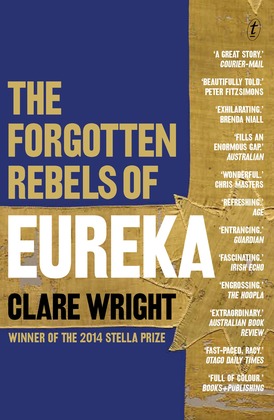
Book cover, The forgotten rebels of Eureka

Courtesy: Text Publishing

Wah! Once again I delayed reading a much heralded book until my reading group did it*, and so it is only now that I’ve read Clare Wright’s Stella Prize winning history, The forgotten rebels of Eureka. The trouble with coming late to a high-profile book is how to review it freshly. All I can do, really, is what I usually do, and that is write about an aspect or two that particularly interested me. Since other bloggers have already beautifully covered one of these, the history**, I’m going to focus on Wright’s writing and the approach she took to telling her story. I won’t be doing this from the angle of historical theory, as I’m not an historian, but in terms of her intention, and her tone, style, and structure.

If you’re not Australian, you may not have heard of the Eureka Stockade. It was a significant event in colonial Australia’s march to democracy and independence, involving the British army and police attacking a stockade created by miners whose grievances included the payment of a compulsory miner’s licence and the fact that this licence, which they saw as a form of taxation, did not give them the right to vote in the legislature. It has traditionally been framed in masculine terms, but Wright discovered, somewhat by accident while researching another project (as historians do!), a new angle – the role of women in the rebellion. There were, she found, over 5,000 women on the goldfields:

Women were there. They mined for gold and much else of economic value besides. They paid taxes. They fought for their rights. And they were killed in the crossfire of a nascent new order.

Consequently, in her book, Wright draws on extensive primary and secondary sources to explore and expose the lives of these women and the until-now-unheralded role that she believes they played in the goldfields, particularly in the lead up to and aftermath of that fateful day of 3 December 1854.

Wright opens the book with three epigraphs, one of which is particularly illuminating in terms of my subject. It’s by Australian historian Geoffrey Blainey and states that “every history of every country is a mirror of the author’s own interests and therefore selective rather than comprehensive”. Having been interested in historical writing since studying EH Carr’s What is history at university, I like the admission that histories are inherently subjective, regardless of how well researched they are. The historian makes decisions about what s/he will research, what the limits of that research will be, and how s/he will interpret that research. It’s common sense. How can it be otherwise? And so, in this history, Wright’s specific interest in the role of women means that all her research – even research into men’s activities – is viewed through that prism. There’s another implication, too, regarding selectivity: with her focus being specifically the women, we cannot read this book as a comprehensive history of the Eureka Stockade. It complements, or expands, or even jousts with other works.

None of this is meant negatively. I thoroughly enjoyed the read. My point is simply that it’s important, as it always is, to be aware of what we are reading – and I like the fact that Wright recognises this. So, what we have here is, to the best of my knowledge, a thorough but selective history. The text is extensively referenced, with 25 pages of meaningful endnotes and nearly 20 pages of bibliography, and there is a useful index. These are things I look for in a good nonfiction work. The book is logically structured, by theme and chronology, and its (creatively titled) chapters are divided into three main parts: Transitions, Transformations and Transgressions. You can sense a writer’s touch in the alliteration here.

And it’s the writer’s touch I want to turn to now, because Wright has achieved that difficult mix – a well-researched but readable history. It has been written, I’m sure, with an eye on a general, but educated audience. The language is often breezy and even jokey (perhaps a little too much) at times, and yet is replete with classical, Shakespearean, biblical and other literary allusions. She uses metaphor, such as “the cornered lizard bared its frills” to describe the hoisting of the famous Australian flag in the days before the attack. Her descriptions are evocative, and often visceral. You feel you are there in the crowded “tent city” that was Ballarat:

The arrival of the extra troops meant squashing more stinky little fish into an already overpacked tin … From the outside, it seemed like the tightrope was about to snap.

Her stories of the childbirth experiences of Sarah Skinner and Katherine Hancock are devastating to read.

Indeed, I would place this book in the narrative non-fiction tradition. It has a strong narrative drive, with a large cast of characters, some of whom stay with us, some of whom pass through. They include Ellen Young whose poems and letters in the Ballarat Times articulate the mining community’s distress and sense of injustice; hotel-keeper Catherine Bentley who, with her husband, earns the ire of the diggers by consorting with government officials; theatre-owner and actor Sarah Hanmer who donated more to the rebels’ cause than anyone else; and newspaper publisher Clara Seekamp who takes the helm when her husband is arrested for sedition. These women provide significant evidence for Wright’s thesis that women played more than a helpmeet role in the intellectual and political life of Ballarat.

In addition to “developing” these characters, Wright uses other narrative techniques, such as:

  • plot cliff-hangers (much like a screenwriter, which she also is, would do) and pointed aphorisms at the end of chapters
  • foreshadowing to suggest causation: “Even female licence holders expected a modicum of representation for their taxation—as dramatic events would later demonstrate”
  • repetition of ideas and motifs to propel her themes. Take, for example, the Southern Cross. It functions as “a hitching post for existential certainty when all else was in mortal flux” during immigrants’ sea journey from the northern hemisphere to the south (Ch. 3, “Crossing the line”) and is later picked up as a symbol for the rebels’ flag “as the one thing that united each and every resident of Ballarat” (Ch. 11, “Crossing the line (Reprise)”).

As an historian, Wright is confident and fearless, expressing clear opinions, either as direct statements, or indirectly through her choice of language. She calls the Bentleys’ murder trial, for example, a “morality play”. She asks questions; she offers close analysis of her sources, such as noting that the use of the word “demand”, rather than “request” or “humbly pray”, conveys the diggers’ frustration with authority; and she makes considered deductions by testing textual evidence against her understanding of the times and the work of other historians. She discusses discrepancies in reportage, such as the different witness reports of the fire at the Bentleys’ hotel. But she also, as other bloggers and my own reading group have commented, draws a long bow when she suggests the full moon and menstrual synchrony may have been a factor in so many men leaving the stockade on the night of the attack. She provides some evidence for this synchrony as a phenomenon, and offers other reasons for the desertion, but it feels a little out of left field.

At times her nod to the popular and her push for dramatic effect jars, but Wright’s argument that women played an active role at the diggings and in the stockade is convincing. I’m not surprised she won the Stella Prize, because this is engaging reading that is underpinned by extensive scholarship and clear thinking. It’s exciting to see a work that doesn’t just explore the role of women in history but that puts them right in the action.

awwchallenge2014Clare Wright
The forgotten rebels of Eureka
Melbourne: Text Publishing, 2013
539pp.
ISBN: 9781922182548

* I bet you can hardly wait until next month now!
** Do check out historian bloggers, the Resident Judge and Stumbling Through the Past, and litblogger Lisa of ANZLitLovers.

Jane Austen, Lady Susan (Review)

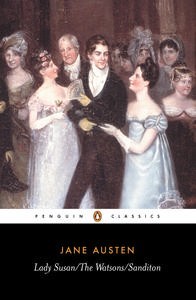
AustenLadySusanPenguinIt is a truth universally acknowledged – I know this is a tired old joke but I seem programmed to do it – that Jane Austen fans will collect multiple editions of her works. There are many reasons for this behaviour, but one of them is our interest in different introductions. And so, although I already had a copy of Lady Susan, in the Minor works volume of R.W. Chapman’s The Oxford Illustrated Jane Austen, I bought the Penguin edition for my Kindle because it had an introduction by Margaret Drabble. And I have a second confession to make: this is a rereading, but my reason for rereading has little to do with the reasons I gave in my recent post on Flanagan. The reason is simple – my local Jane Austen group decided to schedule it for our October meeting. I was happy with that. As far as I’m concerned all bets are off my usual “rules” when it comes to Jane Austen.

If you’re not an Austen fan, you may not have heard of Lady Susan. It is a complete novella that sits between her Juvenilia and her adult novels. It was written, we believe, in 1793/4 when Austen would have been 18-19 years old, but was not published until 1871, well after her death, when her nephew James Edward Austen-Leigh included it in his memoir of her.  It is epistolary in form, something she tried again with Elinor and Marianne. While this latter one she rewrote in her well-known third person omniscient voice, retitling it Sense and sensibility, for some reason she didn’t go back to Lady Susan. One reason might have been its subject matter.

 “the most accomplished coquette in England” (Reginald of Lady Susan)

Lady Susan is a beautiful, 35-year-old widow of four months, who is already on the prowl for a new, wealthy husband. The novel opens with her needing to leave Langford, where she’d been staying with the Manwarings, because she was having an affair with the married man of the house, and had seduced his sister’s suitor, Sir James Martin. She goes to stay with her brother-in-law Charles Vernon and his wife Catherine, whom she’d done her best to dissuade him from marrying. She’s not long there before Reginald, Catherine’s brother, arrives to check her out because, from what he’s heard,

Lady Susan possesses a degree of captivating deceit which must be pleasing to witness and detect.

Of course, the inevitable happens and the artful Lady Susan captivates him. Meanwhile, Lady Susan wants her 16-year-old daughter, Frederica, to marry Sir James, the man she’d seduced away from Miss Manwaring – but sweet, sensible Frederica wants none of this weak “rattle” of a man.

You’ve probably worked out by now that this is not Austen’s usual fare. Lady Susan belongs to the 18th century tradition of wickedness, lasciviousness and adultery, forced marriages, and moralistic resolutions. The novel’s characters tend to be types rather than complex beings, and it is racily written, with a broad brush rather than a fine pen. And yet …

“Lady Susan is not wholly a villain” (Margaret Drabble)

This is also where Austen’s mature touch starts to appear. For all Lady Susan’s self-centred “bewitching” machinations, she is also, as Drabble says, “witty, energetic, intelligent and charming”. Drabble and other critics argue that Lady Susan’s spirit can be seen in characters like Elizabeth Bennet, Emma Woodhouse and, particularly, Mary Crawford who, like Lady Susan, comes from London where she moved in “fast” circles. How could a teenaged country parson’s daughter imagine into being such a duplicitous character? Austen was, we know, a great reader and read the gothic novels of her day. She also knew the behaviour of Mrs Craven, the mother of her neighbour Mrs Lloyd. According to Drabble, Mrs Craven “had treated her daughters shockingly, locking them up, beating them and starving them, until they ran away from home …” just as Lady Susan’s daughter ran away from school. And, as her letters demonstrate, Austen was capable of bite.

We don’t know why Austen didn’t pursue this book, besides making a good copy of it in 1805, or why she didn’t try again to write about a beautiful 35-year-old widow.

Hints of what’s to come

All this is well and good, and I loved the read, but my main reason for reading these early Austens is their insight into the writer to come – her wit and irony, and her commentary on human nature. Lady Susan, having been written on the cusp of her maturity, is particularly interesting in this context. The melodrama, for example, is toned down, compared with the books Austen would have been reading. Frederica isn’t locked up as she might have been in Walpole’s Castle of Otranto (my review), there are no rapes as we see in Richardson’s Clarissa. Austen is moving, in other words, towards the naturalism of her favourite topic, “3 or 4 families in a Country Village”.

I love Austen’s irony, and there’s plenty in evidence here. A good example is when Reginald, completely convinced by Lady Susan, writes to his father of how she has been misrepresented, saying that this

may also convince us how little the general report of any one ought to be credited … I blame myself severely for having so easily believed the scandalous tales invented.

The joke is on him because, of course, he should believe these “scandalous tales”. One of the complexities of the novel is this issue of gossip – who should believe what and whom? As Austen readers know, gossip plays a significant role in her characterisation and plots.

Other ideas and themes that we see in later novels also appear in Lady Susan. Bad mothering is one. Another, more specific, is this delightful comment on accomplishments, reminding us of the discussion between Mr Darcy, Miss Bingley and Elizabeth at Netherfield. Lady Susan writes to her equally scheming friend Alicia Johnson:

Not that I am an advocate for the prevailing fashion of acquiring a perfect knowledge in all the languages arts and sciences; it is throwing time away; to be mistress of French, Italian, German, music, singing, drawing etc., will gain a woman some applause, but will not add one lover to her list.

And then there’s that main reason I love Austen – her terse, pithy commentary on human behaviour. There’s much in Lady Susan, including

but where there is a disposition to dislike a motive will never be wanting

and

Silly woman, to expect constancy from so charming a man!

Have I convinced you to give it a go? I do hope so.

Jane Austen
“Lady Susan”
in Lady Susan, The Watsons, Sanditon
London: Penguin Books, 2003
Kindle Edition EISBN: 9780141907901

Available in e-text.

Kate Forsyth, Stories as salvation (Review)

One of the best things about being involved in the Australian Women Writers’ Challenge is hearing of writers whom I may not otherwise have come across, or, if I had, who may not have registered strongly with me. One such writer who regularly pops up in the challenge is novelist Kate Forsyth. The reviews that keep coming in for her books, particularly for The Wild girl and Bitter greens, have intrigued me, but I haven’t yet found an opportunity to read these novels. I did, however, find time to read the short memoir, “Stories as salvation”, Forsyth wrote for the Griffith Review some months ago now.

Forsyth’s story is both common and unusual. It’s common because it is a tale of a young girl who turned to books and stories as solace during a childhood characterised by much ill-health and many hospital stays. How many memoirs have we read that tell this story?

Stories. My only source of sunshine, my only solace. I would read all day and as late into the night as the nurses would let me … Stories were escape. Stories were magic.

But, it is unusual too, because, like most such stories, hers has its unique elements. Her health problems started when she was two years old with a vicious attack by a family dog which, among other things, destroyed one of her tear ducts. She barely survived that attack, and then suffered multiple serious infections requiring hospitalisation, due mostly to this tear duct problem. She subsequently became, she said, at the age of eleven, “the first Australian to have a successful implantation of an artificial tear duct”. She includes in this memoir her poem “Scars” which was first published in Quadrant in 1994 and which evokes the visible and invisible scars of her experience, their power and her power over them.

What I found most interesting in this essay-length memoir was her clear articulation of how her childhood reading had informed the writer she is today. I am always interested in how writers end up writing what they write, and what their intention is (regardless of whether their intention is what I might take away from their writing.) For Forsyth, her introduction to Grimms’ Fairy Tales when she was seven came “to haunt [her] imagination”. She was particularly attracted to Rapunzel who

too was locked away from the world against her will. She too was lonely and afraid. Her tears healed the eyes of the blinded prince, as I so desperately longed to be healed. The uncanny parallels between Rapunzel and my life seemed to have some potent meaning.

And so, later, she started writing. Her first novels, commencing with The Witches of Eileanan in 1997, were firmly in the fantasy genre. In them, she says, “the themes of imprisonment and escape, wounding and redemption, appear again and again”. However, it seems Rapunzel stayed in her mind. She started researching the origins of the story, and realised that she did not want to write it as “an otherworld fantasy”:

I wanted to capture the charge of terror and despair that young girl must have felt. I wanted to remind readers that women have been locked up for centuries against their will in this world.

Our world.

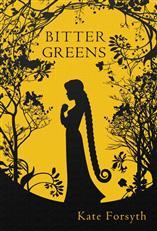
ForsythBitterGreensSo the resultant novel, Bitter greens (2012), is set in a real place at a real time. It could not, therefore, she says, rely on magic to explain all the mysteries in the story. She also explains how this research led her to “undertake a doctorate on the subject, with Bitter greens as the creative component.” It also led her to write The Wild girl about Dortchen Wild who was a neighbour of the Grimm family and who told Wilhelm Grimm “almost one quarter of the eighty-six tales collected” in the brothers’ first edition. (Just to be clear, though … she was one of many from whom the brothers collected.)

Now, I have to say that I am not particularly interested in Forsyth’s fantasy series, but these two books, which tend more to the historical fiction genre, do fascinate me. I will try to get to them one day. Meanwhile, I’m intrigued by what Forsyth loves in a story:

romance, passion, tragedy, struggle, and, finally, triumph.

I do like those things – who doesn’t – but I don’t need “triumph”. I don’t dislike books with this result, but I am happy with stories that are more equivocal, that make me wonder at the end. Life isn’t always, in fact often isn’t, triumphant – and I am more than happy for the arts to reflect that reality. Moreover, I’m not sure what Forsyth thinks, but I think stories can, by their very existence, provide “salvation” without offering “triumph”.  What do you think?

BTW, I was intrigued to read in her Official Biography that Forsyth is a direct descendant of Charlotte Waring, the author of the first book for children published in Australia, A Mother’s Offering to her Children. Waring was the mother of Louisa Atkinson, about whom I have written.

awwchallenge2014Kate Forsyth
“Stories as salvation”
Published in the Griffith Review, Edition 42, 2013
Available: Online at the Griffith Review

Cate Kennedy (ed), Australian love stories (Review)

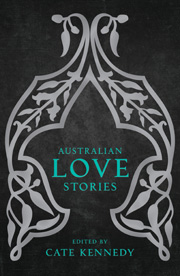
Cate Kennedy, Australian Love Stories cover

(Courtesy: Inkerman & Blunt)

Four hundred and forty-five stories! She read four hundred and forty-five of them! I’m talking about Cate Kennedy, the editor of Australian love stories. These stories were the response to Inkerman & Blunt’s call for Australian writers “to share their love stories, fictional or true”. Having no experience in these things, I don’t know what they expected, but 445 sounds like a good response to me! The final anthology contains just 29, and they are all, not surprisingly, good reads. This is not to say that I loved them all equally, but certainly none jarred for being ordinary or clichéd. Not only is the writing high quality, but Kennedy’s selection has produced a collection that is diverse in subject matter and style. It wasn’t hard to read four or five in a sitting.

If you’ve read my previous reviews of short story collections, you’d know that I’m always interested in the order of the stories. Well, this anthology has been overtly structured, with “like” stories grouped under headings. Each heading, cutely I suppose but nonetheless effectively, draws from a story within the group. So, for example, the heading “A sweetly alien creature” comes from the second story in its group, Susan Midalia’s “A blast of a poem”. I’m easily amused, I know, but I did look forward to spotting the heading-title as I read each group. There are seven of these groups, each containing four stories, with one exception that had five. In her Introduction, Kennedy, herself an award-winning short story writer, says that “Donna Ward [the publisher] and I arranged the stories into a kind of narrative arc of the way love comes, creates its own disorders, then transforms itself and us [in] the process.” This arc, though, isn’t an obvious one, like, you know, young love, broken love, old love. It’s more fluid than that.

And so, the first story, Bruce Pascoe’s “Dawn”, is about an older couple who have been together for a long time. The narrator, the man, clearly still adores his wife, and watches her, caresses her, in the early hours of the morning. While the birds come to life and sing in the day, she sleeps on. He knows her well, knows what he can do, how far he can go, before he will irritate her and break the spell:

So I don’t touch that bone. It would be over. She presses in closer to me and her breasts slide heavily against me and a thigh rises over mine and she squirms again, adjusting, moulding herself to me, fidgeting this limb and that, this foot against that, settling. It is not yet over.

This is a beautifully observed piece. It thrilled and inspired me – and gave me confidence that if the collection started like this, I was going to be in good hands.

What I particularly enjoy about an anthology like this is that it can give me a taste of writers I’ve been wanting to read for a long time (such as Bruce Pascoe, Tony Birch and Lisa Jacobson), or reacquaint me with writers I have read before and enjoyed (such as Irma Gold, Leah Swan, and Carmel Bird), or, perhaps most excitingly, introduce me to writers I don’t know at all (such as  J Anne DeStaic, Sally-Ann Jones and Sharon Kernot). But, here’s the thing. How to write about a collection in which pretty well every story moved me? I don’t want to simply generalise and tell you that they covered the whole gamut of love – from straight to same-sex, from romantic love to parental, from lasting to broken love, from supportive love to betrayal and revenge, from love across nations to love at home – though the anthology does do all these. And I can’t really describe every story in the book. So, I’ll just choose one from each section to give a flavour.

I’ve already mentioned Bruce Pascoe’s “Dawn” so will leave it at that for opening group titled “A sensuous weight”. The second group, “Why cupid is painted blind”, includes stories about love that can be passionate, obsessive, overwhelming. J Anne deStaic’s “Lover like a tree” is a devastating story about a woman in love with a man in love with his drugs (and yes, also with her). DeStaic conveys this two-edged love, his need for the drug as strong as her need for him, with sensitivity and without judgement. It is what it is.

The next four stories, in “Adrift in shards and splattered fruit”, explore same-sex love. They are not the only stories to touch on this issue, which was pleasing to see. Confining them all to one section would have insulted today’s reality. Debi Hamilton’s “The edge of the known world” is about missed opportunities, about the one who loves and the other who doesn’t see it:

Carmelita. Carmelita. There. I like to think her name. If you want to hear a love story I can write you one. If you want a story in which someone breaks someone else’s heart, this is the story for you.

We are warned early in the story, and yet the end still saddens.

From this group we move to “There are tears, there is hubris, there is a damnation and regret”. These stories are about difficult loves, sometimes past loves. It’s a powerful and varied group, but I’ll choose Sally-Ann Jones’ “Hammer orchid” to represent it. It spans thirty odd years in the lives of a young woman and an indigenous man. It starts “when she was eight and he was sixteen” and ends when they are fifty and fifty-eight. Set in Western Australia, it tells the story of a young girl’s crush and a young man’s recognition of the boundaries that need to be maintained. It gently encompasses issues like the patronising “naming” of indigenous workers (“Bill” is called “Biscuits” by his employers), knowing country, and environmental protest, all tied together by Levis and a silver belt buckle – but, beyond that, my lips are sealed.

“A sweetly alien creature”, as you might guess from this group’s title, explores parental love. Of course, like all love, this doesn’t run smooth. There’s a story about a false pregnancy (Rafael SW’s “Small expectations”), and another in which Lola promises to marry Henry and give him a baby if he’ll let her have a cat (Caroline Petit’s clever “The contract”). There’s Irma Gold’s only-too-believable story about “The little things” that can bring it all asunder, and Natasha Lester’s succinct piece about losing the language of adult love, postpartum (“It used to be his eyes”).  And then there’s Susan Midalia’s “A blast of a poem”, a bittersweet story about what happens when conception doesn’t happen on demand. What then?

I hope I’m not boring you, but we are nearly there! The penultimate group, “Firm as anchors, wet as fishes”, looks at how health issues can challenge or get in the way of love. There’s cancer of course, and I had to laugh at Sharon Kernot’s resourceful wife in “Love and antibiotics” when she tells her husband she has chlamydia. Allison Browning’s “These bones” is, we learn from the biographies, an excerpt from her current novel-in-progress. It’s about Enzo, a gay man with dementia. He’s in a care facility and misses waking up next to Nev. He might have dementia, but he still manages to escape the facility, despite its security-coded doors:

Today is a gardening day, the kind where no gloves are needed because the earth is warm and kind to the skin and the dirt feels soothing on the flesh.

We do meet Nev at the end, and he is as tolerant and loving as Enzo remembers and deserves. I’m intrigued now about the novel.

The last section, “The unbroken trajectory of falling” is – and you’ve probably been waiting for this – about love gone very wrong. There’s adultery of course, and breakups. There’s even a murder. Kennedy clearly decided that there would be no whimpering at the end of her anthology. No, we would go out with a bang. And so, if Pascoe opened the collection with a lyrical evocation of mature love, then Carmel Bird’s “Where the honey meets the air” brings it to a close with a breathless piece that barely stops for a comma, let alone a full-stop. Here, Sugar-Sam, in a stream-of-consciousness featuring word-play galore and “mincing metaphors”, chronicles his relationship with Honey-Hannah. It’s wickedly funny, with allusions high and low, little digs at our modern ways of communicating (“the merrymedia, social and anti-social”), and pointed references to contemporary issues. It is surely not a coincidence that Tasmanian-born Bird’s character marries into a family called Gunn. He describes the family’s taking over their wedding:

when Her Family swept in and tied us up in knots, ribbons, bows and a certain amount of barbed wire, and whirled us up the aisle …

Lurking in the language, behind its breezy tone, are, as you can see here, hints of something else. “I should have warned you”, he says at one point, “about how this narrative will tie itself in the knots of several metaphors and coincidences and things”. It certainly does that. By the end we are left fearing that Sugar-Sam has indeed tied us up in knots. A clever, satisfying, not definitively resolved story. What a way to finish.

All in all, a wonderful read. If you don’t want to take my word for it, do check out reviews by John at Musings of a Literary Dilettante and Karen Lee Thompson.

awwchallenge2014Cate Kennedy (ed)
Australian love stories
Carlton South: Inkerman & Blunt, 2014
275pp.
ISBN: 9780987540164

(Review copy supplied by Inkerman & Blunt)

Olivera Simić, Surviving peace: A political memoir (Review)

Olivera Simic, Surviving peace

Courtesy: Spinifex Press

I hadn’t heard of Olivera Simić when Spinifex Press offered me her book, Surviving peace: a political memoir, to review, but her subject matter – the Bosnian war, to put it broadly – was of particular interest to me, so I said yes. You see, I worked for several years with a woman who, like Simić, was also “survivor” of that war, and while she’d talked a little about it, I was hoping this book would fill in some of the gaps. It sure did – and then some.

Simić was born in the former Yugoslavia, and lived through the Yugoslav Wars (1991-1999). She was nineteen years old and living in Banja Luka in Bosnia and Herzegovina (BiH) when the Bosnian War (1992-1995) broke out. To keep her safe, her parents sent her to friends in Serbia for the duration of the war. She was living in Serbia* in 1999 when NATO bombed it –  Operation Merciful Angel** (really!) – as part of the Kosovo War (1998-1999). These aren’t her only traumatic experiences, but I won’t give her whole biography here.

According to her Spinifex author page, Simić is now “a feminist, human rights activist and academic at the Griffith Law School, Australia”. She teaches international law and transitional justice, suggesting that her personal experience of war and peace is underpinned by thorough academic grounding. The book has an extensive bibliography, which not only substantiates her arguments, but provides an excellent resource, both fiction and non-fiction works, for further reading on the subject.

So, how does an academic, working in an area in which she has been personally involved, write and teach about it? Surviving peace is described as a memoir so, as she says in her Preface, “the personal ‘insider’ perspective assumes the lead” in this book, but she also wants to increase understanding of war trauma and its impact on people’s lives. She’s a feminist, and brings a feminist sensibility to her academic work, one which accepts that personal experiences provide legitimate evidence in research. She believes, as I do, that there is no such thing as “objective knowledge”. Consequently, this “memoir” can also work as a scholarly study of the consequences of war, of the challenge of living post-conflict, of, as she describes it, surviving peace.

One of the features that makes this book more than “just” a memoir, is that it’s not told in a simple linear chronology. She does start with the beginning of the war in 1992, and end pretty much with the present, but in between she structures the book more thematically, so I’ll do that too, roughly aligned with her themes.

Where are you from?

In Chapter One Simić describes how within a decade of Tito’s death, Yugoslavia had changed from a place of “collective identity” in which ethnicity was not an issue to being an ethnically divided society that descended into war and genocide. She now “identifies”, reluctantly, as a Serb (Bosnian Serb/Orthodox Christian), formally separated from her old compatriots, Bosniaks (Muslims) and Croats (Roman Catholics). “The war”, she says,”erased my country, my language, my youth”. Her discussion of how language has played out in this breakdown of society is fascinating – but her description of the impact of having an identity “forcibly attached” to her, is painful:

The ethnic identity that I have been reduced to in peacetime has become a chain around my neck that threatens to choke me. It determines everything I do, say and write … Every time someone starts to enquire about my ‘ethnic identity’ I find myself walking a minefield of people’s judgements and closed-mindedness.

Of course, she’s not the only one caught in this trap – and she supports her discussion of the issue with academic writings and the personal experiences of others. Later in the book she describes how her father changed from communist to “ultra-right nationalist”. He now mixes only with Serbs, and has “nothing to discuss” with Bosniaks and Croats, among whom he’d had close friends pre-war. It’s impossible not to generalise, and draw truths, from the “stories” she tells, truths about constructing ethnicity which extend far beyond Bosnia and the Balkans.

Speaking the truth – and moral responsibility

In Chapter Two, titled “Traitor or truthseeker”, Simić discusses why she is driven to write about atrocities – particularly the Srebrenica massacre – committed in “my name” by her people. It has brought her into direct conflict with her father. “Truth” she shows is a relative thing – if we didn’t know it before. Each ethnic group has its own truths about what happened, making it “almost impossible to have respectful conversations about politics and war in today’s BiH”.

I found this section particularly interesting, because its generalities extended, for me anyhow, beyond the Bosnian War to indigenous relations in Australia. She discusses her feelings of “moral responsibility” for acts committed in her name, and argues

Of course, I cannot be held accountable for atrocities perpetrated by members of my ethnic group; that is their burden. However, I can and do feel a responsibility to demand justice and examine crimes committed by ‘my clan’.

That makes perfect sense to me. Simić quotes Hannah Arendt as saying that every government should assume “political responsibility for the deeds and misdeeds of its predecessors, and every nation, for the deeds and misdeeds of the past”. She also quotes Bernard Schlink (of The reader) who wrote that the past can “cast a long shadow over the present, infecting later generations with a sense of guilt, responsibility and self-questioning”. Oh yes! I do hope we here in Australia are finally recognising this … (Interestingly, she also raises the issue of survivors feeling they have sole ownership of their experience and that only they have the right to talk about it. This reminded me of our discussion on this blog earlier this year about whether white writers can write indigenous characters.)

Simić talks of “dirty peace”, which she defines as a time when killings have stopped but ‘war’ is still being fought. In BiH, for example, those who speak uncomfortable truths – and she gives examples – are ostracised and threatened. She talks about forgiveness (which I discussed earlier this year in another post) and argues that real peace is unlikely to be achieved until once-warring parties can sympathise with each other. Reconciliation, she says, means something more than simple co-existence.

“The answer to violence can never be more violence”

Simić is a pacifist and abhors violence. She details in the memoir her own painful experience of post-traumatic stress syndrome (PTSD). It is the most personal, intimate part of the book. Her PTSD primarily stemmed from her experience, as a civilian, of the NATO bombing. She is particularly bitter about NATO’s actions. She discusses it at some length, including both her personal experience, and the “facts”. She doesn’t excuse what the Serbs did in Kosovo, but argues “there must be other ways”. What those other ways might be, however, is not the subject of this book.

Her discussion of modern warfare, in fact, is chilling – and reminded me of Andrew Croome’s inspiration for his novel Midnight empire. The more remotely war is conducted, the easier it is for those conducting it to not see the real people, real lives, being affected. In this new warfare, the number of “ungrievable lives”*** multiplies.

The ramifications of war, then, are enormous, besides the loss of life and destruction that occur during the violence, besides the PTSD suffered by combatants and civilians afterwards. She writes of her own life as a refugee, of dislocation in the lives of others, of a “peace” that for many is no life at all. Some of this she conveys in Chapter Four through letters between three women, including herself, which bear direct witness to violence and its aftermath.

Incorporating truth into history

You’ve probably gathered by now that I found this a deeply engrossing book. It is unapologetically written from the point of view of a survivor. Quoting academic Elizabeth Porter, Simić believes that stories provide the basis for incorporating truth into history. I like this because for me history is more than facts and events, more than great men and their actions. It comprises the truths drawn out of – generalised from – people’s lived experiences. Nonetheless, there were times when I wondered if Simić were pushing her personal barrow a little too far, but then remembered that this is, first, a memoir.

I’m never one to say you must read a book. However, if the subject interests you, then Surviving peace would be well worth adding to your pile!

awwchallenge2014Olivera Simić
Surviving peace: A political memoir
North Melbourne: Spinifex Press, 2014
188pp.
ISBN: 9781742198941

(Review copy courtesy Spinifex Press)

* I mistakenly wrote Sarajevo in my original version of this post.
** The name reported to Simic by a pilot, but this name, used briefly in Yugoslavia, was a misnomer.
*** Janet Butler’s term for whole populations “barely considered as human” by those conducting or reporting on war.

Simone de Beauvoir, Memoirs of a dutiful daughter (Review)

Courtesy: HarperCollins Australia

Courtesy: HarperCollins Australia

I have only read one other work by Simone de Beauvoir – and I’m ashamed to say that it wasn’t The second sex (which still sits in my long-in-the-tooth TBR pile). It was, instead, one of her autobiographical novels, She came to stay. I enjoyed it as I recollect, but that was a long time ago. Then this year, my reading group decided to choose one of the books being discussed in ABC Radio National’s European classics series – and we opted for the first of Beauvoir’s autobiographies, Memoirs of a dutiful daughter.

Now, the things is, it’s a pretty dense book that can be looked at from multiple angles, too many to explore in one review. Consequently, my plan is to focus here on a few that interest me, and to later post a Delicious Descriptions containing examples of her gorgeous descriptive writing.

First though, as always, a brief summary of its content. Published in 1958, the book chronicles her youth from her birth in 1908 to when she turned 21 in 1929. It deals at some depth with her childhood, school and university days; her relationship with family and friends; her youthful thoughts about and experience, such as it was, of love; and, most importantly, the foundations of the ideas that drove her adult life. It shows the inner conflict she experienced as an independent thinker growing up in a conservative Catholic bourgeois family. I’d describe it as the autobiographical equivalent of a bildungsroman, which sounds silly since autobiography is intrinsically about the development of self. But this particular autobiography ends at the moment when she formally leaves childhood behind, and, like a bildungsroman, is primarily the story of her “formation”.

Autobiography

WARNING: THERE BE SPOILERS IN THIS SECTION – DOES THAT MATTER IN AN AUTOBIOGRAPHY?

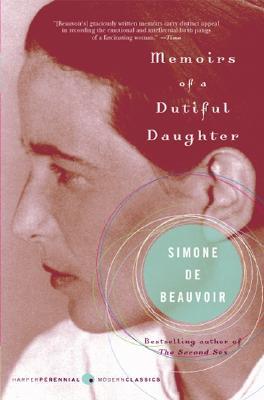
BeauvoirMemoirsHarperPerennialThis leads nicely into the first aspect of the book I’d like to discuss, its form. It is a traditional autobiography in that it starts with her birth and moves in a linear way, with the occasional foreshadowing, to her chosen endpoint which is when she turned 21, finished her schooling and left home. Like an autobiography it contains many characters. (There is a comprehensive index if keeping track becomes difficult, though I didn’t find it that hard).

The book also, though, has some novelistic elements. While at times the style is dry and almost diary-like, at other times it is highly evocative, particularly when she describes her experience of nature. More relevant though to my argument is her use of characters, because while we meet many, there are three that she focuses on – herself, her first cousin and first love, Jacques, and her closest friend Elizabeth “Zaza” Mabille. These two significant people provide coherence to the narrative line and a semblance of a plot. Will she or won’t she marry Jacques? And how will Zaza develop?

Beauvoir doesn’t marry Jacques, but while the book ends when she’s 21 and he’s about 23, she briefly describes what happens to him in the rest of his life, which ends, sadly, when he’s 46. Zaza, on the other hand, could be seen as her alter ego. As we read the book, focussing on Simone as “the dutiful daughter”, we become aware that Zaza is also one. The difference between them is that while Simone is dutiful in an obey-the-parents sense, she is an independent thinker and learns to distance herself intellectually from her parents. Zaza, on the other hand, exemplifies the tragedy that can happen to “dutiful daughters” who don’t achieve this. She, in other words, rounds out the theme implied in Beauvoir’s title.

This sense of Jacques being her potential future and Zaza being her alter ego gives this autobiography some of the sensibility of a novel.

Gender

I couldn’t of course write on this book without discussing gender. But first, it’s important to remember when she was born – 1908 – and the community into which she was born – conservative, Catholic, bourgeois. It was intriguing to see how her ideas developed in this early part of her life.

Early in her childhood she saw that mothers had a life of “servitude”, and were “overburdened with a thousand tiresome tasks”. Her response was to decide not to have children but be a teacher. In her teens, she states that “I believed in the absolute equality of human beings” but doesn’t engage with  the idea of universal suffrage. A few pages later, she is a little fuzzy on this idea of equality when she considers her future husband:

I should be in love the day a man came along whose intelligence, culture, and authority could bring me into subjection.

Why, she says, did she think this? She continues

I never thought of myself as a man’s female companion; we would be two comrades [but, she goes on] My education, my culture, and the present state of society all conspired to convince me that women belong to an inferior caste.

She goes on to explain that the man she loved would be “the model of all I wished to become; he would therefore be superior to me”.

Overall then, her thinking was a little confused. Theoretically she believed in equality and demanded independence for herself, resulting in much conflict with her parents in her later teens, and yet she saw her ideal partner as being “superior”. Part of her belief in equality was an absolute rejection of the double standard. She ascribed to the Christian morality of her times but felt “that men should be subject to the same laws as women […] I saw no reason why my future partner in life should permit himself liberties which I wouldn’t allow myself”.

By the end of the book, that is, by the time she turned 21, her thinking hadn’t developed much beyond this. She believed in equality, she didn’t want to be constrained as she saw married women with children were, but she had not developed the ideas that she presented in The second sex, which she wrote around the age of 40Tellingly, Beauvoir-Sartre biographer Hazel Rowley writes in my edition that it was Sartre who told Beauvoir that if she were to write her memoirs she would need to look into “what it had meant to be a woman”. Beauvoir was apparently dismissive, believing that being a woman had never really affected her but, she decided to do some research. What she discovered was “a revelation” and resulted in her putting her memoirs aside to write The second sex.

Literature and truth

The other issue that spoke strongly to me as I read the book was the importance of literature, of books and reading, to her – and, related to this, her search for truth. Reading was, she writes, “the great passion of my life”. If you are well-versed in French literature, as I am not, you could track her intellectual development through her reading. She discusses the books she read as a young school girl, her reaction as a young teenager to Jo in Little women and Maggie in Mill on the floss (both English books, I know!). She talks of engaging in her late teens with contemporary literature of “the disquiet” through writers like Gide (whom I have reviewed here), and of then moving on from them.

She learns much through reading, not only intellectually and morally, but practically. Books, for example, provided her with much of her sex education, so that when her mother finally decided it was time to tell her the facts she could say “I know all about that” – though what she knew about sex and what she understood about the world were two different things!

She learns that literature and reality are not the same thing, saying at one point that

Literature takes its revenge on reality by making it the slave of fiction.

At times she argues that literature is the truth, while at other times she feels its connections with truth are dubious, but this is all part of a portrait of the writer as a young girl. “Real” truths are not found easily, and she, we see, worked hard for hers.

Finally – and how long we readers had to wait for it – it’s her meeting with Sartre, “the dream-companion I had longed for”, that grounds her, as she reaches the end of her formal childhood. He is, she says, her intellectual superior, and she is, she knows, still naive, but

I no longer asked myself: what shall I do? There was everything to be done, everything I had formerly longed to do: to combat error, to find the truth, to tell it and expound it to the world, perhaps to help to change the world.

And so she did.

Simone de Beauvoir
Memoirs of a dutiful daughter
(Trans. by James Kirkup)
New York: Harper Perennial, 2005
(First pub. 1958; Translated 1959)
364pp.
ISBN: 9780060825195