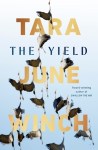
 Tara June Winch’s novel, The yield, follows her impressive – and David Unaipon award-winning – debut novel Swallow the air (my review). Ten years in the making, The yield could be described as her “passion project”. It makes a powerful plea for Indigenous agency and culture.
I wrote about The yield’s genesis last year, but will repeat it here. It was inspired by a short course Winch did in Wiradjuri language run by Uncle Stan Grant Sr (father of Stan Grant whom I’ve reviewed here a couple of times). Discovering language was, she said, transformative, but turning her passion into a book proved tricky. She started with too broad a canvas, until her mentor, Nigerian Nobel Laureate Wole Soyinka, encouraged her to focus on 500 acres of land, telling her she could tell her story through that lens. So, she found her 500 acres on the Murrumbidgee, created fictional places – the Murrumby River, and the towns, Massacre Plains and Broken – and her novel started to take shape.
“that unhandsome truth”
But my, what a shape it takes. It has three, roughly alternating, narrative strands, each quite different in style but each reflecting or enhancing the other two. They are:
- Poppy Albert Gondiwindi, dictionary writer, first person narrator. He is dying but is also a time-traveller, so, Winch said, his story has elements of magical realism. It’s told through the words in his dictionary, starting at the end of the alphabet, “a nod to the backwards whitefella world I grew up in”. “The dictionary”, Poppy says, “is not just words – there are little stories in those pages too.” There sure are. Through them Poppy tells the story of his and his people’s lives; he passes on as much of their culture as he has learnt and can tell; and he shares his hopes and values:
respect – yindyamarra I think I’ve come to realise that with some things, you cannot receive them unless you give them too. Unless you’ve even got the opportunity to give and receive. Only equals can share respect, otherwise it’s a game of masters and slaves – someone always has the upper hand when they are demanding respect. But yindyamarra is another thing too, it’s a way of life – a life of kindness, gentleness and respect at once. That seems like a good thing to share, our yindyamarra.
- August Gondiwindi, Poppy’s grand-daughter, third person voice. She tells a contemporary story of the 500 acres where the Gondiwindis live, and the challenges faced, including from mining and river degradation. Her story is about finding her place after living overseas for ten years. It’s a quest story, in a way, a little like that of Swallow the air’s protagonist. We meet her in Chapter 2 as she hears of the death of Poppy:
She knew that she had once known the beloved land where the sun slapped the barren earth with an open palm and knew too that she would return for the funeral … go back and try to find all the things she couldn’t find so many thousands of kilometres away.
(“Where the sun slapped the barren earth with an open palm”. Winch’s language throughout is gorgeous.)
- Reverend Ferdinand Greenleaf, Lutheran missionary, first person voice. Winch created him, she said, to “round” out the story. He’s her villain, but she gives some balance, humanity, to him by sharing his own experience of loss of home and mother tongue. His story is told through the letter he writes in 1915 to Dr George Cross of the British Society of Ethnography about his experiences running a mission from the 1880s. The first instalment ends with why he is writing it:
To tell how wrongs became accepted as rights. … I will tell that unhandsome truth, even if it will amount to last words. The circumstances and the times demand it.
His story is the most problematic for readers because he, with good intentions, established the ironically named mission, Prosperous House, near the non-ironically named town of Massacre Plains. Indeed, Poppy writes in his dictionary that the Reverend was “the only good white gudyi” he’d known, gudyi meaning medicine man, priest, conjuror. Greenleaf’s heart is in the right place – having seen the “the vile inhumanity practised by the white-skinned Christian on his dark-skinned brother in order to obtain land and residence, for ‘peaceful acquisition'” – but of course he is a man of his times and his paternalistic actions have their own consequences. August sees the paradox in his “trying to protect those ancestors at the same time as punishing them”, while her aunt Missy takes a harsher stance.
These three stories span over 100 years from the late nineteenth century to the present, with Poppy Albert’s dictionary providing the novel’s backbone, spiritually, culturally, and plot-wise. August’s story, on the other hand, provides its emotional heart, while Greenleaf’s provides important historical context.
The stories don’t, then, just meander along side by side for their own sakes. Each contributes to an overall plot which concerns a proposed mine, and efforts to stop it – a story that is broadly reminiscent of non-Indigenous Australian author Madelaine Dickie’s Red can origami (my review). In both stories the Indigenous people need to invoke Native Title if they are to have a chance of stopping the mine, and in both stories competing interests and loyalties, not to mention a helping of skulduggery, work to prevent the Indigenous owners from progressing their claim.
In Winch’s story, Poppy’s dictionary, which documents not only language but his people’s ongoing connection to the land, together with a collection of artefacts that had been donated to a museum by local rich landowners, and the information in Reverend Greenleaf’s letter, are critical to the Native Title claim. August and her family’s challenge is to realise the relevance of and/or discover and locate these “proofs”, while others try to foil them. It’s the oft-repeated story across Australia when traditional owners, protestors and landowners, with competing or criss-crossing interests, confront development, particularly mines.
Threading through all this is the novel’s heart, August’s journey to find herself and her place of belonging, as she navigates her people’s painful history of being “torn apart”, of massacres and dispossession, of racism, of incarceration, and of abuse from both within and without her culture. These are stories we’ve heard before. However, Winch keeps them fresh and urgent by engaging with contemporary thought (concerning, for example, Indigenous agricultural practice and the idea of slavery) and by creating characters who feel real and authentic, who are complicated like those in Melissa Lucashenko’s Too much lip (my review), rather than simple mouthpieces for ideology.
For all the anger and sadness in the book, it is also a positive – perhaps even hopeful – one. Early on, Poppy’s wife and August’s grandmother, Elsie, tells her, “Please don’t be a victim”. This is, I’d say, Winch’s plea to her people, and is reinforced by Poppy’s dictionary words at the end in which he says the time for shame is over. It is time, in other words, to heal, to be proud, to embrace country with confidence.
The yield is a rewarding read. Its three very different voices challenge our minds to think carefully about what we are reading, while its plot and characters engage our hearts. I would be happy to see it win the Stella Prize next week.
 Lisa (ANZLitLovers) also loved the book and includes examples from Poppy’s dictionary.
Tara June Winch
The yield
Hamish Hamilton, 2019
344pp.
ISBN: 9780143785750
 Debut crime author Karina Kilmore
 A book primarily intended for postpartum mothers is not really the sort of book Whispering Gums’ readers would expect to see here, but let me explain. Melbourne-based Heidi Sze started her food blog,
 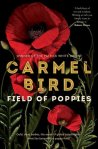 There are some writers whose personalities shine through so strongly that I have taken to characterising them in just a word or two. Jane Austen, for example, I think of as wickedly witty, and Helen Garner as heartbreakingly honest. Carmel Bird is another of these. I describe her as seriously cheeky, by which I don’t mean she is really cheeky, but that there’s seriousness beneath her surface cheekiness. The cheekiness makes me chuckle, but ruefully, suspiciously so, because I know that waiting nearby is very often a skewer of some sort. Her latest novel, Field of poppies, is no exception. Even the title is paradoxical, alluding as it does to both Monet’s pretty painting, Field of poppies in Argenteuil 1873, and the poppy fields of Flanders.
 After reading the first few pages of Charlotte Wood’s latest novel, The weekend, I was starting to wonder how on earth these women, with “their same scratchy old ways”, could be described as “dearest friends”. They seemed so different, and so irritated or, sometimes, cowed by each other’s differences. Where was their point of connection I wondered, besides their late friend Sylvie?
 Unlike many, I think, I have not read Angela Thirkell’s Barsetshire novels which, I understand are very different to her only Australian-set novel, Trooper to the Southern Cross, which, in fact, she published under the male pseudonym of Leslie Parker. It has been on my TBR for some time, so I’m grateful that
  Volume 1 of Ruth Park’s autobiography, A fence around the cuckoo, covers the period of her life up to when she lands in Australia to marry D’Arcy Niland. Not being sure, perhaps, that there’d be a sequel, Park concludes with:
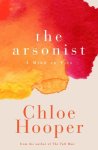 It may not have been the most sensible decision to read Chloe Hooper’s book, The arsonist, during Australia’s worst-ever bushfire week, but in fact I picked it up a few days before the crisis became evident, and once I started I couldn’t put it down. The arsonist tells the story of the man arrested and tried for one of the major fires in the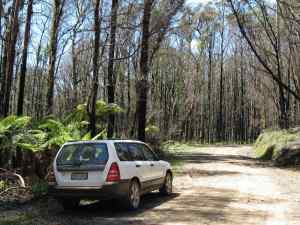
 Whispering Gums