Emma Ashmere, Dreams they forgot (#BookReview)

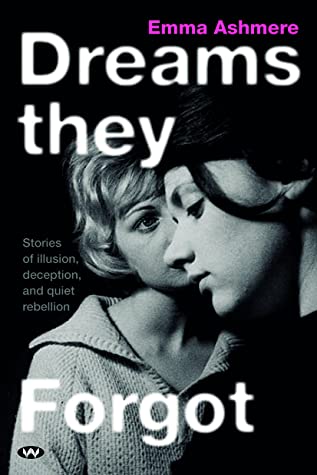
Emma Ashmere’s short story collection, Dreams they forgot, is different again from recent short story collections I’ve read. Certainly very different from the most recent, Adam Thompson’s Born into this (my review). One of the things that makes it different is its breadth in terms of time and place. Thompson’s collection, for example, is mostly contemporary, with occasional forays into the past and a little jump into the future. It is also very definitely centred in Tasmania. Ashmere’s collection on the other hand, while having some grounding in South Australia, has stories set elsewhere in Australia as well as overseas, including London, France, Bali and even Borneo. Furthermore, a significant number of the stories are historical fiction, with some set in colonial Australia, or during the Depression, for example, or post war, or in the 1970s. This is quite unusual in my experience of short story collections.

Unusual I say, but not surprising, because Emma Ashmere’s debut book is an historical fiction novel, The floating garden (my review). It is one of those books that has stuck with me because it tells such a strong story of social injustices that occurred during the building of the Sydney Harbour Bridge.

I could, then, start my discussion with the story in this collection which concerns the Bridge during its construction (“The sketchers”), but instead I’m going to the final story, because it gave me a laugh. This story, “Fallout”, concerns the (not funny) nuclear testing at Maralinga and concludes with the narrator taking her mother to the National Film and Sound Archive (NFSA) in Canberra to show her some relevant treasures. What a great little promo for the importance of collecting institutions like the NFSA. But, that’s not what made me laugh. As some of you know, I spent most of my career at the NFSA, and this is how our narrator introduces it:

I tell her I live with my girlfriend in Canberra and work at the Film and Sound Archive with a bunch of other failed actors, part-time poets and overlooked opera singers.

I wish I could count myself as one of those, but I’m far too prosaic. However, there is probably an element of truth in what she writes. All I can say is that at least the NFSA offers gainful, and valuable, employment! This story, dealing as it does with the “fallout” from nuclear testing – great wordplay here – makes a fitting and strong end to Ashmere’s collection, which deals with all sorts of fallouts in people’s lives.

Take the first story, for example. Titled “The winter months”, it concerns a young woman who, like many young people, is uncertain about what she wants to do with her life, much to her mother’s frustration. She’s in England, and is doing a TEFL course (Teaching English as a Foreign Language) which, she believes, “is going to change everything. It will give me purpose. A goal. A life”. She meets and is attracted to a mysterious and seemingly confident young woman, Aveline, but, unbeknownst to our narrator, Aveline has her own challenges, and suddenly disappears.

“The winter months”, however, is more complex than I’ve described here. It introduces us to several types of characters and relationships which thread through the collection – uncertain young women, lepidopterists (would you believe), mothers-and-daughters, neglected wives, fledgling same-sex attractions, to name a few. The result is that, as the book progresses, some stories start to feel linked, even though in most cases the link isn’t actual. The effect though is to ground the collection because this feeling is supported by recurring concerns.

One of these is Ashmere’s concern for social justice, for overlooked people, for women in particular. “Nightfall” tells the story of a young Irishwoman who arrives in Adelaide during goldfields days:

Most of us here Behind the Wall sailed across the sea with our Billies, Jemmies or Toms. No sooner did they set their boots in the dust, they streaked off like a dog chasing a rabbit across a field, all glint and muscle and hunger and bragging about what they will become. I waited for my Billy to bring back rabbits and gold, but he didn’t come.

And so, girls like her were left behind:

It’s the same in every port for girls like us. You stand with the bones of your back pressed against the wall as sailors rope up their harpoons and aim them at your lower parts, or you go into a tavern for a drink.

She ends up working for an abortionist who is, of course, more concerned about not being caught than her health and safety … This story was shortlisted for the 2019 Commonwealth Writers Prize.

Other stories explore the impact on relationships of PTSD in times when there was no support or recognition (“Warhead” and “Seaworthiness”), and another, as already mentioned, looks at the aftermath of nuclear testing at Maralinga. Many of the more contemporary stories feature children and young adults who find themselves caught in worlds they don’t fully understand or don’t yet know how to handle. “The violin” is a carefully told story about a controlling young man and his bride-to-be.

There is a melancholic or, at least resigned, tone to many of the stories, but most are not completely depressing. While happy endings might be rare, little wins or rebellions or, in some cases, lovely acts of grace lighten the endings. As with most collections, there are stories that didn’t quite work for me, but those that did more than made up for the rest. I particularly loved “Seaworthiness” and “The violin”, but most read well.

This brings me to the title, which is not one of the stories in the collection. What does it mean? It’s certainly true that many of the characters had dreams, and it’s also true that in most cases these dreams do not come to fruition. Did they forget them? Not always, but, for better or worse, other dreams – or, at least events – replace them.

If you’d like a taste of Ashmere’s writing, you can read one of the stories, “Standing up lying down”, online at Overland. I’ll finish with a quote from it:

Apparently she’d heard Laurie’s conference paper on the omissions and silences in Australian history, how particular stories are concreted over, while others are constructed and celebrated in their place.

In Dreams they forgot, Ashmere retrieves some of these concreted over stories – those she feels able to, anyhow – and gives them a darned good airing.

Challenge logo

Emma Ashmere
Dreams they forgot
Mile End: Wakefield Press, 2020
239pp.
ISBN: 9781743057063

(Review copy courtesy Wakefield Press)

Monday musings on Australian literature: Forgotten writers 2, Eliza Hamilton Dunlop

When I started my Monday Musings sub-series on forgotten Australian writers a couple of months ago, I had a few writers in mind, including the first one I did, Helen Simpson. However, a couple of weeks ago, The Conversation published the latest in their Hidden Women of History series, and the subject was an Irish-Australian poet, Eliza Hamilton Dunlop. I figured that, being a poet, she also qualifies for my Forgotten Writers series. I hadn’t heard of her, but she has become well-known in academic circles, because of … well I’ll let The Conversation explain.

Anna Johnston, co-editor with Elizabeth Webbey, of the recently published collection of essays Eliza Hamilton Dunlop: Writing from the colonial frontier, launches her The Conversation article with

Eliza Hamilton Dunlop’s poem The Aboriginal Mother was published in The Australian on December 13, 1838, five days before seven men were hanged for their part in the Myall Creek massacre.

Dunlop, Johnston continues, had arrived in Sydney in February and was “horrified by the violence” she read about in the papers. Her poem was inspired by the evidence given in court about an Indigenous woman and baby who survived the massacre. In it, she condemns “settlers who professed Christianity but murdered and conspired to cover up their crime”.

The poem made Dunlop “locally notorious”, but “she didn’t shrink from the criticism she received in Australia’s colonial press”. She hoped

the poem would awake the sympathies of the English nation for a people who were “rendered desperate and revengeful by continued acts of outrage”.

So, who was this outspoken, confident woman?

She was born in Ireland in 1796. Her father was a lawyer, but her mother died soon after her birth. Soon after, her father moved to India, to be a Supreme Court judge, so she was raised by her paternal grandmother. Johnston writes that she grew up in a “privileged Protestant family with an excellent library”, and “grew up reading writers from the French Revolution and social reformers such as Mary Wollstonecraft”. She started writing at a young age, and had poems published in local magazines in her teens.

These poems reflected her interest in the Irish language and in political campaigns to extend suffrage and education to Catholics. After travelling to India in 1820, she wrote poems about the impact of British colonialism. Then, in 1823 she married book binder and seller David Dunlop, in Scotland. His family history inspired poems about the bloody suppression of Protestant radicals in the 1798 Rebellion.

According to ADB, she had previously married an Irish astronomer in Ireland and had two children, one born in Coleraine, Northern Ireland, in 1816. They don’t mention what happened to this husband, but they concur with Johnston about her marrying Dunlop in 1823. Johnston says that Eliza and David had five children in Coleraine, and that they were engaged there “in political activity seeking to unseat absentee English landlords”. Clearly, Dunlop was politically engaged from an early age.

The family left Ireland in 1837, arriving in Australia, as mentioned above, in February 1838. Husband David worked first as a magistrate in Penrith, before, in 1839, becoming police magistrate and protector of Aborigines at Wollombi and Macdonald River, where he remained until 1847. ADB’s Gunson says that “as a minor poet Mrs Dunlop contributed to the literary life of the Hunter River circle” and that “her acquaintance with the European literary world gave her a place of prestige, and though neither as talented nor radical as, for example, Charles Harpur, her contribution was original”.

Songs of an exile

She may not have been, as “talented” or “radical” as others, but Sydney University Press deems her a worthy subject. Their promo for the above-mentioned book says that, after the publication of “The Aboriginal mother”,

She published more poetry in colonial newspapers during her lifetime, but for the century following her death her work was largely neglected. In recent years, however, critical interest in Dunlop has increased, in Australia and internationally and in a range of fields, including literary studies; settler, postcolonial and imperial studies; and Indigenous studies.

One of those interested is Katie Hansord, who has an essay in the book and who has written about her on the Tinteán online magazine website. Hansord’s article is titled – surprise, surprise – “a forgotten colonial woman poet”. Hansord says that in addition to being a poet she was “a playwright, a writer of short stories, and a passionate advocate of human rights with a keen interest in politics”. She writes that

Dunlop’s poetry reflects her concerns with both gender and nationalism. It should be remembered that in its original publication, ‘The Aboriginal Mother’ was the fourth poem in the series ‘Songs of an Exile’ which Dunlop published in The Australian from October 1838.

The poem is easily found on the web, and has been included in many anthologies, but it is also in Hansord’s article, linked above. The poem was, as were many of Dunlop’s poems, set to music by Isaac Nathan, and performed in concerts at the time.

However, the point I wish to end on concerns the reception of “The Aboriginal mother” because it was, of course, controversial. Leading the negative charge was, apparently, The Sydney Herald, which essentially believed that Dunlop had “given an entirely false idea of the native character”(29 November 1841), that, in effect, the Indigenous people were not capable of such deep feelings.

Hansord says more about this in her article:

Elizabeth Webby has also pointed out that the Sydney Morning Herald* ‘which had strongly opposed the execution of the men involved in Myall Creek was for many years very hostile to her [Dunlop] and her work’ (Blush 45). This hostility seems also to have reflected a growing white masculinist nationalist agenda.

Hansord briefly discusses the construction of “Australianness” during the nineteenth century, a construction that privileged white Australian-born men. For immigrant Irishwoman Dunlop – who was also actively engaged in capturing Indigenous language and translating Indigenous songs – this was clearly not good enough. (You can find an example of an Indigenous poem captured in the original language and translated by Dunlop, in The Band of Hope Journal and Australian Home Companion (5 June 1958)).

Dunlop died in Wollombi in 1880, and is buried in the local Church of England cemetery. There is clearly much more to this woman, but let this be a little introduction to another interesting, independent colonial Australian woman!

* The Sydney Herald, founded in 1831, was renamed The Sydney Morning Herald in 1842.

Delia Owens, Where the crawdads sing (#BookReview)

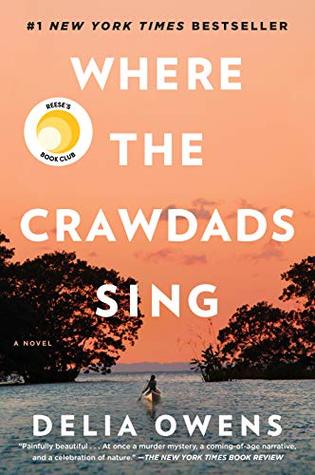
Delia Owens’ bestselling debut novel, Where the crawdads sing, is a problematical novel, as my reading group discovered – and yet, I couldn’t help being emotionally engaged. It reminded me a little of a childhood favourite, Gene Stratton Porter’s A girl of the Limberlost. My heart went out to Owen’s protagonist, Kya, the maligned, ignored, Marsh Girl, and I loved the writing about the North Carolina marshland. But, intellectually, I had to work to defend my enjoyment, which I’ll aim to share here.

“in the end, that is all you have, the connections”

I’ll start with the obvious, a summary of the plot. The main narrative runs from 1952 to 1970, and is told in two chronologies that eventually meet. The novel tells the story of Kya, who, in 1952, is six when her Mum and, soon after, her siblings leave home. Four years later, when she’s ten, her father also departs, leaving her alone, in their North Carolina marsh shack. She can’t read, has no money, and few skills. But, she’s an intelligent, resourceful little girl, and, with the help of a few kind people, she makes a life – albeit a lonely one – for herself. The novel commences, however, in 1969 with the discovery of the body of a young man, Chase Andrews, who is a local football hero. Was it an accident or was he murdered? The second chronology, then, is a crime story, following the investigation of this death through to the court case. You can probably guess where the two chronologies meet.

Owens manages this structure skilfully, drawing us into Kya’s life, and how and why she develops into the person she is in 1970, while, simultaneously, slowly building suspense by recounting the details of the investigation. The writing is lush and evocative, ensuring that we engage with Kya and her struggle to survive, her increasing loneliness and her desperation to connect with others. We see her turn to nature and wildlife to learn about life, as well as to provide herself with sustenance and give her a minimal income (by selling fish and mussels, for example).

This is nature writing at its best, with stunning descriptions of the marsh, and the birds, fish and insects that inhabit it, but it is also eco-fiction, with occasional allusions to development. Tate, a young man who befriends Kya (and provides her with a much-needed connection) tells her:

They think it’s wasteland that should be drained and developed. People don’t understand that most sea creatures—including the very ones they eat—need the marsh.”

The marsh is Kya’s family; it is what, in the absence of family, forms her:

She knew the years of isolation had altered her behavior until she was different from others, but it wasn’t her fault she’d been alone. Most of what she knew, she’d learned from the wild. Nature had nurtured, tutored, and protected her when no one else would. If consequences resulted from her behaving differently, then they too were functions of life’s fundamental core.

It is hard, as a reader, not to care about Kya. Will she find the connections she so badly wants – “Being completely alone was a feeling so vast it echoed” – and will they stick?

“it’s usually the trap that gets foxed”

However, it’s easy to pick holes in the book. Kya’s survival (given her youth) and her development into an educated young woman (given she only spent one day at school) can stretch credulity. Many of the characters feel stereotyped, from the good “colored” people, who put themselves out to help Kya, to the prejudiced townspeople, who reject and exclude her (as they do all marsh people). “Barkley Cove”, writes Owens, “served its religion hard-boiled and deep-fried”. And, if you don’t like your heartstrings being obviously pulled, you may not engage with Kya at all.

All this makes it problematical, because it’s one of those books that whether you love or hate depends largely on what sort of reader you are, what you like to read, and/or how you read this particular book. There are many ways to read Where the crawdads sing – a crime story, a romance, a coming-of-age story, historical fiction, a modern fairy-story or allegory, even, to name a few. Some of these ways demand more realism than others, and expose holes which are irrelevant to other ways. It is one of these other ways that appeals to me.

This way is to read it more like a fairy story or allegory, as a story about the triumph of the maligned, a comeuppance for the underdog. If you read it this way, the stereotyping of the minor characters, and the improbability of Kya’s survival and achievements, serve to emphasise the challenges faced by the underdog. It is hard to explain what I mean without giving away the ending, but I’ll try.

Throughout the novel, we are not only reminded of the prejudice and mistreatment of Kya (as representative of the marsh people) but are also aware of the ostracism of “colored people” as they were called then. Kya turns to nature to learn about life. Early in the novel, when the “colored” Jumpin’ warns her about Social Services looking for her, friend Tate tells her to “hide way out where the crawdads sing”:

Kya remembered Ma always encouraging her to explore the marsh: “Go as far as you can—way out yonder where the crawdads sing.”

“Just means far in the bush where critters are wild, still behaving like critters.”

One of Kya’s main challenges is to work out the differences between what she observes in nature and in human behaviour:

“In nature—out yonder where the crawdads sing—these ruthless-seeming behaviors actually increase the mother’s number of young over her lifetime, and thus her genes for abandoning offspring in times of stress are passed on to the next generation. And on and on. It happens in humans, too. Some behaviors that seem harsh to us now ensured the survival of early man in whatever swamp he was in at the time. Without them, we wouldn’t be here. We still store those instincts in our genes, and they express themselves when certain circumstances prevail. Some parts of us will always be what we were, what we had to be to survive—way back yonder.”

These two quotes – among others – hint at the novel’s underlying idea, which is that it’s not only “critters” who are “wild”, that human beings will be ruthless too. Exploring this ruthlessness in its natural and human manifestations, and how Kya navigates it, is a major theme of this book – and explains why Owens has written it the way she has. The resolution is deeply satisfying (albeit I didn’t love the device used to achieve it).

Where the crawdads sing is a thoughtful read for those who feel passionate about the maligned of this world. It is also a glorious lovesong to the marshland. I’m glad my reading group scheduled it.

Delia Owens
Where the crawdads sing
London: Corsair, 2018
379pp.
ISBN: 9781472154637 (Kindle ed.)

Irma Gold, The breaking (#BookReview)

Book cover

I have broken a golden rule! That is, I am reviewing Irma Gold’s debut novel, The breaking, out of the order in which I received it for review, which is something I (almost) never do! But, I am attending an author event on this book this weekend, and I really wanted to have read it before that conversation.

The breaking is an example of a growing “genre” of literature, eco-literature. This literature encompasses cli-fi, and focuses on human activities that endanger the environment in some way. It’s a broad church, covering climate, water and the land, deforestation, animal rights, and more. Books in this genre are often inspired by their writer’s passions. They tend to have a strong plot because the author wants to engage the reader in an issue: how better to do this than with an engaging plot. However, the plot is, largely, subservient to the issue, because at heart these are political novels, often in the “personal-is-the-political” sense.

So, some examples? Heather Rose’s Bruny (my review), which is deeply concerned about the future of Tasmania, Angela Savage’s crime novel The dying beach (my review), which explores the impact of shrimp-farming on the environment, and Karen Viggers’ novels, like The orchardist’s daughter (my review) which addresses deforestation, are three. These could be called “passion project” books. Critics often find this sort of writing difficult to asses. If it sells well, if it’s popular, is it good?

I’m going to sidestep the implication of that concern, and simply say that of course something popular can be good. If it’s well-plotted, well-written, has engaging characters – and deals intelligently with something relevant or important – then it’s good.

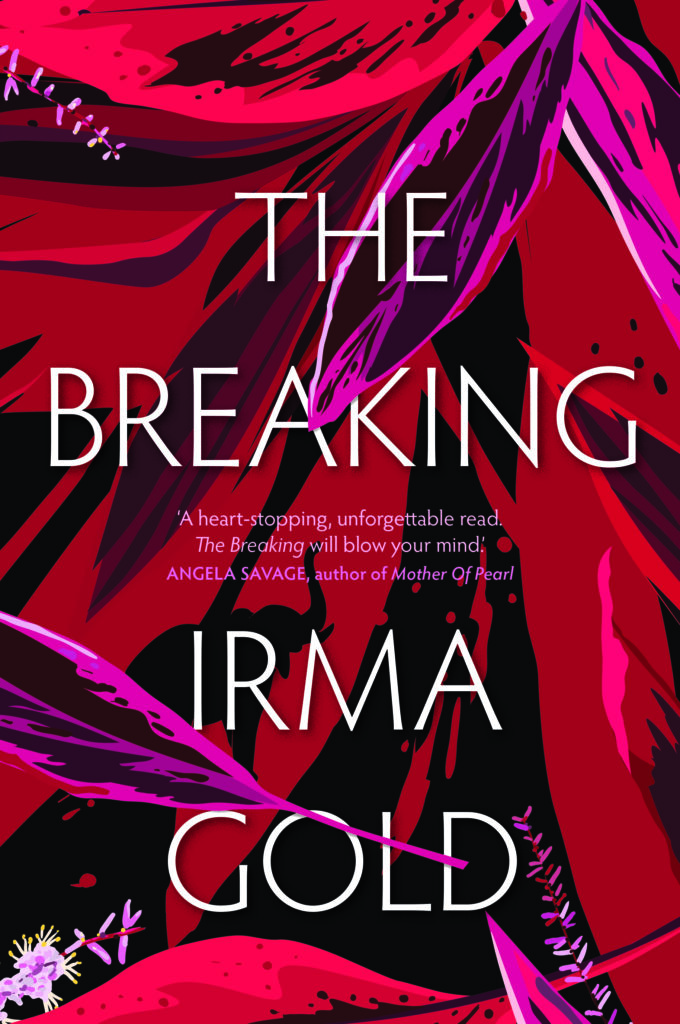
All of this is a very long introduction to Irma Gold’s book, but relevant, I hope. So, The breaking? The title doesn’t give away its passion, though if you look carefully at the gorgeous cover you might see it. It’s the plight or exploitation of elephants in Thailand. Gold, as she explains in the Afterword – I love an Afterword – has been to Thailand, and worked with elephant rescue projects, so she knows whereof she speaks. (I hope to have more to share after the weekend!)

It’s a grim situation, as I’m sure you know, and, like many grim situations in developing nations, it’s complicated by the fight for survival. For many Thais, elephants are their bread-and-butter, both as beasts of burden and, more, for their tourist potential. Gold addresses this dilemma in her novel without being overtly didactic, by having her characters see the situation with their own eyes, discussing it with each other, and weighing up the options.

“Be brave” (Deven)

The breaking is about two young Australian women, Hannah Bird, who has just arrived in Thailand as a tourist, unsettled and insecure because she’s lost her job, and Deven, who has been living there for some time and is involved in elephant rescue projects. They meet in a hostel lobby, as tourists do, and the experienced Deven invites Hannah to go to the night markets with her. From there, a friendship – and eventually something more – develops as the somewhat naive Hannah is drawn into the more experienced and confident Deven’s passions and views of the world. It’s not long before we discover the layers in the title as Hannah is introduced to the cruel practice of phajaan.

We follow their trajectory – told in Hannah’s first person voice – as they tread an activist’s path. It starts with involvement in organised, legal rescue projects that aren’t going to change the world quickly. However, as often happens to those who stay the course, they find themselves confronted with the ultimate activist’s dilemma of “how far will you go” for the cause you believe in? Always, it is Hannah following Deven, deeper and deeper into both political and personal engagement. Deven is driven to save those elephants, while Hannah, who believes in the cause, is more cautious, but, she’s falling for Deven, so, where Deven goes … the ending is powerful, confronting us head on with what can happen if you let passion rule your brain.

“We have to change the culture” (Deven)

Throughout all this Gold takes us on a journey through Thailand, showing it through the eyes of wide-eyed oblivious tourists, like Hannah, and those of the more experienced, aware Deven, who rejects the tourist path, the ladyboy shows, the elephant rides, and so on. Gold shares the food and culture of Thailand, using local words with little attempt to translate. She addresses this in her Afterword, explaining that although it is traditional to italicise foreign words, she “made a deliberate decision not to” do so here. Italics, she says, makes it easy for readers to “skim over foreign words” but she “wanted to encourage readers to engage with Thai language in the way that the Australian characters attempt to”. Gold’s solution is deft, because we readers puzzle and feel our way along with narrator Hannah, who is guided but not spoon-fed by Deven. Deven can be tender and caring, but she doesn’t mollycoddle!

However, if I have given you the impression that Hannah is all follower and Deven all leader, then you’ll have the wrong impression. Deven, alienated from her parents, has her own demons, and Hannah is not a push-over. As the novel progresses she takes in what Deven says but processes it in her own way. She sees “it’s not that simple; it’s not that black and white”, while for Deven it is simple. The denouement suggests where Gold lies, but the question remains for each reader, where do you lie? And, beyond that, whose rights should prevail?

Irma Gold’s The breaking reminded me somewhat of Madeleine Dickie’s Troppo (my review), which also explores the experience of young Australians caught up in unfamiliar lives and cultures, and who must forge their own way, morally and ethically, in places where the usual signposts are missing. Like Troppo, The breaking is an engaging debut novel that encourages us to consider some of the critical questions of our time.

Challenge logo

Irma Gold
The breaking
Rundle Mall, MidnightSun, 2021
271pp.
ISBN: 9781925227819

(Review copy courtesy MidnightSun Publishing via Brendan Fredericks)

Monday musings on Australian literature: Nancy Cato

Book cover

Last year I posted on a book called Trailblazers: 100 inspiring South Australian women. I decided then that it could inspire some Monday Musings posts, because it includes writers among its inspiring women. The first writer to appear in this alphabetically-arranged book is Nancy Cato. She is described as “Writer and activist”, which enhances her interest.

Nancy Cato (1917-2000), who saw most of the 20th century, is best known to Australians for All the rivers run (which I have posted on) but there is much more to her than that.

Brief bio

Cato was born and raised in Glen Osmond, Adelaide. She started writing when she was 8 years old, but got her first writing job at 18, when she won a competition run by the Adelaide newspaper, News. The prize included a cadetship. However, says Trailblazers, she “bristled at sexism in the workplace”. She’d been told that when she became a journalist, she’d be treated and paid as a man, so was horrified when they assigned her to the social pages! She threatened to resign if they didn’t give her a “proper reporter” job.

The job they gave her was “the North Terrace round” which covered the art gallery, public library, museum, university and hospital. She learnt a love of art from gallery director, Louis Frederick McCubbin (son of artist Frederick McCubbin), while the public librarian introduced her to Australian writers writing about Australia. This, says Trailblazers, was “a revelation after being told by her ‘pomified’ university professor that there was no such thing as Australian literature”.

She became involved in the Jindyworobak Movement (1938-1953) which aimed to “express the Australian outback environment in terms that respected the Aboriginal resonances of the land”, though, unsurprising for the time, it was a white movement. Cato edited the 1950 Jindyworobak anthology.

Book cover

Cato married racing-car driver and inventor, Eldred Norman. Early in her marriage, before they established a home on a vineyard on Adelaide’s northern fringes, she spent time grape-picking on the Murray River, thus gaining her river knowledge. Her first book was a poetry collection published in 1950, with her first novel, All the rivers run, appearing in 1958. She went on to publish another book of poetry, many novels, and a few works of non-fiction.

Cato and her husband moved to Noosa, Queensland, for health reasons, in the 1960s. That was where she died in 2000.

Writing and activism

Her activist nature is hinted in the biography above, in her willingness to resign over the paper’s treatment of her as a woman journalist. She was clearly no pushover from a young age. Trailblazers mentions her later activism in Noosa, where she became the bane of “the white shoe brigade” by opposing high-rise coastal development. The authors say that:

In her groundbreaking 1979 environmental study on the region, she described the seaside resort town as ‘a place of ancient unspoilt beauty and instant, man-made ugliness’.

According to Wikipedia, it went into two more editions (in 1982 and 1989).

Of course, I also went to Trove to see what I could find about Cato. I wasn’t surprised to find more than I could possibly read, both writing by, as well as about, her. I’ll share just some of what I found. I didn’t find a lot more about her activist activity. However, The Canberra Times, for whom, Trailblazers tell us, Cato wrote while living in Noosa, did have some articles by her about Indigenous Australians.

She commences one article from 1971 with

QUEENSLAND’S Aboriginal and Island Affairs Department has been dragged screaming into the 20th century by the Commonwealth Government’s threat to force changes in the existing Aboriginal and Island Affairs Act, if the State Government fails to amend its “discriminatory” clauses.

She goes on to describe how the Government responded, but that “the Queensland Council for the Advancement of Aborigines and Torres Strait Islanders’ [ATSI] monthly bulletin” was “hostile and critical” with the bill’s provisions. You can read the article yourself, but my sense is that the way the article is written suggests that Cato was sympathetic to the ATSI cause. Her description of her attempt to research first-hand conditions at Palm Island is telling. Her sympathy is borne out by another article (this one from 1972) in which she talks about Indigenous Australian poet, Kath Walker’s (later Oodgeroo Noonuccal) “new Aboriginal Cultural Centre and Museum on Stradbroke Island”. Cato went across on one occasion “to give a hand”. She writes:

Far from having difficulty in attracting artists, writers and others to stay at her Aboriginal cultural “retreat”, Kath Walker will probably have a waiting list as long as your arm, and the tourist industry will be gnashing its collective teeth at having overlooked the potential of the bay side of the island.

Interestingly, one of Cato’s few non-fiction books tells the story of a missionary, Mister Maloga: Daniel Matthews and his mission, Murray River, 1864–1902, published in 1976. The mission failed, for various reasons, and I’m not sure exactly what Cato’s take was, but reviewer Leonard Ward praises the detail it contains, and says that “As an historical document Mister Maloga earns a place on the bookshelves of those who have at heart the welfare of the Aboriginal people”.

In her novels, her passion for ideas she believed in was more subtle, but definitely there. There is a brief review of her 1960 novel Green grows the vine in the Communist Party’s newspaper, Tribune. The review calls it “a slight piece about the love life of three girls who go grape picking”. However, it continues, the novel “is lifted from the mundane by the author’s … careful descriptions of the labor process. The humor, the pain, the comradeship and the joy of labor, garnished with a democratic contempt for chauvinism, snobbery and such like”.  

John Graham, writing in The Canberra Times about her 1965 novel Northwest by south is more explicit, calling Cato “a curious phenomenon in Australian literature, a feminist without a formed social outlook”.

Her major contemporaries — Eleanor Dark, Kylie Tennant, Eve Langley and Dorothy Hewett — have all expressed definite views on society through their novels. Mostly, they are militant socialist rather than purely feminist ideas, a tradition of political awareness handed down to them by Mary Gilmore and Katherine Susannah Pritchard.Nancy Cato has never been drawn into this dynasty.

She is closer to the individuality of Judith Wright and Rosemary Dobson in her poetry, much more aggressively feminist in her novels.

He argues that Delie, the Murray River trilogy’s heroine, has “all the pioneering qualities that come from one side of the feminist tradition” but is not given “a social viewpoint that might have turned her into a memorable figure”. In Northwest by south,

Lady Franklin’s feminism is of the same activist variety, but much more capable of development through her position as a Governor’s wife. She also has the virtue of reality, a considerable advantage for a writer with limited powers of character development.

(Limited character development is a common criticism of Cato’s work). The review is thoughtful, and makes good reading. Graham argues that Cato shows improvement in her “technical development”, but “has still not controlled her tendency to rush from one event to another without pausing for significance”. He notes positives about her portrayal of Jane Franklin, particularly in exploding some myths about her, but feels that Cato became “so enmeshed in the historical details that the book is not satisfactory either as a character study of an unusual woman or as an examination of Franklin’s governorship”. However, “it is an interesting and at times fascinating study of the dilemma of the intelligent woman in early Victorian, and particularly colonial, society”. 

Cato, in her time, was one of Australia’s most popular writers of historical fiction. She was also, I’ve learnt, a woman of strong social values. A worthy trailblazer, I’d say.

Have you read any Nancy Cato? If so, I’d love to hear your thoughts.

Jane Austen, Juvenilia, Volume the third (#Review)

This month my Jane Austen group completed our reading of Jane Austen’s Juvenilia. (Click the links for my thoughts on the first and second volumes.)

Volume the third is a little different to the other two, as it contains just two unfinished works:

  • Evelyn
  • Catharine, or The bower

Both were written in 1792, when she was 16 to 17 years old.

As with the other volumes, the pieces were later transcribed by her into three notebooks, but there is evidence in this volume of other handwriting. There is uncertainty about the provenance, but the thought is that they were transcribed by her nephew James Edward Austen-Leigh and his daughter Anna. Certainly, handwriting analysis suggests it is their hands, but probably not their words.

Evelyn

Evelyn is an absurd, preposterous story about the idyllic town of Evelyn. A young man comes to town and wants to live there, but every house is inhabited, due to “the sweetness of the Situation, & the purity of the Air” not to mention the fact that “neither Misery, Illhealth, or Vice are ever wafted”. Luckily for him, a family there has “a peculiar Generosity of Disposition” and, immediately on meeting him, agree to give him their house and their daughter in marriage. The laugh-out-loud ludicrousness continues from there.

This story has received very little attention, compared with most of the other juvenilia. Shawn Normandin suggests this is partly because it

seems relatively distant from feminist concerns: its protagonist is male, and its female characters lack the refreshing assertiveness that distinguishes many of the juvenilia’s heroines.

Normandin argues, however, that it is worth considering because it “attempts with extreme–and hilarious–rigour to imagine a true gift”. He discusses it in the light of Jacques Derrida’s work Given time. I’m afraid that I didn’t give this time. However, I do like the idea that Evelyn could be considered within the context of Austen’s questioning “the new Enlightenment capitalism”, as Doody suggests, because it is clear that Austen was engaged in the political ideas of her time. Anyhow, Normandin concludes that Evelyn “may be western literature’s keenest examination of the gift because, not in spite of, its absurd frivolity.”

It’s probably worth giving this article more time, but, meanwhile, one thing I did notice about Evelyn is that although the story is extreme, like the earlier juvenilia, the actual writing is a little more controlled, a little less breathless, and injected with a little more setting and description.

Catharine, or The Bower

Not only does Catharine continue – I’m assuming it was written after Evelyn – in this more controlled vein, but even more so, as it moves into the realism for which Austen’s published novels are known. Catharine, or The bower tells the story of a young woman, who, having been orphaned when very young, is being brought up lovingly but severely protectively by “a Maiden Aunt”, who fears the impact on her charge of “Young Men”. Of course, a Young Man appears!

Catharine is a little tricky to read because, while Austen had done some editing as late as 1810/11, there are confusing changes of names. Catharine is variously named Catherine and Kitty in the text, but, even trickier, is that her aunt is sometimes called Mrs Peterson and sometimes Mrs Percival!

Anyhow, for me, and for some others in our group, it contains clear hints of Northanger Abbey (which Austen first wrote around 1798/9) – of Catherine (note the name) Morland (her youthful naïveté tempered by some good sense), of Isabella Thorpe, and of the interest in young men and propriety.

Catharine also contains one of my favourite Austen quotes about reading. Catharine tells her friend Camilla:

but for my own part, if a book is well written, I always find it too short.

Some of the themes that we see in Austen’s later novels are here, including women’s education (the focus on the attainment of accomplishments versus “useful knowledge and Mental Improvement”), indulgent parenting, city versus country, the idea of women and daughters made destitute on the death of a husband/father (as happens to the Dashwoods in Sense and sensibility), thoughtless young men (like Frank Churchill in Emma). Margaret Anne Doody claims that these “early works were important companions to her during the rest of her writing career” which supports my suggestion that these works were used as sources for ideas, like writers use notebooks today.

The style, as I’ve already said, is calmer, and more formal. There is more of the sort of authorial commentary that we see in her later works. Here’s Catharine, having been easily convinced that the young man who had departed without a farewell, did really like her:

She went in high spirits to her Aunt’s apartment, without giving a Moment’s recollection on the vanity of Young Women or the unacountable conduct of Young Men.

Also, Catharine evinces, says Doody, Claudia Johnson’s argument for Austen’s engagement with politics. Certainly, our character Catharine is frustrated by Camilla’s ongoing chatter about fashion and her refusal to talk about anything else – “She found no variety in her conversation; She received no information from her but in fashions”. Catharine, on the other hand, wants to talk about books and politics.

Here is a good time to share some ideas from Doody’s Introduction to the World Classics edition of the juvenilia. She suggests that Austen, following the rejection in the 1800s of Susan (later Northanger Abbey) and First impressions (later Pride and prejudice), tamed her writing to meet the marketplace. Perhaps, but, I see Catharine as already showing some of this taming down.

Doody discusses the different ways the juvenilia can be approached, and the drawbacks to these. For example, she suggests that seeing them as pointers to later writings – which most of us do – results in our missing “their important effects”. I take her point, but only to a degree, because I’m convinced that we can see the later Austen in these early works.

However, I like that she sees the subversiveness of Austen’s early work, something that was not recognised, she says, by critics like David Cecil. GK Chesterton, on the other hand, praised the early works. In 1922, he said

she was original … naturally exuberant … she could have been a buffoon like the Wife of Bath if she chose. This is what gives an infallible force to her irony. This is what gives a stunning weight to her understatements.

Doody concludes that the mature Austen chose to write “the realistic novel of courtship”, because that was the way to publication. She “had to pretend that the world was better and its general fictions more reliable than she knew them to be”. That’s possibly true, but Austen was seen as formally innovative in her writing, which suggests that her published novels were not completely against the grain, even if they were toned down versions of what she privately felt?

References:

  • Doody, Margaret Anne. “Introduction” in Jane Austen’s Catharine and Other Writings, edited by Margaret Anne Doody and Douglas Murray. Oxford, Oxford University Press, 1998.
  • Normandin, Shawn. “Jane Austen’s “Evelyn” and the “Impossibility of the Gift”.” Criticism 60, no. 1 (2018): 27-46. (Accessed via JSTOR)

Jane Austen
“Juvenilia. Volume the third” (ed. R.W. Chapman & Brian Southam)
in The Oxford illustrated Jane Austen. Vol VI, Minor works
London: Oxford University Press, 1969 (rev. ed.)
pp. 179-242
ISBN: 19 254706 2

Jane Austen, Lesley Castle (#Review)

I mentioned in my post on the second volume of Jane Austen’s Juvenilia, that I might do a separate post on one of its longer pieces, Lesley Castle. It’s one of her three longer pieces in that volume, and is often published separately or in other compilations, so warrants some attention, methinks!

Lesley Castle

Lesley Castle is another of Austen’s epistolary pieces. According to Juliet McMaster, writing in Persuasions Online, it represented a “step forward” in epistolary novels because the writers correspond with each other, rather than to someone “off-stage”. In this piece, in fact, there are several correspondents, writing to each other, resulting in different perspectives being offered on some of the main “characters”.

Lesley Castle is essentially an unfinished collection of correspondence between various “friends” who talk mostly of marriage – and of each other. Like many of the Juvenilia pieces, it demonstrates Austen’s love of writing about wickedness. It starts with Margaret writing of her brother’s adulterous wife running off, leaving not only her husband but her 2-year-old child, and of her widowed father, “fluttering about the streets of London, gay, dissipated and thoughtless at the age of 57”. Her correspondent, Charlotte, reports back about her tragedy, the death of her sister’s fiancé from falling off his horse, but she is more interested in food than in her bereaved sister. Insensitively, she describes her distraught sister’s face being “as White as a Whipt syllabub“. Such-self-centredness is rife in Austen – and you can hear her cheeky teenage self laughing as she wrote it!

Interestingly, this story is set largely in Scotland, which Austen never visited, and rarely mentioned in her works. Why Scotland, then? One reason could be to mock the vogue at the time for things Scottish. Margaret claims that she and her sister are happy there:

But tho’ retired from almost all in the World, (for we visit no one but the M’Leods, the M’Kenzies, the M’Phersons, the M’Cartneys, the M’donalds, the M’Kinnons, the M’lellans, the M’Kays, the Macbeths and the Macduffs) we are neither dull not unhappy …

The inclusions of “the Macbeths and Macduffs” is an additional pointer to Austen’s love of nonsense. She used lists frequently in the Juvenilia, often ending them with something extra “silly” to make her point. As I said in my first Juvenilia post, subtlety was to come in her mature works!

The new Lady Lesley, the aforementioned dissipated father’s new wife, is not so taken. She is also a friend of Charlotte’s and writes to her about her new Scottish-based step-daughters:

I wish my dear Charlotte that you could but behold these Scotch giants; I am sure they would frighten you out of your wits. […] Those girls have no music, but Scotch airs, no drawings but Scotch mountains, and no books but Scotch poems–and I hate everything Scotch.

Charlotte, meanwhile, had written to Margaret about Lady Lesley whom she sees as favouring “haunts of Dissipation” (essentially, cities):

Perhaps however if she finds her health impaired by too much amusement, she may acquire fortitude sufficient to undertake a Journey to Scotland in the hope of finding it at least beneficial to her health, if not conducive to her happiness.

The piece continues in this sort of vein with the correspondents often writing at cross-purposes, and, it must be said, focusing more on self-interest than the needs of others.

Of course, Austen readers always look for hints not only of style and themes (here, self-centredness, snobbishness, sensibility, hypocrisy, country versus city, and marriage) but of characters to come. In Lesley Castle, Charlotte reminds us particularly of a few Emma characters: Mr Woodhouse and his focus on food (though his is of a very particular type), Mrs Elton and her self-centred obliviousness to the needs of others, and, even, says Heller (referenced below) of Miss Bates in her garrulousness.

Margaret is a good example of Austen’s deluded characters who see themselves one way, while showing themselves to be very different. Many of the letters open affectionately, but contain or end with cutting remarks. Margaret, for example, writes to Charlotte complaining about being admired by too “many amiable Young Men” and expressing her “Aversion to being so celebrated both in Public, in Private, in Papers, & in Printshops”. She continues:

How often have I wished that I possessed as little personal Beauty as you do; that my figure were as inelegant; my face as unlovely; and my Appearance as unpleasing as yours!

Lesley Castle is probably not for every-one. So, rather than try to convince you to read it, I’ll conclude with Zoë Heller in The Guardian. Writing about Austen’s youthful work, she says that “as always in Austen’s work, recklessness with facts and inattention to detail are the rhetorical clues to a deeper-seated, moral carelessness”. How perceptive.

Jane Austen
“Lesley Castle”
in
“Juvenilia. Volume the second” (ed. R.W. Chapman & Brian Southam)
in The Oxford illustrated Jane Austen. Vol VI, Minor works
London: Oxford University Press, 1969 (revision)
pp. 76-178
ISBN: 19 254706 2

Monday musings on Australian literature: Best Young Australian Novelists (3)

I’ve posted twice on The Sydney Morning Herald’s Best Young Australian Novelists, last year, and back in 2013. Bill, in fact, chose that 2013 post in his Bill Curates series on this blog.

The award was established in 1997 by the newspaper’s then literary editor, Susan Wyndham, making this year its 25th year. An emerging writing award, it is open to “writers aged 35 and younger” at the time their book is published. It is called a “novelists” award, but is made on the basis of a specific book, which can now include short stories. It seems that the newspaper’s Fairfax Melbourne stablemate, The Age, is involved which is why the name now seems to be, simply, Best Young Australian Novelists. I don’t know when that change occurred.

This year’s winners, as announced by Jason Steger, the current Literary Editor for The Age and The Sydney Morning Herald, are:

  • Vivian Pham’s The coconut children (winner, $8,000)
  • K.M. (Kate) Kruimink’s A treacherous country (runner-up, $1,000) (see Lisa’s review)
  • Jessie Tu’s A lonely girl in a dangerous thing (runner-up, $1,000) (see Kim’s review)

The judging panel always includes the papers’ literary editor, so Jason Steger, plus a previous winner, Pip Smith, and another novelist, Peggy Frew. The number of awards made varies, but this year, as last, there were three.

The winners, briefly

Vivian Pham

According to Steger, Pham was a whopping 19 years old when her novel was published last year. Not what you’d call a “late bloomer” then! Her novel is set in the Vietnamese Australian community in Sydney’s Cabramatta. Steger says that while redrafting the novel, Pham came across the idea of “second-generation trauma inherited via the stories and behaviour of the previous generation”. This idea apparently runs through the novel.

Pham says that “You want to know the people that are closest to you. You know something epic has happened to them, to make them the people that they are, and you want to know why that happened.” She agrees with Steger that that novel is “a love letter to Cabramatta”, because “she felt more connection to Vietnam there than in Vietnam, when she spends all her time at her grandmother’s home”.

One of her significant influences is James Baldwin, who apparently “got her into reading seriously and realising that it could change your world”. Her second favourite writer is P.G. Wodehouse!

The judges said that “Pham’s non-judgmental portraits of parents living with trauma, and children struggling to comprehend their parents’ choices, was nuanced and wise”.

K.M. Kruimink

Lisa, as noted above, has reviewed A treacherous country, and described it as having “a playful narrative”. She tells us, as does Steger, that this novel also won the Vogel (unpublished manuscript) Award. It has also been longlisted for the Walter Scott Prize for historical fiction.

Unlike Pham’s more contemporary work, this novel is historical fiction set in colonial Tasmania. It’s about a young man coming to Tasmania to bring a message to a young convict woman. Originally, Kruimink was writing about the woman. However, she was a new mother at the time that she decided to pick up the work again, and

Because I was in a vulnerable place, it was too emotional for me. It was a sad story and I felt like I couldn’t write about this sad young woman and I decided to write about a silly young man instead.

She thinks she will go back to the young woman’s story, though her next novel is about something very different.

She named Hilary Mantel and Kazuo Ishiguro as writers she likes to read.

The judges loved the voice, saying that she delivered “a stand-out voice – eccentric, funny and deceptively endearing. While the research behind the writing is evident, it is handled with a lightness of touch, and the language itself is truly impressive, ornate, yet controlled and deft”. 

Jessie Tu

Tu’s A lonely girl is a dangerous thing has been making a bit of a splash, having been shortlisted for Readings’ New Australian Fiction Prize and the NSW Premier’s Literary Awards Multicultural Award, as well as longlisted for the Stella Prize. 

Kim, whose review I linked above, was mightily impressed. She thought it would be another book about a millennial, but found it was much more. “Its real strength,” she writes, “lies in its perspective of an Asian-Australian trying to succeed in a closeted world dominated by the white and the privileged”.

Taiwanese-born Tu was apparently clear from the start what she was writing about, and also believes, says Steger, that “what drives a good novel … is the kind of questions it considers”. For her, loneliness is a big issue – as the title suggests. She says that:

I’ve been trying to think constantly where to seek solace for my feeling that I don’t belong in this world and what I found really comforting was reading stories about women in the past, especially female artists or female writers, and realising that they have also gone through sad, lonely lives. For me to know that helps me understand that this feeling that I have is not at all special.

The judges said that “Tu, with unswerving clarity, draws out many unsettling and compelling questions regarding race, talent, performance, perfectionism, agency and worth”. They called it “provocative” and “uncompromising”, reflecting Kim’s assessment, in fact!

Have you read any of these books?

Marian Matta, Life, bound (#BookReview)

In August 2020, small independent publisher MidnightSun sent me two short story collections, Margaret Hickey’s Rural dreams (reviewed last month), and Marian Matta’s Life, bound. I enjoyed Rural dreams, as some of you may remember, for its exploration of rural lives from multiple angles and points of view. Life, bound is a very different collection. It doesn’t have a stated unifying theme but, like many short stories, it is unified by its characters being ordinary people trying to make the best of the life they have been given – or of the life that, sensibly or not, they’ve made for themselves!

The promotion accompanying the book describes it this way:

Free agents or captives of our past?

In Life, Bound, characters find themselves caught in situations not of their own making, or trapped by ingrained habits, walking in grooves carved out by past events. 

What characterises this collection, beyond this, is the varied tone, from the gothic-influenced opening story “The heart of Harvey’s Lane” to the strongly realist closing stories, “He turned up” and “A bench, a bard, a turning tide”. As with many short story collections, you never quite know what you’re going to get when you turn the page to the next story. In “The heart of Harvey’s Lane” a man becomes a famous photographer off the back of a shocking incident, but, after a while, starts to withdraw from the world, into a very strange house. As he scales down his career, he recognises that

The downward turn in my income almost exactly mirrored the upward turn in my satisfaction.

Nonetheless, the ending, when it comes is disconcerting. Covering a few decades, it’s an engrossing story about the way life can go.

Some stories are shocking, such as the second story “Climb”, about a young boy abused by his step-father, while others are cheeky, such as “Lovely apples” about a loving young couple and the suggestive “Drive my car”. In some stories, abused or overlooked characters get their own back. “Roadkill” is particularly cleverly told – with a great opening – and you have to cheer for the much-maligned Emily who’s not as stupid as they all think. But in other stories, things don’t work out, such as the devastating story about blighted hopes, “He turned up”. This title has a powerful double meaning. Titles in short stories are, I think, particularly important, because, given the form’s brevity, every word must count. Matta uses her titles well. Some are purposefully obscure, not giving anything away except perhaps the literal, as in “Climb”; others are more clearly figurative, as in “Desire lines” or “Lovely apples” or “Three-sixty”; while others are superficially descriptive but contain so much more, as in “A bench, a bard, a turning tide”.

Now, though, let’s get back to the characters “caught in situations not of their own making”. They include an abused boy, a transgender person, a woman caught in domestic violence, a homeless woman. These characters can break our hearts, but in Matta’s hands they are the characters who just might come through. I’m not naming the stories, here, because part of Matta’s skill is in slowly revealing the character’s situation, so why should I tell you here straight off?

Other characters are a mixed bunch, some “trapped by ingrained habits”, others just at a certain stage in their lives where an action has, perhaps, unintended reactions. There’s the alcoholic ex-husband who desires reconnection with his family (“Desire lines”), two sea-changers who meet in their new chosen town and become friends (“Claimed by the sea”), two people post-one-night-stand (“Summer of love”). This last one exemplifies how Matta mixes up her structure. Not all stories are simple, linear chronologies. “Summer of love” is linear, but told from the alternating points of view of the woman and the man, a perfect solution for a story about a one-night-stand.

The varied structure is one aspect of this collection that keeps the reader engaged. The above-mentioned variations in tone are another, plus, of course, the characters and stories themselves, but another is the language. Here, for example, is a character deciding that discretion is the better part of valour:

Jimmy decided not to chase that remark down to a point of clarity.

(Waterwise)

Then there are those phrases that make you laugh, such as this on entitled teenage boys being told off by their headmistress:

They shrugged, just sufficiently out of sync to appear like a music video dance troupe.

(Roadkill)

My last example is Rita – her town’s “voice of authority, the historical society’s walking catalogue” – being unusually flummoxed by a question:

A frown settles slowly on Rita’s face; her infallible memory has tripped over a corrupted file.

(Winston Mahaffey’s hat”

The stories are all, fundamentally, about humans – the things that happen to us or the messes we get into, and how, or if, we get out of them. But some of the stories also reference contemporary issues, such as climate change, domestic abuse, and homelessness.

The stories aren’t linked but this does not mean that order is not important. With a collection like this – that is, one dealing with some of life’s toughest challenges – the order in which the stories are presented, and which one is chosen for the end, can be significant. In this collection, Matta has followed the sad, bitter penultimate story with a story about homelessness in which the destitute but proud Merle slowly comes to trust the warm, generous 23-year-old Ethan. Surely this is intended to leave us with a sense that all is not lost, that there is hope if we ignore our differences and focus on our common humanities.

So, another engaging and stimulating collection of stories from Midnight Sun with – is it too shallow to end on this? – another beautiful cover.

Challenge logo

Marian Matta
Life, bound
Adelaide: MidnightSun, 2020
223pp.
ISBN: 9781925227710

(Review copy courtesy MidnightSun)

Sara Phillips (ed), The best Australian science writing 2020 (#BookReview)

In 2016, my reading group discussed the 2015 edition of The best Australian science writing. We enjoyed it so much that we decided to do it again, and so this month we read the 2020 (tenth anniversary) edition. Our discussion was as engaged as before (and the overall reasons I enjoyed this volume are the same as those I listed in my post on it, so I won’t repeat them here.)

The publishers invite a different editor each year, and for 2020 it was Sara Phillips, a respected and award-winning science writer herself, with a particular interest in environmental science. The edition opens, however, with a Preface by UNSW Press’s publisher Kathy Bail. She references the annual Bragg UNSW Prize for Science Writing, which was named for the father and son who were Australia’s first Nobel laureates. All shortlisted pieces are included in the anthology. 2020’s winner was Ceridwen Dovey’s fascinating, moving essay, True grit. (Dovey, many of you will know, is also a respected writer of fiction.) The runners up were Ricky French’s Case of the missing frogs and Konrad Marshall’s Jeepers creepersLesley Hughes’ The milk of human genius, Donna Lu’s Stranger thingsand Nicky Phillips’ Bringing home the ancestors, were the other shortlisted articles.

COVID-19?

There is so much I want to share about this volume, but I’m going to start with a quote I used in my 2015 edition post. It came from one of that edition’s Bragg Prize runners-up, Idan Ben-Barak’s Why aren’t we dead yet. This essay provided a wonderfully lucid description of pathogens and the immune system. You can guess why I want to share it again!

And so, an immune system must correctly identify a diverse array of harmful creatures and react to each one in its own special way. Oh, and you know what would be very helpful? If it could remember the pathogens it’s encountered before and store this information on file, somehow, so that it could make short work of them the next time they pop in. And it needs to be prepared for new invaders it’s never encountered before, because life is like that. And it needs to be prepared for completely new invaders nobody has ever encountered before in the history of humankind, because pathogens evolve over time. And it needs to be economical, so the body can keep it operational. And it needs to be fairly unobtrusive, so the body can keep functioning normally. And it needs to do it all very quickly, every time, or the body will be overrun, because pathogens multiply like the devil.

It sure does, as we all now know only too well. However, if you’re expecting pandemic articles to dominate the 2020 edition, you would be wrong, because the edition’s cut-off was March 2020. There are a couple of articles on the topic, but presumably there’ll be more in the 2021 edition. The two in this edition are Liam Mannix’s The perfect virus: two gene tweaks that turned COVID-19 into a killer, which tells us exactly what the title says it will (and in a clear, intelligent way), and Tessa Charles’ Synchrotons on the coronavirus frontline, which describes the importance of synchrotrons to mapping the crystallography of the SARS-CoV-2 protease. Knowing this is critical for the development of drugs/vaccines.

Science and politics

Each edition seems to have threads, which must surely relate to the “zeitgeist”. Introducing the 2015 edition, editor Nogrady wrote that while the 2014 anthology featured several articles “on our changing climate and its repercussions, this year there were an overwhelming number of submissions about our vanishing biodiversity, and what could be or is being done about it”. There were also several articles on robotics and artificial intelligence. Well, five years on, issues like climate change and biodiversity still feature strongly, as Phillips writes in her introduction, but there are some different threads too, as she also identifies, such as the role and importance of description and taxonomy, which, in fact, underpin many of the biodiversity articles. Dyani Lewis’ Identity crisis for the Australian dingo, is an example.

But, Lewis’ article also references something else I detected running through the volume, the close – and sometimes uncomfortable – relationship between science and politics. In the case of the dingo, there are political implications for whether the dingo is classified as its own (native) species (canis dingo) or as a dog (canis familiaris). As a native animal it “could be listed as threatened” if its populations decline, but as a dog “it wouldn’t qualify”. Some scientists accuse others of “bad science”, of forcing the dingo into its own species in order to protect it, when, they believe, the scientific arguments aren’t there for separate classification or taxonomy.

Nicky Phillips’ Bringing home the ancestors discusses the use of DNA to help identify indigenous remains held in museums (and similar institutions) but, she writes, “As a result of the history of mistreatment, some Indigenous people fear that unscrupulous governments or scientists might misuse their genetic information”. To invoke the potential of science or not, that is the question! The following article, The Murray–Darling’s dry mouth, by Jo Chandler, uses the stressed ecology of South Australia’s Coorong to exemplify “the mal-administration, negligence and ignoring catastrophic risks of climate change” that has brought the river-system to the parlous state it is in.

These are just three of many articles which explored the science-politics nexus. I’d love to share them all with you, but, given the year it is, I’ll end this section with an article written before the pandemic but which is so apposite, Felicity Nelson’s Pathogen sovereignty. Nelson explains how such a thing came to be and its implications for scientific research into, yes, pathogens like SARS-CoV-2. “For poorer nations, exercising state power over pathogen samples was quite often their only point of leverage”. Fair enough, as they’d been taken advantage of, but you can see the implications for the quick-sharing of samples so needed during pandemics.

A related thread through the volume concerned the practice, philosophy and funding of scientific research, but I’ll have to leave that, as I do want to get onto …

Inspiring people

It’s not surprising that articles written by journalists for educated-but-lay readers will often hang their information on the stories of inspiring personalities. Bragg Prize winner Ceridwen Dovey did this in True grit, by telling the story of Brian O’Brien, whose inspired idea about gathering and measuring moon dust in the 1960s was overlooked until the 2000s, when, quite serendipitously, his work was noticed by a scientist after NASA realised that it did indeed need to understand moon dust! Jo Chandler tells her above-mentioned Coorong story through the work of ecologist David Paton. He has studied the region for decades, and, though now officially retired, is not giving up, “not least because of his concerns about the capacity of working scientists to conduct deep, unfettered research. ‘You talk, they cut your funding. It’s as simple as that.’”

The inspiring people aren’t all old, however. Cameron Stewart’s Brain wave tells of Vietnamese-Australian inventor, Tan Le, whose work on producing technology that can read brain waves is already providing benefits – to quadriplegics, for example. The potential of this technology is immense, and Tan Le, herself, is astonishing, particularly when you read her trajectory from boat-person to Silicon Valley entrepreneur.

To end …

It’s impossible to do justice to an anthology like this, so, as I did last time, I’m concluding with three quotes that make important points, to my mind anyhow. First is Michelle Starr, who reminds us about the practice and limits of scientific research in The repeating signals from deep space are extremely unlikely to be aliens – here’s why:

‘Wild speculation can sometimes inform the next generation of instrumentation, which can then either confirm or refute the wild hypothesis, or see something else entirely unexpected. And that too is what makes science fun.’ The difficulty lies in understanding the difference between pondering wild ideas as a thought exercise, and evidence based on data and prior experience, observation and conclusions.

Then comes Brian Key from Peter Meredith‘s Underwater and underrated, which is all about fish brains and intelligence:

On the question of animal welfare, Brian emphasises it needn’t be linked specifically to an animal’s ability to feel pain. ‘You can apply human principles to animal welfare,’ he says. ‘Those principles don’t have to be based on scientific evidence; they can be based on the morals and ethics of a society.’

Finally, here is a Moore Foundation grant recipient in Smriti Mallapaty’s For risky research with great potential, dive deep commenting on one of the Foundaton’s sensible research grant conditions:

‘Science has a rich history of not talking about what doesn’t work,’ says Wilhelm, a grant recipient …. ‘By sharing our failures, we have been able to help each other and avoid making the same mistakes over and over again’ … 

Another rich volume, with so much to offer, but I really must end here – or, I’ll be putting you all to sleep.

Challenge logo

Sara Phillips (ed)
The best Australian science writing 2020
Sydney: NewSouth Publishing, 2020
ISBN: 9781742245072 (ebook)