Biff Ward, The third chopstick: Tracks through the Vietnam War (#BookReview)

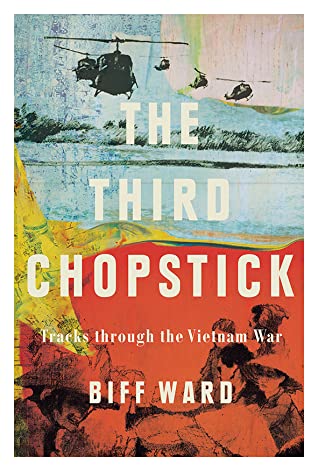
Biff Ward’s The third chopstick was my reading group’s October selection. It’s the second book by Ward that we’ve done, the first being her memoir, In my mother’s hands (my review), about growing up with her academic father, the historian Russel Ward, and her mentally ill mother, at a time when mental illness was shameful and to be hidden. It was a moving book that engendered an engaged and wide-ranging discussion. Biff Ward, in fact, attended that meeting.

The third chopstick is another personal book, but one that’s not so easy to classify. I would describe it as hybrid memoir-creative nonfiction. Memoir, because it’s about her experience as an anti-Vietnam war protester who later chose to meet Vietnam veterans and listen to their stories. And creative nonfiction, because, although nonfiction, it uses some of the devices of fiction to engage its readers. These include hinging her story around one particular vet, Ray, whom she describes as her “muse”, her “archetypal veteran”, her conduit, perhaps, to “the missing piece”. His story, combined with his powerful presence, gives the book its compelling, narrative drive.

The implication of what I’m saying here is that while The third chopstick is historical it is not an academic history. Although Ward did the historian thing, and conducted recorded interviews with vets, she does not attempt to present an “authoritative” analysis of protesters or of vets, but a thoughtful, personal quest. It has no footnotes, although there is a selected reading list at the end, and there’s no index. This is not to say, however, that it doesn’t add to our understanding of history, because it certainly does.

The book has a logical, and more or less chronological, structure, though there is criss-crossing of timelines where appropriate. It has three main parts – Protest, Veterans, Vietnam – which are bookended by a Prologue and Epilogue. In Protest, Ward describes her life as a protester, and introduces us to her ongoing interest in Vietnam long after the war ended. In Veterans, she introduces us to the veterans she met and interviewed, shares their stories and experiences, and reflects on these. Finally, in Vietnam, she discusses post-war Vietnam, including how Vietnamese people have processed, and live with, what happened. She has visited the country many times – as a sole tourist, on war-themed tours, and as a tour leader herself. On some of those visits, she either accompanied or met vets. Through these postwar connections, she starts to bring together her central questions concerning how we Australians got caught up in this, and what it did to us – as a nation, as individuals – though, of course, there are no simple answers.

“a scrambled snarl”

A bit over halfway through the book, while interviewing Nick, an SAS veteran of the war, Ward confronts the issue of “killing”. Nick’s story causes her to think about that and, thence, her stance as a pacifist. She realises she’d never really grappled with it. She had, she writes, a ‘”natural” antipathy to killing, a generalised kind of pacifism which yearns for peace’ but she also believed that, if needed, she would strive as hard as she could to defend “me and mine”. Her pacifism was “a scrambled snarl of thoughts and feelings”. She doesn’t explore this further, as it’s not the subject of the book, but …

… I liked this expression because what her book does is explore just what “a scrambled snarl” war is, whichever way you look at it. I particularly liked her various reflections on war. She makes the point early on that it is well known that war takes years to recover from. Vet Graham tells her that medieval knights “used to go into a monastery after being on a crusade”. He himself had, after leaving the army, been ill; he’d been in hospital and at a health farm, before spending “thirteen years, mostly alone, making music, keeping quiet”. By the time Ward met him, he was working with the Federation for Vietnam veterans.

Throughout the book, then, Ward reflects on war in general, but I’ll just share a couple that captured my attention, both resulting from her reading of Ray’s journal, where he expresses the trauma he experienced. It leads Ward to suggest “that the truth of all war is only these depthless oceans of grief”. A few pages later, she discusses “moral injury”, which “refers to an injury to the soul, to morality, to what can happen when a soldier has to do something against his own sense of what is right and wrong.” The injury done to Ray is immense.

Ward may not have intended this, but her book also functions, at least a little, as a cautionary tale, because she shows how easy it is to believe you are doing the right thing when you protest for a humane cause, and be oblivious to the potential for unintended consequences. The anti-Vietnam War protesters’ beef was with the government and its policies, but the result, as we all know now, was that the soldiers who went to Vietnam were vilified – not so much by the core protesters but by others who took their ideas on without understanding the politics. Ward shares some of the facts and myths about how it played out.

Ward also discusses those other two big fall-outs from this particular war – Agent Orange and its ongoing impact on the health of both soldiers and Vietnamese people, and PTSD, which she describes as the Vietnam vets’ gift to the world.

What makes this book a particularly good read, besides all this subject matter, is the language, which mixes journalistic-style reportage with more evocative writing. There’s too much to share, but here’s one describing her experience of transcribing Ray’s journal:

As I transferred his words from the page to pixels on my screen, they sometimes spiralled off and pranced about the room like leering pixies.

(This sometimes necessitated her needing to take a break!)

Here’s an appropriate point to explain the title, because it came from Ray, as she explains in Chapter 2. While in a restaurant, he places two chopsticks in parallel lines, about two centimetres apart, across a bowl, and names the space between the two as “normal life … where people get born and grow up …” etc. Then, he takes another chopstick (“the third chopstick”), places it parallel to the others, the same distance apart, and says

The veteran lives here, alongside but separate, see? He can see this life, he pointed back to the first space. He can see what other people are doing, but he can’t join in. He doesn’t know the rules anymore. It might look like like garbage to him. It’s got no connection to what’s happening inside him, see?

The secret, Ray continues, is for the veteran to be able to handle both “his own stuff” and join in. There’s a little more to it but that’s the gist.

    Lest you be thinking so, The third chopstick is not just relevant to those who lived through the Vietnam War era. As I read this book, I couldn’t help thinking about a war that is happening right now. Near the end, Ward writes:

    So even today, for the People of the Bag*, the mountains and the rivers, the land and the water and their interconnectedness are concepts integral to the way Vietnamese conceive of themselves. And, I chucke to myself, those men in Washington and Canberra thought they could somehow beat them, that the People of the Bag would eventually give up? Really?

    Given its origins in a leftie anti-Vietnam war protester who went on to engage openly and genuinely with soldiers involved in that very war, The third chopstick is quite an astonishing book. For anyone interested in the complex experience of war, it makes excellent reading. All eleven who attended my reading group agreed.

    * The Vietnamese, from their Creation Myth

    Biff Ward
    The third chopstick: Tracks through the Vietnam War
    Penrith: IndieMosh, 2022
    313pp.
    ISBN: 9781922812025

    Telltale, Carmel Bird and me

    In my recent post on Carmel Bird’s bibliomemoir, Telltale, I hinted that there could be another post in this book. There could, indeed, be many, but I must move on, and I must not spoil the book for others. However, given many blog-readers enjoy personal posts, I’ve decided to share a few of my particular delights in the book. I found myself frequently writing “Yes” in the margins …

    “I’m glad, now, that I have always defaced books”

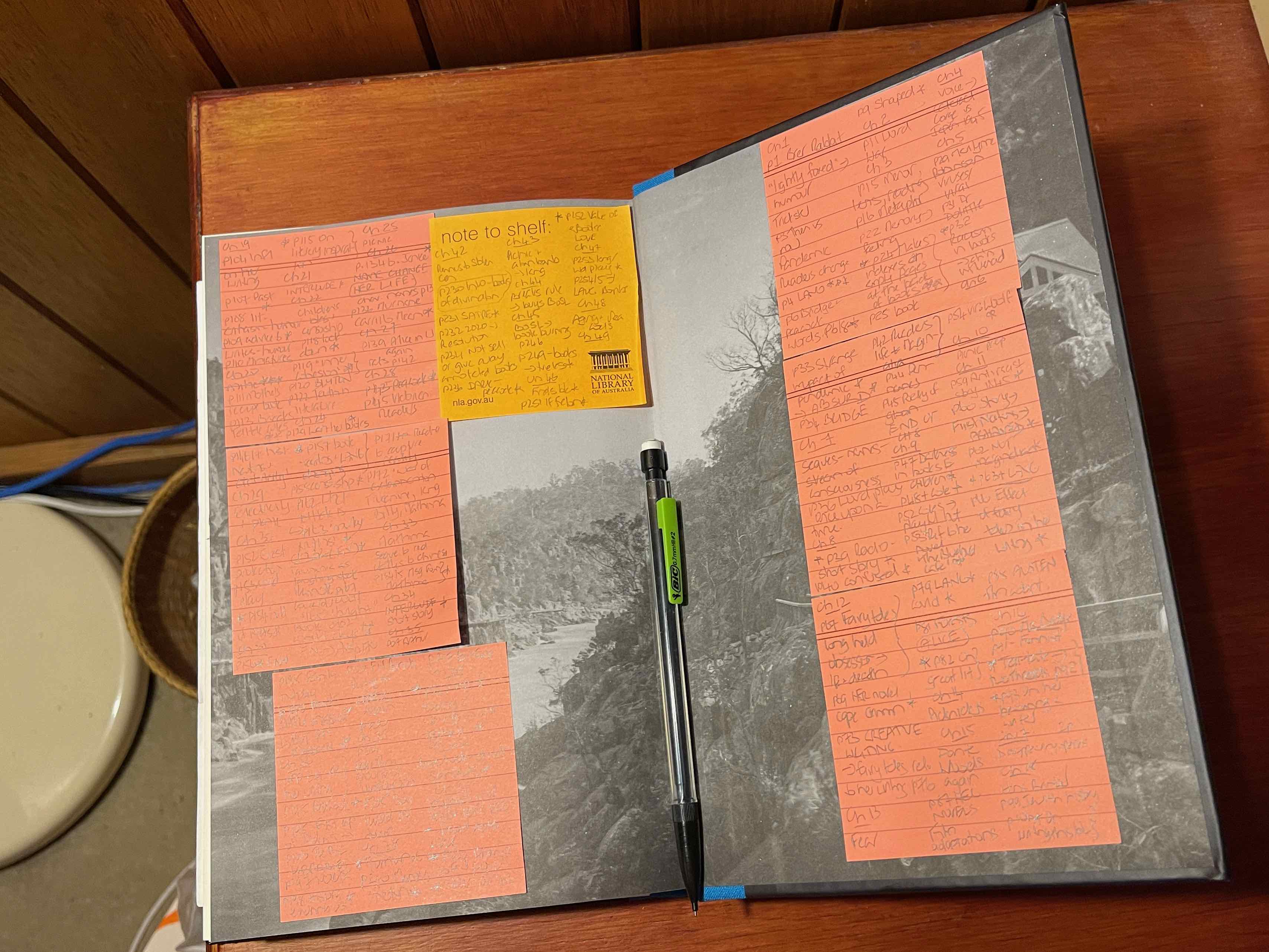
    … because, like Carmel Bird, I have, since I was a student, “defaced” my books. Not only that, but my defacements seem to be of a similar ilk to hers. For example, I sometimes add an old envelope, or post-it notes, inside back covers to carry more notes. Like her, I love books with several empty pages at the back to accommodate note-taking.

    Not enough blank pages at the end of Telltale!

    Carmel Bird also loves indexes – and I love the fact that Telltale has a beautiful index, because such a book should, but often doesn’t. But, what really tickled me was her comment early in the book that “I also make a rough index on the empty pages at the ends of books I read” (or, as she also writes, “pencilled lists of key elements”). Yes! Sometimes, my indexes are more like notes, but other times my notes are more like indexes. Mostly, though, I do a bit of both, with exactly what depending on the book and on my response to it. This latter point is implied in Bird’s statement that:

    In 2020, paying so much attention to books, I took particular notice of the differences in the ‘indexes’I had made at different times, how on each re-reading I had noticed different details.

    Here, she not only shares her reading practice but also comments on reader behaviour, on the fact that each time we read a book we find something new. That can be for various reasons. On subsequent readings we already know the book at some level and so are ready to see more in it; on subsequent readings the world will have changed so the things we notice can also change according to the zeitgeist; and then, of course, the biggie, on subsequent readings, we ourselves have changed so we see the world differently. I love that Bird’s indexes reflect this – and that she saw it.

    But, there’s a downside to all this “defacement”, which Bird also discusses. Writing about discarding books – the how and why – she says, “when I have annotated a book, it is not much use to anybody but myself, so selling it or giving it away are not possible solutions”. I know what she means, though I contest that hers would not be of use to anyone else. Who wouldn’t enjoy owning a book so defaced by her?

    There is, however, a point at which she and I depart. When reading an outsize paperback becomes “too difficult … to manage comfortably” she will attack it “vertically down the spine with an electric carving knife” to divide it into manageable portions. I know some travellers tear out sections of travel guides they no longer need, but librarian-me finds destruction a step too far. Sorry Carmel, I understand, but …

    “oh what a lovely word”

    Like many authors, Carmel Bird loves words. It’s on show in all her work, but in Telltale, it’s front and centre. In her opening chapter, she writes that

    Uncle Remus uses terms such as ‘lippity-clippity’. This is the kind of singing, onomatopoeic language I sometimes invent when writing.

    And, so she does, even in this nonfiction bibliomemoir. Did it come from reading Uncle Remus “all that time ago”, she ponders. Was it “embedded” in her brain, back then, without her “even realising”? Probably.

    Throughout Telltale, Bird discusses words – how they have changed over time (in meaning, for example, or in acceptability), how they look, where they come from, how they sound. As the daughter of a lexicographer, I would be interested in this. As a lover of Jane Austen whose wit and irony I adore, I would be interested in this. And, as one who loves writing that plays well in the mouth and sounds great to the ear, I would be interested in this. If you love words too, this book will be an absolute delight for you.

    Other delights

    As I said when opening this post, I really mustn’t spoil this book for others, so I’ll just add a few other delights:

    • her discussions of the many books and stories she chooses to share – those she found on her shelves that she felt illuminated her life and writing. I’ve mentioned very few of these because, really, this is the thing that most readers will want to discover and enjoy. Get to it … Meanwhile, I will name just two here. One is Dickens’ Bleak House which she writes “might” be her favourite Dickens. It might be mine too. The other is Marjorie Barnard’s “The persimmon tree” which she describes as “extraordinarily powerful”. Barnard’s “The persimmon tree and other stories” is one of the only short story collections I’ve read more than once. I concur!
    • silly little things like the fact that she loves green (as do I) and that she learnt that “lovely” word “tessellated” at the tessellated pavement at Tasmania’s Eaglehawk Neck (as did I).
    • she loves the internet and allowed herself to use it for this book. She was the first fiction writer in Australia to have a website. Like most of us, she prefers printed books, but she also sees the advantage of electronic books (including the ease of searching them – as an index-lover would!)

    Finally, early in the book, Bird discusses memory:

    As is often the case with memory, while some of physical details are clear, the principal element that has been retained is the feeling. Perhaps the feeling is the meaning.

    Yes! This makes sense to me. I can rarely remember plots or denouements, but for the books that are special to me, I can remember how they made me feel – uplifted, melancholic, inspired, distressed, excited, angry, and so on. These feelings are surely associated with what the author intended us to take away, and therefore they must reflect the meaning?

    Here, I will, reluctantly, leave Telltale, but I’ll do so on one of its three epigraphs, the one from her own character:

    ‘memory
    is the carpet-bag
    mire of quag
    filled with light-dark truth-lies
    image innation
    and butterflies’

    CARILLO MEAN,
    Remembrance of Wings Past

    How can you not love this?

    Carmel Bird, Telltale: Reading writing remembering (#BookReview)

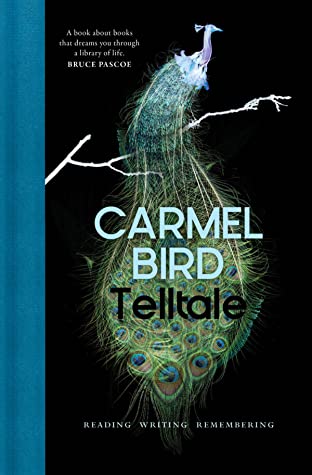
    Finally, I have found something to thank COVID for – Carmel Bird’s Telltale. Best described as a bibliomemoir, Telltale may never have been written if Bird had not been locked down with her extensive library. What is a lively mind to do in such a situation? I can think of a few options, but what Bird decided was to revisit the books she’d read since childhood and, through them, look for patterns in her life and, because they are intertwined, in her writing practice. She would reflect on “the working of the imagination, the behaviour of the unconscious mind”.

    Telltale, in other words, is more than a simple chronological run-through of her books, because the reading and writing life is not so easily compartmentalised. She writes that it

    is composed of two different kinds of narrative.  One is warp and one is weft, and I am not sure which is really which. Will the threads hold? What patterns might I work across the surface? Will the metaphors crumble into useless dust? One thread speaks of books read and sometimes of books written. And also of things that happened in my life. The other speaks of a journey of the heart, a pilgrimage through a patchy history of the world, becoming a poetic thread that runs through the whole narrative.

    A complex book then, but one told in such a personal, confidential come-with-me voice, that it reads like a lovely long conversation with an intelligent friend. Like any intelligent conversations, though, it requires the participants to be on their toes, to be ready for twists and turns, for surprising connections and conclusions, to be both confronted and delighted. Bird heralds this in her opening sentence:

    As a child at the end of World War Two, I was introduced to the concept of the Trickster in literature.

    That trickster was Brer Rabbit, whom I also remember from my childhood, but I was of a more prosaic mind than Bird, who has proven to be a bit of a trickster herself. Yes, the dictionary uses words like “dishonest”, “cunning”, and “deceptive” to describe “trickster”, but the trickster in literature, as Wikipedia explains, “is a character in a story … who exhibits a great degree of intellect or secret knowledge and uses it to play tricks or otherwise disobey normal rules and defy conventional behavior”. This is how I see Carmel Bird as a writer. The surface can look quite simple, but underneath there is usually something else going on. You only have to check out the epigraphs to her books, which frequently include bon-mots “written” by her own character, Carillo Mean. It’s apposite, then, that she starts her book with a “trickster”. It tells us to be ready for – well, anything.

    So, Telltale. It looks like a bibliomemoir – a book about her reading and writing life – but as she explains in the excerpt above, it also encompasses “a patchy history of the world” as it has affected or appeared to her. To unite it all, she crafts her tale around a narrative heart, a loved book, Thornton Wilder’s The Bridge of San Louis Rey. She wants to write about it but can’t find it. This injects a mystery: will she find it? It also introduces a potential conflict: will she break the rule she set for herself to not buy books and only use those on her (clearly extensive) shelves. As the memoir progresses, we become party to her increasing concern about where it is and what to do.

    Why of all the books, you might be asking, The bridge of San Luis Rey? But, that might be for me to know and you to find out.

    “to move the heart and illuminate the mind”

    Late in Telltale, Bird mentions reading Katherine Mansfield’s short story “The fly” when she was fifteen. She writes:

    I suddenly saw how the surface narrative and the narratives and meanings below the surface could dance together with an electrifying elegance to move the heart and illuminate the mind. This was my first conscious lesson in style and structure.

    See! It’s a lesson Bird clearly took to heart, and which is on display in all the works of hers I’ve reviewed. (As for “move and heart and illuminate the mind” – who could want more from reading?) Earlier in the book, she refers to another aspect of her style: “the pleasure I take in moving (drifting, spinning, flicking) from one topic to another”. This pleasure, she suggests, could have come from her father’s six-volume Harmonsworth’s household encyclopedia. Again, we see this approach in Telltale. It’s one of the things I love about Bird’s writing. It can be challenging, of course, but it is exciting to be so challenged – and to thus be respected as a reader.

    Anyhow, the point is that while on the surface Bird seems to move or flick from topic to topic, her books are invariably held together by framing ideas and motifs. Here, it’s not only the search for The bridge of San Luis Rey, but two other narratives, which she draws together towards the end of the book. One concerns a childhood family picnic to Cataract Gorge in 1945, and the other, the gathering of American planes for the rarely-remembered firebombing of Tokyo in March 1945. Woven through these narratives is another, Bird’s growing awareness of the devastating dispossession of Australia’s First Nations people, starting from her acceptance, as a Tasmanian-born child, of their “extinction” in her state.

    These are the main narratives that make up the aforementioned “patchy history”, and I fear this may be sounding disjointed. In fact, however, the “threads” hold, because the relationship between this “patchy history” and the books she has read and written is strong. Not only are there the obvious and expected connections between the “history” and her reading and writing, but there are also two recurring motifs that are real, historical, and literary – bridges, which can symbolise “fragile communication and union”, and peacocks which can signify “eternal life”.

    Telltale is a delicious and revelatory read, and I’m not doing it justice. I’ve not, for example, touched on the quirky, often poetic, tapered chapter ends, or the neat segues between chapters. Nor have I said much about the writing which can turn from seriously descriptive or philosophical to whimsical or poetical in a paragraph. And nor have I shared the reflections about reading and writing, about truth and meaning, about words and language, that I specifically noted down to share, because, frankly, there are too many. There may be another post in this.

    I took some time to read this book, and I’m not sorry. To read Bird, if you haven’t realised already, is to agree to join her on a sometimes merry, sometimes macabre dance. If we do, what we find is a compassionate heart that, despite it all, believes in love and calls us to hope, as that peacock that has accompanied us throughout darts and dances across the sky.

    Lisa also enjoyed this book.

    Carmel Bird
    Telltale: Reading writing remembering
    Melbourne: Transit Lounge, 2022
    274pp.
    ISBN: 9781925760927

    (Review copy courtesy the author)

    Kim Vanessa Scott, Growing up … Katherine style (#BookReview)

    Growing up .. Katherine style is the second self-published book I have reviewed from this Katherine-based artist and writer, the first being her book about some of Katherine’s historical housing, Katherine’s tropical housing precinct 1946-1956. There are a few reasons why I have broken my no-self-published-books rule. One is that both books had some Northern Territory government sponsorship, which gives them some authority. Another is that this book speaks closely to my own experience of childhood that I couldn’t resist sharing them. Moreover, the book is being sold by established outlets like The Bookshop Darwin and the Katherine Museum. Finally, Scott used a desktop publisher/designer to ensure the book looks good – and it does.

    So, with all that out of the way, I’ll get to the content, and why it appeals to me. Scott was born in the small outback Northern Territory town of Katherine in the 1960s, while I was born in a slightly bigger but still rural country town in Queensland in the 1950s. The first 14 years of my life were spent in Queensland, and over half of those in country towns, the last three being in the outback mining town of Mount Isa. From there I went to Sydney, where, although I enjoyed my high school and university days, I never really felt home. I left as soon as I finished my studies for Australia’s “bush capital”, Canberra, which has always felt like home. However, I’m getting off-track, so back to the book.

    Growing up … Katherine style is both written and illustrated by Scott. It takes the form of a series of little illustrated vignettes from Scott’s life, each comprising an image accompanied by a short piece of text commenting or reflecting on the image. Scott’s art is delightful, bright but not garish, with strong outlines and a somewhat naive aesthetic suited to the childhood theme.

    The vignettes take us from her babyhood in 1961 to Cyclone Tracy in 1974. Ending on this event is inspired because the cyclone, which occurred in Darwin a bit north of Katherine, was life-changing for the Northern Territory – and because, coincidentally, Scott would have been entering puberty by then, making it a good time at which to end a book about her childhood. Scott told the Katherine Times, linked below, that the book was at least partly inspired by the catastrophic Katherine flood of 1998 which

    took away all our images and a lot of our family history, so I tried to think of a way to record the childhood without the images.

    In the book’s introduction, she explains further that the “objects” she chose to illustrate her childhood “had many layers of meaning”. They demonstrate, she says, the way she “interacted with them on an emotional, physical and spiritual level”. What I so enjoyed is that many of them mirror memorable times in my own life – the family’s first car and tv, the importance of the radio, her first plane ride, not to mention those horrible sanitary belts we had to wear for our periods! There are also those little events from childhood that can remind us all of our own misdemeanours and accidents. Take for example, “Mulberries”, in which she describes finding a sixpence and carrying it in her mouth while running. The only trouble is that she then climbs a mulberry tree and puts mulberries in her mouth too:

    I had my mouth full of fruit and the coin when I accidentally tipped upside down and swallowed the lot. Rather than tell Mum, I decided to just die.

    Don’t you remember times like that? Anyhow, “fortunately”, she writes, “I woke up the next morning …”

    I flagged many vignettes to share with you, like “Nursery Rhymes” in which she shares her “Little Miss Muffet” mondegreen. How many of us had those in our childhood (and, I have to admit in my case, beyond.) There’s another on “Slide nights” which tickled my fancy because last night we dined with two other couples and we had an impromptu slide night of both couples’ recent, separate holidays to the Kimberleys. The technology might have been different – thumb drives to the smart TV – but the impact was the same. Scott writes that:

    I miss this form of entertainment where we built our oral family history with images.

    There’s the reference to family history again.

    In another blast from the past for me, she writes in “My first real jewels” of the “bluebird lockets earrings” that were given to her and her sister as their first piece of “grown-up, real jewellery”. As she writes, “they were considered a charm”, and oh, how I had wanted some bluebirds too. One birthday I thought I had been given a bluebird bracelet, but when I looked more closely, the little charms were blue angels. Not the same! I was most disappointed. I could go on but you are surely getting the drift. This book offers both a lovely trip down memory-lane (for most baby-boomers) and an engaging picture of childhood in a different place and time to now.

    The book ends on Cyclone Tracy, as I’ve already said. Scott writes that “the path to self-government started on Christmas Eve, 24 December 1974. The warning sound on the radio is burnt into my psyche”.

    You can hear an interview with Kim Scott on the ABC Radio Darwin website, and read an article on the book’s publication in the Katherine Times. The Times also advises that the illustrations were put on exhibition at Katherine’s Godinymayin Yijard Rivers Arts & Culture Centre. Scott is described as a local Katherine artist who enjoys “showcasing all facets of life in the NT through visual arts, poetry and story telling.”

    I love histories told through objects. Scott has shared her childhood in a way that captures her personal experience while also speaking to the universal. Delightful.

    Kim Vanessa Scott
    Growing up … Katherine style
    Katherine: Kim Vanessa Scott, 2022 (with sponsorship by the Northern Territory Government)
    82pp.
    ISBN: 9781642045444

    (Copy received from the author via a mutual friend.)

    Jacqueline Kent’s Seymour Biography Lecture

    Last Thursday night we went to our fifth Seymour Biography Lecture at the National Library of Australia. We missed the last one in 2019 because we were travelling. Little did we know then that it would be three years before another one could be held. The Seymour Biography Lecture, which is one of the highlights on the Library’s calendar, is an annual lecture devoted to life-writing. It was endowed by Dr John and Dr Heather Seymour AO in 2005, and provides eminent ‘life writers’ with an opportunity to explore the business and craft of biography, autobiography or memoir.

    Jacqueline Kent, Sept 2022, National Library of Australia

    This year’s speaker, Jacqueline Kent, was introduced by the NLA’s Director-General, Marie-Louise Ayres. She has an impressive life-writing track record, including:

    • A certain style: Beatrice Davis, a literary life (2001): won National Biography Award and the Nita B. Kibble Award
    • An exacting heart: The story of Hephzibah Menuhin (2008): won the Nita B. Kibble Award 
    • The making of Julia Gillard (2009): written before Gillard became Australia’s first female Prime Minister 
    • Take your best shot: The Prime Ministership of Julia Gillard (2013): covers her Prime Ministership, and her story isn’t finished yet, said Kent.
    • Beyond Words: A year with Kenneth Cook (2019): a memoir; shortlisted for National Biography Award (Lisa’s review)
    • Vida: A woman for our time (2020)

    Kent, though, first came to my attention long before these, with one relevant to my work, Out of the bakelite box: The heyday in Australian radio (1983). She trained as a journalist and broadcaster, but has also been a book editor and reviewer, and has written fiction for young adults. She was, I have to say, one of the liveliest Seymour lecturers I’ve heard, and is also the first woman I’ve heard (though 2019’s lecture was also by a woman, Judith Brett).

    Kent set the tone she was to take by saying that “biography” is such an important word that maybe she should start with the great biographers of the past, like Tacitus, or Boswell, or Lytton Strachey, but she wasn’t going to. Instead, she was going to “lower the tone” and go to Donald Rumsfeld, which of course brought a chuckle from the audience. You can probably guess what’s coming and you’re right; she was going, she said, to structure her discussion by using Rumfeld’s now famous statement that

    there are known knowns; there are things we know we know. We also know there are known unknowns; that is to say we know there are some things we do not know. But there are also unknown unknowns—the ones we don’t know we don’t know.

    She said that this oft-maligned statement does contain some truths. (Yes, agree.) It also reminds her of a quote by Artemus Ward, that was loved by Abraham Lincoln: “It ain’t so much the things we don’t know that get us in trouble. It’s the things we know that ain’t so.” For a biographer all these knowns and unknowns can be quite a challenge.

    She would these ideas, she said, through what she knows best, her own work.

    Known knowns

    What you know, said Kent, usually provides the impetus for starting a biography. It’s some interesting fact, or some central mystery (what made them do it, what did they think they were doing) that makes you want to investigate them. You write about them because “they are worth memorialising”. You also want to like your subject because you spend a few years with them.

    Her first full biography was of Angus and Robertson’s legendary editor, Beatrice Davis, for whom she had worked. Davis was the “grand dame” – in every sense of the word. She did not like the new writers coming up towards the end of her career, like Helen Garner and Kate Grenville! Kent said that many books about publishing focus on the challenges and problems, but she want to write about what fun it also is. She wanted to give her profession its due. Also, she said, these days a book can be produced without ever seeing paper – writing, editing, publishing, can all be digital – so she also wanted to create a record of an industry that was changing.

    As for Hepzibah Menuhin, she and her brother Yehudi were “rock stars” of their time. Kent’s interest here was in people with precocious talent, and what happens to them. Having been nurtured and feted as a musician, Hepzibah suddenly married, at the age of 17, a Victorian grazier and pharmaceutical company heir, and pulled back on her career. Then, she suddenly left her husband and 9- and 11-year-old sons to return to Europe. What someone to do that? She hurt a lot of people, said Kent, but had no idea of this.

    Julia Gillard was suggested to her as a subject. Her interest here were what drove Gillard and what were the steps she took along her way. The mystery was what led her, as an up-till-then loyal Deputy Prime Minister, to undermine Kevin Rudd. Kent felt that Gillard had enormous dignity post-parliamentary-career, particularly in not getting involved in Australian politics, unlike others. She was a challenging subject, however, because she was guarded.

    Vida Goldstein was a much easier subject because she was dead and she had no family, so there were no descendants to worry about. She had previously been written about in a worshipful way.

    Known unknowns

    These, said Kent, are the things you know you have to find out, the things that illuminate a subject. Often friends will share things you already know, because they think they have been privileged to know them. But some information can be hard to unearth. With Hepzibah Menuhin, a critical question was her divorce, the events surrounding her divorce. In this case, out of the blue, she had a stroke of luck when, visiting Hepzibah’s niece, she was suddenly given a bunch of correspondence written between Hepzibah and her father around the time of the divorce. This enabled her to finish the book.

    Unknown knowns

    This was not in Rumsfeld’s list, Kent said, but it refers to the things you don’t realise you know. Regarding her memoir about her life with the author Kenneth Cook, who was her husband for a year and is best-known for the novel Wake in fright. As she wrote the book, she realised that despite its bleakness, it had a jocular tone. It also, in fact, tells the same story as They’re a weird mob, except that this letter was specifically played for laughs. She also realised that Cook’s novel, The wine of God’s anger, is also the same story. It’s not an unusual story – the arrival of a stranger in a place unfamiliar to them – but that Cook told this story more than once was telling.

    (Interestingly, she suggested that The wine of God’s anger is “the only complete Australian anti-Vietnam novel”. However, I can think of Josephine Rowe’s A loving faithful animal (my review). Any others?)

    Unknown unknowns

    These are the worst, said Kent. They can be the things you find out just when you are going into print, or, worse, when it’s too late.

    She quoted American essayist Louis Menand who said there were two truths about historical research:

    The first is that your knowledge of the past–apart from, occasionally, a limited visual record and the odd unreliable survivor–comes entirely from written documents.

    […]

    The second realization that strikes you is, in a way, the opposite of the first: the more material you dredge up, the more elusive the subject becomes … One instinct you need in doing historical research is knowing when to keep dredging stuff up; another is knowing when to stop.

    But, you can’t make stuff up she said, and she referenced the controversial case of Dutch: A memoir of Ronald Reagan, by Edmund Morris, which was intended to be a biography but ended up being more fiction than biography. It was “presented as a proper researched biography” but, she said, you have a contract with reader, which means you can speculate but you must flag it.

    She also talked about how small incidents you discover in your research can turn out to be real “depth charges”. One example was discovering that Beatrice Davis, working at a time when women couldn’t work after marriage, had got married during lunch in a Registry Office, and went straight back to work as Miss Davis. Hepzibah’s wedding photo revealed a very strange outfit which Kent suddenly realised was Hepzibah emulating Little Bo-Peep. (She was marrying a grazier. This outfit gave insight into her expectations.)

    Then there was working out Vida’s washing. Vida was always praised for her looks, not what she said. Who did her washing, to enable her to look so fresh when she was on speaking tours? Questions like this drive you mad, Kent said. Julia had always described how poor she’d grown up, but then her parents bought her a car to drive to Melbourne when she left Adelaide as a young woman. This gave insight into her family’s love and their closeness. Details like this bring your subject alive on the page.

    To conclude, Kent, with a bit of a wink, went erudite, sharing a quote from the London Review of Books. She said “this is a bit pay-attention-class”! Unfortunately, I didn’t pay attention, so missed the name of the writer she was quoting, and can’t find the full quote. It started something like, the “past is more unknown than known”. A cautionary point for biographers and historians.

    Q&A

    There was a short Q&A, which included the following:

    On biographer’s role: there’s what biographers know and the public doesn’t. Often the public has a caricatured view. The biographer’s job is to show a multifaceted person (but Edmund Morris couldn’t find one in Reagan!)

    On getting family/descendants’ support: people find it flattering to have their relative the subject of a book, but problems arise when questions get close to the bone (as they did for Gabrielle Carey with the family of Randolph Stow, but she managed to get around the issue.) She struck problems with extended family in her biography of Hepzibah, and Kenneth Cook’s children were not happy with her memoir. Families are a minefield.

    On whether knowing the techniques of psychology helps: no, she doesn’t find it so; it tends to be too generalised, and can lead to too many rabbit holes, which biography is full of anyhow!

    That seems a good point on which close this report. It was an enjoyable and entertaining lecture, which took a fresh, practical approach to the subject.

    Previous lecture postsRobert Drewe (2015), David Marr (2016), Raimond Gaita (2017) and Richard Fidler (2018).

    Seymour Biography Lecture
    National Library of Australia
    1 September 2022

    Monday musings on Australian literature: Local colour, 1920-style

    Back in June I wrote a post on the Australian Literature Society’s Women’s Night that they held in 1922. This Society, which was formed in Melbourne in 1899, has played an important role in supporting and promoting Australian literature for well over a century – first as itself, and then as part of the Association for the Study of Australian Literature (ASAL) with which it merged in 1982. As I’ve written before, ASAL continues to award the ALS Gold Medal which was established by the Society in 1928.

    Now, I had in fact planned a different post for today, but I have had a busy weekend, and am still away from home, so have not had the time to work on that post. I therefore thought I would share another one of the delightful snippets I found some months ago about about the work of the society. The wonderful thing is, you see, that this Society’s meetings were often written up in the newspapers of the day, which provides us with an interesting insight into what the literati of the time were thinking and caring about.

    And, one of those things was what made “Australian” literature. In 1920, Melbourne’s The Herald (July 10), reported on the meeting that marked the Society’s attaining “its majority”. That is, it turned 21! The meeting’s topic was “Local Color in Women’s Work”, with a paper was presented by Mrs Hilda Vroland. She argued that Australia’s women writers “did not portray very vividly those features of our life which were distinctive”. The report went on to explain what she saw as local color:

    What was meant by local color was certain incidents, scenes and language which were characteristic of a particular country, and not only that, but a portrayal of an outlook on life which was typical of the class of people dealt with. Our local color was derived from incidents which immediately suggested Australian life — scenes that were truly Australian, and traits of character which had been developed by the freedom of this new land and the broader outlook.

    Mrs Vroland named some writers whom she thought did produce good local colour – Doris Egerton Jones, Marie Pitt and Mary Gaunt (the last of whom Brona of Brona’s Books wrote about for the new AWW). Brona notes that some of Gaunt’s attitudes are problematical now, but nonetheless,

    her short stories show a writer concerned with the role of women in society. Mary’s privileged colonial upbringing may be apparent in her writing at times, but her focus was clearly on how double standards, lack of agency and patriarchal practices negatively impacted on the lives of women.

    Sounds like excellent local color to me …

    Anyhow, the poet and journalist Bernard O’Dowd, who presided over the meeting, clearly agreed with the importance of Hilda Vroland’s subject, arguing that

    Australians had as much right to see the universe in our honeysuckle and wattle blossom or even in the opossum’s burrow as the Englishman had to see his world in the oak-tree.

    Furthermore, he was concerned, said The Herald, that Australian literature was not valued unless it “received the hallmark of the English papers”. (The old cultural cringe.) Local journals, he apparently said, “dealt almost exclusively with American literature, and ignored Australian writers”. Another speaker at the meeting, a Charles Carter, is reported as having “said that he “was gratified to know that the women writers quoted did not wholly rely upon the use of slang, horse-racing or bush-ranging for local color”. According to Brona, Mary Gaunt’s stories did include bush-ranging, among other topics. But was Carter being sexist about what “women” writers should write about, or simply complimenting them because these were not truly local color?

    I will close here … and simply say that I enjoyed reading about the passion of these Australians for our own literature, even if (not surprisingly) the idea of First Nations people contributing to that literature doesn’t seem to have crossed their minds. I hope you all have enjoyed this little insight too.

    Audrey Magee, The colony (#BookReview)

    Irish novelist Audrey Magee’s second novel, The colony, was my reading group’s August book, and it proved an excellent choice. Literary and highly readable, with vivid characters and a sophisticated exploration of its subject matter, The colony engaged us on all levels. It was longlisted for the 2022 Booker Prize (and may yet be shortlisted. We will know next week.)

    The novel’s overall subject is, as the title implies, colonisation – and Magee teases out its personal, cultural and political ramifications through a small island colony off the west coast of the Republic of Ireland. The word colony, like much in this book, is multi-layered. The novel is set over the summer of 1979, easily dated for readers by reporting of the assassination of Louis Mountbatten in August 1979.

    “the battle of the colonisers”

    The colony is carefully structured, with chapters about what’s happening on the island alternated with reports of sectarian killings from the Troubles in the north. These reports are brief, stark, and devastating, and serve as a constant reminder of what colonisation can do. But these reports are just one of the layers in the novel, which starts with the arrival of the ambitious British artist Lloyd (whose name is not random. He has plenty of money!)

    Lloyd is coming to the island to make his name. He is a modern colonialist in the way he assumes he can buy what he needs, and manipulate others, to achieve his goal. He promises, for example, to respect the islanders’ wishes that he not paint them, but this doesn’t last. The way Magee unfolds his role is clever and subtle, because the islanders, whose numbers have dwindled to twelve families, want and need his money to survive. His perspective is told through terse, poetic language.

    Arriving soon after Lloyd is the French linguist, JP Masson. He has been visiting this Gaelic-speaking island for years, undertaking a longitudinal study of the island’s linguistic patterns for his PhD. JP is fierce about the need for the islanders’ language to preserved as is. He resents the infiltration of any English into the island, so Lloyd’s appearance is the last straw. It will, he believes, force a “sudden and violent ” shift to English, instead of the slow “linguistic evolution” to bilingualism that was under way:

    The Irish here was almost pure, Lloyd, tainted only by the schoolchildren learning English, by the intermittent visits of emigrants returning from Boston and London with their sophisticated otherness, and by mercenaries in linguistic mediation, men like [islander] Micheál who want only to communicate, indifferent to the medium or its need for protection  …

    JP’s perspective is told through the carefully thought prose of a writer, though when he is writing his paper on colonisation and language, I found it a bit heavy-handed, a bit too much of the telling not showing.

    However, this issue of maintaining language – and its relationship to the colonial project – is intelligently explored. JP argues uncompromisingly for preserving the language, because it “carries their history, their thinking, their being”, and resists the fact that languages change. He rides roughshod over the islanders, insisting that they must use their language. Lloyd, on the other hand, wipes his hands of the issue, “not my concern” he says. Meanwhile, the islanders go about their business, continuing to speak their language with each other, while being willing to use English where it benefits them. They are no fools, for all JP’s exhortations:

    What do you think, Micheál? said Masson. Are you less Irish when you speak English?
    I don’t talk politics, Masson. You know that.
    We’re talking about language, Micheál.
    Same thing

    Just this topic alone, and how Magee uses it to expose colonialism’s short, medium and long tail, could take up a whole review.

    Throughout the novel, the islanders are caught in the middle, but maintain a healthy perspective:

    Imagine that, said Mairéad. A Frenchman and an Englishman squabbling over our turf. 
    They’ve been squabbling over our turf for centuries, said Francis. 

    There is a wonderful, dry humour in this novel. And much of it comes from the islanders, who have their own way of dealing with things. But they, too, are not united. The matriarch, 89-year-old Bean Uí Fhloinn supports the old ways, and is a perfect subject for JP’s research, while her granddaughter Mairéad tends to be the voice of humane or sometimes just resigned reason. Her son James sees Lloyd as his way out. He doesn’t want to be a fisherman, as all the men before him have been (including his drowned father, grandfather and uncle). He shows real talent as an artist, and believes Lloyd’s promise to take him back to England at the end of summer.

    And so, as summer progresses, tensions increase, between Lloyd and JP (who both come from colonising nations, for all JPs attempts to ignore his own complicated origins), but also between the islanders as they respond to what’s happening on the island and up north. They comment on the violence in the news reports. In one telling moment, Mairéad and her brother-in-law Francis discuss the Mountbatten assassination in which two teenage boys were also killed. For Mairéad this is wrong, whilst for Francis it’s “collateral damage”:

    Where does this end, Francis?
    In a united Ireland, Mairéad. One free of British rule.
    And you’ll blow up innocent children to get it. Mairéad swallowed the last of her whiskey. You’re pathetic, Francis Gillan.

    Violence is a constant presence in the book, from the relentless news reports to young James’ brutal killing of rabbits for food. Francis hangs over the novel ominously. What does he do on the mainland? What will he do to “get” Mairéad, for whom, she knows, he is “Waiting. In the long grass. Waiting for me to fall flat on my face so that he can pick me up and make me his.”

    I am interested in this issue of violence and how it permeates society. It’s what I think Tsiolkas was on about in The slap (my review). When people are confronted with violence on a regular basis, how do they respond? How should they respond?

    Another issue Magee explores is art. While Lloyd hides away, painting his magnum opus – which draws inspiration from Gauguin (another artist who worked in a colonial, exploitative environment) – the islanders discuss whether they should be worried. Is it “just” art, or something else?

    James clearly understands that art has meaning, and recognises the message in Lloyd’s final painting:

    It’s me as you want me to be seen, Mr Lloyd. As you want me to be interpreted.

    It’s certainly not James as he wants to be seen. It’s a cruel scene, particularly given Lloyd’s earlier lofty dreams of showing “that art is greater than politics. Art as peacemaker, as bridge builder.”

    Truly, The colony is, to use a favourite word of the islanders, a “grand” book. The writing is expressive, with various motifs running through it – like rabbits, apples, smells – and refrains, like “young widow island woman”. There are gorgeous descriptions of landscape and nature, and of daily life. There’s rhythmic variation, finely evoking different characters and tones. And there’s the shifting of perspectives, sometimes within paragraphs, which brought to mind Damon Galgut’s The promise (my review).

    The colony recognises some of the fundamental ironies in the situation the islanders find themselves in. Both JP and Lloyd, who look like they might (or, at least could) do good, are ultimately there for their own aggrandisement. The little island colony, to which they come, functions then as a perfect microcosm of the colonised. With dwindling numbers, those remaining need to do what they can to survive, but the odds are stacked against them. It’s an all too common story, and Magee tells it skilfully, giving her novel an ending which makes its point without going for the high drama I half expected. It’s all the more powerful for that.

    Coincidentally, Lisa and Jacqui (JacquiWine’sJournal) both reviewed this book last month, and both are worth reading.

    Audrey Magee
    The colony
    London: Faber & Faber, 2022
    376pp.
    ISBN: 9780571367627 (Kindle ed.)

    Monday musings on Australian literature: The new AWW, six months on

    In February, a new AWW (Australian Women Writers blog) team, comprising its founder, Elizabeth Lhuede, Bill Holloway (The Australian Legend) and me, published our first post in our revamped blog. Six months on we have settled into a nice little routine which I’d like to share with you, but first …

    Let me recap what I explained in my last AWW Challenge post for 2021. This challenge was, as many of you know, instigated in 2012 in response to concerns in Australian literary circles about the lack of recognition for women writers. By 2021, things had changed significantly with women writers seeming to be well-established on Australia’s literary scene, at least by observable measures. Because of this and some additional practical reasons, it was agreed that the challenge would change tack in 2022 and focus on past, and often under-recognised or overlooked, women writers from the 19th- and 20th-centuries. The new team decided that we would write articles about and reviews of earlier writers, and publish their actual writings – in full or excerpt form, as appropriate. Our reasoning was that Australia’s rich heritage of Australian women’s writing hasn’t been fully explored and we wanted to nudge it into the limelight.

    So, what have we done? We have established the following routine:

    • on Wednesdays we publish essays or articles on relevant writers, works, or topics; and
    • on Fridays we publish actual writings, related, where possible, to that Wednesday’s post.

    Bill is our commissioning editor, which means he sets up our posting timetable and approaches others (mostly bloggers we know) to contribute to our Wednesday articles, while Elizabeth schedules the Friday posts, drawing from the work she’s done, and is still doing, on locating and listing online content for past women writers. I have the easy job, being part of the ongoing consultations and keeping an eye on some of the background issues like our category and label policy and practice. Each of us also writes one Wednesday article a month, with the other week/s (given there are three of us) being a guest post.

    We have not imposed a structure over the content of the posts. That is, we have not decided to explore past Australian women writers chronologically or geographically or thematically. Instead, we have drawn on contributors’ interests and experiences. This has resulted in an eclectic mix of posts, but, we believe, an interesting one, that should appeal to a variety of tastes and interests.

    So, for example, Jonathan Shaw (Me fail? I fly!), who contributed many poetry reviews to the original blog, agreed to write articles on past women poets. His first was on Zora Cross. Brona (Brona’s Books) posted on Mary Gaunt, while author and blogger Michelle Scott Tucker posted on the children’s writer Patricia Wrightson and the issue of appropriation. We have also been thrilled to have contributions from overseas bloggers interested in classic Australian literature, like French blogger Emma (Book Around the Corner) on Catherine Helen Spence’s Mr Hogarth’s will, and Canadian Marcie McCauley (Buried in Print) on Katherine Susannah Prichard’s Goldfield’s trilogy.

    Meanwhile, Elizabeth has focused specifically on our goal of finding forgotten and overlooked writers. Putting her research skills to work, she has unearthed writers we really never have heard of – and, along the way, has discovered some fascinating stories. Netta Walker, for example, took her on a merry chase, as did another wonderful find of hers, the case of Eucalypta (or, Mrs H.E. Russell). As for Bill, in between tracking down guest posters, he has been contributing posts on works by some of his favourite independent women, like Miles Franklin and Ada Cambridge.

    Posts on topics other than individual writers and works include guest poster and literature honours student Stacey Roberts on Using the AWWC Archives, and mine on Primary and Secondary Sources.

    So, six months in, we seem to be going strong, though there’s not a lot of comment engagement on the blog. More of that would be lovely.

    We’d love to know whether you’ve looked at the blog. If you have, what have you liked or not liked, and is there anything you would particularly like to see? (We are open to offers too!)

    Larissa Behrendt, After story (#BookReview)

    Larissa Behrendt’s latest novel After story has been on my wishlist since it came out last year, so I was thrilled when my reading group chose it as our 2022 NAIDOC-Week read. What self-respecting reader, after all, doesn’t like a literary tour?

    After story, for those who haven’t caught up with it yet, is framed around a ten-day literary tour of England that is undertaken by a First Nations Australian mother and daughter, Della and Jasmine, whose relationship is fraught. Through this plot device, Behrendt marries her two storytelling loves – English literature and Indigenous Australian storytelling. In doing so, she draws comparisons between them, and explores ways in which both can reflect on and enhance our lives. She also shows how travel can be an engine of change for people.

    Although it contains some very dark matter concerning grief and abuse, After story is a gentle and generous read – for two reasons. First, there’s the characters. Della and Jasmine, are strong, thoughtful and, importantly, real. Both have made mistakes in managing the challenges in their lives, but both genuinely want to have better relationships with those they love. Della, the less educated and more naive of the two, is particularly engaging for her honesty and lack of pretension, for her open-mindedness, and for the rawness of her pain. The other reason is the novel’s tone. It is clear and passionate about the wrongs done to Australia’s First Nations peoples but it is not angry. This is not to say that anger doesn’t have its place – it certainly does – but it’s not the only approach to telling the story of dispossession and dislocation.

    What is particularly striking about this book is its structure and voice. After a prologue in Della’s voice telling of the disappearance twenty-five years ago of her 7-year-old daughter Brittany, the novel is structured by the tour, with each day being told, in first person, by Della and then Jasmine, until Day 8, when Della’s built-up grief overcomes her. After that, the order changes and Jasmine goes first. This change marks a turning point in their relationship – albeit not an immediate, epiphanic one. It also jolts the narrative out of a pattern that had risked becoming a little too rigorous. Like a coda, it makes the reader sit up and wonder what will happen next?

    What does happen, however, as I’ve already implied, is not particularly dramatic. Rather, this book emulates something Virginia Woolf said, as Jasmine shares:

    The great revelation perhaps never did come. Instead, there were little daily miracles, illuminations, matches struck unexpectedly in the dark.

    Like life.

    But, back to the structure. After story is one of those books in which the structure mirrors or supports its intention – and Jasmine, again, explains it well. Talking about Jane Eyre and Jean Rhys’ response to it in Wide Sargasso Sea, she says, “it’s compelling, the uncovering of the other side of the story”. “Uncovering the other side of the story” is the nub of this novel – personally, in terms of Della, Jasmine, and their relationship with each other and the rest of their family, and politically, in terms of the conflicting views and experiences of the colonisers and colonised. What Behrendt aims for in this novel, I believe, is to bring people together through improved mutual understanding.

    Lest this sound too earnest, though, let me reiterate my earlier comment that this novel has a light touch. To balance the heavy material, which includes a number of losses including those related to abandoned and lost children, Behrendt creates a cast of typical tour participants. There’s the white male know-it-all professor and his seemingly mouse-like wife; the feminist young lesbian couple willing to take him on at every turn; the recently retired, educated middle-class couple; the bossy woman and her down-trodden sister; Della and Jasmine; and of course Lionel, the long-suffering tour guide, and bus-driver Brett. Behrendt handles these almost-stereotypical characters well, so that, by the end, even the arrogant Professor Finn is softened for us.

    There is much humour in the telling, such as this, for example, from Della as she enters the British Museum, which, she has just discovered, still holds Aboriginal remains:

    As we walked into the imposing white building there was a big glass bowl with money in it and a sign asking for donations.
    “We already gave,” I said to the guard who was standing next to it.

    Comments and asides like this are used throughout the novel to draw our attention to the truths we may not otherwise see. Truth, in fact, is a recurring idea in the novel – the withholding and the sharing. Della, reflecting on Thomas Hardy’s first wife being written out of history, remembers stories of erasure told by her community’s elder Aunty Elaine, and thinks “Sometimes the truth matters and you shouldn’t try to hide the facts”. A little later, Jasmine is also reminded of Aunty Elaine’s wisdom:

    Aunty Elaine would remind me that there is more than one way to tell a story; there can sometimes be more than one truth. ‘The silences are as important as the words,’ she’d often say. There is what’s not in the archive, not in the history books – those things that have been excluded hidden overlooked.

    Throughout the novel, Aunty Elaine’s stories and wisdom, shared through the memories of Della and Jasmine, provide the First Nations’ foil to the literary tour, sometimes enhancing, sometimes counteracting the messages and lessons of English literature.

    I did, however, have one issue with the novel, one shared by a few in my reading group. This concerned its occasional didactic tone. Frequently, for example, the characters tell us what they’d learnt at various sites, such as about Jane Austen’s life or Virginia Woolf’s death. While we could see the point, the way the information was imparted did feel teachy at times. Fortunately, this tone did not extend to the novel’s underpinning ideas which are conveyed through the narrative rather than “told”.

    In a Sydney Writers’ Festival panel, Behrendt said something that appeals to me, which is that the goal of being a great writer is to say something important. In After story, she has written an engaging, accessible novel, that also says important things – some subtle, some more overt, but all stemming, ultimately, from the traumas First Nations people have suffered, and continue to suffer, at the hands of the settlers.

    Jasmine comes to a significant realisation near the end:

    Suddenly I found the museum stuffy. When Aunty Elaine would talk about it, our culture felt alive – the sewing of possum cloaks … the gift of telling stories. They were living and breathing, not relics of the past, frozen in time. Looking at the artefacts surrounding me, I couldn’t help but feel I missed an opportunity with Aunty Elaine to capture her knowledge.

    She had, she continues, “rightly valued education” but she had also “taken Aunty Elaine and her knowledge for granted”.

    This is the call Behrendt makes in her novel. She wants both cultures given equal respect for what they can offer us. She knows the value of stories in bringing people together. Wouldn’t it be great if her story here achieved just that?

    Larissa Behrendt is a Eualeyai/Kamillaroi woman

    This book has been reviewed by several bloggers including Lisa, Brona and Kimbofo.

    Larissa Behrendt
    After story
    St Lucia: UQP, 2021
    307pp.
    ISBN: 9780702263316

    Jeanne Griggs, Postcard poems (#BookReview)

    If you love travel, you would enjoy Jeanne Griggs’ poetry collection, Postcard poems, which comprises postcard-sized poems ostensibly sent from locations around the USA, and further afield. Like all good travel writing, though, these poems offer more than just simple travel.

    However, before I discuss them, I should introduce the poet. Some of you will already know her, because Jeanne Griggs is the blogger behind the wonderfully titled Necromancy Never Pays … and other truths we learn from literature. How could a reader not love this? You can read about her and her blog’s name on the blog, so I’ll just add that at the back of the collection we are told that besides writing her blog she directs the Writing Centre at Kenyon College, and plays violin in the Knox County Symphony.

    So, the collection. It’s divided into three parts, and each poem occupies a page – on the left of the page is the poem and on the right is the addressee (like “To Allen/Crystal Lake, IL”) plus that little rectangular box you get on postcards for the stamp. It’s a clear, simple layout, which maintains our focus on the poems’ context. The titles of the individual poems ground us further, with each referencing its subject, such as “Note on a postcard of Cypress Gardens” or “A postcard of Antelope Canyon” or “A postcard with ornamental pear tree”. There is also an epigraph, and I’ll share it because it’s perfect. It’s from Tennyson’s Ulysses: “I am a part of all that I have met; / Yet all experience is an arch wherethro’ / Gleams that untravell’d world whose margin fades / For ever and forever when I move.”

    Regarding the trigger for this collection, besides the obvious travel that is, Griggs wrote on GoodReads that “I was writing poems and fitting them onto the back of actual postcards and then sometimes I would send them to my friends and family. Very soon it became clear that this was a collection, that together the poems told a kind of story”.

    Now, all this might sound a little cute, but the idea has not resulted in something formulaic or overly structured. Indeed, the poems roam through place and time, and encompass a variety of holidays and trips, some overseas to, say, the Alhambra in Spain (“Note on a postcard of the Alhambra”), and others closer to home, like visiting a child at college (“Note on a postcard of Wellington, Ohio”).

    What captures the attention, however, is that alongside the expected description of a place, most poems contain more. There are reflections, some delightfully wry and some pointedly ironic, on the experience of travel – the joys and challenges, the misses and triumphs, the surprises and the ordinary – and their impact on the traveller. I enjoyed, for example, poems about attending festivals, like:

    We’ve come to hear about books,
    drink bourbon, and eat crawfish,
    casting aside our inhibitions
    like layers of clothing, extraneous
    in the bloodworm Louisianna night.

    (from “Note on a postcard of the St Francisville Inn”)

    There are also the personal stories that made these trips worth writing about, such as memories of family holidays followed later by cards to children now grown up. There’s the mother remembering her own mother, only to recognise the pattern is repeating:

    and thinking about my mother
    how she would take me
    to fancyhotels and
    sit, saying she was content
    with the view, watching me
    disappearing over the horizon,
    like my daughter, now.

    (from “Note on a postcard from the El Tovar hotel”)

    Letting go isn’t as easy when it’s you doing the letting go!

    … so it was the first trip
    we took without you. I missed you,
    loosing my regret out of earshot,
    drowned out by water roaring,
    wishing I could watch you
    see this …

    (from “Notes on a postcard of Niagara Falls”)

    The Contents list, in which a poem on Santa Monica Pier, for example, is followed by one containing a piece of the Berlin Wall followed by one from Waikiki, might suggest, on the surface, something quite random. However, reading the poems reveals subtle segues in nearby poems, from simple things like mentions of cereals (Froot Loops and Cheerios anyone?) to concepts like growing older. Books feature too. Few are named, but keen readers will spy the likes of Tolkien and Shakespeare within these pages.

    There’s also some politics. One, “Note on a postcard of the Mount Vernon public square”, documents weeks of protesting, of wanting neighbours to realise that their congressman “is voting against / their health benefits, our water supply”, while another, “Note on a postcard of the Marie Laveau Voodoo Museum”, shares how a human skeleton brings to mind “desperate people feeling / no control over their lives, / the deck stacked against them”.

    A couple of the poems particularly resonated with me – in addition to those dealing with family, ageing and children growing up. “Notes on a postcard of Mesa Verde”, for example, captured my own wonder about that amazing place and the people who lived there, while the opening poem, “A postcard of a mirrored room”, makes that poignant (there’s no other word for it) point about

    … all the places
    we’ve been, until
    we get to the last one
    and who will know
    where that is until after
    we reach a final destination.

    The last poem, “A postcard from the Getty Museum”, offers a different sort of finality – the arrival of the pandemic. It’s not named, but when Griggs writes of not thinking about the crowds until “After, when the press of all / those people became unimaginable” followed by “all future plans suspended”, we know what she means.

    Postcard poems is an engaging and accessible collection that uses something as relatable as writing postcards to explore things that matter. It’s nicely crafted, but also accessible. Well worth reading.

    Jeanne Griggs
    Postcard poems
    Frankfort, KY: Broadstone, 2021
    56pp.
    ISBN: 9781937968885

    (Review copy courtesy the author)