Snow gums

Give me a home among the gum trees (from song by W. Johnson and B. Brown)

Every Australian should have a gum in their yard somewhere! Pretty well every home I’ve lived in, and I’ve lived in a few, has had one in the yard or in the street just outside. My current home, in which we’ve lived for 12 years, has a lovely Snow Gum or Eucalyptus Pauciflora, and here it is:

Eucalyptus Pauciflora

Eucalyptus Pauciflora

Pauciflora means “few (or poor) flowers” and I suppose that’s true. Our tree does produce flowers in season – creamy white ones – but, while you can see them, they don’t jump out at you, partly I suppose because of their muted colour and the height of the tree. According to the article at the Australian National Botanic Gardens, another name they go by is Weeping Gum. I think you can see why when you look at ours. It has quite a lovely drooping habit (and would have had more if I’d been able to stop Mr Gums having a go at it last year!)

But, the thing they are most famous for is their wonderfully coloured bark, particularly on the subspecies (at least I think it’s a subspecies) that grows in Australia’s (admittedly not very high) alpine regions. These alpine ones can also be stunted, often into quite amazing shapes. As a result, if you search for “snow gums” on the internet you will find many gorgeous photos (both amateur and professional). I may as well add to them: it was taken on the Dead Horse Gap Walk in Kosciusko National Park in the Snowy Mountains. Judging by the little off-trail detour path to it, I’m not the only one to have photographed it:

Snow Gum trunk

Snow Gum trunk

This trunk, after rain, would be wearing a more intense technicolour coat of creams, browns, olives, and greys. And, just to bring this back to books, think of these (and other) gums when you read my next review (coming soon) – A.B. (Banjo) Paterson’s The man from snowy river and other verses.
Time for another gum

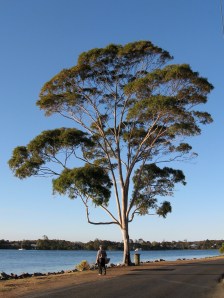
Sydney Blue Gum on the Hastings River

Sydney Blue Gum on the Hastings River

This is, I believe, a Sydney Blue Gum (Eucalyptus saligna) though I could also be wrong as I’m very much an amateur when it comes to tree identification. It does look like: they can be found up and down the east coast of New South Wales, of which the Hastings River is part, and they can grow to 60 or more metres tall which this one certainly seems to be aiming for. Whatever it is, I couldn’t resist photographing it. It rather dwarfs Mr Gums below doesn’t it?

Blue Gums are apparently the trees referred to in Henry Lawson’s 1919 poem, “Chatswood”:

And a little wood was on it, and the trees were tall and good,
And his young wife used to dream there, so he called it “Chattie’s Wood”.

“Chattie’s Wood” has long since gone, and shops are standing in a row
Where the young wife went a-dreaming in a the days of long ago,

Chattie was apparently Charlotte Harnett, the second wife of Richard Hayes Harnett, a North Shore Sydney landowner in the 1860s and one-time Mayor of Willoughby, and she did wander the Blue Gum High Forest of Chatswood West. The trees have long disappeared (from there anyhow) and some suggest that Lawson played a little loose with the specific details of their story but  it is generally agreed that Chattie’s Wood is the origin of the name of the Sydney suburb of Chatswood.

Another poem, “Blue Gum Forest” (1976) by Roland Robinson, was also inspired by these trees:

The blue gums soar, naked
smooth, to where they over arch …

This year Australian composer Matthew Orlovich set this poem to music for a capella choir. I’d love to hear it one day. Anyhow, these are just two examples I found by doing some quick research. It seems that while the Sydney Blue Gum may have made way for shops in Chatswood, they still survive – in both physical and imaginative form. Long live the gum!

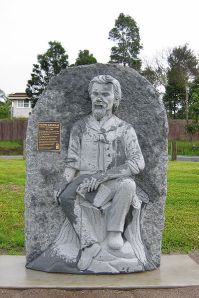
Kendall’s favourite son

Statue of Henry Kendall, on an inclement day in Kendall, NSW

Statue of Henry Kendall, on an inclement day in Kendall, NSW

…is the Australian poet, Henry Kendall. Except, he’s not REALLY a son – he was not born there,  and he only lived there for 6 years, from 1875 to 1881, when he was New South Wales’ first Forest Inspector. But, you know the story, when you are on a good thing…! And, anyhow, as a lover of Australian literature, I’m not going to argue against naming a town after one of our favourite poets. Anything that keeps our writers front and centre is fine by me.

Henry Kendall’s most famous poem is “Bell-birds”. It’s not quite as famous as Dorothea Mackellar’s “My country” and Banjo Paterson’s “Waltzing Matilda” but it is definitely up there. It is, for example, included in last year’s anthology, 100 Australian poems you need to know. It was written in 1869, two years before he went to Camden Haven (ie, Kendall as it was then known) and it reflects his love of nature – the sort of temperate forest landscape he would have found around Kendall. You can imagine the bell-birds in this scene can’t you? The first verse goes like this:

Driving towards Kendall

Driving towards Kendall

By channels of coolness the echoes are calling,
And down the dim gorges I hear the creek falling:
It lives in the mountain where moss and the sedges
Touch with their beauty the banks and the ledges.
Through breaks of the cedar and sycamore bowers
Struggles the light that is love to the flowers;
And, softer than slumber, and sweeter than singing,
The notes of the bell-birds are running and ringing.

And I will close on this little Henry Kendall taster … posting from an iffy Internet Cafe in sunny Port Macquarie (about 30mins drive from the little village of Kendall).

Here come some gums

Actually, the terms “gum tree” and “eucalypt” are more complex than many of us, I think, realise. The trees I have habitually called Gums or Eucalypts actually come from three genera: Eucalyptus, Corymbia and Angophera. I was quite shocked when I discovered a few years ago that in the 1990s there had been a reclassification of Eucalypts, with about 113 species being moved to the Corymbia genus. Apparently the Angophera had already existed. I just wasn’t aware that they too were what I called gums. They all belong to the Myrtle family. Perhaps it would be easier to just call them that? Whispering Myrtles anyone?

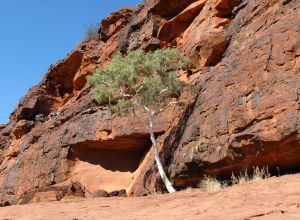
Anyhow, while Central Australia is not the place where gums are the most prolific, you do find some wonderful specimens there. One of the most famous is the Ghost Gum (which is actually a Corymbia aparrerinja). It can grow in the most amazing places, seeming often to prefer exposed rock faces.

Ghost Gum against the red rocks of Palm Valley

Ghost Gum against the red rocks of Palm Valley

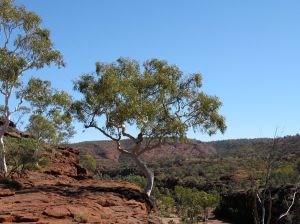
And here’s one, in a really precarious spot…

Ghost Gum on a cliff edge in Palm Valley

Ghost Gum on a cliff edge in Palm Valley

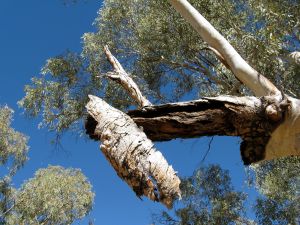
One of the other common gums in the area is the River Red Gum (which is really a eucalyptus – the Eucalyptus Camaldulensis). It is found in many parts of Australia, including Central Australia, and mostly grows in or by water courses. A useful marker in the Centre!

River Red Gum trunk at Jessie Gap

River Red Gum trunk at Jessie Gap

These are the gums that are sometimes called “widow makers” for their habit of suddenly dropping large boughs – apparently a protective mechanism against drought. We walked under this one – though this is only half the bough that is about to fall off. Still it looked dramatic.

Looking up at a River Red Gum in Serpentine Gorge

Looking up at a River Red Gum in Serpentine Gorge

I took many more photos but will save more for another post! But, aren’t they beautiful?

Home thoughts from abroad

Well, it feels like it’s home thoughts from abroad as we’ve probably spoken to more non-Australians over the last ten days than Australians. And, interestingly, the highest proportion of those are not German as it seems to have been in the last decade or so but French. We spoke in more detail to one young (how old it feels to say that!) couple on the Valley of Winds walk in Kata Tjuta and were told that Australia is now a popular destination for the French, partly due the fellow said to cheaper airfaires. Whatever the reason it’s great to see them here!

The “foreigners” we’ve met have not only been other tourists of course, but people working in the hospitality industry. We even met a young Japanese guide (for the AATKings company) along the Kings Canyon Rim Walk. She works out of Yulara (the tourist village that supports Uluru) and has for the last 5 years. Now THAT was interesting. 

One night we went to the gorgeous Sounds of Silence dinner in the dunes. The first couple we met over champagne and canapes was Australian (from Melbourne in fact), but the next was a honeymooning middle-aged Spanish couple and then at our table for the dinner we were the only Aussies. We dined with two groups of New Zealanders, and an American couple. I love this aspect of travel. Oh, and we did meet some Germans too! In Kata Tjuta we met a German teacher of English – who had wonderful English. This was her third visit to Australia she told us!

However, we do also have our “it’s a small world” story because we did meet an Aussie couple on the Valley of Winds walk. And they just happen to live about 5 houses from us! We know well the people across the road from them but hadn’t met them before! Truly, the world is a wonderful place…for the lucky ones of us anyhow.

And that’s about all from me in the Centre. Look out for the next post from home – I’m hoping to post some images – especially of GUMS of which we have seen some absolutely gorgeous specimens.

(PS Don’t you think I deserve a bit of a kickback from the Northern Territory Government for all this promotion?)

Climate change, ferals and Central Australia

While we generally prefer to go it alone, we did decide a few days ago, due to access challenges, to book onto an organised tour of Palm Valley. A good tour can work well and this one turned out to be one of the good ones – decent tour guide, uncrowded tour with congenial companions, and a relaxed style.

During the tour, our guide told us – and he came across as pretty knowledgeable though we didn’t ask him for his sources! – that climate change is pretty evident in the Central Australian deserts. He said that, over the last 40 years, there has been significantly more rain, more frequent flooding, and a higher number per annum of high temperature days. Fascinating, eh, that the desert has had more rain while much of the rest of Australia (particularly in the south and southeast) has had much less! It sounds as though there aren’t many climate change sceptics here in the Centre.

The golden feral buffel grass in Palm Valley

The golden feral buffel grass in Palm Valley

Just as, if not more, scary, though, was his discussion of the problem of ferals. We all know about feral cats, foxes, horses, camels etc but he showed us some feral plants, the worst of which seemed to be buffel grass. It gives the desert, to we more naïve visitors, a lovely golden tinge but in fact it is a highly invasive plant which creates a monoculture thereby removing the habitats for many Australian flora and fauna. And, like the cane toad, its march seems inexorable and hard to halt. It was designed by the CSIRO (in the 1930s/40s if I recollect properly) as a hardy dry-country stockfeed grass! He also showed us a Ruby Dock plant which is an efficient water “gatherer” and which as a result leaves less water for native Australian plants to use. It’s a pretty plant though – and I remember proudly photographing some on a previous trip to the Northern Territory only to discover when I got home that it was not a plant to promulgate proudly! Traps for young players!

Some thoughts from Centralia

With daughter and dog minding the fort, Mr Gums and I headed out last weekend to Central Australia where we are spending ten or so days escaping the wintry south.

It is an interesting place to visit, geologically, botanically and culturally; it is where we urban Aussies come across more indigenous people than we usually do in our daily lives. This rather makes us (re)think. Is it shame or is it guilt? Whatever it is, I feel a little sad wandering through Alice Springs and noticing the number of local indigenous people who seem to be at loose ends. It seems unreasonable that I, the newcomer, should be living a comfortable life while they, whose land it is, live a displaced life. Alice Springs is the setting of the central part of the recent Aussie film Samson and Delilah, about which I posted a couple of months ago. The Todd River, over which we drive a few times each day, is where Samson and Delilah “live” when they come to Alice after escaping the brutality of their own community. It’s not a pretty story. Alice, we are told – and we can see – is being “cleaned up”. In recent years, Dry Town Legislation has been enacted which applies strict controls on the sale of alcohol to white and black customers. And a couple of years ago there was the infamous “Intervention” instituted by the previous conservative government which rather ham-fistedly tried to “fix” violence and dysfunction in indigenous communities. Our tour guide on a day tour we did told us that these things have made Alice Springs a “quieter” place BUT the question is whether it has just pushed the real problem of displacement and dysfunction underground or is actually resulting in a better life for our indigenous compatriots? I don’t know. All I know is that I feel a little guilty and a little helpless. Should I buy some artwork from a street hawker? Or are there better ways we can help? What is better? Helping personally on the street, or impersonally through a “reputable” indigenous organisation? The problem is everyone has a different answer, including indigenous people themselves…more later.